
Wen Hua Cai Jing

Search documents
基本面新变化是否将令沪铅加速下跌?【机构会诊】
Wen Hua Cai Jing· 2025-07-17 10:02
Core Viewpoint - The imposition of varying tariffs on China's lead-acid battery exports by Middle Eastern countries is expected to have a limited impact on the overall lead market demand, despite creating negative sentiment that may drive lead prices down [2][3][4]. Group 1: Tariff Impact on Lead Market - Middle Eastern countries will impose tariffs ranging from 25% to 70% on Chinese lead-acid batteries, which is an increase from previous rates of 5% to 30% [2][3]. - In 2023, China's exports of lead-acid batteries to Oman, Qatar, and Saudi Arabia accounted for 7.67% of total exports, indicating that the overall impact on lead consumption is relatively small [2][3]. - The expected reduction in exports to the Middle East due to tariffs is estimated to affect lead market demand by only 0.2-0.3 percentage points [3]. Group 2: Current State of Recycled Lead Production - Recycled lead enterprises are currently facing losses due to high costs of raw materials, with the latest price at 10,250 yuan per ton [5][6]. - The operating rate for recycled lead was only 38.81% in June, indicating a slow recovery in production [5][6]. - The supply of waste batteries is tightening, leading to a continued loss for many recycled lead producers, with expectations of limited production increases [5][6]. Group 3: Seasonal Demand and Inventory Levels - The current consumption season for lead does not show significant characteristics of a peak, with downstream companies remaining cautious in their purchasing [7][8]. - The seasonal peak for lead-acid battery consumption is expected to begin in late July, but demand recovery appears limited so far [7][8]. - Lead ingot inventory levels remain high, but there are signs of a gradual reduction in inventory accumulation as downstream demand begins to improve [8]. Group 4: Price Support and Market Dynamics - The downward pressure on lead prices is being countered by significant losses in recycled lead production, which may provide some support for prices around the 16,500 yuan level [9]. - The overall supply-demand balance remains weak, with external factors limiting price increases despite strong cost support from raw materials [9][10]. - The potential for a recovery in lead prices hinges on the performance of downstream demand and the ability of producers to manage inventory levels effectively [9][10].
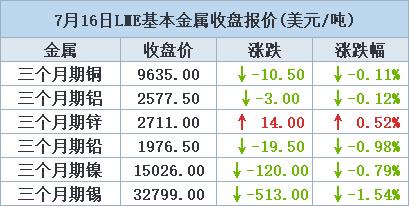
金属多飘绿 期铜收跌 因供应中断忧虑缓解且库存续增【7月16日LME收盘】
Wen Hua Cai Jing· 2025-07-17 00:59
Group 1: Copper Market Overview - LME three-month copper closed at $9,635.00 per ton, down $10.50 or 0.11%, retreating from a recent high of over $10,000 on July 2 [1] - Investors are focusing on the potential increase in copper supply, with no new supply disruption factors currently pushing prices up [5] - LME copper inventory increased by 10,525 tons on Wednesday, marking a 33% surge over the past two and a half weeks [5] Group 2: Global Copper Production and Consumption - The World Bureau of Metal Statistics reported a global refined copper production of 2.3775 million tons and consumption of 2.2933 million tons for May 2025, resulting in a surplus of 84,200 tons [5] - For the first five months of 2025, global refined copper production was 11.2979 million tons, with consumption at 11.0344 million tons, leading to a surplus of 263,400 tons [5] - Rio Tinto announced a 9% year-on-year increase in quarterly copper production, forecasting that annual production will reach the high end of its guidance range [5] Group 3: Impact of U.S. Tariffs and Currency Fluctuations - Following the announcement of a 50% tariff on copper imports by the U.S. effective August 1, traders expecting tariffs have gradually reduced copper exports to the U.S. [5] - A weaker U.S. dollar typically makes dollar-denominated commodities cheaper for buyers holding other currencies, potentially influencing demand [4] Group 4: Other Base Metals Performance - Three-month tin fell by $513.00 or 1.54%, closing at $32,799.00 per ton, amid concerns over supply surplus [7] - The International Tin Association indicated that tin shipments from Myanmar's Wa State are expected to resume in the coming months after nearly two years of mining bans [8]


安托法加斯塔公司上半年铜产量增加11%至31.49万吨
Wen Hua Cai Jing· 2025-07-16 09:38
Core Viewpoint - Antofagasta reported a 10.6% increase in copper production for the first half of the year, driven by higher output from its Centinela and Los Pelambres mines, while maintaining its annual production guidance of 660,000 to 700,000 tons [1][2] Group 1: Production and Financial Performance - Copper production for the first half of the year reached 314,900 tons, up from 284,700 tons in the same period last year [5] - The company’s net cash cost decreased by 32% to $1.32 per pound, attributed to increased production [1][5] - Gold production increased by 36% year-on-year to 91,200 ounces, with a second-quarter output of 48,300 ounces [2][5] - Molybdenum production also saw a significant rise, with a 42% increase in the first half to 7,400 tons [3][5] Group 2: Future Outlook and Strategic Initiatives - The company maintains its capital expenditure guidance at $3.9 billion for the year, higher than the $2.7 billion planned for 2024, due to peak production at the Centinela concentrator [1] - Antofagasta's CEO expressed optimism about the copper market, citing structural trends such as energy security and decarbonization driving demand [2] - The company is exploring opportunities to advance the Twin Metals copper-nickel project in Minnesota, which had previously faced regulatory hurdles [1][2]

沪铜窄幅震荡 进一步下跌动能暂时不强【7月16日SHFE市场收盘评论】
Wen Hua Cai Jing· 2025-07-16 08:30
Group 1 - Copper prices showed a slight increase of 0.06% in the morning session, with limited downward momentum due to low inventory accumulation in non-US regions and a narrowing price gap between refined and scrap copper [1] - Positive economic data from China has somewhat boosted metal demand expectations, while the US June CPI rose by 2.7%, slightly above the expected 2.6%, indicating the impact of tariffs [1] - LME copper inventory has been gradually increasing, influenced by the potential implementation of US copper tariffs, with a notable decrease in cancellation warehouse receipts [1] Group 2 - New Lake Futures indicates that the easing of the US siphon effect has led to a significant alleviation of tightness in LME and domestic spot markets, resulting in weaker copper prices [2] - The copper price around 80,000 has notably suppressed domestic consumption, but this consumption is expected to gradually release as prices decline [2] - Overall domestic and LME inventories remain at historically low levels, suggesting limited downside for copper prices, with potential opportunities for companies to procure raw materials at lower prices [2]
50%的铜关税扰动美国市场——买家削减进口推迟订单
Wen Hua Cai Jing· 2025-07-16 02:28
Group 1 - The imposition of a 50% tariff on copper imports by the U.S. government has led to a significant decrease in demand for copper across various states, with companies like RM-Metals reducing their import orders by approximately 25% [1] - The price of copper in the U.S. has been consistently higher than the global benchmark due to tariff expectations, with Comex copper prices rising by 38% this year compared to a 10% increase in London Metal Exchange prices [2] - The uncertainty surrounding the specifics of the tariffs, including which products will be affected and potential exemptions, has caused companies like Aviva Metals to pause transactions and delay business decisions [3][4] Group 2 - The rising costs due to tariffs are expected to be passed on to customers, creating confusion and concern within the industry about how clients will respond to increased prices [5] - The current high inventory levels in the U.S. provide a buffer for manufacturers, but there is uncertainty regarding the speed and scale of future investments in the domestic copper industry [5] - Concerns about inflation during this period may pressure the U.S. to reconsider the implementation of tariffs, adding to the uncertainty faced by companies like RM-Metals [5]
高盛:短期内铜价将下滑,因美国关税影响缓解全球供应紧张
Wen Hua Cai Jing· 2025-07-16 02:21
Group 1 - Goldman Sachs predicts a short-term decline in copper prices due to a surge in imports before the implementation of a 50% tariff on copper in the U.S. on August 1 [1] - The bank has revised its August LME copper price forecast from $10,050 per ton to $9,550 per ton [1] - The recent tariff announcement by President Trump has led to a wave of copper imports as buyers stockpile to mitigate rising costs, temporarily easing supply shortages outside the U.S. [1] Group 2 - Goldman Sachs expects that once the tariffs are implemented, liquidity will significantly slow down, ending supply tightness outside the U.S. and alleviating upward pressure on LME prices [1] - The bank maintains a long-term bullish outlook, projecting a copper price of $9,700 per ton by the end of 2025, citing low inventories outside the U.S. that will take months to replenish post-tariff [1] - The bank also forecasts an average copper price of $10,000 per ton in 2026 and $10,750 per ton in 2027 [2]

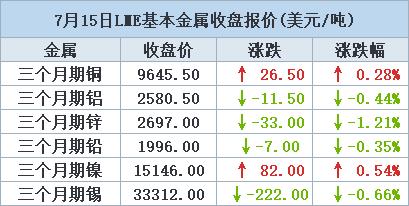
金属多下行 期铜上涨,但库存增加和美元走高令涨幅受限【7月14日LME收盘】
Wen Hua Cai Jing· 2025-07-16 00:54
Group 1 - LME copper prices experienced a slight increase due to strong industrial production data from China, offsetting the impact of rising available inventory and a stronger dollar [1] - As of July 15, LME three-month copper closed at $9,645.50 per ton, up $26.50 or 0.28%, but has declined over 2% since the beginning of the month [1][2] - The copper price has retreated from a three-month high of $10,020 per ton reached in early July [1] Group 2 - Commodity Market Analytics predicts that copper prices may fall to around $9,585 per ton in the short term [3] - Goldman Sachs has lowered its August LME copper price forecast from $10,050 per ton to $9,550 per ton, while maintaining long-term forecasts for 2025, 2026, and 2027 at $9,700, $10,000, and $10,750 per ton respectively [5] - The announcement of a 50% tariff on copper imports by the U.S. has made exports to the U.S. less attractive for other countries, leading to a decrease in LME canceled warrants to 11% of total inventory, the lowest level in five months [4] Group 3 - Recent data from China's National Bureau of Statistics indicates that the production of primary aluminum in June 2025 was 3.81 million tons, a year-on-year increase of 3.4%, with a cumulative production of 22.38 million tons in the first half of the year, up 3.3% [5] - In June 2025, the production of ten non-ferrous metals in China reached 6.95 million tons, a year-on-year increase of 4.4%, with a cumulative production of 40.32 million tons in the first half of the year, up 2.9% [5]
铜的混乱不会像2月份的黄金那样有利可图
Wen Hua Cai Jing· 2025-07-15 07:17
Group 1 - Copper prices have increased by 12% since last Tuesday, while copper inventories have decreased by 1.5% [1] - The U.S. relies on imports for half of its refined copper, with 90% coming from other regions in the Americas, primarily Chile [1] - Trump's proposed 50% tariff on copper imports aims to boost domestic copper supply and reduce reliance on foreign sources [1][2] Group 2 - Following the tariff announcement, U.S. copper prices surged by 15%, while prices in the UK and China actually declined [2] - The expectation of the tariff has led companies to build inventory to avoid future costs associated with the tariff [2] - The response of copper supply to these tariffs is expected to be slower compared to gold, indicating different fundamental factors will drive copper prices in the coming months [3]
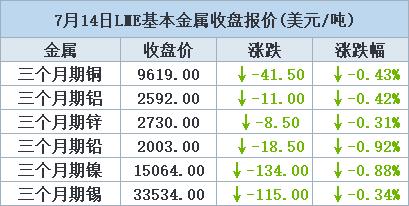
金属全线下跌 期铜收跌 因库存跳增且美元走高【7月14日LME收盘】
Wen Hua Cai Jing· 2025-07-15 00:54
Core Viewpoint - The London Metal Exchange (LME) copper prices fell due to a significant increase in inventory and a strengthening US dollar, leading to sell-offs [1][9]. Group 1: Market Performance - On July 14, LME three-month copper closed at $9,619.00 per ton, down $41.50 or 0.43% [1][2]. - The lowest point for the contract earlier in the day was $9,575 per ton, with strong technical support around the 100-day moving average of $9,565 [1]. Group 2: Inventory and Supply Dynamics - LME copper inventory totaled 109,625 tons, with a slight increase of 900 tons from the previous trading day [3]. - Over 26,000 tons of copper inventory, originally set to exit the LME system from Asia, have been re-registered, allowing them to be traded again [3]. - The increase in LME copper supply has widened the spot/three-month contract discount to $50 per ton, the highest level since April 23 [5]. Group 3: Trade Policies and Impacts - President Trump announced a 50% tariff on copper products effective August 1, which traders believe may have influenced the cancellation of warehouse receipts that were likely intended for the US before the tariff took effect [3][4]. - The short time frame from the announcement to the tariff deadline is insufficient for transporting metals from Asia [4]. Group 4: Import and Export Data - China's imports of unwrought copper and copper products in June were 464,000 tons, with a cumulative total of 2.633 million tons for the first half of the year, reflecting a year-on-year decrease of 4.6% [5]. - In contrast, China's imports of copper concentrate increased by 6.4% year-on-year, totaling 1.4754 million tons in the first half of the year [6]. - China's exports of unwrought aluminum and aluminum products in June were 489,000 tons, with a cumulative total of 2.918 million tons for the first half of the year, down 8% year-on-year [7].
基本面缺乏驱动 沪镍区间波动【7月14日SHFE市场收盘评论】
Wen Hua Cai Jing· 2025-07-14 10:45
Group 1 - Nickel prices are experiencing a range-bound fluctuation, with the main contract closing at 121,100 yuan/ton, down 0.07% [1] - The Indonesian government has increased the 2025 nickel ore quota to 364 million tons, but mining has been affected by rainfall, leading to tight overall supply [1] - Recent price movements in nickel ore have shown a slight decline, with domestic 1.3% nickel ore transactions settling at CIF 43 and CIF 44.5 [1] Group 2 - The refined nickel market lacks significant contradictions in fundamentals, with continued oversupply limiting price increases [2] - Short-term market sentiment is heavily influenced by macroeconomic factors, while the reality of consumption remains pessimistic [2] - The overall expectation for the nickel market is weak, with macro uncertainties and high nickel-iron inventories contributing to a bearish outlook [2]