国泰海通证券研究

Search documents
国泰海通|固收:美联储“转鸽”后,国内宽货币空间几何
国泰海通证券研究· 2025-08-29 12:07
Core Viewpoint - The probability of further interest rate cuts in China within the year remains low, primarily due to three key reasons [1][2][3]. Group 1: Impact of Federal Reserve's Actions - The logic behind the Federal Reserve's rate cuts opening up space for domestic rate cuts hinges on the pressure for RMB depreciation. Since mid-April, the RMB has strengthened, indicating that external factors like US Treasury yields and the dollar index are not trending downwards. The recent dovish stance from Powell is more about favorable external interest differentials rather than alleviating depreciation pressure [1]. - The relationship between external exchange rates and internal interest rates is viewed as a one-way logic, where significant depreciation pressure may allow for rate cuts, but a strong RMB does not necessarily lead to domestic rate cuts [1]. Group 2: Focus on Economic Stability and Financial Risk - Currently, the focus on exchange rates in rate cut decisions is relatively limited, with more emphasis on stabilizing growth and preventing financial risks. The monetary policy report from Q2 maintains a consistent stance on keeping the exchange rate stable [2]. - Historical context shows that the only time the exchange rate significantly constrained domestic rate cuts was from late 2024 to early 2025, where expectations for cuts were high but ultimately unmet due to market dynamics [2]. Group 3: Structural and Targeted Monetary Policy - The central bank's approach to "cost reduction" is becoming more structural and targeted, reducing the necessity for broad rate cuts. The current strategy emphasizes the use of structural tools and prioritizes quality over quantity in credit allocation [3]. - Even if external or internal factors trigger a rate cut, liquidity may not significantly loosen. For short-term funds, a 10 basis point cut may be the lower limit, while for long-term funds, rate cuts aimed at stabilizing the exchange rate or supporting the stock market may not lead to significant declines in long-term interest rates [3].


国泰海通|宏观:利润改善,结构分化
国泰海通证券研究· 2025-08-29 12:07
Core Viewpoint - The overall decline in corporate profits has narrowed in July, showing a differentiated structure primarily due to profit recovery relying on "anti-involution" policies leading to supply contraction and price increases, alongside demand support from certain high-end manufacturing sectors. However, downstream consumer demand remains weak, causing marginal profit shrinkage in downstream industries. The current inventory cycle is characterized by proactive destocking driven by policies. A comprehensive recovery in corporate profits will require policy efforts to boost downstream demand, transitioning profit recovery from structural to comprehensive [1]. Summary by Sections - Corporate Profit Trends: The decline in corporate profits has slowed down, indicating a potential recovery phase influenced by specific policies and market conditions [1]. - Structural Differentiation: The recovery is uneven, with high-end manufacturing benefiting while downstream sectors face challenges due to weak consumer demand [1]. - Inventory Cycle: The current phase is marked by proactive destocking, suggesting a strategic approach to inventory management under policy guidance [1]. - Future Outlook: A full recovery in corporate profits hinges on policy measures aimed at stimulating downstream demand, which is essential for transitioning from structural recovery to overall profit growth [1].

国泰海通|新能源:再读固态电池投资机会——固态电池工艺与设备
国泰海通证券研究· 2025-08-29 12:07
Core Viewpoint - Solid-state batteries are expected to become a key development direction for high-performance batteries due to their advantages in safety and energy density, with significant market potential in consumer batteries, new energy vehicles, and low-altitude applications [1][2]. Group 1: Industry Development - The solid-state battery industry is currently experiencing a competitive rush among equipment, materials, and battery companies, with expected phased progress in 2025-2026 [1]. - The production of solid-state batteries requires specialized equipment to achieve large-scale commercialization, with the equipment sector likely to benefit first [1][2]. - The semi-solid-state battery has already been mass-produced and installed in vehicles, with expectations for full solid-state battery mass production by 2027 [2]. Group 2: Technology and Equipment - The production process of full solid-state batteries differs significantly from existing technologies, presenting high technical barriers, with various stages focusing on different equipment types [2]. - As companies enter the pilot testing phase and technology matures, new equipment is expected to accelerate production [2].

国泰海通|计算机:国务院推进人工智能行动文件正式发布,政策支持与产业共振
国泰海通证券研究· 2025-08-28 13:56
报告导读: AI 是新一轮科技革命与产业变革的重要驱动力,受益于持续的技术进步与政 策支持, AI 产业链正迎来广阔的发展机遇。 维持计算机行业"增持"评级。 人工智能是新一轮科技革命和产业变革的重要驱动力量。 AI 产业快速发展,此前 8 月 21 日深度求索发布 DeepSeek-V3.1 版本,性能大幅提升之外,还使用了为下一代国产芯片设计的 UE8M0 FP8 Scale 的参数精度,我们认为国产大模型与国产芯片正朝着软硬协同的统一生态 演进,持续的政策支持 AI 应用落地,国内 AI 产业的发展有望进一步加速,我们看好从 AI 基础设施到 AI 大模型到 AI 应用的发展闭环,维持计算机行业"增 持"评级。 人工智能顶层纲领文件正式发布。 8 月 26 日,国务院关于深入实施"人工智能 + "行动的意见正式发布,总体要求到 2027 年率先实现人工智能与 6 大重 点领域广泛深度融合,新一代智能终端、智能体等应用普及率超 70% ;到 2030 年,我国人工智能全面赋能高质量发展,新一代智能终端、智能体等应用普 及率超 90% ,智能经济成为我国经济发展的重要增长极;到 2035 年,我国全面步入智 ...

国泰海通|新能源:再读固态电池投资机会
国泰海通证券研究· 2025-08-28 13:56
Core Viewpoint - Sulfide solid electrolytes are expected to become the mainstream choice for all-solid-state batteries, with lithium sulfide as the core raw material, indicating a vast potential market space that has attracted numerous companies to invest in this area [1][2]. Summary by Relevant Sections Sulfide Solid-State Batteries - Sulfide solid-state batteries are seen as the core direction for future battery technology due to their high ionic conductivity, safety, and energy density advantages [1]. - Lithium sulfide is identified as the key raw material, with its market space expected to explode alongside the rise of all-solid-state batteries [1]. Preparation Methods for Lithium Sulfide - The mainstream preparation methods for lithium sulfide are categorized into three types: solid-phase method, liquid-phase method, and gas-phase method [2]. - The solid-phase method is suitable for large-scale production but has drawbacks such as high energy consumption and lower product purity [2]. - The liquid-phase method addresses some issues of the solid-phase method, offering higher purity and better results, but faces challenges in achieving stable batch production at scale [2]. - The gas-phase CVD method is suitable for producing high-purity and high-uniformity lithium sulfide [2]. - Overall, various preparation methods have their advantages and disadvantages, indicating a diverse and competitive landscape [2]. Industry Trends - Numerous companies are entering the lithium sulfide research and development space, leading to breakthroughs in process innovation, production line implementation, and performance validation [2]. - The industry is moving towards a phase of accelerated supply scale for lithium sulfide [2].

国泰海通|宏观:加关税:影响了多少美国通胀
国泰海通证券研究· 2025-08-28 13:56
Core Viewpoint - The actual tariff implementation in the US during the first half of the year was less than expected, leading to a moderate rise in inflation. The average import tariff rate is expected to increase in the second half, potentially accelerating price increases by companies, which may result in a "slow heating" inflation scenario in the US [1][3]. Tariff Policy - As of June, the actual average import tariff rate in the US increased by only 6.6 percentage points compared to the end of 2024, which is significantly below market expectations. The low tariff collection is attributed to changes in import structure and a low proportion of taxable goods. The average import tariff rate is expected to rise further in the second half of the year due to the implementation of new tariff rates and gradual enforcement of industry tariffs [1][2]. Overseas Exporters - The US import price index, which reflects the dollar prices paid by importers excluding tariffs, shows no significant decline in import prices for most goods since the implementation of reciprocal tariffs in April. Although overseas exporters may lower prices due to a weaker dollar since 2025, the extent of this price reduction may be offset by the dollar's depreciation. Overall, US import costs have not shown a significant decline, and the burden of tariff costs primarily falls on US companies and consumers [2]. US Companies - As of June, US companies bore approximately 63% of the tariff costs, while consumers accounted for less than 40%. As inventory is gradually consumed and trade policy uncertainty decreases, companies are expected to continue raising prices. However, given the current sensitivity of consumers to prices, companies may still need to absorb a significant portion of the tariff costs [2]. Consumer Inflation - Certain goods, such as auto parts, new cars, clothing, and furniture, have a high dependency on imports. However, the transmission of tariffs to prices for new cars, clothing, personal care items, and other durable goods remains limited. If the average import tariff rate in the US rises by 10% within the year, and demand remains stable, tariffs could push the PCE year-on-year growth rate to 3.1% and the core PCE growth rate to 3.4%. Conversely, a significant drop in demand could alleviate inflationary pressures in the US [3].

国泰海通|物理智能产业与资本峰会:L3高阶智驾专题暨VLA模型产业白皮书及产业图谱发布
国泰海通证券研究· 2025-08-28 13:56
Core Insights - The article discusses the rapid development of large models and their integration into intelligent driving, highlighting the increasing feasibility of L3 level autonomous driving commercialization due to supportive policies [1][2]. Group 1: Industry Developments - The integration of large models into intelligent driving is seen as a consensus within the industry, which is expected to reshape the landscape of intelligent driving and embodied intelligence, creating significant market and capital opportunities [2]. - The event features key speakers from various companies, including Guotai Junan Securities and SAIC Group, discussing the future of L3 intelligent driving and the role of visual-language-action models (VLA) [3]. Group 2: Company Innovations - Momenta, a leading autonomous driving company, focuses on scalable autonomous driving solutions through deep learning and AI, aiming to provide a comprehensive intelligent driving experience across various scenarios [3]. - CarLink, a global leader in AI intelligent cockpit and robotic systems, is redefining vehicle experiences by optimizing safety, computing power, and energy consumption, while integrating multiple large language models [3][5]. - Juefei Technology emphasizes a data-driven approach to intelligent driving, offering customized data engines and services through multi-sensor data fusion for high-precision processing [5]. Group 3: Technological Advancements - Al-Link, an innovative company in the automotive intelligent cockpit sector, leverages AI large models to enhance user experience and reduce development costs significantly [5]. - Zero One Automotive aims to lead in the new energy heavy truck sector by integrating advanced technologies and systems to create cost-effective products and promote green transportation [6].


国泰海通|金工:如何利用期权实现保护对冲
国泰海通证券研究· 2025-08-28 13:56
Core Viewpoint - The article discusses two common hedging strategies: protective put strategy and collar strategy, highlighting their effectiveness in different market conditions, particularly during market downturns [1][2]. Group 1: Protective Put Strategy - The protective put strategy significantly reduces maximum drawdown during the downtrend of the 300ETF, decreasing it from 42% to 27% [2]. - In downtrending phases, in-the-money put options outperform a pure hold strategy on the ETF, while out-of-the-money options show weaker performance except during sharp declines [2]. - The strategy is more effective in covering option costs during prolonged downturns due to frequent triggers of in-the-money options, while out-of-the-money options incur larger cumulative losses [2]. Group 2: Collar Strategy - The collar strategy does not outperform the 300ETF overall, with annualized returns around -1%, compared to the ETF's 2% [3]. - However, the collar strategy reduces maximum drawdown to below 30%, compared to the ETF's 42% [3]. - In down markets, the collar strategy benefits from using in-the-money puts for strong protection and selling high-strike calls for additional income, creating a dual enhancement effect [3]. - Caution is advised when using the collar strategy during uptrending markets due to potential losses from exercised calls and untriggered puts [3]. Group 3: Performance of Structured Hedging Products - Structured hedging strategies like TAIL and JHEQX have shown effective drawdown control during market volatility, with JHEQX demonstrating a more moderate decline compared to the S&P 500 during the significant market correction in 2022 [1]. - The barbell strategy employed by TAIL combines bonds and options to provide a hedge during market panic phases [1].

国泰海通|非银:利变产品转型深化,资负改善可期
国泰海通证券研究· 2025-08-28 13:56
Core Viewpoint - The insurance industry is transitioning from traditional insurance products to "variable benefit" products represented by participating insurance, which is beneficial for reducing rigid liability costs and improving asset-liability matching, maintaining an "overweight" rating [1][2]. Group 1: Transition in Product Strategy - In a low-interest-rate environment, the previous reliance on traditional insurance products is becoming unsustainable for insurance companies. The demand for financial insurance products, such as increasing death benefit whole life insurance, has surged due to their ability to lock in returns. However, the mismatch between liability costs and investment returns has increased pressure on asset-liability matching [1]. - The product structure's high dependence on interest spreads has heightened uncertainty in profitability under low-interest conditions. The substantial pressure on asset-liability management contrasts with the rapid growth in current profits, indicating a potentially unsustainable operational model [1]. Group 2: Impact of Regulatory Guidance - The shift towards participating insurance is expected to be firmly supported by regulatory guidance aimed at reducing liability costs. The realization rate of dividends is expected to be capped, which will help improve interest spread losses. Companies with strong investment capabilities are anticipated to benefit more from this transition [2]. - The sales capabilities of agents will be tested with the shift to participating insurance, and channel transformation is expected to deepen further. The importance of asset-liability management is increasing, with the negative impact of low-margin VFA policies on profitability becoming more pronounced [2]. Group 3: Investment Recommendations - Currently, life insurance companies are firmly pursuing the transition to participating insurance, which is expected to alleviate rigid liability cost pressures and enhance net profit and net asset stability. Long-term success in this transition will depend on collaboration across channels, products, and investments [2]. - In a stable stock market environment, it is recommended to focus on undervalued and underweighted blue-chip stocks, shifting from a "marginal thinking" approach based on fundamentals to a "total risk-return ratio" perspective [2].

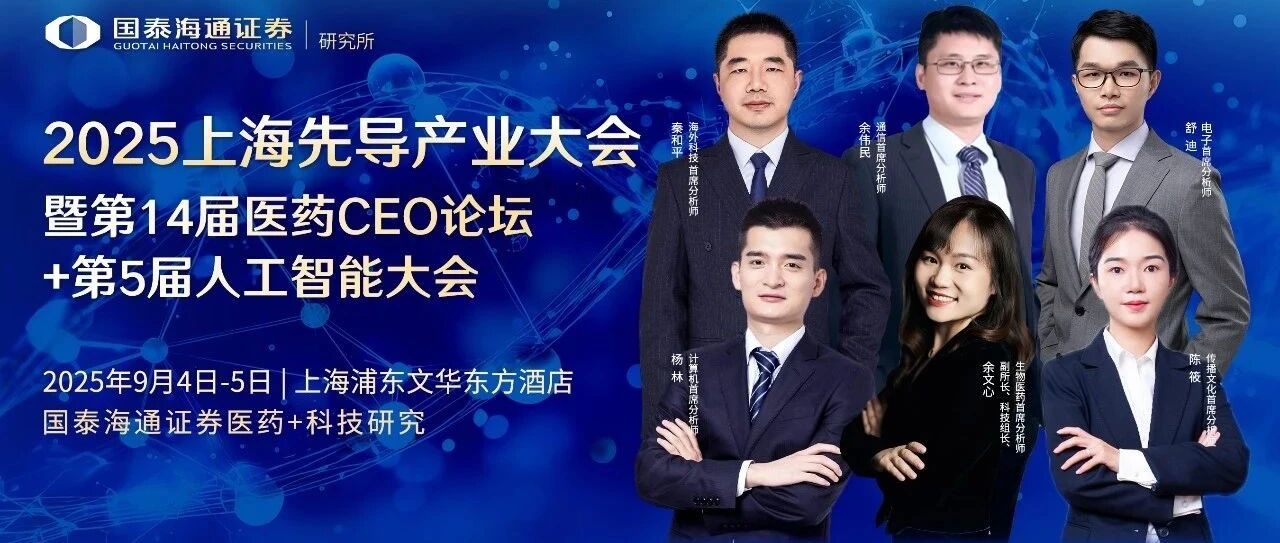
国泰海通|2025上海先导产业大会暨第14届医药CEO论坛+第5届人工智能大会
国泰海通证券研究· 2025-08-28 00:06
Core Viewpoint - The article discusses the upcoming 2025 Shanghai Leading Industries and the 14th Pharmaceutical CEO Forum, highlighting the focus on innovation and global expansion in the pharmaceutical industry, particularly for Chinese companies [1]. Summary by Sections Event Overview - The event will take place on September 4-5, 2025, at the Mandarin Oriental Hotel in Pudong, Shanghai, featuring discussions and presentations from industry leaders [1]. Pharmaceutical Main Forum - The main forum will include several roundtable discussions, such as: - "From Local Innovation to Global Leadership: The Era of Chinese Pharmaceutical Companies Going Abroad" [4]. - "The Birth of Big Drugs is the Future of Pharmaceuticals: Finding the Next Billion-Dollar Blockbuster" [4]. - "Next-Generation Weight Loss Drug Development Hotspots and China's Pipeline Competitiveness" [5]. - "Which Disease and Technology Areas in Pharmaceuticals are Worth Expecting for Going Global?" [5]. - "The New Cycle of Chinese Innovative Drugs Under Global Competition: Breaking Through from R&D to Commercialization" [5]. - "Technological Upgrades: Exploring the Next Wave of Drug Development Platforms" [5]. - "The Future is Here: Dialogue on the New World of Brain-Machine Interfaces" [6]. - "Innovation Going Global" [6]. TMT Sub-Forum - The TMT sub-forum will cover topics such as: - "Outlook for the Two-Dimensional Animation Industry" [6]. - "How AI Disrupts the Game Industry Structure" [6]. - "The Future of AI Companion Toys" [6]. - "Innovations and Explorations in AI Immersive Video" [6]. - "ASIC and Internet Giants' Innovations" [7]. - "Demonstrations and Introductions of Brain-Machine Interface Products" [7]. Additional Discussions - The second day will feature discussions on AI's impact on finance and healthcare, including: - "AI Infrastructure Development" [9]. - "Current Status and Outlook of Direct Satellite Communication Technology in Domestic Mobile Phones" [9]. - "Future Development of AI Network Architecture" [9]. Industry Participation - The event will see participation from numerous leading companies in pharmaceuticals, medical devices, and technology sectors, including major players in drug development, medical services, and internet healthcare [13][15].