LONGFOR GROUP(00960)

Search documents
行业深度报告:房价止跌回稳系列三:鉴往知来,人口不是影响房价唯一因素
KAIYUAN SECURITIES· 2025-09-24 09:50
Investment Rating - The investment rating for the real estate industry is "Positive" (maintained) [1] Core Insights - The report indicates that new housing transaction areas have shown a month-on-month increase, while real estate development investment has decreased year-on-year from January to August 2025 [3] - The report highlights that the decline in housing prices has been consistent since 2022, with a significant drop in both new and second-hand housing prices across 70 cities, although the rate of decline has started to narrow due to supportive policies [5][16] - It emphasizes that the relationship between population growth and housing prices is not straightforward, as effective housing demand driven by economic development and income growth is crucial for influencing prices [5][25] Summary by Sections Industry Overview - The real estate market has entered a downward trend since 2022, with new and second-hand housing prices experiencing a decline for over 40 months [5][16] - As of August 2025, the new housing price index across 70 cities has decreased by 3.0% year-on-year, while the second-hand housing price index has dropped by 5.5% [16][20] Population Impact - The report concludes that population factors are long-term variables with limited mid-term impact on housing prices, as the marginal changes in housing prices are influenced more by monetary policy, supply-demand relationships, and economic expectations [25][39] - A regression analysis across several developed countries shows that housing price indices do not have a significant correlation with population growth rates [40][42] International Experience - The report draws parallels with international experiences, noting that stable fiscal and monetary policies are essential for stabilizing housing prices after declines [6][46] - It cites examples from the U.S., Japan, and South Korea, where coordinated fiscal and monetary policies have successfully supported housing market recovery after significant downturns [46][49] Investment Recommendations - The report recommends focusing on real estate companies with strong credit ratings and solid fundamentals in urban areas, such as China Overseas Development and Poly Developments [7] - It also suggests that companies excelling in both residential and commercial real estate, as well as those providing high-quality property management services, are well-positioned for growth [7]



开源证券-房地产行业深度报告:房价止跌回稳系列三,鉴往知来,人口不是影响房价唯一因素-250924
Xin Lang Cai Jing· 2025-09-24 09:49
Group 1 - The core viewpoint is that the impact of mid-term population changes on housing prices in developed countries/regions is limited, as there is no significant positive correlation between housing price indices and population growth rates or numbers [1] - From 2022, housing prices in 70 cities have entered a downward trend, with a widening decline expected in Q3 2024, although the year-on-year decline has narrowed since Q4 due to supportive policies [1] - The current adjustment cycle in the housing market has seen both new and second-hand housing price indices decline for over 40 months [1] Group 2 - Historical data shows that housing prices in developed countries/regions have experienced fluctuations since the 1980s, with price corrections often exceeding those in China, but eventually stabilizing [2] - Key factors for stabilizing and recovering housing prices include coordinated fiscal and monetary policies, such as large-scale quantitative easing, interest rate cuts, and fiscal subsidies [2] - A stable policy outlook, low interest rate environment, and improved supply-demand structure are crucial for halting the decline and stabilizing the real estate market [2] Group 3 - The stabilization of housing prices is influenced by multiple factors, including monetary policy, supply-demand relationships, and economic expectations, rather than solely by population dynamics [3] - Recommended investment targets include strong credit property companies with good urban fundamentals and leading product capabilities, as well as firms that can drive both residential and commercial real estate [3] - The increasing penetration rate of second-hand housing indicates a promising outlook for the real estate after-service sector [3]


克而瑞地产:2025年上半年房企毛利率修复至10.87% 净利润维持亏损
Zhi Tong Cai Jing· 2025-09-24 09:33
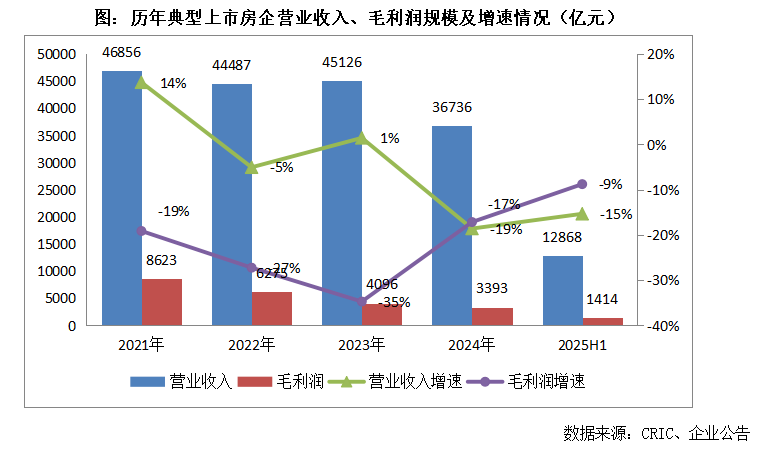
Core Viewpoint - The real estate industry is experiencing a significant decline in both revenue and profitability, with major listed companies reporting substantial losses and a challenging outlook for the near future [1][2][4][7]. Revenue and Profitability - In the first half of 2025, typical listed real estate companies achieved total revenue of 12,868 billion yuan, a year-on-year decrease of 15%, while operating costs were 11,454 billion yuan, down 16% [1]. - The gross profit for these companies was 1,414 billion yuan, reflecting a 9% decline compared to the previous year [1]. - The net profit loss for the industry expanded to 2,762 billion yuan in 2023, further increasing to 3,397 billion yuan in 2024, and reaching 902 billion yuan in the first half of 2025 [2]. Profitability Ratios - The overall gross margin for the industry in the first half of 2025 was 10.87%, an increase of 1.8 percentage points from the entire year of 2024, while the net margin was -7.45% [4]. - Excluding companies that have faced financial distress, the gross margin for 27 stable firms was 15.09%, up 2 percentage points from 2024, with a net margin of 1.71%, indicating a recovery from previous losses [4]. Factors Affecting Profitability - The decline in profitability is attributed to high land acquisition costs, increased sales pressure, and asset impairment provisions, which have negatively impacted current profit performance [4][7]. - Companies are resorting to discount promotions to boost sales, leading to a situation where revenue increases do not translate into profit growth [4]. Industry Outlook - The industry is at a turning point, with a shift in policy focus from deleveraging to risk prevention, and a change in demand dynamics from broad increases to differentiation [7]. - Major companies like Longfor and Vanke express cautious optimism, highlighting the ongoing demand for quality housing in core urban areas despite recent price declines [7][8]. Strategic Planning of Key Companies - China Resources Land plans to maintain an annual opening pace of around six shopping centers, with a focus on public REITs to enhance asset value [9]. - China Merchants Shekou aims to optimize asset structure and enhance operational capabilities through a new asset management model [9]. - Longfor Group anticipates a 10% growth in its commercial sector and plans to open approximately ten new projects annually in the coming years [9]. - New City Holdings is focused on enhancing its commercial operations and leveraging financial policies to improve its capital structure [9].


专题 | 2025年上半年房企盈利能力报告——毛利率修复至10.87%,净利润维持亏损
克而瑞地产研究· 2025-09-24 09:08
Core Viewpoint - The real estate industry in China continues to face significant challenges, with a decline in both revenue and profit, leading to a net profit loss for four consecutive years. The industry is undergoing deep adjustments, and companies must adapt their operational strategies to ensure profitability and navigate through the current cycle [3][6][18]. Group 1: Revenue and Profit Decline - The overall revenue of typical listed real estate companies decreased by 15% to 12,868 billion, while gross profit fell by 9% [4][6]. - The gross profit margin for the industry was recorded at 10.87%, with a net profit margin of -7.45%, indicating a sustained loss [8][6]. - The net profit loss reached 902 billion, with attributable net profit loss at 954 billion, marking a continuous decline in profitability since 2022 [6][8]. Group 2: Industry Trends - 66% of real estate companies reported net profit losses, with four companies experiencing losses exceeding 10 billion [12][15]. - The industry’s return on equity (ROE) has further declined, remaining at historically low levels [15]. - Nearly 60% of companies saw a decrease in gross profit, while operational business recovery is essential for improving profitability [15][12]. Group 3: Inventory and Asset Valuation - The period saw inventory impairment losses amounting to 49.4 billion, with over 70% of companies recognizing such losses [13][16]. - The fair value of investment properties suffered a loss of 3.3 billion due to declining demand in commercial properties [16][13]. - The overall income from investment properties decreased by 3%, accounting for 5% of total revenue [11][23]. Group 4: Strategic Shifts - Companies are shifting focus from scale expansion to quality competition, with asset operations becoming a stabilizing factor during the cycle [17][19]. - Major firms are planning to enhance their operational capabilities and asset management through public REITs and other innovative financing methods [21][19]. - The industry outlook suggests that the second half of 2025 or 2026 could be pivotal for market stabilization, emphasizing the need for precise investment and product upgrades [19][18].

港股异动丨内房股集体上涨 龙光集团涨近4% 世茂集团涨近3%
Ge Long Hui· 2025-09-24 03:27
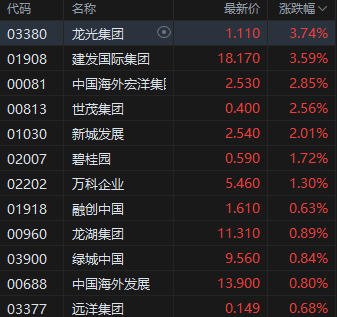
Group 1 - The core viewpoint of the article highlights a collective rise in Hong Kong's property stocks, driven by government reforms aimed at stabilizing the real estate market and addressing sector challenges [1] - The Ministry of Housing and Urban-Rural Development of China has announced plans to deepen reforms and promote breakthroughs in housing, real estate, urban construction, and the construction industry [1] - Several property companies are undergoing domestic debt restructuring, including Country Garden, Sunac China, Longfor Group, and CIFI Holdings [1] Group 2 - Notably, the luxury housing market in Shanghai has seen a surge, with a recent launch of 120 units in the Kerry Jinling Huating Phase II selling out completely, generating a sales revenue of 9.843 billion yuan in a single day [1] - Specific property stocks such as Longfor Group and Jianfa International have seen increases of nearly 4%, while Shimao Group and China Overseas Grand Oceans have risen by nearly 3% [1] - The article provides a detailed list of stock performance for various property companies, indicating positive market sentiment [1]



房地产行业周报(2025年第38周):上海优化房产税政策,旭辉中标成都代建项目-20250923
Huachuang Securities· 2025-09-23 07:45
Investment Rating - The report maintains a "Buy" recommendation for the real estate sector [2] Core Insights - The real estate index increased by 0.7% in the 38th week, ranking 9th among 31 primary industry sectors [9][10] - New housing demand is declining, inventory issues remain unresolved, and land finance continues to negatively impact the economy, necessitating stronger policy measures to alleviate downward pressure on the real estate fundamentals [34] Summary by Sections Industry Basic Data - Total number of stocks: 107 - Total market capitalization: 1,233.623 billion - Circulating market capitalization: 1,183.334 billion [3] Relative Index Performance - Absolute performance over 1 month: 4.7% - Absolute performance over 6 months: 12.2% - Absolute performance over 12 months: 31.4% - Relative performance over 1 month: 1.4% - Relative performance over 6 months: -3.4% - Relative performance over 12 months: -9.9% [4] Policy News - Various local governments are implementing measures to boost housing consumption and support affordable housing development, including adjustments to housing provident fund contributions and property tax policies [15][18] Sales Data - New housing transactions in 20 monitored cities increased by 32% year-on-year, with a total transaction area of 176 million square meters in the 38th week [21] - Second-hand housing transactions in 11 monitored cities increased by 71% year-on-year, with a total transaction area of 191 million square meters [25][29] Financing Data - Most bond issuances this week were by local state-owned enterprises, with the largest issuance being 1.98 billion by Jinqiao Group [30][32] Investment Strategy - Focus on companies with strong product differentiation and stable rental income from quality commercial real estate, as well as stock brokerage businesses in the existing housing market [34]



行业从“增量扩张”走向“存量运营” 数智化转型成房企必答题
Zhong Guo Jing Ying Bao· 2025-09-23 04:00
Core Insights - The transformation towards digital intelligence in the real estate industry is deemed essential for survival and improvement, moving from traditional construction to a new paradigm of "space operation + data empowerment" [1][3] Group 1: Industry Transformation - The real estate sector is undergoing a significant shift from an incremental to a stock-based era, driven by digital transformation [2] - From 2000 to 2010, new housing construction reached 115% of the initial stock, doubling growth; from 2010 to 2020, it achieved 80% growth on an already expanded stock; projections for 2020 to 2030 indicate new construction will decline to around 40% [2] - The focus of the industry is shifting from large-scale new construction to stock operation and quality enhancement, with future growth rates stabilizing at 20% to 25% [2] Group 2: Key Elements of Change - In the incremental era, core elements were land and capital; in the stock era, data and operational capability become central [3] - The redefinition of real estate to include data alongside physical rights and location is expected to fundamentally alter the industry's value recognition system [3] Group 3: Digital Transformation in Practice - The past two years have seen rapid digital transformation in the real estate sector, driven by the need to improve space, energy, organizational, and service efficiencies [3] - Companies like Longfor Group have reported significant efficiency improvements, with project design times reduced by 64% to 72% due to digitalization [3] - Over half of the companies have initiated digital transformation, anticipating disruptive impacts within five years, although challenges such as assessing economic benefits and data quality persist [3][4] Group 4: Recommendations for Companies - Companies are advised to maintain their core business while enhancing productivity through digital means, focusing on information, digitalization, and intelligent applications [4][5] - Exploring related or innovative business areas, including horizontal expansion and strategic emerging industries, is recommended to create comprehensive service solutions [5]
政策利好持续叠加,上海新房成交放量:光大地产板块及重点公司跟踪报告
EBSCN· 2025-09-22 10:28
Investment Rating - The investment rating for the real estate development sector is "Buy" for key companies such as Poly Developments, China Merchants Shekou, and Binhai Group, while "Hold" is given to companies like Vanke A and China Overseas Development [6][35][60]. Core Insights - The real estate development sector's price-to-book ratio (PB) is 0.85, with a historical percentile of 31.46% as of September 19, 2025, indicating a relatively low valuation compared to historical levels [1][11]. - The property service sector has a price-to-earnings ratio (PE) of 47.78, with a historical percentile of 75.95%, suggesting a higher valuation compared to historical averages [2][38]. - Recent policy changes in major cities like Beijing, Shanghai, and Shenzhen have led to increased transaction volumes in the new housing market, particularly in Shanghai, where transaction intensity increased by 62.5% post-policy implementation [3][70]. Summary by Sections Real Estate Development Sector - As of September 19, 2025, the real estate development sector has seen a 5.2% increase in stock prices from September 1 to September 19, outperforming the CSI 300 index by 5.05 percentage points [1][29]. - Key companies in the A-share market with the highest stock price increases include Binhai Group (+34.68%), New Town Holdings (+31.77%), and Huafa Group (+0.99%) [1][31]. - In the H-share market, China Jinmao (+63.25%), Jianfa International Group (+49.68%), and China Overseas Hongyang Group (+48.88%) led the gains [1][31]. Property Service Sector - The property service sector experienced a 4.1% increase from September 1 to September 19, 2025, outperforming the CSI 300 index by 3.97 percentage points [2][49]. - The top-performing A-share companies in the property service sector include Nandu Property (+67.33%), New Dazheng (+46.07%), and China Merchants Jinling (+14.70%) [2][55]. - In the H-share market, the leading companies were China Resources Vientiane Life (+52.36%), Jianfa Property (+42.22%), and Greentown Service (+35.34%) [2][55]. Policy Impact and Market Dynamics - Since August 2025, favorable policies have been introduced, including measures in Beijing, Shanghai, and Shenzhen, which have significantly boosted new housing transactions [3][68]. - The average daily transaction volume for new homes in Shanghai surged by 62.5% following the policy changes, indicating a strong market response [4][70]. - The report highlights that the real estate market is gradually stabilizing, with core cities expected to benefit from urban renewal initiatives [5][79].


观楼|昆明西客站西广场率先启动招标,房企积极备货迎战国庆、中秋双节
Xin Lang Cai Jing· 2025-09-22 09:40
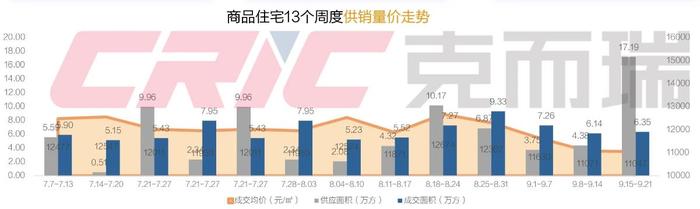
Market Overview - In the week of September 15-21, 2025, Kunming's real estate market saw an increase in supply as developers prepared for the upcoming National Day and Mid-Autumn Festival, with a supply volume of approximately 171,900 square meters, a significant increase of 292% week-on-week [1] - Transaction volume reached about 63,500 square meters, with a slight increase of 3% week-on-week, and the average transaction price remained stable at approximately 11,047 yuan per square meter [1] Sales Performance - The "Zhu You Shuang He Wan" project achieved notable sales, ranking third and second in sales volume, with a weekly sales amount of about 29 million yuan, selling 36 units at an average price of approximately 6,592 yuan per square meter [3] - "Bang Tai" projects, including "Bang Tai · Guan Yun" and "Bang Tai Ying Yue," dominated the top sales positions, with sales amounts of approximately 46 million yuan and 30 million yuan, respectively, and average prices of 18,849 yuan per square meter and 8,638 yuan per square meter [3] - "Long Hu · Feng Cui," located in the resort area, recorded the highest average price at approximately 21,117 yuan per square meter, with a weekly sales amount of about 26 million yuan [3] Project Launches - No new projects were launched last week, but five projects were re-launched, totaling 585 units, with a subscription of 97 units, resulting in an overall absorption rate of approximately 17% [5] - "Bang Tai Chun Hua Xu" launched 34 units with a high absorption rate of 41%, selling at an average price of approximately 10,000-10,500 yuan per square meter [5] - "Vanke" projects saw varied absorption rates, with "Vanke · Gui Yu Dong Fang" achieving a 23% absorption rate and "Vanke · Gong Yuan Cheng Shi" only 7% [5] Land Supply - There was no land supply or transactions in Kunming's main urban area last week [4] Infrastructure Development - The Kunming West Railway Station comprehensive transportation hub phase one construction project is set to begin, with a total construction area of approximately 58,600 square meters and an estimated investment of 850 million yuan [7][8]

龙湖亮出一个“看不见的龙湖”
3 6 Ke· 2025-09-22 04:52
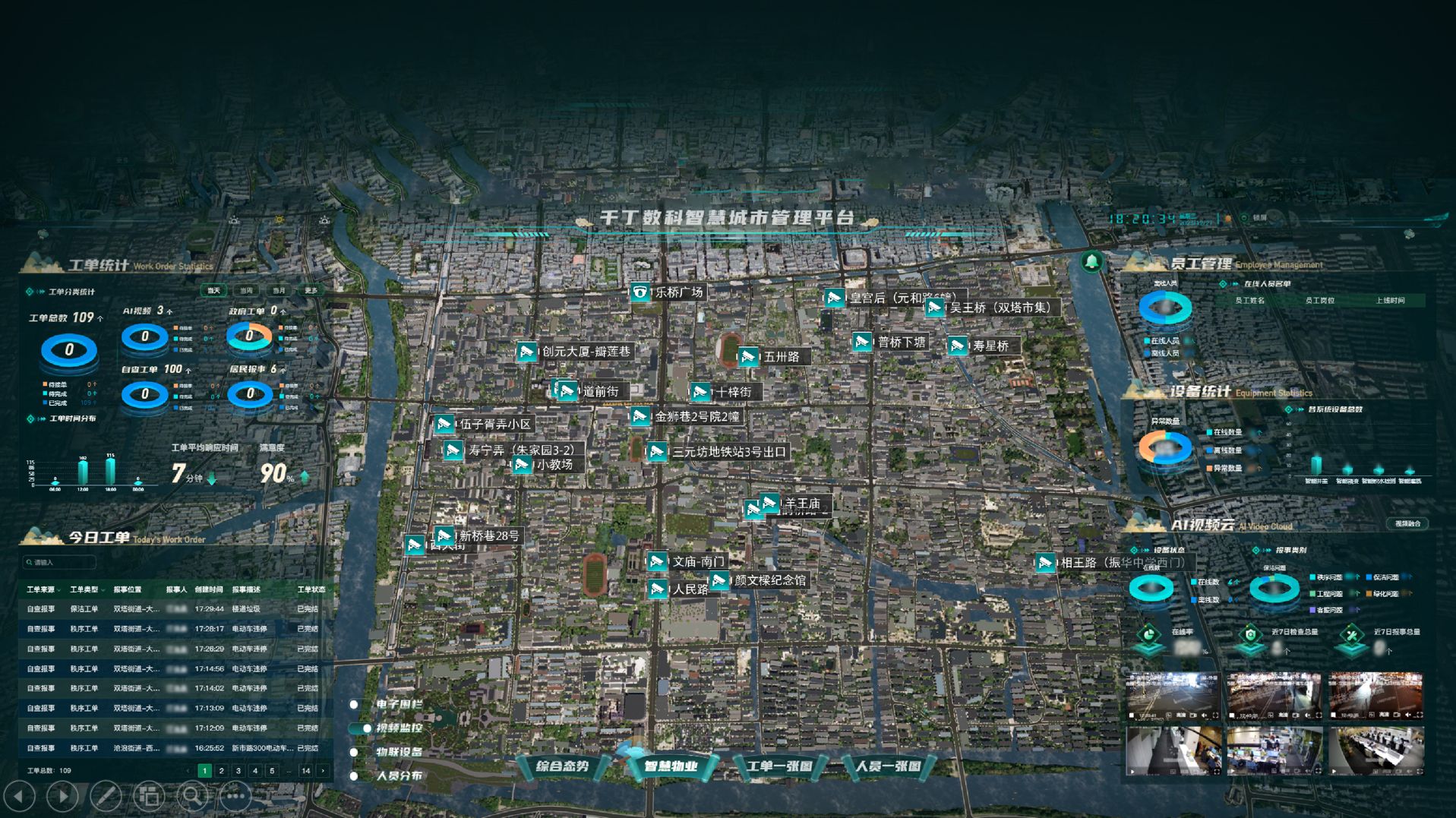
苏州姑苏古城智慧城服平台 这套系统改变了空间管理和物业服务的底层逻辑,之前"靠人",增加单位面积的员工密度,增加巡检次数,让人去"找事";现在,每个需要重点维护的点位 都装上智能传感器,靠工具和AI巡检,让"事找人"。尤其到了"具身"时代,"移动巡检机器人"的出现更进一步在夜间、节假日等人工覆盖薄弱的时段,彻底 解决了漏检与误报问题。在服务被装进"无形工厂",变成了一套准工业化方案。解决问题跑到了感知问题的前面,每天的市民报事数量也下降到了个位数。 凭借自研并融合了AI的数字化系统技术,千丁数科成为了很多空间、企业的AI领路人,除了在龙湖自有的物业、商业、办公等空间应用,同样被推广到了 街区治理、城市图书馆、市政公园、康养园区等更多场景中。在这些场景里,从"人找事"到"事找人"只是关键的第一步,终极的目标,是通过数智化架设一 套"神经系统",让建筑完成高效、睿智的进化。 寒山寺,因唐朝诗人张继的《枫桥夜泊》闻名中外,到了今天,每年会有超200万人慕名而来。 在面积14.2平方公里的苏州姑苏区古城,像寒山寺这样被列入文物保护单位的,有500多个,庞大的客流对街区的日常维护是一个高难度的挑战。仅在垃圾 桶满溢等" ...