
XPENG-W(09868)

Search documents
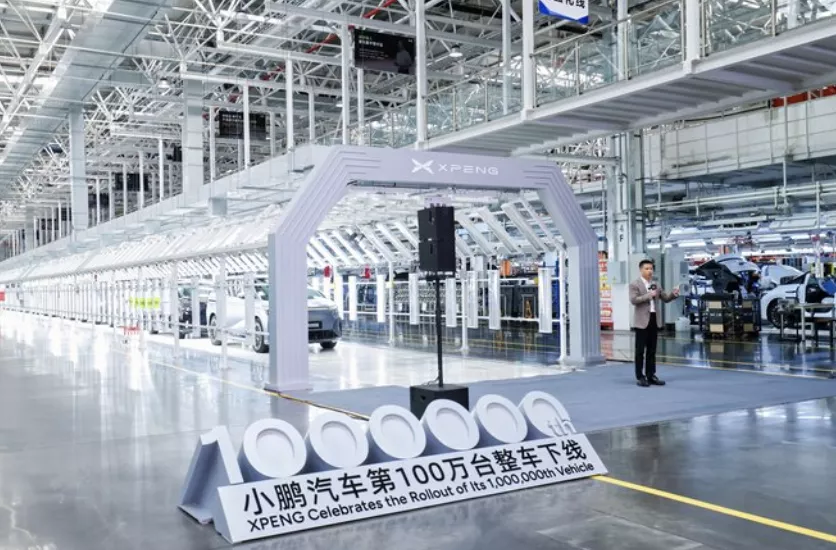
小鹏汽车在广州工厂举行第100万台下线仪式
Cai Jing Wang· 2025-11-24 07:49
Core Insights - Xiaopeng Motors celebrated the production of its one millionth vehicle and the delivery of the first batch of X9 Super Extended Range vehicles, achieving this milestone in just 14 months after the previous half-million mark, which took 82 months to reach [1][3] Group 1: Company Milestones - The CEO of Xiaopeng Motors, He Xiaopeng, defined the one million vehicle milestone as a new level for the company, emphasizing a focus on safety, quality, service, and operational systems as core responsibilities [3] - Xiaopeng Motors reiterated its new brand positioning as a "mobility explorer in the physical AI world, a globally embodied intelligent company" during the recent Guangzhou Auto Show [5] Group 2: Technological Advancements - At the "2025 Technology Day," Xiaopeng Motors showcased breakthroughs in the physical AI field, announcing four AI applications, including the second-generation VLA, Robotaxi, a new generation of IRON, and two types of flying cars, all set to enter mass production by 2026 [5] - The second-generation VLA model is expected to facilitate the transition from L2 level assisted driving to L4 level advanced autonomous driving [5] Group 3: Sales Performance - From January to October 2025, Xiaopeng Motors achieved cumulative deliveries of 355,209 vehicles, representing a year-on-year increase of 190%, with overseas deliveries reaching 34,712 units, a year-on-year increase of 106.7% [5]

小鹏汽车-W(09868):单三季度销量同比增长149%,打造物理AI未来出行全新范式
Guoxin Securities· 2025-11-24 07:37
Investment Rating - The investment rating for the company is "Outperform the Market" [7][5]. Core Insights - In Q3 2025, the company achieved a revenue of 20.4 billion RMB, representing a year-on-year growth of 102%. The total sales volume reached 116,000 units, a year-on-year increase of 149.3% [2][11]. - The company is focusing on developing a new paradigm for future mobility through physical AI, with significant advancements in autonomous driving and robotics showcased during the 2025 Xiaopeng Technology Day [4][23]. - The company maintains its revenue forecasts for 2025, 2026, and 2027 at 88.5 billion, 128 billion, and 147.2 billion RMB respectively, while projecting net profits of -1.6 billion, 2.7 billion, and 4.7 billion RMB for the same years [5][49]. Financial Performance - In Q3 2025, the gross margin was 20.1%, an increase of 4.9 percentage points year-on-year, while the net margin was -1.9%, improving by 16.0 percentage points year-on-year [3][15]. - The automotive sales revenue for Q3 2025 was 18.05 billion RMB, up 105.3% year-on-year, driven by increased deliveries of new models [11][19]. - The company reported a net loss of 3.8 billion RMB in Q3 2025, a significant improvement from a loss of 18.1 billion RMB in the same period last year [2][11]. Sales and Delivery Guidance - The company delivered 42,000 vehicles in October 2025, marking a year-on-year increase of 76% and a quarter-on-quarter increase of 1% [4][21]. - For Q4 2025, the company expects to deliver between 125,000 and 132,000 vehicles, representing an annual increase of approximately 36.6% to 44.3% [4][21]. Product Development and Innovation - The company introduced the second-generation VLA (Vision-Language-Action) system, which integrates visual perception and language understanding for enhanced autonomous driving capabilities [31][32]. - The company plans to launch three Robotaxi models in 2026, leveraging a pure vision solution without reliance on lidar or high-definition maps [37][41]. - The new generation of IRON humanoid robots is designed for various applications, featuring advanced AI capabilities and a focus on safety and user privacy [42][45].
股票市场概览:资讯日报:纽约联储行长鸽派言论提振市场情绪-20251124
Guoxin Securities Hongkong· 2025-11-24 06:39
Market Overview - The Hang Seng Index closed at 25,220, down 2.38% for the day and 5.09% for the week, but up 25.72% year-to-date[3] - The Hang Seng Technology Index fell 3.21% to 5,395, with a year-to-date increase of 20.76%[3] - The Hang Seng China Enterprises Index decreased by 2.45% to 8,920, with a year-to-date rise of 22.36%[3] - The Shanghai Composite Index dropped 2.45% to 3,835, with a year-to-date increase of 14.41%[3] Sector Performance - The lithium battery sector saw significant declines, with Ganfeng Lithium down over 12% and Tianqi Lithium down over 11%[9] - Semiconductor stocks also performed poorly, with Innolux down over 8% and SMIC and Hua Hong Semiconductor both down over 6%[9] - Xiaomi-related stocks rose against the trend, driven by the launch of Xiaomi's enhanced smart driving system[9] U.S. Market Insights - On November 21, U.S. markets saw all major indices rise, with the Dow Jones gaining approximately 1.1%[9] - The probability of a 25 basis point rate cut by the Federal Reserve in December increased from under 40% to over 70% following dovish comments from New York Fed President Williams[9] - Notable movements in large tech stocks included Google up 3.53% and Nvidia down 0.96%[9] Japanese Market Trends - The Nikkei 225 index fell 2.4%, with a cumulative decline of 3.5% over the past week[13] - Japanese semiconductor stocks faced significant drops, with Tokyo Electron down 7.14% and Advantest down 12.10%[13] - The Japanese government announced a $135 billion economic stimulus plan, adding pressure to the yen and government bonds[13]







研报 | 2025年第三季新能源车销量年增31%,全年预计年增长25%
TrendForce集邦· 2025-11-24 04:36
Core Insights - The global sales of new energy vehicles (NEVs) reached 5.39 million units in Q3 2025, marking a year-on-year increase of 31% [2] - Battery electric vehicles (BEVs) accounted for 3.71 million units sold, up 48% year-on-year, while plug-in hybrid electric vehicles (PHEVs) saw sales of 1.67 million units, a 4% increase [2] NEV Market Performance - BYD maintained its position as the top seller of BEVs with a market share of 15.4%, although its sales decreased compared to Q2 [5] - Tesla ranked second with a strong Q3 performance, achieving a 29% quarter-on-quarter increase, driven by incentives in the U.S. and growth in China [5] - Geely and Leapmotor showed remarkable growth, with market shares of 6% and 4.1% respectively, surpassing Xpeng for two consecutive quarters [6] - Volkswagen's ranking fell to seventh due to a decline in the Chinese market, offsetting gains in Europe and the U.S. [6] - Hyundai ranked ninth with a quarterly decline but year-on-year growth, while BMW faced challenges with decreasing sales of its electric vehicles [6] PHEV Market Dynamics - BYD faced saturation and intense competition in the Chinese PHEV market, experiencing year-on-year sales decline despite quarterly growth [6] - AITO, Chery, and Geely ranked second to fourth in PHEV sales, with Chery showing rapid growth and a market share increase to 6.6% [6] - Li Auto, despite being the second in sales in Q2, faced market share erosion due to increasing competition from range-extended electric vehicles (REEVs) [6] Future Projections - TrendForce forecasts global NEV sales to reach 20.43 million units in 2025, a year-on-year increase of approximately 25% [7] - For 2026, despite regional subsidy policy adjustments leading to market differentiation, global NEV sales are expected to rise to 22.8 million units, reflecting a 12% year-on-year growth [7]



小鹏回应顾客“脚夹门”
Xin Lang Cai Jing· 2025-11-24 02:41
近日,有网友在社交平台公开视频及录音爆料,其在海南海口一家小鹏汽车4S店试驾时被感应门夹到 脚,玻璃门坏了,却被要求赔偿门的损失。此事在社交平台上一经发布,就引发大量关注。 据该网友在视频中透露,事件发生时,其在导购引导下前往门口查看试驾车。等转身准备返回店内,感 应门突然自动合拢,夹到了这名网友的脚。但此后其还是加了导购微信约定下次试驾。但在其离开不到 10分钟,便接到门店电话要求返回协商赔偿事宜。从网友公开的录音中,门店工作人员明确表示"你的 脚夹到了门""你不来门就不会坏"。 在该网友发布的视频评论区,很多网友纷纷评论4S店处置不当。"'你不来店里,这个门就不会坏',我 这辈子也想不出来这句话"、"今年海口小鹏4S店上大分!还解锁新词汇:你的脚夹到我的门"…… 炒股就看金麒麟分析师研报,权威,专业,及时,全面,助您挖掘潜力主题机会! 公开资料显示,小鹏汽车成立于2014年8月,是最早的新势力车企之一。2015年1月,小鹏汽车正式注 册。 11月17日,小鹏汽车(09868.HK)在港交所公告。最新财报显示,截至2025年9月30日,小鹏汽车的 实体销售网络共有690间门店,自营充电站网络达至2676座充 ...

2025年第199期:晨会纪要-20251124
Guohai Securities· 2025-11-24 02:39
Group 1 - The smart electric vehicle business of Xiaomi Group achieved its first quarterly profit, with a record high profit in Q3 2025, reporting revenue of approximately 113.1 billion RMB, a year-on-year increase of 22.3% [4][5] - The automotive segment saw a significant increase in revenue, reaching 283 billion RMB in Q3 2025, a year-on-year growth of 197.9%, driven by an increase in delivery volume and average selling price (ASP) [7] - The IoT and lifestyle products segment maintained year-on-year growth, achieving revenue of 276 billion RMB in Q3 2025, despite subsidy reductions [6] Group 2 - Top Group reported a revenue of 209.28 billion RMB for the first three quarters of 2025, a year-on-year increase of 8.14%, with a notable growth in the automotive electronics business [10] - The company’s Q3 2025 revenue reached 79.94 billion RMB, reflecting a quarter-on-quarter increase of 11.53%, primarily due to increased sales from key customers [10][11] Group 3 - Baidu Group's total revenue for Q3 2025 was approximately 311.74 billion RMB, a year-on-year decline of 7%, influenced by decreases in online marketing and iQIYI revenues [13][15] - The AI-driven marketing services within Baidu's core business saw a significant increase, with revenue reaching 28 billion RMB, a year-on-year growth of 262% [15] Group 4 - XPeng Motors reported a revenue of 203.8 billion RMB in Q3 2025, a year-on-year increase of 101.8%, with automotive revenue contributing 180.5 billion RMB [19][20] - The company expects Q4 2025 deliveries to reach between 125,000 and 132,000 units, representing a year-on-year growth of 36.6% to 44.3% [21] Group 5 - Lenovo Group reported a revenue of approximately 204.52 billion USD for FY2026Q2, a year-on-year increase of 15%, with AI-related business revenue accounting for 30% of total revenue [24][25] - The infrastructure solutions group within Lenovo saw a revenue increase of 24%, driven by new customer acquisitions and business transformations [26] Group 6 - The AIDC storage report indicates a high demand in the industry, with significant growth expected in the data center storage market, projected to reach 212 GWh globally by 2030 [28][29] - The report highlights that data center storage has shifted from being an optional configuration to a necessity, driven by increasing power density and load demands [29][30]





中国汽车制造商_11 组数据;11 大趋势(2025 年 10 月总结)
2025-11-24 01:46
Summary of Key Points from the Conference Call on China Auto Manufacturers Industry Overview - The conference call focused on the **China Auto Manufacturers** industry, particularly the performance of **New Energy Vehicles (NEVs)** and traditional internal combustion engine (ICE) vehicles in October 2025. Core Insights and Arguments 1. **NEV Market Performance**: - October 2025 saw a **-8% month-over-month (MoM)** decline in domestically produced NEV passenger vehicle (NEV-PV) sales, although there was a **+1% year-over-year (YoY)** increase, which missed expectations [1][9]. - Local Chinese brands maintained a high NEV market share of **84.3%**, increasing by **+1.2 percentage points (ppt) MoM** [6]. 2. **ICE Vehicle Sales**: - The penetration of ICE vehicles increased to **42.4%**, up **+0.8 ppt MoM** [2]. - Chinese brands' ICE market share rose by **+1.7 ppt MoM** to **35.4%**, while foreign brands (German, Japanese, US) experienced declines [3]. 3. **Market Share Changes**: - **Xiaomi, Nio, and Seres** gained BEV market shares with increases of **+1.3 ppt, +1.0 ppt, and +0.8 ppt** respectively, while **Tesla and BYD** lost market shares of **-4.9 ppt and -2.6 ppt** [2]. - **Geely and Chery** gained PHEV market shares by **+1.2 ppt and +0.3 ppt** respectively, while **GWM and BYD** lost shares [2]. 4. **Tesla's Performance**: - Tesla's domestic insurance retail sales dropped **-61% MoM** and **-34% YoY** to **27,367 units**. Wholesales were **61,497 units**, down **-32% MoM** and **-10% YoY** [4][19]. - Tesla's inventory levels increased, indicating potential overstock issues [5]. 5. **Inventory Levels**: - Overall inventory for major OEMs rose from **2.3 months** at the end of September to **2.7 months** at the end of October [5]. - NEV inventory also increased by **0.3 months MoM** to **1.7 months** [5]. Additional Important Insights 1. **Export Performance**: - The export volume of NEVs reached **35,491 units**, reflecting a **+84% MoM** and **+28% YoY** increase, indicating strong international demand [4]. 2. **Sales Data**: - Total domestically produced NEV PV sales for October 2025 were **1,189,321 units**, with a **1% YoY increase** but an **8% MoM decrease** [9]. 3. **Market Dynamics**: - The competitive landscape is shifting, with local brands gaining ground against established players like Tesla and BYD, suggesting a potential long-term trend favoring domestic manufacturers [2][3]. 4. **Analyst Certification and Disclosures**: - The report includes important disclosures regarding potential conflicts of interest and the analysts' certifications, emphasizing the need for investors to consider these factors in their decision-making [7][26]. This summary encapsulates the key points discussed in the conference call, highlighting the current state and trends within the Chinese auto manufacturing industry, particularly focusing on NEVs and ICE vehicles.



传媒互联网教育行业2026年度策略
2025-11-24 01:46
Summary of Key Points from Conference Call Records Industry Overview - **Industry Focus**: Media, Internet, and Education sectors are highlighted for 2026 strategies, with significant emphasis on AI-driven advancements and market dynamics [1][2]. Core Insights and Arguments Advertising Sector - **AI Impact**: AI has significantly improved advertising efficiency, with Tencent's advertising revenue growing by 20% year-over-year in Q2 and continuing to rise in Q3. Kuaishou has made notable progress in user profiling and targeted advertising, while Bilibili achieved over 20% growth through AI enhancements [6][4]. - **Competition**: Third-party programmatic advertising platforms like Huishuangzang Technology and Yidian Tianxia are gaining competitiveness, driving transformation in the advertising industry [1][5]. Gaming Industry - **Regulatory Environment**: The normalization of game license issuance ensures a steady supply of content, supported by a resilient consumer environment. Major companies like Century Huatong and Giant Network are expected to benefit from a concentrated release of new products [7][9]. - **Market Dynamics**: The gaming sector is projected to maintain a high level of activity, driven by product innovation and commercial efficiency. Key players include Tencent, Century Huatong, and Giant Network [14][9]. Instant Retail Market - **Market Growth**: The instant retail market is expected to reach 1.175 trillion yuan by 2026, with a year-on-year growth rate of 28%. Major players like Alibaba, Meituan, and JD.com are heavily investing in this space, although profitability is under pressure due to intense competition [11][8]. - **Consumer Trends**: The county-level market is emerging as a new growth point, supported by the increasing number of rural internet users and their consumption habits [11][10]. Autonomous Driving Sector - **Competitive Landscape**: The autonomous driving sector is entering a price competition phase, with companies like Xpeng and Li Auto differentiating themselves through chip technology and self-driving capabilities. This trend is expected to enhance user experience and drive further development in the electric vehicle industry [12][10]. Short Drama and AI Animation - **Market Expansion**: The short drama market is rapidly growing, with approximately 700 million users in China. The market share of Hongguo exceeds 50%, while companies like China Online and Kunlun Wanwei are performing well in overseas markets, particularly targeting the U.S. [18][1]. - **AI Animation Growth**: The supply of AI animation (dynamic comics) has surged, with a compound monthly growth rate of about 83% in the first half of the year, resulting in over 3,000 works produced and a revenue scale that has increased twelvefold [19][3]. Education Sector - **AI Integration**: AI is increasingly penetrating the education sector, with companies like Dou Shen Education expected to achieve full AI integration by 2026, with AI revenue accounting for 90% of total income. Fenbi Education's AI interview courses are projected to enhance profit margins significantly [20][21]. - **Valuation Appeal**: Dou Shen Education's valuation metrics, such as a PS ratio of around 7 and a PE ratio in the 30s, are considered attractive compared to other sectors, which often see PE ratios of 60-70 [21][20]. Additional Important Insights - **Consumer Resilience**: The macroeconomic environment is supporting consumer resilience, with trends like the "lipstick effect" maintaining consumption levels [9][8]. - **Content Supply Recovery**: The film and television sectors are experiencing a recovery in content supply, with stable growth in box office revenues and favorable policies aiding the industry [17][7]. This summary encapsulates the key points from the conference call records, providing a comprehensive overview of the current trends and future outlooks across various sectors.




补齐“标准缺位”短板 汽车芯片认证审查升级
Shang Hai Zheng Quan Bao· 2025-11-23 18:02
Core Viewpoint - The automotive industry is experiencing a significant demand for high-reliability and high-safety chips due to the ongoing development of automotive intelligence, necessitating a unified quality evaluation system for the large-scale application of domestic automotive chips [1] Industry Pain Points - The automotive chip industry is facing challenges such as non-unified standards, high verification costs, insufficient testing coverage, and a lack of trust systems, which have emerged as the industry transitions from technical validation to large-scale implementation [2][3] - Different admission requirements among automakers lead to repeated testing and adaptation for the same chip, increasing both development costs and time for chip manufacturers and automakers alike [2] - The absence of a comprehensive review mechanism covering the entire "chip-system-vehicle" chain makes it difficult to meet quality, safety, and reliability needs, particularly affecting small and medium-sized chip design companies [3] Multi-layered Effects - The upgraded "2.0 version" of the automotive chip certification review system aims to establish a unified trust foundation for the automotive chip industry, potentially reducing costs and enhancing efficiency [4] - The new system includes nine modules and sixty indicators, covering ten categories of automotive chips in five domains of new energy vehicles, promoting systematic and standardized certification [4] - For chip manufacturers, this system acts as a valuable "pass" that significantly lowers communication and repeated testing costs when entering various automaker supply chains [4][5] Industry Development Acceleration - The domestic automotive chip industry is entering a new phase of rapid development, driven by the increasing requirements for computing power, perception capabilities, and system safety from automakers [6] - Automakers are accelerating the iteration and mass production of self-developed chips, with companies like NIO and XPeng making significant advancements in their chip technologies [6] - New players in the smart driving chip sector are emerging, with companies like Chipida achieving substantial production milestones and entering the supply chains of major automakers [6] Future Outlook - The upgrade of the automotive chip certification review system is expected to provide better quality assurance for domestic automotive chips and facilitate smoother collaboration among automakers, chip manufacturers, and ecosystem partners [7] - As the system is further promoted, the domestic automotive chip industry is likely to enhance its quality, efficiency, and innovation capabilities, gaining a stronger position in the global smart driving development wave [7]
