
XPENG-W(09868)

Search documents
特朗普签署行政命令,重申2028年登月目标;王毅分别同柬埔寨、泰国外长通电话;46岁!国盾量子董事长离世;康师傅换帅丨每经早参
Mei Ri Jing Ji Xin Wen· 2025-12-18 23:13
Group 1 - The U.S. White House announced that President Trump signed an executive order to establish a vision for a "America First" space policy, aiming for a return to the Moon by 2028 and the establishment of initial facilities for a permanent lunar outpost by 2030 [12][12] - The order includes directives for deploying nuclear reactors on the Moon and in orbit [12] Group 2 - The chairman of Guoshun Quantum, Lv Pin, passed away on December 18, 2023 [3] - The CEO of Master Kong, Chen Yingrang, announced his retirement effective December 31, 2025, with Wei Hongcheng appointed as the new CEO starting January 1, 2026 [3][16] Group 3 - The U.S. Labor Department reported that the November CPI increased by 2.7% year-on-year, lower than the expected 3.1% [5] - Major U.S. stock indices closed higher, with the Dow Jones up 0.14%, the Nasdaq gaining over 310 points (1.38%), and the S&P 500 rising by 0.79% [5] - Tesla shares rose over 3%, while other tech giants like Amazon and Facebook saw increases of over 2% [5] Group 4 - The U.S. Treasury reported that Japan's holdings of U.S. Treasury securities increased from $1.189 trillion in September to $1.2 trillion in October [6] - International oil prices saw a slight increase, with WTI crude oil futures rising by 0.38% to $56.15 per barrel [7] Group 5 - The Ministry of Industry and Information Technology announced plans to strengthen capacity regulation in the photovoltaic industry, aiming for a dynamic balance of production capacity by 2026 [9] - The Ministry of Commerce confirmed that some applications for general export licenses for rare earths have been approved [9] Group 6 - The market supervision authority is focusing on addressing "involution-style" competition to promote a healthy market order [10] - The film "Zootopia 2" has become the highest-grossing imported film in China's history, surpassing "Avengers: Endgame" with over 91.06 million viewers [11]





陆家嘴财经早餐2025年12月19日星期五
Wind万得· 2025-12-18 22:45
Group 1 - China's Hainan Free Trade Port officially launched its zero-tariff operation on December 18, expanding the range of zero-tariff goods to over 6,600 items, enhancing consumer experience for travel and shopping [2] - The Ministry of Commerce has reintroduced export license management for steel for the first time in 16 years to strengthen monitoring and analysis of steel product exports [2] - A giant underwater gold mine has been discovered in Shandong Province, with proven gold reserves of over 3,900 tons, accounting for approximately 26% of the national total [2] Group 2 - The State Administration for Market Regulation emphasizes the need to strengthen the construction of a unified national market and promote fair competition [3] - The U.S. has initiated a military sale to Taiwan valued at approximately $11 billion, marking one of the largest military sales [3] - The State-owned Assets Supervision and Administration Commission has issued guidelines for holding central enterprises accountable for investment violations, effective from January 1, 2026 [3] Group 3 - The China Securities Regulatory Commission is advancing the "14th Five-Year" plan for the capital market, focusing on comprehensive reforms and high-level opening-up [4] - A-share indices showed divergence, with the Shanghai Composite Index closing up 0.16% while the Shenzhen Component Index and ChiNext Index fell by 1.29% and 2.17%, respectively [4] - The Hong Kong stock market is undergoing a narrow consolidation, with the Hang Seng Index closing up 0.12% [4] Group 4 - Morgan Stanley predicts that chip stocks will remain one of the best-performing sectors in the U.S. stock market next year, highlighting Nvidia, Broadcom, and Astera Labs as top picks [5] - Insurance asset management institutions have registered 83 asset-backed plans this year, totaling approximately 344.56 billion yuan [5] - Domestic GPU companies, Moore Threads and Muxi Co., have recently listed on the STAR Market, attracting significant investment from insurance funds [5] Group 5 - A wave of IPOs is expected in the Hong Kong capital market, with several companies starting public offerings on December 18 [6] - The Ministry of Industry and Information Technology announced that the photovoltaic industry will enter a critical phase in 2026, focusing on capacity regulation [8] Group 6 - The State Council has issued guidelines to strengthen electronic cigarette regulation and combat illegal tobacco-related activities [9] - The upcoming New Year's holiday is projected to significantly boost the domestic tourism market, with flight bookings increasing by approximately 46% year-on-year [9] - The total scale of bank wealth management products reached a historical high of about 34 trillion yuan by the end of November [9] Group 7 - The People's Bank of China will issue 40 billion yuan in central bank bills in Hong Kong on December 22, with a maturity of six months [18] - The U.S. Treasury Department reported an increase in Japan's holdings of U.S. Treasury securities to $1.2 trillion in October [18]





XPeng stock price has crashed 35%: Is it safe to buy the dip?
Invezz· 2025-12-18 13:02
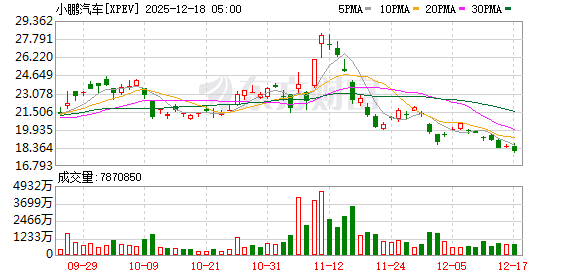
XPeng stock price has nosedived in the past few weeks as investors have dumped Chinese EV companies. XPEV dropped to $18 in New York, down by 35% from its highest point this year. ...

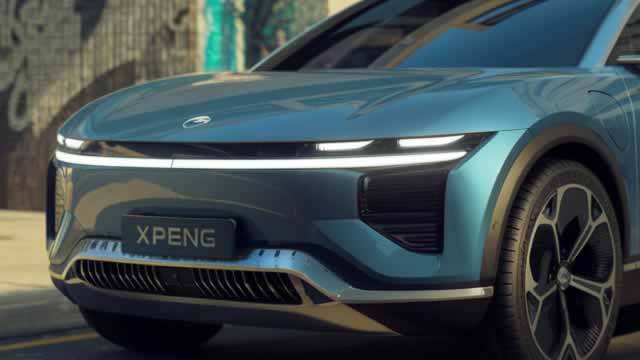
小鹏汽车-W根据股权激励计划发行188.15万股A类普通股
Zhi Tong Cai Jing· 2025-12-18 11:26
Core Viewpoint - Xiaopeng Motors (09868) announced the issuance of 1.8815 million Class A ordinary shares on December 18, 2025, to fulfill restricted stock units as part of its equity incentive plans approved by shareholders in 2020 and 2025 [1] Group 1 - The issuance of shares is based on the 2019 equity incentive plan adopted on June 28, 2020, and approved by shareholders on August 20, 2020 [1] - The company will also issue shares according to the 2025 equity incentive plan adopted on March 18, 2025, and approved by shareholders on June 27, 2025 [1]
小鹏汽车-W(09868)根据股权激励计划发行188.15万股A类普通股
智通财经网· 2025-12-18 11:20
智通财经APP讯,小鹏汽车-W(09868)发布公告,于2025年12月18日,根据于2020年6月28日采纳及2020 年8月20日获公司股东批准的2019年股权激励计划以及根据于2025年3月18日采纳及2025年6月27日获公 司股东批准的2025年股份激励计划而发行188.15万股A类普通股以满足限制性股份单位。 ...
小鹏集团-W(09868) - 翌日披露报表
2025-12-18 11:13
FF305 翌日披露報表 (股份發行人 ── 已發行股份或庫存股份變動、股份購回及/或在場内出售庫存股份) 表格類別: 股票 狀態: 新提交 B. 贖回/購回股份 (擬註銷但截至期終結存日期尚未註銷) (註5及6) 備註: 已發行股份佔有關股份發行前的現有已發行股份數目百分比是依據本公司已發行股份數目總數(不包括庫存股份)1,909,771,413股 (包括1,561,063,156 A 類普通股及 348,708,257 B 類普通股)計算。 第 2 頁 共 6 頁 v 1.3.0 公司名稱: 小鵬汽車有限公司(於開曼群島註冊成立以不同投票權控制的有限公司) 呈交日期: 2025年12月18日 如上市發行人的已發行股份或庫存股份出現變動而須根據《香港聯合交易所有限公司(「香港聯交所」)證券上市規則》(「《主板上市規則》」)第13.25A條 / 《香港聯合交易所有限公司GEM證券 上市規則》(「《GEM上市規則》」)第17.27A條作出披露,必須填妥第一章節 。 | 第一章節 | | | | | | | | | | --- | --- | --- | --- | --- | --- | --- | --- | ...
一图读懂|人形机器人爆发元年!产业链核心标的全梳理
机器人圈· 2025-12-18 10:18
Core Insights - The humanoid robot industry is expected to transition from laboratory experiments to industrialization by 2025, with significant orders already being secured by leading companies like UBTECH, ZhiYuan, and Yushu, including a record order of 250 million yuan by UBTECH in September [1] - The humanoid robot sales in China are projected to exceed 10,000 units this year, representing a year-on-year growth of 125% [1] Group 1: Key Players in the Humanoid Robot Market - The main players in the domestic humanoid robot sector include automotive companies, startups, and tech giants [2] - Notable companies entering the market include UBTECH, Xiaomi, Xiaopeng Motors, and ZhiYuan, with significant product launches and strategic partnerships [3][4] Group 2: Industry Chain and Manufacturing - The manufacturing of humanoid robots can be divided into three main components: "brain" (perception, decision-making, human-machine interaction), "small brain" (cloud motion control), and the physical body [5][6] - Key components in the physical manufacturing include actuators, sensors, batteries, and skin materials [6] Group 3: Notable Companies in the Industry Chain - Companies involved in the "brain" and "small brain" segments include major internet firms like Tesla, Google, and NVIDIA, as well as startups like Youlu Robotics and Qianjue Technology [7] - For physical manufacturing, companies such as UBTECH, Xiaomi, and ZhiYuan are highlighted for their contributions to the development of humanoid robots [9] Group 4: Major Industry Events and Developments - Significant investments and partnerships are being formed, such as the 20.27 billion yuan fundraising by Green Harmonic for new precision transmission devices [11] - Companies like Huazhong University and various tech firms are collaborating on research and development for humanoid robots, indicating a strong focus on innovation in this sector [13][14]




遭遇“盗电” 小鹏汽车:已报案!
Mei Ri Jing Ji Xin Wen· 2025-12-18 09:35
Group 1 - The core issue of illegal electricity theft has been identified, with the company reporting criminal activities involving unauthorized devices and fake user accounts [2] - The company has filed a formal report to law enforcement, and some cases have been successfully resolved, leading to the arrest of key suspects for theft and fraud [2] Group 2 - The company announced plans to add 150 self-operated charging stations by November 2025, including 11 S5 ultra-fast charging stations and 124 S4 ultra-fast charging stations [4] - As of December 1, 2025, the company has established a total of 2,910 self-operated charging stations and 15,900 charging guns across 430 cities [4] Group 3 - In November 2025, the company delivered 36,728 smart electric vehicles, representing a year-on-year growth of 19% [5] - From January to November 2025, cumulative deliveries reached 391,937 units, marking a significant year-on-year increase of 156% [5] - The overseas market deliveries for the company reached 39,773 units during the same period, reflecting a 95% year-on-year growth [5]
小鹏汽车:已报案
Xin Jing Bao· 2025-12-18 08:53
Core Viewpoint - Xiaopeng Motors has reported illegal activities involving theft of electricity through unauthorized devices and fake user accounts, leading to criminal investigations and arrests [1] Group 1: Company Actions - Xiaopeng Motors has filed a formal report to law enforcement regarding the illegal activities [1] - The company expresses gratitude to the police for their efficient investigation and to the media for providing leads on the cases [1] - Xiaopeng Motors commits to continue cooperating in combating illegal activities in the industry to protect its legal rights and consumer service rights [1] Group 2: Criminal Activities - The illegal activities include the use of unauthorized electricity theft devices and the registration of fraudulent user accounts [1] - Some cases have been successfully solved, with key suspects arrested for theft and fraud [1]
“百万英才汇南粤”2025年N城联动秋季招聘活动收官 走进19省市覆盖逾百高校
Nan Fang Ri Bao Wang Luo Ban· 2025-12-18 07:44
Core Insights - The "Million Talents Gathering in Nanyue" autumn recruitment event successfully concluded, covering 19 provinces and attracting over 15,000 participating companies and more than 500,000 job positions [1] - The event aims to stabilize employment and upgrade the talent pool in Guangdong, supporting high-quality development [1] Group 1: Recruitment Scope and Duration - The recruitment event expanded from 8 key cities in the spring to over 100 universities across 19 provinces, targeting excellent graduates nationwide [2] - The duration of the recruitment has shifted from a concentrated two-week period to a continuous effort throughout the autumn semester [2] - Various cities in Guangdong initiated recruitment activities in September, October, November, and December, establishing long-term cooperation mechanisms with universities [2] Group 2: Talent Demand and Job Offerings - The recruitment focuses on 20 strategic industrial clusters in Guangdong, aiming to attract key talents for emerging and future industries [3] - A diverse range of participating companies includes state-owned enterprises, leading private firms, and high-level research institutions, ensuring precise matching of supply and demand [3] - Job offerings span cutting-edge fields such as artificial intelligence and new energy, catering to various educational backgrounds and professional specializations [3][4] Group 3: Salary and Job Quality - Over 30% of the job positions offered annual salaries exceeding 200,000 yuan, with more than 27,000 positions offering salaries above 500,000 yuan [4] - The recruitment event provides opportunities for graduates from various levels of universities to find desirable jobs, including positions in both urban and rural areas of Guangdong [4] Group 4: Recruitment Services and Support - The recruitment process is enhanced by the "Yue Employment" app and a public job service platform, creating a streamlined and intelligent recruitment service system [5] - AI recruitment service areas were set up at various university recruitment events, offering resume optimization, interview practice, and job matching services [5] - Cities provided policy packages for graduates, covering multiple aspects of employment and life, while also promoting local culture and attractions [5]


