KWEICHOW MOUTAI(600519)

Search documents
【21日资金路线图】电子板块净流入逾240亿元居首 龙虎榜机构抢筹多股
证券时报· 2026-01-21 11:53
Market Overview - The A-share market saw an overall increase on January 21, with the Shanghai Composite Index closing at 4116.94 points, up 0.08%, the Shenzhen Component Index at 14255.13 points, up 0.7%, and the ChiNext Index at 3295.52 points, up 0.54% [2]. Capital Flow - The net inflow of main funds in the A-share market was 56.08 billion yuan, with an opening net outflow of 41.97 billion yuan and a tail-end net inflow of 6.26 billion yuan [3]. - The CSI 300 index experienced a net inflow of 154.35 billion yuan, while the ChiNext and STAR Market saw net outflows of 61.61 billion yuan and 17.06 billion yuan, respectively [5]. Sector Performance - The electronics sector led with a net inflow of 240.76 billion yuan, followed by non-ferrous metals with 103.65 billion yuan and machinery equipment with 92.59 billion yuan [7]. - The banking sector had the highest net outflow at -104.20 billion yuan, followed by non-bank financials at -84.79 billion yuan and electric power equipment at -76.06 billion yuan [8]. Stock Highlights - China Great Wall had the highest net inflow of main funds at 14.27 billion yuan [9]. - Institutions showed significant interest in stocks such as Zhongtung High-tech, which saw a net purchase of 30.50 million yuan, and Dazhu CNC with a net purchase of 27.86 million yuan [12]. Institutional Focus - Recent institutional ratings include China Railway with a target price of 8.15 yuan, indicating a potential upside of 48.72%, and Hikvision with a target price of 45.00 yuan, suggesting a 38.04% upside [13].








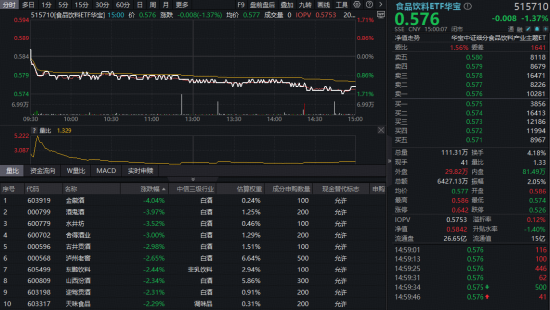
吃喝板块突遭寒流,白酒股领跌!食品饮料ETF华宝(515710)重挫1.71%,机构激辩:布局时刻到了吗?
Xin Lang Cai Jing· 2026-01-21 11:23
Core Viewpoint - The food and beverage sector continues to experience a downturn, with the Huabao Food and Beverage ETF (515710) showing a significant decline, particularly in the liquor stocks, which have collectively dropped, impacting the overall sector performance [1][10]. Group 1: Market Performance - On January 21, the Huabao Food and Beverage ETF (515710) experienced a maximum intraday decline of 1.71%, closing down 1.37% [1][10]. - Major liquor stocks such as Jinhui Liquor fell by 4.04%, while others like Guizhou Moutai and Wuliangye also saw significant declines, contributing to the sector's downturn [1][10]. Group 2: Company Insights - Guizhou Moutai, the largest holding in the Huabao Food and Beverage ETF, had a holding ratio of 14.89% as of the third quarter of 2025 [3][12]. - The brand value of Guizhou Moutai increased by 2.2% to reach $59.63 billion, ranking first in the global liquor industry according to the Brand Finance report [1][12]. Group 3: Valuation and Investment Strategy - The current valuation of the food and beverage sector is at a historical low, with the price-to-earnings ratio of the ETF's underlying index at 19.83, placing it in the bottom 3.33% of the last decade [4][12]. - Analysts suggest that the food and beverage sector may present a good opportunity for left-side positioning due to its low valuation and strong cash dividend capabilities [4][14]. Group 4: Future Outlook - The market is expected to show a "growth first, liquor accumulation" characteristic as the Spring Festival approaches, with increasing demand for liquor as inventory levels decrease [14][15]. - The food and beverage ETF is positioned to capture core assets in the sector, with approximately 60% of its holdings in high-end and mid-range liquor stocks, and 40% in other beverage and dairy segments [15][16].


贵州茅台股价七连跌创阶段新低 飞天上线i茅台21天仍“难买”
Ge Long Hui· 2026-01-21 11:18
Group 1 - The stock price of Kweichow Moutai has experienced a seven-day decline, approaching the 1350 yuan mark, reaching a new low since September 24, 2024 [1] - The core products of Kweichow Moutai are now available on its direct sales channel, the iMoutai APP, with the flagship product priced at 1499 yuan having been on sale for 21 days and frequently selling out [1] - Consumers have reported delays in receiving orders placed on the iMoutai platform, with some waiting nearly 10 days without receiving specific logistics information [1] Group 2 - There are reports of consumers struggling to connect with Kweichow Moutai's customer service, as calls are met with busy signals [1] - On secondary trading platforms, scalpers have emerged to purchase the flagship Moutai product, with price increases ranging from 50 to 100 yuan per case, and they are not accepting orders for individual bottles [1]
贵州茅台价格市场化改革专题研究报告:海外溢依赖到独立生态,构建消费者导向的价格形成机制
Guoxin Securities· 2026-01-21 11:12
Investment Rating - The report maintains an "Outperform" rating for Kweichow Moutai [5][6] Core Insights - Kweichow Moutai is undergoing a market-oriented transformation with a focus on a consumer-driven pricing mechanism, which is expected to reshape the competitive landscape and pricing dynamics in the industry [1][3][4] - The 2026 pricing system reform aims to create a "multi-price coexistence" ecosystem that aligns with consumer needs and enhances channel profitability [3][35] - The white liquor industry is transitioning from dependence on Moutai's demand to establishing independent ecosystems, leading to differentiated development among companies [4][25] Summary by Sections Investment Outlook - Short-term expectations indicate stable pricing for the flagship product, with anticipated sales growth during the Spring Festival [5] - Medium-term recovery in demand and product structure upgrades are expected to enhance profitability [5] - Long-term prospects remain positive as the company focuses on consumer-centric strategies and service capabilities, with continued potential for price increases [5] Market Dynamics - The report highlights a shift in the white liquor industry towards a "product + service" economy, driven by changes in consumer preferences and market conditions [3][25] - The competitive landscape is evolving, with companies moving away from following Moutai's lead to developing their own customer bases and market strategies [4][25] Pricing Strategy - The new pricing mechanism breaks away from rigid factory prices, allowing for dynamic adjustments based on market conditions and consumer expectations [35] - The introduction of a multi-channel sales approach, including self-sale, agency sale, and consignment, aims to improve channel profitability and consumer access [34][35] Company Performance Forecast - Revenue projections for Kweichow Moutai are set at CNY 183.3 billion, CNY 184.3 billion, and CNY 186.1 billion for 2025-2027, reflecting growth rates of +5.3%, +0.5%, and +1.0% respectively [5] - Expected net profit for the same period is CNY 90.45 billion, CNY 90.50 billion, and CNY 91.79 billion, with growth rates of +4.9%, 0.0%, and +1.4% respectively [5]
贵州茅台1月21日现1笔大宗交易 总成交金额312万元 溢价率为-3.78%
Xin Lang Cai Jing· 2026-01-21 10:29
第1笔成交价格为1,300.00元,成交0.24万股,成交金额312.00万元,溢价率为-3.78%,买方营业部为广 发证券股份有限公司上海民生路证券营业部,卖方营业部为中国中金财富证券有限公司上海静安区灵石 路证券营业部。 进一步统计,近3个月内该股累计发生12笔大宗交易,合计成交金额为1.03亿元。该股近5个交易日累计 下跌3.36%,主力资金合计净流出26.26亿元。 责任编辑:小浪快报 炒股就看金麒麟分析师研报,权威,专业,及时,全面,助您挖掘潜力主题机会! 1月21日,贵州茅台收跌1.64%,收盘价为1,351.06元,发生1笔大宗交易,合计成交量2400股,成交金 额312万元。 ...
曾经依赖经销商的贵州茅台,为何开始加码直销? | 声动早咖啡
声动活泼· 2026-01-21 10:04
Core Viewpoint - Moutai is facing challenges such as price inversion and high inventory, prompting the company to reclaim pricing power through direct online sales channels [3][4][5] Group 1: Market Dynamics - Moutai has historically maintained a high-end image through controlled distribution and pricing strategies, contrasting with competitors like Wuliangye, which diluted its brand through extensive sub-branding [4] - The decline in government and business consumption of liquor has shifted focus towards younger consumers, who prefer other alcoholic beverages like beer and cocktails, leading Moutai to explore new product lines aimed at this demographic [5][8] - The actual market price of Moutai products has seen significant fluctuations, with the price of a bottle of Flying Moutai dropping from 2320 yuan to below 1499 yuan within a year, indicating a broken supply-demand balance [5][6] Group 2: Strategic Adjustments - Moutai has shifted to a direct sales model via its "i Moutai" platform, allowing the company to bypass traditional distributors and directly engage with consumers, thus addressing issues like price inflation and inventory management [5][6] - The company has announced the cessation of forced distribution of non-standard products, aiming to regain pricing authority and focus on best-selling items, which may lead to short-term revenue impacts but is intended to strengthen brand integrity [6][7] - Moutai's product strategy includes a pyramid structure, with Flying Moutai at the base and premium products at the top, enhancing the perceived value of older Moutai products in the collector's market [7] Group 3: Consumer Engagement - The "i Moutai" platform has seen rapid user growth, with over 2.7 million new users registered shortly after the launch of Flying Moutai, indicating a successful strategy to engage consumers and boost sales [7] - Despite efforts to broaden the consumer base, there are concerns about whether ordinary consumers, especially younger ones, will be willing to spend significant amounts on Moutai products, which could dilute the brand's high-end image [8]

贵州茅台今日大宗交易折价成交2400股,成交额312万元
Xin Lang Cai Jing· 2026-01-21 09:45
Group 1 - The core transaction of Kweichow Moutai involved 2,400 shares with a total transaction value of 3.12 million yuan, representing 0.04% of the total trading volume for the day [1] - The transaction price was set at 1,300 yuan, which is a discount of 3.78% compared to the market closing price of 1,351.06 yuan [1][2] - The transaction occurred on January 21, indicating ongoing trading activity in the stock despite the slight discount [1]

食品饮料行业今日跌1.53%,主力资金净流出24.16亿元
Zheng Quan Shi Bao Wang· 2026-01-21 09:20
Market Overview - The Shanghai Composite Index rose by 0.08% on January 21, with 18 out of the 28 sectors experiencing gains. The top-performing sectors were non-ferrous metals and electronics, with increases of 2.79% and 2.62% respectively [1] - The banking and coal sectors saw the largest declines, with drops of 1.58% and 1.57% respectively [1] Capital Flow Analysis - The net inflow of capital in the two markets was 11.983 billion yuan, with 14 sectors receiving net inflows. The electronics sector led with a net inflow of 16.369 billion yuan, while the non-ferrous metals sector followed with a net inflow of 7.289 billion yuan [1] - Conversely, 17 sectors experienced net outflows, with the power equipment sector seeing the largest outflow of 6.688 billion yuan, followed by the defense and military sector with an outflow of 2.906 billion yuan [1] Food and Beverage Sector Performance - The food and beverage sector declined by 1.53%, with a net outflow of 2.416 billion yuan. Out of 124 stocks in this sector, 23 rose while 97 fell, including one stock that hit the daily limit down [2] - The top three stocks with the highest net inflows in the food and beverage sector were "Hao Xiang Ni" with 61.106 million yuan, "*ST Chun Tian" with 12.8997 million yuan, and "Wei Zhi Xiang" with 12.7381 million yuan [2] - Major stocks with significant net outflows included Kweichow Moutai with 9.52 billion yuan, Wuliangye with 3.66 billion yuan, and Shanxi Fenjiu with 1.33 billion yuan [2][4] Food and Beverage Sector Capital Inflow and Outflow - The capital inflow leaderboard in the food and beverage sector included "Hao Xiang Ni" (+8.11%), "*ST Chun Tian" (+4.85%), and "Wei Zhi Xiang" (+1.43%) [2] - The capital outflow leaderboard featured Kweichow Moutai (-1.64%), Wuliangye (-1.77%), and Shanxi Fenjiu (-2.34%) [4]


融资融券周报:主要指数多数下跌,两融余额继续上升-20260121
BOHAI SECURITIES· 2026-01-21 08:27
- The report does not contain any quantitative models or factors, nor does it discuss their construction, evaluation, or backtesting results. The content primarily focuses on market data, financing and securities lending balances, industry characteristics, and ETF/stock-specific financing and securities lending activities[1][2][9]. - The report provides detailed data on financing and securities lending balances, including weekly changes in financing balances (+267.64 billion RMB) and securities lending balances (-2.63 billion RMB), as well as the total two-market balance of 27,003.83 billion RMB as of January 20, 2026[12][13][15]. - Industry-specific financing and securities lending characteristics are analyzed, highlighting sectors with the highest and lowest financing and securities lending activities. For example, the non-bank financial, communication, and electronics sectors had the highest financing buy-in ratios, while the textile and apparel, light manufacturing, and building materials sectors had the lowest[29][34][35]. - The report also identifies the top ETFs and stocks by financing net buy-in amounts, such as the "China Ping An" stock (601318) with a financing net buy-in of 230.64 million RMB and the "China Securities Electric Network Equipment Theme ETF" (159326.SZ) with a financing net buy-in of 42.23 million RMB[44][45][49]. - Securities lending activities are also detailed, with the top stocks by net securities lending sell-out amounts including "Jerry Shares" (002353.SZ) with 18.67 million RMB and "Giant Network" (002558.SZ) with 17.67 million RMB[50][51].



超3000只个股上涨
第一财经· 2026-01-21 07:28
Core Viewpoint - The A-share market experienced a slight increase before retreating, with the Shanghai Composite Index rising by 0.08% and the ChiNext Index increasing by 0.54% [3] Market Performance - The Shanghai Composite Index closed at 4116.94, up 3.29 points [4] - The Shenzhen Component Index closed at 14255.13, up 99.50 points [4] - The ChiNext Index closed at 3295.52, up 17.54 points [4] - The Science and Technology Innovation Index closed at 1862.69, up 42.21 points [4] Sector Performance - The semiconductor and AI computing power sectors saw significant gains, with stocks in GPU, advanced packaging, and CPO directions rising collectively [4] - Precious metals stocks surged, with companies like Zhaojin Mining, Sichuan Gold, and Western Gold hitting the daily limit [5] - The banking, coal, liquor, and retail sectors showed weakness, with major banks like CITIC Bank and Agricultural Bank of China declining over 3% [7] Trading Volume - The total trading volume in the Shanghai and Shenzhen markets was 2.6 trillion, a decrease of 177.1 billion from the previous trading day [8] Capital Flow - Main capital inflows were observed in the semiconductor, non-ferrous metals, and computer sectors, while there were outflows from the electric grid, banking, and cultural media sectors [10] - Notable net inflows included Zhongke Shuguang (16.36 billion), Industrial Fulian (15.39 billion), and China Great Wall (14.03 billion) [10] - Significant net outflows were seen in XW Communications (18.51 billion), Kweichow Moutai (14.80 billion), and TBEA (12.94 billion) [10] Institutional Views - Flash Gold Asset Management emphasized seizing opportunities around annual report performances [11] - Dongfang Securities noted that oversold conditions and hard technology are resonating, indicating potential stability [12] - Industrial Securities suggested that the current spring market is still in its early stages, with further developments expected after a short-term adjustment [13]