
YILI(600887)

Search documents
育儿补贴落地,婴配粉市场两极分化
2 1 Shi Ji Jing Ji Bao Dao· 2025-07-29 01:50
Group 1 - The implementation of the "Childcare Subsidy System" is set to begin on January 1, 2025, providing annual subsidies of 3600 yuan per child for families with children under three years old, benefiting over 20 million families annually [1] - Local governments are also introducing their own subsidy programs, with examples including Hubei Ezhou offering 500 yuan per year for second children and 800 yuan for third children, and Inner Mongolia providing a one-time subsidy of 10,000 yuan for first children [1] - Companies like Feihe and Yili are also entering the market with their own subsidy programs, with Yili announcing a 1.6 billion yuan subsidy plan [2] Group 2 - The infant formula market is experiencing polarization, driven by high-end products, with ultra-high-end products capturing 33.2% of the market share [3] - Companies such as Feihe, FrieslandCampina, Danone, and Nestlé are maintaining growth in high-end products, while Mengniu's milk powder business is declining [3][4] - Feihe expects a revenue decline of 8% to 10% in the first half of the year due to reduced purchasing demand from the introduction of subsidies and inventory clearance [4] - The increasing subsidies are likely to further drive the premiumization of the maternal and infant market [5]


食品饮料行业周报:板块情绪改善,关注潜在催化-20250728
Donghai Securities· 2025-07-28 15:34
Investment Rating - The report assigns an "Overweight" rating to the food and beverage industry, indicating that the industry index is expected to outperform the CSI 300 index by 10% or more over the next six months [1]. Core Insights - The food and beverage sector saw a 0.74% increase last week, underperforming the CSI 300 index by 0.95 percentage points, ranking 26th among 31 first-level sectors [12]. - The report highlights a rebound opportunity in the liquor sector, particularly for high-end and regional leading brands, as market sentiment improves and policy catalysts emerge [7][12]. - The beer sector is expected to recover this year, despite short-term disruptions from delivery platforms, with low inventory levels and favorable cost trends [7][12]. - The snack segment shows high growth potential, driven by strong categories and new channels, with specific products like konjac gaining popularity [7][12]. - The report emphasizes the importance of monitoring the dairy sector, where prices are stabilizing, and a potential turning point in raw milk prices is anticipated [7][12]. Summary by Sections 1. Market Performance - The food and beverage sector's performance last week was characterized by a 0.74% increase, with pre-processed foods and health products performing relatively well, rising by 1.97% and 1.88% respectively [12][17]. - The top five gainers included *ST Xifa, Jiaoda Anli, Huang Shang Huang, Tianyou Dejiu, and Tianrun Dairy, with increases ranging from 5.92% to 9.89% [12][17]. 2. Price Trends - As of July 27, 2024, the batch price for 2024 Moutai (scattered) was 1900 yuan, reflecting a weekly increase of 10 yuan and a monthly increase of 50 yuan [21]. - The beer production for June 2025 was reported at 4.12 million kiloliters, showing a year-on-year decrease of 0.2% [26]. 3. Industry Dynamics - The beverage manufacturing sector's profit decreased by 2.1% year-on-year in the first half of 2025, with total revenue reaching 814.69 billion yuan, a 1.9% increase [53]. - Jiangsu province's liquor production in the first half of 2025 was 81,700 kiloliters, down 15% year-on-year [53]. 4. Company Updates - Yanjing Beer announced a cash dividend of 1.90 yuan per 10 shares, totaling 536 million yuan, with the record date set for July 28 [55]. - Jiu Gui Jiu declared a cash dividend of 6.00 yuan per 10 shares, amounting to 195 million yuan, with the record date on July 30 [55].





育儿补贴政策公布,母婴行业有望回暖
Haitong Securities International· 2025-07-28 15:27
Investment Rating - The report does not explicitly state an investment rating for the industry but indicates a positive outlook for the maternal and infant industry due to the new childcare subsidy policy. Core Insights - The national childcare subsidy program, effective from January 1, 2025, will provide 3,600 yuan per child per year until the age of 3, covering all children including first, second, and third children [2][6] - The subsidy is expected to significantly reduce childcare costs, benefiting the maternal and infant industry by covering approximately 14.4% of direct childcare costs [3][7] - The annual subsidy scale is estimated at 72 billion yuan, with an expected 60% of this amount directed towards maternal and infant consumption, leading to an annual consumption increment of about 43.2 billion yuan for the industry [3][7] Summary by Sections Policy Announcement - The childcare subsidy policy was officially launched on July 28, 2023, aligning with market expectations and aims to support families with children under three years old [2][6] Policy Impact - The policy is designed to lower childcare costs effectively, with a broad coverage that includes both existing and new infants [3][7] - The subsidy amount is set at 3,600 yuan per year, which is 3.7% of the projected per capita GDP for 2024 [3][7] - The policy allows for local governments to supplement the national subsidy, potentially enhancing the overall support for families [4][8] Beneficiary Targets - The dairy products sector, particularly infant milk powder, is expected to benefit significantly, with leading companies identified such as China Feihe, Yili Group, and Mengniu Dairy [5][10] - The diaper industry is also highlighted as a key beneficiary due to its essential nature and low penetration in rural areas [11] - Maternal and infant retail chains are anticipated to see increased customer flow and demand improvements as a result of the subsidy [11]

2025世界人工智能大会伊利携手多家企业共建“全球智链生态圈”
第一财经· 2025-07-28 14:48
Core Viewpoint - The article emphasizes the growing integration of AI technology in the dairy industry, particularly in production, quality control, and supply chain management, as part of the broader digital transformation trend in China [1][8]. Group 1: Global Smart Chain Ecosystem - The "Global Smart Chain Ecosystem" was launched by Yili Group in collaboration with various domestic and international organizations, marking the establishment of the world's first industry collaboration organization focused on the integration of AI and the entire industrial chain [2][4]. - The ecosystem aims to promote the deep integration of AI technology in production, supply chain, and consumer experience, while also fostering innovation and setting industry standards [4][6]. Group 2: Digital Transformation and AI Integration - Yili Group has initiated a comprehensive digital strategy that encompasses all aspects of its operations, aligning with national digitalization strategies and policies [7][8]. - The company has successfully implemented a full-chain digital transformation, utilizing AI to enhance efficiency and quality across various production stages, including livestock management and supply chain logistics [11][12]. Group 3: Technological Innovations and Achievements - Yili has developed advanced projects such as the "Intelligent Unmanned Cowhouse" and global manufacturing benchmarks for liquid milk and infant formula, showcasing its leadership in the digital transformation of the dairy industry [13]. - The integration of AI technologies has enabled Yili to optimize logistics, improve production efficiency, and enhance customer satisfaction, demonstrating the effectiveness of its digital solutions [12][13]. Group 4: Future Outlook - The establishment of the "Global Smart Chain Ecosystem" is expected to foster cross-industry collaborative innovation, reduce operational costs, and enhance supply chain resilience, contributing to the transition from "Made in China" to "Intelligent Manufacturing in China" [13].


惊现黄金坑?吃喝板块震荡回调,估值跌至十年低位!政策纠偏+高股息,布局时机或至?
Xin Lang Ji Jin· 2025-07-28 12:05
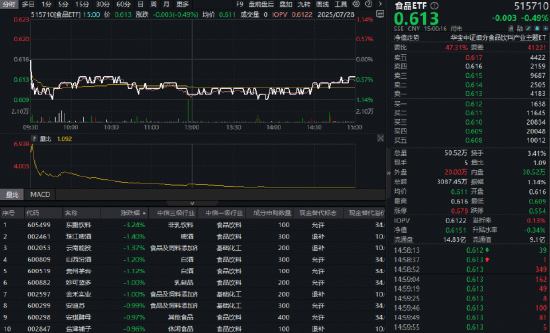
Group 1 - The food and beverage sector continues to experience a pullback, with the Food ETF (515710) showing a decline of 0.49% as of the close on July 28 [1] - Major consumer goods and leading liquor brands have underperformed, with Dongpeng Beverage down 3.24% and several other liquor stocks, including Shanxi Fenjiu and Kweichow Moutai, also declining over 1% [1][3] - Despite recent declines, many institutions remain optimistic about the liquor sector, citing factors such as policy corrections and improved dividend yields as catalysts for recovery [3][5] Group 2 - The current valuation of the food and beverage sector is considered attractive, with the Food ETF's underlying index PE ratio at 20.37, which is at a low point historically [4] - The liquor industry is expected to see a gradual improvement in fundamentals, with analysts suggesting that the policy bottom has been reached and that there are opportunities for valuation recovery [5][6] - Recommendations include focusing on high-quality leading companies with stable performance and attractive dividend yields, particularly in the liquor segment [6] Group 3 - The Food ETF (515710) tracks the CSI segmented food and beverage industry index, with approximately 60% of its holdings in leading high-end and mid-range liquor stocks [6] - The ETF also includes significant allocations to beverage, dairy, and seasoning sectors, with top-weighted stocks including Moutai, Wuliangye, and Yili [6]


光大证券食品饮料行业周报:白酒已处于深度价值区间,大众品积极变革-20250728
EBSCN· 2025-07-28 11:17
Investment Rating - The report maintains a "Buy" rating for the food and beverage industry [5]. Core Viewpoints - The liquor sector is currently in a deep value zone, with the CITIC liquor index showing a rebound and a dividend yield of 3.72% as of July 25, 2025, indicating strong profitability and willingness to distribute dividends [1][13]. - The restaurant supply chain is undergoing active transformation, with companies like Weizhi Xiang expanding their product categories and enhancing their sales channels, particularly in lower-tier cities [2][14]. - The snack food sector is focusing on steady growth in store openings and exploring new product categories, with companies like Wancheng Group adapting to market demands [3][15]. Summary by Sections Liquor Industry - The CITIC liquor index has seen a rebound, with a dividend yield of 3.72% as of July 25, 2025, placing it in a deep value zone [1][13]. - The cumulative net profit for the liquor sector is projected to reach 166.6 billion yuan in 2024, with a dividend payout ratio of 71% [1][13]. - The proportion of actively managed equity public funds holding liquor stocks has decreased to 5.1%, indicating significant clearing of positions [1][13]. - The market price of Moutai has dropped over 10% since the announcement of austerity measures, impacting confidence in the market [1][13]. Restaurant Supply Chain - Weizhi Xiang is actively transforming its channels, expanding product categories, and enhancing its online presence to boost sales [2][14]. - The company is also focusing on expanding into lower-tier cities and encouraging franchisees to open multiple stores [2][14]. - The B-end group meal channel has shown significant growth, with expectations for further expansion [2][14]. Snack Food Sector - Wancheng Group is maintaining a steady pace of store openings, with an increase in customer traffic despite a slight decline in average transaction value [3][15]. - The company is transitioning from rapid expansion to improving operational efficiency and brand building [3][15]. - New product categories are being explored, including collaborations with local suppliers for baked goods [3][15]. Investment Recommendations - The report suggests maintaining positions in dairy and snack sectors, recommending companies like Yili and Yanjinpuzi for core holdings [4][43]. - It also advises flexible trading in underperforming sectors with potential for recovery, such as Lihai Food and New Dairy [4][43]. - For the liquor sector, it recommends focusing on companies with better competitive positioning, such as Kweichow Moutai and Wuliangye [4][43].


食品饮料行业专题研究:25Q2基金持仓分析:板块持仓回落,白酒超配收窄
East Money Securities· 2025-07-28 10:57
Investment Rating - The report maintains an investment rating of "stronger than the market" for the industry, indicating an expected performance that exceeds the benchmark index by more than 10% [2][42]. Core Viewpoints - The report highlights that the darkest period for the liquor sector has passed, and the sector is entering a configuration phase. Supply-side rationality is improving, and market expectations are low, with institutional holdings being relatively low, suggesting a gradual recovery [9][38]. - The food and beverage sector is experiencing a decline in institutional holdings, particularly in the liquor segment, where the overweight position has narrowed. The overall allocation for the food and beverage sector in Q2 2025 is 9.35%, down 1.96 percentage points from Q1 2025 [6][14]. - The report suggests focusing on specific companies within the liquor sector, including Moutai, Wuliangye, and others, as well as opportunities in the beer and soft drink segments due to recovering demand and seasonal consumption peaks [9][38]. Summary by Sections 1. Institutional Holdings in Food and Beverage - The allocation for the food and beverage sector has decreased, with a notable decline in liquor holdings, which fell by 1.90 percentage points in Q2 2025. The market capitalization of liquor stocks accounts for 3.74% of the A-share market, with an overweight position of 4.27% [6][14][15]. - The report indicates a mixed performance in the consumer goods sector, with slight increases in snack and soft drink allocations [14][19]. 2. Heavyweight Liquor Stocks - Only two liquor stocks are among the top 20 holdings by funds, namely Moutai and Wuliangye, with Wuliangye dropping to the 20th position. Moutai's holding ratio in Q2 2025 is 1.85%, down 0.47 percentage points [25][26]. - The report notes a significant decrease in the number of funds holding major liquor stocks, indicating a trend of reduced interest among institutional investors [30][31]. 3. Individual Stock Analysis - The report identifies a decline in the number of funds holding high-end liquor stocks, with Moutai and Wuliangye seeing substantial reductions in both the number of funds and the quantity held [30][31]. - In the beer segment, Yanjing Beer has seen a significant increase in fund holdings, while Qingdao Beer has experienced a decrease [31][32]. 4. Investment Recommendations - The report recommends focusing on liquor stocks that are entering a configuration phase, such as Moutai, Wuliangye, and others. It also suggests monitoring the beer sector for companies with strong fundamentals [9][38]. - For consumer goods, the report emphasizes the growth potential in the snack segment and suggests companies that are expanding their product lines and channels [39].


伊利股份(600887) - 内蒙古伊利实业集团股份有限公司关于为控股子公司提供担保的进展公告
2025-07-28 09:45
证券代码:600887 证券简称:伊利股份 公告编号:临 2025-058 内蒙古伊利实业集团股份有限公司 关于为控股子公司提供担保的进展公告 本公告中担保金额折算汇率以 2025 年 7 月 25 日的汇率中间价计 算:1 欧元对人民币 8.4001 元 本公司董事会及全体董事保证本公告内容不存在任何虚假记载、误导性陈述或 者重大遗漏,并对其内容的真实性、准确性和完整性承担法律责任。 一、担保情况概述 (一)担保的基本情况 | 担保对象一 | 被担保人名称 | | | 澳优乳业股份有限公司(简称"澳优乳业") | | --- | --- | --- | --- | --- | | | 本次担保授信金额 | 不超过 | 0.40 | 亿港元或等值其他货币 | | | 实际为其提供的担保余额 | 0.90 | 亿元人民币 | | | | 是否在前期预计额度内 | √是 | □否 | □不适用:________ | | | 本次担保是否有反担保 | □是 | √否 | □不适用:________ | | 担保对象二 | 被担保人名称 | Ausnutria | B.V. | | | | 本次担保授信金额 | 不超 ...
中证中国内地企业全球主要消费综合指数报8671.19点,前十大权重包含农夫山泉等
Jin Rong Jie· 2025-07-28 09:36
金融界7月28日消息,上证指数高开震荡,中证中国内地企业全球主要消费综合指数(CN消费综合, H30379)报8671.19点。 从指数持仓来看,中证中国内地企业全球主要消费综合指数十大权重分别为:贵州茅台(26.08%)、 五粮液(6.78%)、伊利股份(4.97%)、牧原股份(3.67%)、温氏股份(2.71%)、泸州老窖 (2.63%)、山西汾酒(2.59%)、农夫山泉(2.29%)、海天味业(1.85%)、东鹏饮料(1.69%)。 从中证中国内地企业全球主要消费综合指数持仓的市场板块来看,上海证券交易所占比53.35%、深圳 证券交易所占比35.01%、香港证券交易所占比11.16%、北京证券交易所占比0.31%、纽约证券交易所占 比0.14%、纳斯达克证券交易所(Consolidated Capital Market)占比0.01%、纳斯达克全球精选市场证券交 易所(Consolidated Issue)占比0.00%、纳斯达克股票市场证券交易所(Consolidated Large Cap)占比0.00%。 从中证中国内地企业全球主要消费综合指数持仓样本的行业来看,酒占比48.53%、食品占比20 ...


联想与伊利共创制造业AI生态圈
Zheng Quan Ri Bao Wang· 2025-07-28 06:42
Core Insights - The core viewpoint of the articles emphasizes the transformation of China's manufacturing industry through AI, particularly illustrated by the collaboration between Yili and Lenovo, which aims to create a new architecture for AI integration in manufacturing [1][2][4] Group 1: AI Transformation in Manufacturing - Traditional manufacturing faces challenges in integrating advanced technologies while ensuring data security and business continuity, leading to the development of a hybrid AI architecture [2] - Yili's proactive approach in digital transformation includes smart manufacturing, supply chain optimization, and comprehensive marketing, supported by Lenovo's hybrid AI capabilities [2][3] - The collaboration has resulted in the creation of over 600 algorithm models, reshaping the entire production chain from farm management to consumer services [2][3] Group 2: Breakthroughs Achieved - Three major breakthroughs were achieved: redefining "human-machine collaboration" to enhance intelligence rather than speed, creating a consumer-centric business model connecting over 60 million consumers, and establishing an intelligent supply chain that significantly reduces transportation costs and improves delivery efficiency [3] - The integration of digital twin technology and MES systems allows real-time visibility of equipment operation, production line status, and energy consumption data, enhancing production control accuracy [3] Group 3: Practical Implications and Global Relevance - Lenovo's global data indicates a nearly 40% year-on-year increase in AI application within organizations, with some companies experiencing a 31% boost in employee efficiency and operational effectiveness [4] - The partnership between Yili and Lenovo exemplifies a unique path for AI transformation in Chinese manufacturing, balancing the adoption of advanced AI technologies with the need for core capabilities to remain autonomous and controllable [4] - This approach not only addresses the immediate needs of Chinese manufacturing but also offers valuable insights for global manufacturing AI transformations by focusing on architectural restructuring rather than mere acceleration [4]
