
YILI(600887)

Search documents
生娃就发钱,两家民企猛砸28亿催生
盐财经· 2025-04-14 09:24
Core Viewpoint - The article discusses the recent initiatives by leading Chinese dairy companies, Yili and Feihe, to launch substantial "fertility subsidies" aimed at supporting families and responding to the country's declining birth rates. Yili announced a 1.6 billion yuan subsidy, while Feihe introduced a 1.2 billion yuan plan, both targeting pregnant families with financial support and health services [3][5][7]. Group 1: Company Initiatives - Yili's fertility subsidy plan, announced on April 10, 2025, offers at least 1,600 yuan per eligible family, along with comprehensive health consultation services from pregnancy to the child's third year [5][11]. - Feihe's plan, which started on April 1, 2025, provides at least 1,500 yuan in the form of vouchers redeemable for milk powder, potentially benefiting up to 800,000 families [9][11]. - The combined subsidies from both companies total 3,100 yuan per family, reflecting a competitive strategy in the dairy market [10][12]. Group 2: Market Context and Competition - The initiatives are seen as a response to the government's push for increased birth rates, with the recent government work report emphasizing the need for fertility support policies [11][12]. - Both companies aim to enhance their brand image and consumer loyalty by addressing societal needs, with Feihe and Yili competing closely in the infant formula market [12][13]. - The competition is intensified by the fact that Feihe has established a strong position in the high-end infant formula segment, while Yili maintains a comprehensive industry chain advantage [13][16]. Group 3: Financial Performance - Yili reported a total revenue of approximately 29 billion yuan for the current reporting period, with a net profit of about 3.34 billion yuan, marking an 8.53% increase year-on-year [15][20]. - Feihe's total revenue reached approximately 20.75 billion yuan, reflecting a 6.2% increase compared to the previous year, with a significant portion derived from infant formula sales [17][18]. - Yili's infant formula segment has shown strong growth, with a revenue of 21.33 billion yuan in the first three quarters of 2024, a 7.07% increase year-on-year [16][20]. Group 4: Industry Trends - The article highlights a shift in consumer preferences towards high-end infant formula, with increasing willingness to pay for premium products, driven by a focus on quality and nutritional value [22][23]. - The implementation of new national standards for infant formula in 2023 has led to improved nutritional formulations, further enhancing consumer trust in domestic brands [25][29]. - The overall dairy market is facing challenges, including a decline in imports and a need for local brands to enhance product development to meet consumer demands [27][29].



中证800价值指数上涨0.45%,前十大权重包含美的集团等
Jin Rong Jie· 2025-04-14 08:30
Group 1 - The core viewpoint of the news is that the CSI 800 Value Index has shown a slight increase of 0.45% to 5841.17 points, despite a decline of 3.19% over the past month and 5.49% year-to-date [1] - The CSI 800 Value Index is part of a style index series that includes both growth and value factors, providing diversified investment opportunities for investors [1] - The index is based on the CSI 800 Index, which was established on December 31, 2004, with a base point of 1000.0 [1] Group 2 - The top ten holdings of the CSI 800 Value Index include China Ping An (5.44%), China Merchants Bank (5.27%), and Midea Group (3.53%) [2] - The market composition of the CSI 800 Value Index shows that 75.03% of the holdings are from the Shanghai Stock Exchange, while 24.97% are from the Shenzhen Stock Exchange [2] - The industry breakdown of the CSI 800 Value Index indicates that financials account for 43.36%, followed by industrials at 13.54% and materials at 8.99% [2] Group 3 - The index samples are adjusted biannually, with adjustments occurring on the next trading day after the second Friday of June and December [3] - The adjustment process allows for a maximum change of 30% in sample composition, with priority given to new samples ranked within the top 175 and existing samples ranked within the top 325 [3] - Public funds tracking the CSI 800 Value Index include Huatai-PB CSI 800 Value Link A, Huatai-PB CSI 800 Value Link C, and Huatai-PB CSI 800 Value ETF [3]




食品饮料行业报告:关注内需,建议积极布局(附重点标的一季度预测)
China Post Securities· 2025-04-14 03:23
Industry Investment Rating - The investment rating for the food and beverage industry is "Outperform the Market" and is maintained [1] Core Viewpoints - The report emphasizes the focus on domestic demand due to tariff events, with food and beverage companies primarily targeting the domestic market, leading to better stock performance. It outlines four main investment themes centered on domestic circulation, highlighting short-term catalysts for stock prices, medium to long-term growth prospects, and high dividend yield assets [3][4][19] Summary by Relevant Sections Industry Overview - The closing index for the food and beverage sector is 18005.21, with a 52-week high of 20128.95 and a low of 14118.56 [1] Investment Highlights - Short-term catalysts include the gradual digestion of pressure from snack quarterly reports and the arrival of buying opportunities, with beer entering its peak season and cost improvements continuing. Companies like Dongpeng Beverage and Chengde Lulux are highlighted for their strong performance and attractive valuations [3] - Medium to long-term prospects are positive for companies like Angel Yeast, which is expected to benefit from strong overseas demand and cost improvements, and dairy companies like Yili and New Dairy, which are anticipated to recover profitability due to improved milk prices and demand from birth subsidy policies [3] - High dividend yield assets include brands like Master Kong (5.73%), Uni-President (5.56%), and Chengde Lulux (4.92%) [3] Weekly Performance Review - The food and beverage sector performed well, with the industry index showing a weekly increase of +0.20%, ranking 4th among 30 sectors, outperforming the CSI 300 index by 3.07%. The current dynamic PE ratio is 22.15, which is considered low historically [7][32] Company-Specific Forecasts - Guizhou Moutai is expected to see a revenue growth of 7% and a net profit growth of 8% in Q1 2025, with a focus on maintaining price stability [20] - Yili's revenue is projected to remain flat with a significant drop in net profit due to previous asset transfers, while New Dairy is expected to see a profit increase of 18-20% [22][30] - Dongpeng Beverage is forecasted to achieve a revenue growth of 30% and a net profit growth of 36% in Q1 2025, driven by strong demand for its products [23][30] Market Trends - The report notes a trend towards rational growth in the liquor sector, with major brands like Moutai and Wuliangye maintaining competitive valuations and dividend yields, indicating resilience and risk management capabilities [19][30]





伊利、农夫山泉、统一们11年财报拆解:存量市场时代,增长该从哪里"抢"?
3 6 Ke· 2025-04-14 02:25
Core Viewpoint - The financial reports of major food and beverage companies in China for 2024 show modest revenue growth, indicating a competitive landscape where established players are adapting to market changes and consumer preferences [1][4][9]. Group 1: Revenue Performance - Unified Enterprises China reported total revenue of 30.332 billion yuan, a year-on-year increase of 6.1% [1]. - Nongfu Spring's total revenue reached 42.896 billion yuan, growing by 0.5% year-on-year [1]. - Master Kong's revenue was 80.651 billion yuan, with a growth of 0.3% [1]. - China Foods reported 41.492 billion yuan in revenue, up 0.21% year-on-year [1]. - Haitian Flavoring's revenue was 26.901 billion yuan, reflecting a 9.53% increase [1]. - The revenue growth of these companies translates to significant absolute increases, with Unified Enterprises China adding 1.741 billion yuan, Master Kong adding 233 million yuan, and Nongfu Spring adding 229 million yuan compared to 2023 [1]. Group 2: Business Adaptation - Nongfu Spring experienced a 21.3% decline in its core bottled water segment, which dropped from 47.5% to 37.2% of total revenue, while its tea beverage segment grew by 32.3%, increasing its share from 29.7% to 39% [3][4]. - The shift in revenue sources illustrates how companies like Nongfu Spring are adapting to market fluctuations by reallocating resources to more profitable segments [3][4]. Group 3: Industry Trends - Companies with annual revenues exceeding 20 billion yuan are increasingly diversifying their business lines to maintain growth and fend off competition [4][5]. - The average revenue of companies in this category is significant, with the 500th ranked company on the China Private Enterprises 500 list having a revenue of 26.3 billion yuan [5]. - The historical context shows that these companies have evolved over decades, adapting to market changes and consumer demands, which has allowed them to emerge as industry leaders [5][6]. Group 4: Growth Strategies - The transition from "quantity" to "quality" in the consumer market from 2013 to 2024 highlights the need for companies to innovate and adapt to changing consumer preferences [8][9]. - The overall revenue of major food and beverage companies has shown slight fluctuations but maintains a growth trend, indicating resilience in the face of market challenges [9][10]. Group 5: Long-term Growth Metrics - The compound annual growth rate (CAGR) for major companies from 2013 to 2023 shows varied performance, with Nongfu Spring leading at 15.39% and others like Wahaha and China Wangwang showing negative growth [17][19]. - The average CAGR for the 14 companies analyzed is 6.48%, comparable to global top-tier companies during the same period [19][20]. Group 6: Market Expansion - Companies are increasingly looking to international markets for growth, with Wan Zhou International's acquisition of Smithfield Foods exemplifying a successful global expansion strategy [63]. - Mengniu's acquisition of the Southeast Asian ice cream brand Aice demonstrates the potential for growth in international markets [64].




2025年食品饮料行业策略:年胜一年,内外兼修方得大成之道
LIANCHU SECURITIES· 2025-04-14 02:21
Group 1 - The report highlights that in 2024, the total demand in the food and beverage industry is under pressure, with a year-on-year growth of 3.5% in social retail consumption, reflecting a significant slowdown compared to previous years [3][12] - The report anticipates that the food and beverage sector will see steady progress in 2025, supported by three main factors: increased consumer subsidies, potential valuation recovery, and accelerated industry innovation [3][4] - The report emphasizes that the food and beverage industry is expected to benefit from a combination of internal and external factors, leading to a more resilient market outlook [3][36] Group 2 - The report identifies that the performance of the food and beverage sector has been mixed, with essential goods showing resilience while discretionary spending remains volatile [12][30] - It notes that the liquor segment may see a strategic shift, with a focus on demand cultivation as the key to future growth [4][31] - The report suggests that the condiment sector could benefit from the recovery of the restaurant industry and the acceleration of chain operations, leading to increased market concentration [4][31] Group 3 - The report indicates that the dairy sector is poised for growth driven by strong domestic demand and a focus on product upgrades, presenting opportunities for domestic replacements and demand expansion [4][31] - It highlights that the snack food market remains fragmented, with supply chain advantages becoming more pronounced, and emphasizes the importance of revenue growth following scale expansion [4][31] - The beer segment is noted for its stable production but faces pressure on sales volume and pricing, with a focus on innovation and structural upgrades [4][31] Group 4 - The report discusses the overall market performance, indicating that the food and beverage sector experienced a cumulative decline of 8% in 2024, ranking it among the lowest in the industry [23][30] - It mentions that the food and beverage sector's revenue growth has been primarily driven by supply-side optimization, with demand remaining weak [30][31] - The report provides insights into the performance of various sub-sectors, with soft drinks and snacks showing double-digit growth, while liquor and processed foods faced declines [30][31]




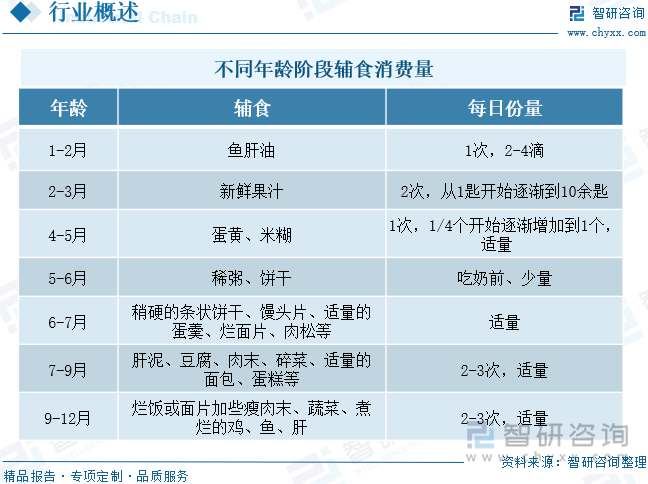
研判2025!中国婴幼儿营养品行业发展背景、产业链、产量、市场规模及竞争格局分析:国民消费力不断提高,刺激婴幼儿营养品需求增长[图]
Chan Ye Xin Xi Wang· 2025-04-14 01:26
Core Insights - The demand for infant nutrition products in China has significantly changed, with consumers increasingly prioritizing safety, scientific formulation, and functionality, leading to a willingness to pay higher prices for quality products [1][20] - The market size of China's infant nutrition industry has grown from 86.7 billion yuan in 2015 to 156.78 billion yuan in 2023, with a compound annual growth rate (CAGR) of 7.69%, and is projected to reach approximately 168.83 billion yuan in 2024 [1][20] - The industry is expected to focus more on technological innovation and research and development to enhance product nutritional value and safety in response to diverse and personalized consumer demands [1][20] Industry Overview - The infant nutrition industry caters to infants aged 0-3 years, providing essential nutritional supplements and complementary foods tailored to their developmental stages [3] - The industry has evolved through four stages, from a weak foundation post-1949 to a robust market with over 700 manufacturers and a complete product system by the 1990s [9] Market Dynamics - In 2024, China's birth population is projected to be 9.54 million, marking the first year-on-year increase in eight years, which presents new opportunities for the infant nutrition market [6] - The average per capita consumption expenditure for residents in 2024 is expected to be 28,227 yuan, with food and beverage spending accounting for 29.8% of this amount [6] Production and Supply Chain - The infant nutrition product supply chain is structured as an "inverted pyramid," with a wide range of upstream raw materials, including fruits, vegetables, fresh milk, and grains, leading to the production and manufacturing of infant nutrition products [11] - The production of infant nutrition products in China is projected to reach approximately 1.77 million tons in 2024, with infant formula accounting for about 1.563 million tons and complementary foods for about 207,000 tons [16] Competitive Landscape - The market features a diverse and segmented competitive landscape, with both international brands like Wyeth and Mead Johnson and domestic brands like Feihe and Yili competing vigorously [22] - Companies are increasing R&D investments to launch new products that meet the growing demand for high-end, specialized infant nutrition products [22] Future Trends - The industry is expected to emphasize product diversification and refinement, targeting specific age groups and dietary needs with scientifically formulated nutrition products [29] - Technological innovation and R&D capabilities will be crucial competitive factors, with companies collaborating with research institutions to drive advancements [30] - The integration of online and offline sales channels will be a significant trend, enhancing consumer shopping experiences and satisfaction [32] - Brand building and market competition will be vital, with companies focusing on increasing brand awareness and market share through effective marketing strategies [33]

招商证券:内需有望发力 重申食品饮料板块配置价值
Zhi Tong Cai Jing· 2025-04-13 23:33
五粮液:五粮液计划6个月内增持5-10亿元。集团公司计划自公告之日起6个月内通过深圳证券交易所交 易系统增持公司股票,拟增持金额不低于5亿元,不超过10亿元。截至公告日,五粮液集团公司持有公 司股份7.95亿股,占公司总股本的20.49%。在本次公告前的12个月内,五粮液集团公司累计增持公司股 份340.67万股,占公司总股本的0.09%,增持金额为人民币5亿元。 投资建议 招商证券发布研报称,本周受贸易摩擦影响板块震荡。从Q1情况来看,高端白酒需求相对稳定,次高 端酒企表现分化,整体边际改善。食品板块需求企稳,调味品、乳制品、啤酒等板块轻装上阵全年业绩 改善确定性更高,而零食、饮料赛道仍然延续高景气。当前茅台、五粮液(000858)纷纷出台回购方 案,龙头底线价值清晰,白酒位置进可攻退可守,食品把握趋势向上及高景气赛道。内需有望发力背景 下,该行重申板块配置价值。 招商证券主要观点如下: 核心公司跟踪:重啤维持高位分红,中炬全年稳健收官 重庆啤酒(600132):分红维持高位,结构表现依旧承压。公司24年高档酒结构表现仍然承压,带动吨 价同比下滑,税收政策及诉讼费用影响盈利,收入/归母净利润同比-1.2%/ ...


场景牵引轻工业数字化转型
Jing Ji Ri Bao· 2025-04-13 21:53
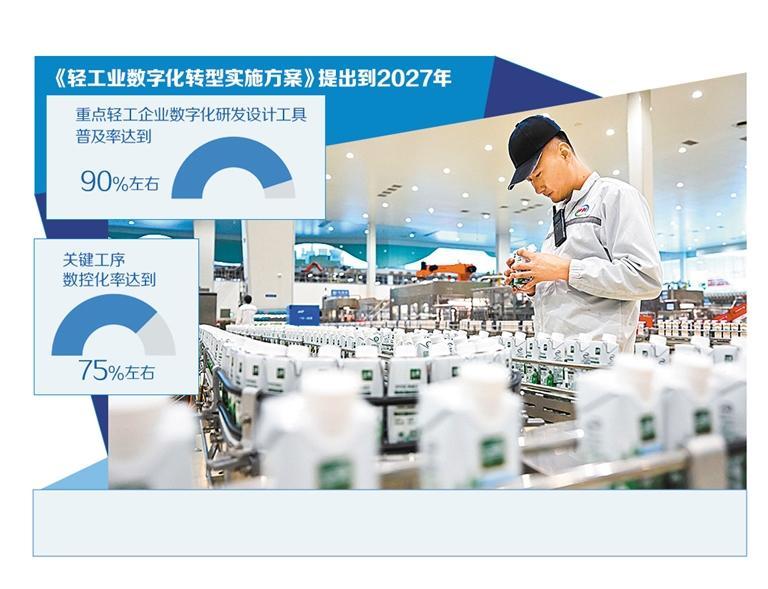
Core Viewpoint - The implementation plan for the digital transformation of the light industry aims to enhance digital capabilities, with specific targets set for 2027, including a 90% penetration rate of digital R&D design tools and a 75% CNC rate for key processes [2][7]. Group 1: Digital Transformation Goals - By 2027, the plan targets a 90% adoption rate of digital R&D design tools and a 75% CNC rate for key processes in major light industry enterprises [2]. - The initiative aims to cultivate around 60 benchmark enterprises and develop approximately 50 national and industry standards [2][4]. - The plan emphasizes the importance of digital technology innovation and talent development to support the transformation [2][4]. Group 2: Role of Artificial Intelligence - Artificial intelligence (AI) is identified as a key driver for the digital transformation of the light industry, enhancing product design capabilities and supply chain management [3][4]. - Companies like Yili Group are collaborating with Lenovo to implement AI-driven solutions, achieving a 100% accuracy rate in data transmission [3]. - The integration of AI is expected to lead to new interaction models, higher automation levels, and improved decision-making capabilities [3][4]. Group 3: Implementation Strategies - The plan focuses on cultivating digital transformation scenarios, with an emphasis on collaborative design, intelligent production, and preventive maintenance [4][5]. - It encourages the development of data models and application testing in key sectors such as home appliances and furniture [4][5]. - A list of typical scenarios for digital transformation is provided, including digital R&D design and flexible manufacturing [5]. Group 4: Industry Trends and Innovations - The light industry is experiencing a shift towards service-oriented manufacturing, driven by consumer demand for customization and scenario-based solutions [7]. - New market segments such as pre-prepared foods and smart home products are emerging, necessitating advancements in flexible design and traceability [7]. - The plan aims for widespread digital transformation by 2030, with a focus on creating a digital ecosystem characterized by intelligence, connectivity, and sustainability [7][8]. Group 5: Quality and Safety Enhancements - The China Light Industry Federation is promoting quality management through digital technologies, aiming to enhance product quality and market trust [8]. - The plan includes initiatives for lifecycle traceability and the promotion of benchmark cases for digital transformation [8][9]. - Emphasis is placed on integrating advanced technology and ensuring product safety throughout the supply chain [9].
上证红利潜力指数下跌0.12%,前十大权重包含福耀玻璃等
Jin Rong Jie· 2025-04-11 16:15
Core Viewpoint - The Shanghai Dividend Potential Index (H50020) experienced a slight decline of 0.12%, closing at 6806.28 points, with a trading volume of 35.597 billion yuan, reflecting the overall performance of companies with strong dividend expectations and capabilities [1] Group 1: Index Performance - The Shanghai Dividend Potential Index has increased by 0.47% over the past month and by 2.45% over the past three months, but has decreased by 2.73% year-to-date [1] - The index is based on a comprehensive ranking of securities using indicators such as EPS, undistributed profits per share, and ROE, selecting the top 50 securities to represent the index [1] Group 2: Index Holdings - The top ten weighted stocks in the index are: China Merchants Bank (16.94%), Kweichow Moutai (15.89%), Ping An Insurance (13.85%), Yangtze Power (8.97%), Yili Group (6.89%), China Shenhua Energy (5.92%), Shaanxi Coal and Chemical Industry (3.54%), Wanhua Chemical (2.54%), Anhui Conch Cement (2.04%), and Fuyao Glass (2.0%) [1] - The index's holdings are entirely composed of stocks listed on the Shanghai Stock Exchange, with a 100% representation [1] Group 3: Industry Composition - The industry composition of the index holdings includes: Financials (30.78%), Consumer Staples (29.53%), Energy (13.85%), Utilities (8.97%), Consumer Discretionary (6.53%), Materials (6.01%), Healthcare (1.63%), Information Technology (1.49%), Industrials (0.58%), Communication Services (0.32%), and Real Estate (0.30%) [2] Group 4: Sample Adjustment Criteria - The index samples are adjusted annually, with the next adjustment occurring on the trading day following the second Friday of December [3] - Samples that do not meet the following criteria are removed: (1) Cash dividends distributed in the past year must be at least 30% of the net profit attributable to shareholders; (2) Average total market capitalization must rank within the top 90% of the Shanghai 180 Index; (3) Average trading volume must also rank within the top 90% of the Shanghai 180 Index [3] - The adjustment typically does not exceed 20% unless more than 20% of the original samples are disqualified based on the dividend criteria [3]


沪深300食品饮料指数报24673.68点,前十大权重包含古井贡酒等
Jin Rong Jie· 2025-04-11 08:02
Core Viewpoint - The Shanghai Composite Index opened lower but rose throughout the day, with the CSI 300 Food and Beverage Index reported at 24,673.68 points [1] Group 1: Index Performance - The CSI 300 Food and Beverage Index has increased by 2.84% over the past month, 7.60% over the past three months, and 1.18% year-to-date [2] - The index is designed to reflect the overall performance of different industry companies within the CSI 300, categorized into 11 primary industries, 35 secondary industries, over 90 tertiary industries, and more than 200 quaternary industries [2] Group 2: Index Composition - The top ten weights in the CSI 300 Food and Beverage Index are: Kweichow Moutai (50.1%), Wuliangye (13.31%), Yili (9.73%), Shanxi Fenjiu (5.58%), Luzhou Laojiao (5.03%), Haitian Flavoring (3.63%), Dongpeng Beverage (2.75%), Yanghe (2.34%), Jinshiyuan (2.07%), and Gujing Gongjiu (1.51%) [2] - The market share of the CSI 300 Food and Beverage Index is composed of 75.32% from the Shanghai Stock Exchange and 24.68% from the Shenzhen Stock Exchange [2] Group 3: Industry Breakdown - The industry composition of the CSI 300 Food and Beverage Index includes: Baijiu (79.94%), Dairy Products (9.73%), Condiments and Cooking Oils (4.63%), Soft Drinks (2.75%), Beer (1.47%), and Meat Products (1.47%) [3] - The index samples are adjusted biannually, with adjustments occurring on the next trading day after the second Friday of June and December each year [3] - Weight factors are generally fixed until the next scheduled adjustment, with temporary adjustments made in response to changes in the CSI 300 Index samples [3]
