SERES(601127)

Search documents
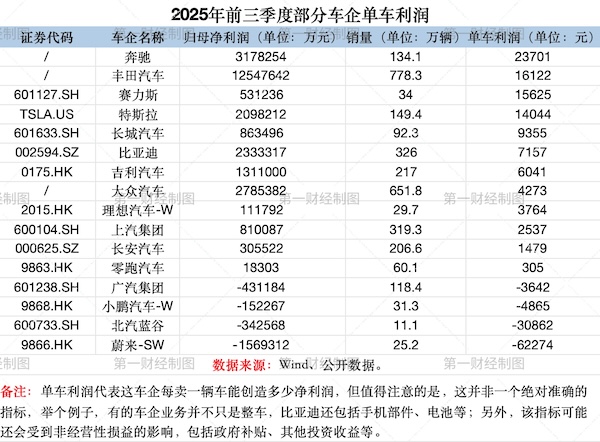
蔚来每卖一辆车亏超6万,奔驰赚2.3万
Di Yi Cai Jing· 2025-11-28 12:00
Core Insights - The profitability of major automotive companies is a focal point, particularly the per-vehicle profit, with luxury brands like Mercedes-Benz and Toyota leading the rankings [1][2] - The data indicates a shift in the narrative around electric vehicles, with companies like Seres and Tesla showing significant per-vehicle profits, challenging the notion that electric vehicles are unprofitable [1] Group 1: Profitability Rankings - Mercedes-Benz has the highest per-vehicle profit at approximately 24,000 yuan, followed by Toyota at 16,000 yuan, and Seres, a Chinese brand, at over 15,000 yuan, surpassing Tesla's profit of 14,000 yuan [1] - Among the 16 companies analyzed, only four have a per-vehicle profit exceeding 10,000 yuan, representing 25% of the sample [1] Group 2: Performance of Domestic and Foreign Brands - The "Big Three" private Chinese automakers, Great Wall, BYD, and Geely, have per-vehicle profits of 9,355 yuan, 7,157 yuan, and 6,041 yuan, respectively [2] - Xiaomi's automotive division reported a third-quarter operating profit of 700 million yuan with a delivery volume of 108,000 vehicles, showing significant improvement from a previous loss of 60,000 yuan per vehicle [2] Group 3: Challenges Faced by Multinational Companies - Volkswagen's net profit dropped by 61.5% year-on-year to 3.4 billion euros, with per-vehicle profit falling to around 4,000 euros due to various challenges including tariffs and restructuring [2] - Mercedes-Benz's net profit for the first three quarters was 3.878 billion euros, down from 7.806 billion euros the previous year, with a per-vehicle profit decline from 44,000 yuan to 24,000 yuan [2] Group 4: Losses in Certain Companies - NIO reported a cumulative loss of nearly 15.7 billion yuan in the first three quarters, with a per-vehicle loss exceeding 60,000 yuan, although there is an improvement trend compared to the previous year [3] - BAIC Blue Valley incurred a cumulative loss of over 3.4 billion yuan, with a per-vehicle loss exceeding 30,000 yuan, also showing signs of improvement [3]






赛力斯张正萍:正全力推进“人工智能+”产业化落地
Nan Fang Du Shi Bao· 2025-11-28 10:00
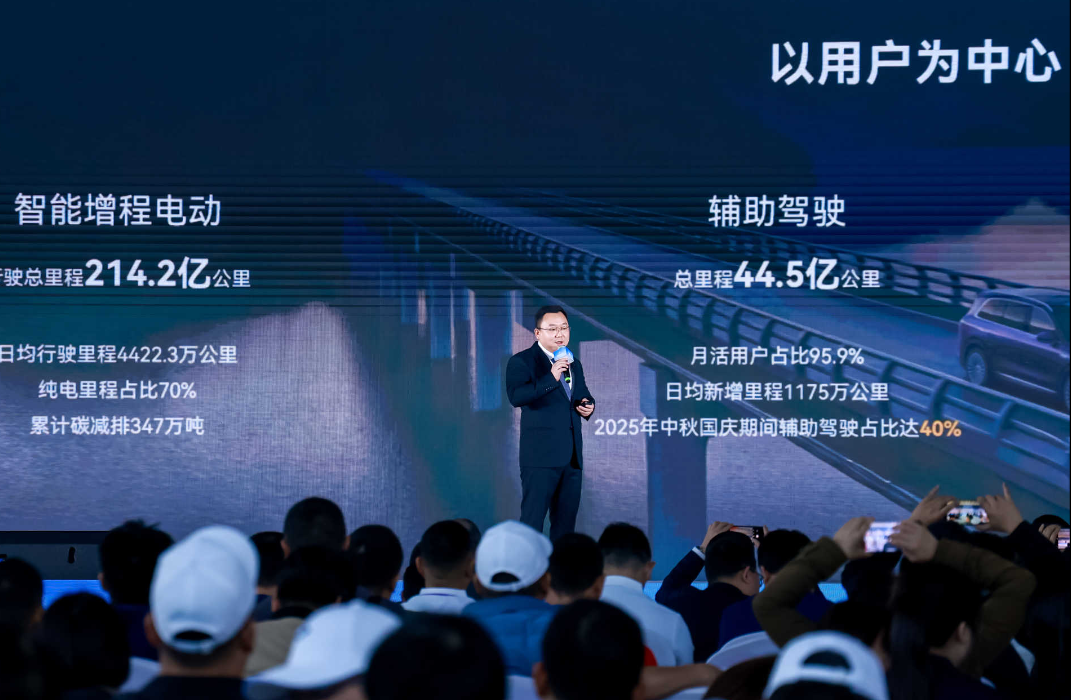
Group 1 - The core viewpoint of the articles highlights the strategic initiatives of the company in building a world-class high-end industrial chain for new energy vehicles, emphasizing deep collaboration with industry partners and efficient synergy mechanisms [1][3] - The company is focusing on product integration, intelligent manufacturing, and industrial clustering to enhance the overall competitiveness of China's automotive industry in the global market [1] - The company has reported significant growth in its new energy vehicle sales, with October sales reaching 51,500 units, a year-on-year increase of 42.89%, and cumulative sales for the first ten months totaling 356,000 units [3] Group 2 - The company has positioned "intelligence" as a key brand label, with its assisted driving feature having safeguarded over 4.45 billion kilometers for users, particularly during peak travel periods [3] - The company is committed to advancing the industrialization of "Artificial Intelligence +" technologies, aiming to transform its products into emotional, intelligent, and reliable "mobile intelligent entities" [3] - For the first three quarters of the year, the company reported revenue of 110.5 billion yuan, a year-on-year increase of 3.67%, and a net profit attributable to shareholders of 5.312 billion yuan, reflecting a growth of 31.56% [3]
赛力斯张正萍:深化产业链协同 积极推进“人工智能+”产业化落地
Yang Guang Wang· 2025-11-28 09:31
Core Viewpoint - The company, Seres, is focused on building a world-class high-end electric vehicle industry chain through deep collaboration with industry partners and efficient synergy mechanisms [1] Group 1: Strategic Initiatives - Seres is actively promoting product integration, intelligent manufacturing clustering, and industrial agglomeration to enhance the overall competitiveness of China's automotive industry in the global market [1] - The company aims to anchor its strategy in the high-end smart electric vehicle sector and deepen strategic cooperation with industry partners to drive high-quality development in the new energy vehicle industry [1] Group 2: Technological Advancements - "Intelligentization" has become a key brand label for the company, with the assisted driving feature deeply integrated into users' daily travel scenarios [1] - As of now, the assisted driving feature has safeguarded users for over 4.45 billion kilometers, with a significant 40% of the driving distance during the recent Mid-Autumn and National Day holidays attributed to this feature [1] Group 3: AI Integration - The company is fully committed to advancing the industrialization of "Artificial Intelligence+" to transform products into emotional, intelligent, and trustworthy "mobile intelligent entities," accelerating the transition of the automotive industry from electrification to intelligentization [1]
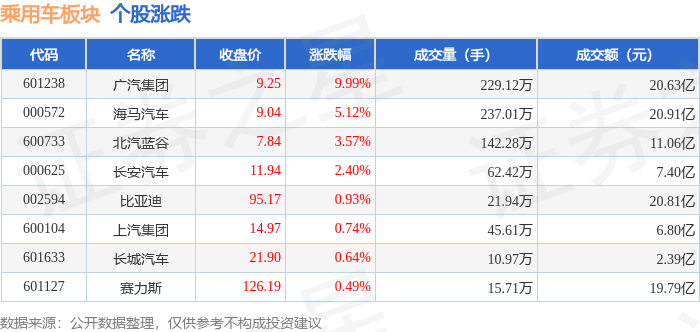
乘用车板块11月28日涨1.57%,广汽集团领涨,主力资金净流入11.25亿元
Zheng Xing Xing Ye Ri Bao· 2025-11-28 09:08
Core Points - The passenger car sector experienced a rise of 1.57% on November 28, with GAC Group leading the gains [1] - The Shanghai Composite Index closed at 3888.6, up 0.34%, while the Shenzhen Component Index closed at 12984.08, up 0.85% [1] Passenger Car Sector Summary - GAC Group's stock closed at 9.25, with a significant increase of 9.99%, and a trading volume of 2.29 million shares, amounting to a transaction value of 2.063 billion yuan [1] - Other notable performers included: - BAW Blue Valley, which rose by 3.57% to close at 7.84, with a transaction value of 1.106 billion yuan [1] - Changan Automobile, which increased by 2.40% to close at 11.94, with a transaction value of 740 million yuan [1] - BYD, which saw a modest increase of 0.93% to close at 95.17, with a transaction value of 2.081 billion yuan [1] Fund Flow Analysis - The passenger car sector saw a net inflow of 1.125 billion yuan from main funds, while retail investors experienced a net outflow of 643 million yuan [1] - The overall fund flow indicates a mixed sentiment, with institutional investors showing confidence while retail investors withdrew [1]



问界M9交付破26万持续领跑高端新能源市场 多家券商看好成长潜力
Zhong Zheng Wang· 2025-11-28 07:09
Group 1 - The luxury car market is becoming increasingly competitive, with the Wanjie M9 setting a new delivery record for vehicles priced at 500,000 yuan, highlighting its leadership in the high-end market and attracting significant attention from the capital market [1] - The Wanjie M9, a flagship product co-developed by Seres and Huawei, has surpassed cumulative deliveries of 260,000 units, maintaining its position as the sales champion in the 500,000 yuan luxury car segment [1] - Multiple securities firms, including CITIC Securities, Huachuang Securities, and Guohai Securities, have released reports expressing optimism about Wanjie's product strength and brand power [1] Group 2 - The successful listing of Seres on the Hong Kong Stock Exchange has established an "A+H" dual capital platform, with 30% of the funds raised earmarked for new model development, enhancing the high-end product matrix [2] - The Wanjie M9 has begun its overseas expansion, with the Hong Kong listing providing strong momentum for internationalization, focusing on core markets such as ASEAN and the Middle East [2] - Wanjie aims to consolidate its leading position in the high-end new energy vehicle market through a combination of product strength, brand power, and support from the capital market [2]
比亚迪、广汽、吉利、奇瑞等车企捐款,驰援香港大埔火灾救援
Xin Jing Bao· 2025-11-28 03:09
Group 1 - BYD, Xpeng, and other car manufacturers have donated a total of 4.1 million Hong Kong dollars to support fire rescue efforts in Tai Po, Hong Kong [1] - BYD announced a donation of 10 million Hong Kong dollars, while Xpeng and Seres each donated 5 million Hong Kong dollars [1] - GAC Group pledged 6 million Hong Kong dollars for emergency medical assistance, temporary housing, and post-disaster reconstruction for affected residents [1] Group 2 - Geely Holding Group, in collaboration with the Li Shufu Public Welfare Foundation, donated 10 million Hong Kong dollars for medical aid, emergency housing, and reconstruction efforts [1] - Chery Automobile donated 10 million Hong Kong dollars through the China Red Cross Foundation for urgent rescue efforts in the Tai Po disaster area [1] - The fire in Tai Po occurred on November 26, resulting in significant casualties, with rescue operations ongoing as of November 28 [1]

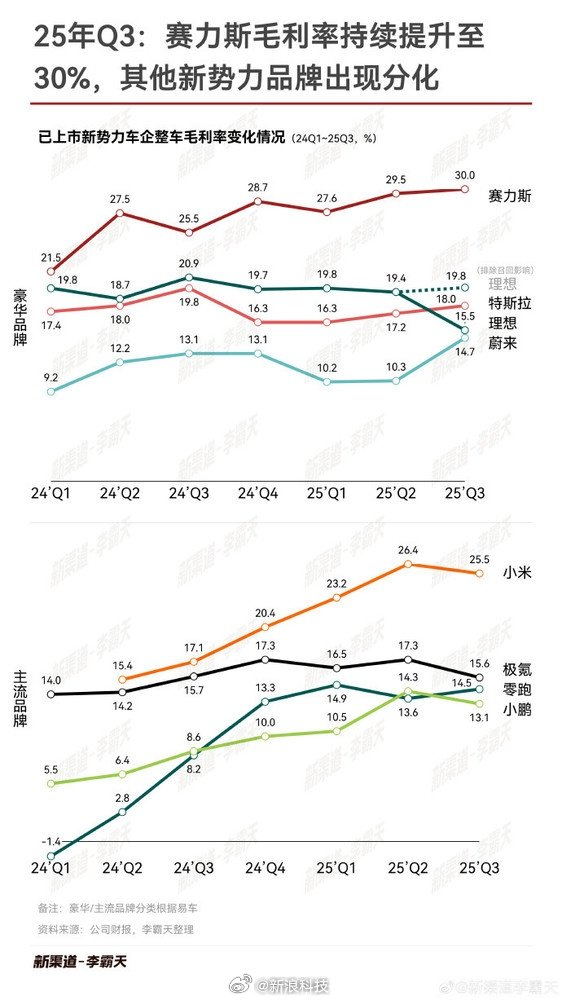
赛力斯问界以30%毛利率领跑中国新能源车企,小米增速显著
Xin Lang Ke Ji· 2025-11-28 02:15
Core Viewpoint - The highest gross margin among Chinese new energy vehicle companies is held by Seres, which has achieved a gross margin of 30% in Q3 2025, driven by the strong sales of its Wanjie model [1][2]. Summary by Category Gross Margin Performance - Seres leads the industry with a gross margin of 30% in Q3 2025, marking a significant increase from 21.5% in Q1 2024 [1][2]. - Xiaomi's gross margin has also seen substantial growth, rising from 15.6% in Q1 2024 to 25.5% in Q3 2025, making it the fastest-growing among mainstream brands [1][2]. - Other new energy vehicle brands show varied performance: - Li Auto at 19.8% - NIO at 14.7% - Xpeng at 13.1% - Zeekr at 15.6% - Leap Motor at 14.5% in Q3 2025 [1][2][3]. - Tesla's gross margin has shown slight fluctuations, recorded at 15.5% in Q3 2025 [1][2]. Industry Dynamics - The current competitive landscape indicates that Xiaomi may pose the only significant challenge to Seres in terms of gross margin [1].


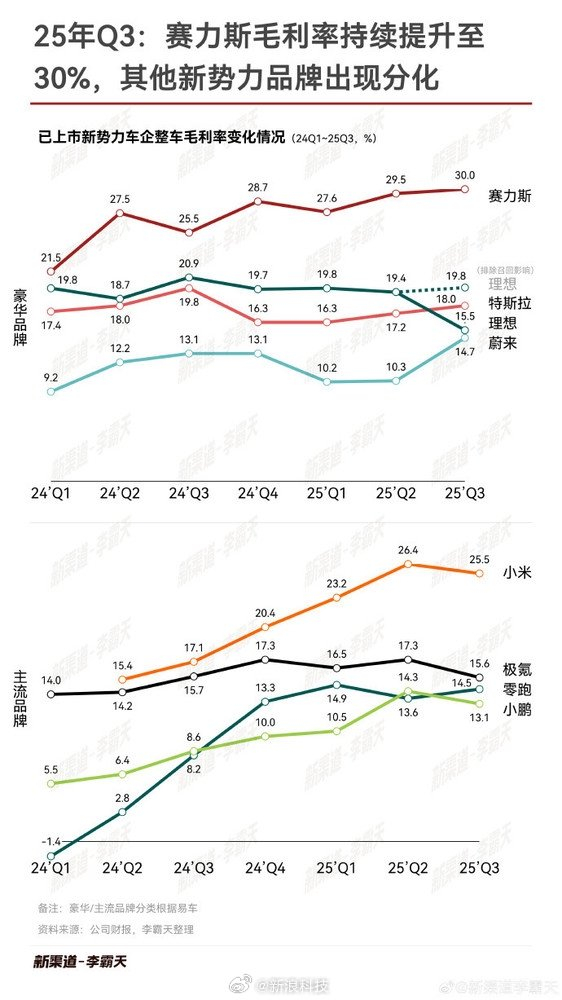
赛力斯毛利率30%领跑新势力,小米增速第一达25.5%
Xin Lang Ke Ji· 2025-11-28 02:15
Core Insights - The article highlights the significant increase in gross margins among Chinese electric vehicle (EV) manufacturers, particularly noting the performance of Seres and Xiaomi [1]. Group 1: Gross Margin Performance - Seres leads the industry with a gross margin of 30% in Q3 2025, marking it as the only brand to surpass the 30% threshold among listed new EV brands [1][2]. - Xiaomi's gross margin has shown remarkable growth, rising from 15.6% in Q1 2024 to 25.5% in Q3 2025, making it the fastest-growing brand in terms of gross margin among mainstream manufacturers [1]. - Other brands such as Li Auto, NIO, and Xpeng have gross margins of 19.8%, 14.7%, and 13.1% respectively, while Zeekr and Leap Motor have also seen gradual increases, reaching 15.6% and 14.5% in Q3 2025 [1][2]. Group 2: Competitive Landscape - Tesla's gross margin has experienced slight fluctuations, standing at 15.5% in Q3 2025, indicating a relatively stable performance compared to the rapid growth of other brands [1]. - The current competitive landscape suggests that Xiaomi may pose a significant challenge to Seres in terms of gross margin performance moving forward [1].
汽车早报|多家车企捐款驰援香港 本田10月全球汽车产量同比下降10.9%
Xin Lang Cai Jing· 2025-11-28 00:42
Group 1: Automotive Industry Overview - The automotive industry in China reported a profit of 38.95 billion yuan from January to October 2025, reflecting a year-on-year increase of 4.4% [1] - During the same period, the production of vehicles reached 27.33 million units, marking an 11% increase year-on-year [1] - The industry's revenue for the first ten months of 2025 was 88.778 billion yuan, up 7.9% compared to the previous year, while costs increased by 8.7% to 78.243 billion yuan [1] Group 2: Company Developments - Avita Technology submitted a listing application to the Hong Kong Stock Exchange, reporting a revenue of 12.208 billion yuan for the first half of 2025, which is a 98.5% increase year-on-year [2] - WM Motor established a new company with a registered capital of 200 million yuan, focusing on the sales of new energy vehicles and related products [3] Group 3: Corporate Donations for Disaster Relief - BYD donated 10 million HKD to support disaster relief efforts in Hong Kong following a major fire [3] - Chery Automobile also contributed 10 million HKD for emergency rescue and post-disaster recovery in Hong Kong [4] - GAC Group donated 6 million HKD for medical assistance and temporary housing for fire victims [5] - XPeng Motors announced a donation of 5 million HKD to aid families affected by the fire [6] - Seres Group contributed 5 million HKD for medical aid and living arrangements for those impacted by the disaster [7] Group 4: Global Automotive Sales Performance - Nissan reported a global sales decline of 4.8% in October 2025, with production down by 3.9% to 276,323 units [8] - Honda's global production in October 2025 decreased by 10.9%, totaling 302,671 units [9]

【深度分析】2025年10月份全国新能源市场深度分析报告
乘联分会· 2025-11-27 08:38
Overall Market - The overall market for passenger vehicles in China includes ICE, BEV, and PHEV, with a total production of 2,949,257 units and retail sales of 2,250,157 units in the first ten months of 2025 [4][6][7]. - The market share of new energy vehicles (NEV) has increased significantly, with NEV accounting for 41.0% of the total market in terms of production and 43.2% in retail sales [7][8]. New Energy Market - The new energy vehicle market has shown robust growth, with a production of 1,652,312 units and retail sales of 1,282,267 units in the first ten months of 2025, reflecting a year-on-year increase of 19.5% in production [4][6][9]. - The penetration rate of NEVs in the overall market reached 52.7% in 2025, indicating a strong trend towards electrification [9][11]. Export Market - The export of new energy vehicles has also seen growth, with a total of 1,865,675 units exported in the first ten months of 2025, marking a 70.5% increase compared to the previous year [14][20]. - The share of NEVs in the export market reached 35.8% in 2025, showcasing the increasing global demand for Chinese electric vehicles [14][16]. Manufacturer Performance - BYD remains the leading manufacturer in the new energy vehicle segment, with wholesale sales of 436,856 units in October 2025, despite a year-on-year decline of 12.7% [20][21]. - Other notable manufacturers include Geely and SAIC-GM-Wuling, with significant increases in their respective sales figures, indicating a competitive landscape in the NEV market [20][21]. Segment Analysis - In the first ten months of 2025, the retail sales of NEVs were dominated by SUVs, followed by sedans and MPVs, reflecting consumer preferences in the market [24][25]. - The overall market for fuel vehicles has seen a decline, with a 9.2% decrease in retail sales, contrasting with the growth in the NEV segment [24][25].