
TKGF(601233)

Search documents
桐昆股份(601233) - 桐昆集团股份有限公司第九届董事会第二十二次会议决议公告
2025-12-29 08:15
股票代码:601233 股票简称:桐昆股份 公告编号:2025-077 桐昆集团股份有限公司 第九届董事会第二十二次会议决议公告 本公司及董事会全体成员保证本公告不存在任何虚假记载、误导性陈述或 重大遗漏,并对其内容的真实性、准确性、完整性承担法律责任。 桐昆集团股份有限公司(以下简称"桐昆股份"或"公司")第 九届董事会第二十二次会议通知于 2025 年 12 月 19 日以书面或电子 邮件、电话等方式发出,会议于 2025 年 12 月 29 日在公司总部会议 室以现场表决和通讯表决相结合的方式召开,会议应到董事十一名, 实到董事十一名。会议由董事长陈蕾女士主持,本次会议的召开符合 《中华人民共和国公司法》《公司章程》及有关法律、法规的规定。 经过有效表决,会议一致通过如下决议: 一、审议并通过《关于注销公司回购专用证券账户股份的议案》。 根据《公司法》《上市公司股份回购规则》《上海证券交易所上 市公司自律监管指引第 7 号—回购股份》等相关规定,公司拟对回购 专用证券账户中的 21,225,873 股股份予以注销,并相应减少公司注 册资本。本议案尚需提交公司股东会审议。 表决结果:赞成 11 票,反对 ...

石油化工行业周报(2025/12/22—2025/12/28):PX供需偏紧景气回暖,PTA供给支撑毛利修复-20251228
Shenwan Hongyuan Securities· 2025-12-28 12:23
Investment Rating - The report provides a "C" investment rating for the petrochemical industry, indicating a cautious outlook for investment opportunities [2]. Core Insights - The PX supply-demand balance is expected to tighten in the first half of 2026, leading to a recovery in market conditions. The operating rate is projected to improve from 78% in 2023 to over 85% [3][11]. - The PTA industry has reached the end of its capital expenditure cycle, with no new capacity expected until mid-2027. The current industry is entering a phase of coordinated production cuts, which may reduce PX demand [11][12]. - The downstream polyester sector is gradually tightening, with expectations for improved market conditions. Recommended companies include Tongkun Co. and Wankai New Materials [16]. Summary by Sections PX Supply and Demand - PX supply-demand is expected to be tight in the first half of 2026, with a significant recovery in market conditions anticipated. The operating rate is projected to rise from 78% in 2023 to over 85% [3][11]. - There are no large-scale new capacity plans in the short term, and maintenance seasons for domestic refineries may create temporary supply gaps [3]. PTA Industry Overview - The PTA industry's capacity increased from 46.08 million tons in 2018 to 86.02 million tons in 2024, with an average annual growth rate of 11%. The current capacity accounts for about 75% of global PTA capacity [11]. - The PTA industry is expected to enter a phase of coordinated production cuts, which may weaken PX demand [11][12]. Investment Recommendations - The report recommends focusing on high-quality companies in the polyester sector, such as Tongkun Co. and Wankai New Materials, as well as large refining companies like Hengli Petrochemical and Rongsheng Petrochemical [16]. - The upstream exploration and development sector remains highly prosperous, with expectations for continued high capital expenditure in offshore services, recommending companies like CNOOC Services and Haiyou Engineering [16].




石油化工行业周报:PX供需偏紧景气回暖,PTA供给支撑毛利修复-20251228
Shenwan Hongyuan Securities· 2025-12-28 11:14
Investment Rating - The report maintains a "Positive" outlook on the petrochemical industry, highlighting a recovery in PX supply-demand dynamics and PTA profitability restoration [3][5]. Core Insights - The PX market is expected to see a tightening supply-demand balance, with a recovery in operating rates from 78% in 2023 to over 85% as downstream PTA production ramps up in 2024-2025. This is anticipated to lead to a significant improvement in market conditions [5][6]. - PTA production capacity in China is projected to increase from 46.08 million tons in 2018 to 86.02 million tons by 2024, accounting for 75% of global capacity. The report indicates that there will be no new capacity additions post-2026, leading to a collaborative reduction phase in the industry [13][19]. - The upstream oil sector is experiencing rising oil prices, with Brent crude futures closing at $60.64 per barrel, reflecting a 0.28% increase week-on-week. This is expected to support the profitability of refining companies [5][26]. - The polyester sector is showing mixed performance, with PTA profitability increasing while polyester filament profits are declining. The report emphasizes the need to monitor demand changes closely [19]. Summary by Sections PX Market - PX supply-demand is tightening, with a forecasted increase in operating rates to over 85% due to no new capacity additions and seasonal maintenance in early 2026 [5][6]. - The report notes that the PX price has risen to $878.87 per ton, a week-on-week increase of 5.61% [19]. PTA Market - PTA production capacity is expected to reach 71.14 million tons in 2024, a 13% year-on-year increase. The report anticipates a collaborative reduction phase starting in 2026 due to no new capacity additions [13][19]. - PTA prices have shifted from a downward trend to an upward trend, with current prices in East China averaging 4,936 RMB per ton, reflecting a 6.94% increase week-on-week [19]. Upstream Oil Sector - Brent crude oil prices have increased, with a weekly average price of $61.91 per barrel, indicating a positive trend for upstream oil companies [5][26]. - The report highlights a decrease in the number of active drilling rigs in the U.S., with 545 rigs reported, a decrease of 44 year-on-year, suggesting a potential impact on future oil supply [41]. Investment Recommendations - The report recommends focusing on high-quality companies in the polyester sector, such as Tongkun Co. and Wankai New Materials, as well as major refining companies like Hengli Petrochemical and Rongsheng Petrochemical due to expected improvements in profitability [19].
大炼化周报:长丝减产与产销放量共振,产业链价格重心上移-20251228
Xinda Securities· 2025-12-28 08:31
Investment Rating - The report does not explicitly state an investment rating for the oil refining industry Core Insights - The domestic key refining project price difference is 2557.23 CNY/ton, with a week-on-week change of +11.87 CNY/ton (+0.47%), while the international key refining project price difference is 1254.57 CNY/ton, with a week-on-week change of -43.45 CNY/ton (-3.35%) [2][3] - Brent crude oil's average price for the week ending December 26, 2025, is 61.73 USD/barrel, reflecting a week-on-week increase of +2.74% [2][3] - The refining sector is affected by geopolitical tensions, particularly regarding Venezuela and Russia, which have led to supply concerns and fluctuations in oil prices [2][15] - The chemical sector is experiencing weak demand, leading to a downward shift in chemical product prices [2][49] - Polyester production has seen a significant increase in sales volume, with downstream demand improving, which has positively impacted upstream prices [2][55] Summary by Sections Refining Sector - The report highlights the impact of geopolitical events on oil prices, with Brent and WTI crude prices at 60.64 and 56.74 USD/barrel respectively, showing slight increases [2][15] - Domestic refined oil prices have slightly decreased, with diesel, gasoline, and aviation kerosene averaging 6566.86, 7622.14, and 5716.07 CNY/ton respectively [2][15] Chemical Sector - The report notes a decline in demand for chemical products, with prices for polyethylene and EVA showing downward trends [2][55] - The average price for LDPE, LLDPE, and HDPE is reported as 9000.00, 6329.29, and 8000.00 CNY/ton respectively, with corresponding price differences from crude oil [2][55] Polyester & Nylon Sector - The polyester sector has seen a significant increase in production and sales, with a notable reduction in inventory levels and a slight increase in prices for polyester filament yarn [2][55] - The report indicates that the nylon filament prices remain stable, with slight improvements in price differences [2][55] Stock Performance - The report provides stock performance data for six major refining companies, with notable increases in stock prices for companies like Hengli Petrochemical (+11.01%) and Rongsheng Petrochemical (+12.12%) over the past week [2]


大炼化周报:PTA供应端发生变化,产品价格上涨-20251228
Soochow Securities· 2025-12-28 05:19
1. Report Industry Investment Rating - No industry investment rating information is provided in the report. 2. Core Viewpoints - The report presents a weekly analysis of the large refining and chemical industry, covering data on key domestic and foreign refining projects, the polyester, refining, and chemical sectors, as well as performance and profit forecasts of relevant listed companies [2]. 3. Summary by Related Catalogs 3.1 Big Refining Weekly Data Briefing - **Stock Price and Market Performance**: The report tracks the stock price changes of six major private refining and chemical companies in the past week, month, three - month, and one - year periods. For example, from 2025/12/26, Rongsheng Petrochemical had a weekly increase of 12.1%, a monthly increase of 16.4%, a three - month increase of 16.9%, and a one - year increase of 21.6% [8]. - **Profit Forecast**: It provides profit forecasts for these six companies from 2024 to 2027, including归母净利润, PE, and PB. For instance, Hengli Petrochemical's 2024A归母净利润 was 7044 million yuan, and it is expected to reach 10657 million yuan in 2027E [8]. - **Oil Prices and Refining Spreads**: International crude oil prices (Brent and WTI) showed an increase this week. The average price of Brent was 61.7 dollars/barrel, with a week - on - week increase of 2.7%. The average price of WTI was 57.7 dollars/barrel, with a week - on - week increase of 2.5%. The spread of domestic refining projects was 2640.2 yuan/ton, with a week - on - week decrease of 0.1%. The spread of foreign refining projects was 1254.1 yuan/ton, with a week - on - week decrease of 3.5% [8]. - **Polyester Sector**: - **Upstream Products**: The average price of PX was 903.0 dollars/ton, with a week - on - week increase of 64.4 dollars/ton. The average price of MEG was 3616.4 yuan/ton, with a week - on - week decrease of 19.3 yuan/ton. The average price of PTA was 4990.0 yuan/ton, with a week - on - week increase of 345.0 yuan/ton [10]. - **Polyester Filament**: The average prices of POY, FDY, and DTY increased, but their profits decreased. For example, the average price of POY was 6385.7 yuan/ton, with a week - on - week increase of 92.9 yuan/ton, but the profit per ton decreased by 130.9 yuan. The inventory of FDY decreased by 8.2 days, and the inventory of DTY decreased by 3.0 days [10]. - **Short Fiber and Bottle Chip**: The average price of polyester short fiber was 6404.3 yuan/ton, with a week - on - week increase of 137.1 yuan/ton, and the profit per ton decreased by 101.5 yuan. The average price of polyester bottle chip was 5900.0 yuan/ton, with a week - on - week increase of 224.3 yuan/ton, and the profit per ton decreased by 42.7 yuan [10]. - **Downstream Products**: The inventory of weaving enterprises increased by 0.2 days, and the operating rate decreased by 2.2 percentage points [10]. - **Refining Sector**: The prices of gasoline, diesel, and aviation kerosene in China and the US decreased this week, while in Europe, the prices of gasoline, diesel, and aviation kerosene showed a mixed trend, and in Singapore, the prices of gasoline, diesel, and aviation kerosene decreased [10]. - **Chemical Sector**: The prices and spreads of various chemical products changed. For example, the price of EVA photovoltaic material decreased by 339 yuan/ton, and the price of LLDPE decreased by 197 yuan/ton [10]. 3.2 Big Refining Weekly Report - **Big Refining Index and Project Spread Trends**: The report may analyze the trends of the big refining index and the spreads of key domestic and foreign refining projects, but specific analysis content is not provided [12]. - **Polyester Sector**: It includes the price, profit, inventory, and operating rate of various products in the polyester industry chain, as well as the relationship between polyester filament and downstream weaving operating rates [12]. - **Refining Sector**: It analyzes the price and spread changes of refined oil products in different regions such as China, the US, Europe, and Singapore [12]. - **Chemical Sector**: It presents the price and spread changes of various chemical products [12].
每周股票复盘:桐昆股份(601233)兑付5亿科创债本息
Sou Hu Cai Jing· 2025-12-27 17:47
Core Viewpoint - Tongkun Co., Ltd. (601233) has seen its stock price rise by 8.08% to 16.85 CNY as of December 26, 2025, reaching a near one-year high of 17.32 CNY during the week [1] Company Performance - The stock price fluctuated with a weekly low of 15.47 CNY on December 22, 2025 [1] - The current total market capitalization of Tongkun Co., Ltd. is 40.521 billion CNY, ranking 6th out of 30 in the refining and trading sector and 458th out of 5,178 in the A-share market [1] Company Announcements - Tongkun Co., Ltd. fully repaid the principal and interest of the 2025 fifth phase of the technology innovation bonds, totaling 504,487,260.27 CNY [1] - The bonds had an issuance amount of 500 million CNY, a term of 183 days, and an interest rate of 1.79%, with a single repayment at maturity [1]
石油化工行业研究:油价围绕地缘风险带来的供应预期波动博弈
SINOLINK SECURITIES· 2025-12-27 15:36
Investment Rating - The report indicates a positive outlook for the petrochemical sector, with various indices showing significant weekly gains, particularly the polyester index which increased by 8.52% [9]. Core Insights - Oil prices experienced fluctuations due to geopolitical tensions and supply concerns, with WTI closing at $56.74 and Brent at $63.73 as of December 26, reflecting a week-on-week increase of $0.59 and $2.30 respectively [15][17]. - The report highlights that the U.S. is focusing on economic measures against Venezuela's oil exports, while tensions in the Gulf region, particularly with Saudi airstrikes in Yemen, contribute to market volatility [17]. - The report notes that the overall oil market remains influenced by geopolitical factors and supply-demand dynamics, with expectations of a potential peace agreement impacting market sentiment [17]. Summary by Sections Market Review - The petrochemical sector outperformed the Shanghai Composite Index, with a weekly increase of 3.18% [9]. - The oil and gas resource index rose by 3.35%, while the refining and chemical index saw a 4.16% increase [9]. Petrochemical Subsector Overview - **Oil**: The report indicates a mixed outlook with oil prices fluctuating due to geopolitical tensions and supply concerns. U.S. crude oil production is reported at 13.84 million barrels per day, with a decrease in net imports [15]. - **Refining**: The average refining margin for major refineries was reported at 663.63 yuan/ton, showing an increase of 49.75 yuan/ton from the previous period [15]. - **Polyester**: The report notes that polyester production is facing challenges with profitability, as the average profit for polyester POY150D was reported at -135.19 yuan/ton [15]. - **Olefins**: Ethylene prices remained stable at 6172 yuan/ton, while propylene prices decreased by 240 yuan/ton to 5715 yuan/ton [15]. Price Tracking - The report provides detailed tracking of various petrochemical product prices, indicating significant fluctuations in margins and costs across different segments [12][14].


炼化及贸易板块12月25日跌0.03%,大庆华科领跌,主力资金净流出4.4亿元
Zheng Xing Xing Ye Ri Bao· 2025-12-25 09:14
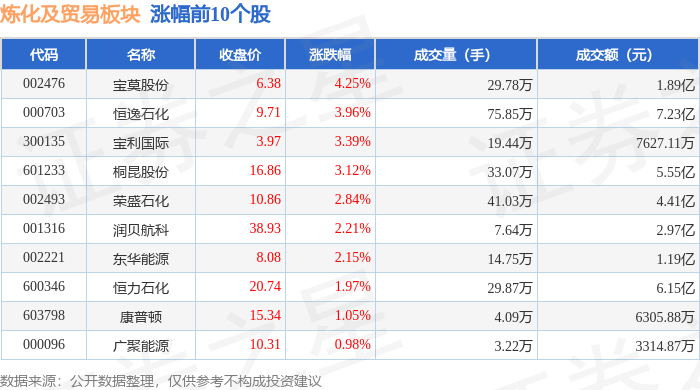
Group 1 - The refining and trading sector experienced a slight decline of 0.03% on December 25, with Daqing Huake leading the drop [1] - The Shanghai Composite Index closed at 3959.62, up 0.47%, while the Shenzhen Component Index closed at 13531.41, up 0.33% [1] - Notable gainers in the refining and trading sector included Baomo Co., which rose by 4.25% to a closing price of 6.38, and Hengyi Petrochemical, which increased by 3.96% to 9.71 [1] Group 2 - Daqing Huake saw a significant decline of 6.37%, closing at 20.30, with a trading volume of 155,500 shares and a transaction value of 319 million [2] - The overall net capital outflow from the refining and trading sector was 440 million, while retail investors saw a net inflow of 253 million [2] - The capital flow analysis indicated that Hengli Petrochemical had a net outflow of 29.23 million from institutional investors, while Baomo Co. had a net inflow of 6.43 million [3]


炼化及贸易板块12月24日涨0.08%,大庆华科领涨,主力资金净流入6379.3万元
Zheng Xing Xing Ye Ri Bao· 2025-12-24 09:17
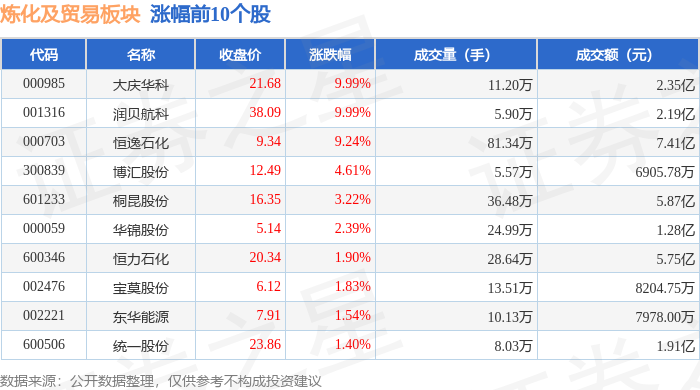
Group 1 - The refining and trading sector saw a slight increase of 0.08% on December 24, with Daqing Huake leading the gains [1] - The Shanghai Composite Index closed at 3940.95, up 0.53%, while the Shenzhen Component Index closed at 13486.42, up 0.88% [1] - Daqing Huake's stock price rose by 9.99% to 21.68, with a trading volume of 112,000 shares [1] Group 2 - The main funds in the refining and trading sector had a net inflow of 63.79 million yuan, while retail investors experienced a net outflow of 32.84 million yuan [2] - The trading volume for the refining and trading sector was significant, with Daqing Huake and Runbei Hangke both showing strong performance [2] - The stock of Hengyi Petrochemical increased by 9.24% to 9.34, with a trading volume of 813,400 shares [1] Group 3 - Hengyi Petrochemical had a net inflow of 77.40 million yuan from main funds, while retail investors showed a significant outflow of 76.74 million yuan [3] - Runbei Hangke also saw a net inflow of 49.92 million yuan from main funds, with a notable outflow from retail investors [3] - China Petroleum had a smaller net inflow of 4.41 million yuan from main funds, indicating mixed investor sentiment [3]



桐昆集团股份有限公司关于2025年度第五期科技创新债券到期兑付的公告
Shang Hai Zheng Quan Bao· 2025-12-23 20:08
Core Viewpoint - Tongkun Group Co., Ltd. successfully redeemed its fifth phase of technology innovation bonds, indicating strong financial management and commitment to fulfilling debt obligations [1] Group 1: Bond Issuance Details - The company issued the fifth phase of technology innovation bonds on June 20, 2025, with a total amount of 500 million RMB [1] - The bonds have a maturity period of 183 days and an interest rate of 1.79% [1] - The total amount of funds raised was fully received by June 23, 2025 [1] Group 2: Redemption Information - The bonds matured on December 23, 2025, and the company completed the repayment of both principal and interest [1] - The total amount paid for the redemption was 504,487,260.27 RMB [1]