Marubi(603983)

Search documents
日用化工板块走强 福瑞达涨停




news flash· 2025-05-15 02:05
暗盘资金正涌入这些股票,点击速看>>> 日用化工板块走强,福瑞达(600223)涨停,拉芳家化(603630)、洁雅股份(301108)、丸美生物 (603983)、水羊股份(300740)、嘉亨家化(300955)等涨幅居前。 ...
可选消费行业点评报告:618大促节奏前置,机制简化补贴加码
Guoyuan Securities· 2025-05-14 13:44
Investment Rating - The report maintains an "Overweight" rating for the industry [4][6]. Core Insights - The 618 promotional event has been advanced, with Tmall's pre-sale period shortened compared to the previous year's Double Eleven event. The first wave of Tmall's 618 sales runs from May 13 to May 26, 2025, with a pre-sale deposit payment phase from May 13 to May 16, and a final payment and early purchase phase from May 16 to May 26. This is a 7-day advance compared to last year's 618 event and a 4-day reduction compared to last year's Double Eleven pre-sale period [2][11]. - The promotional mechanisms have been simplified, with Tmall and JD.com eliminating cross-store discounts and increasing platform subsidies. Tmall's official discounts range from 15% to 50%, and the number of coupons issued to 88VIP members has increased significantly from 2 to 6 compared to last year [2][12]. - The first hour of sales in Li Jiaqi's live stream saw a GMV increase of over 10% year-on-year, with notable performances from domestic brands such as Proya and Kefu Mei [3][15]. Summary by Sections 1. 618 Promotional Event - The promotional event's schedule has been advanced, with Tmall's pre-sale period shortened compared to the previous year [2][11]. - JD.com has canceled the pre-heating period, maintaining the same sales period as last year [2][11]. 2. Li Jiaqi's Live Stream Sales Performance - The first hour of the "Explosive Beauty Festival" in Li Jiaqi's live stream saw a GMV increase of over 10% year-on-year, with multiple brand collaborations [3][15]. - Domestic brands such as Proya and Kefu Mei performed exceptionally well during the first day of sales [3][16]. 3. Tmall 618 Pre-sale Rankings - Proya ranked first in the beauty sales during the first four hours of Tmall's pre-sale, with Kefu Mei entering the top three [3][21]. - The rankings indicate a strong performance from domestic brands, with Proya maintaining its leading position and Kefu Mei rising three spots [3][21].

珀莱雅突破百亿、上海家化亏损8亿:国产美妆市场的“洗牌进行时”
3 6 Ke· 2025-05-13 01:56
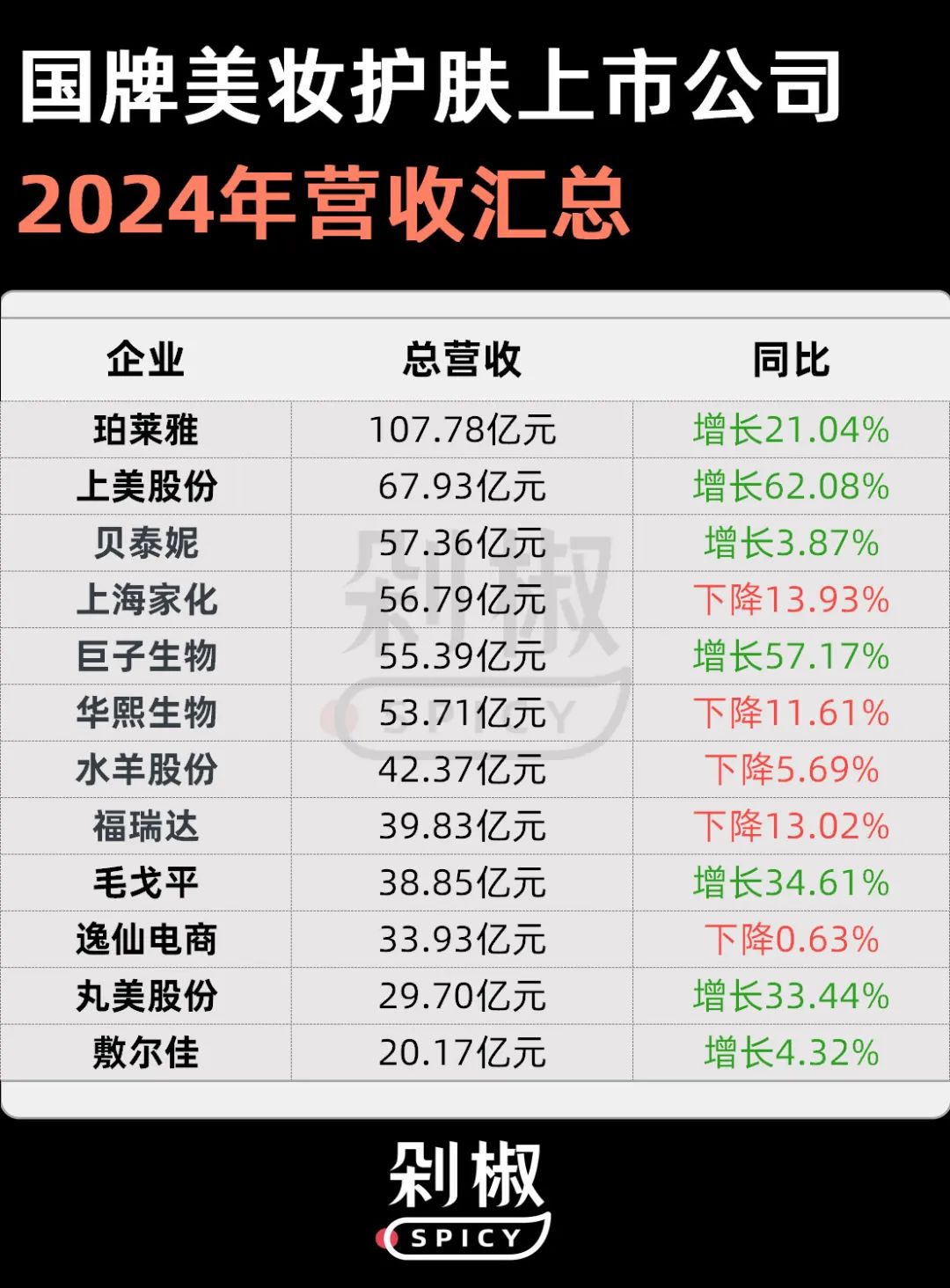
Core Insights - The performance of domestic beauty companies in China is showing significant divergence, with some achieving remarkable growth while others face declines, indicating a reshaping of the market landscape [1][4][42] Group 1: Company Performance - Proya has become the first domestic beauty company to enter the 10 billion yuan club, with a revenue of 10.778 billion yuan, growing by 21.04% [2] - Other companies like Shangmei and Juzi Biological also reported substantial revenue increases of 62.08% and 57.17% respectively, while Shanghai Jahwa experienced a revenue decline of 13.93% [2][3] - Six beauty companies have revenues exceeding 5 billion yuan, suggesting that this threshold will soon become a significant benchmark for the top 10 domestic beauty brands [1] Group 2: Profitability Trends - Juzi Biological leads in profitability with a profit of 2.062 billion yuan, up 42.06%, while Proya's profit reached 1.552 billion yuan, growing by 30% [3] - In contrast, Shanghai Jahwa reported a loss of 833 million yuan, marking a 266.60% decline, highlighting the stark differences in profitability among companies [3][11] Group 3: Market Dynamics - The current market dynamics indicate a shift towards efficacy-driven products, with companies that successfully launched standout products seeing better performance [4][5] - The competition is intensifying, with new entrants emerging and established brands needing to adapt to changing consumer preferences and market trends [7][30] Group 4: R&D and Strategic Focus - Companies are increasingly focusing on R&D, with most reporting a rise in R&D expenditures, indicating a strategic shift towards innovation and efficacy [20][21] - The trend of acquisitions and investments in technology is becoming a key strategy for companies aiming to enhance market share and scale [23][24] Group 5: Emerging Opportunities - The male skincare market is growing rapidly, presenting new opportunities for brands to capture this segment [36] - The aging population is creating demand for products targeting older consumers, which remains largely untapped [39] - As online sales plateau, brands are shifting focus to offline channels, indicating a potential new battleground for market share [40]


未知机构:申万美护深圳上市公司见面会及近期调研反馈内需消费崛起国货美妆加速完善产品-20250512
未知机构· 2025-05-12 01:55
Summary of Conference Call Records Industry Overview - The beauty and personal care industry in China is experiencing significant growth, driven by domestic consumption and the expansion of domestic brands [1][2]. Key Company Insights Shangmei Co., Ltd. (上美股份) - **Sales Growth**: - Tmall sales increased by 30% - JD.com sales grew nearly 70% - Kuaishou and Pinduoduo saw growth between 150% to 200% [1] - **NewPage Performance**: - Q1 revenue reached 160 million, with a 100% growth rate - Expected profit margin improvement for the year [1] - **Product Launches**: - NanBeauty plans to launch mid-to-high-end cosmetics in the second half of the year - Jifang Hair Care is set to expand after obtaining necessary certifications [1] - **Douyin Growth**: - Sales recovery began in April, with an increase in self-broadcasting and improved profit margins [1] - **Marketing Strategy**: - X Peptide aims for a GMV of 1 billion, with new endorsements to enhance marketing effectiveness [1] - Increased brand promotion and collaborations with influencers, including Ding Yuxi as the global ambassador for Han Shu [1] Runben Co., Ltd. (润本股份) - **Revenue Growth**: - Overall revenue increased by approximately 30% in April, with online sales up by about 10% - Significant growth in offline non-platform distribution (toB business) exceeding 50%, particularly in the Sam's Club channel [2] - **Sales Performance**: - Sales in Sam's Club reached over 20 million in April, up from approximately 12 million in March [2] - **Future Projections**: - Anticipates a revenue growth of over 20% in Q2, maintaining a target of 30% growth for both revenue and profit for the first half of the year [2] Marubi Biotechnology Co., Ltd. (丸美生物) - **Q1 Performance**: - Revenue growth of 28% with a net profit increase of 22% [2] - **Annual Targets**: - Aiming for a 32% growth in net profit for the year, referencing the previous year's performance [2] - **Product Sales Forecast**: - Xiaohongbi Eye Cream projected to achieve over 500 million in sales for 2024, representing a 146% growth - Xiaojin Needle expected to reach 350 million in online sales, with a 96% increase, alongside a doubling of offline sales [2] Additional Insights - The emphasis on high-quality ingredients and effective products is becoming a key profitability driver for companies in the beauty sector [3]

商贸零售行业周报:关注零售行业中期投资策略:深挖情绪消费景气赛道
KAIYUAN SECURITIES· 2025-05-12 00:23
Investment Rating - The investment rating for the retail industry is "Positive" (maintained) [1] Core Insights - The retail industry is experiencing a slow recovery in social consumption, with overall business pressure on retail enterprises. The report emphasizes the importance of emotional consumption and suggests focusing on high-quality companies in high-growth segments [4][27] - The report identifies key segments within the retail industry, including traditional retail, gold and jewelry, cosmetics, and medical aesthetics, each with unique dynamics and investment opportunities [4][27] Summary by Sections Retail Market Overview - The retail industry index rose by 0.88% during the week of May 6 to May 9, 2025, underperforming the Shanghai Composite Index, which increased by 1.92% [6][15] - The brand cosmetics sector showed the highest growth, with a weekly increase of 2.89% and a year-to-date increase of 15.91% [18][21] Investment Strategy - The report recommends focusing on high-quality companies in segments driven by emotional consumption, including: 1. **Gold and Jewelry**: Emphasizing brands with differentiated products and consumer insights, recommending companies like Laopuhuangjin, Chaohongji, and Zhou Dasheng [7][48] 2. **Offline Retail**: Highlighting companies that are actively transforming and exploring new models, recommending Yonghui Supermarket and Aiyingshi [7][48] 3. **Cosmetics**: Focusing on domestic brands with strong growth potential, recommending brands like Pola, Shangmei, and Juzi Biological [7][49] 4. **Medical Aesthetics**: Suggesting attention to differentiated product manufacturers and leading medical aesthetic institutions, recommending Aimeike and Kedi-B [7][49] Segment Analysis - **Traditional Retail**: The report notes that offline retail must leverage its strengths in customer service and emotional satisfaction to attract consumers back from online channels [4][28] - **Gold and Jewelry**: The industry is shifting from supply-driven to demand-driven, with emotional consumption becoming a key factor. High-end and fashionable gold segments are emerging as significant opportunities [4][36] - **Cosmetics**: The industry is stable in the short term, with a long-term trend favoring domestic brands. Emotional consumption is spreading across various cosmetic categories [4][41] - **Medical Aesthetics**: The industry is experiencing accelerated differentiation, with high-end products showing resilience due to their safety and scarcity [4][44]




品牌工程指数 上周涨1.99%
Zhong Guo Zheng Quan Bao· 2025-05-11 20:26
Market Performance - The market rebounded last week, with the China Securities Index rising by 1.99% to 1650.47 points [1][2] - The Shanghai Composite Index increased by 1.92%, the Shenzhen Component Index by 2.29%, and the ChiNext Index by 3.27% [2] Strong Stock Performances - Notable strong performers included: - Zhongji Xuchuang (300308) up by 13.55% - Shanghai Jahwa (600315) up by 9.31% - AVIC Shenyang Aircraft (600760) up by 8.25% - CATL (300750) up by 7.24% - Beitaini (300957) up by 6.01% [2] - Other stocks such as Hisense Home Appliances (000921), EVE Energy (300014), and Stone Technology saw gains exceeding 5% [2] Year-to-Date Stock Performance - Since the beginning of 2025, Shanghai Jahwa has surged by 51.39%, leading the gains [3] - Marumi Bio (603983) follows with a 50.59% increase, while Xintai (002294) and Anji Technology have both risen over 30% [3] Market Outlook - Positive factors are emerging as the market stabilizes, with expectations for gradual recovery in investor sentiment and stock performance [4] - The domestic economy is on a steady recovery path, supported by ongoing policy efforts [4] - The current A-share market is viewed as being in a high cost-performance zone, indicating medium to long-term investment value [4] - However, short-term market movements may remain volatile unless strong driving factors emerge [4]




化妆品医美行业周报:聚美丽大会指引美业发展,国际集团在华触底反弹-20250511
Shenwan Hongyuan Securities· 2025-05-11 14:40
Investment Rating - The report maintains an "Overweight" rating for the cosmetics and medical beauty sector, with specific recommendations for various companies based on their market positions and growth potential [5][12][17]. Core Insights - The cosmetics and medical beauty sector has shown weaker performance compared to the market, with the Shenwan Beauty Care Index rising by 1.7% from April 30 to May 9, 2025, which is lower than the Shenwan A Index by 0.6 percentage points [5][6]. - The "Jumeili Conference" held in Shanghai highlighted the industry's development direction amidst a challenging environment, emphasizing the importance of technology-driven beauty, refined operations, and AI assistance [5][12]. - Domestic brands are gaining traction, while international brands are also experiencing growth, with Estee Lauder reporting a return to positive growth in key brands in China during Q1 2025 [5][12][28]. Summary by Sections Industry Performance - The cosmetics and medical beauty sector's performance has been below market expectations, with the Shenwan Cosmetics Index increasing by 2.8%, outperforming the Shenwan A Index by 0.5 percentage points [5][6]. - The report notes a competitive landscape where domestic brands are aggressively entering the market, prompting international brands to rebound [5][12]. Company Analysis - Shanghai Jahwa's Q1 2025 results showed a revenue of 1.704 billion yuan, down 10.59% year-on-year, with a net profit of 217 million yuan, down 15.25% [5][13]. - Estee Lauder's Q3 2025 results indicated a net sales figure of 3.55 billion USD (approximately 25.8 billion yuan), a 10% decline year-on-year, but with a notable increase in gross margin [5][28]. - The report highlights the employee stock ownership plan at Shanghai Jahwa, aimed at binding key personnel and setting profit recovery targets for 2025 [5][17]. Market Trends - The report indicates that the retail sales of cosmetics in Q1 2025 reached 114.9 billion yuan, with a year-on-year growth of 3.2% [22][26]. - The domestic skincare market is projected to continue growing, with local brands capturing a significant market share, reflecting a shift in consumer preferences towards domestic products [36][38]. E-commerce Insights - The report provides data on the performance of domestic brands on e-commerce platforms, with notable growth in GMV for brands like Proya and Marubi [20][19]. - The overall e-commerce landscape for cosmetics is evolving, with brands leveraging social media platforms to enhance visibility and sales [5][12].


3230.19万元资金今日流出美容护理股
Zheng Quan Shi Bao Wang· 2025-05-09 15:45
Market Overview - The Shanghai Composite Index fell by 0.30% on May 9, with seven industries experiencing gains, led by the beauty and personal care sector, which rose by 1.41% [1] - The electronic and computer sectors faced the largest declines, with drops of 2.07% and 1.96% respectively [1] Capital Flow Analysis - The main capital outflow from the two markets totaled 47.4 billion yuan, with only four industries seeing net inflows [1] - The textile and apparel industry had the highest net inflow, amounting to 226 million yuan, while the coal industry saw a modest increase of 0.10% with a net inflow of 18.6 million yuan [1] Beauty and Personal Care Sector - The beauty and personal care industry saw a rise of 1.41%, despite a net outflow of 32.3 million yuan in main capital [2] - Out of 31 stocks in this sector, 18 experienced gains, including one stock that hit the daily limit [2] - The top three stocks with net inflows were Beitaini (35.1 million yuan), Proya (23.1 million yuan), and Shuiyang (13.7 million yuan) [2][3] Notable Stocks in Beauty and Personal Care - Qingdao Kingking had the largest net outflow at 40.9 million yuan, followed by Runben (8.7 million yuan) and Kesi (8.4 million yuan) [2] - Other notable stocks with significant net outflows included Marubi (8.0 million yuan) and Aimeike (7.5 million yuan) [2] - The stock performance varied, with some stocks like Beitaini and Shuiyang showing strong gains, while others faced significant outflows [2][3]


从品类到品质,从品质到品牌
China Securities· 2025-05-09 01:20
Investment Rating - The report maintains a rating of "Outperform the Market" for the industry [3]. Core Insights - The industry fundamentals are expected to remain under pressure in 2024, with most sectors and companies still significantly affected by macroeconomic factors. However, a number of companies are emerging that are successfully navigating the challenges of consumer downgrade by upgrading from categories to quality and then to brand [1][2]. - The report highlights that companies with strong brand attributes are likely to continue outperforming as the market transitions from price-performance to quality-price comparisons [2]. Summary by Sections 1. Duty-Free Sector - The duty-free sales in Hainan are gradually stabilizing, with the implementation of the Hainan closure policy expected to benefit the duty-free sector. The market is seeing improvements in channel and supply chain capabilities, leading to a stable outlook for profitability [2][49]. - Key companies to watch include China Duty Free Group and Wangfujing [2]. 2. Tourism and Gaming - The tourism sector shows strong resilience in demand, becoming a crucial driver for domestic consumption. The recovery in inbound and outbound travel is significant, with a focus on new consumption scenarios and the silver-haired tourism market [2][3]. - Recommended companies include Jiuhua Tourism, Lingnan Holdings, and Sands China [2]. 3. Hotel Industry - The hotel sector is experiencing weak business travel demand, leading to pressure on RevPAR. However, leisure demand remains resilient, and leading companies are enhancing profitability through brand matrix validation and supply chain optimization [3][72]. - Companies to focus on include Huazhu Group, Atour, and Jinjiang Hotels [3]. 4. Restaurant Sector - Leading restaurant companies are demonstrating strong supply chain negotiation and profitability advantages. The overall supply in the restaurant industry is optimizing, with a competitive trend in price-performance [3][7]. - Notable companies include Mixue Ice City, KFC, and Haidilao [3][7]. 5. Cosmetics and Medical Aesthetics - The cosmetics sector is seeing a shift in focus towards profitability, with companies restructuring their product and channel strategies. High-growth companies are expected to achieve both revenue and profit increases [7][23]. - Key players include Juzhibio, Shumei, and Marubi [7][23]. 6. General Retail - The retail sector is undergoing digital upgrades and operational adjustments, with a focus on essential demand and cash flow stability. Companies like Yonghui Supermarket and Multi-Point Intelligence are recommended [8][30]. - The report also highlights the ongoing challenges in the jewelry sector due to rising gold prices [8][30]. 7. Overall Market Performance - The consumer services sector is expected to face challenges, with a projected performance of -8.70% in 2024. However, the beauty and personal care sector is anticipated to recover with a growth of +8.15% in 2025 [11][19].



餐饮和化妆品怎么没跟上消费板块?
Sou Hu Cai Jing· 2025-05-08 02:38
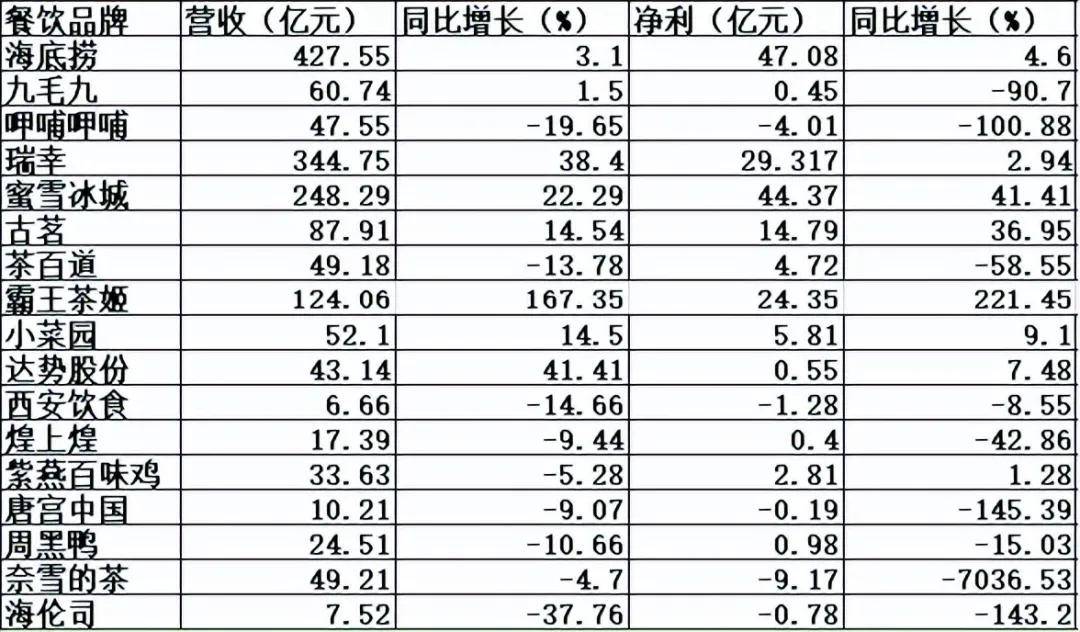
Core Viewpoint - The current hot sectors in the Chinese stock market are new consumption areas such as toys, tea drinks, and snacks, while traditional sectors like dining and cosmetics are lagging behind, with negative average growth rates in 2023 [1][14]. Dining Industry - The dining sector is experiencing a comprehensive downturn, with major players like Haidilao showing minimal growth, while tea drink companies are accelerating [1][7]. - The dining market is projected to grow at approximately 5.3% in 2024, contrasting with the 20% growth in the ready-to-drink tea segment, indicating a negative growth trend for dining [2][7]. - The dining industry faces challenges such as high competition, a saturated market with 9 million restaurants, and a business model that often prioritizes novelty over customer retention [7][9]. - Major dining companies are struggling with profitability, as evidenced by significant declines in net profits for brands like Jiumaojiu and Jiabujiahe [2][8]. - The dining sector's business model is unsustainable, with many restaurants failing to maintain long-term customer engagement, leading to a high turnover of brands [9][10]. Cosmetics Industry - The overall growth rate of the cosmetics industry is declining, with a notable 9% drop in imported cosmetics in 2024, indicating that domestic companies are not entirely to blame for the downturn [14][16]. - Consumer behavior is shifting towards reducing non-essential spending, impacting higher-priced cosmetics, which are often seen as replaceable [16][21]. - The performance of cosmetic companies is highly variable, with some achieving significant growth while others, like Aimeike and Huaxi Shengwu, face severe declines [18][21]. - The rise of new product trends, such as collagen-based skincare, is reshaping the competitive landscape, leading to the decline of established brands that fail to innovate [21][23]. - The cosmetics sector is characterized by intense competition and frequent brand turnover, making it difficult for companies to maintain long-term growth and stability [23][24]. Conclusion - Both the dining and cosmetics industries are facing significant challenges that hinder performance and valuation compared to more successful sectors like ready-to-drink tea and snacks [24].