
Roborock(688169)

Search documents
家电|看好出海与红利 - 2Q25策略报告
2025-08-06 14:45
Summary of Key Points from the Conference Call Industry Overview - The home appliance industry is experiencing significant growth potential in emerging markets, which account for 67% of the global population but only 32% of home appliance retail sales, indicating a substantial opportunity for growth [1][2][4] Core Insights and Arguments - **Emerging Market Growth**: Emerging markets are expected to be a key growth driver for the home appliance industry, with a notable increase in demand for air conditioners, refrigerators, and washing machines due to low penetration rates compared to developed countries [1][2][5] - **Air Conditioner Market**: The air conditioner market is growing rapidly, closely linked to GDP per capita. Countries with GDP per capita reaching $3,000 or $6,000 show significant increases in penetration rates [1][7] - **Export Recovery**: China's home appliance exports are gradually recovering from tariff impacts, with a notable increase in exports to Southeast Asia, Latin America, and the U.S. [1][8] - **Domestic Market Growth**: The domestic market is experiencing steady growth driven by the "trade-in for new" policy, with air conditioner shipments increasing by 8% and washing machines showing double-digit growth in the first five months of 2025 [1][9] Competitive Landscape - **Market Dynamics**: The competitive landscape is stabilizing, with Xiaomi's market share leveling off and major players like Midea and Gree adjusting their product structures [3][12] - **Small Appliances Growth**: The small appliance market, particularly for robotic vacuum cleaners and floor washers, continues to show high growth, with companies like Ecovacs reporting revenue and profit growth exceeding expectations [3][13] Investment Recommendations - **Focus on Dividend Stocks**: Investment strategies should focus on companies with strong dividend yields such as Gree, Midea, Haier, and Hisense, which have dividend rates exceeding 4% [3][15] - **Export Opportunities**: Companies in the export sector, particularly in small appliances and black electronics, are recommended for investment due to their growth potential in emerging markets and the U.S. [3][16][19] Additional Important Insights - **Impact of National Subsidies**: The national subsidy policy has led to structural growth in the domestic market, with significant price increases observed [1][9][14] - **Long-term Potential of Robotic Vacuums**: The robotic vacuum segment is viewed as a long-term growth area due to its strong growth potential and limited impact from domestic subsidy policies [3][17] - **Advantages of OEMs**: OEMs like New Bao and Dechang are positioned well in the global market due to scarce overseas production capacity, which enhances their competitiveness in exports to the U.S. [3][19]




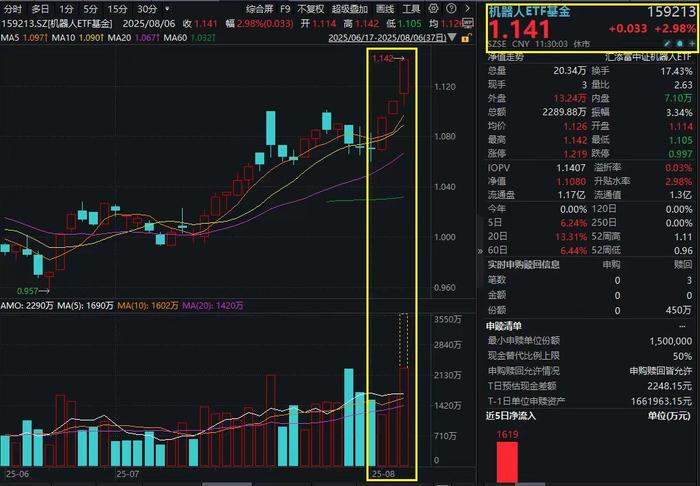
能爬能跑!宇树科技再发机器人新品,机器人再度大涨,机器人ETF(159213)涨2.8%,冲击三连阳!
Xin Lang Cai Jing· 2025-08-06 05:53
Group 1 - The core index of the Robot ETF Fund (159213), the CSI Robot Index (H30590), has seen a strong increase of 2.73%, with most constituent stocks rising significantly [1] - Notable performers include Robot (300024) which surged by 14.50%, and Huadong CNC (002248) and Zhongdali De (002896) hitting the daily limit up [1] - The ETF fund has shown continuous strength, with a reported increase of 2.8% as of 13:10 on August 6, marking a potential three-day winning streak [4] Group 2 - The top ten constituent stocks of the Robot ETF Fund include Huichuan Technology (300124) with a rise of 2.08%, and Keda Xunfei (002230) with a slight increase of 0.20% [2] - The performance of Stone Technology (688169) has slightly declined by 0.53%, while other stocks like Shuanghuan Transmission (002472) increased by 5.06% [2] - The total market capitalization of the top ten stocks reflects significant historical values, with Robot (300024) having a historical market cap of 35.78 billion [2] Group 3 - On August 5, Yushu Technology launched a new quadruped robot, Unitree A2, which weighs approximately 37 kg and has a maximum running speed of 5 m/s [3] - The Shanghai government has issued a development plan for the embodied intelligence industry, aiming for breakthroughs in at least 20 core algorithms and technologies by 2027, with a target industry scale exceeding 50 billion [5] - CITIC Securities predicts that 2025 will be a pivotal year for the mass production of embodied intelligent robots, emphasizing the integration of AI and robotics as a significant industrial revolution [5][6]





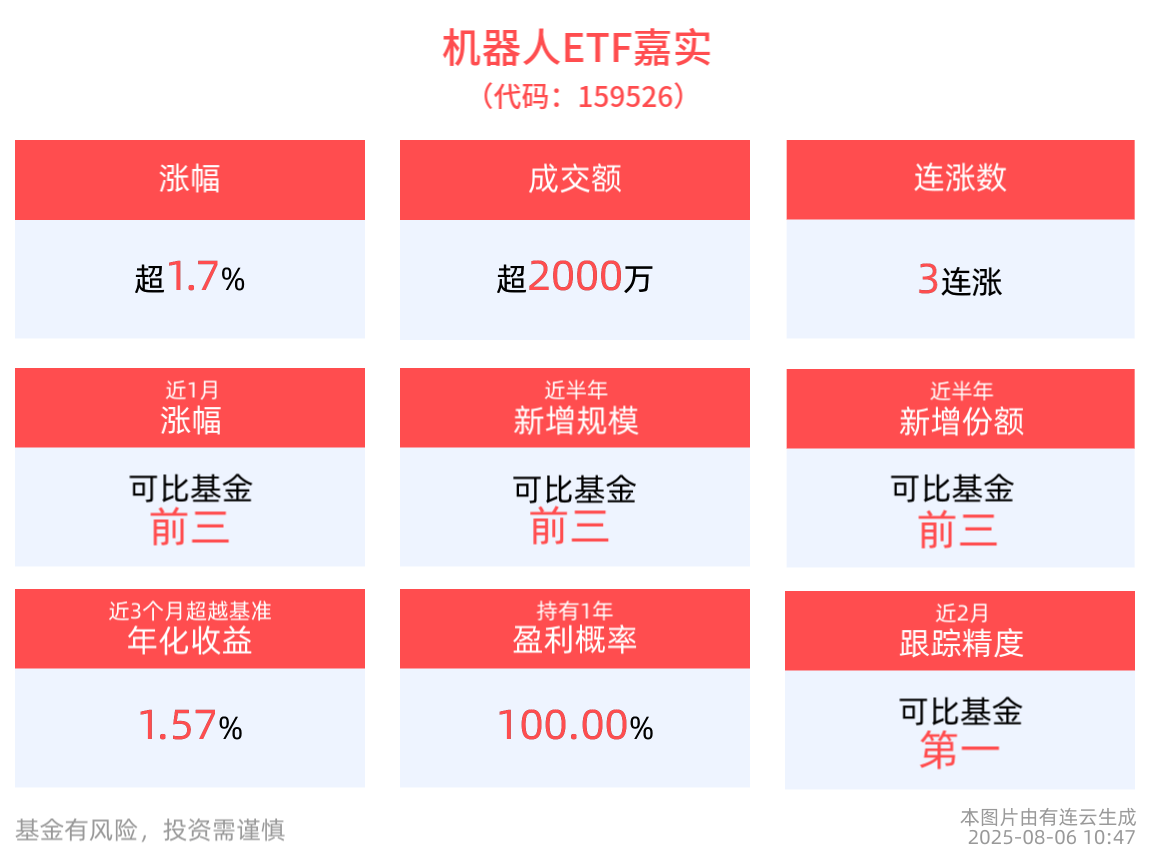
宇树科技发布新款四足机器狗产品Unitree A2,机器人ETF嘉实(159526)冲击3连涨
Sou Hu Cai Jing· 2025-08-06 03:36
Group 1: ETF Performance - The liquidity of the Robot ETF managed by Jiashi has a turnover rate of 4.52%, with a transaction volume of 24.7961 million yuan. The average daily transaction volume over the past week is 36.7179 million yuan as of August 5 [3] - The Robot ETF has seen a significant growth in scale, increasing by 284 million yuan over the past six months, and its shares have grown by 207 million shares during the same period [3] - As of August 5, the net value of the Robot ETF has increased by 59.49% over the past year, ranking 345 out of 2948 in the index stock fund category, placing it in the top 11.70% [3] Group 2: Historical Returns - Since its inception, the Robot ETF has recorded a highest single-month return of 25.78%, with the longest consecutive months of increase being 3 months and the longest increase percentage being 37.12%. The average return during the months of increase is 8.93% [3] Group 3: Index Composition - As of July 31, 2025, the top ten weighted stocks in the CSI Robot Index include Keda Xunfei, Huichuan Technology, Stone Technology, Dahua Technology, Zhongkong Technology, Dazhu Laser, Shuanghuan Transmission, Robot, Ecovacs, and Julun Intelligent, collectively accounting for 48.86% of the index [3] Group 4: Market Trends - According to a report from Open Source Securities, the financing of domestic embodied intelligence companies is characterized by "rapid growth and hardware-software layout." The hardware sector focuses on humanoid robot bodies and core components, while the software sector emphasizes embodied intelligence algorithms and system development, forming a comprehensive industry chain layout [6] - In the secondary market, the capital actions of leading companies are accelerating, driving the collaborative development of the entire industry chain [6]


美联储降息预期点评:美联储降息概率加大,利好家电出口链
CMS· 2025-08-05 06:49
Investment Rating - The report maintains a strong buy rating for multiple companies in the home appliance sector, indicating a positive outlook for their stock performance [3]. Core Insights - The expectation of a 25 basis point interest rate cut by the Federal Reserve is anticipated to boost the recovery of the U.S. real estate and home appliance sectors, leading to increased consumer spending in these areas [1][7]. - The report highlights that the consumer spending on home appliances in the U.S. is projected to grow by 1.3% and 1.7% year-on-year in Q1 and Q2 of 2025, respectively [7]. - The report emphasizes the strong correlation between the demand for tools and the U.S. real estate cycle, suggesting that companies like QuanFeng Holdings and JuXing Technology will benefit from this trend [7]. Company Summaries - **QuanFeng Holdings (2285.HK)**: Market cap of 9.8 billion, with a projected EPS of 1.95 for 2025 and a strong buy rating [3]. - **TCL Electronics (1070.HK)**: Market cap of 25.8 billion, projected EPS of 0.92 for 2025, rated as a strong buy [3]. - **Ninebot (689009.SH)**: Market cap of 43.9 billion, projected EPS of 3.16 for 2025, rated as a strong buy [3]. - **Midea Group (000333.SZ)**: Market cap of 544.4 billion, projected EPS of 5.61 for 2025, rated as a strong buy [3]. - **Gree Electric (000651.SZ)**: Market cap of 258.3 billion, projected EPS of 6.25 for 2025, rated as a strong buy [3]. - **Hisense Home Appliances (000921.SZ)**: Market cap of 35.2 billion, projected EPS of 2.66 for 2025, rated as a strong buy [3]. - **JuXing Technology (002444.SZ)**: Market cap of 37.9 billion, projected EPS of 2.00 for 2025, rated as a strong buy [3]. - **Hisense Visual (600060.SH)**: Market cap of 29.8 billion, projected EPS of 1.93 for 2025, rated as a strong buy [3]. - **Haier Smart Home (600690.SH)**: Market cap of 234.2 billion, projected EPS of 2.24 for 2025, rated as a strong buy [3]. - **Chunfeng Power (603129.SH)**: Market cap of 34.3 billion, projected EPS of 13.77 for 2025, rated as a strong buy [3]. - **Ecovacs (603486.SH)**: Market cap of 47.2 billion, projected EPS of 3.84 for 2025, rated as a strong buy [3]. - **Roborock (688169.SH)**: Market cap of 46.2 billion, projected EPS of 8.05 for 2025, rated as a strong buy [3]. Industry Overview - The home appliance sector consists of 88 companies with a total market capitalization of 1846.2 billion, indicating a robust industry presence [4]. - The report notes a significant absolute performance increase of 37.6% over 12 months for the home appliance sector, outperforming the benchmark index [6].

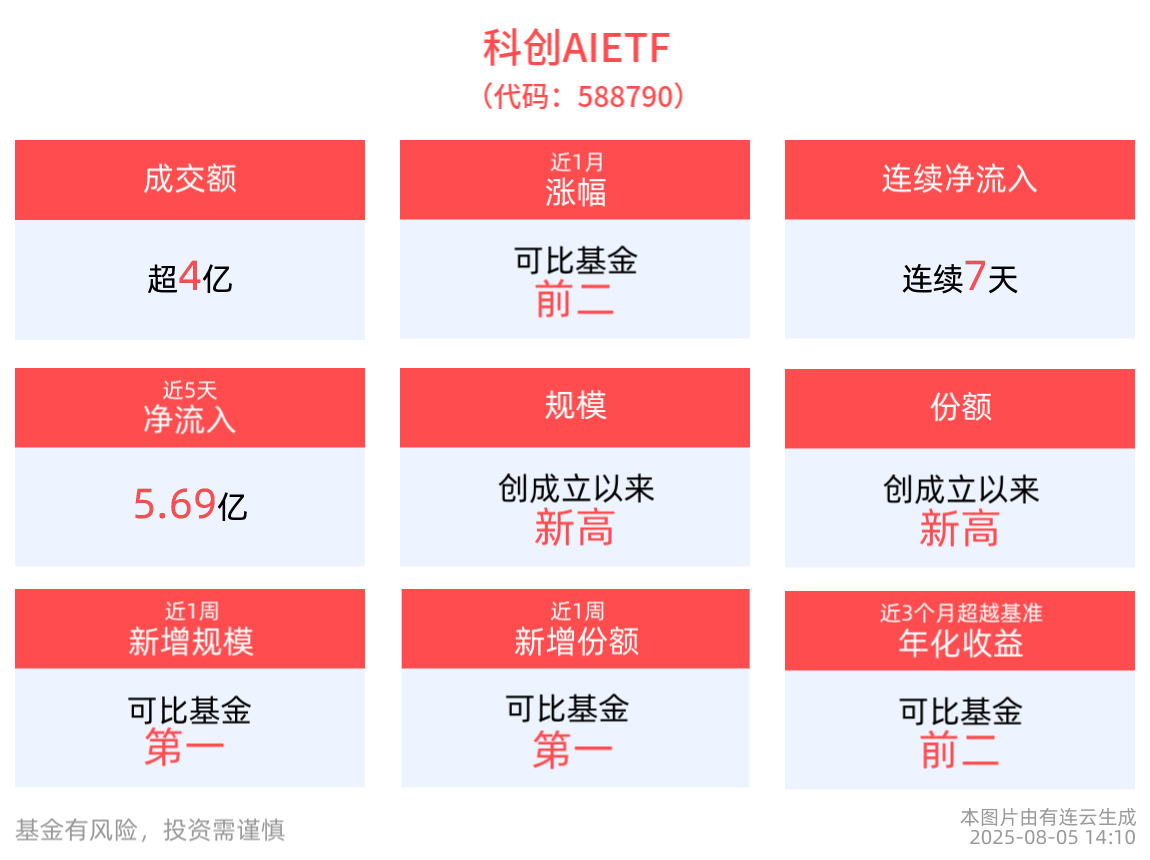
科创AIETF(588790)连续7日资金净流入,最新规模达超62亿元,“人工智能+”空间或更为广阔
Sou Hu Cai Jing· 2025-08-05 06:30
Core Viewpoint - The article highlights the performance and growth potential of the AI sector in China, particularly focusing on the performance of the Sci-Tech Innovation Board AI Index and the related ETF, indicating a positive trend in investments and market interest in AI technologies [3][4][5]. Group 1: Market Performance - As of August 5, 2025, the Sci-Tech Innovation Board AI Index (950180) increased by 0.09%, with notable gains from constituent stocks such as Zhongke Xingtai (688568) up 4.29% and Aerospace Hongtu (688066) up 3.62% [3]. - The latest size of the Sci-Tech AI ETF reached 6.203 billion yuan, marking a new high since its inception and ranking first among comparable funds [4]. - The Sci-Tech AI ETF has seen a net inflow of 1.042 billion yuan in financing, with a total financing balance of 6.43 billion yuan as of the previous trading day [5]. Group 2: Investment Trends - The AI sector is experiencing rapid growth, driven by increasing demand for computing power and ongoing investments in large models, indicating a robust market environment [4]. - The Sci-Tech AI ETF has recorded a 16.89% increase in net value over the past six months, ranking first among comparable funds [5]. - The ETF's management fee is 0.50% and the custody fee is 0.10%, which are relatively low compared to similar funds [5]. Group 3: Tracking and Composition - The Sci-Tech AI ETF closely tracks the Sci-Tech Innovation Board AI Index, which includes 30 large-cap companies that provide foundational resources, technology, and application support for the AI industry [6]. - As of July 31, 2025, the top ten weighted stocks in the index accounted for 67.36% of the total index weight, indicating concentrated investment in key players within the AI sector [7].


石头科技:7月份公司未进行回购
Zheng Quan Ri Bao Wang· 2025-08-04 10:43
证券日报网讯 8月4日晚间,石头科技发布公告称,2025年7月份,公司未进行回购。截至2025年7月31 日,公司通过上海证券交易所交易系统以集中竞价交易方式已累计回购股份67,000股,占公司总股本 的比例为0.0259%。 ...
扫地机行业框架、观点深度解读-20250804
Tianfeng Securities· 2025-08-04 10:43
Industry Overview - The vacuum cleaner industry is characterized by high ceiling and rapid penetration rate, with cleaning appliances being a necessity [2][10] - Historical analysis of the penetration rates in the US and Japan shows that vacuum cleaners have a high ceiling similar to other household appliances like refrigerators and washing machines [10][12] - The transition from traditional vacuum cleaners to efficient cleaning appliances is highly probable, driven by increasing housing space and declining household labor [20][22] Industry Development & Outlook - The industry focuses on "intelligence" and "functionality," indicating that product maturity does not equate to a lack of innovation [3] - Short-term procurement costs may rise due to product iteration and added functionalities, but economies of scale are expected to reduce upstream component costs in the long run [3][23] - The market still has significant growth potential, especially in core countries and regions, with a projected increase in penetration rates [27] Competitive Landscape - The competitive landscape is dynamic, with companies like Roborock, Ecovacs, and Dreame leading in various market segments. Xiaomi dominates the low-end market, while Ecovacs and Dreame focus on mid to high-end segments [28][30] - The market is segmented by price, with a clear differentiation in competition across various price bands, indicating a high concentration in the high-end market [30][31] - The importance of product strength, cost-effectiveness, and marketing strategies is paramount in shaping the competitive dynamics of the industry [32][35] Investment Perspective - The expected improvement in industry sales is likely to enhance valuations, with investors focusing on short-term data [4] - Key metrics to monitor include SKU data during the introduction phase, innovation cycles, market share of individual products during growth, and brand market share during maturity [4] - Recommended investment targets include Roborock and Ecovacs, which are positioned well within the competitive landscape [4] Market Trends - The industry is expected to see a shift towards products with dual functionalities, such as "mop + side brush expansion," which will drive new product launches and market share gains [65][66] - The focus on maintaining price stability while enhancing product features is anticipated to be a key strategy for companies in 2024 [61][72] - The competitive landscape will continue to evolve with a focus on product upgrades and marketing strategies, particularly in the context of the upcoming promotional events [69][70]
家电行业2025年8月投资策略:白电淡季排产有所承压,美国家电门店出现加库存迹象
Guoxin Securities· 2025-08-04 09:57
Core Viewpoints and Investment Recommendations - The report maintains an "Outperform" rating for the home appliance sector, indicating a positive outlook for the industry [7] - The report highlights the expected stable growth in domestic demand driven by the "old-for-new" policy, while external sales may face challenges due to U.S. tariff policies [15][17] - Key recommended companies include Midea Group, Gree Electric Appliances, Haier Smart Home, TCL Smart Home, and Hisense Home Appliances, with a focus on those with strong overseas growth potential and efficient operations [14][15][17] Monthly Research Tracking and Investment Insights - In August, the white goods production volume decreased by 5% year-on-year, with domestic sales experiencing a slowdown due to the seasonal demand drop and adverse weather conditions [20][21] - The report notes that in June, domestic sales of major home appliances showed robust growth, with air conditioners, refrigerators, and range hoods achieving over 10% growth [27][29] - U.S. retail sales of home appliances grew by 0.7% year-on-year in June, with inventory levels rising, indicating a stable demand despite tariff impacts [30][33] Key Data Tracking - The home appliance sector experienced a relative decline of 2.90% in July compared to the Shanghai Composite Index, which rose by 3.54% [35][37] - In July, the prices of copper and aluminum decreased by 1.9% and 0.4% respectively, while cold-rolled steel prices increased by 15.8% [38][40] - Shipping indices showed a significant decline in rates for routes to the U.S. West and East coasts, while European routes saw a slight increase [48][49] Key Company Announcements and Industry Dynamics - The report indicates that the home appliance market in China saw significant growth in H1 2025, particularly in the cleaning appliance segment, which grew by 30% year-on-year [52] - The kitchen appliance market is expected to show resilience, with stable performance from leading companies like Robam Appliances, which is focusing on expanding its product categories [15][52] - The report also highlights the ongoing adjustments in the home appliance sector, with companies like Ecovacs and Roborock showing strong overseas growth and product diversification [18][19]


石头科技(688169.SH):已累计回购6.7万股
Ge Long Hui A P P· 2025-08-04 08:32
格隆汇8月4日丨石头科技(688169.SH)公布,截至2025年7月31日,公司通过上海证券交易所交易系统以 集中竞价交易方式已累计回购股份67,000股,已回购股份占公司总股本(以公司2025年7月31日总股本 259,085,550股计算)的比例为0.0259%,成交的最高价为191.59元/股,最低价为179.88元/股,已支付的 总金额为人民币12,259,711.32元(不含印花税、交易佣金等交易费用)。本次回购股份符合法律法规的 规定及公司回购股份方案。 ...
石头科技(688169) - 北京石头世纪科技股份有限公司关于以集中竞价交易方式回购公司股份的进展公告
2025-08-04 08:30
证券代码:688169 证券简称:石头科技 公告编号:2025-061 北京石头世纪科技股份有限公司 重要内容提示: | 回购方案首次披露日 | 2025/4/4 | | | | | | | --- | --- | --- | --- | --- | --- | --- | | 回购方案实施期限 | 2025 年 4 月 | 4 | 月 | 2 日~2026 | 年 | 1 日 | | 预计回购金额 | 5,000万元~10,000万元 | | | | | | | 回购用途 | □减少注册资本 √用于员工持股计划或股权激励 □用于转换公司可转债 | | | | | | | | □为维护公司价值及股东权益 | | | | | | | 累计已回购股数 | 67,000股 | | | | | | | 累计已回购股数占总股本比例 | 0.0259% | | | | | | | 累计已回购金额 | 1,225.97万元 | | | | | | | 实际回购价格区间 | 179.88元/股~191.59元/股 | | | | | | 一、回购股份的基本情况 根据《上市公司股份回购规则》《上海证券交易所上市公司自律监管指引 ...