LZLJ(000568)

Search documents
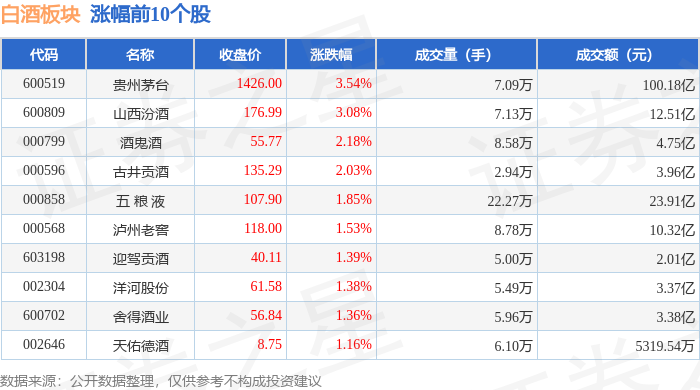
白酒板块1月5日涨2.87%,贵州茅台领涨,主力资金净流入14.41亿元
Zheng Xing Xing Ye Ri Bao· 2026-01-05 08:59
Group 1 - The core viewpoint of the article highlights the significant rise in the liquor sector, particularly led by Kweichow Moutai, which saw a 2.87% increase in the sector on January 5, with the Shanghai Composite Index rising by 1.38% and the Shenzhen Component Index by 2.24% [1] Group 2 - Kweichow Moutai (stock code: 600519) closed at 1426.00 CNY, up 3.54%, with a trading volume of 70,900 shares and a transaction value of 10.018 billion CNY [1] - Other notable stocks in the liquor sector included Shanxi Fenjiu (600809) with a 3.08% increase, closing at 176.99 CNY, and Wuliangye (000858) which rose by 1.85% to 107.90 CNY [1] - The liquor sector experienced a net inflow of 1.441 billion CNY from main funds, while retail funds saw a net outflow of 1.07 billion CNY [1][2]




招商白酒指数基金乏力,基民应该焦虑吗?
Xin Lang Cai Jing· 2026-01-05 08:51
来源:翠鸟资本 净值不上不下,反弹力度有限,持有人开始频繁问一个问题:白酒到底还行不行? 在很多普通投资者的记忆里,白酒指数曾经是一条清晰而省心的赛道。不用选股,不用判断公司治理, 只要我国消费升级存在,白酒龙头就会走出趋势。 招商中证白酒指数LOF就是这一轮逻辑下的典型代表之一,但是,当时间拉长到最近几年,这种熟悉的 安全感正在被反复消耗。 站在今天回看这只产品的阶段性表现,它并不是突然失效,而是被完整地拖进了一个行业与估值同步消 化的周期里。 下跌时间长 从阶段性数据看,招商中证白酒指数基金A份额的表现给人的第一感受是:乏力。 截至2025年12月26日,产品近3个月下跌5.91%。近1年下跌11.27%,近2年下跌20.14%,近3年下跌 36.15%。 这组数据的特点很清晰:下跌时间长,反弹幅度弱。 即便在近6个月内实现0.72%的微弱正收益,也很难给投资者带来明显的信心修复。 但同时也要看到,这并不是一只出现极端回撤或结构性失控的产品,而是一种典型的行业横盘期指数表 现。 什么情况? 这意味着可以得出一个非常直接的结论:招商中证白酒指数的表现,本质上就是几家核心白酒公司的加 权组合。 当茅台、五粮液 ...


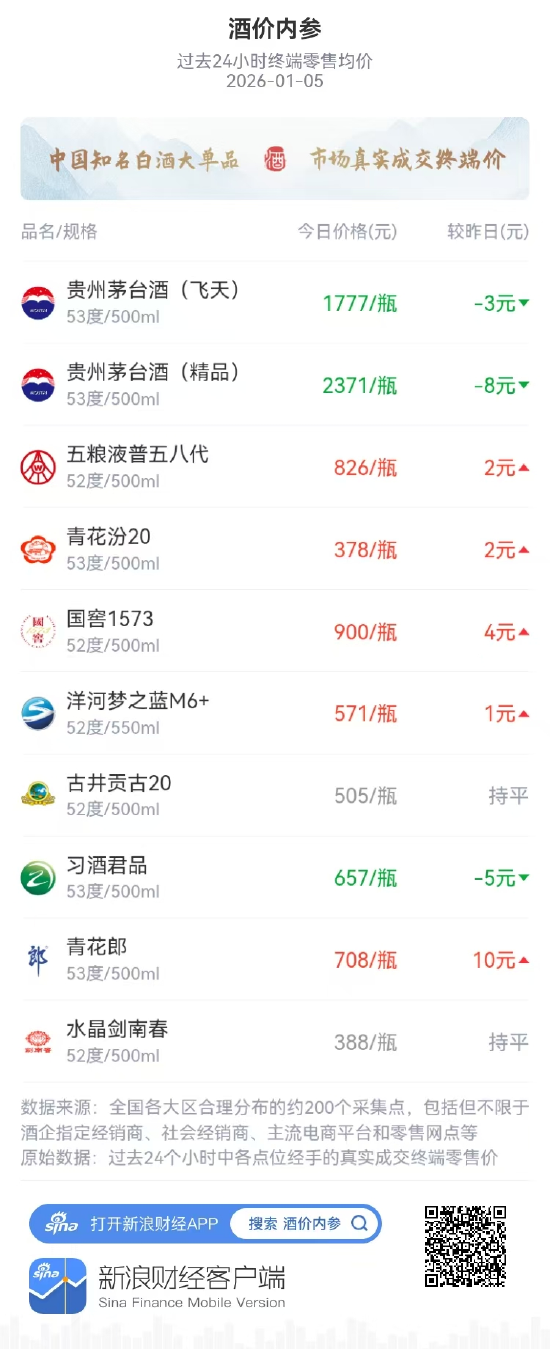
酒价内参1月5日价格发布 习酒君品价格下跌5元/瓶
Xin Lang Cai Jing· 2026-01-05 01:32
Core Insights - The article highlights the recent slight rebound in the retail prices of China's top ten liquor products, indicating a stabilization after a period of decline [1][5]. Price Trends - The overall retail price for the top ten liquor products reached 9081 yuan, an increase of 3 yuan from the previous day, suggesting a potential market recovery [1][5]. - The market exhibited a trend of more price increases than decreases, with notable price rises for several products, including: - Qinghua Lang increased by 10 yuan per bottle, leading the market [6]. - Guojiao 1573 rose by 4 yuan per bottle, marking its fifth consecutive day of price increases [6]. - Qinghua Fen 20 and Wuliangye Pu 58th generation both saw increases of 2 yuan per bottle [6]. - Yanghe Dream Blue M6+ experienced a slight increase of 1 yuan per bottle [6]. - Conversely, some products saw price declines, with: - The price of the premium Moutai dropping by 8 yuan per bottle [6]. - Xijiu Junpin decreased by 5 yuan per bottle [6]. - Feitian Moutai fell by 3 yuan per bottle [6]. Data Collection Methodology - The data for the "Liquor Price Reference" is sourced from approximately 200 collection points across various regions, including designated distributors, social distributors, mainstream e-commerce platforms, and retail outlets, ensuring a comprehensive and objective representation of market prices [2][6]. Industry News - On January 4, Kweichow Moutai Co., Ltd. issued a warning regarding fraudulent recruitment information circulating online, falsely using the Moutai name and claiming direct sales at 1169 yuan, which the company has not authorized [2][6].
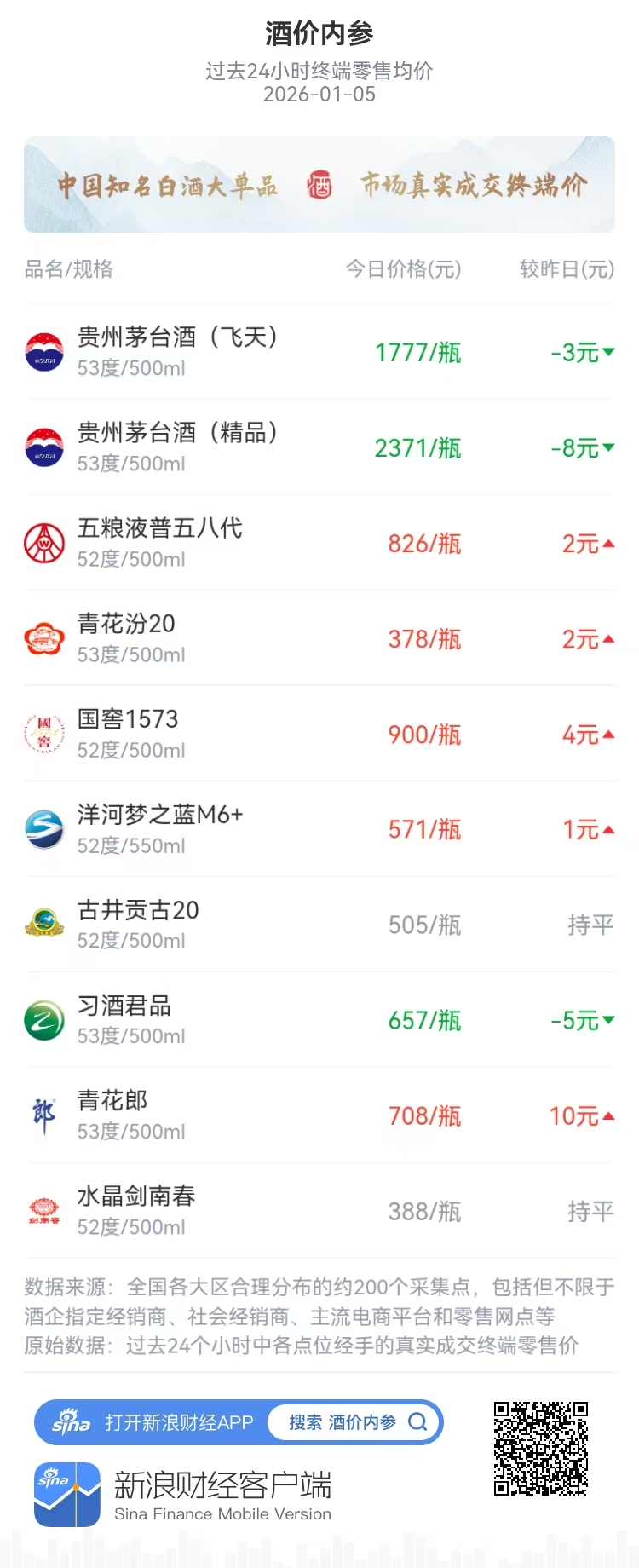
酒价内参1月5日价格发布:青花汾20价格上涨2元/瓶
Xin Lang Cai Jing· 2026-01-05 01:27
Core Insights - The core viewpoint of the news is that the Chinese liquor market, particularly the top ten baijiu products, has shown signs of price stabilization after a period of decline, with a slight rebound in retail prices observed on January 5 [1][5]. Price Trends - The overall retail price for the top ten baijiu products reached 9081 yuan, reflecting a minor increase of 3 yuan compared to the previous day, indicating a potential stabilization after hitting new lows [1][5]. - The market is experiencing a recovery pattern with more products increasing in price than decreasing. Notably, Qinghua Lang saw a significant increase of 10 yuan per bottle, leading the market [6]. - Other products that increased in price include Guojiao 1573 (+4 yuan), Qinghua Fen 20 (+2 yuan), and Wuliangye Pu 58th generation (+2 yuan). Yanghe Dream Blue M6+ saw a slight increase of 1 yuan [6][8]. - Conversely, the prices of some products have decreased, with the premium Moutai dropping by 8 yuan, Xijiu Junpin down by 5 yuan, and Feitian Moutai down by 3 yuan [6][8]. Data Collection Methodology - The data for the "Liquor Price Reference" is sourced from approximately 200 collection points across various regions, including designated distributors, social distributors, mainstream e-commerce platforms, and retail outlets. This aims to provide an objective and traceable representation of the market prices for well-known baijiu [2][6]. Industry News - On January 4, Kweichow Moutai Co., Ltd. issued a warning regarding false recruitment information circulating online, claiming to offer Moutai at 1169 yuan. The company clarified that it has not authorized any such offers and is cooperating with authorities to address the issue [2][6].
酒价内参1月5日价格发布:国窖1573价格上涨4元/瓶,已实现连续五日上涨
Xin Lang Cai Jing· 2026-01-05 01:27
Core Insights - The core viewpoint of the news is that the Chinese liquor market, particularly the top ten baijiu products, has shown signs of price stabilization after a period of decline, with a slight rebound in retail prices observed on January 5 [1][5]. Price Trends - The overall retail price for the top ten baijiu products reached 9081 yuan, an increase of 3 yuan from the previous day, indicating a potential stabilization after hitting new lows [1][5]. - The market is experiencing a recovery pattern with more products increasing in price than decreasing. Notably, Qinghua Lang saw a significant increase of 10 yuan per bottle, leading the market [6]. - Other products that increased in price include Guojiao 1573 (+4 yuan), Qinghua Fen 20 (+2 yuan), and Wuliangye Pu 58th generation (+2 yuan). Yanghe Dream Blue M6+ saw a minor increase of 1 yuan [6][8]. - Conversely, products that decreased in price include the premium Moutai, which fell by 8 yuan, Xijiu Junpin by 5 yuan, and Flying Moutai by 3 yuan [6][9]. Data Collection Methodology - The data for the "Liquor Price Reference" is sourced from approximately 200 collection points across various regions, including designated distributors, social distributors, mainstream e-commerce platforms, and retail outlets. The aim is to provide objective and traceable data on the market prices of well-known baijiu [2][6]. Industry News - On January 4, Kweichow Moutai Co., Ltd. issued a warning regarding false recruitment information circulating online, claiming to offer Moutai at 1169 yuan. The company clarified that it has not authorized any such offers and is cooperating with authorities to address the issue [2][6].
酒价内参1月5日价格发布 市场企稳反弹整体价格小幅回升
Xin Lang Cai Jing· 2026-01-05 01:04
Core Viewpoint - The Chinese white liquor market has shown signs of stabilization with a slight rebound in retail prices after a period of decline, indicating a potential recovery in market sentiment [1]. Price Trends - The average retail price of the top ten white liquor products ended a continuous decline on January 5, with a total price of 9081 yuan for a bundled sale, reflecting a 3 yuan increase from the previous day [1]. - The market is experiencing a recovery pattern with more products increasing in price than decreasing, suggesting a structural rebound [1]. Notable Price Changes - Qinghua Lang saw a strong performance with a price increase of 10 yuan per bottle, leading the market [1]. - Guojiao 1573 has increased by 4 yuan per bottle, marking its fifth consecutive day of price increases [1]. - Other products with price increases include Qinghua Fen 20 and Wuliangye Pu 58, both up by 2 yuan per bottle, and Yanghe Dream Blue M6+ with a slight increase of 1 yuan per bottle [1][4]. - Conversely, the price of the premium Moutai has decreased significantly, with the boutique version down by 8 yuan, and the Flying Moutai down by 3 yuan per bottle [1][3].
回购增持分红多措并举 深市公司“真金白银”护航市场稳定
Shang Hai Zheng Quan Bao· 2026-01-04 20:26
Core Viewpoint - The trend of share buybacks and increases in holdings by listed companies is expected to continue until 2026, with several companies announcing their plans and progress to enhance investor confidence and solidify the foundation for value investment [1][3]. Group 1: Share Buyback and Increase Plans - Dongcheng Pharmaceutical announced a share buyback plan on January 4, 2026, with a budget of no less than 1 billion yuan and no more than 2 billion yuan, aimed at implementing equity incentives and/or employee stock ownership plans [3]. - Century Huatong also disclosed a share buyback plan on the same day, with a budget of no less than 3 billion yuan and no more than 6 billion yuan, intended for equity incentives or employee stock ownership plans [3]. - As of December 31, 2025, a total of 424 share buyback and increase plans were disclosed by companies in the Shenzhen market, with 288 buyback plans amounting to a maximum of 82.725 billion yuan and 136 increase plans amounting to a maximum of 31.521 billion yuan [4]. Group 2: Dividend Distribution - From December 31, 2025, to January 4, 2026, 15 companies in the Shenzhen market announced dividend distributions, with cash dividends expected to be distributed starting January 2026 [2]. - Tianshi Materials announced a cash dividend of 0.5 yuan per 10 shares, totaling 101 million yuan, while Huibai New Materials announced a cash dividend of 2.20 yuan per 10 shares, totaling 20.2987 million yuan [2]. - Watson Bio and Haocreative Technology also disclosed their dividend distributions, with Watson Bio distributing 0.30 yuan per 10 shares (totaling 47.9804 million yuan) and Haocreative distributing 5 yuan per 10 shares (totaling 55 million yuan) [2]. Group 3: Market Leadership - Leading companies in various industries are playing a crucial role in guiding market trends through significant buybacks, continuous increases in holdings, and stable dividend distributions [5]. - Midea Group has implemented a second phase of its buyback plan, accumulating over 10 billion yuan in buybacks by December 31, 2025, to enhance shareholder equity and bind the interests of the core team [6]. - CATL plans to repurchase shares totaling no less than 4 billion yuan and no more than 8 billion yuan, with a cumulative buyback amount of 4.386 billion yuan by December 31, 2025 [6].




食品饮料行业周报:茅台调整线上渠道,落实市场化转型-20260104
Shenwan Hongyuan Securities· 2026-01-04 15:13
Investment Rating - The report maintains a positive outlook on the food and beverage industry, particularly on the liquor sector, with a focus on high-quality companies for long-term investment [3][7]. Core Insights - The report emphasizes the importance of domestic demand, which has been highlighted by authoritative media and government officials since mid-December 2025. It notes that the high-end liquor prices have recently declined, indicating a market shift towards finding a balance between volume and price [3][7]. - For 2026, the report anticipates a double-digit decline in sales volume in Q1, with a potential stabilization in Q2 and a turning point in fundamentals by Q3. If the fundamentals recover as expected, a dual boost in valuation and performance is anticipated towards the end of 2026 and into 2027 [3][7]. - The report recommends several key liquor companies, including Luzhou Laojiao, Shanxi Fenjiu, Guizhou Moutai, and Wuliangye, while also suggesting attention to other brands like Yingjia Gongjiu and Jinhuijiu [3][7]. - In the consumer goods sector, the report highlights opportunities in the supply chain related to condiments, frozen foods, and dairy products, recommending companies such as Anjijia, Yili, and Qianhe Flavoring [3][10]. Summary by Sections 1. Food and Beverage Weekly Insights - The food and beverage sector experienced a decline of 2.26% last week, with liquor down 2.79%, underperforming the broader market [6][33]. - The report notes that the liquor sector's performance is closely tied to the upcoming Spring Festival, with expectations of improved market conditions compared to the previous months [11]. 2. Market Performance of Food and Beverage Sectors - The report indicates that the food and beverage industry underperformed the Shenwan A index by 1.95 percentage points, with the liquor sector lagging behind by 2.48 percentage points [33][34]. 3. Key Company Updates - Guizhou Moutai announced a significant adjustment to its online sales strategy, which is expected to have a profound impact on both the company and the industry. The adjustment includes a new product matrix aimed at better consumer engagement and market pricing [8][11]. - The report also mentions that Moutai's product prices have seen a decline, with the retail price for its flagship product dropping to 1490 yuan per bottle, reflecting a broader trend in the high-end liquor market [8][19].
元旦总结:消费结构性亮眼,白酒变革、大众品推新
GOLDEN SUN SECURITIES· 2026-01-04 10:04
Investment Rating - The report maintains an "Accumulate" rating for the food and beverage industry, indicating a positive outlook for selected stocks within the sector [5]. Core Insights - The report highlights a structural improvement in consumer spending, particularly in the liquor and mass-market product segments, with a strong recovery in consumption during the New Year holiday [1][2]. - The focus is on the market transformation of Moutai, which aims to enhance its market presence and adapt to consumer demands, while also emphasizing the importance of supply-side improvements and dividend strategies for long-term investments [3]. Summary by Sections Liquor Industry - Moutai has initiated a market-oriented transformation, focusing on a consumer-centric approach and enhancing its product portfolio, including a pyramid structure for product offerings [3]. - The report suggests investing in both supply-side improvements and long-term leaders like Moutai and Wuliangye, with a positive outlook for gradual demand recovery in 2026 [3]. Mass-Market Products - The report notes a robust recovery in consumer spending during the New Year holiday, with significant growth in dining and dairy products, indicating a clear upward trend in both volume and price [1][2]. - Key companies to watch include Yili, Anjuke Foods, and Qingdao Beer, which are expected to benefit from this recovery [1]. Beer and Beverage Sector - The craft beer segment has seen over 100% growth in sales, while fruit-flavored beers have increased by over 70%, reflecting a trend among younger consumers [4]. - New product launches, such as the 1L juice from Uni-President, are positioned to attract consumers with competitive pricing and quality [4]. Consumer Behavior - The report emphasizes the high engagement in experiential consumption during the holiday season, with travel and shopping activities showing significant year-on-year growth [2][7]. - The report also highlights the impact of government-issued consumption vouchers in stimulating retail sales across major cities [7].

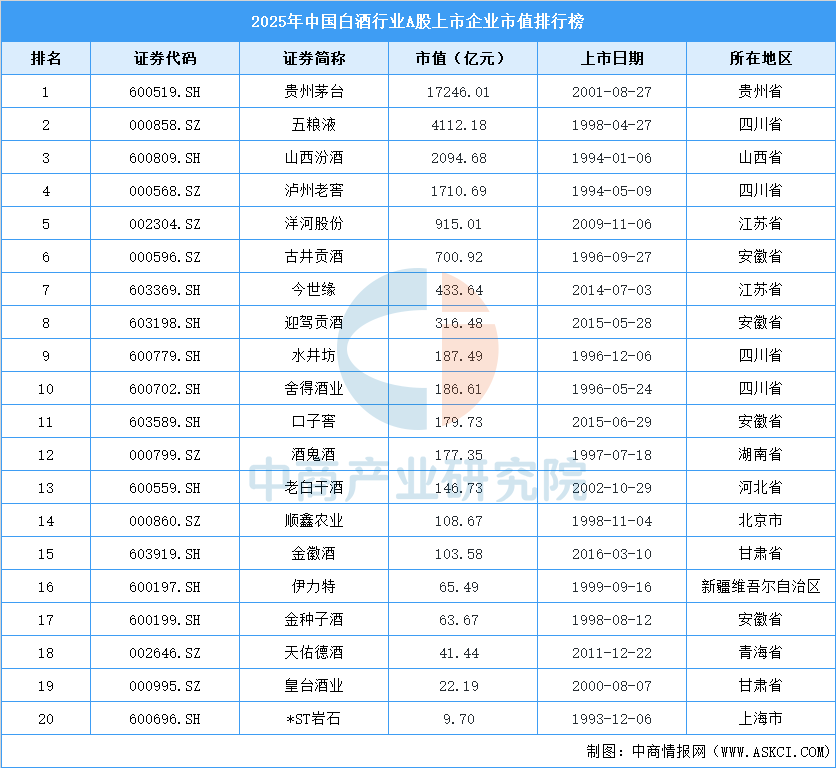
2025年中国白酒行业A股上市公司市值排行榜(附榜单)
Sou Hu Cai Jing· 2026-01-04 09:04
| | | | 2025年中国白酒行业A股上市企业市值排行榜 | | | | --- | --- | --- | --- | --- | --- | | 排名 | 证券代码 | 证券简称 | 市值(亿元) | 上市日期 | 所在地区 | | ਹ | 600519. SH | 贵州茅台 | 17246.01 | 2001-08-27 | 贵州省 | | 2 | 000858. SZ | 五粮液 | 4112. 18 | 1998-04-27 | 四川省 | | 3 | 600809. SH | 山西汾酒 | 2094. 68 | 1994-01-06 | 山西省 | | 4 | 000568. SZ | 泸州老窖 | 1710.69 | 1994-05-09 | 四川省 | | 5 | 002304. SZ | 洋河股份 | 915.01 | 2009-11-06 | 江苏省 | | 6 | 000596. SZ | 古井贡酒 | 700. 92 | 1996-09-27 | 安徽省 | | 7 | 603369. SH | 今世缘 | 433. 64 | 2014-07-03 | 江苏省 | | 8 | 60 ...