
BYD(002594)

Search documents
比亚迪:动态点评闪充进阶,万站可期-20260306
HTSC· 2026-03-06 02:25
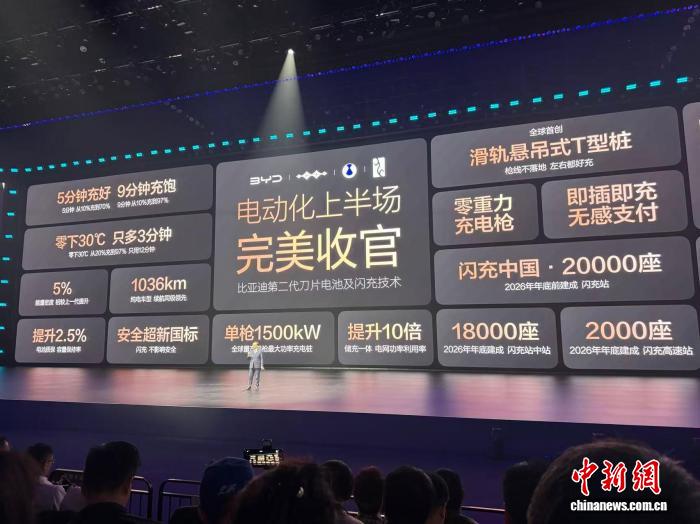
Investment Rating - The report maintains a "Buy" rating for BYD with a target price of 130.63 RMB [6][11]. Core Insights - BYD has made significant advancements in battery technology with the launch of the second-generation blade battery, achieving industry-leading performance in fast charging, low-temperature charging, and safety [2][3]. - The company plans to establish 20,000 fast charging stations by the end of 2026, enhancing user experience and alleviating charging anxiety [3]. - BYD's sales are expected to benefit from favorable EU carbon emission policies, with projected overseas sales reaching 1.4 million units in 2026, a year-on-year increase of 49% [4]. Summary by Sections Battery Technology - The second-generation blade battery can charge from 10% to 70% in just 5 minutes and from 10% to 97% in 9 minutes, setting a new global record for mass-produced batteries [2]. - In extreme cold conditions (-30°C), the battery can charge from 20% to 97% in 12 minutes, addressing a significant industry challenge [2]. - The energy density of the new battery is improved by 5%, with a maximum range of 1036 km for equipped vehicles [2]. Charging Infrastructure - BYD's "Fast Charging China" strategy aims to build 20,000 fast charging stations by the end of 2026, with 4,239 already completed [3]. - The urban stations will cover 90% of city areas within 5 km, while highway stations will cover nearly one-third of the national highway network [3]. - New fast charging vehicle owners will enjoy one year of free charging, valued at approximately 5,000 RMB [3]. Sales and Market Expansion - BYD's exports have exceeded 100,000 units for four consecutive months, indicating strong growth momentum [4]. - The company is well-positioned to meet EU carbon emission standards, with plans for localized production in Thailand, Brazil, and Hungary to support market penetration in Europe and South America [4]. - The report anticipates a 15% year-on-year increase in sales in northern cold regions due to improved battery performance [2]. Financial Projections - Revenue forecasts for 2025-2027 are set at 820 billion, 955.3 billion, and 1,109.8 billion RMB, respectively, with net profit estimates of 35 billion, 46.6 billion, and 56.7 billion RMB [5][10]. - The valuation method applied suggests a total market value of 11.91 trillion RMB, with a price-to-earnings ratio of 25x for the automotive business and 28x for mobile components and assembly [11].

比亚迪发布第二代刀片电池:9分钟充至97% 破解充电速度瓶颈
Zhong Guo Xin Wen Wang· 2026-03-06 02:20
Core Insights - BYD's second-generation blade battery achieves a record fast charging speed, taking only 5 minutes to charge from 10% to 70% and 9 minutes to reach 97% [1][3] - The new battery technology also performs well in low temperatures, requiring only 3 additional minutes to charge from 20% to 97% at -30 degrees Celsius compared to normal conditions [3] - The second-generation blade battery has improved energy density by over 5% compared to the first generation, while maintaining fast charging capabilities [3] Charging Infrastructure - To support the fast charging technology, BYD has launched the "Flash Charge China" strategy, aiming to build 20,000 fast charging stations by the end of 2026 [4] - Of these, 18,000 stations will be constructed in collaboration with existing charging operators, focusing on urban core areas, while 2,000 will be located at highway service areas [4] - As of March 5, BYD has already established 4,239 fast charging stations, which are now open for use [4] Technological Advancements - The second-generation blade battery features a "lithium-ion high-speed channel" and an "all-temperature intelligent thermal management system," which reduces heat generation and enhances heat dissipation, ensuring minimal impact on battery lifespan during fast charging [3] - BYD has introduced a fast charging pile with a power output of 1,500 kilowatts, along with a supporting energy storage system to alleviate pressure on the power grid [3]

未知机构:华泰晨报0306两会行稳致远名义增长5CPI2就业目标5-20260306
未知机构· 2026-03-06 02:20
Summary of Key Points from Conference Call Records Industry or Company Involved - **Industry**: Energy, Technology, Public Utilities, Automotive - **Companies Mentioned**: 银轮股份 (Yinlun), 比亚迪 (BYD), 东方电气 (Dongfang Electric), 杰克科技 (Jack Technology), 哔哩 (Bilibili) Core Insights and Arguments - **Economic Indicators**: The nominal growth target is set at 5%, with a CPI of 2% and an employment target of 5.5%. The deficit ratio is at 4%, and there is a slight decrease in bank injections into special government bonds, indicating a flexible monetary policy [1][3] - **Yinlun's Growth Potential**: Yinlun has secured a new gas engine exhaust emission point, with expected annual sales of $130 million and a target net profit margin of 20%. The company has a strong order backlog of approximately 6,000 to 7,000 gas engines, with potential for higher pricing in future contracts [7] - **BYD's Battery Advancements**: BYD has achieved significant breakthroughs in battery performance, including a charging time of 5 minutes from 10% to 70% and improved energy density by 5%. The company anticipates increased battery demand, particularly in northern regions [8] - **Public Utilities Valuation**: The public utilities sector is seeing a bottoming out in valuations, with energy prices expected to rise. Coal prices are a major determinant of electricity prices, accounting for 70%-90% of costs [9] - **Dongfang Electric's Market Position**: Dongfang Electric is experiencing strong domestic demand, supporting double-digit growth. The company has secured orders for gas turbines in North America, indicating recognition of its products in international markets [10] - **Jack Technology's Pricing Strategy**: Jack Technology announced a 10% price increase across its systems, projecting a growth of 20-30% in 2026 with profits estimated at 1.1 to 1.2 billion [11] - **Bilibili's Advertising Growth**: Bilibili's Q4 advertising revenue exceeded expectations, with a guidance of over 25% growth for Q1. The company is optimistic about its advertising capabilities driven by AI applications and a strong gaming year [11] Other Important but Possibly Overlooked Content - **Energy Transition**: There is a focus on energy transition towards safety and self-sufficiency, with a high reliance on LNG in the short term and a shift towards green hydrogen and methanol in the medium to long term [10] - **Market Sentiment**: Despite some negative feedback regarding AI investments impacting short-term profitability, there is a belief in improved commercial capabilities and user engagement in the mid-term [11]


未知机构:每日复盘36油价飙升引发通胀担忧芯片股领跌美股美债四连跌美元走强-20260306
未知机构· 2026-03-06 02:20
Summary of Key Points from Conference Call Records Industry Overview - **Oil and Gas**: Geopolitical conflicts have driven oil prices up, raising inflation concerns. WTI crude oil saw a peak increase of 8%, closing at $79 after a late drop due to government intervention signals [1][2] - **Semiconductors**: Chip stocks led the decline in the U.S. market, with the semiconductor sector down by 1.2%. Notably, Nvidia managed a slight recovery, closing up 0.16% [1] - **Electricity and Energy**: Electric stocks surged while oil and gas stocks experienced significant adjustments [3] Company Highlights - **Nvidia**: Despite market trends, Nvidia's stock showed resilience with a late-session increase [1] - **Broadcom**: Post-earnings, Broadcom's stock rose by 4.8% [1] - **BYD**: The second-generation blade battery has improved energy density by 5%, with a rapid charging time from 10% to 97% in just 9 minutes [6] Government and Economic Policies - **Economic Growth Targets**: The government has set a GDP growth target of 4.5%-5% for 2026, with a CPI target of around 2% [2] - **New Strategic Initiatives**: The government report introduced new production capabilities focusing on smart technology, future energy, and satellite internet, marking a shift in industrial priorities [2][7] Emerging Technologies and Investment Opportunities - **Micro LED Technology**: Institutions suggest that Micro LED CPO solutions could significantly reduce overall energy consumption to 5% of copper cable solutions, presenting a potential investment opportunity [9] - **Smart Economy**: The government aims to develop a new smart economy, focusing on domestic computing power and AI applications, with companies like Cambricon and Zhongkong Technology highlighted as potential beneficiaries [9] - **Future Energy**: The report emphasizes the development of future energy sources, including hydrogen and controlled nuclear fusion, with companies like Xiongtao and Yihua Technology identified as key players [9] Market Reactions - **Stock Market Trends**: The A-share market saw a rebound with the total index rising by 1.08%, while the Hong Kong market showed mixed results [2][4] - **Cryptocurrency**: Bitcoin experienced a decline of nearly 3%, trading around $71,000 [1] Additional Insights - **AI and Export Controls**: The U.S. plans to extend AI chip export controls globally, indicating a tightening of regulations in the tech sector [7] - **Energy Supply Commitments**: Major tech companies, including Microsoft and Google, signed a commitment for self-sufficient power supply, highlighting the growing concern over energy shortages [9][10]


比亚迪(002594):闪充技术发布会点评:利剑出鞘,第二代刀片电池+闪充技术重磅发布
Changjiang Securities· 2026-03-06 02:17
Investment Rating - The investment rating for BYD is "Buy" and is maintained [7]. Core Viewpoints - On March 5, 2026, BYD held a conference to launch its second-generation blade battery and megawatt flash charging technology, marking a significant advancement in electric vehicle technology [4][10]. - The new flash charging technology allows for rapid charging, with 10%-70% charge in just 5 minutes and 10%-97% in 9 minutes, enhancing product competitiveness and expected to boost domestic sales [10]. - BYD's new technology is anticipated to strengthen its market position as a global leader in electric vehicles, with plans to establish 20,000 flash charging stations by 2026 [10]. Summary by Relevant Sections Company Overview - BYD is positioned as a global leader in the electric vehicle market, leveraging technological advancements and scale to enhance competitive advantages [10]. Financial Projections - Projected net profit for BYD is expected to reach 35 billion CNY in 2025 and 48.1 billion CNY in 2026, corresponding to a PE ratio of 24.6 and 17.9 respectively [10]. Technology and Innovation - The second-generation blade battery and flash charging technology are set to revolutionize electric vehicle charging, addressing issues like slow charging and low-temperature performance [10]. - Historical innovations in battery technology have significantly increased BYD's market share, with expectations for further growth driven by the new flash charging capabilities [10]. Market Expansion - BYD is expanding its overseas presence with local production facilities in countries like Thailand, Uzbekistan, Brazil, and Hungary, contributing to record-high overseas sales [10].
比亚迪发布二代刀片电池,王传福喊话再次用技术改变世界
2 1 Shi Ji Jing Ji Bao Dao· 2026-03-06 02:03
Core Viewpoint - BYD officially launched its second-generation blade battery and supporting fast-charging technology on March 5, showcasing advancements in energy density and charging speed [1] Group 1: Product Development - The energy density of the second-generation blade battery has increased by over 5% year-on-year [1] - The charging speed is significantly improved, with the battery charging from 10% to 70% in just five minutes, and from 10% to 97% in nine minutes [1] - In extreme cold conditions, such as -20°C in Harbin, the battery can charge from 20% to 97% in only 12 minutes [1]
终端探需-如何看待当前车市热度和后续景气拐点
2026-03-06 02:02
Summary of Conference Call Records Industry Overview - The records focus on the automotive industry, particularly the electric vehicle (EV) market in China, with specific mentions of brands like BYD, NIO, and others. The discussion revolves around market trends, consumer behavior, and pricing strategies in the context of new policies and economic conditions. Key Points Market Recovery and Consumer Demand - Since late February, the automotive market has seen a better-than-expected recovery in orders, with brands like BYD, Aito, and NIO using cash discounts and financial incentives to stimulate demand, resulting in a year-on-year decline in orders narrowing to 10%-15% [1][2] - The "trade-in" policy has been implemented across 31 provinces, with orders involving purchase subsidies accounting for 70%-80%, significantly improving transaction conversion rates [1][5] - The overall order levels in February were higher than in January, although still down approximately 10%-15% year-on-year [2][3] Pricing Strategies and Brand Competition - Luxury brands like BMW, Mercedes-Benz, and Audi have adopted a "one-price" model by lowering their guide prices to eliminate price bubbles, which is expected to improve single-vehicle gross margins from a loss of 20,000 yuan to a profit of 5,000-8,000 yuan [1][8][9] - BYD's upcoming technology release is anticipated to impact the market significantly, especially in the 100,000-150,000 yuan segment, potentially exerting pressure on joint venture and competing products [1][3][20] Future Market Predictions - The forecast for the total automotive market in 2026 is cautious, with expectations of slower growth in new energy vehicles (NEVs) and a structural replacement of 10%-20% market share from joint ventures to domestic brands in the 100,000-150,000 yuan price range [1][6] - The overall sentiment for March remains optimistic, with expectations of a "small spring" in demand, but the sustainability of this recovery will depend on the performance in April and May [4][6] Regulatory Environment - The automotive industry is facing stricter price compliance regulations starting in March, which will enforce that dealers cannot sell below cost, shifting the competitive logic from "price for volume" to "stable prices with reduced volume" [2][15][19] - The implementation of the "Automotive Industry Price Compliance Guidelines" is expected to significantly impact dealer operations and profitability, with a focus on ensuring that new car sales margins are positive [17][18] Brand-Specific Insights - BYD is expected to launch several new models in March, focusing on pure electric vehicles and advanced technology features, which could reshape the competitive landscape in the 100,000-150,000 yuan segment [21][22] - Traditional luxury brands are adjusting their pricing strategies to maintain competitiveness, with significant price adjustments observed in models like the Mercedes-Benz GLC, which has shifted from a loss to a profit margin post-adjustment [9][14] Conclusion - The automotive industry is navigating a complex landscape of recovering demand, regulatory changes, and competitive pressures. Brands are adapting their strategies to maintain market share and profitability, particularly in the growing EV segment. The upcoming months will be critical in determining the sustainability of the current recovery trends and the overall health of the market.
两会政府工作报告学习解读与投资看点
2026-03-06 02:02
Summary of Key Points from the Conference Call Industry Overview - The conference call primarily discusses the macroeconomic outlook and government policies impacting various sectors, particularly focusing on the construction, energy, and real estate industries. Core Insights and Arguments 1. **GDP Growth Target**: The GDP growth target for 2026 is set at 4.5%-5.0%, aligning with expectations. However, there is a notable gap in fiscal spending versus debt increase, necessitating reliance on tax revenue recovery and central government support for local tax sources [1][2][3]. 2. **Dual Carbon Policy**: The dual carbon policy has shifted from "energy consumption control" to "carbon emission control," enhancing quantitative constraints. This is expected to benefit sectors like carbon accounting software, carbon trading, smart grids, and hydrogen energy [1][4]. 3. **Coal Sector Outlook**: The coal sector is viewed as having a "second growth curve," driven by AI-related electricity demand growth, which offsets dual carbon pressures. Domestic and import supply reductions are anticipated, with coal prices expected to rise from a bottoming phase, suggesting over 50% upside potential for coal stocks [1][20][21]. 4. **Debt Market Expectations**: The bond market has already priced in the subdued fiscal expectations, with a short-term forecast for 10-year government bond yields to retreat to 1.85%-1.9%. There remains room for interest rate cuts throughout the year [1][12][14]. 5. **Construction and Building Materials**: The focus is on major projects under the "15th Five-Year Plan," with significant investment opportunities in western development, major canals, and high-standard farmland construction. The construction materials sector is nearing a profitability inflection point, with leading companies like Oriental Yuhong expected to benefit [1][22][26]. 6. **Consumer Sector Trends**: Consumer spending is expected to show a "high-low" rhythm, with potential weakness in Q2. Opportunities in high-end travel and service consumption are highlighted, particularly with the expansion of spring break trials [2][15]. 7. **Investment Directions**: The report emphasizes investment in new infrastructure, urbanization, and livelihood improvements, with a focus on projects like major railways and hydropower. The total investment in these areas is projected to exceed 8 trillion yuan [22][24]. 8. **Real Estate Policy Changes**: The real estate sector's focus has shifted from risk prevention to stabilizing the market, with a new emphasis on a "people-centered" approach. The reform of housing provident funds is highlighted as a key support mechanism [27][30][31]. Other Important but Potentially Overlooked Content 1. **Tax Revenue Recovery**: The anticipated recovery in tax revenue due to price increases and economic expansion is crucial for addressing the fiscal gap [2][3]. 2. **AI and Energy Demand**: The demand for coal is expected to increase due to AI-driven electricity needs, indicating a shift in energy consumption patterns [20]. 3. **Urban Renewal Initiatives**: The report outlines significant urban renewal projects, with a focus on old neighborhood renovations and infrastructure safety, potentially driving demand for construction materials [23][34]. 4. **Green Energy Initiatives**: The introduction of "green fuels" and a multi-energy approach is noted, with major state-owned enterprises involved in clean energy projects [24]. 5. **Market Sentiment**: The overall market sentiment reflects cautious optimism, with expectations for gradual recovery in various sectors, particularly in construction and real estate [1][10][12]. This summary encapsulates the key points discussed in the conference call, providing insights into the macroeconomic environment and sector-specific developments that may influence investment strategies moving forward.





比亚迪二代刀片:闪充技术颠覆行业
数说新能源· 2026-03-06 02:01
Group 1: Current Status of New Energy Vehicles - The current ownership of new energy vehicles and fuel vehicles stands at 0.45 million and 3.22 million units respectively, with over 300,000 gas stations and over 100,000 public charging stations available, achieving refueling efficiencies of 5 and 50 vehicles per charging gun per day [2] - The power utilization rate of existing public charging piles is only 5.6%, leading to significant waste of copper resources [2] Group 2: Flash Charging Technology - The second-generation blade battery allows for rapid charging, with a time of 5 minutes to charge from 10% to 70% and 9 minutes to charge from 10% to 97% in normal conditions, significantly faster than the industry standard of 60 minutes for fast charging [2] - Flash charging stations have been established, with 4,239 built as of March 5, aiming for 20,000 by the end of the year, including 18,000 urban stations and 2,000 highway stations [2] - All owners of vehicles equipped with the second-generation blade battery will receive one year of free flash charging rights upon delivery [2] Group 3: New Vehicle Models - The Dynasty series introduces the flagship SUV, the Tang, with a range of up to 950 km, and the Song Ultra is available for pre-sale, priced between 155,000 to 185,000 yuan [3] - The Ocean series includes the 2026 model of the Sea Lion and the Sea Leopard, with prices ranging from 159,900 to 189,900 yuan, featuring upgrades in range and seating [3] - The new Z9GT plug-in hybrid version is priced at 309,800 to 339,800 yuan, with a pure electric range of up to 1,036 km, and a significant reduction in starting price compared to the previous model [3] Group 4: Battery Performance Improvements - The energy density of the new battery generation has improved by 5% compared to the first generation, with a longer lifespan and enhanced warranty policies [3] - Safety tests for fast charging cycles have surpassed new national standards, ensuring better performance under extreme conditions [3]

比亚迪二代刀片电池发布,充电速度大幅提升,电池ETF易方达(159175)备受关注
Xin Lang Cai Jing· 2026-03-06 01:47
Core Insights - BYD released its second-generation blade battery on March 5, achieving a charging speed from 10% to 97% in just 9 minutes, and from 20% to 97% in under 12 minutes at -20°C [1] - The energy density of the new battery has improved by over 5% compared to the previous generation [1] - The breakthrough in battery technology is expected to stimulate new demand, coinciding with a highly prosperous energy storage market, marking the official start of the post-Spring Festival peak season for the battery industry [1] - The E Fund Battery ETF (159175), which tracks the CSI Battery Industry Index and focuses on the entire battery supply chain, is highlighted as a suitable choice for capturing investment opportunities in the battery sector [1]