
Desay SV(002920)

Search documents
德赛西威(002920) - 董事、高级管理人员所持公司股份及其变动管理制度(2025年12月)
2025-12-02 14:02
第一条 为加强对惠州市德赛西威汽车电子股份有限公司(以下简称"公司") 董事、高级管理人员持有或买卖本公司股票行为的申报、披露与监督和管理,进 一步明确管理程序,根据《中华人民共和国公司法》、《中华人民共和国证券法》、 《上市公司董事和高级管理人员所持本公司股份及其变动管理规则》、《深圳证券 交易所股票上市规则》、《深圳证券交易所上市公司自律监管指引第 18 号——股 东及董事、高级管理人员减持股份》等法律、法规、规范性文件,以及《惠州市 德赛西威汽车电子股份有限公司章程》的有关规定,结合公司的实际情况,特制 定本制度。 第二条 公司董事、高级管理人员在买卖本公司股票及其衍生品种前,应知 悉并遵守《公司法》《证券法》等法律、法规关于内幕交易、操纵市场等禁止行 为的规定,不得进行违法违规的交易。 惠州市德赛西威汽车电子股份有限公司 第三条 公司董事、高级管理人员要严格职业操守和遵守相关法律、法规、 规范性文件及本制度,对未经公开披露的本公司经营、财务等信息严格承担保密 义务,不得利用公司内幕信息炒作或参与炒作公司股票,从中谋取不正当的利益。 董事、高级管理人员所持公司股份及其变动管理制度 第四条 公司董事、高级 ...
德赛西威(002920) - 董事、高级管理人员离职管理制度
2025-12-02 14:02
惠州市德赛西威汽车电子股份有限公司 第一条 为规范惠州市德赛西威汽车电子股份有限公司(以下简称"公司" 或者"本公司")董事、高级管理人员离职管理,保障公司治理稳定性和股东 的合法权益,根据《中华人民共和国公司法》《中华人民共和国证券法》《上 市公司章程指引》及《惠州市德赛西威汽车电子股份有限公司章程》(以下简 称"《公司章程》")及其他有关法律法规和规范性文件的规定,特制订本制 度。 第二条 本制度适用于公司全体董事(含独立董事)及高级管理人员因任 期届满、辞任、被解除职务等离职情形。 第二章 离职情形与生效条件 董事、高级管理人员离职管理制度 第一章 总 则 第三条 董事、高级管理人员候选人的任职资格应当符合法律法规、深圳 证券交易所业务规则和《公司章程》等规定。存在下列情形之一的,不得担任 公司董事或者高级管理人员: (一)无民事行为能力或者限制民事行为能力; (二)因贪污、贿赂、侵占财产、挪用财产或者破坏社会主义市场经济秩 序,被判处刑罚,或者因犯罪被剥夺政治权利,执行期满未逾五年,被宣告缓 刑的,自缓刑考验期满之日起未逾二年; (四)担任因违法被吊销营业执照、责令关闭的公司、企业的法定代表人, 并负 ...
德赛西威(002920) - 内部审计工作制度(2025年12月)
2025-12-02 14:02
惠州市德赛西威汽车电子股份有限公司 内部审计工作制度 惠州市德赛西威汽车电子股份有限公司 内部审计工作制度 第一章 总则 第一条 为了加强惠州市德赛西威汽车电子股份有限公司(以下简称"公司") 的内部监督管理,规范公司经营行为,提高经济效益,确保公司稳定、快速、健 康地发展,根据《中华人民共和国审计法》、《深圳证券交易所股票上市规则》、 《深圳证券交易所上市公司自律监管指引第 1 号——主板上市公司规范运作》等 法律、法规、规范性文件及《惠州市德赛西威汽车电子股份有限公司章程》(以 下简称"《公司章程》")的规定,结合公司实际情况,制定本制度。 第二条 公司董事会审计委员会下设审计部,为公司的内部审计部门。审计 部在审计委员会的领导下,对公司内部控制制度的建立和实施、公司财务信息的 真实性和完整性等情况进行检查监督。 第三条 审计部应当保持独立性,不得置于财务部门的领导之下,或者与财 务部门合署办公,对审计委员会负责,向审计委员会报告工作。 审计委员会在监督及评估内部审计部门工作时,应当履行下列主要职责: (一)指导和监督内部审计制度的建立和实施; (二)审阅公司年度内部审计工作计划; (三)督促公司内部审计 ...
德赛西威(002920) - 关于变更注册资本并修订《公司章程》的公告
2025-12-02 14:01
惠州市德赛西威汽车电子股份有限公司 证券代码:002920 证券简称:德赛西威 公告编号:2025-092 (2)限制性股票回购事项 鉴于 16 名激励对象因个人原因已离职,不再符合《激励计划》中规定的激 励对象范围,公司拟回购注销其已获授但尚未解除限售的限制性股票合计 28,873 股。鉴于 6 名激励对象因个人层面业绩考核不达标,公司拟回购注销其已获授但 尚未解除限售的限制性股票合计 4,467 股。本次公司回购注销后,公司股份总数 将减少 33,340 股,公司注册资本将减少 33,340 元。 基于上述原因,公司总股本将由 554,949,301 股变更至 596,809,294 股,公司 注册资本将由 554,949,301 元变更至 596,809,294 元。 惠州市德赛西威汽车电子股份有限公司 关于变更注册资本并修订《公司章程》的公告 本公司及董事会全体成员保证信息披露的内容真实、准确和完整,没有虚 假记载、误导性陈述或重大遗漏。 惠州市德赛西威汽车电子股份有限公司(以下简称"公司")于 2025 年 12 月 2 日召开第四届董事会第十五次会议,会议审议通过了《关于变更注册资本并修 订<公司 ...
专家谈中国智能车出海:“千载难逢的机会”
Di Yi Cai Jing· 2025-12-02 02:52
Core Insights - The article emphasizes the significant opportunity for Chinese automotive companies to expand internationally in the field of smart vehicles, driven by the technological advancements and competitive advantages in the domestic market [1][2][3] Industry Overview - Chinese automotive intelligence has surpassed global standards, with smart cockpit penetration exceeding 80% compared to 50% in Europe, and advanced driver assistance systems (ADAS) penetration over 65%, outperforming Europe and Japan [2] - The cost of key technologies, such as LiDAR, has dramatically decreased from 200,000 yuan in 2017 to the current price in the thousands, indicating a trend towards affordability and scalability in the industry [2] Market Trends - The global market for autonomous driving services is projected to reach $4.4 billion by 2025 and grow to over $18 billion by 2034, with a compound annual growth rate exceeding 50%, highlighting a substantial growth opportunity [2] - 2025 is recognized as a pivotal year for the globalization of Chinese autonomous driving, with companies like RoboTaxi and Momenta actively expanding their international presence [3] Strategic Recommendations - To navigate the complexities of international expansion, collaboration with local partners is essential, as the challenges of smart vehicle deployment include regulatory, cultural, and operational differences [4][5] - Companies are advised to avoid internal competition and focus on building partnerships that enhance their market entry strategies, ensuring they do not disrupt local ecosystems [5]

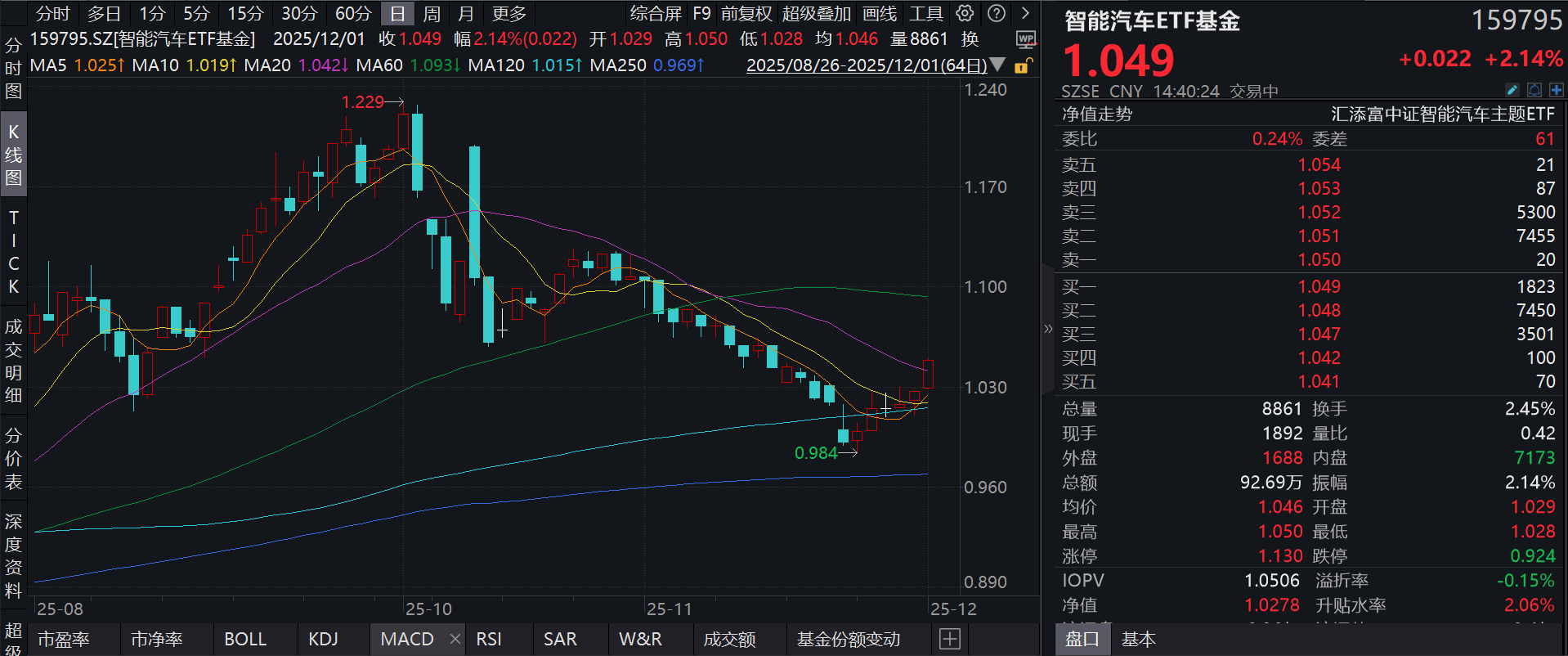
智能车板块走强,广和通20cm涨停,拓普集团涨超4%,智能汽车ETF基金(159795)涨超2%冲击3连涨,中国智能汽车产业链迎来全球化机遇
Sou Hu Cai Jing· 2025-12-01 07:03
Group 1: Market Performance - The China Securities Intelligent Vehicle Theme Index (930721) rose by 2.20% as of December 1, 2025, with component stocks such as Guanghetong (300638) increasing by 20.01% and Beijing Junzheng (300223) by 17.04% [1] - The Intelligent Vehicle ETF Fund (159795) also saw a rise of 2.14%, marking its third consecutive increase, with a latest price of 1.05 yuan [1] - Over the past week, the Intelligent Vehicle ETF Fund has accumulated a rise of 3.63% [1] Group 2: Company Developments - Leap Motor reported a record high delivery of 70,327 units in November, representing a year-on-year growth of over 75%, maintaining a growth trend for nine consecutive months [3] - Xiaomi Group announced the launch of its embodied AI model MiMo-Embodied, which integrates autonomous driving and embodied intelligence, with Xiaomi's vehicle deliveries exceeding 40,000 units in November [3] - Great Wall Motors introduced the VLA auxiliary driving model and previewed a new generation of the auxiliary driving system, CPMaster [3] Group 3: Investment Insights - Ideal Auto plans to invest 12 billion yuan in R&D for 2025, with over 6 billion yuan allocated to AI [4] - According to GF Securities, as overseas automakers lose market share, they are accelerating their smart technology advancements to enhance competitiveness, while Chinese brands are positioned to benefit from global opportunities in the intelligent vehicle supply chain [4] - The integration of intelligent vehicles and robotics is expected to expand the valuation ceiling of the sector, with the Intelligent Vehicle ETF Fund closely tracking the performance of leading companies in intelligent vehicle applications [4] Group 4: Index Composition - As of September 9, 2025, the top ten weighted stocks in the China Securities Intelligent Vehicle Theme Index (930721) include Chipone (688521), Luxshare Precision (002475), and Top Group (601689), collectively accounting for 48.47% of the index [4][5]





AI全域赋能,业绩周期与技术周期同步向上
Xinda Securities· 2025-12-01 03:03
Core Insights - The report emphasizes the upward synchronization of performance cycles and technology cycles in the computer industry, driven by AI empowerment and structural improvements in fundamentals [1][2][3] - The computer sector is characterized as a "bull market leader," with a significant resonance between fundamentals and liquidity, reflecting strong market recognition of revenue expansion potential [3][20] - The report forecasts substantial growth in various AI applications, including AI Coding, AI in office software, AI in finance, network security, intelligent driving, and industrial software, indicating a broad market opportunity [3][11][12][13][14][16][17] Group 1: AI Applications - AI Coding is projected to reshape software development paradigms, with a global market value expected to grow from $6.7 billion in 2024 to $25.7 billion by 2030, reflecting a compound annual growth rate (CAGR) of 25.2% [3][11][12] - The Chinese AI code generation market is anticipated to expand from 6.5 billion RMB in 2023 to 33 billion RMB by 2028, with a CAGR of 38.4% [3][12] - AI in office software is expected to reach a market size of 30.86 billion RMB in 2024, growing to 191.14 billion RMB by 2028, with a CAGR of 57.75% [3][12] - The network security market is projected to grow to $1.6 billion by 2028, with a CAGR exceeding 230%, driven by the integration of AI technologies [3][14] - Intelligent driving technologies are evolving towards L3 commercial applications, with significant growth in high-speed NOA penetration from 8.7% to 35.7% between 2023 and 2025 [3][16] Group 2: Investment Recommendations - The report suggests focusing on companies involved in AI Coding, such as Zhuoyi Information, and those in AI office software like Kingsoft Office and Foxit Software [3][11][12] - In the AI finance sector, companies like Tonghuashun and Jiufang Zhitu are highlighted for their innovative applications [3][13] - For network security, firms such as Deepin and Anheng Information are recommended due to their advancements in AI-driven security solutions [3][14] - In the intelligent driving space, companies like Desay SV and Zhongke Chuangda are noted for their leadership in high-performance driving solutions [3][16] - Industrial software firms like Zhongkong Technology and Rongzhi Rixin are recognized for their contributions to AI-driven industrial transformations [3][17]


计算机行业周报:AI Infra:重点关注数据层软件及MaaS-20251129
Shenwan Hongyuan Securities· 2025-11-29 15:20
Investment Rating - The report rates the industry as "Overweight," indicating a positive outlook for the sector's performance compared to the overall market [61]. Core Insights - The report emphasizes the importance of AI Infrastructure (AI Infra) as a foundational system for AI workloads, which includes computing power, storage, and networking [5][11]. - The AI Infra market in China is projected to grow significantly, reaching CNY 3.45 billion in 2024 and CNY 6.73 billion in 2025, representing a year-on-year growth of 95.1% [7][10]. - Key players in the AI Infra space include both domestic and international companies, with a focus on data layer software and models [4][36]. Summary by Sections AI Infra Overview - AI Infra is defined as the hardware and software systems designed to support AI workloads, aiming for efficient and large-scale AI model training and inference [5][11]. - The infrastructure consists of several layers, including computing, storage, and networking, with a focus on optimizing AI model performance [8][11]. Market Growth and Trends - The AI Infra market is expected to see rapid growth, with a significant increase in the number of AI applications anticipated in 2024 [29][32]. - The demand for private deployment and data integration solutions is rising, particularly in sectors with stringent data security requirements [29][36]. Key Players and Technologies - Major players in the AI Infra market include Alibaba Cloud, Huawei Cloud, and various startups focusing on Machine as a Service (MaaS) [12][13]. - Technologies such as virtualization and containerization are central to the computing management layer, enhancing resource utilization and efficiency [12][22]. Investment Opportunities - The report identifies several investment targets across different categories, including AIGC applications, digital economy leaders, and data infrastructure [52][53]. - Companies like Snowflake and MongoDB are highlighted as international benchmarks for data layer software, with strong revenue growth trends [36][38]. Future Outlook - AI infrastructure providers are expected to maintain high growth potential due to their critical role in supporting AI applications and the increasing integration of AI into traditional industries [51].



中国银河证券:双轮驱动下的行业变革 2026年Robotaxi迈入规模化商用拐点 @李程
Zhi Tong Cai Jing· 2025-11-28 05:41
Core Insights - The report from China Galaxy Securities highlights that by 2026, the Robotaxi sector is expected to reach a commercialization turning point driven by policy support, technological advancements, and cost reductions [1][3] - The automotive industry in China is projected to experience stable volume and gradual price increases in 2025, with a dual drive from exports and new energy vehicles [1][2] Group 1: 2025 Overview - In 2025, the Chinese automotive industry is expected to achieve a pattern of "stable volume and gradual price increase," supported by the effective recovery of domestic demand due to vehicle replacement policies [1] - Both wholesale and retail sales are anticipated to grow year-on-year, with an increasing penetration rate of new energy vehicles [1] - The industry is facing continued price wars, leading to further pressure on profitability, with revenue growth outpacing profit growth [1] Group 2: 2026 Outlook - The exemption of the new energy vehicle purchase tax is expected to continue until the end of 2025, with a reduction to half in 2026-2027, potentially impacting sales significantly, especially for vehicles priced below 300,000 yuan [2] - Major automakers like Hongmeng Zhixing, Leap Motor, Geely, and JAC are entering a period of intensive new product launches, which may enhance their sales and market share [2] - The mainstream automakers' pure electric platforms are expected to be validated by 2025, with new models being launched at scale in 2026 [2] - The rollout of L3-level intelligent driving technology is imminent, becoming a key driver for new model launches in 2026 [2] Group 3: Emerging Business Opportunities - The Robotaxi sector is benefiting from policy support, technological progress, and cost reductions, leading to a commercial breakthrough, with major manufacturers and tech giants expanding their operations [3] - Low-speed unmanned logistics vehicles and mining trucks are moving towards scale due to policy support and economic advantages [3] - The integration of the intelligent automotive supply chain with the robotics industry is creating multiple advantages, including technological migration and resource consolidation [3] Group 4: Investment Recommendations - The report recommends focusing on leading passenger vehicle manufacturers, the intelligent industry chain, and humanoid robotics industry, highlighting companies like Geely and Great Wall Motors as key players [3] - Beneficiary stocks include JAC Motors and Leap Motor in the passenger vehicle sector, and companies like SUTENG and Desay SV in the intelligent sector [3] - In the humanoid robotics sector, companies such as Top Group and Aikodi are identified as beneficiaries [3]



基金11月26日参与19家公司的调研活动
Zheng Quan Shi Bao Wang· 2025-11-27 04:04
Group 1 - A total of 30 companies were investigated by institutions on November 26, with 19 companies specifically targeted by funds, indicating a strong interest in these firms [1] - Luxshare Precision was the most popular among funds, with 94 funds participating in its investigation, while Desay SV and Noposion each attracted 17 funds [1] - The companies investigated are distributed across 12 industries, with the electronics and machinery sectors having the highest representation, each with 3 companies [1] Group 2 - Among the companies investigated, only 2 had a total market capitalization exceeding 500 billion, with Luxshare Precision being one of them, while 6 companies had market caps below 100 billion [1] - In terms of market performance, 6 of the investigated stocks increased in value over the past 5 days, with the highest gains seen in Yintan Zhikong (3.39%), Meilixin (1.86%), and Yian Technology (1.66%) [1] - Conversely, 13 stocks experienced declines, with the largest drops recorded by Chuaneng Power (-12.68%), Lianhua Technology (-11.98%), and Chongde Technology (-9.40%) [1] Group 3 - In terms of capital flow, 5 stocks saw net inflows over the past 5 days, with Luxshare Precision receiving the highest net inflow of 490 million yuan [2] - The only company to release an annual performance forecast among those investigated was Luxshare Precision, which anticipates a net profit of 16.852 billion yuan, representing a year-on-year increase of 26.09% [2]
