Hunan Yuneng New Energy Battery Material (301358)

Search documents
湖南裕能:向特定对象发行股票申请获证监会同意注册批复
Xin Lang Cai Jing· 2026-01-18 08:21
湖南裕能公告称,近日收到中国证监会《关于同意湖南裕能新能源电池材料股份有限公司向特定对象发 行股票注册的批复》。批复同意公司向特定对象发行股票注册申请,本次发行应按报送深交所的申报文 件和发行方案实施,批复自同意注册之日起12个月内有效。公司董事会将在规定期限内办理相关事宜并 及时披露信息。 ...

到欧洲北非去系列之四|西班牙,正上演中国汽车的“诺曼底登陆”
汽车商业评论· 2026-01-17 23:06
Core Viewpoint - The article discusses the strategic importance of Spain as a key entry point for Chinese automotive companies into the European market, highlighting various partnerships and investments that are reshaping the automotive landscape in Spain and beyond [4][12][20]. Group 1: Chinese Automotive Expansion in Spain - The establishment of a joint venture, EBRO, between Chery Automobile and Spanish company EV Motor in Barcelona marks a significant step in revitalizing the local automotive industry [6][24]. - Other Chinese companies, such as Leap Motor and Dongfang Automotive, are also setting up manufacturing bases in Spain, indicating a broader trend of Chinese automotive firms entering the European market [9][12]. - The article emphasizes that Spain serves as a strategic hub for Chinese automotive companies to access the EU market, leveraging its favorable trade conditions and logistical advantages [20][28]. Group 2: Economic and Market Context - Spain is the fifth largest new car market in the EU, with new car registrations expected to reach approximately 1.017 million in 2024, reflecting a 7.1% year-on-year growth [18]. - The EU's electric vehicle penetration rate is around 38%, making it a lucrative market for Chinese electric vehicle manufacturers [16]. - The article notes that by 2025, Chinese electric vehicle brands had captured over 11% of the European market share, indicating significant growth potential [16]. Group 3: Strategic Advantages of Spain - Spain's geographical position allows for efficient access to key markets in Europe, Latin America, and North Africa, enhancing the logistics and distribution capabilities for Chinese automotive firms [20][28]. - The country offers attractive tax incentives for new automotive ventures, including tax reductions and subsidies for companies that create jobs and invest in local production [27][28]. - The existing automotive ecosystem in Spain, characterized by a mature supply chain and skilled workforce, provides a conducive environment for Chinese companies to establish operations and innovate [34][35]. Group 4: Challenges and Adaptation - Chinese automotive companies face challenges in fully integrating into the local market and supply chain, necessitating a deep commitment to local partnerships and community engagement [29][32]. - The article highlights Chery's strategic approach of leveraging local assets and forming partnerships to mitigate risks associated with entering the European market [24][29]. - The need for Chinese firms to adapt to local regulations and consumer preferences is emphasized as crucial for long-term success in Spain and the broader European market [29][32].





锂电池产业链跟踪点评:2025年12月电池产销量同环比双增长
Dongguan Securities· 2026-01-16 09:56
Investment Rating - The industry investment rating is "Overweight," indicating that the industry index is expected to outperform the market index by more than 10% over the next six months [5]. Core Insights - In December 2025, the production and sales of new energy vehicles (NEVs) and batteries showed year-on-year growth but a month-on-month decline, primarily due to consumer hesitation during a subsidy policy gap [4]. - The penetration rate of NEVs reached 52.3% in December, a decrease of 0.9 percentage points month-on-month, while the annual penetration rate for 2025 was 47.9%, an increase of 7 percentage points year-on-year [4]. - The battery production and sales in December 2025 saw significant growth, with production at 201.7 GWh (up 14.4% month-on-month, 62.1% year-on-year) and sales at 199.3 GWh (up 11.1% month-on-month, 57.5% year-on-year) [4]. - The demand for power batteries is expected to weaken in the short term due to the traditional off-season for the NEV market and adjustments in the vehicle purchase tax [4]. - The solid-state battery industry is progressing towards commercialization, which will create incremental demand for materials and equipment in the industry chain [4]. Summary by Sections New Energy Vehicle Market - December 2025 saw NEV production and sales of 171.8 million and 171 million units, respectively, with year-on-year growth of 12.3% and 7.2%, but month-on-month declines of 8.6% and 6.2% [4]. - For the entire year of 2025, NEV production and sales reached 16.626 million and 16.49 million units, with year-on-year growth of 29% and 28.2% [4]. Battery Production and Sales - In December 2025, the production of power and energy storage batteries was 201.7 GWh, with a year-on-year increase of 62.1% [4]. - The sales of power batteries accounted for 72.1% of total sales, with a month-on-month increase of 7.3% and a year-on-year increase of 49.2% [4]. Export and Market Dynamics - Battery exports in December 2025 reached 32.6 GWh, with a year-on-year increase of 49.2% [4]. - The report anticipates stable demand in the energy storage market and potential short-term support for demand due to adjustments in export tax policies [4]. Investment Recommendations - The report suggests focusing on the recovery pace of the industry chain and prioritizing sectors benefiting from solid-state battery advancements, including core materials and equipment [4]. - Key stocks to watch include CATL, EVE Energy, and others listed in the report [4].




湖南裕能(301358):穿越周期的铁锂正极龙头
HTSC· 2026-01-16 08:05
Investment Rating - The report initiates coverage on Hunan YN Energy with a "Buy" rating, assigning a target price of 114.18 RMB based on a 22x PE for 2026 [3][9]. Core Views - Hunan YN Energy is a leading enterprise in lithium iron phosphate (LFP) with strong technical accumulation and excellent cost control, demonstrating robust profitability during industry downturns. The company is expected to benefit from a potential price increase cycle as industry supply and demand are anticipated to tighten [3][4]. - The demand for lithium iron phosphate is projected to grow significantly, with a compound annual growth rate (CAGR) of 72% from 2022 to 2024, outpacing the overall battery industry growth of 38%. The demand is expected to continue with growth rates of 63%, 49%, and 29% from 2025 to 2027 [4][31]. - The company has a strong cost advantage, with a single-ton cost at least 2,000 RMB lower than its peers, benefiting from large-scale production and low energy costs in regions like Yunnan and Guizhou [5][17]. - Hunan YN Energy enjoys a first-mover advantage in high-density products, with new products accounting for approximately 40% of sales in the first half of 2025, which enhances product pricing power [6][18]. Summary by Sections Industry Overview - The lithium iron phosphate sector is expected to enter a price increase cycle due to high demand growth and a slowdown in new supply. The industry is projected to maintain high capacity utilization rates of 72%, 75%, and 81% from 2025 to 2027, indicating a tightening supply-demand balance [4][16]. Cost and Efficiency - Hunan YN Energy has achieved significant cost advantages through vertical integration, self-supplying phosphoric acid, and benefiting from low electricity prices in resource-rich areas. The company’s large-scale production facilities further enhance its cost efficiency [5][17]. Technology and Product Development - The company is actively developing new materials and has a strong pipeline of high-value products, including manganese iron phosphate and lithium-rich manganese-based materials, which are expected to enhance its competitive position in the market [6][18]. Market Perspective - The report contrasts with market concerns regarding demand uncertainty post-subsidy reductions, asserting that strong support exists for both passenger and commercial vehicle battery demand, as well as for energy storage systems [7][19]. Financial Projections - Hunan YN Energy's projected net profits for 2025, 2026, and 2027 are 1.145 billion, 3.947 billion, and 4.994 billion RMB, respectively, reflecting year-on-year growth rates of 93%, 245%, and 27% [8][13].
湖南裕能股价连续6天下跌累计跌幅10.08%,金信基金旗下1只基金持48.21万股,浮亏损失329.27万元
Xin Lang Cai Jing· 2026-01-14 07:29
1月14日,湖南裕能跌0.21%,截至发稿,报60.96元/股,成交19.64亿元,换手率8.29%,总市值463.79 亿元。湖南裕能股价已经连续6天下跌,区间累计跌幅10.08%。 资料显示,湖南裕能新能源电池材料股份有限公司位于湖南省湘潭市雨湖区鹤岭镇日丽路18号,成立日 期2016年6月23日,上市日期2023年2月9日,公司主营业务涉及公司是国内主要的锂离子电池正极材料 供应商,专注于锂离子电池正极材料研发、生产和销售。公司的主要产品包括磷酸铁锂、三元材料等锂 离子电池正极材料,目前以磷酸铁锂为主,主要应用于动力电池、储能电池等锂离子电池的制造,最终应用 于新能源汽车、储能领域等。主营业务收入构成为:磷酸盐正极材料98.04%,其他(补充)1.96%。 截至发稿,黄飙累计任职时间4年237天,现任基金资产总规模15.33亿元,任职期间最佳基金回报 133.53%, 任职期间最差基金回报21.45%。 杨超累计任职时间4年250天,现任基金资产总规模21.86亿元,任职期间最佳基金回报111.22%, 任职 期间最差基金回报-22.52%。 从基金十大重仓股角度 风险提示:市场有风险,投资需谨慎。本文 ...
2025年11月新能源车销量高景气延续,碳酸锂价格快速上行
Zhong Guo Neng Yuan Wang· 2026-01-14 02:05
Core Viewpoint - The lithium battery industry is experiencing significant growth in production and demand, with notable increases in both battery and phosphoric iron lithium cathode material output in November 2025 compared to the same period in 2024 [1][2]. Production - In November 2025, domestic battery production reached 176.3 GWh, marking a year-on-year increase of 49.66% and a month-on-month increase of 3.34% [1][2]. - The production of phosphoric iron lithium cathode materials in December 2025 was 26.93 million tons, reflecting a year-on-year growth of 32.48% and a month-on-month growth of 0.16%, with a capacity utilization rate of 59.85% [1][2]. Pricing - As of January 9, 2026, the price of industrial-grade lithium carbonate rose to 138,000 yuan per ton, with a weekly increase of 17.92% [3]. - The price of phosphoric iron lithium (for power) was reported at 47,100 yuan per ton on January 9, 2026, up 4.43% from January 4 [3]. - The price of lithium hexafluorophosphate slightly decreased to 160,700 yuan per ton on January 10, 2026, down 10.72% from January 3 [3]. Demand - In November 2025, the monthly shipment volume of phosphoric iron lithium batteries reached 75.3 GWh, a year-on-year increase of 43.62% and a month-on-month increase of 11.56%, setting a new high for the year [4]. - The monthly shipment volume of ternary power batteries was 18.2 GWh, reflecting a year-on-year increase of 33.82% and a month-on-month increase of 10.30% [4]. - The new bidding capacity for domestic new energy storage projects in January to October 2025 was higher than in the same period of 2024, with a total new bidding scale of 21.8 GW/64 GWh in November, marking a month-on-month increase of 65% [4]. - In November 2025, China's battery exports were 21.2 GWh, a year-on-year increase of 69.60% and a month-on-month increase of 9.28% [4]. - Global sales of new energy vehicles reached 2 million units in November 2025, a year-on-year increase of 8.53% and a month-on-month increase of 4.63% [4]. Investment Recommendations - The domestic production of batteries and phosphoric iron lithium cathode materials in January to November 2025 exceeded that of 2024, with stable raw material and cell prices, and an increase in monthly battery shipments and new energy storage bidding capacity [5]. - The rising demand for lithium batteries suggests a focus on companies involved in lithium battery materials [5]. - Recommended companies include CATL (300750), Yiwei Lithium Energy (300014), Xinwanda (300207), Hunan Youneng (301358), Rongbai Technology (688005), Tianci Materials (002709), and Duofluoride (002407) [5].


锂电行业跟踪:2025年11月新能源车销量高景气延续,碳酸锂价格快速上行
Shanghai Aijian Securities· 2026-01-13 10:34
Investment Rating - The industry is rated as "Outperform" [3] Core Insights - The production of positive electrode materials has increased significantly, with domestic battery production reaching 176.3 GWh in November 2025, a year-on-year growth of 49.66% [3] - Lithium carbonate prices have risen sharply, reaching 138,000 CNY per ton as of January 9, 2026, with a weekly increase of 17.92% [3] - The demand for lithium iron phosphate batteries has shown strong growth, with a monthly loading volume of 75.3 GWh in November 2025, marking a year-on-year increase of 43.62% [3] Summary by Sections Production - In November 2025, the production of lithium iron phosphate positive electrode materials was 26.93 million tons, a year-on-year increase of 32.48% [3] Prices - As of January 9, 2026, the price of lithium iron phosphate (power type) was reported at 47,100 CNY per ton, up 4.43% from January 4, 2026 [3] - The average price of square lithium iron phosphate energy storage batteries remained stable, with slight increases noted for various capacities [3] Domestic Demand - The monthly loading volume for lithium iron phosphate batteries reached a new high in November 2025, with significant increases in both domestic and new energy storage project bidding capacities [3] Overseas Demand - In November 2025, China's power battery exports reached 21.2 GWh, a year-on-year increase of 69.60% [3] - Global new energy vehicle sales reached 2 million units in November 2025, reflecting a year-on-year growth of 8.53% [3]
两家磷酸铁锂企业宣布提价 一家提价1500—2000元/吨 产线检修或加剧涨势
Xi Niu Cai Jing· 2026-01-13 08:45
Group 1 - The core point of the article is that lithium iron phosphate (LFP) companies have raised prices for downstream customers due to tight supply, driven by strong demand in energy storage and better-than-expected sales forecasts for electric vehicles [2] - One company has increased prices for major customers by 1500 to 2000 yuan per ton, indicating a significant price adjustment in the market [2] - Despite January typically being a slow season for the industry, recent positive developments in the lithium battery sector, including rising raw material prices and news of production halts, have stimulated market sentiment [2] Group 2 - Multiple LFP production companies, including Hunan Youneng, Deyang Nano, Wanrun New Energy, and Anda Technology, have announced production halts for maintenance, which is expected to have a short-term impact on supply and is interpreted as a contraction signal by the market [4] - Wanrun New Energy has stated that its LFP production lines have been operating beyond capacity since Q4 2025, and it will conduct maintenance starting December 28, 2025, which is expected to reduce LFP output by 5,000 to 20,000 tons [4] - Hunan Youneng's production capacity utilization exceeded 100% in 2025, and it will also conduct maintenance on some production lines starting January 1, 2026, with an expected reduction in output of 15,000 to 35,000 tons of phosphate cathode materials [4] - The first price increase for LFP has been accepted by most customers, with processing fees rising by 1,000 yuan per ton, although some major customers are still in negotiations [4]

兴业证券:需求双轮驱动+供给刚性约束 锂电材料行业景气上行
智通财经网· 2026-01-13 02:53
Group 1 - The core viewpoint of the report is that global lithium battery demand is expected to grow at a rate of 26% year-on-year by 2026, driven by both power storage and electric vehicle sectors [1][4] - In the electric vehicle sector, the registration of global electric vehicles reached 17.1 million units from January to October 2025, representing a year-on-year increase of 25.5%, primarily due to the resumption of subsidies in Europe and vehicle replacement policies in China [1][4] - The global energy storage battery shipments reached 428 GWh from January to September 2025, showing a significant year-on-year increase of 90.7%, supported by the scaling of independent storage projects in China and market demand in the U.S. [1][4] Group 2 - The lithium battery materials supply side is undergoing optimization due to previous overcapacity leading to low-price competition, resulting in many companies facing continuous losses and high debt levels [2][3] - Companies are focusing on improving existing production efficiency and cost optimization rather than blind expansion, leading to a significant weakening of expansion capabilities and intentions among lithium battery material companies [2][3] - The tightening of environmental policies and energy consumption controls is raising industry entry barriers, causing smaller companies to exit the market, thus enhancing the rigidity of supply constraints [2][3] Group 3 - Technological upgrades are driving supply-side optimization, with advancements in high-pressure lithium iron phosphate and high-strength separators, which require higher production precision and R&D investment [3][4] - Leading companies are leveraging continuous R&D investment to scale up high-end product capacity, while smaller firms struggle to upgrade their products and processes, leading to market elimination [3][4] - The supply structure is evolving towards a "few but excellent" model, with resources concentrating on leading enterprises, which is expected to restore market share and profitability for these companies [3][4] Group 4 - The report indicates a strong certainty of profit recovery in lithium battery materials, driven by supply-side constraints, high demand growth, and industry restructuring [4] - The consensus among companies to scientifically release capacity has led to a continued limitation of supply over the next 1-2 years, while demand is experiencing rapid growth from both power storage and electric vehicle sectors [4] - Core material prices, such as lithium hexafluorophosphate, have started to rebound, and the overall capacity utilization rate in the industry is expected to continue its upward trend in 2026 [4] Group 5 - Investment recommendations suggest prioritizing attention on lithium hexafluorophosphate and lithium iron phosphate sectors, with specific companies like Tianqi Materials and Hunan Youneng being highlighted [5] - Other companies to watch include Duofu Technology, Fulian Precision, Longpan Technology, Defang Nano, Tianji Co., Shida Shenghua, and Wanrun New Energy, particularly in the context of price recovery [5] - For long-cycle, heavy-asset sectors like copper foil and separators, companies such as Enjie, Xingyuan Materials, Fusheng Technology, Defu Technology, Jiayuan Technology, and Nord are recommended for attention [5]


光伏锂电出口退税新政出台 一季度产能释放“淡季不淡”
2 1 Shi Ji Jing Ji Bao Dao· 2026-01-12 14:40
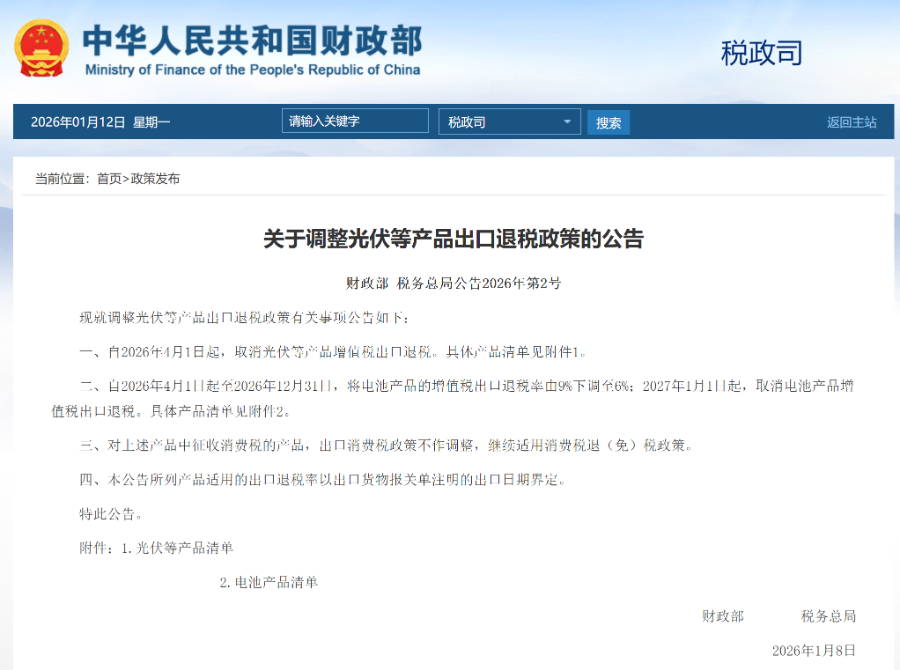
Core Viewpoint - The recent announcement by the Ministry of Finance and the State Taxation Administration to cancel export VAT rebates for photovoltaic and battery products is seen as a significant measure in the "anti-involution" actions within the new energy sectors, aimed at addressing the industry's profitability issues and promoting higher value-added products [5][6][8]. Industry Overview - The new energy photovoltaic and lithium battery industries have been facing challenges due to mismatched supply and demand and intense price competition, leading to weak profitability across the sector [3]. - Since 2025, there have been ongoing calls within the lithium battery sector to resist vicious competition, control capacity growth, and enhance technological innovation [3]. Policy Changes - Starting from April 1, 2026, the export VAT rebate for photovoltaic products will be canceled, and the rebate rate for battery products will be reduced from 9% to 6% until the end of 2026, after which it will be completely eliminated [1][5]. - The Ministry of Industry and Information Technology and other regulatory bodies have proposed 20 measures to regulate industry competition, including tightening approvals for low-capacity projects and establishing a cost-based price monitoring mechanism [4]. Market Reactions - Following the announcement, the stock performance of key players in the lithium battery sector showed significant volatility, with leading companies like CATL experiencing declines, while some photovoltaic companies saw substantial gains [1]. - The cancellation of export VAT rebates is expected to lead to an increase in the cost and price of Chinese photovoltaic components in overseas markets, which may help clear out low-end production capacity [8]. Price Trends - The prices of lithium carbonate futures have surged to over 160,000 yuan per ton, compared to 60,000 yuan per ton in June 2025, indicating a significant recovery in the battery materials market [6]. - The demand for upstream materials remains strong, with companies reporting full production capacity and no immediate adjustments in order volumes from downstream clients [7]. Future Outlook - The upcoming policy changes are anticipated to drive a surge in orders for photovoltaic components before the new VAT regulations take effect, although this demand may be temporary [7]. - Long-term, the cancellation of export VAT rebates is expected to facilitate industry consolidation and price normalization, benefiting the overall market structure [8].