NIO(NIO)

Search documents
造车新势力Q3财报
2 1 Shi Ji Jing Ji Bao Dao· 2025-12-01 23:13
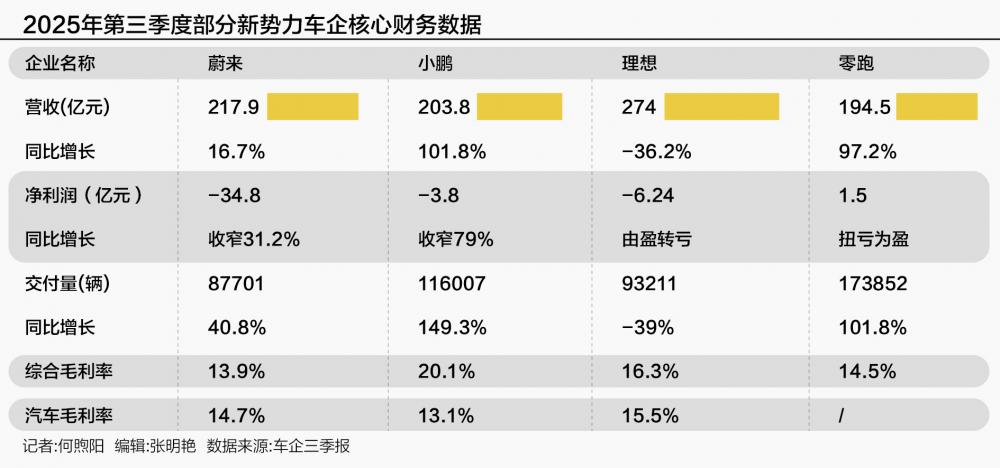
Core Insights - The competitive landscape of new energy vehicle manufacturers in China is undergoing significant changes as Q3 2025 financial reports are released, with Xpeng Motors showing remarkable growth while NIO and Li Auto face challenges [1][2][3] Company Performance - **Xpeng Motors**: Achieved a revenue of 203.8 billion yuan, with a year-on-year growth of 101.8%. Despite a net loss of 3.8 billion yuan, this represents a 79% reduction in losses compared to the previous year. The company delivered 116,007 vehicles, marking a 149.3% increase year-on-year [4][6][8] - **NIO**: Reported a revenue of 217.9 billion yuan, with a year-on-year growth of 16.7%. The net loss was 34.8 billion yuan, a 31.2% reduction from the previous year. NIO delivered 87,701 vehicles, a 40.8% increase year-on-year [4][12][14] - **Li Auto**: Generated a revenue of 274 billion yuan, but experienced a 36.2% year-on-year decline. The company reported a net loss of 6.24 billion yuan, ending an 11-quarter streak of profitability. Vehicle deliveries fell by 39% to over 93,000 units [4][9][11] - **Leap Motor**: Achieved a revenue of 194.5 billion yuan, with a year-on-year growth of 97.2%. The company reported a net profit of 1.5 billion yuan, marking its second consecutive profitable quarter. Leap Motor delivered nearly 174,000 vehicles, a 101.8% increase year-on-year [4][15][16] Strategic Adjustments - The new energy vehicle market is shifting from growth to competition based on product, technology, and brand strength, as companies adapt their strategies to survive in a more competitive environment [3][16] - **Xpeng Motors**: Focused on improving operational efficiency and profitability, launching new models like the X9 Super Range Extender, which aims to address consumer pain points regarding range and charging speed [7][8] - **Li Auto**: Shifted focus towards AI integration in vehicles, moving away from traditional family-oriented branding to emphasize technological advancements [10][11] - **NIO**: Reduced operational costs and refocused on core automotive sales, moving away from previous explorations in other business areas [12][13] - **Leap Motor**: Adjusted its strategy to enter the range extender market and target the high-end SUV segment, while also attempting to elevate its brand image [15][16]




连滚带爬又过了一个月,车市没人从从容容
汽车商业评论· 2025-12-01 23:06
Core Insights - The article discusses the current state of the Chinese automotive market, highlighting the challenges faced by traditional and new energy vehicle manufacturers, as well as the impact of major events like the Guangzhou Auto Show on industry dynamics [1][4][5]. Group 1: Market Trends - The Guangzhou Auto Show has lost its previous excitement, with luxury brands like Bentley, Porsche, and Lamborghini absent this year, reflecting a cooling market [5]. - New energy vehicle sales are showing mixed results, with companies like NIO and Li Auto facing significant challenges, while others like Leap Motor are achieving record deliveries [15][17]. - The competition remains fierce, with many companies reducing prices to attract consumers, indicating a price war in the market [10][12]. Group 2: New Energy Vehicle Performance - Leap Motor achieved a record delivery of 70,327 units in November, surpassing its annual sales target ahead of schedule [14]. - Xiaopeng Motors reported a delivery of 36,728 units in November, showing a month-on-month decline of 12.58% but a year-on-year increase of 18.88% [15]. - NIO's deliveries reached 36,275 units, with a year-on-year growth of 76.3%, indicating a strong recovery despite a month-on-month decline [15]. Group 3: Traditional Automakers - Geely's November sales reached 310,400 units, a year-on-year increase of 24%, driven by strong performance in the new energy segment [31]. - BYD's sales decreased by 5.24% in November, with total sales of 480,200 units, although its overseas sales continue to grow significantly [36]. - Changan and other traditional automakers are also experiencing varied performance, with some brands like Great Wall Motors showing growth while others struggle [39][41]. Group 4: Strategic Partnerships - Huawei is expanding its influence in the automotive sector, collaborating with multiple automakers to enhance smart vehicle technologies, with significant deliveries reported for models equipped with Huawei's systems [20][22]. - The partnership between GAC Group and Huawei has led to the launch of new brands, indicating a trend of traditional automakers embracing tech collaborations [22][29]. Group 5: Future Outlook - The article suggests that the automotive market is at a critical juncture, with companies needing to adapt quickly to changing consumer preferences and competitive pressures [10][30]. - The focus on electric vehicles and smart technologies is expected to continue shaping the industry landscape, with companies like NIO and Xiaopeng Motors aiming for profitability in the near future [17][18].




造车新势力Q3财报:李斌、李想、何小鹏终于活成了对方的模样
2 1 Shi Ji Jing Ji Bao Dao· 2025-12-01 22:38
Core Insights - The competitive landscape of new energy vehicle manufacturers in China is undergoing significant changes as Q3 2025 financial reports are released, with companies adjusting strategies to improve profitability and market positioning [1][2] Company Summaries XPeng Motors - XPeng Motors has seen a remarkable turnaround with a revenue increase of 101.8% year-on-year, despite a net loss of 380 million yuan, which has narrowed by 79% compared to the previous year [1][3] - The company achieved a record delivery volume of 116,000 vehicles in Q3, marking a 149.3% increase year-on-year [4] - XPeng is launching the X9 Super Extended Range model, which has received four times the pre-order volume compared to its predecessor, indicating strong market interest [5] NIO - NIO has managed to reduce its net loss by 31.2% year-on-year, although it remains the largest loss-maker among new energy vehicle manufacturers [1][3] - The company is focusing on cost reduction and efficiency, with a significant cut in R&D expenses by 28% year-on-year [8] - NIO's delivery volume reached 87,000 vehicles in Q3, with a goal to achieve a gross margin of 20% for the ES8 model in Q4 [9] Li Auto - Li Auto reported a revenue of 27.4 billion yuan in Q3, a decline of 36.2% year-on-year, marking the end of its 11-quarter profitability streak with a net loss of 624 million yuan [6][7] - The company is shifting its focus towards AI technology, aiming to transform vehicles into intelligent products, while still facing challenges in its pure electric vehicle transition [7] - Li Auto's delivery volume fell by 39% year-on-year, indicating a need for strategic reassessment [6] Leap Motor - Leap Motor achieved a revenue of 19.45 billion yuan in Q3, with a year-on-year growth of 97.2%, and reported a net profit of 150 million yuan, marking its second consecutive profitable quarter [10][11] - The company is entering the extended range market with its new D19 model, targeting the competitive 300,000 yuan SUV segment [10] - Despite strong sales growth, Leap Motor's profitability remains low, raising concerns about its long-term financial health [11] Industry Trends - The Chinese new energy vehicle market is transitioning from growth to a more competitive landscape, where companies must leverage product, technology, and brand strengths to survive [2] - The focus on profitability is becoming increasingly critical as the market matures, with companies needing to adapt their strategies to meet evolving consumer demands and competitive pressures [1][10] - The competitive dynamics are shifting as companies learn from each other, blurring the lines of their original market positioning [2]
热门中概股收盘多数上涨


Xin Lang Cai Jing· 2025-12-01 22:34
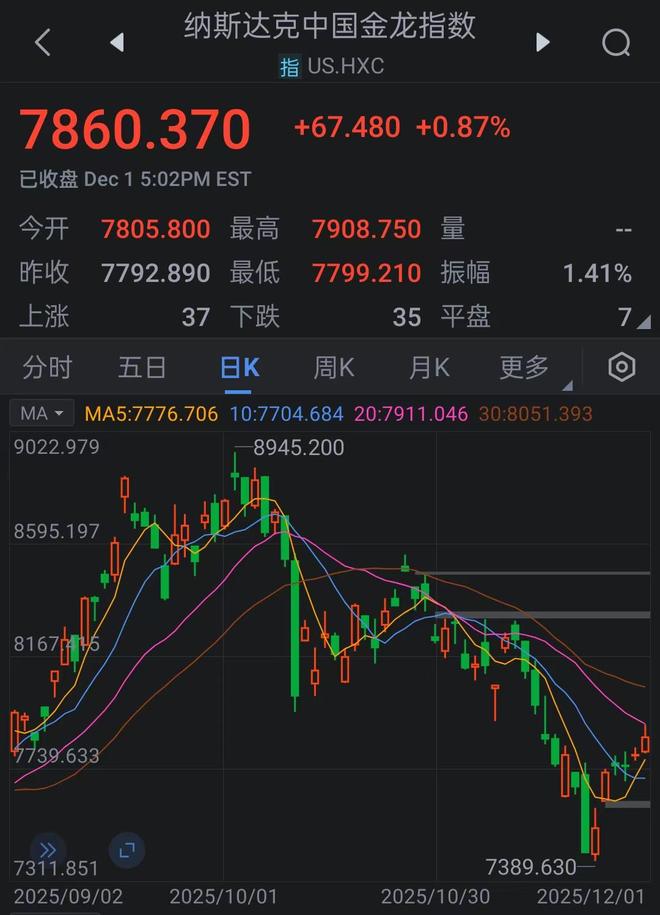
Core Viewpoint - The majority of popular Chinese concept stocks experienced an increase in their closing prices on Monday, with the Nasdaq Golden Dragon China Index rising by 0.87% [1] Group 1: Stock Performance - Alibaba saw a significant increase, rising over 4% [1] - Pinduoduo increased by more than 1% [1] - NetEase rose by over 5% [1] - Baidu experienced a rise of over 2% [1] - Xpeng declined by more than 2% [1] - Beike fell by over 3% [1] - Li Auto dropped by more than 2% [1] - NIO saw a decrease of over 5% [1]
Here's Why You Should Retain NIO Stock in Your Portfolio Now
ZACKS· 2025-12-01 15:22
Core Insights - NIO Inc. is positioned for significant growth due to a strong vehicle lineup and expansion beyond luxury models, although challenges such as subsidy phaseouts and rising operating costs may hinder progress [1][6][8] Vehicle Lineup and Growth - NIO's expanding vehicle portfolio, including models like ES6, ET5T, ES8, and others, is driving delivery growth, with expectations of 40,000 ES8 units sold in 2025, primarily in Q4 [2][4] - The introduction of the ONVO brand and Firefly brand is expected to enhance volume, with ONVO's L60 model delivering 33,000 units in its first three months and Firefly delivering over 26,000 units in its first six months [3][8] Margin Improvement - Vehicle margins improved to 14.7% in Q3 2025 from 13.1% in Q3 2024, with expectations to reach 20% overall due to new model launches and cost synergies [4][8] Battery Swap Technology - NIO's battery swap technology, part of its BaaS strategy, provides a competitive advantage, with over 3,641 swap stations and more than 27,000 chargers installed [5] Challenges and Risks - The phaseout of trade-in and replacement subsidies is expected to dampen demand, particularly affecting lower-priced models like ONVO L60 and L90 [6][8] - Rising SG&A expenses, which increased by 1.8% year-over-year, are anticipated to continue due to increased sales and marketing efforts [7][8] - NIO's long-term debt to capital ratio stands at 0.82, significantly higher than the industry average of 0.27, limiting financial flexibility [8][9]
车企11月“翘尾”行情降温,比亚迪月度销量仍未超50万辆
Zhong Guo Ji Jin Bao· 2025-12-01 15:20
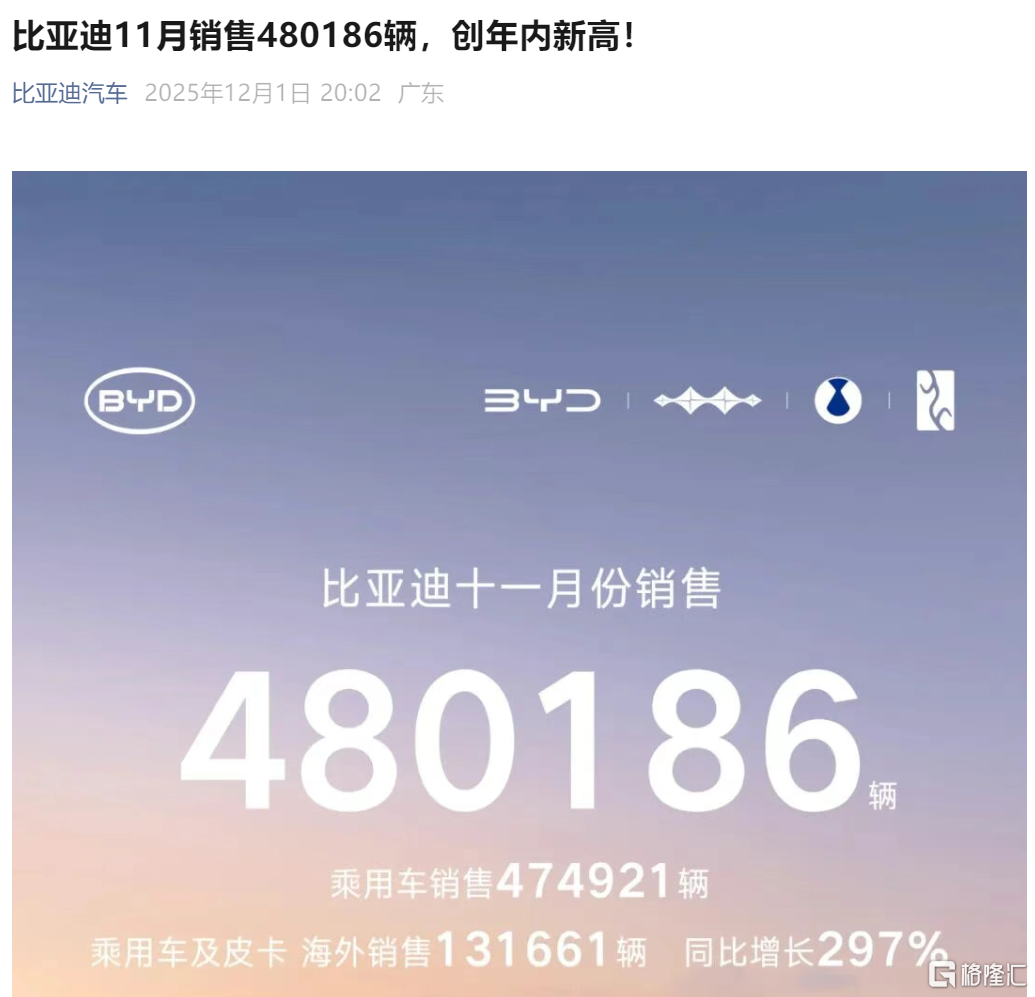
Core Insights - The automotive industry in China is experiencing a mixed performance in November, with some leading companies showing a slowdown in sales growth or declines, while others achieve record sales [2][3][21] - BYD's November sales reached 480,186 units, a year-on-year decrease of 5.25%, with domestic sales down 26.81% [2][5][11] - New energy vehicle companies like Leap Motor and others have successfully met their annual delivery targets ahead of schedule [15][17] Group 1: Sales Performance - BYD's November sales were 480,186 units, failing to surpass the 500,000 mark [5][11] - SAIC and Geely saw significant year-on-year growth in November, with sales increasing by 19.75% and 53.36%, respectively [11][12] - Leap Motor's sales reached 70,327 units, marking a 75.08% increase year-on-year [4][15] Group 2: Market Trends - The expected year-end sales surge, known as the "tailwind effect," is cooling down, with many companies reporting lower growth rates compared to the previous year [21][22] - NIO's delivery guidance for Q4 remains unchanged, expecting deliveries between 120,000 and 125,000 units [21][22] - The suspension of vehicle trade-in subsidies in several regions is impacting short-term sales expectations [21][22] Group 3: Competitive Landscape - Geely's new energy vehicle penetration rate reached a record high of 60.50% in November, driven by the success of its Galaxy brand [12][14] - New energy vehicle companies like Lantu and Avita are also seeing significant sales growth, with Lantu's sales up 84.28% year-on-year [19][20] - Xiaomi and Xpeng have also set ambitious new sales targets for 2025, reflecting confidence in their market positions [17][15]


利好突袭!暴增112%!
券商中国· 2025-12-01 15:17
Core Viewpoint - The article highlights significant growth in the sales of electric vehicles (EVs) in November, indicating a strong upward trend in the Chinese EV market and the potential for continued growth in the coming years [1][2][5]. Sales Data Summary - Multiple EV manufacturers reported their November sales figures, with notable performances: - BAIC BluePark's subsidiary, BAIC New Energy, sold over 30,000 units, a year-on-year increase of 112.71% [1][2]. - NIO delivered 36,275 vehicles, up 76.3% year-on-year [1][2]. - Leap Motor achieved 70,327 deliveries, marking a growth of over 75% [1][2]. - Seres sold 55,203 units, a 49.84% increase, setting a new historical high [1][3]. - BYD's sales reached 480,200 units, while Li Auto delivered 33,181 vehicles [1][4]. - Xiaomi's deliveries exceeded 40,000 units [1][4]. Market Share and Growth Projections - The global automotive market is projected to reach 8.64 million units by October 2025, with a year-on-year growth of 4% [1]. - China's share of the global automotive market has improved, reaching 38% in October, an increase of 1 percentage point from the previous year [1]. - The domestic EV market is expected to maintain high growth rates in 2025, driven by increased demand for batteries and materials [1][5]. Policy Support and Industry Outlook - Recent government policies are expected to bolster the EV sector, including a requirement for at least 30% of government vehicle purchases to be EVs by December 2024 [5]. - The inclusion of fuel cell vehicles in government procurement standards is anticipated to provide further support to the industry [5]. - The penetration rate of EVs in China has surpassed 50%, indicating a shift from subsidy-driven growth to market-driven dynamics [6]. Component and Technology Trends - The demand for intelligent components, such as smart cockpits and electric drive systems, is rapidly increasing, benefiting related companies [7]. - The overall automotive and component industry is expected to see significant investment opportunities due to trends in electrification and globalization [7].



11月压力大!车企销量看环比就露馅
Jing Ji Guan Cha Bao· 2025-12-01 15:03
Group 1 - The Chinese automotive market remains strong in November, but the impact of subsidy reductions is spreading beyond price-sensitive consumers, leading to a general delay in purchasing decisions [2] - NIO's CEO Li Bin noted a significant drop in new orders across the industry in November, with consumers adopting a wait-and-see approach [2] - BYD's sales in November reached 480,000 units, a year-on-year decline of 5.25%, indicating a shift from rapid growth to a need for structural adjustment [2] Group 2 - Geely's sales in November were 310,000 units, a year-on-year increase of 24%, supported by multiple product lines [3] - SAIC's overall sales reached 316,000 units, with a growth rate of 9.5%, indicating a stable performance across its brands [3] - Great Wall and Chery maintained steady sales, with Great Wall selling 133,200 units (up 4.57%) and Chery selling 255,800 units (down 2%) [3] Group 3 - The new energy vehicle segment is gaining traction among state-owned enterprises, with Dongfeng's Lantu surpassing 20,000 units in November [4][5] - Traditional brands like FAW showed stable performance, with total sales of 306,000 units in November, including a significant increase in new energy vehicle sales [5] Group 4 - Huawei's automotive strategy is evolving, with its smart vehicle delivery reaching 81,864 units in November, reflecting its growing influence in the industry [6] - The competition is shifting from vehicle-to-vehicle to ecosystem-to-ecosystem, highlighting the importance of integrated capabilities [6] Group 5 - New entrants like Leap Motor delivered 70,327 units in November, marking a year-on-year growth of over 75%, positioning themselves as significant competitors [6] - Xiaomi maintained stable delivery levels above 40,000 units, while XPeng and NIO also reported strong growth in November [7] Group 6 - The automotive market is entering a phase that tests companies' capabilities, with consumers becoming more discerning and extending their decision-making processes [8] - The focus of competition is shifting from subsidies to long-term brand value, supply chain stability, and technological advancement [9]


11月车市厮杀落幕!鸿蒙智行爆卖超8万,零跑、赛力斯刷新纪录
Ge Long Hui· 2025-12-01 15:00
Group 1: Overall Market Performance - In November, major automakers revealed their sales figures, indicating a shift in the competitive landscape among leading companies [1] - BYD maintained its top position with sales of 480,186 units, marking a year-to-date total of 4.182 million units, a year-on-year increase of 11.3% [2] - The overall passenger car market retail sales from November 1 to 23 reached 1.384 million units, a year-on-year decline of 11% [20] Group 2: New Energy Vehicle (NEV) Performance - Hongmeng Zhixing achieved remarkable growth with total deliveries of 81,864 units, a year-on-year increase of 89.61%, setting a new monthly delivery record [5] - Leap Motor also set a new record with 70,327 units delivered in November, reflecting a growth of over 75% year-on-year [7] - Seres sold 55,203 units, a year-on-year increase of 49.84%, achieving a new historical high [9] Group 3: Emerging Players - Xiaomi's automotive division continued to deliver over 40,000 units in November [10] - XPeng Motors delivered 36,728 smart electric vehicles, a year-on-year increase of 19%, with a cumulative delivery of 391,937 units for the year [11] - NIO delivered 36,275 vehicles in November, a year-on-year increase of 76.3%, with cumulative deliveries reaching 949,457 units [13] Group 4: Traditional Automakers - Geely performed notably well with total sales of 310,428 units in November, a year-on-year increase of 24%, and a year-to-date total of 2.78775 million units, up 42% [19] - Great Wall Motors sold 133,200 units in November, a year-on-year increase of 4.57%, with NEV sales reaching 40,113 units [19] Group 5: Market Trends and Future Outlook - The automotive market is expected to face challenges in the fourth quarter, with cautious sales guidance from multiple automakers due to subsidy adjustments and earlier demand surges [20][21] - A significant policy change is set for January 1, 2026, where the full exemption from vehicle purchase tax for NEVs will shift to a 50% reduction, potentially impacting consumer demand [22]
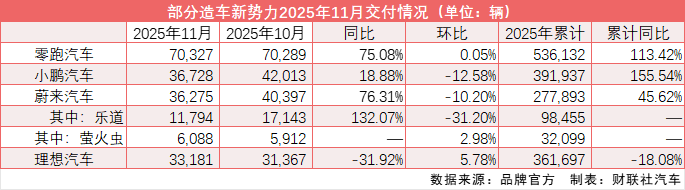
造车新势力11月齐遇“寒流”:“蔚小理”集体环比下滑
Feng Huang Wang· 2025-12-01 15:00
Core Viewpoint - The new energy vehicle market is experiencing varied delivery performances among different manufacturers in November, with some companies showing growth while others face declines. The overall market sentiment is cautious due to tightening policies and consumer hesitation. Group 1: Delivery Performance - Leap Motor led the delivery numbers with 70,327 units in November, marking a 75.08% year-on-year increase and a slight 0.05% month-on-month growth, achieving its annual sales target of 500,000 units 45 days ahead of schedule [2][3] - Xiaopeng Motors delivered 36,728 units, reflecting an 18.88% year-on-year increase but a 12.58% month-on-month decline, marking its first monthly drop in six months [3][4] - NIO delivered 36,275 units, a 76.31% year-on-year increase, with its sub-brands showing significant growth, particularly the LeDao brand with a 132.07% increase [2][3] - Li Auto's deliveries were at 33,181 units, showing a 31.92% year-on-year decline, continuing a six-month trend of year-on-year decreases [4][5] Group 2: Future Projections and Strategies - Leap Motor aims to reach a sales target of 1 million units by 2026, supported by the launch of new models like the A10 and Lafa5, which cater to different market segments [3][4] - Xiaopeng Motors is expanding its overseas market presence, with a 95% year-on-year increase in overseas deliveries, and is optimistic about new models contributing to future growth [3][4] - NIO has set a quarterly delivery guidance of 120,000 to 125,000 units, needing to deliver over 43,000 units in December to meet this target [4] - Li Auto is focusing on enhancing its long-term competitiveness through organizational, product, and technological improvements, with a cautious delivery guidance of 100,000 to 110,000 units for the fourth quarter [5]