美的

Search documents
泓淋电力20260629
2025-06-30 01:02
Summary of Hongyun Electric's Conference Call Company Overview - **Company**: Hongyun Electric - **Acquisition**: Acquired 54.16% stake in Dawai Interconnect in January 2025 to expand into AI computing and new energy high-speed cable sectors [2][3][10] Financial Performance - **2024 Revenue**: Approximately 3.4 billion RMB with a net profit of around 200 million RMB [2][10] - **2025 Revenue Projection**: Expected to reach 4 billion RMB in traditional business [2][10] - **Dawai Interconnect Q1 2025 Performance**: Generated over 30 million RMB in revenue and over 7 million RMB in net profit, nearing last year's total [4][10] - **2025 Total Revenue Target**: 41-42 billion RMB, with traditional business at 35 billion RMB and new energy at 5 billion RMB [5][10] Business Segments Traditional Business - **Segments**: Home appliances, computers, terminals, and new energy [3][10] - **Key Clients**: Includes major brands like Dell, HP, Samsung, LG, and BYD [5][7][9] New Energy Business - **Products**: New energy charging guns, cables, and sockets [9][10] - **Market Position**: Exclusive supplier for Xiaomi's SU7 charging gun, holding 70% market share for SAIC-GM Wuling Bingo model [2][9][10] - **Profit Margins**: Charging guns have a gross margin of 10%-20%, higher than traditional business [2][21] Dawai Interconnect Insights - **Client Structure**: Top three clients account for 70%-80% of revenue [13][14] - **Revenue Growth**: Expected to exceed 200 million RMB in 2025, with a long-term goal of becoming a market leader in high-speed cables [12][15] - **Profitability**: Gross margin over 30% and net margin over 20% [14][26] Market Dynamics - **Automotive Wiring Market**: Significant growth potential, with high-voltage wiring market estimated at 300-500 billion RMB [24][26] - **Competitive Landscape**: Domestic manufacturers gaining market share but still lagging behind international giants like TE Connectivity and Amphenol [24][26] Future Outlook - **2026 Revenue Target**: Aim to reach 5 billion RMB in high-speed cable revenue and total revenue of 50 billion RMB [26] - **Margin Expectations**: Traditional business net margin around 5%-6%, while high-speed cables expected to achieve 30%-40% gross margin [26] Additional Insights - **Production Equipment**: Investment in Rosenberger equipment to enhance production quality and expand product lines [16][18] - **Challenges**: Domestic production of high-speed cable equipment faces challenges, relying on imported technology [17][18] - **Collaboration with Xiaomi**: Exploring further partnerships in high-voltage and low-voltage wiring for electric vehicles [23][20] This summary encapsulates the key points from the conference call, highlighting Hongyun Electric's strategic direction, financial performance, and market positioning.
美的还有成长空间吗?
虎嗅APP· 2025-06-24 23:43
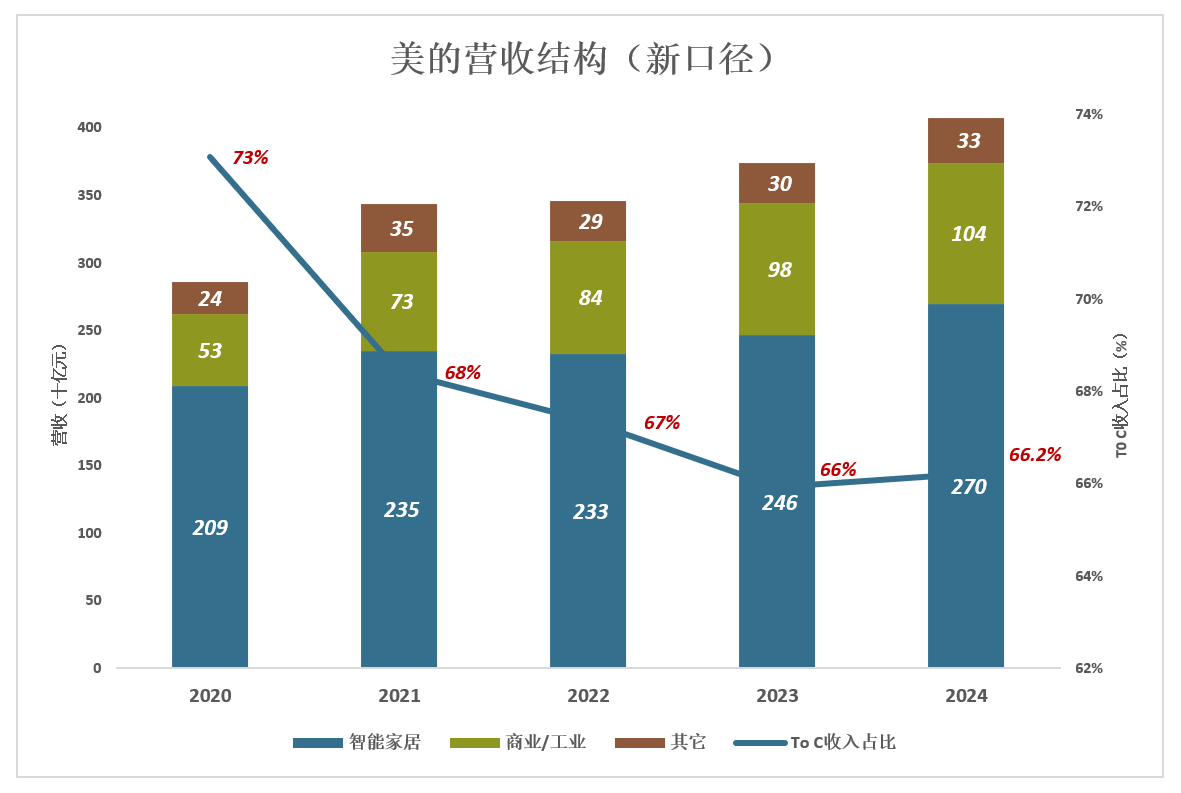
Core Viewpoint - Goldman Sachs has identified the "Ten Giants" of the Hong Kong stock market, which includes Tencent, Alibaba, BYD, Xiaomi, Meituan, Midea, NetEase, Ctrip, Anta, and Heng Rui Pharmaceutical, with a total market capitalization of approximately $1.6 trillion. Notably, Baidu and JD.com are excluded from this list [3]. Group 1: Market Overview - The global home appliance market is projected to reach a sales volume of 3.9 trillion RMB in 2024, with China, Europe, and North America accounting for 66.8% of the total sales [4]. - In 2023, Midea, Haier, and Gree's combined sales (excluding commercial) reached 670 billion RMB, representing 70% of China's home appliance sales, indicating a high market concentration [4]. Group 2: Business Segmentation - Midea has transitioned to a new business segmentation focusing on To C (Consumer) and To B (Business) models, with To C representing smart home products and To B covering commercial and industrial solutions [6]. - In 2023, Midea's smart home revenue was 246.35 billion RMB, accounting for 66% of total revenue, while commercial/industrial revenue was 104.5 billion RMB, making up 25.7% [7][9]. Group 3: Competitive Landscape - Midea's air conditioning sales have recently surpassed Gree's, with the "Gree-Midea ratio" dropping to 76.8% in the first half of 2024, indicating Midea's growing market share [12]. - Midea's decision to stop disclosing detailed smart home revenue may be strategic, aiming to avoid direct competition with Gree and to focus on broader business goals [14][16]. Group 4: International Expansion - Midea's overseas revenue has shown consistent growth, with a 7.7% annual increase from 2019 to 2024, resulting in a projected overseas revenue of 169 billion RMB in 2024, which is 41.5% of total revenue [18]. - In 2024, Midea's domestic and international gross profit margins are projected to be 26.2% and 26.8%, respectively, indicating a competitive edge in international markets [23]. Group 5: E-commerce Performance - Midea's online sales have stabilized at over 20% of total revenue, with online revenue reaching 856.2 billion RMB in 2024, reflecting a growing importance of e-commerce in its business model [26][31]. - The gross profit margin for online sales is significantly higher than that of offline sales, with online gross profit margin reaching 31% in 2024 compared to 25.2% for offline [29]. Group 6: Consumer Trends - The home appliance market in China is experiencing a consumption upgrade, with a shift towards higher quality and more advanced products, as consumers increasingly prioritize features and performance [34]. - Despite the high sales of air conditioners in China, the overall home appliance penetration remains low compared to developed markets, suggesting significant growth potential for companies like Midea [36].


美的还有成长空间吗?
Hu Xiu· 2025-06-24 23:03
Group 1 - Goldman Sachs has identified ten major Hong Kong stocks, referred to as the "Ten Giants," which include Tencent, Alibaba, BYD, Xiaomi, Meituan, Midea, NetEase, Ctrip, Anta, and Hansoh Pharmaceutical, with a total market capitalization of approximately $1.6 trillion [1] - Among the "Ten Giants," 50% are involved in manufacturing, highlighting a unique characteristic of the Chinese market, although BYD and Xiaomi are classified as technology stocks [2] - Midea's H-shares were issued at HKD 54.8, raising over HKD 35 billion, and saw a peak price of HKD 96.73, representing a 76.5% increase from the issue price [3] Group 2 - Midea's H-shares have not seen significant growth over the past year, closing at HKD 74.6 on June 20, 2025, with a market capitalization of approximately HKD 560 billion [4] - The average price-to-earnings ratio of the "Ten Giants" is around 16 times, while Midea's is below 14 times, indicating potential concerns among investors regarding its growth prospects [5] Group 3 - The global home appliance market is projected to reach CNY 3.9 trillion in 2024, with China, Europe, and North America accounting for 66.8% of total sales [6] - In 2023, Midea, Haier, and Gree collectively achieved sales of CNY 670 billion, representing 70% of China's home appliance sales, indicating a high market concentration [7] Group 4 - Midea's revenue structure is transitioning to a new classification of To C (consumer) and To B (business) segments, with To C comprising smart home products and To B covering commercial and industrial solutions [8] - In 2023, Midea's smart home revenue was CNY 246.35 billion, accounting for 66% of total revenue, while commercial/industrial revenue was CNY 104.5 billion, making up 25.7% [9] Group 5 - Midea's air conditioning segment has seen a shift in market leadership, with its sales surpassing Gree's in recent years, although Gree remains the leader in household air conditioning [10][13] - Midea's To B revenue from air conditioning is significant, with 30% of its revenue coming from this segment [13] Group 6 - Midea's international revenue has been growing, with overseas sales accounting for 41.5% of total revenue in 2024, reflecting a strong international presence [18] - The company has seen a steady increase in overseas revenue, with a 7.7% annual growth rate from 2019 to 2024 [18] Group 7 - Midea's online sales have stabilized at over 20% of total revenue, with online gross profit margins significantly higher than offline [26] - In 2024, online sales accounted for 21% of total revenue, with online gross profit margins reaching 31% compared to 25.2% for offline sales [26] Group 8 - The home appliance industry in China is experiencing a consumption upgrade, with increasing consumer demand for high-quality products [31] - The structure of home appliance sales in China differs significantly from that in Europe and North America, with air conditioning sales making up 40% of total sales in China [32] Group 9 - Midea is focusing on high-end products, international expansion, and online marketing strategies to drive growth [36] - The company is navigating challenges in its IoT and robotics divisions, indicating a strategic pivot towards core competencies [35]
2025年“618”数据点评:大促平稳收官,即时零售热度抬升
EBSCN· 2025-06-22 05:15
Investment Rating - The industry is rated as "Buy" with expectations of leading market benchmark returns by over 15% in the next 6-12 months [7]. Core Insights - The 2025 "618" promotional event saw a stable conclusion with comprehensive e-commerce platforms achieving a sales increase of 15.2% year-on-year, totaling 855.6 billion yuan, while instant retail sales grew by 18.7% to 29.6 billion yuan [1]. - The performance of brands on platforms like Tmall was strong, with 453 brands achieving over 100 million yuan in sales during the event, a 24% increase from the previous year [2]. - JD.com reported over 100% growth in overall user orders during the "618" event, with daily orders for its food delivery service surpassing 25 million [3]. - Pinduoduo leveraged multiple promotional activities, resulting in significant sales increases across various categories, with some participating merchants seeing sales double [4]. - Instant retail gained traction during the event, with platforms like Meituan, Alibaba, and JD.com incorporating instant retail into their promotional strategies, indicating a positive trend for online penetration across categories [5]. Summary by Sections E-commerce Performance - Comprehensive e-commerce platforms recorded a total sales of 855.6 billion yuan during the "618" event, marking a 15.2% increase year-on-year [1]. - Instant retail sales reached 29.6 billion yuan, reflecting an 18.7% growth [1]. - Community group buying sales fell by 9.1% to 12.6 billion yuan [1]. Brand and Consumer Insights - Tmall saw 453 brands surpassing 100 million yuan in sales, with notable brands like Apple and Xiaomi leading the performance [2]. - The number of high-net-worth 88VIP members on Tmall exceeded 50 million, with brand membership increasing by 15% [2]. JD.com Highlights - JD.com reported over 22 billion total orders during the "618" event, with significant growth in 3C and home appliance categories [3]. - The launch of the first fully live-streamed food mall in Harbin marked a new milestone for JD's offline operations [3]. Pinduoduo Strategies - Pinduoduo's promotional strategies, including "100 billion subsidies," led to substantial sales growth, particularly in agricultural products [4]. - The "government subsidy" section on Pinduoduo saw a 177% increase in sales for subsidized products [4]. Instant Retail Trends - Instant retail's inclusion in the "618" event by major platforms indicates a growing trend, with Meituan reporting over 100 million users placing orders [5]. - The focus on consumer experience and ecosystem building is expected to foster healthy development in the e-commerce sector [5].

A股如期反弹!中国十强是它们?!
格兰投研· 2025-06-16 14:51
Group 1: Market Environment - The recent geopolitical tensions between Israel and Iran have not negatively impacted the A-share market, which saw a rise of 11.73 points, with 3,559 stocks gaining an average of 0.7% [5] - Goldman Sachs has issued three reports indicating a positive outlook for A-shares, highlighting an improved overall environment and the growing strength of private enterprises [7][8] Group 2: Private Enterprises - Since the peak in early 2021, private listed companies in China have lost a total market value of $4 trillion, with a 56% gap compared to state-owned enterprises [10] - Private enterprises contribute significantly to the economy, accounting for 60% of GDP, 80% of urban employment, and two-thirds of national tax revenue [10] - The majority of these companies are concentrated in technology and consumer sectors, which are crucial for economic growth [10][11] Group 3: AI and Growth Potential - The application of AI is expected to increase annual earnings per share by 2.5% over the next decade, with private enterprises holding a 72% share in the AI sector, growing 15% faster than others [13] - The past decade has seen private enterprises outperform state-owned ones in profit and revenue growth by 42% and 86%, respectively [11] Group 4: Industry Concentration - The top ten companies in the A-share market account for only 17% of the total market capitalization, which is significantly lower than the concentration seen in the U.S. [14][16] - Higher industry concentration typically leads to stronger profitability for companies, as evidenced by the TMT (Technology, Media, and Telecommunications) sector [20][21] Group 5: Key Companies - Goldman Sachs identifies ten leading companies in China, including Tencent, Alibaba, Xiaomi, BYD, Meituan, NetEase, Midea, Hengrui, Trip.com, and Anta, which represent significant investment trends [22][23] - These companies collectively have a market capitalization of $1.6 trillion, accounting for 42% of the MSCI China index, with a projected compound annual growth rate of 13% over the next two years [23] - The average price-to-earnings ratio for these ten companies is 16 times, which is considerably lower than the nearly 28 times for their U.S. counterparts, indicating a favorable valuation [24]


全球贸易形势日趋复杂
citic securities· 2025-06-13 03:11
Market Overview - A-shares experienced slight fluctuations, with the Shanghai Composite Index up 0.01% and the Shenzhen Component down 0.11%[17] - Hong Kong stocks were affected by global market sentiment, with the Hang Seng Index down 1.36% and the Hang Seng Tech Index down 2.2%[11] - European markets showed weakness, with the STOXX 600 index down 0.3% and the DAX down 0.7%[9] Economic Indicators - The U.S. PPI data for May showed a month-on-month increase of 0.1%, below the expected 0.2%, indicating continued inflation cooling[30] - The U.S. 30-year Treasury auction saw a strong demand with a bid-to-cover ratio of 2.43, indicating investor confidence despite geopolitical tensions[30] Geopolitical Tensions - Israel's attack on Iran's nuclear facilities heightened tensions in the Middle East, leading to a surge in oil prices by over 8% during Asian trading hours[27] - The geopolitical situation has contributed to increased demand for safe-haven assets, pushing gold prices up by over 1%[27] Sector Performance - In the U.S. market, 8 out of 11 S&P sectors rose, with utilities leading the gains at 1.26%[9] - In Hong Kong, the healthcare sector rose by 3.8%, while consumer discretionary stocks fell by 2.4%[12] Trade Policies - The U.S. announced an increase in steel tariffs on household appliances, raising the rate from 25% to 50%, impacting Chinese manufacturers significantly[15] - The U.S. continues to face trade uncertainties with China, particularly regarding tariffs and trade agreements[9]
618促销叠加国补 智能化小家电成年轻人新宠
Zhong Guo Zheng Quan Bao· 2025-06-09 20:40
Group 1: Market Dynamics - The 618 promotional event combined with national subsidies has significantly boosted the small home appliance market, leading to increased sales both online and offline [1][2] - Online platforms like JD.com and Tmall reported substantial growth in small appliance sales, with specific products like portable fans and ice-making water purifiers seeing sales increases of 300% and 350% respectively [2] - Offline sales at stores like Suning have also surged, with a reported 69% year-on-year increase in sales of cleaning appliances since the start of the 618 promotion [2] Group 2: Consumer Trends - Young consumers are driving the demand for smart and health-oriented small appliances, with products like smart vacuum cleaners and health-focused cooking devices gaining popularity [3][5] - The sales of cleaning appliances, particularly vacuum robots and washing machines, accounted for 70% of total small appliance sales in stores, indicating a strong consumer preference for these products [4] - The trend towards health-conscious products is evident, with sales of water purifiers increasing by 195% and microwave ovens by 76% during the promotional period [5] Group 3: Product Innovation and Quality Upgrade - The small appliance market is experiencing a quality upgrade, with brands focusing on product innovation and higher quality offerings, as indicated by rising average prices for various kitchen appliances [7] - Companies like Bear Electric and Supor are implementing strategies to enhance product quality and brand image, with a focus on mid-to-high-end flagship products [7] - There is a growing market opportunity for small appliances targeting specific demographics such as the elderly and single-person households, highlighting the industry's shift towards specialization [8]



电商直播间“618”新品销量亮眼 首发经济活力十足
Zheng Quan Shi Bao Wang· 2025-06-06 13:45
Group 1 - The "618" shopping festival has shown strong momentum, with e-commerce platforms serving as important windows to observe consumer trends, particularly through live streaming channels where new products have performed exceptionally well [1] - In the live streaming session hosted by Li Jiaqi, nearly 3,000 tickets for the Shanghai Lego Resort were sold within half an hour, indicating the effectiveness of live commerce [1] - Over 20 newly launched beauty products achieved sales in the tens of thousands on their first day of pre-sale, showcasing the competitive strength of domestic brands in various segments [1] Group 2 - Remote Technology has collaborated with celebrities to launch new products during the "618" festival, achieving significant sales, such as 500,000 units of sanitary napkins sold within 30 minutes [2] - The company has plans to automate its production processes by mid-June to ensure sufficient inventory for the ongoing shopping festival [2] - Various new products from brands like Tongrentang and Proya have also been launched, with significant sales figures reported, such as over 5 million in GMV for a collagen product [2] Group 3 - Traditional e-commerce giant JD.com reported impressive sales figures during the "618" festival, with over 10,000 units of TCL air conditioners sold in the first hour [3] - Other products, such as Leader washing machines and Midea water heaters, also saw substantial sales increases, with some items experiencing a 500% increase in transaction volume [3] - More than 1,000 newly launched products on JD.com became top-selling items in their respective categories, highlighting the success of the festival [3]

618”大促进行中,国补政策助力,家电手机等销量迎“开门红
Zheng Quan Shi Bao Wang· 2025-06-06 13:16
Group 1 - The "618" shopping festival is experiencing significant sales growth, driven by national subsidy policies that stimulate consumer spending [1][2] - Major e-commerce platforms report impressive sales figures, with categories like smartphones, computers, and smart devices seeing over 100% year-on-year growth [1] - Brands such as Huawei, Xiaomi, and Midea have reported sales increases exceeding 200% during the initial phase of the "618" event [1][2] Group 2 - The participation in national subsidies has led to a 283% increase in total sales for home appliances and digital products compared to last year's "Double 11" event [2] - Live streaming sales, particularly in small appliances, have become a significant growth driver, with emerging domestic brands performing exceptionally well [2] - The demand for air conditioners and cleaning appliances is expected to surge in the second quarter, with intensified competition in these categories [2] Group 3 - The continuation of national subsidies is anticipated to positively impact domestic demand for home appliances, benefiting leading brands with strong financial capabilities and comprehensive distribution channels [3] - The implementation of "old for new" policies has significantly boosted consumer spending, with substantial sales figures reported in various regions [3][4] - As of early June, the "old for new" program has led to the sale of millions of home appliances and digital products, contributing to a notable increase in overall sales [3][4]
智元人形机器人拥有中美欧认证,机器人ETF基金(159213)跌逾2%溢价走阔,再度逆市吸金!从"表演型"迈向"实用型",人形机器人还要多久?
Sou Hu Cai Jing· 2025-05-30 09:11
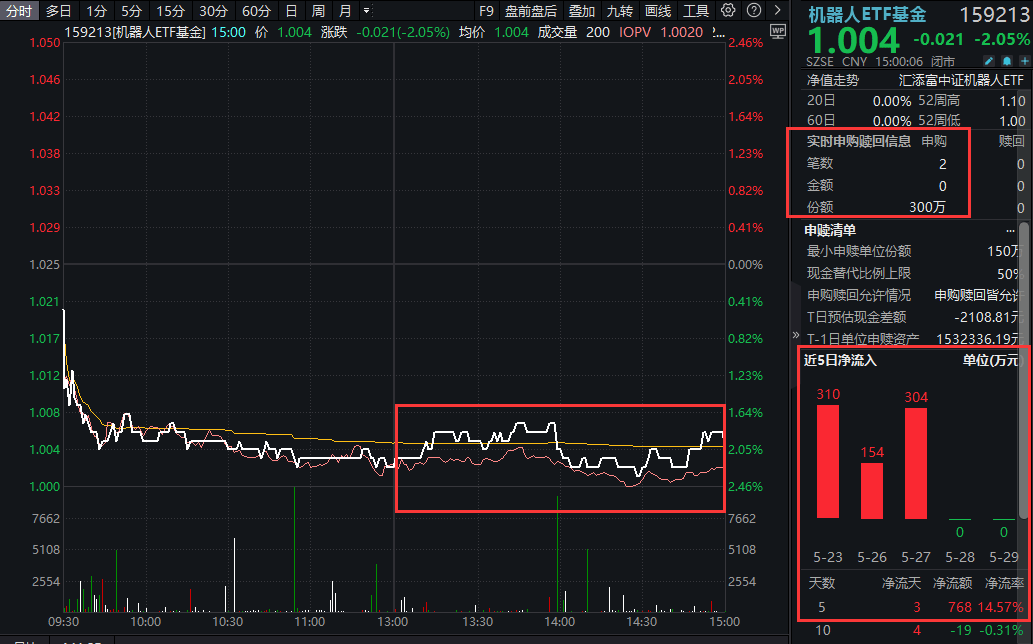
Core Viewpoint - The robot industry is experiencing a mix of challenges and opportunities, with significant developments in technology and policy support driving the commercialization of humanoid robots, while also facing hurdles in cost reduction and capability enhancement [4][5][8]. Group 1: Market Performance - The A-share market saw a pullback after a previous rebound, with the Robot ETF Fund (159213) closing down over 2%, despite a net inflow of 3 million shares throughout the day [1]. - The majority of the index component stocks for the Robot ETF Fund experienced declines, with only a few stocks like Nanwang Technology and Ruishun Technology showing gains [3]. Group 2: Industry Developments - The 2025 Zhangjiang Embodied Intelligence Developer Conference and International Humanoid Robot Skills Competition highlighted the transition of humanoid robots from experimental to practical applications in various settings [4]. - Shanghai Zhiyuan Robotics announced that its humanoid robot, the Expedition A2, received multiple certifications, making it the first humanoid robot to achieve certifications in China, the EU, and the US [4]. - The first global standard for "Humanoid Robot Intelligence Classification" was released, indicating a shift towards policy support for the humanoid robot industry [4]. Group 3: Commercialization Challenges - The commercialization of humanoid robots is estimated to take at least 10 years, with challenges including the need for improved generalization capabilities and cost reduction [5]. - The current progress in humanoid robot hardware is outpacing software development, particularly in the area of generalization capabilities, which is a critical barrier to commercialization [5]. Group 4: Opportunities in the Industry - Continuous policy support at the national level is expected to drive the development of humanoid robots, with significant funding being allocated to the sector [8]. - Major tech companies and industry leaders are entering the humanoid robot space, expanding applications in both industrial and domestic settings [9]. - The domestic robot industry has seen an increase in localization rates, with the localization rate rising from 17.5% in 2015 to 35.7% in 2022, indicating a growing capacity for cost reduction [7]. Group 5: Investment Insights - The Robot ETF Fund (159213) provides investors with a tool to gain exposure to the entire robot industry chain, including upstream hardware, midstream software, and downstream applications [10].