
龙湖集团

Search documents
年轻人的生活圈,能盘活商业地产吗?
虎嗅APP· 2025-07-06 09:34
Core Viewpoint - The article discusses the transformation of commercial real estate through the lens of living spaces, emphasizing the shift from hardware-centric value to emotional value production as a new currency in the industry [3][4]. Group 1: Market Trends - The emergence of new community living forms, such as co-living and digital nomad communities, reflects a shift in real estate logic, focusing more on social interaction and human connections rather than just physical space [6][8]. - The rental market is experiencing a downturn, with high rents not translating into desirable living conditions, leading to a decline in the usage of communal spaces [6][12]. - The article highlights the increasing popularity of flexible living arrangements, such as short-term rentals and community-driven spaces, as a response to changing consumer preferences [14][15]. Group 2: Business Strategies - Companies are adopting differentiated strategies to address vacancy pressures, such as flexible rental terms and community engagement initiatives [14]. - The integration of lifestyle elements into living spaces is becoming a key focus, with businesses exploring ways to create value beyond traditional rental income [13][15]. - The article notes that the market is evolving, with new players entering and existing companies rethinking their operational models to enhance user experience and engagement [14][15]. Group 3: Future Outlook - The article suggests that the market for long-term rentals will see significant opportunities by 2025, as borrowing costs decrease and real estate valuations stabilize [14]. - The potential for creating living environments that foster community and collaboration is highlighted as a critical factor for success in the evolving real estate landscape [15].



6月百强房企销售同比降幅走宽,关注三季度政策窗口
Orient Securities· 2025-07-06 02:45
Investment Rating - The industry investment rating is "Positive (Maintain)" [5] Core Insights - In June, the sales of the top 100 real estate companies saw a year-on-year decline, with total sales amounting to 370.7 billion yuan, a decrease of 21% compared to the previous year. The total sales area was 16.8 million square meters, down 30% year-on-year, indicating a widening decline compared to May [2] - The cumulative sales for the first half of the year for the top 100 companies decreased by 11% to 1.8 trillion yuan, reflecting a seasonal decline in the second quarter after a temporary stabilization in the first quarter due to policy effects [2] - The report anticipates that the launch of more "good housing" in core cities will lead to a hot market in first and second-tier cities, while third and fourth-tier cities will continue to experience low transaction volumes [2] Summary by Sections Sales Performance - In June, the sales performance of the top 100 real estate companies showed a significant decline, with the top 10 companies experiencing a 26% drop in sales, while the second and third tiers saw declines of 13% and 18% respectively [2] - The report highlights that the sales decline is expected to narrow in 2025 due to improved housing quality and stability in new home prices in high-energy cities [2] Market Dynamics - The report discusses the competitive pressure of high-value new homes on the second-hand market, emphasizing that the advantages of new homes stem from local government concessions on land prices and planning [3] - It notes that the second-hand housing market has seen a significant drop in transaction volume since April, with new residential prices in 70 cities declining by 0.22% month-on-month and 4.08% year-on-year as of May [3] Policy Outlook - The report suggests that there is a high likelihood of new supportive policies being introduced in the third quarter, especially in first-tier cities like Beijing and Shanghai, where there is still room for relaxation of purchase restrictions [3] - Potential policy measures include easing of provident fund withdrawal policies and monetary policy support, which could stimulate short-term market recovery [3] Investment Recommendations - The report recommends focusing on stocks with strong price elasticity, including Beike-W (02423, Buy), Jindi Group (600383, Increase), Longfor Group (00960, Buy), Poly Development (600048, Buy), and China Merchants Shekou (001979, Buy) [7]





龙湖集团(00960.HK):25年有望穿越债务周期 运营业务继续助力转型突围
Ge Long Hui· 2025-07-05 18:16
Core Viewpoint - The company is focused on debt management and operational performance, with a clear plan for debt repayment by 2025, aiming to reduce interest-bearing liabilities to approximately 140 billion yuan by the end of 2025 [1][2]. Debt Management - The company has effectively reduced interest-bearing liabilities by over 30 billion yuan in the past two years, with a projected decrease to 176.3 billion yuan by the end of 2024, reflecting a year-on-year reduction of 9% [2]. - The net debt ratio stands at 52%, with an asset-liability ratio of 57% after excluding advance receipts [2]. - The company is transitioning its debt structure by replacing short-term credit bonds with long-term financing from operational properties, leading to a financing cost reduction of 0.24 percentage points to 4.0%, the lowest in five years [2]. Operational Performance - The company’s operational business revenue reached 11.02 billion yuan from January to May, showing continuous growth year-on-year [1]. - The operational and service revenue is projected to be 26.7 billion yuan in 2024, a year-on-year increase of 7%, contributing 70% to the gross profit [3]. - The company is focusing on inventory reduction while enhancing its operational business to support overall profitability, with commercial revenue growth of approximately 20% and daily customer traffic growth exceeding 25% [3]. Financial Projections - The company has adjusted its net profit forecasts for 2025-2027 to 7.92 billion yuan, 8.15 billion yuan, and 8.51 billion yuan respectively, down from an earlier estimate of 9.89 billion yuan for 2025 [3]. - A price-to-earnings (PE) valuation of 8x is assigned for 2025, corresponding to a target price of 10.24 HKD [3].
信用利差再度压缩,二永债表现强势
Xinda Securities· 2025-07-05 14:57
Report Industry Investment Rating Not provided in the given content. Report's Core View - Credit bonds return to strength, with yields of 3Y and above varieties generally declining by around 5BP. Interest rates of interest rate bonds fluctuate and decline, and credit spreads mostly decline except for some high-grade short-duration varieties [2][5]. - Credit spreads of urban investment bonds decline across the board, with spreads of each variety decreasing by about 4BP [2][9]. - Most credit spreads of industrial bonds decline, while those of mixed-ownership real estate bonds slightly increase [2][18]. - Yields of secondary and perpetual bonds decline across the board, and their overall performance is stronger than that of ordinary credit bonds [2][23]. - Excess spreads of industrial perpetual bonds are generally stable, while those of 3Y urban investment perpetual bonds decline [2][25]. Summary by Directory 1. Credit bonds return to strength, with yields of 3Y and above varieties generally declining by around 5BP - Interest rate bond yields fluctuate and decline. The yields of 1Y, 3Y, 5Y, and 7Y Guokai bonds decline by 3BP, 2BP, 1BP, and 4BP respectively, and the 10Y yield remains flat [2][5]. - Credit bond yields return to a downward trend. Yields of 3Y and above varieties generally decline by around 5BP, and credit spreads mostly decline except for some high-grade short-duration varieties [2][5]. - Rating spreads and term spreads mostly remain flat or decline [5]. 2. Credit spreads of urban investment bonds decline across the board - Credit spreads of external rating AAA, AA+, and AA platforms all decline by about 4BP. Spreads of most AAA-level platforms decline by 3 - 4BP, AA+ by 3 - 5BP, and AA by 3 - 6BP [2][9]. - By administrative level, credit spreads of provincial, municipal, and district-level platforms all decline by 4BP [2][16]. 3. Most credit spreads of industrial bonds decline, while those of mixed-ownership real estate bonds slightly increase - Credit spreads of central and local state-owned real estate bonds decline by 4BP, those of mixed-ownership real estate bonds increase by 2BP, and those of private real estate bonds increase by 13BP [2][18]. - Credit spreads of coal bonds at all levels decline by 3BP, those of AAA and AA+ steel bonds decline by 3BP and 4BP respectively, and those of chemical bonds at all levels decline by 4 - 5BP [2][18]. 4. Yields of secondary and perpetual bonds decline across the board, and their overall performance is stronger than that of ordinary credit bonds - Yields of secondary and perpetual bonds follow the decline of certificate of deposit rates. Spreads of medium and short-term high-grade varieties compress significantly [2][23]. - Specifically, the yield of 1Y AAA- secondary capital bonds declines by 9BP, and the spread compresses by 6BP. Yields of other grades decline by 8BP, and spreads compress by 4 - 5BP [23]. 5. Excess spreads of industrial perpetual bonds are generally stable, while those of 3Y urban investment perpetual bonds decline - The excess spread of industrial AAA3Y perpetual bonds increases by 0.01BP to 3.82BP, and that of AAA5Y remains flat at 8.51BP [2][25]. - The excess spread of urban investment AAA3Y perpetual bonds declines by 2.38BP to 3.76BP, and that of AAA5Y increases by 0.10BP to 9.91BP [25]. 6. Credit Spread Database Compilation Instructions - Market-wide credit spreads, commercial bank secondary and perpetual spreads, and credit spreads of urban investment/industrial perpetual bonds are calculated based on ChinaBond medium and short-term notes and ChinaBond perpetual bonds data [27]. - Credit spreads of industrial and urban investment individual bonds are calculated by subtracting the yield of the same-term government bond from the medium-term valuation of the individual bond, and then the arithmetic average method is used to calculate the credit spreads of the industry or regional urban investment [31]. - Samples of medium-term notes and public corporate bonds are selected for industrial and urban investment bonds, and guaranteed bonds and perpetual bonds are excluded [31].
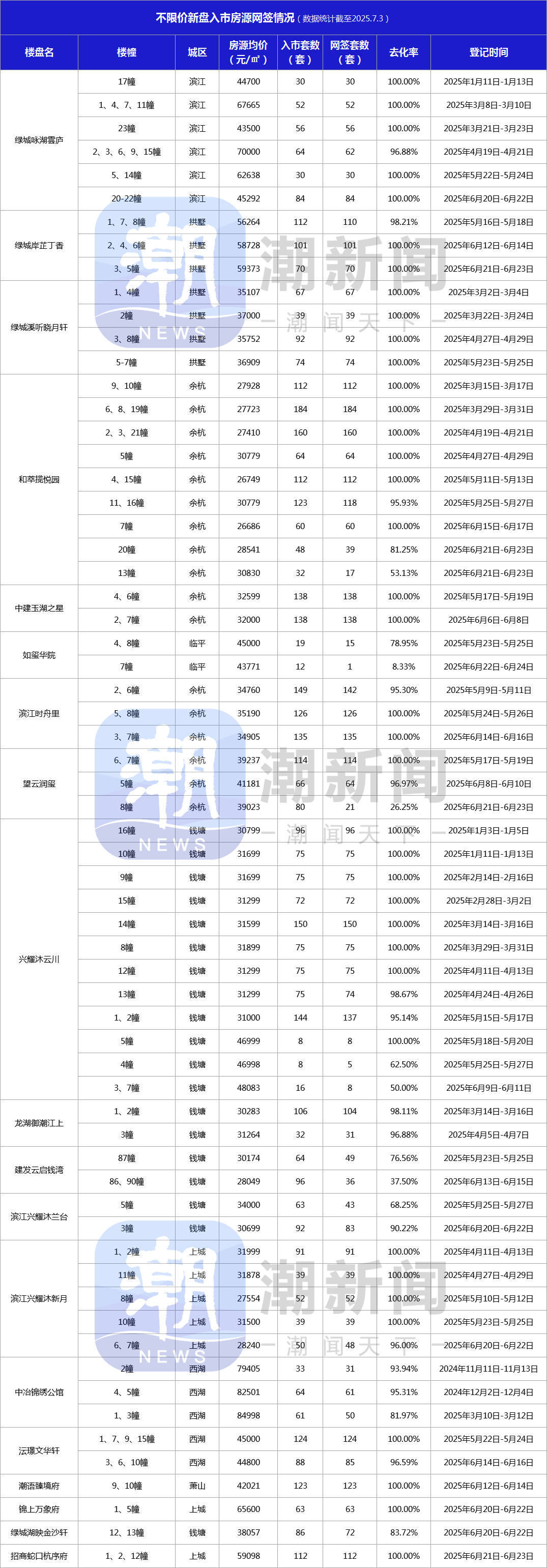
不限价新房最新网签数据出炉,市区改善盘去化率大多在100%
Sou Hu Cai Jing· 2025-07-05 11:19
Core Viewpoint - The average transaction price of newly built residential properties in Hangzhou has steadily increased, particularly in the residential sector, with a month-on-month rise of 0.44% in June [1] Group 1: Market Trends - Hangzhou has officially entered a price-unrestricted era this year, with significant price increases observed in various districts such as Gongshu Dongxin, Shangcheng Chengdong New City, and Xihu Zhijiang [1] - Over 20 projects have entered the market since the price cap was lifted, with many properties quickly selling out [4] Group 2: Sales Performance - The overall sales rate of newly launched unrestricted price properties in Hangzhou has exceeded 90%, with many projects achieving nearly 100% sales rates on the day of online selection [4] - Specific projects like "Anzhi Dixiang" and "Xiting Xiaoyue" have seen complete sell-outs within a month, with price increases from 56,264 yuan/m² to 59,373 yuan/m² [5] Group 3: Market Segmentation - While high-end improvement projects have strong sales performance, some newly launched properties are experiencing sluggish sales, particularly larger units priced over 7 million yuan [6] - The market is showing signs of differentiation, with developers needing to adjust pricing strategies in response to varying demand across different property types [6]
上半年千亿房企仅剩4家,政策支持力度有望持续加码,7月楼市或延续弱复苏走势
Hua Xia Shi Bao· 2025-07-05 03:09
Group 1 - The core viewpoint of the articles indicates that the real estate market is experiencing fluctuations and adjustments, with a need for further policy support to stabilize the market [1][6][7] - In the first half of the year, the total sales of the top 100 real estate companies reached 18,364.1 billion yuan, a year-on-year decrease of 11.8%, with only four companies exceeding 100 billion yuan in sales [2][4] - The land acquisition strategy is shifting towards core cities such as Beijing, Shanghai, and Chengdu, with the average premium rate for land transactions increasing to 9.2% [4][5] Group 2 - Major cities like Beijing, Shanghai, and Guangzhou have shown significant growth in new residential sales, with Guangzhou experiencing a 16% year-on-year increase [3][6] - The government is expected to continue implementing policies to stabilize the market, including measures to enhance housing demand and improve supply [6][7] - The trend of "good cities + good houses" is emerging, indicating structural opportunities in the market, with a focus on product innovation to meet changing consumer preferences [7][8]


热销项目|6月新规项目和高改盘集中入市支撑去化率攀升
克而瑞地产研究· 2025-07-04 09:56
Core Viewpoint - The real estate market is experiencing a weak recovery trend, with new home transaction volumes expected to continue fluctuating at low levels in July, although the year-on-year decline may narrow due to a low base from last year [1][23]. Group 1: Market Performance - In June, the average opening sales rate for new homes in 30 major cities was 41%, showing a month-on-month increase of 3 percentage points and a year-on-year increase of 11 percentage points, indicating a stable upward trend [2][22]. - Major cities like Beijing, Shanghai, Shenzhen, Chengdu, and Hangzhou saw increases in sales rates, while cities like Ningbo and Jiaxing continued to experience low sales rates below 20% [3][22]. - The introduction of high-quality new projects, particularly those with high usable area ratios, has positively impacted market activity, with new regulations promoting the construction of "good houses" [4][22]. Group 2: Project Performance - In Guangzhou, new projects under the new regulations accounted for 60% of the total supply in June, achieving a sales rate 30 percentage points higher than older projects, with some projects exceeding 40% [5][6]. - In Chongqing, new generation residential projects had sales rates above 75%, while traditional residential projects struggled with rates around 20% [7][22]. - High-end properties in core areas of cities like Shanghai and Chengdu have seen strong demand, with some projects achieving over 70% sales on the first day of opening [12][22]. Group 3: Government Policies and Market Dynamics - In cities like Suzhou and Zhengzhou, government-led initiatives such as stock housing buybacks and housing vouchers have helped boost sales in non-core areas [19][22]. - In cities like Beijing and Fuzhou, strategies such as price discounts and increased commissions have successfully driven sales [20][22]. - The overall market is characterized by significant differentiation between cities and projects, with core urban areas maintaining high demand while many peripheral projects struggle [23][22].

代建双周报 | 金地管理清岚产品品牌发布,腾云筑科与浪潮智慧签署合作(2025.6.21-7.4)
克而瑞地产研究· 2025-07-04 09:56
Company Developments - Tengyun Zhike signed a strategic cooperation agreement with Inspur Smart Building [1] - Longfor Longzhizao signed a digital design service contract for the XDG-2024-93 land parcel in Wuxi [3] - Longfor Longzhizao also signed a project management and sales service contract for the FX202422 land parcel in Hefei [4] - Greenland Zhizao successfully won the bid for the future coastline project in Pattaya, Thailand, with a total saleable area of 30.16 million square meters and a total value exceeding 20 billion THB [6] - Runzhi Management and China Resources Cultural and Sports jointly won the consulting service for the Ningbo Olympic Sports Center, with a project value of approximately 59.7 billion [7] Project Highlights - Jindi Management launched the "Qinglan" product brand and the "Qinglan Song" project [1] - The project aims to promote technology and product replication, focusing on smart buildings and smart living services [2] - The project in Zhangzhou High-tech Zone covers an area of approximately 164.8 acres, with a total construction area of about 220,000 square meters and nearly 1,000 planned beds [13]
中指研究院:1-5月全国商办用房新开工面积同比下降24.9%
智通财经网· 2025-07-04 06:42
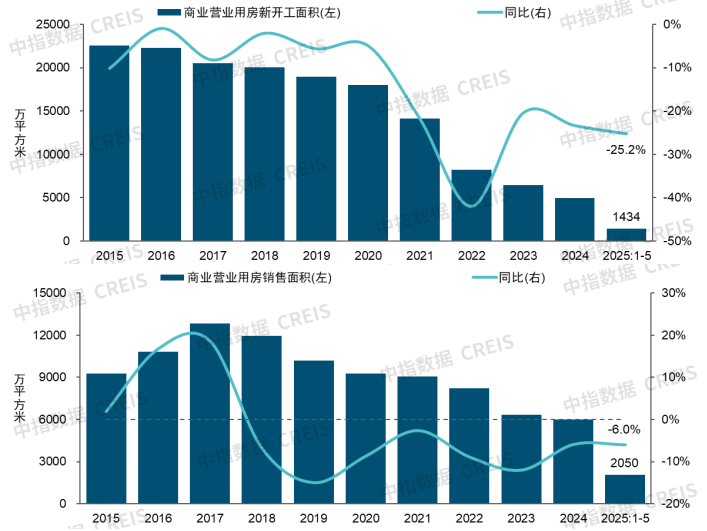
Core Viewpoint - The commercial real estate market in China continues to face challenges, with declines in investment, new construction, and sales in the first five months of 2025, although the rate of decline has shown some signs of narrowing compared to 2024. Group 1: Investment and Construction Trends - Total investment in commercial properties reached 398.5 billion yuan, a year-on-year decrease of 10.9%, with the decline rate narrowing by 1.2 percentage points compared to the entire year of 2024 [1] - New construction area totaled 20.49 million square meters, down 24.9% year-on-year, with the decline rate widening by 0.3 percentage points compared to 2024 [1] - Sales area amounted to 28.6 million square meters, reflecting a year-on-year decrease of 6.4%, with the decline rate narrowing by 1.2 percentage points compared to 2024 [1] Group 2: Commercial Property Market Performance - In the commercial property sector, investment decreased by 7.6%, new construction area fell by 25.2%, and sales area dropped by 6.0% in the first five months of 2025 [2] - For office buildings, investment declined by 16.3%, new construction area decreased by 24.1%, and sales area fell by 7.4% [3][5] - The land market for commercial properties saw a significant drop, with a 24.6% decrease in new land supply and a 17.1% decrease in transaction area across 300 cities in the first half of 2025 [6][10] Group 3: Retail and Leasing Market Dynamics - The number of new retail commercial projects opened in the first five months of 2025 was 89, with a total construction area of approximately 7 million square meters, representing a 17% decrease in area compared to the same period in 2024 [12] - The average rent for major shopping streets in key cities fell by 0.35%, while the average rent for shopping centers decreased by 0.12%, indicating a narrowing decline compared to the previous year [15][18] - The rental market for office buildings remains weak, with an average rent decline of 1.06% in key cities during the first half of 2025 [20] Group 4: Market Activity and Transaction Trends - The large transaction market remained active, with 83 transactions recorded in the first five months of 2025, maintaining a similar level to the previous year [23] - The total transaction amount reached 93.3 billion yuan, a significant increase of 85% year-on-year, driven by several large transactions [24] - Retail commercial properties and office buildings were the most favored types in transactions, with retail transactions accounting for 60% of the total transaction amount [27] Group 5: Corporate Strategies and Performance - Leading companies are focusing on enhancing operational capabilities and stabilizing occupancy rates through innovative strategies and improved service quality [28][30] - The average occupancy rate for operational shopping centers among leading companies remained above 90%, with some companies reporting significant year-on-year growth in sales [31] - In contrast, the office rental performance of major real estate companies showed weaker growth, with occupancy rates around 80% [31] Group 6: Financing and Investment Trends - The issuance of CMBS/CMBN and REITs products remained low, with a total issuance of 38.2 billion yuan in the first five months of 2025, reflecting a slight year-on-year increase [39] - The market for consumption REITs has seen a steady increase, with nine products issued, totaling over 22 billion yuan, indicating a growing interest in this financing avenue [40][42] Group 7: Future Trends and Opportunities - Community commercial projects are expected to play a crucial role in enhancing service consumption and meeting local needs, supported by government policies [43][47] - The integration of culture, tourism, and commerce is emerging as a significant direction for commercial upgrades, with various supportive policies being implemented [50][52]
宝城期货资讯早班车-20250704
Bao Cheng Qi Huo· 2025-07-04 02:40
1. Report Industry Investment Rating No relevant content provided. 2. Core Views of the Report - The Chinese economy shows a mixed picture with stable GDP growth, but some indicators like PPI and export growth face challenges [1]. - Infrastructure investment is expected to accelerate, with most institutions forecasting a 6% growth in full - year infrastructure construction investment [2][17]. - The bond market has a complex situation with different trends in yields and prices, and the money market rates are mostly declining [24][25][26]. - The stock market has different performances in A - shares and Hong Kong stocks, and the insurance capital's active participation and IPO inspections are notable [34]. 3. Summary by Directory Macro Data - GDP in Q1 2025 grew 5.4% year - on - year, the same as the previous quarter [1]. - In June 2025, the manufacturing PMI was 49.7%, up from 49.5% in the previous month, and the non - manufacturing PMI was 50.5%, up from 50.3% [1]. - In May 2025, social financing scale increment was 22870 billion yuan, M0 grew 12.1% year - on - year, M1 grew 2.3%, and M2 grew 7.9% [1]. Commodity Investment Comprehensive - The Chinese government hopes to promote healthy and sustainable Sino - US economic and trade relations [2][3][17]. - The US "big and beautiful" tax and spending bill will raise the debt ceiling by 5 trillion dollars and may increase the budget deficit by 3.4 trillion dollars in the next decade [3]. - The US non - farm employment in June increased by 147,000, and the unemployment rate was 4.1% [3]. Metal - Peruvian copper mine transportation is disrupted due to protests by small miners [5][9]. - UBS raised its copper price forecasts for 2025 and 2026 by 7% and 4% respectively [5]. - Central banks are increasing gold reserves due to the "weaponization" of foreign exchange [6]. Coal, Coke, Steel and Minerals - Indonesia plans to change the mining quota validity period from three years to one year [9]. - China is summarizing the implementation of the "14th Five - Year Plan" for mineral resources and planning for the "15th Five - Year Plan" [5][9]. Energy and Chemicals - China's first natural gas full - chain multi - condition cryogenic treatment plant is put into operation [10]. - OPEC+ is discussing an 8 - month oil production increase of 411,000 barrels per day [12]. Agricultural Products - China's Ministry of Agriculture and Rural Affairs launches an action to ensure autumn grain harvest [14]. - The second import corn auction is about to start with changes in quantity, area and target [14]. Financial News Open Market - On July 3, the central bank conducted 57.2 billion yuan of 7 - day reverse repurchase operations, with a net withdrawal of 452.1 billion yuan [16]. Key News - In June, the Caixin China Services PMI was 50.6, and the composite PMI output index rebounded to 51.3 [17]. - From January to May, China's service import and export totaled 32543.6 billion yuan, a year - on - year increase of 7.7% [18]. Bond Market - Bank - to - bank bond yields were generally stable with a slight decline, and the money market was more liquid [24]. - The on - shore RMB against the US dollar rose 59 points, and the US dollar index rose 0.35% [29]. Research Reports - Guoxin Macro Fixed Income expects China's CPI to decline slightly in June and PPI to continue to fall [30]. - Yangtze River Fixed Income believes that liquidity will remain relatively loose in July [30]. Stock Market - On Thursday, A - shares rose, with consumer electronics and innovative drugs leading the gains, while Hong Kong stocks fell [34]. - Insurance funds have accelerated their pace of stock market participation, and banks and public utilities are major targets [34]. - The China Securities Association announced the list of 12 IPO on - site inspection enterprises in the second batch of 2025 [35].