问界

Search documents
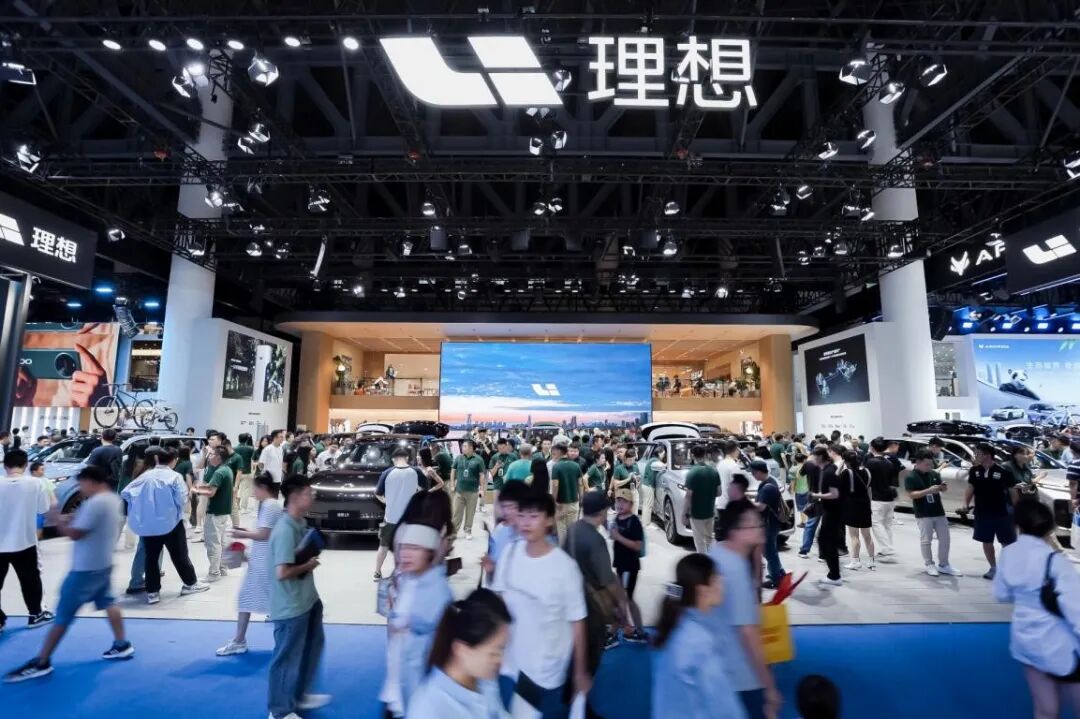
理想i6上市,当“奶爸”拥抱“年轻人”
Guan Cha Zhe Wang· 2025-10-01 06:08
Core Viewpoint - The launch of the Li Auto i6 is seen as a timely solution for the company to address current market pressures and competition, particularly in the electric vehicle segment [1][17]. Group 1: Brand Strategy and Marketing - Li Auto's founder, Li Xiang, initially stated that the company would not use celebrity endorsements, emphasizing that car owners are the best brand ambassadors [1]. - However, at the i6 launch event, Li Auto announced its first brand ambassador, celebrity Yi Yangqianxi, who appeals strongly to Generation Z [3]. - The marketing strategy has shifted to target younger consumers, moving away from the previous focus on family-oriented vehicles [5][6]. Group 2: Product Features and Design - The i6 is priced starting at 249,800 RMB (approximately 24.98 million RMB), making it competitive against similar models like the Xiaomi YU7 [6]. - The design of the i6 emphasizes aerodynamics and spaciousness, featuring a rounded front and sloping rear, which distinguishes it from traditional SUVs [8][10]. - The interior includes advanced features such as dual screens in the front, a 21.4-inch entertainment screen in the rear, and a "single bed mode" for added comfort [12][14]. Group 3: Market Position and Sales Expectations - Li Auto's i6 is positioned to attract young consumers who prioritize comfort and outdoor activities rather than extreme performance [16]. - The company anticipates a significant demand for the i6, with over 20,000 pre-orders on the launch day, and expects monthly sales of 9,000 to 10,000 units [17][19]. - Despite the competitive pricing and features, Li Xiang noted that the i6 has the lowest profit margin in the company's history, indicating a strategic shift towards electric vehicles to alleviate pressure from its range-extended models [24].



讨厌隐藏式门把手的用户们,如今终于胜利了
Hu Xiu· 2025-10-01 03:45
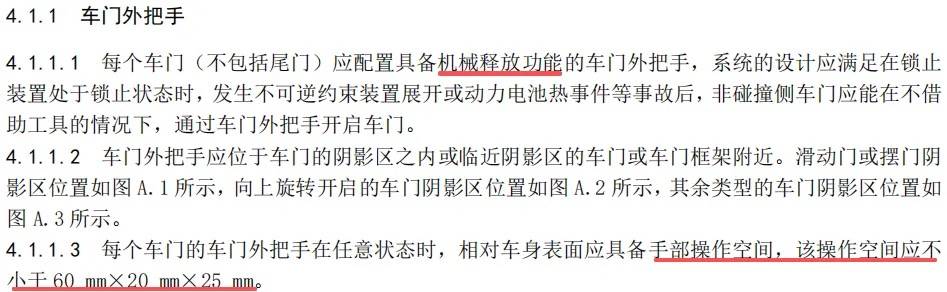
Core Viewpoint - The new national standard for car door handles prohibits hidden handles, significantly impacting new energy vehicle manufacturers and potentially leading to their decline in the market [1][2][55]. Summary by Sections New National Standard Details - The new standard mandates that external door handles must have a mechanical release function, eliminating electronic-only designs [8]. - External door handles must provide a hand operation space of at least 60mm x 20mm x 25mm, disallowing fully hidden designs [9]. - Internal door handles must also have a mechanical release function and be unobstructed, located within an accessible area [10][13]. - The standard is expected to take effect on January 1, 2027, with compliance required for all new models released after this date [15][16]. Impact on Existing Vehicles - Vehicles purchased before the new standard takes effect will not require modifications or recalls, allowing owners to continue using their existing hidden handle designs without concern [38][40]. Industry Reactions - Responses from car manufacturers vary significantly; some international companies express concern about meeting the new requirements, while domestic manufacturers feel less impacted due to their ongoing design adaptations [43][49]. - The rapid development cycles in the domestic market, with new vehicle development timelines reduced to 18 months, suggest that many manufacturers can adapt quickly to the new regulations [51]. Safety and Practicality Concerns - The hidden door handle design has been criticized for its lack of practicality and potential safety issues, particularly in emergency situations [58][60]. - Traditional mechanical handles are viewed as more reliable and easier to validate for safety compared to hidden designs, which require complex testing [66][68]. Conclusion - The new standard is seen as a positive change for vehicle safety and practicality, pushing manufacturers to prioritize functional designs over aesthetic trends [70].
2025年汽车行业网络营销监测报告
艾瑞咨询· 2025-10-01 00:00
Core Insights - The domestic automotive market is entering a new cycle characterized by accelerated growth, structural optimization, and renewed marketing strategies, with a cumulative retail of 12.746 million passenger vehicles from January to July 2025, representing a year-on-year growth of 10.3% [1][4] - The penetration rate of new energy vehicles (NEVs) has exceeded 50% for five consecutive months, indicating a significant shift towards NEVs and driving the replacement of traditional fuel vehicles [1][4] - The market is supported by a collaborative policy framework from national and local governments, which includes trade-in programs and subsidies for NEVs, aimed at stimulating consumer demand [1][7] Market Overview - The cumulative retail sales of passenger vehicles in the domestic market reached 12.746 million units from January to July 2025, with NEVs showing a growth rate consistently above 10% [4] - NEVs are becoming the core engine of industry growth, with their sales rapidly increasing and contributing to the replacement effect of fuel vehicles [4] Advertising and Marketing Trends - The automotive advertising market saw a positive turning point in July 2025, with the number of advertisers experiencing growth for the first time, particularly in the NEV sector [2][14] - Mobile and OTT platforms are gaining a larger share of advertising spend, while PC advertising is declining; web banner ads remain a core choice for advertisers [2][18] - The marketing strategy is shifting towards a user-centric approach, leveraging data and AI to enhance efficiency across the entire customer journey [3][37] Policy Environment - National policies such as trade-in programs and subsidies for NEVs are being complemented by local government initiatives tailored to regional needs, enhancing the overall market vitality [7][9] Manufacturer Landscape - The top three manufacturers (BYD, Geely, FAW-Volkswagen) account for approximately one-third of the market share, indicating a clear oligopolistic effect in the industry [10][11] - BYD leads the market with retail sales of 1.885 million units from January to July 2025, significantly outpacing traditional manufacturers [10][11] Advertising Strategies - The advertising content focuses on product launches, price discounts, and brand building, with a clear emphasis on enhancing consumer perception and driving sales conversion [27][32] - The automotive marketing landscape is evolving from a focus on traffic acquisition to user engagement, aiming to improve trust and conversion efficiency [37][39] Case Studies - Automotive platforms like Autohome are leveraging their content expertise to provide integrated marketing solutions, enhancing brand visibility and consumer engagement [39][43] - Specific marketing campaigns, such as those for the AITO M7 and Zeekr 009, illustrate targeted strategies that address consumer pain points and leverage social engagement for brand positioning [45][47]



多地汽车国补暂停?发改委:第四批消费品以旧换新资金已下达
Nan Fang Du Shi Bao· 2025-09-30 12:13
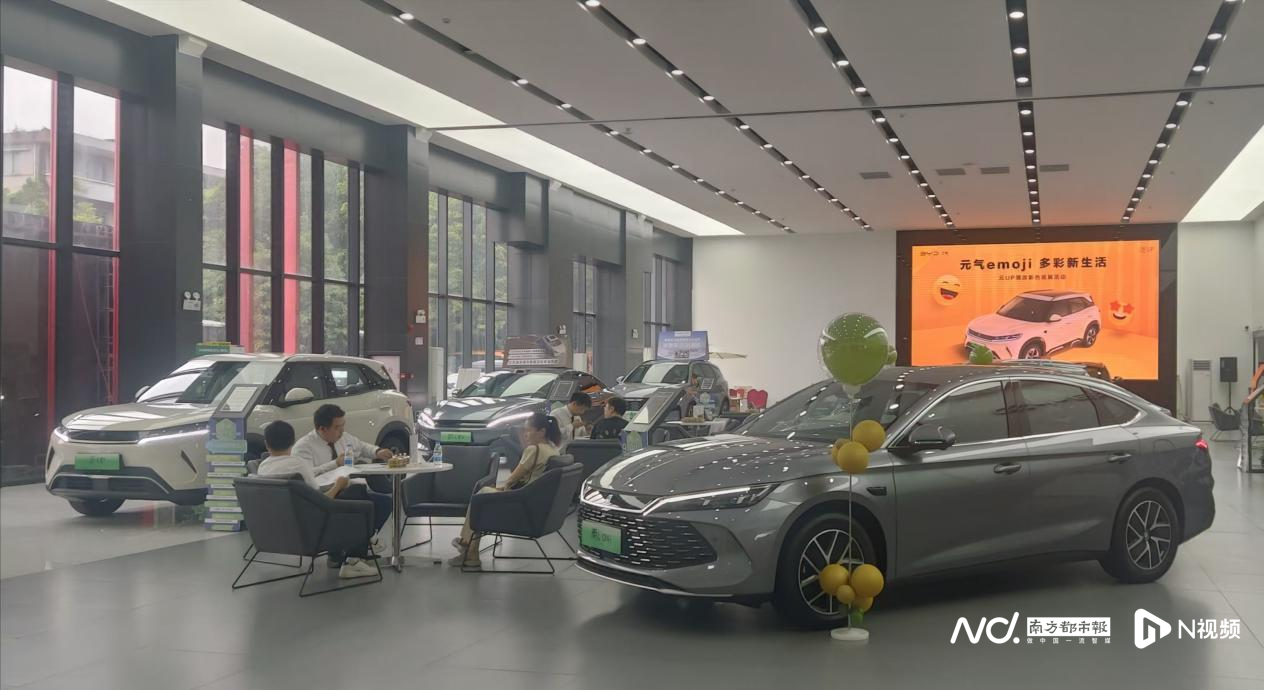
Core Viewpoint - The recent suspension of the "old-for-new" vehicle subsidy across multiple regions in China is a strategic adjustment by local governments to ensure the smooth and orderly use of annual subsidy funds, rather than a reduction in support for the automotive industry [1][2][8]. Group 1: Policy Changes - Various regions, including Jiangsu and Zhejiang, have announced the suspension of their vehicle "replacement and update" subsidies, with specific deadlines set for October 2025 [2][3]. - The Guangzhou Municipal Bureau of Commerce has also adjusted its vehicle "replacement and update" policy, with applications for subsidies ending on September 30, 2025 [3][5]. - The Guangdong Provincial Automobile Circulation Association indicated that the end dates for subsidies vary by city, depending on the actual usage of subsidy funds [5]. Group 2: Financial Support - The National Development and Reform Commission (NDRC) announced the allocation of 69 billion yuan in special bonds to support the "old-for-new" vehicle program, completing the annual allocation of 300 billion yuan [6][8]. - As of September 10, 2025, the number of applications for the "old-for-new" vehicle program reached 8.3 million, indicating strong consumer interest [8]. Group 3: Market Impact - The suspension of subsidies may impact vehicle sales, as some dealers express concerns about the potential decline in demand for certain models due to the lack of available subsidies [8]. - The automotive industry analyst noted that the adjustment in subsidy policies is a form of refined regulatory control rather than a decrease in national support [8]. Group 4: Consumer Guidance - Consumers are advised to distinguish between "scrapping" and "replacement" subsidies, as many regions continue to implement scrapping subsidies while suspending replacement subsidies [9]. - It is important for consumers to stay updated on local subsidy policies, as adjustments may occur based on funding availability, and to be aware of application deadlines to avoid missing out on potential benefits [9].
【具身智能产业动态】傅利叶第三代机器人首次亮相,跨维智能发布升级版视频学习框架
GUOTAI HAITONG SECURITIES· 2025-09-30 11:12
Investment Rating - The report does not explicitly state an investment rating for the industry Core Insights - The embodied intelligence industry is primarily represented by embodied robots and smart vehicles, which are mutually reinforcing in their development [7] - Recent advancements include the unveiling of Fourier's third-generation humanoid robot GR-3C and the establishment of the largest humanoid robot training center in China [10][11] - Significant investment activities have been observed in the embodied intelligence sector, with multiple companies securing funding to enhance their technological capabilities and market presence [24] Summary by Sections 1. Embodied Robot and Smart Vehicle Dynamics - Fourier's third-generation humanoid robot GR-3C was showcased at the Industrial Expo, featuring 55 degrees of freedom and advanced interaction capabilities [10] - A new humanoid robot training center in Beijing can produce over 6 million data points annually, enhancing the practical application of humanoid robots [11] - Cross-dimensional intelligence released an upgraded video learning framework that allows rapid task adaptation across different robot bodies [12] - DeepMind introduced the Gemini Robotics 1.5 series, enhancing robots' capabilities in visual and language processing [13] - A strategic partnership between Lingyi Robotics and AIRS aims to integrate hardware and algorithms for humanoid robot development [15] - Kepler has initiated mass production of the world's first commercially available hybrid humanoid robot, K2 "Bumblebee," with significant pre-orders [16] 2. Smart Vehicle Dynamics - The sales ranking for new energy vehicles in the third week of September shows Leap Motor leading with 12,900 units sold, followed by Xiaomi and Aion [17][18] - A new autonomous driving test base was established in Jinan by Lingong Heavy Machinery and Huawei, focusing on comprehensive testing of autonomous mining vehicles [19] - ZF signed an investment agreement to expand its smart chassis localization efforts in Zhangjiagang [20] - NineSight signed a strategic agreement with Dubai's Roads and Transport Authority to launch an autonomous driving demonstration zone [21] - New Stone Technology delivered its 10,000th unmanned vehicle, marking a significant milestone in the commercialization of unmanned delivery [23] 3. Investment and Financing Events - A total of 9 financing events related to embodied intelligence were recorded from September 22 to 28, 2025, with notable investments in companies like LeXiang Technology and LuoBo Intelligent [24][34] - LeXiang Technology completed a 200 million RMB angel round led by Zhongding Capital, focusing on core component development and product scaling [24] - LuoBo Intelligent raised several million RMB in a round led by Sequoia China, targeting AI emotional companionship hardware [25] - Other companies like HeShan Technology and ShouZhi Innovation also secured funding to advance their respective technologies in humanoid robots and core components [26][27]
极氪攻占豪车上甘岭
Hua Er Jie Jian Wen· 2025-09-30 10:52
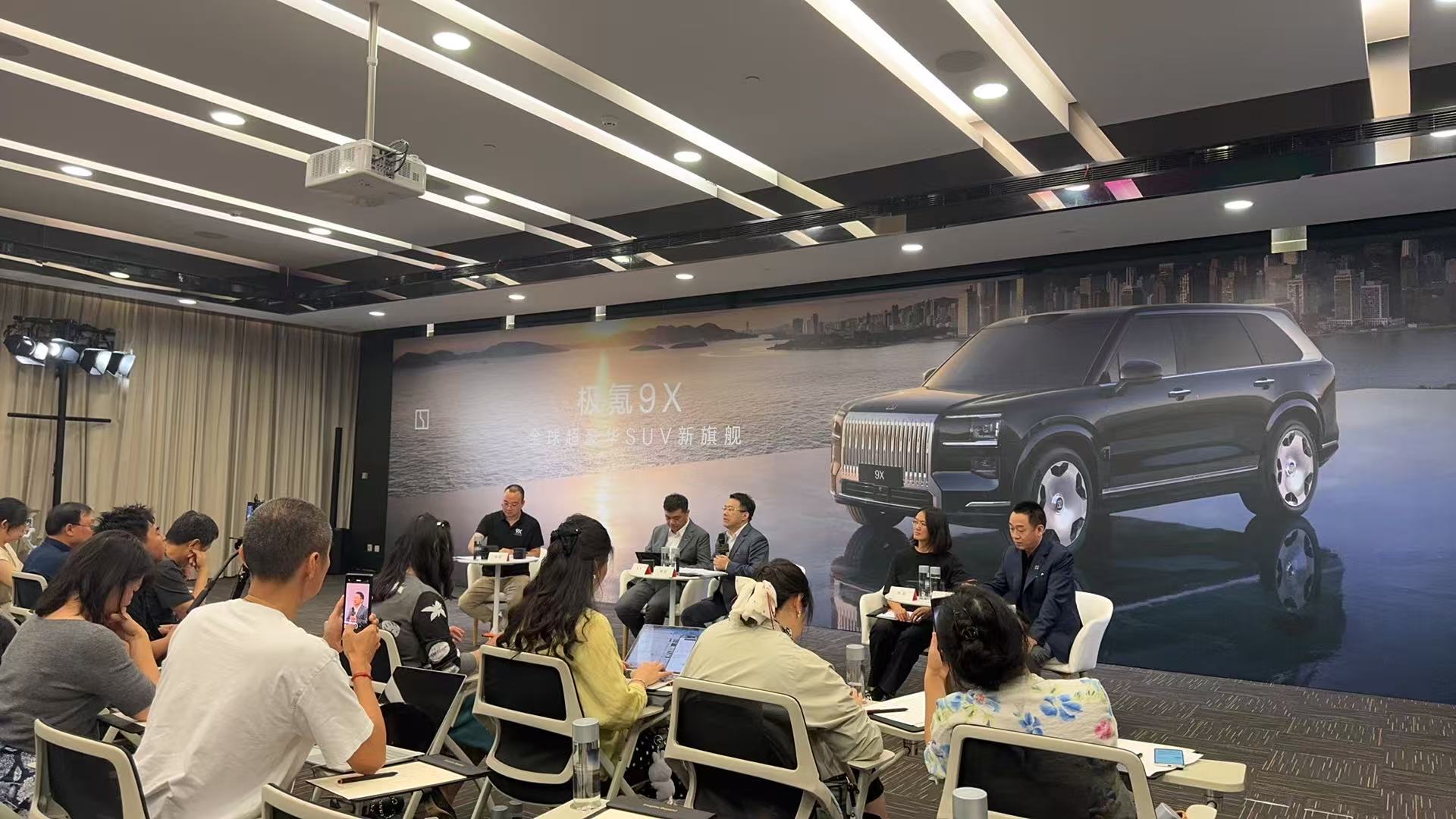
Core Insights - The launch of the Zeekr 9X, priced at 455,900 to 589,900 yuan, has disrupted the existing market dynamics, achieving over 10,000 pre-orders within 13 minutes and 42,667 orders in the first hour, indicating a strong demand that exceeded internal expectations [2][3][5] - The Zeekr 9X aims to compete in the luxury SUV segment, positioning itself against established models like the AITO M9 and NIO ES8, with a focus on extreme luxury and advanced technology [3][5] - The user demographic for the Zeekr 9X includes seasoned luxury car owners, existing Zeekr customers, and tech enthusiasts, showcasing a diverse appeal [5][8] Product Features and Strategy - The Zeekr 9X incorporates advanced technologies such as the H9 intelligent driving system, multiple laser radars, and a luxurious interior design, including a yacht-style roof and 22-inch wheels, aiming to rival high-end brands like Rolls-Royce [3][5] - The vehicle's pricing strategy reflects a commitment to capturing the premium market segment, with the goal of establishing Zeekr as a leading brand in the 450,000 yuan and above category [3][5] - The production capacity for the Zeekr 9X is currently conservative, with plans to ramp up as demand increases, while ensuring quality remains a priority [9][10] Market Position and Competition - The competitive landscape for vehicles priced above 400,000 yuan is intense, with only a few models like the Li L9 and MEGA achieving significant sales, highlighting the challenges Zeekr faces in maintaining momentum [5][10] - The Zeekr brand is strategically positioned to reclaim pricing power in the luxury segment, with the 9X serving as a critical opportunity for market penetration [5][10] - The overall market for luxury vehicles in China is evolving, with increasing consumer support for domestic brands, which is seen as a foundation for future growth [14][18] Technological Advancements - Zeekr's commitment to technological innovation is evident in its development of the 800V high-voltage platform and advanced battery systems, which are positioned as industry-leading solutions [6][12] - The integration of AI and advanced driving technologies is a key focus, with plans to enhance the driving experience and maintain a competitive edge in the smart driving sector [21][23] - The Zeekr 9X's hybrid system is designed to transition from pure electric to hybrid seamlessly, addressing consumer pain points and enhancing user satisfaction [26]
十余款“9”字头大六座SUV扎堆比拼
Di Yi Cai Jing· 2025-09-29 11:17
Core Insights - The competition in the mid-to-large SUV market is intensifying, with multiple models launching under the "9" series, including Tengshi N9, GAC S9, and others, all targeting the 2025 sales goals [1][2] - The price range for these SUVs spans from 170,000 to 500,000 yuan, indicating a significant price variation and heightened competition [1] - Intelligent features and high cost-performance ratios are becoming key selling points for these SUVs, with many models offering advanced technology as standard [2] Group 1 - The launch of Tengshi N9 and the upcoming pre-sale of Tengshi N8L highlight the brand's strategy to expand its SUV lineup, which will include various vehicle types in the future [2] - The market is seeing a trend where brands are enhancing their models with similar intelligent configurations, making it uncertain how much market share each model can capture [3] - Sales data shows that from January to June 2025, mainstream six-seat SUV sales reached 368,000 units, reflecting a year-on-year growth of 2.2% [3] Group 2 - The competitive landscape is characterized by a significant number of models vying for consumer attention, with the top ten large SUV models frequently changing positions in sales rankings [3] - Recent data indicates that only 1 to 3 models in the large SUV category achieve monthly sales exceeding 10,000 units, underscoring the fierce competition [3] - Industry insiders note that the differentiation among mid-to-large SUVs is minimal, with many models offering similar intelligent features, leading to a saturated market [3]
多地汽车置换补贴收紧!消费者连夜抢搭政策末班车
Hua Xia Shi Bao· 2025-09-29 09:57
Core Points - Jiangsu Province announced the suspension of the vehicle replacement subsidy policy effective from September 28, 2025, marking a shift from broad-based consumer incentives to more targeted regulatory measures [2][3] - The new model for scrapping subsidies will require consumers to first obtain qualification before applying for subsidies, effective from September 29, 2025 [3][6] - The rapid consumption of subsidy funds in Jiangsu, exceeding 100 billion yuan in the first half of the year, necessitated this policy adjustment to prevent fiscal risks [6] Summary by Sections Policy Changes - The vehicle replacement subsidy will officially cease on September 28, 2025, with a deadline for consumers who purchased vehicles before this date to submit their applications by October 20, 2025 [3] - The scrapping subsidy will now follow a "qualify first, then apply" model starting September 29, 2025, while previous purchasers can still apply under the old rules [3][4] Market Reactions - The announcement led to a surge in consumer purchases, with dealerships experiencing a significant increase in sales as consumers rushed to take advantage of the subsidies before they ended [5][6] - In various cities, dealerships implemented marketing strategies to encourage last-minute purchases, highlighting the financial impact of the subsidy cessation on price-sensitive consumers [5] Industry Trends - The automotive market is transitioning from a policy-driven model to a market-driven one, with increasing internal growth dynamics as evidenced by a 59.8% retail penetration rate for new energy vehicles in early September [6][8] - The upcoming end of the full exemption from vehicle purchase tax for new energy vehicles in 2025 is prompting manufacturers to accelerate new model launches during the traditional sales peak in September and October [6][8] Local Government Initiatives - Local governments are responding to the national subsidy cuts with targeted measures, such as Lanzhou's expanded subsidy program and Zhengzhou's substantial 560 million yuan green vehicle subsidy [7][8] - The focus is shifting towards environmentally friendly vehicles and the scrapping of older, high-emission vehicles, indicating a move from broad subsidies to more precise financial support [8]
新能源汽车-电池产业链
数说新能源· 2025-09-29 07:09
Battery - The domestic lithium battery market prices are generally stable, with a strong demand for stocking during the peak season of September to October, and a projected battery production growth of within 5% in October. Global battery production is expected to reach 2150 GWh this year, significantly exceeding initial expectations due to the successful delivery of popular models and the growth in commercial vehicles and energy storage demand [2] New Energy Vehicles - In the last week, 508,000 passenger cars were sold, a year-on-year increase of 10.30% and a month-on-month increase of 10.72%. New energy vehicles accounted for 298,000 units, with a year-on-year increase of 28.25% and a month-on-month increase of 9.60%. The weekly penetration rate of new energy vehicles reached 58.66%, an increase of 8.21 percentage points compared to the same period last year, while the cumulative penetration rate for the year is 52.18%, up by 7.62 percentage points [3] - In terms of weekly deliveries, Leap Motor delivered 12,900 units, Xiaomi 10,800 units, AITO 10,200 units, XPeng 9,200 units, and Li Auto 8,600 units. Chery Automobile has been listed in Hong Kong, and NIO announced the completion of a $1.16 billion financing round. Automakers are competing for both orders and delivery capabilities, with over 30 new models launched this week [3] Energy Storage - The energy storage cell market prices are generally stable, although some leading companies plan to raise cell prices. The energy storage technology is transitioning from "scale expansion" to "quality improvement," with large-capacity cells becoming the focus of competition. Major manufacturers have begun mass production and delivery of 587Ah energy storage cells, but uncertainties remain regarding yield, consistency, and insufficient production capacity. BYD launched its new generation energy storage system "Haohan" and the 2710Ah energy storage blade battery, which has set a global record, improving capacity by over 300% compared to conventional energy storage batteries and achieving a breakthrough in energy density [4]

理想,背水一战
3 6 Ke· 2025-09-29 02:48
Core Insights - The launch of the Li Auto i6 marks the completion of the company's vehicle releases for the year, following a challenging trajectory in 2023 with fluctuating sales and a need to adjust targets [1][3] - Li Auto's ambition for 700,000 annual sales has been undermined by declining sales in its extended-range series and increased competition in the market, leading to a shift in focus towards pure electric vehicles [1][4] Group 1: Sales Performance - After a promising start in early 2023, Li Auto's sales peaked in May at 40,000 units but have since declined, with August sales dropping below 30,000 units [4][6] - The average selling price of Li Auto vehicles has decreased amid falling sales, although net profit for the first half of the year remained positive at 1.744 billion yuan, with a slight increase in vehicle gross margin to 20.3% [8] - The company anticipates a significant drop in third-quarter vehicle deliveries, projecting a year-on-year decrease of 37.8% to 41.1%, with revenues expected to fall by 38.8% to 42.1% [8][9] Group 2: Competitive Landscape - Li Auto faces intense competition, particularly from the AITO brand, which has successfully launched multiple models that directly compete with Li Auto's offerings, leading to a loss of market share [6][8] - The introduction of lower-priced competitors targeting the extended-range market has further pressured Li Auto's sales, particularly affecting the performance of its L6 model [8][9] Group 3: Product Strategy and Challenges - The launch of the i8 model faced challenges due to pricing and configuration complexities, leading to a need for strategic adjustments, including a return to simpler configurations and price reductions [9][11] - The i6 model's launch has shown initial success, with significant pre-orders, but it raises concerns about cannibalizing sales from the L6 model, which is crucial for Li Auto's extended-range segment [11][16] - The company is at a crossroads, needing to balance the growth of its pure electric segment while maintaining the sales momentum of its extended-range vehicles, a challenge that reflects broader industry trends [16]