零跑汽车

Search documents
在葡萄牙,中国电动汽车吸引力持续上升
Xin Hua She· 2026-01-08 00:26
Group 1 - The core viewpoint of the article highlights the increasing attractiveness of Chinese electric vehicles (EVs) in Portugal, with a notable shift in consumer preferences towards these vehicles [2][3]. - In the first eleven months of 2025, pure electric vehicles accounted for 22.9% of new car registrations in Portugal, nearing the 25% mark for gasoline vehicles, indicating a rapid transition towards electric mobility [2]. - BYD led the Portuguese electric vehicle market with 645 registrations in November 2025, reflecting a significant year-on-year growth of 119.4%, and a total of 4,477 registrations in the first eleven months of 2025, up 90.5% from the same period in 2024 [2]. Group 2 - Tesla remains the leader in annual cumulative registrations in Portugal, but the gap with Chinese electric vehicle brands is narrowing, indicating a shift from being an alternative option to becoming a significant force in the Portuguese automotive market [2]. - The competitive advantages of Chinese electric vehicles in Portugal include quality, technology, design, and cost-effectiveness, making brands like BYD appealing to consumers [2]. - Emerging Chinese brands are also gaining traction in the Portuguese market, with registrations for Leap Motor at 210, Xpeng at 785, and Polestar at 484 from January to November last year, showcasing the growing acceptance of these brands [3].

遭吉利23亿天价索赔,电池龙头欣旺达错了吗?
阿尔法工场研究院· 2026-01-08 00:05
Core Viewpoint - The recent lawsuit between XWANDA and Geely highlights significant quality issues in battery production, which may jeopardize XWANDA's upcoming IPO and reflects broader industry challenges related to rapid expansion and quality control [6][11][20]. Group 1: Lawsuit and Financial Impact - XWANDA announced a major economic loss due to quality issues in battery cells, resulting in a compensation claim of 2.314 billion yuan from Geely's subsidiary, which accounts for 90% of XWANDA's net profit for 2023 and 2024 [6][11]. - Following the announcement, XWANDA's stock plummeted by 15.97% at the opening and closed down 11.39%, leading to a market value loss of 6.3 billion yuan in a single day [6][11]. - The lawsuit could potentially derail XWANDA's plans for a Hong Kong IPO, which was submitted in July 2025 [6][11]. Group 2: Quality Issues and Industry Context - The lawsuit reveals underlying quality problems in the battery industry, exacerbated by rapid production expansion and intense competition, which have led to compromised quality control [20][23]. - XWANDA's production capacity surged from 4 GWh in 2018 to a planned 140 GWh by 2025, with a significant increase in battery shipments, reflecting the industry's aggressive growth strategy [17][20]. - The electric vehicle market's explosive growth has resulted in numerous quality complaints from major automakers, indicating that XWANDA's issues are part of a larger trend affecting the industry [20][23]. Group 3: Customer Reactions and Brand Image - Following battery quality complaints, Geely's brand, Zeekr, faced significant backlash, leading to a costly battery replacement program estimated at 2 to 2.4 billion yuan for around 40,000 vehicles [8][12]. - XWANDA's reputation has suffered as consumers express concerns over battery quality, with some customers of Li Auto opting to cancel orders when informed their vehicles would be equipped with XWANDA batteries [12][14]. - The negative publicity surrounding battery quality issues has resulted in a broader loss of consumer trust in XWANDA and potentially other manufacturers in the industry [14][20]. Group 4: Industry-Wide Challenges - The rapid expansion of battery production capacity has led to a significant increase in output, from 83.4 GWh in 2020 to an estimated 826 GWh by 2024, raising concerns about quality management [20][21]. - The intense price competition in the battery market has prompted some manufacturers to cut corners, leading to safety risks and quality failures [21][22]. - Regulatory bodies are beginning to address these quality issues, with new safety standards being implemented to ensure battery safety and reliability [31][33].



多家车企公布2026销量目标
智通财经网· 2026-01-07 22:35
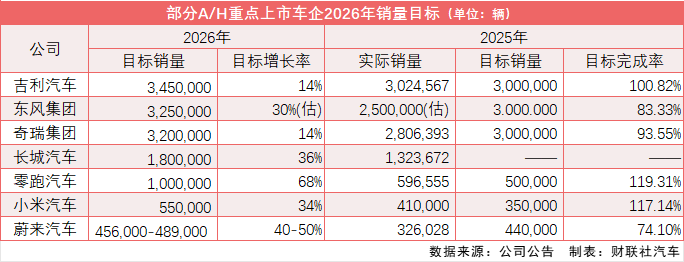
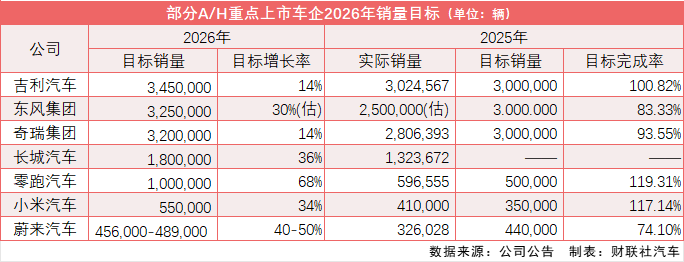
已连续多年未达成年度目标的长城汽车,下调了2026年员工持股计划业绩考核目标,将原计划中2026年 的汽车销量考核目标从不低于249万辆下调至不低于180万辆,较去年实际销量增长36%;净利润考核目 标(不低于100亿元)保持不变。 新能源汽车购置税减半政策的实施及"两新"补贴政策的调整延续,为2026年国内汽车市场带来了新的变 量。 在此背景下,多家车企相继披露的2026年销量目标呈现出截然相反的走势——尚处于全面智电转型、且 背负较大燃油车时代存量资产、销量基数较大的传统车企普遍给出了较为审慎的增长目标,而新造车企 业对市场估计则更为乐观。其中,在2025年均超额完成KPI的零跑、小米汽车今年销量目标的增幅分别 达到68%和34%;意欲在2026年实现全年盈利的蔚来汽车,年度目标增幅同样高达40-50%。 | | | 部分A/H重点上市车企2026年销量目标(单位:辆) | | | | | --- | --- | --- | --- | --- | --- | | 公司 | 2026年 | | 2025年 | | | | | 目标销量 | 目标增长率 | 实际销量 | 目标销量 | 目标完成率 | | 吉 ...



多家车企公布2026销量目标
财联社· 2026-01-07 16:07
Core Viewpoint - The implementation of the half-price purchase tax policy for new energy vehicles and the continuation of the "two new" subsidy policy have introduced new variables for the domestic automotive market in 2026, leading to divergent sales targets among traditional and new car manufacturers [2]. Group 1: Traditional Automakers - Geely has set the highest sales target for 2026 at 3.45 million units, with a growth rate of 14%, including 2.75 million units for the Geely brand, 300,000 for Zeekr, and 400,000 for Lynk & Co [4]. - Dongfeng Group aims for a total sales target of 3.25 million units in 2026, with an estimated growth rate of over 30%, including 1.7 million units for new energy vehicles, representing a 63% increase [5]. - Chery Group has set a target of 3.2 million units for 2026, reflecting a 14% growth compared to 2025, with a total of 2.806 million units sold in 2025 [5]. - Great Wall Motors has lowered its 2026 sales target from at least 2.49 million to at least 1.8 million units, indicating a 36% increase from last year's actual sales [5][6]. Group 2: New Car Manufacturers - Leap Motor has set an aggressive target of 1 million units for 2026, following a record sales performance in 2025 [7]. - Xiaomi aims for a sales target of 550,000 units in 2026, a 34% increase from the previous year, with new models expected to launch [7]. - NIO has set a target of 456,000 to 489,000 units for 2026, with a growth rate of 40-50%, supported by the introduction of several new models [8]. Group 3: Market Outlook - The automotive market is expected to experience a "front low and back high" trend in 2026, with overall growth driven by favorable national policies [9]. - The continuation of the vehicle replacement subsidy policy is anticipated to mitigate the impact of the half-price purchase tax policy, providing a stabilizing effect on market growth [8][9].


乔诺咨询创始人龙波2026致辞:增长,本质是价值观的外化体现
Sou Hu Cai Jing· 2026-01-07 14:22
Core Insights - The article discusses the challenges companies face in achieving growth and highlights the importance of understanding their current stage and market conditions [2][3] - It emphasizes that many companies have successfully transformed and maintained growth through strategic changes and innovations [6][7] Group 1: Reasons for Growth Challenges - Companies often rush to implement new projects without fully understanding their unique challenges and market conditions, leading to ineffective strategies [2] - The article suggests that many businesses are stuck in outdated growth models and need to adapt to the changing market landscape [3] Group 2: Key Drivers of Sustained Growth - The pursuit of high growth has led to innovative business models, as seen in companies like Yadea, which transformed its growth targets from 15% to 50% and significantly increased revenue [8][11] - A focus on product quality and customer experience is crucial, with companies like Tesla and Apple exemplifying how high-quality products lead to customer loyalty and recommendations [12][13] - Retail transformation is essential, emphasizing the importance of consumer experience over mere channel focus, which has been adopted by companies like Yadea and TCL [15][17] - Companies are increasingly recognizing the need for extreme cost management and efficiency, as demonstrated by firms like Zero Run and TCL, which have successfully reduced costs while improving quality [17][18] - Global expansion is becoming a necessity for survival, with companies like DJI and Shein successfully penetrating international markets, highlighting the importance of understanding local cultures and markets [19][20] Group 3: Organizational Vitality and Transformation - Successful companies exhibit traits such as ambitious goals that exceed current capabilities, fostering a culture of innovation and growth [24][26] - Emphasis on internal talent development over reliance on external hires is crucial for sustainable growth, as internal teams better understand the company's unique challenges [27][28] - Companies that embrace open growth and learning from global best practices tend to outperform their peers, as seen in the investment in training and development by firms like Yadea and TCL [30][31] Group 4: Value System Upgrades - The article posits that growth is a reflection of an organization's evolving values, with companies needing to shift their focus from merely attracting customers to prioritizing quality and customer satisfaction [32][33] - Continuous self-reflection and adaptation of values are essential for companies to navigate challenges and achieve long-term success [33]


从移动设备到机器人,高通如何解锁端侧AI的「全域智能」?
雷峰网· 2026-01-07 13:30
Core Viewpoint - Qualcomm is showcasing its advancements in personal AI and physical AI at CES 2026, emphasizing the shift from cloud dependency to terminal autonomy through powerful edge computing capabilities [2][6][7]. Group 1: Personal AI Developments - Qualcomm's Snapdragon X series processors are enabling a new generation of AI PCs, demonstrating capabilities such as real-time multimodal AI content creation without latency [2][6]. - The demand for AI PCs has surged, with companies like Lenovo and ASUS reporting a 2.5 times increase in AI PC product offerings within a year [9]. - 62% of users consider "local intelligent agent invocation" a core reason for purchasing AI PCs, highlighting the importance of local processing in enhancing user experience [13]. Group 2: Physical AI Innovations - Qualcomm's advancements in physical AI are evident in the automotive sector, with over 400 million vehicles utilizing Snapdragon digital chassis solutions [19]. - The company is leading in the in-car infotainment and cockpit SoC solutions, with over 75 million vehicles adopting the Snapdragon cockpit platform [19]. - The Snapdragon 8797 platform supports multi-modal large models for cockpit and driving assistance, enhancing the in-vehicle experience [21]. Group 3: Strategic Vision and Market Trends - Qualcomm's strategy focuses on building a comprehensive ecosystem that integrates personal AI and physical AI, aiming for a seamless user experience across various devices [8][26]. - The global AI PC market penetration is expected to exceed 80% in the next three years, indicating a significant shift towards edge computing [27]. - The company is positioned to capitalize on the exponential growth in demand for edge computing capabilities, as AI evolves towards intelligent agents and embodied forms [10][11]. Group 4: Technological Advancements - The Snapdragon X2 Plus platform features an 80 TOPS NPU, setting a new speed record for its class, and offers a 35% performance improvement while reducing power consumption by 43% compared to previous generations [15][29]. - Qualcomm's new processors, such as the Q-8750 and Q-7790, are designed for diverse IoT applications, enhancing the company's ability to support a wide range of smart devices [26][39]. - The Snapdragon Ride platform has been validated in over 60 countries, accumulating extensive data that enhances Qualcomm's capabilities in physical AI applications [46].

AI“统治”CES 2026:车企加码全域智能
Mei Ri Jing Ji Xin Wen· 2026-01-07 13:16
Core Insights - The 2026 Consumer Electronics Show (CES) highlights the automotive electronics sector, showcasing advancements in AI applications across various automotive domains, including smart driving assistance and intelligent cockpit experiences [1][2] - AI remains a central theme at CES 2026, driving breakthroughs in autonomous driving and industrial automation, reshaping lifestyles and work environments [1] Automotive Technology Showcase - Automakers focus on demonstrating technological roadmaps and electronic architectures rather than just vehicle models at CES [2] - Geely introduced its AI 2.0 technology system, which integrates various domains such as intelligent driving and cockpit systems, enhancing collaboration among different AI agents [3] - BMW showcased its AI-driven personal assistant integrated with Amazon's "Alexa+", allowing intuitive interaction between passengers and vehicles [3] Advanced Driver Assistance Systems (ADAS) - The popularity of advanced driver assistance systems remains strong, with many exhibitors presenting the latest developments in this field [7] - Nvidia's CEO unveiled the Alpamayo series of open-source AI models, which include advanced reasoning and simulation capabilities [7] - Geely and Qianli Technology launched the G-ASD brand, a high-capacity driving assistance solution covering levels from L2 to L4 [8] Robotics Integration - Human-like robots are transitioning from novelty to practical applications, with companies like Hyundai showcasing production versions of robots capable of performing real tasks [10][11] - Hyundai plans to integrate its Atlas robot into its global production network, starting with simple tasks and expanding to more complex operations by 2030 [11] - Companies are increasingly investing in robotics, with a focus on enhancing capabilities in various sectors, including automotive and smart devices [10][11]
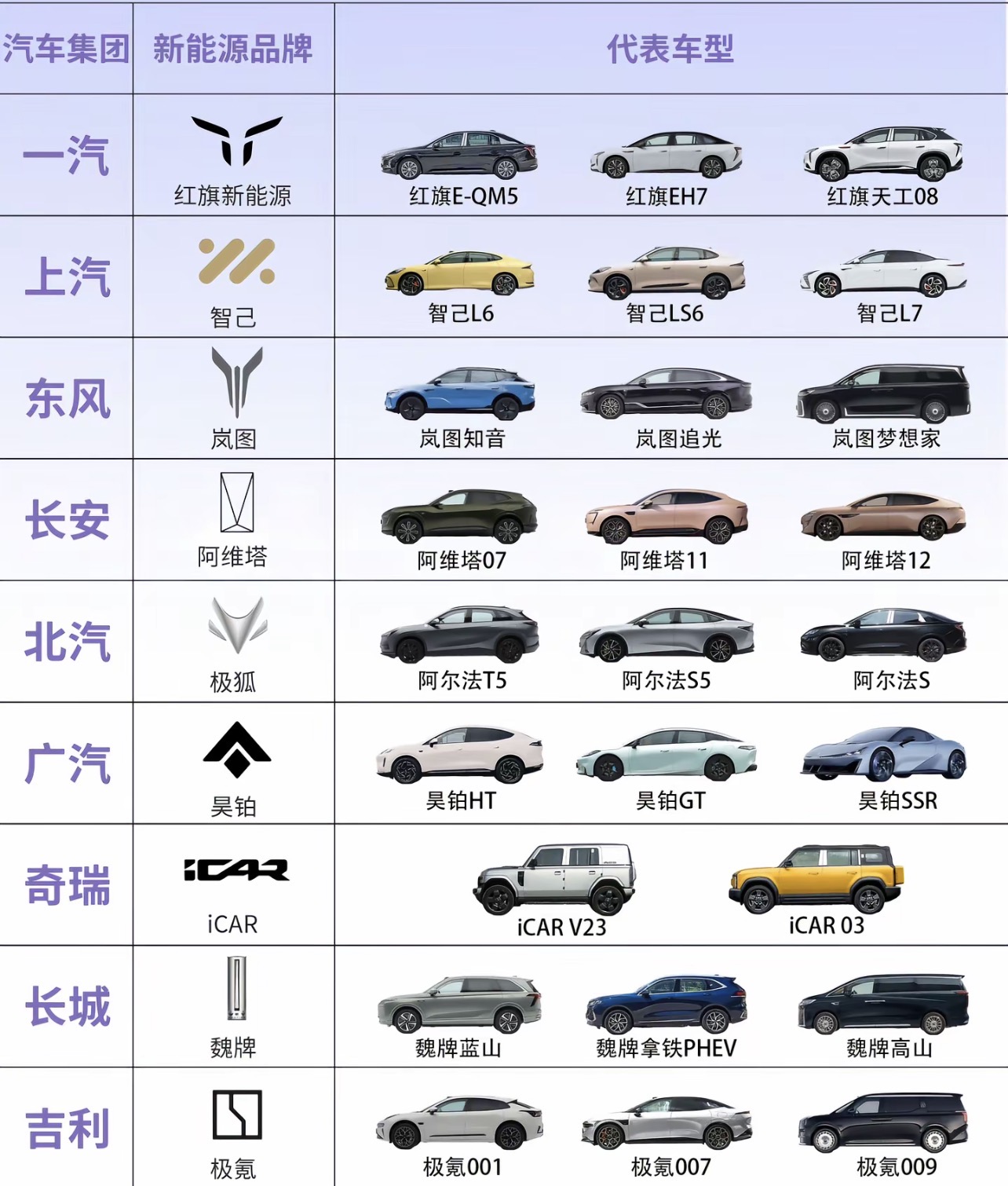
2026年,这些“创二代”,谁能突围,谁是扶不起的阿斗?
3 6 Ke· 2026-01-07 13:07
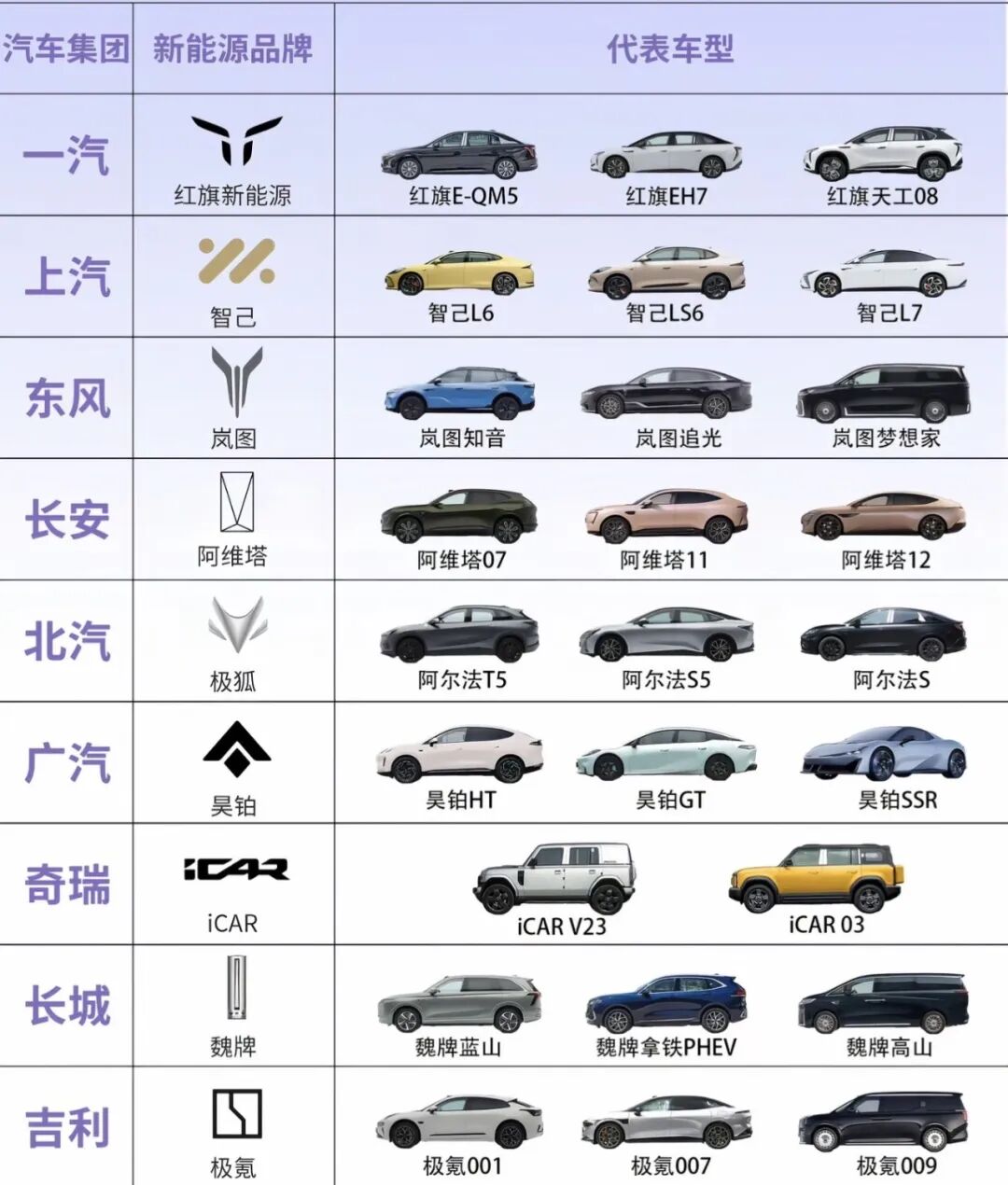
Core Insights - The new energy vehicle (NEV) industry in 2025 has seen a clear division between leading brands and those lagging behind, with companies like Leap Motor, Hongmeng Zhixing, and Xiaopeng firmly establishing themselves in the top tier, while traditional automaker-backed brands struggle to gain traction [1][6][11] Group 1: Market Performance - In 2025, the top three new car brands were Leap Motor (596,555 units, +103%), Hongmeng Zhixing (589,107 units, +32%), and Xiaopeng (429,445 units, +126%) [6][7] - The second tier includes Xiaomi Auto (over 411,625 units), Li Auto (406,343 units), and Deep Blue (333,117 units), while brands like Lantu, Avita, and Zhiji lagged with sales of 150,169, 128,772, and 81,017 units respectively [6][7][8] - The overall NEV market is expected to enter a phase of slower growth and intensified competition in 2026, with significant price cuts from major players like BMW and Tesla reigniting a price war [2][5] Group 2: Brand Dynamics - The "second-generation" brands, despite their backing from established automakers, have not been able to match the performance of pure new car brands, with significant sales gaps [6][11] - However, brands like Deep Blue and Lantu have shown impressive growth rates, with Lantu achieving a 87% increase in sales [8][21] - Traditional automakers are heavily investing in these "second-generation" brands, providing them with essential resources and support to compete in the high-end NEV market [11][13][15] Group 3: Future Outlook - Predictions for 2026 indicate a potential market growth of only about 2%, significantly lower than the previous year's growth [16] - Lantu is expected to expand its product lineup significantly and is on track for an IPO, which could enhance its market position [21][23] - Deep Blue is also positioned for growth, having achieved a high completion rate of its annual sales target [21][23] - Brands like Avita and Zeekr may stabilize but face challenges in maintaining competitive pricing and market share [26][29]


多家车企公布2026销量目标:传统车企审慎、新势力乐观
Feng Huang Wang· 2026-01-07 12:58
Core Viewpoint - The implementation of the half-price purchase tax policy for new energy vehicles and adjustments to the "two new" subsidy policies have introduced new variables for the domestic automotive market in 2026, leading to divergent sales targets among traditional and new car manufacturers [1] Traditional Automakers - Geely has set the highest sales target for 2026 at 3.45 million units, with a growth rate of 14%, including 2.75 million for the Geely brand, 300,000 for Zeekr, and 400,000 for Lynk & Co [3] - Dongfeng Group aims for a total sales target of 3.25 million units in 2026, with an estimated growth rate of 30%, and plans to sell 1.7 million new energy vehicles, reflecting a 63% increase [4] - Chery Group has set a target of 3.2 million units for 2026, a 14% increase from 2025, with its five brands aiming for a combined sales target of 3 million units [4] - Great Wall Motors has lowered its 2026 sales target from 2.49 million to 1.8 million units, reflecting a 36% increase from the previous year, while maintaining its net profit target [4] New Automakers - Leap Motor has set an aggressive target of 1 million units for 2026, representing a 68% increase from the previous year, following a record sales performance in 2025 [5][6] - Xiaomi aims for a sales target of 550,000 units in 2026, a 34% increase from 2025, with plans to launch new models including the SU7 [6] - NIO has set a target of 456,000 to 489,000 units for 2026, with a growth rate of 40-50%, and plans to introduce several new models [6] Market Outlook - The automotive market is expected to experience a "front low and back high" trend in 2026, with overall growth driven by supportive national policies, including the continuation of the vehicle replacement subsidy policy [7] - Industry experts predict that the overall growth rate of the automotive market in 2026 will exceed zero growth, with January expected to show strong sales performance [7]
特斯拉吹响号角,2026年新能源汽车竞赛进入下一轮
Xin Lang Cai Jing· 2026-01-07 12:53
Core Insights - The new energy vehicle (NEV) industry in 2025 has shown a clear division between leading brands and those lagging behind, with a notable performance from new entrants like Leap Motor, Hongmeng Zhixing, and Xiaopeng, which have solidified their positions in the first tier of the market [2][5][6] - Traditional automakers' second-generation brands, such as Deep Blue, Zhiji, and Avita, despite having strong backing, have struggled to compete and remain in the second tier [2][5] Market Performance - In 2025, the top three new car brands were Leap Motor (596,555 units, +103%), Hongmeng Zhixing (589,107 units, +32%), and Xiaopeng (429,445 units, +126%) [5][7] - Other notable brands included Xiaomi Auto (over 411,625 units), Li Auto (406,343 units), and Deep Blue (333,117 units) [5][7] - The bottom performers were Avita (128,772 units), Zhiji (81,000 units), and Deep Blue (150,169 units), with Zhiji being the only brand with sales below 100,000 units [6][7][8] Competitive Landscape - The NEV market is transitioning from growth to intensified competition, with a resurgence of price wars as seen with BMW's significant price cuts across multiple models [3][4][14] - The first-tier brands are primarily pure new car manufacturers, while many second-tier brands are traditional automakers' second-generation brands, which have shown promising growth rates despite lower overall sales [8][11] Future Outlook - The NEV market is expected to see slower growth in 2026, with predictions of only about 2% increase in sales, leading to a more competitive environment [14][15] - Brands like Lantu and Deep Blue are anticipated to perform well in 2026, with Lantu expected to expand its product lineup significantly and Deep Blue achieving high delivery rates [19][21] - Conversely, brands like Avita and Zeekr may face challenges in maintaining momentum due to market saturation and pricing pressures [22][25] Consumer Sentiment - Consumers show a preference for traditional automakers' NEV brands, citing concerns over the stability and reliability of newer entrants [26][27] - The backing of established manufacturers provides a sense of security for consumers, influencing their purchasing decisions [26][27]