
弱美元格局

Search documents
菜百股份:利润大幅增长,投资金业务持续受益-20260201
Guolian Minsheng Securities· 2026-02-01 10:25
Investment Rating - The report maintains a "Recommended" rating for the company [2][8]. Core Insights - The company is expected to achieve a net profit attributable to shareholders of 1.06 to 1.23 billion yuan in 2025, representing a year-on-year increase of 47% to 71%. The non-recurring net profit is projected to be between 0.95 to 1.12 billion yuan, with a growth of 39% to 64% [8]. - The fourth quarter of 2025 is anticipated to see a significant increase in net profit, estimated at 413 to 583 million yuan, reflecting a year-on-year growth of 150% to 254% [8]. - The upward trend in gold prices, coupled with favorable tax reforms, is expected to enhance the company's investment gold business, leading to an increase in market demand [8]. - The company benefits from high consumer demand for gold in the Beijing region, which is expected to drive sales of gold jewelry [8]. - The report forecasts revenues of 33.23 billion yuan for 2025, with a growth rate of 64.2%, and net profits of 1.15 billion yuan, with a growth rate of 60% [2][8]. Financial Projections - Revenue projections for 2024, 2025, 2026, and 2027 are 20.23 billion yuan, 33.23 billion yuan, 37.05 billion yuan, and 40.24 billion yuan, respectively, with growth rates of 22.2%, 64.2%, 11.5%, and 8.6% [2][9]. - The net profit attributable to shareholders is expected to be 719 million yuan in 2024, 1.15 billion yuan in 2025, 1.35 billion yuan in 2026, and 1.52 billion yuan in 2027, with growth rates of 1.7%, 60.0%, 17.1%, and 12.5% [2][9]. - Earnings per share (EPS) are projected to be 0.92 yuan in 2024, 1.48 yuan in 2025, 1.73 yuan in 2026, and 1.95 yuan in 2027 [2][9].

菜百股份(605599):利润大幅增长,投资金业务持续受益
Guolian Minsheng Securities· 2026-02-01 09:58
Investment Rating - The report maintains a "Recommended" rating for the company [2][8]. Core Insights - The company is expected to achieve a net profit attributable to shareholders of 1.06 to 1.23 billion yuan in 2025, representing a year-on-year increase of 47% to 71%. The non-recurring net profit is projected to be between 0.95 to 1.12 billion yuan, with a growth of 39% to 64% [8]. - The fourth quarter of 2025 is anticipated to see a significant increase in net profit, estimated at 413 to 583 million yuan, reflecting a year-on-year growth of 150% to 254% [8]. - The upward trend in gold prices, coupled with favorable tax reforms, is expected to enhance the company's investment gold business, leading to increased market demand [8]. - The company benefits from high consumer demand for gold in the Beijing region, which is expected to drive sales of gold jewelry [8]. - The report forecasts revenues of 33.23 billion yuan in 2025, with a growth rate of 64.2%, and net profits of 1.15 billion yuan, with a growth rate of 60% [8]. Financial Projections - Revenue projections for 2024, 2025, 2026, and 2027 are 20.23 billion yuan, 33.23 billion yuan, 37.05 billion yuan, and 40.24 billion yuan, respectively, with growth rates of 22.2%, 64.2%, 11.5%, and 8.6% [2][9]. - The net profit attributable to shareholders is expected to be 719 million yuan in 2024, 1.15 billion yuan in 2025, 1.35 billion yuan in 2026, and 1.52 billion yuan in 2027, with growth rates of 1.7%, 60%, 17.1%, and 12.5% [2][9]. - Earnings per share (EPS) are projected to be 0.92 yuan in 2024, 1.48 yuan in 2025, 1.73 yuan in 2026, and 1.95 yuan in 2027 [2][9].
人民币中间价“破7”后,后续怎么走?
Sou Hu Cai Jing· 2026-01-28 15:52
Core Viewpoint - The recent appreciation of the Renminbi (RMB) against the US dollar has been driven by a combination of external market conditions and domestic supply-demand dynamics, with the RMB middle rate breaking the 7.0 mark for the first time in two and a half years, indicating a strong upward trend [1][2][3]. Exchange Rate Trends - The RMB to USD middle rate has shown a pattern of steady appreciation, with a significant increase of 103 basis points to 6.9755 on January 28, 2026, following a previous rise that broke the 7.0 threshold [1][2]. - The RMB middle rate experienced its largest single-day appreciation since August 2025 on January 23, 2026, rising 90 basis points to 6.9929 [2]. - Both onshore and offshore RMB rates began appreciating at the end of 2025, with fluctuations around the 6.9 range continuing into 2026 [2]. Factors Driving Appreciation - The "weak dollar" environment has provided crucial external support for the RMB's appreciation, with the US dollar index declining from 100.22 to 97.51 since late November 2025, a drop of approximately 2.7% [2]. - A surge in seasonal foreign exchange settlement demand has been identified as a core driver of the RMB's strength, with settlement demand in late 2025 significantly exceeding historical seasonal levels [2][3]. Market Sentiment and Future Outlook - Market sentiment has been buoyant, contributing to the RMB's strong performance, with analysts noting that the release of accumulated settlement demand from high export growth may accelerate [3]. - Despite the current strength, there is a consensus that the RMB will not experience a one-sided appreciation trend, with regulatory measures in place to prevent excessive fluctuations [4][5]. Regulatory and Institutional Perspectives - The People's Bank of China (PBOC) has indicated that the RMB exchange rate will continue to exhibit two-way fluctuations and maintain elasticity, emphasizing the importance of market forces in exchange rate formation [4]. - Analysts from institutions like Galaxy Securities predict a stable appreciation of the RMB rather than a rapid increase, with expectations of seasonal fluctuations in demand affecting the rate in the coming months [5]. Long-term Considerations - The RMB may face depreciation pressure in 2026 due to potential stabilization of the US dollar index and the impact of high tariffs on global trade and exports [6]. - Domestic economic fundamentals are expected to provide critical support for the RMB's stability, with regulatory interventions likely to manage significant volatility [6].
结汇需求与弱美元共振,人民币中间价“破7”后如何演绎?
Di Yi Cai Jing· 2026-01-28 11:02
Core Viewpoint - The market generally believes that the RMB exchange rate will not exhibit a unilateral appreciation trend, despite recent strengthening against the USD [4][6]. Exchange Rate Trends - As of January 28, the RMB to USD central parity rate was reported at 6.9755, a significant increase of 103 basis points from the previous trading day, continuing the appreciation trend after breaching the 7.0 mark [1]. - The RMB's central parity rate has shown a fluctuating upward trend, with a notable increase of 90 basis points on January 23, marking the largest single-day appreciation since August 25, 2025 [2]. - The onshore and offshore RMB rates began appreciating at the end of 2025, with both markets continuing to show slight appreciation around the 6.9 range in 2026 [2]. Factors Driving Appreciation - The rapid appreciation of the RMB is driven by a combination of international market conditions and domestic supply-demand dynamics [2]. - A "weak dollar" environment has provided significant external support for RMB appreciation, with the dollar index declining from 100.22 to 97.51 since late November 2025, a drop of approximately 2.7% [2]. - Domestically, a surge in seasonal foreign exchange settlement demand has been a core driver of the RMB's strength, with settlement demand in late 2025 significantly exceeding historical seasonal levels [2][3]. Market Sentiment and Future Outlook - Recent RMB appreciation has been fueled by high market sentiment, with accumulated settlement demand from previous high export growth potentially accelerating [3]. - Analysts predict that while the RMB may continue to show strength in the short term, it is unlikely to maintain a unilateral appreciation trend throughout the year [4][6]. - The People's Bank of China has indicated that the RMB exchange rate will continue to exhibit two-way fluctuations and maintain elasticity, aiming to prevent rapid appreciation or unilateral trends [5]. Long-term Projections - Analysts from Galaxy Securities expect the RMB to appreciate steadily rather than sharply, with seasonal settlement demand typically weakening in February and March [5]. - The RMB exchange rate will largely depend on three factors: the dollar's performance, the intensity of central parity regulation, and the effects of domestic export and growth policies [5][6]. - There is a potential for depreciation pressure on the RMB in 2026, influenced by a stabilization of the dollar index and the impact of high tariffs on global trade and exports [6].
长江有色:27日锌价续涨 现货总体成交增量有限
Xin Lang Cai Jing· 2026-01-27 08:31
Core Viewpoint - The domestic zinc prices continue to rise, supported by macroeconomic factors and production cost increases, but face pressure from weak demand and inventory accumulation expectations [2][3]. Group 1: Market Performance - Today's Shanghai zinc futures opened strong, with the main contract 2603 starting at 25,280 yuan/ton, reaching a high of 25,280 yuan/ton and a low of 24,710 yuan/ton, closing at 24,950 yuan/ton, up 190 yuan, or 0.77% [1]. - The trading volume for the Shanghai zinc 2603 contract was 255,674 lots, an increase of 47,753 lots, while open interest decreased by 2,681 lots to 118,946 lots [1]. - The latest price for London zinc was reported at 3,335 USD, down 16 USD [1]. Group 2: Price Statistics - The ccmn comprehensive zinc price for 0 zinc was reported between 24,710-24,810 yuan/ton, with an average of 24,760 yuan, up 40 yuan; 1 zinc was between 24,630-24,730 yuan/ton, averaging 24,680 yuan, also up 40 yuan [1]. - In Guangdong, the 0 zinc price ranged from 24,500-24,800 yuan/ton, averaging 24,650 yuan, up 60 yuan; 1 zinc was between 24,430-24,730 yuan/ton, averaging 24,580 yuan, also up 60 yuan [1]. - The current spot zinc market quotes for 0 zinc are between 24,700-24,810 yuan/ton, and for 1 zinc between 24,630-24,730 yuan/ton [1]. Group 3: Macroeconomic Factors - The U.S. Department of Commerce reported a 5.3% increase in durable goods orders, the largest growth in six months, driven by orders for commercial aircraft and other capital equipment [2]. - Market expectations for a potential U.S. government shutdown by the end of January have risen to 78%, up from less than 10% the previous week [2]. - Rising natural gas prices in Europe and the U.S. due to cold weather have increased production costs for overseas smelters, supporting higher zinc prices [2]. Group 4: Supply and Demand Dynamics - Domestic zinc processing fees have stabilized weakly, with some smelters reducing production; however, downstream companies are facing pressure from poor orders and high raw material prices, leading to increased inventory expectations [2]. - The current market shows active selling by holders, but the total demand from downstream for replenishment is not keeping pace, resulting in a gradual adjustment of spot premiums [2]. - Overall, the market sentiment remains cautious, with limited increases in overall transaction volumes [2]. Group 5: Price Outlook - Short-term support for zinc prices comes from a weak dollar and rising costs, but weak demand and inventory accumulation expectations are exerting pressure, leading to an anticipated range-bound and slightly strong price trend [3].


睿远基金总经理饶刚:中国企业出海将是长期值得挖掘的投资机遇
Zhong Zheng Wang· 2026-01-05 14:48
Core Viewpoint - The global liquidity easing trend remains the primary driver of asset pricing, despite the differentiated monetary policies in Europe, the U.S., and Japan [1] Group 1: Global Economic Outlook - By 2026, the influence on global asset pricing is expected to shift from being solely driven by monetary policy to a combination of monetary and fiscal policies [1] Group 2: Investment Opportunities - The rapid development of AI in recent years presents significant macro-level volatility, representing both risks and opportunities that cannot be overlooked [1] - China's manufacturing sector is advancing, with both risks and opportunities in overseas investments; currently, China's overseas investment returns are lower than those of some developed countries, but Chinese manufacturing firms possess significant cost-performance advantages, making overseas expansion a long-term investment opportunity worth exploring [1] - Many leading consumer companies in China now offer dividend yields exceeding 4% and have stable demand, which may indicate potential future increases in domestic demand, presenting left-side allocation value [1]
金价、银价下跌,金融圈人士直言:有人在出货
Mei Ri Jing Ji Xin Wen· 2025-12-31 08:01
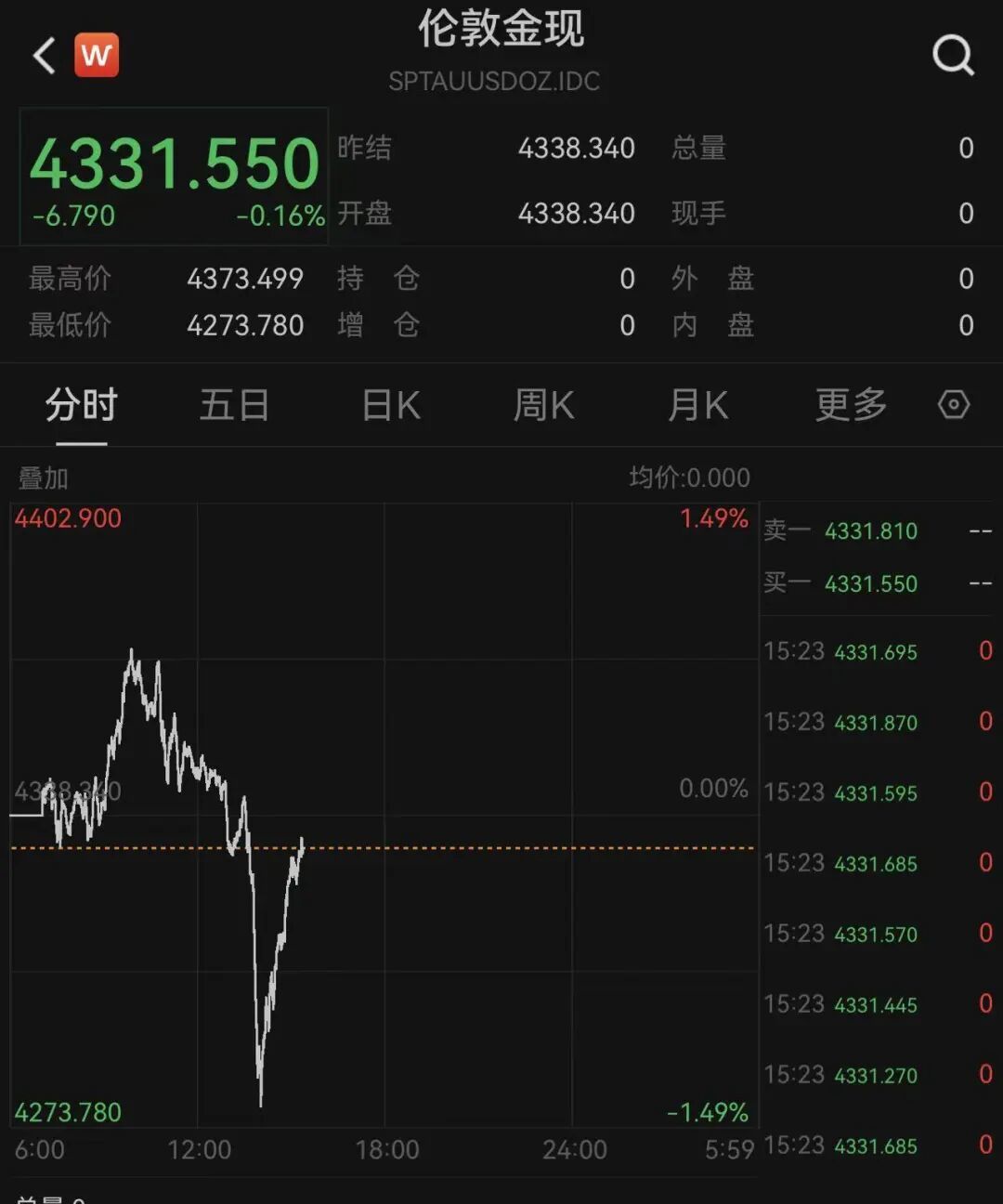
Core Viewpoint - The precious metals market is experiencing significant volatility, with gold, silver, and platinum prices declining sharply after a period of substantial gains, driven by profit-taking and reduced geopolitical risks [6][7][11]. Price Movements - Gold prices fell by 1.50%, dropping below $4300 per ounce, while silver saw a decline of over 7%, currently down by 5.02% [1][3]. - The main silver futures contract dropped over 5%, currently at 17074 yuan per kilogram, while platinum futures fell by 14%, now priced at 527.25 yuan per gram [3]. Market Dynamics - The recent surge in precious metal prices, particularly silver, saw it rise from around $50 to over $80 per ounce, with a monthly increase of approximately 150% [6]. - As of last week, gold had increased by about 70% for the year, while silver's rise exceeded 150%, with other metals like platinum and palladium also seeing gains over 100% [6]. Factors Influencing Price Changes - The decline in precious metal prices is attributed to profit-taking after previous gains, reduced geopolitical risks, and increased margin requirements by major exchanges [7][8]. - Financial institutions are under pressure to settle accounts as the year-end approaches, leading to selling at high prices, which has put downward pressure on prices [7]. Future Outlook - Short-term volatility in precious metals is expected to continue, with silver and platinum facing larger adjustments due to liquidity constraints [8]. - Long-term prospects remain positive, with expectations of continued demand from central banks and a potential shift to a "weak dollar" environment supporting prices [9][10]. Central Bank Activity - Central banks are projected to significantly increase gold purchases, with estimates suggesting an average monthly purchase of 70 tons by 2026, compared to 17 tons before 2022 [9]. - Emerging market central banks are strategically increasing their gold reserves, indicating a strong demand for gold [9]. Market Sentiment - The precious metals market is increasingly influenced by investor sentiment and liquidity, with emotional factors becoming critical in price determination [12]. - The market is experiencing a "bungee jump" effect, reflecting rapid price fluctuations that investors should be cautious of [11][12].
中信期货晨报:商品期货多数上涨,中小盘股指涨幅较好-20250912
Zhong Xin Qi Huo· 2025-09-12 05:11
1. Report Industry Investment Rating - No relevant content provided. 2. Core Viewpoints of the Report - The report notes that most commodity futures rose, and small - and mid - cap stock index futures had good gains. In the overseas market, the US labor market shows a clear slowdown trend, and the weak non - farm data increases the probability of a September interest rate cut. In the domestic market, the PPI is expected to see a slight increase in the central value, while the CPI may be slightly lower than the first - half level. Short - term domestic assets present mainly structural opportunities, with a higher probability of incremental policies in the fourth quarter. Overseas, the situation is generally favorable for gold. Long - term US fundamentals are fair, and a weak US dollar pattern continues [6]. 3. Summary by Related Catalogs 3.1 Market Performance - **Stock Index Futures**: The CSI 300 futures closed at 4562, up 2.92% daily, 2.37% weekly, 1.24% monthly, 17.40% quarterly, and 16.35% year - to - date. The SSE 50 futures closed at 2990.2, up 1.78% daily, 1.68% weekly, 0.34% monthly, 11.20% quarterly, and 11.66% year - to - date. The CSI 500 futures closed at 7124.6, up 3.81% daily, 3.28% weekly, 1.83% monthly, 21.52% quarterly, and 25.11% year - to - date. The CSI 1000 futures closed at 7387.8, up 3.31% daily, 2.24% weekly, 0.29% monthly, 20.15% quarterly, and 26.32% year - to - date [3]. - **Treasury Bond Futures**: The 2 - year Treasury bond futures closed at 102.41, up 0.06% daily, 0.02% weekly, - 0.01% monthly, - 0.22% quarterly, and - 0.55% year - to - date. The 5 - year Treasury bond futures closed at 105.59, up 0.16% daily, 0.00% weekly, 0.07% monthly, - 0.63% quarterly, and - 0.89% year - to - date. The 10 - year Treasury bond futures closed at 107.58, up 0.08% daily, - 0.34% weekly, - 0.21% monthly, - 1.24% quarterly, and - 1.23% year - to - date. The 30 - year Treasury bond futures closed at 114.74, down 0.02% daily, - 1.38% weekly, - 1.55% monthly, - 4.61% quarterly, and - 3.44% year - to - date [3]. - **Foreign Exchange**: The US dollar index was at 97.8433, unchanged daily, up 0.11% weekly, unchanged monthly, up 1.11% quarterly, and down 9.81% year - to - date. The euro - US dollar exchange rate was 1.1695, with 0 pips change daily, - 24 pips weekly, 9 pips monthly, - 93 pips quarterly, and 1342 pips year - to - date. The US dollar - yen exchange rate was 147.46, with 0 pips change daily, up 0.03% weekly, up 0.28% monthly, up 2.40% quarterly, and down 6.20% year - to - date [3]. - **Overseas Commodities**: NYMEX WTI crude oil was at $63.75, up 1.56% daily, 2.87% weekly, - 0.41% monthly, - 1.88% quarterly, and - 11.30% year - to - date. ICE Brent crude oil was at $67.6, up 1.61% daily, 2.94% weekly, 0.21% monthly, 1.46% quarterly, and - 9.66% year - to - date. COMEX gold was at $3680.4, up 0.45% daily, 1.12% weekly, 4.67% monthly, 11.02% quarterly, and 39.45% year - to - date [3]. 3.2 Macro Situation - **Overseas Macro**: The US released August non - farm data, with only 22,000 new jobs, lower than the previous value and expectations. The labor market's downward risk has increased, and wage growth has slowed. The number of initial and continued unemployment claims shows that the labor market slowdown is becoming more obvious [6]. - **Domestic Macro**: In August, the PPI rebounded from - 3.6% to - 2.9% year - on - year, while the CPI dropped from 0% to - 0.4% year - on - year. The tail - wagging effect had a large impact, and food prices dragged down the CPI. The PPI's month - on - month rebound to 0 and the core CPI's rise to 0.9% indicate that domestic policies are starting to take effect. The PPI central value is expected to rise slightly, and the CPI may be slightly lower than the first - half level [6]. 3.3 Asset Views - **Short - term**: Domestic assets mainly present structural opportunities. The market sentiment has cooled down after important domestic events this week. In the overseas market, the weak US non - farm data increases the probability of a September interest rate cut, which is favorable for gold. - **Long - term**: The US fundamentals are fair, and interest rate cuts are expected to boost the fundamentals. The weak US dollar pattern continues, and investors should be vigilant about volatility spikes and focus on non - US dollar assets [6]. 3.4 Viewpoint Highlights - **Financial Sector**: Stock index futures should adopt a dumbbell structure to deal with market differences; stock index options should continue the hedging and defensive strategy; the stock - bond seesaw may continue in the short term for Treasury bond futures. All are expected to be in a volatile state [7]. - **Precious Metals**: Driven by dovish expectations, the prices of gold and silver are expected to rise in a volatile manner, as the probability of a September interest rate cut in the US increases, and the risk of the Fed's loss of independence expands [7]. - **Shipping Sector**: For the container shipping to Europe route, attention should be paid to the game between peak - season expectations and price - increase implementation. Steel and iron ore are expected to be volatile, with the impact of production restrictions on steel weakening and iron ore showing an unexpected decline in molten iron production and a slight increase in port inventories [7]. - **Black Building Materials**: Despite the "anti - involution" impact, the prices of varieties in this sector are still supported during the peak season. However, most varieties are expected to be in a volatile state, such as coke starting the first - round price cut after the end of military parade - related production restrictions, and the supply of coking coal significantly decreasing [7]. - **Non - ferrous Metals and New Materials**: Affected by the better - than - expected July China's import and export data, non - ferrous metals were initially boosted. However, most varieties are expected to be volatile, with some facing downward pressure, such as copper due to the rising risk of overseas recession [7]. - **Energy and Chemicals**: The supply - demand situation of crude oil has weakened significantly, and coking coal's decline has dragged down the chemical industry. Most varieties in this sector are expected to be volatile, with some facing downward pressure, such as PP due to the increasing pressure of new production capacity [9]. - **Agricultural Sector**: The agricultural market is in a narrow - range volatile state, waiting for the results of field inspections. Most agricultural products are expected to be volatile, such as livestock products facing a supply - demand imbalance and rubber facing pressure from previous highs [9].
中信期货晨报:国内商品期货涨跌互现,能源化工短期受益中东冲突-20250911
Zhong Xin Qi Huo· 2025-09-11 05:10
1. Report Industry Investment Rating - The provided content does not mention the report industry investment rating. 2. Core Viewpoints of the Report - Overseas: The US released its August non - farm payroll data, with only 22,000 new jobs added, falling short of the previous value and expectations. The slowdown in the US labor market is becoming more evident. The weak non - farm data increases the probability of a September interest rate cut, and Trump's "recalibration" of policies is beneficial to gold. In the long run, the US fundamentals are fair, and interest rate cuts are expected to boost the fundamentals further, with a weak US dollar pattern continuing [6]. - Domestic: In August, the PPI rebounded year - on - year, while the CPI declined. The anti - involution and trade - in policies have shown initial results. In the short term, domestic assets present mainly structural opportunities. The policy - driven logic will be strengthened in the second half of the year, and there is a higher probability of incremental policies in the fourth quarter [6]. 3. Summary by Relevant Catalogs 3.1 Financial Market - **Stock Index Futures**: The market uses a dumbbell structure to handle market divergence, and the short - term judgment is a sideways trend due to the decline in incremental funds [8]. - **Stock Index Options**: The hedging and defensive approach continues, and the short - term judgment is a sideways trend, with concerns about the deterioration of option market liquidity [8]. - **Treasury Bond Futures**: The stock - bond seesaw may continue in the short term, and the short - term judgment is a sideways trend, with attention to factors such as unexpected tariffs, supply, and monetary easing [8]. 3.2 Precious Metals - **Gold/Silver**: The restart of the US interest rate cut cycle in September and the increased risk of the Fed's independence drive prices up. The short - term judgment is a sideways - up trend, with attention to the US fundamentals, Fed's monetary policy, and the global equity market trend [8]. 3.3 Shipping - **Container Shipping to Europe**: The market focuses on the game between peak - season expectations and the implementation of price increases. The short - term judgment is a sideways trend, with attention to tariff policies and shipping companies' pricing strategies [8]. 3.4 Black Building Materials - **Steel Products**: The impact of production restrictions weakens, and the price is in a low - level sideways trend. The short - term judgment is a sideways trend, with attention to the progress of special bond issuance, steel exports, and hot metal production [8]. - **Iron Ore**: The hot metal production decreases more than expected, and port inventories increase slightly. The short - term judgment is a sideways trend, with attention to overseas mine production and shipment, domestic hot metal production, weather, port inventory changes, and policy dynamics [8]. - **Coke**: After the military parade production restrictions end, the first round of price cuts begins. The short - term judgment is a sideways trend, with attention to steel mill production, coking costs, and macro sentiment [8]. - **Coking Coal**: The supply drops significantly, and the spot price weakens. The short - term judgment is a sideways trend, with attention to steel mill production, coal mine safety inspections, and macro sentiment [8]. 3.5 Non - ferrous Metals and New Materials - **Copper**: The risk of overseas recession rises, putting pressure on copper prices. The short - term judgment is a sideways - down trend, with attention to supply disruptions, unexpected domestic policies, less - than - expected dovishness from the Fed, and less - than - expected domestic demand recovery [8]. - **Aluminum Oxide**: The warehouse receipts increase again, and the price is under sideways pressure. The short - term judgment is a sideways - down trend, with attention to factors such as unexpected delays in ore复产 and unexpected increases in electrolytic aluminum复产 [8]. - **Aluminum**: Market sentiment fluctuates, and the price continues to rise. The short - term judgment is a sideways trend, with attention to macro risks, supply disruptions, and less - than - expected demand [8]. 3.6 Energy and Chemicals - **Crude Oil**: Supply pressure persists, and the short - term judgment is a sideways - down trend, with attention to OPEC+ production policies and the Middle East geopolitical situation [10]. - **LPG**: The valuation repair is over, and the short - term judgment is a sideways trend, with attention to cost - side developments such as crude oil and overseas propane [10]. - **Asphalt**: The spot prices in South China and Shandong are at parity, and the futures price is in a downward trend below 3500. The short - term judgment is a downward trend, with attention to sanctions and supply disruptions [10]. 3.7 Agriculture - **Oils and Fats**: The MPOB report is relatively bearish, and market sentiment is weak. The short - term judgment is a sideways trend, with attention to US soybean weather and Malaysian palm oil production and demand data [10]. - **Protein Meal**: The market has both long and short factors, and the price continues to fluctuate narrowly. The short - term judgment is a sideways trend, with attention to US soybean weather, domestic demand, macro factors, and Sino - US and Sino - Canadian trade wars [10]. - **Corn/Starch**: As new grains are gradually put on the market, look for opportunities to short at high prices. The short - term judgment is a sideways trend, with attention to less - than - expected demand, macro factors, and weather [10].
国新国证期货早报-20250807
Guo Xin Guo Zheng Qi Huo· 2025-08-07 02:12
Report Overview - The report provides daily analysis and insights on various commodities and financial markets, including overseas and domestic macroeconomics, stock indices, and futures contracts for commodities such as coal, sugar, rubber, and agricultural products. 1. Macroeconomic Analysis Overseas Macro - Early in the week, market bets on Fed rate cuts declined, but the August 1st non - farm payrolls data raised concerns about US employment and economic downturn. Market expectations for Fed rate cuts in the second half of the year have increased, which is favorable for gold. In the long - term, the weak US dollar pattern continues [1]. Domestic Macro - In the context of stable and progressive domestic economic operation in the first half of the year, the tone of the July Politburo meeting was to improve the quality and speed of using existing policies, with relatively limited incremental policies. The July composite PMI remained above the critical point. Attention should be paid to the progress of negotiations between the US and economies such as China and Mexico [1]. 2. Asset Views Domestic Assets - Domestic assets present mainly structural opportunities. The policy - driven logic will be strengthened in the second half of the year, and the probability of incremental policy implementation is higher in the fourth quarter [1]. Overseas Assets - Concerns about US employment decline and economic slowdown are rising. The long - term weak US dollar pattern continues. Attention should be paid to non - US dollar assets and be vigilant against volatility spikes [1]. 3. Stock Index Analysis A - share Market - On August 6th, the three major A - share indices rose collectively. The Shanghai Composite Index reached a new closing high for the year, with a 0.45% increase to 3633.99 points; the Shenzhen Component Index rose 0.64% to 11177.78 points; the ChiNext Index rose 0.66% to 2358.95 points. The trading volume of the two markets reached 1734.1 billion yuan, an increase of 138 billion yuan from the previous day [1]. CSI 300 Index - On August 6th, the CSI 300 Index remained strong, closing at 4113.48, a环比 increase of 10.04 [2]. 4. Commodity Futures Analysis Coke and Coking Coal - On August 6th, the coke weighted index showed a strong oscillation, closing at 1696.6, a环比 increase of 46.7. The coking coal weighted index maintained an upward - trending oscillation, closing at 1194.6 yuan, a环比 increase of 79.7. Some mines in Linfen have been shut down for rectification, and the supply of coking coal is difficult to increase significantly in the short term. The fifth round of coke price increases has been fully implemented, and the profitability of coke enterprises has improved [2][3]. Zhengzhou Sugar - International oil price decline and concerns about global demand weakness have pressured the US sugar market. Affected by the decline of US sugar and spot price adjustments, the Zhengzhou Sugar 2601 contract declined slightly on August 6th. As of July 31st, Yunnan's cumulative sugar sales reached 1.9514 million tons, with a sales rate of 80.68% [5]. Rubber - Due to large short - term gains, the Shanghai rubber futures oscillated and adjusted on August 6th. From January to June 2025, Hainan's natural rubber output was 91,900 tons, a 6.0% decrease compared to 2024 [6]. Soybean Meal - On August 6th, the international CBOT soybean futures closed down. The new - season soybean planting in Brazil is expected to expand, which will make the global soybean supply more abundant. The domestic soybean meal futures price showed a trend of rising and then falling. The domestic supply is sufficient, but there are concerns about future supply shortages, so the soybean meal may oscillate widely [7]. Live Pigs - On August 6th, live pig futures closed up. The short - term supply is sufficient, and the mid - term production capacity is still being released. The demand is weak due to high - temperature weather and reduced school procurement. The overall live pig market is in a state of loose supply and demand [8]. Palm Oil - On August 6th, palm oil futures failed to continue the previous day's strength. From August 1 - 5, 2025, Malaysia's palm oil production decreased by 17.27% compared to the same period last month [8]. Shanghai Copper - Globally, LME copper inventories are high, while SHFE inventories are low. US copper inventory may flow back, which may suppress prices. Technically, Shanghai copper is in a state of oscillation [10]. Cotton - On the night of August 6th, the main contract of Zhengzhou cotton closed at 13,660 yuan/ton. The cotton inventory in Xinjiang decreased by 90 lots compared to the previous day, and the cotton growth in Xinjiang is good, with the expected harvest time one week earlier than usual [10]. Logs - On August 6th, the 2509 log futures contract opened at 829, with a low of 826, a high of 836, and a close of 832.5, with a reduction of 370 lots. The spot prices in Shandong and Jiangsu remained unchanged. The increase in external quotes has driven up the domestic futures price [10][11]. Steel - On August 6th, the rb2510 contract closed at 3,234 yuan/ton, and the hc2510 contract closed at 3,451 yuan/ton. The sharp rise in coking coal futures has driven up steel prices. In the short term, steel prices may be strong, but there is a risk of correction if demand is insufficient [11]. Alumina - On August 6th, the ao2509 contract closed at 3,241 yuan/ton. The sentiment of "anti - involution" has cooled down. The supply of alumina has increased, and the market may maintain a range - bound oscillation [11]. Shanghai Aluminum - On August 6th, the al2509 contract closed at 20,650 yuan/ton. The macro environment is relatively cold, and the supply of aluminum is increasing slightly while the demand is shrinking. The aluminum price may oscillate within a range [12].