
PPI转正

Search documents
招商宏观:在中性情境下,2026年PPI同比大概率于二季度中后期转正
Sou Hu Cai Jing· 2026-02-12 03:45
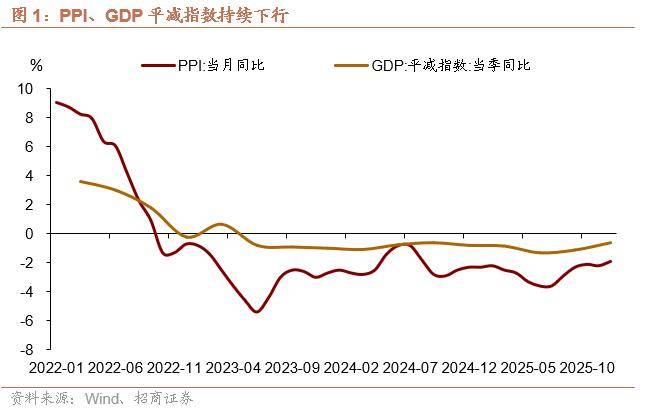
Core Viewpoint - The return of inflation is one of the macro themes in China for 2026, driven by three main factors: the marginal demand for commodities like copper due to artificial intelligence, the decline of the US dollar index since 2025 enhancing the financial properties of commodities, and resource populism increasing global investor concerns about commodity supply [1][2]. Group 1: PPI Trends and Influences - Insufficient domestic demand is the primary drag on PPI from 2022 to 2025, with real estate investment being the decisive factor contributing over 60% to the decline [3][4]. - The PPI's low performance and the divergence between nominal GDP and real GDP highlight the negative impact of price declines on economic perception, with PPI being negative for 39 consecutive months by the end of 2025 [3][4]. - The contribution of various factors to PPI changes shows that demand factors, particularly in real estate, have the most significant impact, while supply and oil price factors contribute less [4][10]. Group 2: Industry Contributions to PPI - Since 2022, key industries such as oil and coal processing, chemical manufacturing, and non-ferrous metallurgy have significantly increased their contribution to PPI, shifting the pricing power from traditional real estate to energy, resources, and high-end manufacturing [10][11]. - The eight major industries contributing to PPI include oil and coal processing, chemical manufacturing, and electrical machinery, accounting for approximately 70% of the overall PPI changes [10][11]. Group 3: Commodity Market Dynamics - The commodity market has entered a significant upward cycle since the second half of 2025, supported by a depreciating dollar and global credit expansion, which improves the financial environment for commodities [2][24]. - Industrial metals have seen substantial price increases, with copper and aluminum prices rising by 18.51% and 45.78% respectively since early 2025, driven by structural demand and supply constraints [17][26]. - Energy and chemical sectors are currently lagging in price recovery but are expected to gain momentum as geopolitical tensions and domestic economic recovery support demand [21][22]. Group 4: Future PPI Projections - The PPI is likely to turn positive in the second half of 2026, with key commodities like iron ore, crude oil, and copper expected to drive this change, showing a strong correlation with PPI movements [2][36]. - The analysis indicates that the PPI's upward movement will be influenced by the ongoing price increases in major commodities, with a potential earlier turnaround in PPI if commodity prices rise significantly [39][40].

输入性通胀、物价口径修正、AI传导、PPI何时转正
Sou Hu Cai Jing· 2026-02-12 03:38
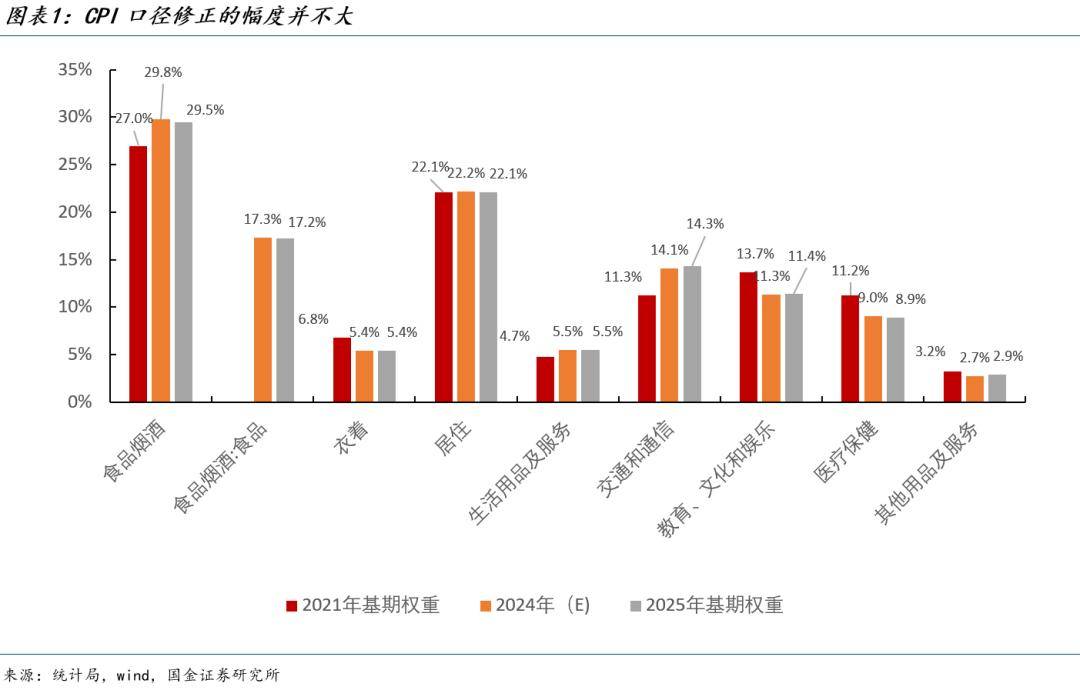
在低基数、AI相关行业需求延续的背景下,PPI可能在二季度个别月份转正,但持续性取决于房地产投资能否见底企稳。 文:国金宏观宋雪涛/联系人孙永乐 2026年的第一份物价数据报告出炉,1月CPI同比因春节错位下滑0.6个百分点至0.2%,但在输入性通胀的带动下,PPI同比上行0.5个百分点至-1.4%。以此 估算,1月GDP平减指数同比在-0.4%左右。 对于1月物价,我们认为有三个方面值得关注: 第一,物价数据口径修正的影响较小。 2026年物价数据迎来了五年一次的基期轮换,此次基期轮换对CPI和PPI各月同比指数的影响平均约为0.06和0.08个百分点,总体较小。 从类别上看,CPI在总类别不变的情况下(8大类、268基本分类),通过删减、合并等方式增加了一部分与新消费相关的商品价格如医疗美容服务、车用 电力、互联网医疗服务等等。同时,新增了新增计算出行服务价格指数数据。 从CPI权重上看,本轮基期CPI各分类权数总体变动不大。2025年食品烟酒及在外餐饮、衣着、居住、生活用品及服务、交通通信、教育文化娱乐、医疗 保健、其他用品及服务八个大类的权数分别为29.5%、5.4%、22.1%、5.5%、14.3% ...
输入性通胀、物价口径修正、AI传导、PPI何时转正(国金宏观孙永乐)
雪涛宏观笔记· 2026-02-12 03:22
Core Viewpoint - The PPI may turn positive in certain months of Q2 2026 due to low base effects and sustained demand in AI-related industries, but its sustainability depends on whether real estate investment stabilizes [2][17]. Group 1: Price Data Overview - In January 2026, the CPI decreased by 0.6 percentage points year-on-year to 0.2%, while the PPI increased by 0.5 percentage points to -1.4% due to input inflation [4]. - The impact of the price data revision is minimal, with the average effect on CPI and PPI year-on-year indices being approximately 0.06 and 0.08 percentage points, respectively [5]. - The weight distribution of CPI categories remains largely unchanged, with food, clothing, and housing accounting for significant portions of the index [5]. Group 2: Industry Contributions to PPI - The weight of midstream industries like electrical machinery and electronic equipment manufacturing, as well as non-ferrous metals, has steadily increased, while the share of black-related and downstream industries has slightly decreased [6]. - Gold prices have significantly supported CPI, contributing 0.3 percentage points, while AI-related investments have driven PPI up by 0.9 percentage points [8]. - In January, the PPI for non-ferrous metal mining and smelting industries rose by 22.7% and 17.1% year-on-year, respectively, contributing 1.1 percentage points to the PPI increase [8]. Group 3: Future PPI Trends - The PPI is expected to turn positive in Q2 2026, with tail effects contributing to this change, potentially moving from -1.5 percentage points at the beginning of the year to around +0.4 percentage points by July [13]. - If the PPI's month-on-month average stabilizes above 0%, it could lead to a positive year-on-year PPI by June, with a potential increase of around 1% [16]. - The sustainability of price increases will depend on downstream demand and the stabilization of real estate investments, which have been a drag on PPI due to declining property investments [17].

20cm速递|科技+顺周期主线价值凸显,科创创业ETF国泰(588360)盘中涨超1%
Mei Ri Jing Ji Xin Wen· 2026-02-10 17:30
Group 1 - The core viewpoint emphasizes that the combination of technology and cyclical sectors remains a key investment theme, with expectations of PPI turning positive driving EPS growth and liquidity support [1] - The article highlights the importance of focusing on stable growth in end-user sectors and the commercialization of ToB applications, particularly in areas such as computing hardware, energy storage, AI applications, and intelligent driving [1] - The Guotai Science and Innovation ETF (588360) tracks the Science and Innovation 50 Index (931643), which includes 50 large-cap emerging industry companies from the Sci-Tech and ChiNext boards, reflecting the overall performance of representative emerging industries [1] Group 2 - The index focuses on industries such as electronics, power equipment, communications, and biomedicine, emphasizing technological attributes and innovative growth, with a relatively balanced industry allocation [1] - The cyclical sectors are expected to show significant price and valuation elasticity during the phase of PPI turning positive, with reduced competition potentially leading to improved performance in sectors like non-ferrous metals, chemicals, machinery, steel, and building materials [1]

PPI将或将重回正增长通道,石化行业配置价值凸显,石化ETF(159731)强势上行
Sou Hu Cai Jing· 2026-02-06 03:31
瑞银表示,全球化工行业盈利低迷背景下,海外高成本产能加速退出。当前中国化工行业1.5倍的P/BV 估值处于过去20年43%分位,主动权益基金对化工板块的超配比例在2025年Q4触底回升,处于10年低 位。历史数据显示,当PPI同比转正时,化工板块多实现超额收益,而瑞银宏观团队预测2026年末至 2027年初PPI将重回正增长通道,行业配置价值凸显。 截至2月6日10:50,中证石化产业指数强势上涨2.18%,同标的指数规模最大的石化ETF(159731)上涨 2.02%,石化ETF近20个交易日资金净流入超14.37亿元,资金抢筹特征显著。 石化ETF(159731)及其联接基金(017855/017856)紧密跟踪中证石化产业指数,受基础化工和石油 石化双轮驱动,同时涵盖高股息和高成长资产,权重股包括万华化学(全球MDI龙头)、中国石油(国 内油气龙头)、中国石化(国内炼化龙头)、盐湖股份(国内钾肥龙头)等。 【免责声明】本文仅代表作者本人观点,与和讯网无关。和讯网站对文中陈述、观点判断保持中立,不 对所包含内容的准确性、可靠性或完整性提供任何明示或暗示的保证。请读者仅作参考,并请自行承担 全部责任。邮箱: ...




大逆转!近百亿,加仓!
Zhong Guo Ji Jin Bao· 2026-02-04 05:53
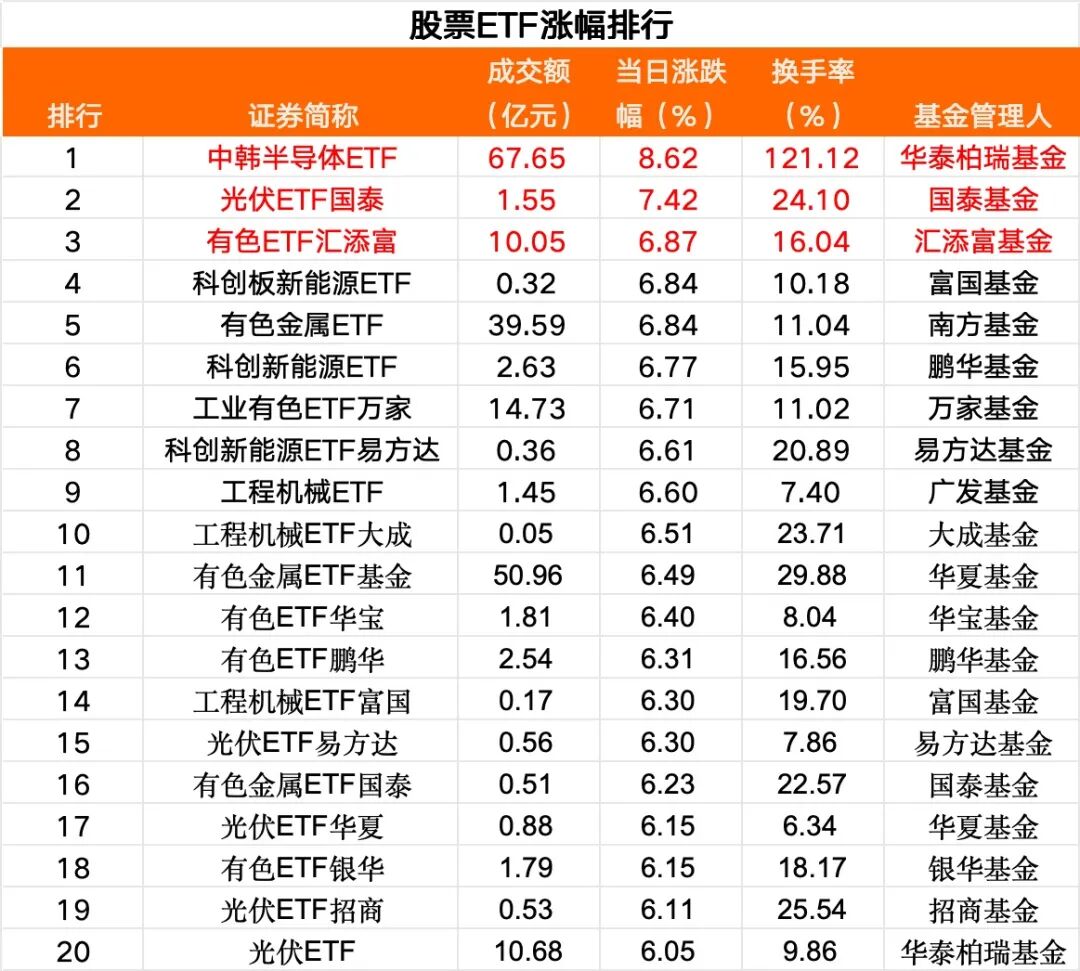
Group 1 - The A-share market experienced a reversal with net inflows after several days of capital outflows, with total trading volume exceeding 2.5 trillion yuan on February 3 [1] - On February 3, nearly 10 billion yuan flowed into the stock ETF market, marking one of the few days of net inflow since January [1][5] - The top-performing ETFs included those tracking the CSI 500, CSI 300, and STAR Market 50 indices, while sectors like non-ferrous metals and photovoltaics saw significant outflows [1][5] Group 2 - As of February 3, the total scale of stock ETFs reached 4.15 trillion yuan, with trading volume for stock ETFs at 298.75 billion yuan, a decrease of nearly 20 billion yuan from the previous trading day [2] - The leading sectors on that day were new energy and non-ferrous metals, with four of the top ten ETFs by increase in price belonging to the new energy sector [2][3] - The worst-performing ETFs included those related to new economy, Hong Kong Stock Connect technology, brokerage, and banking, with declines around 1% to nearly 7% [3] Group 3 - On February 3, the net inflow for stock ETFs was approximately 97.52 billion yuan, with 56 ETFs seeing inflows exceeding 100 million yuan [5][7] - The CSI 500 index led with a net inflow of 3.80 billion yuan, while the SGE Gold 9999 index saw a net outflow of 6.84 billion yuan [6] - Recent inflows into sector-specific indices included over 6.1 billion yuan into the semiconductor index and over 4.6 billion yuan into the STAR Market chip index [6] Group 4 - The top three ETFs by net inflow on February 3 were the CSI 500 ETF with 3.57 billion yuan, the Securities ETF with 1.12 billion yuan, and the A500 ETF with 973 million yuan [7] - Conversely, the ETFs with the highest net outflows included the Non-Ferrous Metals ETF and the Gold Stock ETF, with outflows of 4.18 billion yuan and 714 million yuan respectively [8] Group 5 - Major fund companies like E Fund and Huaxia Fund saw significant inflows into their ETFs, with E Fund's total ETF scale reaching 652.35 billion yuan, an increase of 9.64 billion yuan [9] - Notable inflows for E Fund included 711 million yuan into the CSI 300 ETF and 528 million yuan into the China Concept Internet ETF [9] - Fund manager Huang Yue from Guotai Fund expressed optimism for a spring market rally in Q1 2026, focusing on sectors like securities, new energy, semiconductors, and consumer services [9]
【策略快评】:调整或已到位,把握配置区间
Huachuang Securities· 2026-02-03 04:11
Group 1 - The report indicates that the recent market pullback is primarily due to external events, particularly the appointment of the Federal Reserve Chairman and the tendency to reduce the balance sheet, which has led to a rebound in the US dollar and a significant drop in gold and silver prices, adversely affecting emerging markets [1][6] - The report highlights that the mid-term trend remains positive, with clear evidence of performance recovery in the domestic market, as indicated by a 37% earnings forecast positive rate for 2025, surpassing the 33.5% rate of 2024 [2][6] - Analysts have been increasingly revising upward their earnings forecasts for 2026, with a maintained neutral (optimistic) profit growth estimate of 11% (17%) for non-financial sectors [2][6] Group 2 - The report emphasizes the importance of identifying the right allocation range, suggesting that the upcoming National People's Congress in early March could act as a catalyst for improving risk appetite [3][7] - It is recommended to focus on sectors with growth potential, particularly in technology and cyclical industries, as the report notes that the transition to a slow bull market makes it easier to price risks through rapid pullbacks [3][7] - The report identifies key sectors to watch, including materials, chemicals, machinery, steel, and construction, which are expected to benefit from supply advantages [3][7]
宏观与大类资产周报:沃什当选与PPI提前转正,谁将成为下阶段市场主要矛盾-20260201
CMS· 2026-02-01 12:06
证券研究报告 | 宏观点评报告 沃什当选与 PPI 提前转正,谁将成为下阶段市场主要矛盾 ——宏观与大类资产周报 频率:每周 国内方面,1)"新质生产力"与"反内卷"取得实质性进展,2025 年工业企 业扭转了此前三年持续亏损局面,特别是高技术制造业的利润贡献率大幅提 升。2)开年以来,以有色为代表的大宗大幅涨价,预计 1 月 PPI 环比超预期 增长 0.3%,对应 1 月 PPI 同比回升至-1.2%,预计 PPI 或于 Q2 中后期转正。 海外方面,1)美联储 1 月议息会议并未进一步降息,本次会议中鲍威尔略显 鹰派。2)特朗普提名沃什为美联储下一任主席。3)伊朗局势紧张,贵金属与 有色大幅调整之际,油价依然走高。 资金经历跨月扰动,央行继续通过 OMO 操作释放流动性对冲资金缺口,对资 金面保持温和呵护取向,周度平均走势来看,以 DR001、007 以及 R001、 定期报告 相关报告 1、《PMI 淡季回落———2026 年 1 月 PMI 点评》2026-02-01 2、《如何看 2025 年财政数据 与 2026 年一季度财政节奏?》 2026-01-31 资产方面,1)沃什被任命下一届美联储主 ...
未知机构:请珍惜手中的化工股票筹码化工景气度修复真的才刚刚开始今天化工-20260128
未知机构· 2026-01-28 01:55
请珍惜手中的化工股票筹码,化工景气度修复真的才刚刚开始! 1、1月份化工股持续上涨,化工品价格没怎么涨,股价又涨了,是不是太领先了? 在25年12月底到1月初,确实是预期化工企业盈利改善,到1月27日,化工企业实时的利润已经发生很大的变化。 比如烟煤价格从去年11月份820跌到现在700。 宝丰能源一年化工用煤2800万吨,华鲁用煤近1000万吨,煤价跌120,成本端改善分别是30、10亿以上。 关键这还是化工品是淡季,价格还没怎么涨的情况下。 炼化企业利润改善更夸张,从去年11月到现在人民币相比美元升值了3%。 今天化工板块略有调整,市场对这个位子的化工比较犹豫,其实才刚刚开始,统一回复大家关注度高的两个问 题: 1、1月份化工股持续上涨,化工品价格没怎么涨,股价又涨了,是不是太领先了? 在25年12月底到1月初,确实是预期化工企业盈利改善,到1月27日,化工企业实时的利润已经发生很大的变化。 比如烟煤价格从去年11月 请珍惜手中的化工股票筹码,化工景气度修复真的才刚刚开始! 今天化工板块略有调整,市场对这个位子的化工比较犹豫,其实才刚刚开始,统一回复大家关注度高的两个问 题: 如果在算配套的1000万吨煤 ...
宏观周周谈-当前的核心矛盾是什么
2026-01-26 02:49
Summary of Key Points from Conference Call Records Industry and Company Overview - The discussion primarily revolves around macroeconomic trends, inflation expectations, and the performance of various industries in the context of the Chinese and U.S. markets. [1][2][3] Core Insights and Arguments Market Sentiment - Market sentiment has improved, particularly in second and third-tier cities, indicating a recovery in market activity to about 50-66% of previous levels. [2] Inflation Expectations - A "pork-oil resonance" phenomenon is anticipated in 2026, signaling the end of deflation and a return to inflation, with a CPI central tendency expected to reach 0.5% and PPI likely turning positive in Q3. [1][3][4] Industry Focus - Industries that may benefit from the positive PPI include resource-related sectors and raw materials, while the technology sector's valuations are no longer seen as advantageous. [1][4] U.S. Stock Market Outlook - The U.S. stock market is expected to experience a rally from May to August 2026, potentially boosting related sectors such as computing power. However, the main focus remains on the implications of PPI turning positive. [1][6] PPI Impact on Industries - Positive PPI is expected to favor industries such as construction materials, non-ferrous metals, steel, and basic chemicals, while sectors like machinery, automotive, electronics, pharmaceuticals, and home appliances show strong alpha correlation but weak beta correlation. [1][7][8] Currency Exchange Rate - The Chinese yuan is projected to appreciate significantly, with the effective exchange rate expected to return to levels seen at the end of 2024. This appreciation will benefit yuan-denominated assets, including Hong Kong stocks. [1][9] Geopolitical Risks - Geopolitical risks are increasing due to the disintegration of the old international order, U.S. strategic adjustments, and rising global political uncertainties. Key areas of concern include the Russia-Ukraine conflict, the situation in Iran, and developments in U.S.-China relations. [1][10][11] Other Important but Potentially Overlooked Content Specific Industry Dynamics - The relationship between PPI and various industries has shifted, with some sectors like real estate losing their previous correlation with PPI, while others have become more competitive due to changes in consumer behavior and market dynamics. [1][7][8] Recent Developments in Geopolitical Situations - The situation in Greenland has shown signs of easing, with diplomatic negotiations taking precedence over military threats. However, tensions remain in the Middle East, particularly regarding Iran and the ongoing Russia-Ukraine conflict. [10][11][12][14] U.S.-China Relations - Recent developments indicate a potential stabilization in U.S.-China relations, with high-level diplomatic engagements expected to continue throughout the year. [15][16]