
套息交易

Search documents
挪威央行维持基准利率于4%不变,强调通胀“任务尚未完成”
Xin Hua Cai Jing· 2025-11-06 10:20
Core Viewpoint - The Norwegian central bank has decided to maintain the benchmark interest rate at 4.00%, aligning with market expectations, while indicating that the work to combat inflation is not yet complete [1] Group 1: Monetary Policy - The core inflation rate in September slightly decreased from 3.1% in August to 3.0%, still significantly above the 2% policy target [1] - The central bank plans to implement interest rate cuts during 2026 if the economy follows the current expected path [1] - Following a "hawkish cut" in September, where the interest rate was lowered from 4.25% to 4.00%, the central bank has signaled that future easing will be very gradual [1] Group 2: Market Reaction - The market reacted calmly to the decision, indicating that investors have fully priced in the central bank's hawkish stance [1] - The prolonged maintenance of relatively high interest rates in Norway may last longer than in most developed economies, providing ongoing support for carry trades involving the Norwegian krone [1]
9月全球投资十大主线
一瑜中的· 2025-10-10 16:04
Group 1 - The global asset performance in September shows that global stocks outperformed other asset classes, with a return of 3.31%, followed by global bonds at 0.65%, and commodities at 0.05% [2] - The international spot gold price has recently continued its strong upward momentum, breaking through $3,800 per ounce at the end of September, driven by multiple systemic factors and market sentiment [4][12] - Despite the U.S. government shutdown, the stock market showed resilience, with the Dow Jones Industrial Average and S&P 500 reaching historical highs, buoyed by optimistic market sentiment and expectations of a Federal Reserve rate cut [4][17] Group 2 - The credit spread for U.S. high-yield corporate bonds narrowed to a historical low of 2.67% by the end of September 2025, indicating high investor confidence in corporate credit quality [5][20] - Global fund managers increased their allocations to stocks, pharmaceuticals, communications, consumer discretionary, and technology, while reducing exposure to the UK, utilities, energy, Eurozone, and emerging markets [6][23] - The Indian stock market has underperformed the MSCI Asia-Pacific index for five consecutive months, reflecting a divergence between foreign and domestic investor sentiment [6][28] Group 3 - Speculative net positions in Japanese yen have decreased to 79,500 contracts, indicating a waning bullish sentiment towards the yen [6][31] - The volatility ratio of emerging market currencies to G7 currencies has continued to decline, reaching a low of 0.76, improving the risk-return profile for carry trades [6][36] - The scale of reserves held by banks at the Federal Reserve has fallen below $3 trillion, the lowest level since the beginning of the year, due to large-scale Treasury issuance and ongoing quantitative tightening [6][39] Group 4 - The S&P 500 index and the MOVE index (a measure of U.S. Treasury market volatility) have shown a strong correlation, suggesting that the current stock market rally is supported by low interest rate volatility [6][42] - The overnight interbank offered rate in Hong Kong surged to 5.35%, the highest level in nearly a year, highlighting short-term funding market tensions [6][45] Group 5 - From a fundamental perspective, the weekly economic activity index has shown signs of recovery, indicating a potential divergence between asset prices and economic fundamentals [6][47] - From a sentiment perspective, the market sentiment index has rebounded, reflecting improved investor confidence [6][63]


每日投行/机构观点梳理(2025-10-10)
Jin Shi Shu Ju· 2025-10-10 09:51
Group 1: Inflation and Economic Outlook - Citigroup economists expect a cooling in core CPI for September, projecting a rise of 0.28%, down from 0.35% in August, with housing inflation easing overall service inflation [1] - Barclays highlights that the rise in gold prices reflects increasing market distrust in the existing fiscal and monetary order, with major economies' debt exceeding 100% of GDP and a lack of political will for fiscal consolidation [1] - Dutch International Group anticipates a continued bull market for gold, forecasting an average price of $4,000 per ounce in Q4, driven by central bank purchases and geopolitical risks [1] Group 2: Bond Market and Eurozone Stability - Dutch International Group reports that the low volatility environment in the Eurozone makes current bond yield spreads highly attractive, with the 10-year French and Italian bond spreads tightening to 82 basis points [2] - The political crisis in France serves as a warning for Europe, with ongoing challenges in managing rising government debt and the need for structural reforms [2] - Mitsubishi UFJ analysts suggest that if France avoids early elections, the euro may regain an upward trend against the dollar [2] Group 3: Currency and Interest Rate Predictions - Dutch International Group indicates that the yen is becoming the preferred funding currency for carry trades, as expectations for low interest rates persist [4] - Capital Economics forecasts that the USD/JPY exchange rate will end at 150 by the end of 2025, with a potential rebound for the yen expected once the Bank of Japan resumes rate hikes [4] - Mizuho Securities maintains that the Bank of Japan will adopt a hawkish stance in the short term, despite reduced urgency for rate hikes [4] Group 4: Gold Market Projections - China International Capital Corporation predicts that gold prices could exceed $4,500 per ounce in Q1 of next year, driven by rising expectations for Fed rate cuts and geopolitical tensions [5] - The report emphasizes that while short-term factors may fade, the long-term bullish fundamentals for gold remain intact [5] Group 5: Energy Storage and Lithium Battery Industry - CITIC Securities identifies that the energy storage sector is at a pivotal point, with significant cost reductions and policy support driving demand and market penetration [6] - The report highlights that the lithium battery supply chain is expected to improve significantly as energy storage demand accelerates [6] Group 6: Superhard Materials and Coal Sector - CITIC Securities notes that recent export controls on superhard materials may accelerate industry consolidation, leading to potential price increases in the long term [7] - The coal sector is projected to experience sustained excess returns due to balanced supply and demand dynamics, with potential price upside in the upcoming quarter [7] Group 7: AI Industry Developments - CITIC Securities observes that advancements in AI technology are exceeding expectations, with significant progress in commercialization and monetization [7] - The report emphasizes the growing importance of computing power in the AI industry, highlighting opportunities in related sectors such as optical modules and fiber optics [7]
港股吸“金” 港元吸“睛”
Shang Hai Zheng Quan Bao· 2025-09-24 19:46
Core Viewpoint - The Hong Kong dollar (HKD) is experiencing a rare strengthening against the US dollar, marking the strongest 30-day appreciation since 2003, driven by changes in the currency market environment and strong performance in the Hong Kong stock market, underpinned by the resilience of the Chinese economy [2][3][6]. Currency Market Dynamics - The HKD appreciated sharply from the "weak side convertibility guarantee" level of 7.85 in mid-August to around 7.77, reflecting a 1% increase over the past 30 days, the strongest rise since 2003 [3][4]. - The Hong Kong Interbank Offered Rate (HIBOR) has surged, with the overnight HKD borrowing rate rising from below 0.2% in mid-August to 4.45% by September 24 [3][4]. - The rapid fluctuations in the HKD's value since May, including a swift transition from the "strong side" to the "weak side" of the convertibility guarantee, highlight the volatility in the currency market [3][4]. Stock Market Influence - The strong performance of the Hong Kong stock market, particularly the Hang Seng Index reaching a nearly four-year high of over 27,000 points, has significantly contributed to the demand for HKD [4][5]. - Year-to-date, net inflows from southbound trading have reached 110.97 billion HKD, a 37% increase compared to the entire previous year, indicating robust foreign investment in the Hong Kong stock market [5]. Monetary Policy and Economic Factors - The Hong Kong Monetary Authority (HKMA) has actively intervened to stabilize the HKD by withdrawing HKD liquidity, reducing the currency's balance from nearly 175 billion HKD in June to about 54 billion HKD [5]. - Seasonal factors, such as increased demand for HKD near quarter-end, have added upward pressure on the currency's value [5]. - The macroeconomic environment, including the Federal Reserve's interest rate cuts, has contributed to a narrowing interest rate differential between the HKD and USD, further supporting the HKD's appreciation [5][6]. Future Outlook - Analysts predict that the HKD may touch the "strong side convertibility guarantee" level of 7.75 in the short term, closely linked to the performance of the Hong Kong stock market [7]. - The ongoing influx of both domestic and foreign capital into the stock market is expected to remain a core factor influencing the HKD's exchange rate against the USD in the medium to long term [7].
2025,一直“在线”!
赵伟宏观探索· 2025-09-24 16:03
Core Viewpoint - The article emphasizes the importance of continuous research iteration to approach the truth, highlighting that growth comes from persistent denial and reconstruction [2][26]. Group 1: Research Framework and Goals - The team is undergoing a comprehensive upgrade in 2025, focusing on restructuring the research framework and systematically displaying research outcomes [2]. - The guiding principle is to provide valuable independent research results that are grounded in reality and actionable [2]. Group 2: Economic Insights - The article discusses the shift in the economic "three drivers" from manufacturing to services, indicating that as GDP per capita reaches $10,000 to $30,000 and urbanization hits 70%, service sector demand will accelerate [28]. - It notes that new consumption policies emphasize long-term strategies for domestic demand expansion rather than short-term stimuli, while also providing support for manufacturing to counter tariff impacts [29]. - The concept of "anti-involution" is presented as a new phase of supply-side structural reform, with increased government and industry focus, broader coverage, and stronger coordination among policies and market mechanisms [31]. Group 3: Global Economic Trends - The article highlights that the biggest expectation gap in the global macroeconomic landscape for the first half of 2025 is the disproof of the "American exceptionalism" narrative [21]. - It mentions that the focus of tariffs may shift towards validating economic data, with potential concerns about recession if the U.S. unemployment rate rises to 4.6% [21]. - The impact of geopolitical risks, particularly since the Russia-Ukraine conflict, is noted as a significant factor in global macroeconomic conditions and asset pricing [23].

2025,一直“在线”!
申万宏源宏观· 2025-09-23 16:04
Core Viewpoint - The article emphasizes the importance of continuous research and iteration in approaching the truth, highlighting the commitment to independent and valuable research outcomes in the evolving landscape of 2025 [2][26]. Group 1: Research Framework and Goals - The team is undergoing a comprehensive upgrade in 2025, focusing on restructuring the research framework and systematically presenting research results [2]. - The guiding principle is "research with reason, grounded in reality," aiming to provide genuinely valuable independent research [2]. Group 2: Economic Insights - The article discusses the shift in the economic "three drivers" from manufacturing to services, indicating that as GDP per capita reaches $10,000 to $30,000 and urbanization hits 70%, service demand will accelerate [28]. - It notes that new consumption policies emphasize long-term strategies for domestic demand expansion rather than short-term stimuli, with ongoing support for manufacturing to counter tariff impacts [29]. Group 3: Structural Reforms - The concept of "anti-involution" is presented as a new phase of supply-side structural reform, with increased government and industry focus, broader coverage, and stronger coordination among policies and market mechanisms [31].

新兴市场债市年内狂飙15% 交易员押注美联储降息将再添动力
智通财经网· 2025-09-22 01:48
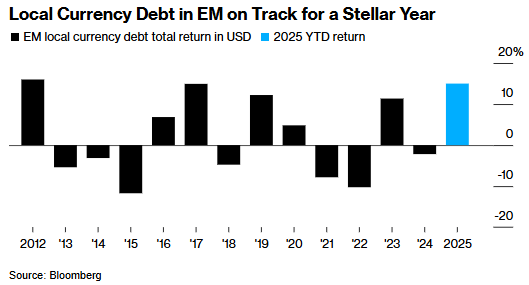
Core Viewpoint - The Federal Reserve's decision to restart the interest rate cut cycle is expected to drive significant gains in emerging market debt, marking the largest rally in recent years [1][4]. Group 1: Market Performance - Year-to-date, dollar-denominated local government bonds in developing countries have delivered a 15% return, potentially achieving the best annual performance since 2017 [1]. - Emerging market government bonds have outperformed most global fixed-income assets, with a 15% increase, more than double the 5.4% rise of the Bloomberg U.S. Treasury Index [4]. Group 2: Investment Strategies - Local currency-denominated bonds are becoming increasingly attractive, with institutions like DoubleLine Capital and JPMorgan Asset Management favoring these assets [2]. - The strategy of borrowing from low-interest countries to invest in high-yield markets is deemed "irreplaceable" for the remainder of the year by Bank of America [2]. Group 3: Economic Factors - The weakening of the dollar and the potential for currency appreciation are expected to enhance returns on local currency-denominated bonds [4]. - The Federal Reserve's actions are believed to support the view of a weaker dollar and future interest rate declines, benefiting emerging market stocks and bonds [4]. Group 4: Fund Flows - Emerging market debt funds have seen a net inflow of approximately $300 million in the week ending September 17, marking 22 consecutive weeks of inflows, totaling $45 billion year-to-date [7]. - The current environment continues to support emerging markets, with a clear trend favoring these investments [8].

宽松周期进一步确认 大宗商品价格支撑显著
Shang Hai Zheng Quan Bao· 2025-09-18 19:00
Group 1: Federal Reserve Rate Cut Impact - The Federal Reserve's interest rate cut has been anticipated by the market, confirming a global easing cycle [1] - Following the rate cut, the US dollar index fell, leading to potential support for commodities priced in dollars, such as gold and copper [1][4] - The rate cut is expected to lower the interest income on dollar-denominated assets, prompting international capital to seek higher-yielding investments [4] Group 2: Gold Market Outlook - As of September 18, 2023, gold prices showed slight increases, with London spot gold at $3,654.58 per ounce and COMEX futures at $3,691.60 per ounce, both with daily gains of less than 1% [2] - Experts predict that gold prices may experience short-term fluctuations between $3,500 and $3,900 per ounce, with long-term support factors remaining intact [3] - The ongoing easing cycle by the Federal Reserve, combined with other factors, suggests that gold remains in a bull market [3] Group 3: Oil Market Dynamics - On the day of the Federal Reserve's rate cut, WTI crude oil futures closed at $64.05 per barrel, down 0.73%, while Brent crude futures closed at $67.95 per barrel, down 0.76% [5] - Analysts forecast that international oil prices are likely to experience a downward trend due to a supply surplus, with geopolitical factors providing limited support [6] - Seasonal demand fluctuations are expected to further impact oil prices, as the end of summer travel reduces gasoline consumption and the upcoming maintenance season in major markets will lead to decreased demand [7]
宏观深度报告:日债利率新高之后:风险与机遇
Ping An Securities· 2025-09-05 12:15
Group 1: Reasons for Rising Japanese Bond Yields - The 10-year Japanese bond yield has reached a new high of 1.63%, the highest since 2008, driven by multiple factors including weak bond auction results and reduced demand from life insurance companies[6][7]. - The bid-to-cover ratio for the 20-year bond auction on May 20 was 2.50, significantly lower than the previous auction's 2.96, indicating waning investor interest[11]. - Japanese life insurance companies, holding 17% of government bonds, are reducing long-term bond allocations due to substantial unrealized losses, with one major insurer reporting a loss of 3.6 trillion yen in FY2024[13]. - Political instability following the ruling party's loss in the July 20 elections has exacerbated bond sell-offs, leading to increased market uncertainty[17]. Group 2: Outlook and Risks - The Japanese bond yield is expected to continue rising over the next six months to a year, primarily driven by domestic inflation and interest rate hike expectations, with potential increases of over 50 basis points if the policy rate reaches 1%[30][36]. - The Japanese government debt-to-GDP ratio is projected to remain high at 237%, raising concerns about fiscal sustainability amid rising interest rates[27]. - Risks include a potential debt spiral as rising yields increase debt servicing costs, and the possibility of a "carry trade" unwind, which could lead to market volatility[6][30]. Group 3: Opportunities in Japanese Bonds - The attractiveness of Japanese bonds is increasing as yields rise, making them a viable investment option amid a backdrop of improving economic fundamentals and fiscal outlook[6][30]. - Japan's economy is on a path to recovery, with stable employment and a positive inflation outlook, which supports the long-term investment case for Japanese bonds[6][30]. - Global diversification needs are rising, positioning Japan's bond market as an attractive alternative for investors seeking options beyond the U.S. and European markets[6][30].
人民币汇率是否会升破7.0?|一财号每周思想荟(第34期)
Di Yi Cai Jing· 2025-09-05 03:31
Group 1: Currency and Economic Trends - The RMB has shown a gradual appreciation against the USD since July, with signs of accelerated upward movement expected in the short term [1] - On August 28, both onshore and offshore RMB quickly appreciated against the USD, breaking through multiple key levels, indicating a potential convergence towards the central parity [1] - Future movements in the RMB exchange rate will depend on factors such as "carry trade" reversals and the central parity's guidance [1] Group 2: Housing and Related Industries - Improvement-driven housing demand is expected to significantly boost consumption across various sectors, including home appliances, furniture, textiles, and electronics [2] - The construction and usage of housing will generate substantial digital, electronic, and informational demands, leading to a chain reaction of consumption [2] Group 3: Cultural and Tourism Insights - The importance of cultural assets in cities is emphasized, with a strong opposition to transforming tourist spots into mere "check-in" locations [3] - The competition among cities is viewed as a struggle for cultural narrative control, which is essential for future urban development [3] Group 4: Stock Market and Investment Outlook - The US stock market is experiencing a volatile upward trend, driven by breakthroughs in the AI sector and expectations of a soft landing for the US economy [4] - With the anticipated interest rate cuts by the Federal Reserve, the investment value of high-quality fixed income assets is gaining attention [4] - There is an upward revision of gold price expectations, highlighting its role in portfolio diversification and geopolitical risk hedging [4]