
反内卷

Search documents
A股,明天见!机构最新研判来了
Zhong Guo Zheng Quan Bao· 2026-01-04 14:16
明日,A股市场将迎来2026年首个交易日。元旦假期期间,港股迎来新年开门红,在美上市的中国资产 也有强势表现,一定程度上提振了市场对A股新年开门红的预期。 展望后市,机构认为,开年后A股震荡向上的概率更高,投资者对春季行情应保持耐心,消费与成长板 块有望成为春季行情的两条主线。配置上,热度和持仓集中度相对较低但关注度开始提升、催化开始增 多且长期ROE有提升空间的板块值得关注,此外人民币汇率也具备继续走强可能,这或为港股带来一定 利好。 影响后市投资大事件 多型新火箭将首飞并挑战回收 2025年,我国在载人航天、深空探测、商业航天等领域完成多项突破,实现多个首次。在"十五五"开局 之年,中国航天的新蓝图正在展开。载人登月项目将展开多项试验,嫦娥七号将奔赴月球南极寻找水冰 存在的证据,多型新火箭将首飞并挑战回收。中国航天正朝着建设航天强国的目标开启新的征程。 机构后市投资观点 中信证券:开年后市场震荡向上概率更高 2026年开年后,市场震荡向上的概率更高。中期维度下,建议抱着"赚业绩的钱而不期待估值的钱"的思 维布局,聚焦热度和持仓集中度相对较低,但关注度开始提升、催化开始增多且长期ROE有提升空间的 板块,如 ...
财信证券宏观策略周报(1.5-1.9):慢牛行情仍将延续,择机配置科技成长-20260104
Caixin Securities· 2026-01-04 13:36
Group 1 - The report predicts that the A-share bull market will continue in 2026, driven by resilient overseas economies, likely continued dollar liquidity easing, and domestic policies maintaining a "dual easing" tone, with technology growth remaining the long-term market focus [4][7][8] - During the New Year holiday, the Hang Seng Technology Index rose by 4.00%, and the Hang Seng Index increased by 2.76%, indicating a positive market sentiment driven by technology and materials sectors [4][8] - The manufacturing PMI returned to the expansion zone at 50.1% in December, marking the first increase since April, driven by policy support and pre-holiday inventory buildup [8][9] Group 2 - The report highlights the importance of service consumption policies, with the National Development and Reform Commission announcing a 2.95 billion yuan investment plan and 625 million yuan in special bonds to support consumption [9][10] - The real estate sector is expected to experience a significant divergence in policy expectations, with new housing sales projected to stabilize at 700-800 million square meters annually during the 14th Five-Year Plan period [11][12] - The public fund industry is expected to see a high-quality development trend, with new regulations aimed at reducing investor costs and promoting long-term holding of funds, potentially saving investors 51 billion yuan annually [12]
A股展望牛市2.0
IPO日报· 2026-01-04 13:14
Core Viewpoint - The A-share market is expected to continue its bullish trend into 2026, with a projected index increase of 10%, driven by a shift from valuation recovery to profit growth [1][3]. Group 1: Market Outlook - A-shares, Hong Kong stocks, and US stocks are anticipated to maintain a bullish trend, supported by global liquidity easing, economic recovery, rapid development of the AI industry, and rising resource prices [3]. - Analysts predict that A-share companies' profits may grow by 6% in 2025 and further accelerate to 8% in 2026, with a focus on profit realization rather than valuation [3][4]. - Goldman Sachs forecasts a transition from the "hope" phase to the "growth" phase for the Chinese stock market, with a potential 38% increase by the end of 2027, driven by profit growth of 14% in 2026 [3][4]. Group 2: Investment Strategies - Key investment themes for 2026 include technology and resource sectors, with a focus on AI applications, new energy, and materials [5][6]. - Analysts recommend increasing allocations to emerging markets, particularly in sectors benefiting from the weak dollar trend [5]. - Investment directions include technology sectors, consumer sectors driven by profit acceleration, and industries benefiting from "anti-involution" policies [4][6]. Group 3: Market Phases - The market is expected to enter a "prosperity verification phase" in 2026, characterized by a slower index increase and a shift in focus from valuation to fundamental improvements [4]. - The transition from a "bull market 1.0" to "bull market 2.0" is anticipated, with a potential for a comprehensive bull market in the second half of 2026 [3][4]. Group 4: Risk Factors - Analysts highlight concerns regarding insufficient domestic demand and low inflation, which could impact corporate profitability and investment willingness [7]. - Potential risks include the progress of US-China trade negotiations, real estate market developments, and the possibility of an AI bubble affecting the tech sector [7][8].


平安证券:26年1月利率债月报:再通胀对债市的影响路径-20260104
Ping An Securities· 2026-01-04 13:05
Report Industry Investment Rating - The report does not mention the industry investment rating. Core Viewpoints of the Report - In December 2025, the weakening of the US dollar and the improvement of risk appetite led to a steeper curve overseas, while in China, loose funds drove the yield curve to steepen. The bond market remained volatile due to the supply - demand contradiction at the long end [2]. - In 2026, the PPI is facing three positive factors: the tail - lifting factor, imported inflation, and the continued effectiveness of the "anti - involution" policy. Under the neutral scenario, the PPI is expected to turn positive in the second quarter of 2026 and reach around 1.2% by the end of the year. The mild re - inflation needs to resonate with other factors to significantly affect the bond market [3][55]. - Currently, the bond market is in a wait - and - see state. It is expected to remain volatile in the short term, lacking the motivation and space for trend trading. There are some structural opportunities, such as the follow - up rise opportunity of 5 - 7Y China Development Bank bonds and the compression opportunity of credit spreads [4]. Summary by Directory PART1: December 2025 - Curve Steepening Driven by Overseas and Domestic Factors Overseas - In December 2025, the Fed announced reserve management - style purchases (RMP) and continued to cut interest rates. The US dollar index weakened, liquidity improved, the US stock market rose, and risk appetite recovered. The US bond yield curve steepened due to factors like Fed's short - term bond purchase, market concerns about Fed independence, and rising commodity prices. Precious and industrial metals performed well, with copper benefiting from AI demand and gold and silver supported by geopolitical events [10][16]. Domestic - In November 2025, the domestic economic fundamentals showed a divergence between quantity and price, and in December, both supply and demand declined. The capital market was generally loose, and the overnight interest rate hit a new low for the year. The bond market remained volatile due to the long - end supply - demand contradiction, and the yield curve steepened [17][23]. - In terms of institutional behavior, large banks and insurance companies, as allocation players, increased their bond - buying in the secondary market in December. Large banks added some policy - related financial bonds and focused on 5 - 7 - year varieties. Insurance companies mainly added long - term treasury bonds. Trading players became conservative. Rural commercial banks mainly invested in certificates of deposit, funds reduced duration and mainly sold long - term treasury bonds, and wealth management products seasonally reduced bond allocation and slightly increased credit bond allocation [26][35][47]. PART2: How the 2026 Re - inflation Narrative May Affect the Bond Market 2026 PPI's Three Positive Factors - The tail - lifting factor can support the PPI to turn positive in the second half of 2026 even without new price - increasing factors [55]. - Imported inflation may occur as overseas capital expenditure and manufacturing investment are likely to rise in 2026. The US deficit rate may expand, and the Fed's new round of easing may release emerging market countries' capital expenditure demand [57]. - The "anti - involution" policy has shown a supporting effect on the PPI. Since August 2025, the month - on - month PPI of the mining industry has turned positive, driving the overall PPI to turn positive since October [60]. PPI Forecast under Different Scenarios - Under the pessimistic scenario, the PPI is expected to turn positive in the second half of 2026 with an average monthly PPI growth rate of 0%. Under the neutral scenario, with a monthly average PPI growth rate of 0.1%, the PPI is expected to turn positive in the second quarter of 2026 and reach around 1.2% by the end of the year. Under the optimistic scenario, with a monthly average PPI growth rate of 0.2%, the PPI is expected to turn positive in April 2026 and exceed 2% in the second half of the year [67]. PPI's Impact on the Bond Market - Historically, during the four PPI upward cycles since 2009, three typical upward periods were driven by the resonance of domestic and overseas demand or supply - demand. The PPI and the bond market generally move in the same direction, but there were several periods of divergence, mainly due to strong economic recovery expectations or PPI being mainly affected by the supply side while the domestic demand did not improve significantly and the monetary policy remained loose [69][71]. - In 2026, the mild re - inflation needs to resonate with other factors such as total demand, central bank's capital management, financial institutions' liability - side stability, and the flow of activated household deposits to significantly affect the bond market. The trading of typical total assets based on re - inflation may have limited odds [78]. PART3: Bond Market Strategy for January 2026 - In January 2026, the bond market may still be in a wait - and - see period. Potential risks include government bond supply pressure, the spring rally in the equity market, and the first - quarter credit boom. Potential positive factors include the possible relaxation of large banks' bond - allocation pressure and the relatively loose capital market, with a higher probability of a reserve - requirement ratio cut than an interest - rate cut in January [81]. - The bond market is expected to remain volatile in the short term, lacking the motivation and space for trend trading. Structurally, there are opportunities such as the follow - up rise of 5 - 7Y China Development Bank bonds and the compression of credit spreads in credit bonds [4][83].
投资策略周报:春季躁动提前启动,牛市格局依旧未改-20260104
HUAXI Securities· 2026-01-04 13:00
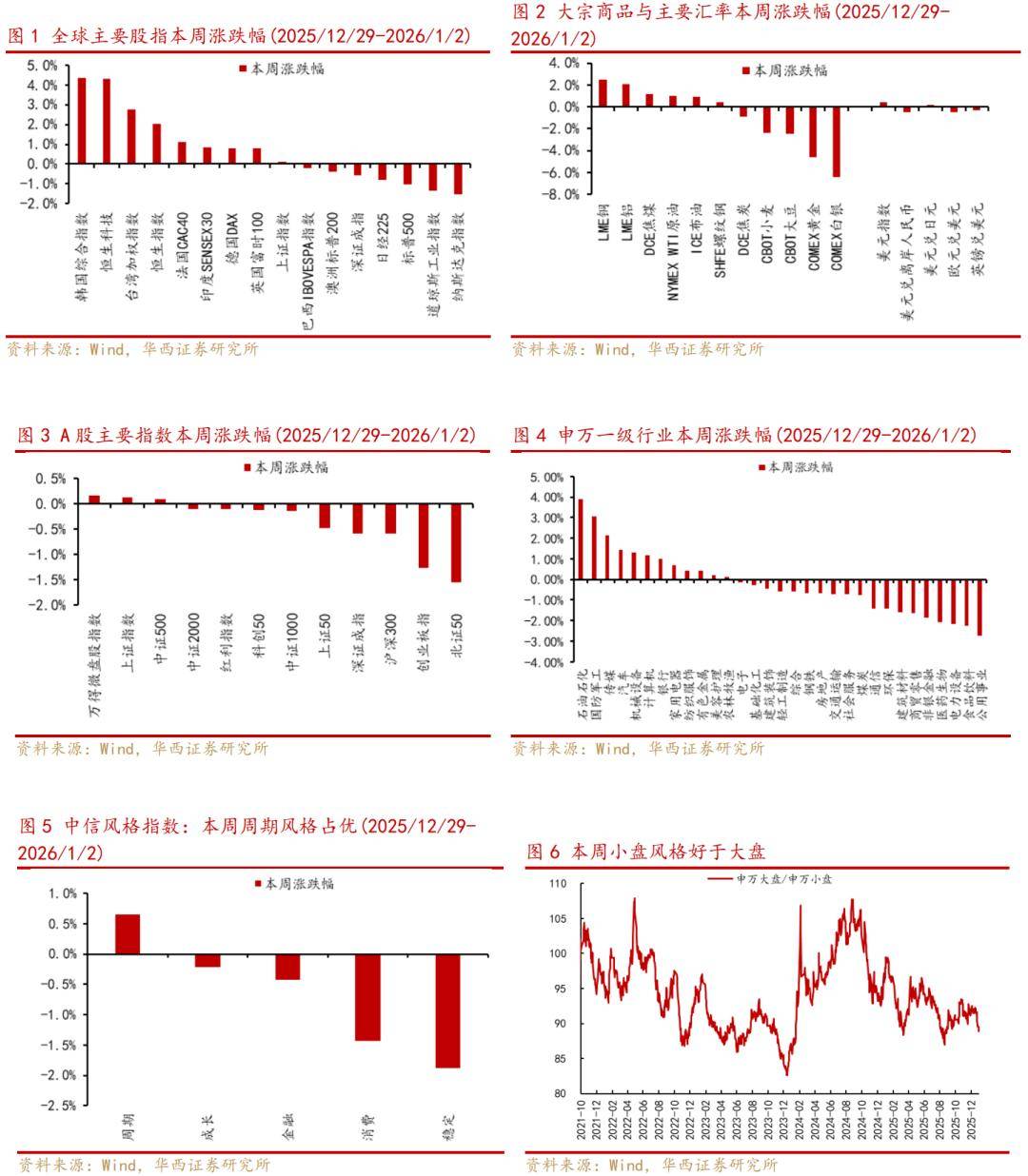
Market Review - The South Korean Composite Index, Hong Kong's Hang Seng Tech Index, and Taiwan Weighted Index led global gains, while US stock indices declined during the week of December 29, 2025, to January 2, 2026. In the A-share market, cyclical and growth sectors performed well, with oil, military, and media industries leading, while utilities faced the largest declines [1] - On January 2, the first trading day after New Year's, the Hong Kong stock market experienced a "good start," with the Hang Seng Tech Index surging 4% in a single day, particularly in semiconductor, AI computing, and internet giants, indicating a recovery in market risk appetite [1] Market Outlook - The year 2026 is anticipated to be a "big year" with multiple positive factors converging, maintaining a solid bull market foundation. The spring rally has started early due to several reasons: 1. Macro policy cycle indicates that 2026, as the first year of the 14th Five-Year Plan, will see multiple departments intensifying the rollout of supporting industrial policies and investment plans, creating a favorable liquidity environment through coordinated fiscal and monetary policies [2] 2. In December, institutional funds, represented by stock ETFs, showed significant inflows, with insurance funds expected to contribute to the market's upward trend due to favorable exchange rate movements [2] 3. With the narrowing decline in PPI, corporate earnings are expected to enter a mild recovery phase in 2026, making the bet on earnings inflection points a crucial support for the market [2] Key Focus Areas - The new chairperson of the Federal Reserve is a focal point this month, with the December meeting minutes indicating a majority support for further rate cuts, although there are significant policy path divergences among officials. The probability of a rate cut in January is currently low at 17% [2] - The manufacturing PMI for December 2025 returned to the expansion zone at 50.1%, with production and new orders indices at 51.7% and 50.8%, respectively, indicating improvements in both supply and demand [3] - The non-manufacturing PMI also rose to 50.2%, with the construction sector PMI at 52.8%, reflecting the effectiveness of policy-driven financial tools [3] Policy Measures - The National Development and Reform Commission has issued a list of early construction projects and a central budget investment plan totaling approximately 295 billion yuan for 2026 [4] - The "two new" policies for 2026 will continue and be optimized, with the first batch of 62.5 billion yuan in subsidy funds being released early [4] - New local government bond limits will also be issued ahead of schedule, alongside measures in the real estate sector to reduce transaction costs for residents [4] Institutional Investment Trends - Since December, there has been a significant net inflow of institutional funds, particularly into A500-related ETFs, indicating a proactive approach to the spring rally [5] - The beginning of the year typically sees aggressive credit issuance from banks, which is expected to improve the liquidity outlook for the real economy and enterprises [5] - Recommended sectors for investment include emerging growth themes supported by industrial policies, such as AI computing, robotics, and domestic substitution, as well as sectors benefiting from "anti-involution" and price increases, such as chemicals and new energy [5]
李立峰、张海燕:春季躁动提前启动,牛市格局依旧未改
Sou Hu Cai Jing· 2026-01-04 12:53
Market Review - The South Korean Composite Index, Hong Kong's Hang Seng Tech Index, and Taiwan Weighted Index led global gains, while US stock indices declined during the week of December 29, 2025, to January 2, 2026. In the A-share market, cyclical and growth sectors performed well, with oil and petrochemicals, military industry, and media leading gains, while utilities lagged behind. On January 2, 2026, the Hong Kong stock market opened strong, with the Hang Seng Tech Index surging 4%, particularly in semiconductor, AI computing, and internet giants, indicating a recovery in market risk appetite. In commodities, base metals and crude oil rose, while precious metals fell, with COMEX silver and gold down 6.39% and 4.63%, respectively. The offshore RMB strengthened against the US dollar, surpassing 6.97 on Friday [1][2][3]. Market Outlook - The market is expected to maintain a bullish trend into 2026, driven by several positive factors. The macro policy cycle is favorable, with multiple departments rolling out supportive industrial policies and investment plans as 2026 marks the start of the 14th Five-Year Plan. Coordinated fiscal and monetary policies are creating a friendly liquidity environment. Institutional funds, particularly in stock ETFs, have shown significant inflows, indicating a strong willingness to invest as foreign capital returns due to currency appreciation. The narrowing decline in PPI suggests a mild recovery in corporate profits, which will support market sentiment [2][4][5]. Key Focus Areas 1. **Overseas Developments**: The selection of a new Federal Reserve Chair is a key focus, with the December meeting minutes indicating a majority support for further rate cuts, though there are significant policy path divergences. The probability of a rate cut in January is low at 17%, with potential candidates like Hassett and Waller advocating for further easing [2][3]. 2. **PMI Data**: Both manufacturing and non-manufacturing PMIs returned to expansion territory in December 2025, with manufacturing PMI at 50.1% and non-manufacturing PMI at 50.2%. This improvement in production and new orders supports the spring market rally [3][4]. 3. **Policy Measures**: The government has implemented a series of targeted policies to boost market confidence, including a 295 billion yuan investment plan and early release of subsidies and local debt limits. The real estate sector is also seeing policy adjustments to lower transaction costs, which may stabilize market expectations [4][5]. 4. **Institutional Investment Trends**: There has been a notable net inflow of institutional funds into stock ETFs, particularly those related to the A500 index, indicating a proactive approach to the upcoming spring market rally. The favorable policy outlook and stable currency are expected to attract further foreign investment [5]. Industry Focus - The focus for industry investment should be on emerging growth sectors supported by policy, such as AI computing, robotics, and energy storage, as well as sectors benefiting from price increases and "anti-involution" trends, including chemicals and non-ferrous metals [5].
供需逐步向好下PC或迎景气周期
HTSC· 2026-01-04 12:36
Investment Rating - The report maintains an "Overweight" rating for the basic chemical industry [2] Core Views - The report indicates that the supply and demand for polycarbonate (PC) are gradually improving, suggesting that the industry may enter a prosperous cycle [6][8] - The demand for PC is expected to grow significantly due to the increasing penetration of downstream applications such as electric vehicles, electronics, and optical materials [9] - The report highlights that the domestic production capacity of PC has increased from 12% in 2017 to 49% by 2025, indicating a significant shift towards domestic production [6][9] Summary by Sections Investment Recommendations - Recommended stocks include: - Wanhua Chemical (600309 CH) with a target price of 85.20 and a "Buy" rating - Luxi Chemical (000830 CH) with a target price of 17.85 and a "Buy" rating - Hengli Petrochemical (600346 CH) with a target price of 24.48 and an "Overweight" rating - Rongsheng Petrochemical (002493 CH) with a target price of 12.48 and an "Overweight" rating [5][34] Supply and Demand Dynamics - The report forecasts that the industry operating rates will improve to 87% in 2025, 94% in 2026, and 95% in 2027, driven by limited new capacity additions and ongoing demand growth [10] - The overall demand for PC is projected to reach 360 million tons in 2024, with a compound annual growth rate (CAGR) of 11% from 2018 to 2024 [9][32] Competitive Landscape - The competitive landscape for PC is relatively favorable, with major production concentrated among leading chemical companies that possess the necessary technical qualifications [6] - The report notes that the market concentration has decreased from 80% in 2017 to 62% globally by 2025, while domestic concentration is expected to be 66% [6] Price Trends - As of December 30, 2024, PC prices have increased by 3% from the low point in September 2024, indicating a recovery in the market [10] - The report highlights that the price of PC is expected to continue to rise as supply and demand improve [10]



FICC月报:地缘局势骤紧,关注商品轮动可能-20260104
Hua Tai Qi Huo· 2026-01-04 12:24
Report Summary 1) Report Industry Investment Rating No information provided. 2) Core View of the Report The report points out that there is a risk of a swing in policy expectations both at home and abroad. Geopolitical tensions are intensifying, and global instability will be the norm. The supply - side risks of commodities and loose monetary policies are decisive factors for rising commodity prices. It also mentions bifurcations in domestic and overseas economic outlooks and suggests investment strategies for different asset classes [1][2][3]. 3) Summary by Relevant Catalogs Market Analysis - **Macro**: There is a risk of a swing in policy expectations after domestic important meetings and the Fed's stance adjustment. Attention should be paid to specific domestic policies and Trump's Fed chair candidate. Geopolitical tensions during the New Year holiday may lead to supply - side risks for commodities and support price increases [1]. - **Meso**: There is a divergence in domestic and overseas economic outlooks. The Central Economic Work Conference emphasized consumption promotion and "anti - involution." Trade supported the December economic outlook, with consumption leading the industry recovery, and the persistence of new orders' resilience needs attention [2]. - **Micro**: Focus on high - certainty sectors such as non - ferrous metals and precious metals, and also look for opportunities in low - valued commodity price hikes. For non - ferrous metals, aluminum is a preferred choice. Energy prices are affected by geopolitical events and future supply expectations. In the chemical sector, the "anti - involution" space of some varieties is worth noting. For agricultural products, weather and short - term pig diseases should be monitored. For precious metals, consider buying on dips [3]. Strategy - **Commodities and Stock Index Futures**: Allocate more on dips for stock indices, precious metals, and non - ferrous metals [4]. Economic Heat Maps - **US Economic Heat Map**: In 2025, different economic indicators showed various trends. Consumption contributed 66.8% to GDP, investment 26.1%, and fiscal 20.3%. Indicators such as GDP growth, employment, inflation, and consumption had their own fluctuations [7]. - **European Economic Heat Map**: In 2025, GDP growth, industrial confidence, investment, employment, consumption, inflation, trade, and credit indicators all had different trends. For example, the inflation rate was around 2% - 2.5% [8]. - **Chinese Economic Heat Map**: In 2025, net exports contributed 30.3% to GDP, investment 25.2%, and consumption 44.5%. GDP growth, investment in different sectors, consumption, inflation, and financial indicators showed their own characteristics. For instance, the real estate investment growth rate was negative [9].
我们该怎样记住2025年的中国汽车?
Xin Lang Cai Jing· 2026-01-04 11:30
Core Insights - The Chinese automotive industry has undergone a significant transition in 2025, moving towards the popularization of electrification and the acceptance of safety and responsibility in intelligent driving, while the focus has shifted from expansion to efficiency, governance, and organizational capability [2][69]. Group 1: Industry Competition and Regulation - The Chinese automotive sector has seen a comprehensive intervention from the government to restore competitive order, addressing issues like price wars and production consistency [4][70]. - The intervention marks a shift from merely addressing price control to tackling the root cause of competition, which is the high degree of product and capability homogeneity among companies [6][73]. - The need for differentiation in competition is emphasized, suggesting that true market differentiation must be established to eliminate the cycle of homogeneous competition [9][75]. Group 2: State-Owned Enterprise Reform - The establishment of a new state-owned enterprise, Changan Automobile, marks a significant reform in the state-owned automotive sector, indicating a shift from scale and form to mechanisms and efficiency [10][14]. - The reform aims to enhance the capabilities of state-owned enterprises, focusing on creating irreplaceable advantages in key areas [12][14]. - The changes in state-owned enterprises reflect a broader trend towards efficiency and capability building in the face of new industry challenges [15][64]. Group 3: Intelligent Driving and Safety - The rapid adoption of intelligent driving technologies has led to a shift in focus from technical capabilities to safety and responsibility, with companies facing increased scrutiny over their marketing practices [16][18]. - A significant traffic accident in March 2025 highlighted the urgent need for clear definitions of responsibility and safety standards in intelligent driving [18][21]. - Companies like Geely are taking proactive steps to enhance safety standards, indicating a broader industry trend towards building safety as a core competency [21][23]. Group 4: Globalization and Market Dynamics - The Chinese automotive industry is increasingly viewed as a key player in global market dynamics, with companies recognizing the need for localized manufacturing and long-term partnerships abroad [44][46]. - The shift from merely exporting products to establishing a presence in foreign markets reflects a deeper understanding of the complexities of global trade [44][46]. - The evolving landscape of international relations, particularly between China and the West, is reshaping how Chinese automotive companies approach global expansion [43][48]. Group 5: Capital Market Engagement - The surge of Chinese automotive companies seeking IPOs in Hong Kong indicates a strategic reassessment of capital and risk in light of global market changes [56][58]. - The focus on stable cash flow and clear profit models is becoming essential as the industry transitions into a phase of stock competition and technological differentiation [56][58]. - The choice of Hong Kong for IPOs reflects a desire for regulatory stability and alignment with global standards, enhancing transparency and governance [58][61]. Group 6: Industry Consolidation and Efficiency - A trend of strategic consolidation is emerging, with companies prioritizing resource concentration and efficiency over brand proliferation [66][66]. - Major global automakers are also reducing operations and focusing on core competencies, indicating a broader industry recognition that scale alone may not ensure safety in a volatile market [66][66]. - The end of the expansion phase in the automotive industry signals the beginning of a more competitive environment that tests endurance, efficiency, and organizational capabilities [66][66].



个人销售住房增值税率下调,关注后续更多政策落地情况
GOLDEN SUN SECURITIES· 2026-01-04 10:04
Investment Rating - The report maintains a "Buy" rating for key stocks in the construction materials sector, including Yao Pi Glass, Yinlong Co., Puyang Huicheng, San Ke Shu, and Beixin Building Materials, while recommending "Hold" for Weixing New Materials [9]. Core Insights - The construction materials sector experienced a decline of 1.25% from December 29 to December 31, 2025, with cement down 1.54%, glass manufacturing down 3.53%, and fiberglass down 1.19% [12]. - The recent policy change regarding the personal sales tax on housing is expected to impact the market positively, with potential for further supportive measures [1]. - The cement industry is currently facing weak demand, with prices fluctuating around the breakeven point, and a focus on improving cash flow rather than just sales volume [2][17]. - The glass market is experiencing a supply-demand imbalance, but self-regulation in the photovoltaic glass sector may alleviate some pressure [3][7]. - Consumer building materials are benefiting from favorable second-hand housing transactions and consumption stimulus policies, with a long-term potential for market share growth [1][8]. Summary by Sections Cement Industry Tracking - As of December 31, 2025, the national cement price index was 352.65 CNY/ton, with a slight decrease of 0.06% from the previous week [17]. - The cement output for the week was 2.847 million tons, down 1.04% week-on-week, indicating a continued contraction in demand as temperatures drop and the Spring Festival approaches [2][17]. - The utilization rate of cement clinker production lines was 38.43%, showing a slight increase, while the cement inventory ratio decreased to 59.1% [17]. Glass Industry Tracking - The average price of float glass was 1121.29 CNY/ton as of December 31, 2025, reflecting a 1.65% decline from the previous week [3]. - Inventory levels for float glass increased year-on-year, indicating ongoing supply challenges despite some production line shutdowns [3][7]. Fiberglass Industry Tracking - The fiberglass market is currently stable, with no significant price changes reported, although demand remains weak [7]. - The electronic fiberglass segment continues to see strong demand for high-end products, while traditional fiberglass demand is expected to decline [7]. Consumer Building Materials - The consumer building materials sector is showing signs of weak recovery, with stable prices for key raw materials like asphalt and acrylic but fluctuations in aluminum and natural gas prices [8]. - The report highlights the potential for growth in companies like San Ke Shu and Beixin Building Materials due to favorable market conditions [1][8].


