地缘政治风险

Search documents
贵金属数据日报-20260114
Guo Mao Qi Huo· 2026-01-14 03:00
1. Report's Industry Investment Rating - Not provided in the given content 2. Core Viewpoints of the Report - In the short - term, precious metals prices are expected to remain strong under the dual support of macro and fundamental factors. However, due to risk - control measures by the Shanghai Futures Exchange and CME, price fluctuations may be significant. It's recommended to control positions. Long - term, the upward logic for precious metals remains unchanged, and strategies should focus on buying on dips or selling slightly out - of - the - money put options [4]. - In the medium - to - long - term, the Fed is in an easing cycle, global geopolitical uncertainties are rising, and dollar credit risks are increasing. Gold prices will likely shift upward, and long - term investors are advised to buy on dips [5]. 3. Summary by Relevant Catalog 3.1 Price Tracking - On January 13, 2026, London gold spot was at $4580.07/oz, London silver spot at $84.87/oz, COMEX gold at $4588.80/oz, and COMEX silver at $84.71/oz. The prices of AU2602, AG2602, AU (T + D), and AG (T + D) were 1027.18 yuan/g, 21030 yuan/kg, 1024.62 yuan/g, and 21030 yuan/kg respectively. Compared to January 12, 2026, the price increases were 0.1%, 0.6%, 0.0%, 0.4%, 0.1%, 0.3%, 0.2%, and 0.4% respectively [3]. - On January 13, 2026, the gold TD - SHFE active price spread was - 2.56 yuan/g, and the silver TD - SHFE active price spread was 0 yuan/kg. The gold and silver spreads between domestic and foreign markets and other price spreads also had corresponding values and changes from January 12, 2026 [3]. 3.2 Position Data - As of January 12, 2026, the gold ETF - SPDR held 1070.8 tons, and the silver ETF - SLV held 16347.94785 tons. The non - commercial long, short, and net long positions in COMEX gold and silver also had corresponding quantities and changes compared to January 9, 2026, such as a 0.59% increase in gold ETF - SPDR and a - 6.18% decrease in COMEX silver non - commercial net long positions [3]. 3.3 Inventory Data - On January 13, 2026, SHFE gold inventory was 98283.00 kg, a 0.65% increase from January 12, 2026, and SHFE silver inventory was 630066.00 kg, a - 3.01% decrease. COMEX gold and silver inventories also had corresponding values and changes [3]. 3.4 Interest Rate/Exchange Rate/Stock Market - On January 13, 2026, the USD/CNY central parity rate was 7.01, with a - 0.01% change from January 12, 2026. The dollar index, U.S. Treasury yields, VIX, S&P 500, and NYWEX crude oil also had corresponding values and changes [3]. 3.5 Market Review - On January 13, the Shanghai gold futures main contract rose 1.01% to 1027.18 yuan/g, and the Shanghai silver futures main contract rose 5.9% to 21004 yuan/kg [3]. 3.6 Influencing Factor Analysis - Geopolitical risks and the Fed's independence crisis support the strong rise in precious metal prices. The U.S. December data on inflation makes the market increase bets on Fed rate cuts, further driving precious metal prices. Silver's spot premium, futures structure, inventory situation, and the change in photovoltaic export tax - rebate policy also help release silver price elasticity [4]. 3.7 Medium - to - Long - Term Views - In the medium - to - long - term, the Fed's easing cycle, global geopolitical uncertainties, increasing dollar credit risks, and the continued allocation demand of global central banks, institutions, and residents will likely cause the center of gold prices to move upward. Long - term investors are advised to buy on dips [5].
新高不断!白银首次站上90美元,LME锡价格突破51000美元
Sou Hu Cai Jing· 2026-01-14 02:58
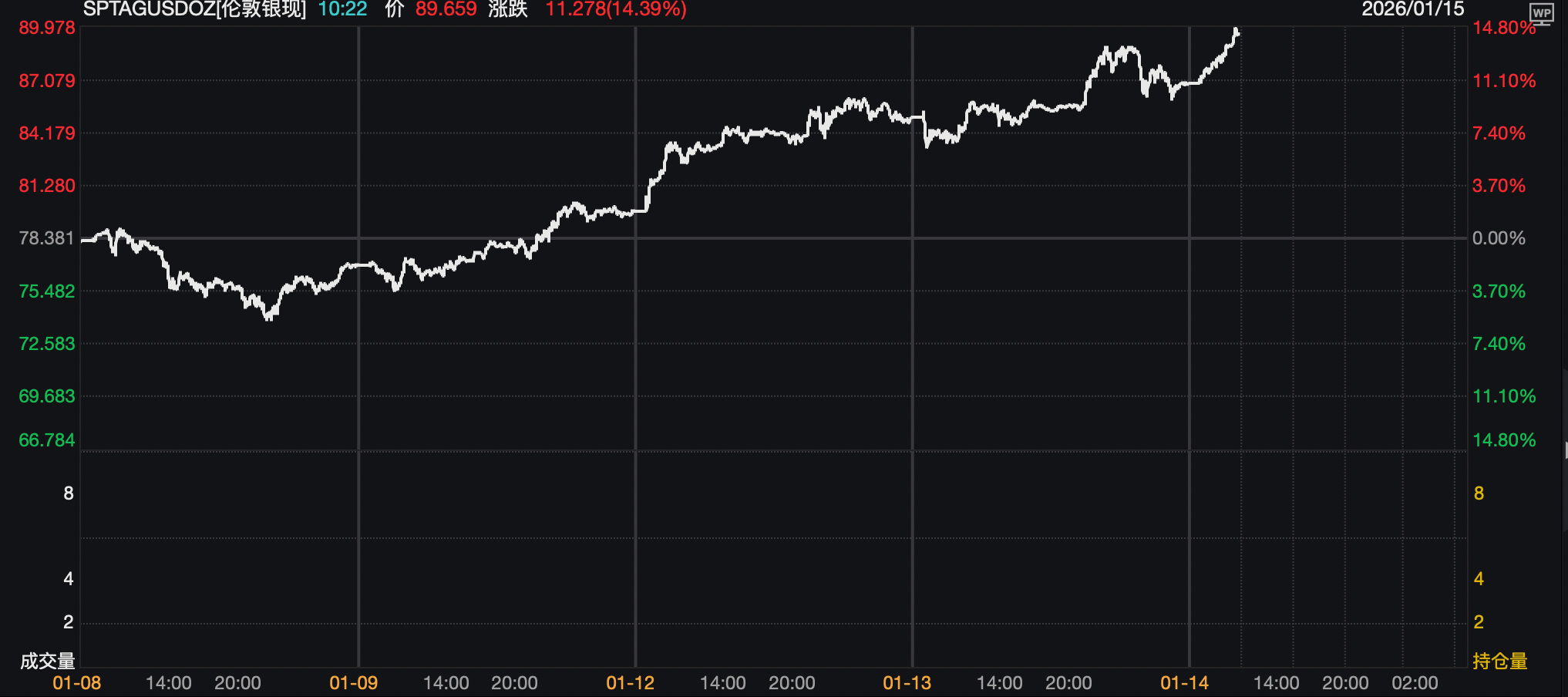
Group 1: Silver Price Surge - The spot silver price has surpassed $90 per ounce for the first time, with a current increase of 3.25% to $89.745 per ounce [1] - In 2025, the spot silver price experienced a maximum increase of over 170% within the year, achieving an annual growth of approximately 150% despite a significant drop at year-end [3] - As of the beginning of 2026, both spot and futures silver prices have already increased by over 25% [3] Group 2: Market Influences - The U.S. Labor Department reported a 2.7% year-on-year increase in the Consumer Price Index (CPI) for December 2025, leading traders to increase bets on an earlier interest rate cut by the Federal Reserve [4] - Following the CPI data release, the probability of a Fed rate cut in April rose to about 42%, up from 38% prior to the data [4] - Citigroup forecasts that silver will reach $100 per ounce within the next three months, assuming geopolitical risks will ease [5] Group 3: Supply and Demand Dynamics - Global inventory tightness and increased long positions by institutions through ETFs and physical delivery are driving strong silver prices, with expectations of a rising price center [6] - However, rising raw material costs may suppress demand in the industrial sector [6] - The London Metal Exchange (LME) has also seen strong performance in other metals, with tin prices breaking $51,000, setting a new historical high [6]

亚洲炼厂增购美国原油
Zhong Guo Hua Gong Bao· 2026-01-14 02:48
Core Viewpoint - East Asian refineries are expected to continue increasing purchases of US light low-sulfur crude oil by 2026 to diversify supply channels, mitigate geopolitical risks, and enhance refining profits while maintaining diplomatic relations with the US [1][2]. Group 1: Market Trends - East Asian refineries, particularly in South Korea, Japan, and Thailand, are shifting from high-sulfur crude oil to US light low-sulfur crude oil to improve energy supply security and stabilize supply chains [1][2]. - Japan's crude oil imports from the US surged to 106,300 barrels per day in October 2025, a more than 26-fold increase from 4,029 barrels year-on-year, and nearly tripled from 36,200 barrels in September 2025 [1]. Group 2: Economic Factors - The narrowing price differential between Brent and Dubai crude oil futures has made US West Texas Intermediate crude more economically attractive compared to mainstream heavy sour crude, leading to a shift in refining profit margins [2][3]. - South Korea is projected to remain the largest buyer of US crude oil in Asia, with an expected annual purchase of 136 million barrels in 2025 [2]. Group 3: Strategic Partnerships - Thailand has committed to increasing US crude oil purchases as part of a bilateral trade agreement framework announced on October 26, 2025, aimed at deepening cooperation with the US [4]. - South Korea signed a $100 billion energy procurement agreement with the US, which is a key component of a broader trade agreement to reduce mutual tariffs from 25% to 15% [4]. - Japan and the US signed a comprehensive trade and investment agreement on October 28, 2025, which includes Japan's commitment to invest $550 billion in US energy infrastructure and related sectors [4].
银河期货每日早盘观察-20260114
Yin He Qi Huo· 2026-01-14 01:55
Report Industry Investment Rating No relevant content provided. Core Viewpoints of the Report The report provides a comprehensive analysis of various futures markets, including agricultural products, black metals, non - ferrous metals, shipping, and energy chemicals. It assesses the current market situation, influencing factors, and offers corresponding trading strategies for each sector, taking into account factors such as supply and demand, geopolitical events, and policy changes. Summary by Related Catalogs Financial Derivatives - **Stock Index Futures**: On Tuesday, the stock index fluctuated significantly. Although there were short - term rebounds, the overall market closed down. The basis of each variety continued to rise, and the discount of stock index futures continued to narrow, indicating that futures investors are still optimistic about the future market. It is recommended to go long on IC and IM on dips, conduct cash - and - carry arbitrage on IM/IC 2606 + short ETF, and use bull spreads for options [19][20][21]. - **Treasury Bond Futures**: On Tuesday, most treasury bond futures closed higher, but the market capital continued to converge, which put pressure on the short - end. In the short term, although market sentiment has recovered, it is not advisable to be overly optimistic. It is recommended to stop profit on previous long positions and then wait and see. For cash bond holders, they can consider selling hedges. For arbitrage, it is recommended to try shorting the basis of the 30 - year active bond [23][24]. Agricultural Products - **Protein Meal**: The supply pressure increases, and the price of US soybeans continues to decline. It is recommended to have a short - term bearish view, conduct M79 reverse arbitrage, and use the strategy of selling wide - straddle options [25][26]. - **Sugar**: Both domestic and international sugar prices are oscillating at the bottom. It is recommended to expect international sugar prices to oscillate at the bottom in the short term, and domestic sugar prices to oscillate within a range. Consider buying at the lower end and selling at the upper end of the range, and sell put options [27][30][31]. - **Oilseeds and Oils**: The US biodiesel sector is disturbed, and the price of US soybean oil has increased significantly. In the short term, the oil market oscillates with increased volatility. It is recommended to wait and see for both arbitrage and options [31][33]. - **Corn/Corn Starch**: The US corn report shows increased production, and the short - term price is weak. The spot price of corn is currently stable but may face pressure later. It is recommended to go long on the 03 US corn contract after it stabilizes, try short - selling the 03 corn contract, and widen the spread between the 05 corn and starch contracts [35][36]. - **Hogs**: The overall slaughter increases, but the spot price continues to rise. It is recommended to have a short - selling view, wait and see for arbitrage, and use the strategy of selling wide - straddle options [37][38]. - **Peanuts**: The spot price is stable, and the futures price oscillates at the bottom. It is recommended to go long on the 05 peanut contract on dips, wait and see for arbitrage, and sell the pk603 - C - 8200 option [39][41][42]. - **Eggs**: The demand has improved, and the egg price is stable with a slight increase. It is recommended to expect the near - month contract to oscillate weakly, and consider going long on the far - month May contract on dips [42][45]. - **Apples**: The cold - storage inventory is low, and the apple price is firm. It is recommended to hold long positions in the May contract and short the October contract, and conduct long - May and short - October arbitrage [46][48][49]. - **Cotton - Cotton Yarn**: The sales progress is fast, and the cotton price oscillates. It is recommended to expect the US cotton to oscillate in the short term, and go long on Zhengzhou cotton on dips [50][52]. Black Metals - **Steel Products**: Steel products start to accumulate inventory, and the steel price continues to oscillate. It is recommended to maintain an oscillating and strengthening trend, short the hot - rolled coil - coking coal ratio on rallies, and continue to hold the short - hot - rolled coil and long - rebar spread [55][56]. - **Coking Coal and Coke**: The price fluctuates sharply, and it is recommended to be cautious. It is expected to continue to oscillate widely, and it is recommended to wait and see for both arbitrage and options [57][59]. - **Iron Ore**: Market expectations are volatile, and the iron ore price is considered bearish at high levels. It is recommended to short lightly at high levels [60][63][64]. - **Ferroalloys**: Driven by cost, the price oscillates strongly. It is recommended to expect a short - term strengthening trend due to improved supply - demand and cost factors, wait and see for arbitrage, and sell out - of - the - money straddle options [66][67][69]. Non - Ferrous Metals - **Gold and Silver**: Inflation is moderate, and geopolitical conflicts drive the prices of gold and silver to new highs. It is recommended to hold long positions in Shanghai gold based on the previous high at the end of December and in silver based on the support near the previous high on the 7th of this month [70][73][74]. - **Platinum and Palladium**: The slowdown of CPI growth eases the macro - pressure on precious metals. It is recommended to go long on platinum on dips, and be cautious about going long on palladium before the result of the 232 investigation is announced [75][76][77]. - **Copper**: Short - term fluctuations intensify, but the upward trend remains unchanged. It is recommended to hold long positions entered at 98000 - 99000 yuan/ton [78][79]. - **Alumina**: The contradiction between commodity sentiment and fundamentals expands price fluctuations. It is recommended to wait and see [81][82]. - **Electrolytic Aluminum**: It runs strongly with oscillations. It is recommended to wait and see for both arbitrage and options [83][86]. - **Cast Aluminum Alloy**: It oscillates at a high level with the sector. It is recommended to wait and see for both arbitrage and options [87]. - **Zinc**: Pay attention to the impact of the capital side. It is recommended for conservative investors to wait and see, and for aggressive investors to hold short positions with strict position control [89][91]. - **Lead**: Take partial profit on long positions and raise the stop - loss line. It is recommended to take partial profit on profitable long positions, wait and see for arbitrage, and buy out - of - the - money call options appropriately [93][96]. - **Nickel**: It follows the correction of non - ferrous metals. It is recommended to have a long - term long view after the correction stabilizes [97][98][99]. - **Stainless Steel**: It follows the nickel price. It is recommended to go long on dips after the correction stabilizes [99][101]. - **Industrial Silicon**: Short on rallies. It is recommended to short on rallies as the medium - term demand is weak [102]. - **Polysilicon**: Wait and see in the short term. It is recommended to be cautious due to the current vacuum period of spot trading [103][105]. - **Lithium Carbonate**: The risk of over - rise increases. It is recommended to take partial profit on long positions and pay attention to the support of the 5 - day moving average [106][107][109]. - **Tin**: The supply vulnerability is prominent, and the tin price reaches a new high. It is recommended to be vigilant against the selling pressure after the digestion of macro - positive sentiment [110][111][112]. Shipping - **Container Shipping**: Maersk lowers the price for wk5, and there are still differences in the intensity of rush - shipping. It is recommended to wait and see in the short term and conduct positive arbitrage on the 6 - 10 spread [113][114][115]. Energy Chemicals - **Crude Oil**: Geopolitical factors continue to drive the price. It is recommended to pay attention to the follow - up of the Iranian event and expect an oscillating and strengthening trend. Also, note that domestic gasoline is strong and diesel is weak, and the crude oil calendar spread is strong [116][118]. - **Asphalt**: Cost support is favorable, but supply and demand are weak. It is recommended to expect a high - level oscillation [118][120]. - **Fuel Oil**: Geopolitical factors drive the price. It is recommended to expect a short - term oscillating and strengthening trend and hold the FU59 positive spread [121][124][125]. - **Natural Gas**: TTF/JKM rebounds, and HH oscillates weakly. It is recommended to hold short positions in the third - quarter TTF and JKM contracts and sell out - of - the - money call options on TTF or JKM [126][127][129]. - **LPG**: There is a strong current situation and weak expectations. It is recommended to have a short - term long and long - term short view and pay attention to the follow - up of the Iranian event [129][132][133]. - **PX&PTA**: Downstream production cuts increase, and geopolitical disturbances strengthen cost support. It is recommended to expect a high - level oscillation and conduct positive arbitrage on the 3 and 5 contracts [133][134][135]. - **BZ&EB**: Pure benzene is expected to reduce supply, and styrene is boosted by exports. It is recommended to pay attention to short - selling opportunities for pure benzene and conduct long - styrene and short - pure - benzene arbitrage [136][137]. - **Ethylene Glycol**: Downstream production cuts increase, and the price has limited upside. It is recommended to expect a weak oscillation and sell call options [138][140]. - **Short - Fiber**: The purchasing sentiment is cautious, and the processing margin is under pressure. It is recommended to expect a high - level oscillation [140][142]. - **Bottle Chips**: Some maintenance device plans are announced. It is recommended to expect a high - level oscillation [142][144]. - **Propylene**: It oscillates at a high level. It is recommended to expect a high - level oscillation [144][146][147]. - **Plastic PP**: Hold long positions. It is recommended to hold long positions in the L 2605 contract, try to go long on the PP 2605 contract, and sell and hold the PP2605 put 6100 contract [148][152]. - **Caustic Soda**: The price of caustic soda weakens. It is recommended to expect an oscillating trend and wait and see [153][155]. - **PVC**: It mainly oscillates. It is recommended to wait and see [155][157]. - **Soda Ash**: It has a wide - range oscillation this week. It is recommended to short on rallies during the wide - range oscillation and sell out - of - the - money call options on the far - month high [158][160]. - **Glass**: The futures price falls. It is recommended to expect a wide - range oscillation this week, short on rallies, conduct short - glass and long - soda - ash arbitrage, and sell call options [160][164]. - **Methanol**: It runs firmly. It is recommended to avoid short positions and go long with attention to the Middle East situation [165][167]. - **Urea**: It runs weakly. It is recommended to short lightly and pay attention to the 5 - 9 positive spread [167][169][170]. - **Pulp**: The pulp price oscillates widely at a high level. It is recommended to hold short positions [172][174][175]. - **Log**: The spot price rebounds slightly. It is recommended for aggressive investors to buy a small amount of long positions and pay attention to the LG03 - 05 reverse arbitrage [176][178][179]. - **Offset Printing Paper**: High inventory suppresses the rebound of cultural paper. It is recommended to wait and see and sell the OP2602 - C - 4200 option [179][180][182]. - **Natural Rubber**: The import value of Thai rubber machinery decreases. It is recommended to wait and see for the RU 05 contract, try to go long on the NR 03 contract, and hold the RU2605 - NR2605 spread [183][185]. - **Butadiene Rubber**: The decline of the US dollar index sets a record. It is recommended to try to go long on the BR 03 contract and hold the BR2603 - NR2603 spread [186][188].
宁证期货今日早评-20260114
Ning Zheng Qi Huo· 2026-01-14 01:38
Report Industry Investment Ratings No relevant information provided. Core Views of the Report - Geopolitical risks and concerns over the Fed's independence have led to a resurgence in precious metals, but excessive bullishness on gold is not recommended [1]. - Geopolitical risks have driven up crude oil prices, and in the short - term, the price may remain strong with emotional premiums [1]. - Steel prices may rise first and then fall this week, showing a range - bound pattern [3]. - The fundamentals of coking coal are expected to improve, and there is still upward momentum in both futures and spot prices [3]. - The supply - demand situation of manganese silicon remains loose, and the price is expected to gradually decline to the cost valuation in the medium term [4]. - The short - term supply - demand game in the pig market continues, with prices fluctuating slightly in the range of 11700 - 11900 and the price center shifting upward [4]. - Palm oil is expected to fluctuate strongly in the short term, with inventory accumulation suppressing the upside but strong support at the bottom [5]. - The upside of soybean meal prices is restricted, and the 05 contract is expected to continue to adjust in the short term [5]. - The bond market is under pressure due to tightening funds, and treasury bonds will show more volatility [6]. - Silver prices have risen due to risk - aversion and expectations of monetary easing, but the upward momentum needs attention [6]. - Methanol is expected to fluctuate strongly in the short term, with high - level inventory increase and expected decline in imports [7]. - Soda ash is expected to fluctuate in the short term, with high - level inventory increase and new production capacity pressure [8]. - PVC prices are expected to remain range - bound in the short term, with sufficient supply, weak domestic demand, and rising inventory [9]. - Copper prices are expected to remain in a high - level range - bound pattern, supported by long - term expectations but lacking short - term demand drive [10]. - PTA will transit in a fluctuating manner, with a supply increase and weakening demand as the holiday approaches [11]. - Natural rubber will be treated with a wide - range fluctuation, with rising raw material prices, inventory accumulation, and flexible production control in the demand side [12]. Summary by Product Precious Metals - **Gold**: Geopolitical tensions have eased slightly, but risk - aversion factors still exist. The Fed's independence has raised market concerns, leading to a resurgence in precious metals. However, excessive bullishness on gold is not recommended. Attention should be paid to geopolitical disturbances and the interaction between gold and silver [1]. - **Silver**: The ongoing investigation of Fed Chairman Powell has affected market expectations. Risk - aversion and expectations of monetary easing have led to a rise in silver prices, but the upward momentum needs attention [6]. Energy - **Crude Oil**: API data shows an increase in US crude oil, gasoline, and distillate inventories. EIA predicts a decline in US crude oil production in the forecast period. Geopolitical risks have driven up prices, and in the short - term, the price may remain strong with emotional premiums [1]. Metals - **Steel**: On January 13, domestic steel markets showed mixed trends. High costs support steel prices, but weakening downstream demand may lead to a decline in prices later this week, with a range - bound pattern [3]. - **Coking Coal**: The capacity utilization rate of coking enterprises has increased, and inventory has decreased. The supply pressure is expected to ease, and the demand is expected to improve, leading to upward momentum in prices [3]. - **Manganese Silicon**: The开工率 of silicon - manganese enterprises has decreased slightly, and the supply - demand situation remains loose. The price is expected to decline to the cost valuation in the medium term [4]. - **Copper**: The US CPI growth rate has reached the lowest level since July 2025, and market expectations of Fed rate cuts in the second quarter have increased, which may boost copper prices in the short term. The market is in a game between "strong expectations" and "weak reality", and copper prices are expected to remain in a high - level range - bound pattern [10]. Agricultural Products - **Palm Oil**: Indonesia will maintain the biodiesel policy at the B40 level. The domestic import profit has been significantly repaired, and the number of domestic purchases has increased. Palm oil is expected to fluctuate strongly in the short term [5]. - **Soybean Meal**: The downstream feed enterprises have high inventory levels, and the supply of soybeans and soybean meal in oil mills is still abundant, restricting the upside of prices. The 05 contract is expected to continue to adjust in the short term [5]. - **Pig**: The national pig prices showed mixed trends. The supply - demand game will continue in the short term, with prices fluctuating slightly in the range of 11700 - 11900 and the price center shifting upward [4]. Chemicals - **Methanol**: The domestic methanol production is at a high level, downstream demand has declined slightly, and inventory has continued to accumulate. The price is expected to fluctuate strongly in the short term [7]. - **Soda Ash**: The price of heavy - quality soda ash has declined slightly, production has increased, and inventory has risen significantly. The market is expected to fluctuate in the short term [8]. - **PVC**: The price has increased slightly, production is expected to increase slowly, and inventory has risen. The market is expected to remain range - bound in the short term [9]. - **PTA**: The production of PTA has increased year - on - year, and the supply is expected to increase in January. The demand is expected to weaken as the holiday approaches, and the market will transit in a fluctuating manner [11]. - **Natural Rubber**: The raw material prices in Southeast Asia have stopped falling and rebounded, and domestic inventory has accumulated. The demand side is in a state of flexible production control, and the market will show a wide - range fluctuation [12]. Bonds - **Short - term Treasury Bonds**: Shibor short - term varieties have risen, indicating tightening funds. The bond market is under pressure, and treasury bonds will show more volatility [6].
美伊地缘风险扰动,碳酸锶或迎涨价机遇
Guotou Securities· 2026-01-14 01:38
Investment Rating - The industry investment rating is "Leading the Market-A" with a maintained rating [5]. Core Insights - The geopolitical risks involving the US and Iran may create opportunities for price increases in strontium carbonate [1]. - The demand for strontium carbonate is expected to accelerate due to its wide applications, particularly in high-quality optical glass and advanced packaging [2]. - The supply of strontium carbonate is highly dependent on Iran, which poses significant uncertainties due to geopolitical tensions, potentially leading to price volatility [3]. Summary by Sections Industry Overview - Strontium carbonate (SrCO3) is a colorless crystalline compound with limited solubility in water, primarily used in various industries including electronics and metallurgy [2]. - The downstream consumption structure of strontium carbonate includes strontium ferrite (66.0%), metallurgy (6.9%), electronic components (3.3%), fireworks (2.1%), and other strontium salts (21.7%) [2]. Supply Chain Analysis - Iran holds 85% of the world's high-grade strontium mineral reserves, with a production share of 32.1% in 2022, making it the second-largest producer globally [3]. - China's strontium carbonate production is heavily reliant on imports, with 70% sourced from Iran, indicating a significant supply risk if geopolitical tensions escalate [3]. Company Focus - Key companies in the strontium carbonate sector include: - Hongxing Development with a production capacity of 30,000 tons/year, expected to increase to 60,000 tons/year post-project completion [4][10]. - Jinrui Mining with a current capacity of 20,000 tons/year and plans for further expansion [9][10]. - The industry is characterized by high concentration, and any disruption in the supply of strontium minerals could lead to unexpected price increases [3].


中辉有色观点-20260114
Zhong Hui Qi Huo· 2026-01-14 01:30
中辉有色观点 | 品种 | 核心观点 | 主要逻辑 | | --- | --- | --- | | 黄金 | | 美联储独立性被重创,全球地缘问题升级。国际局势紧张,地缘溢价交易继续,流 | | ★★ | 长线持有 | 动性风险偏好尚可。中长期来看,地缘秩序重塑,不确定性持续存在,央行继续买 | | | | 黄金,长期战略配置价值不变。【1000-1060】 | | 白银 | | 尽管短期 COMEX 白银有较大仓位持仓抛压,但是避险、交割逻辑、资源品紧张预期 | | | 长期持有 | 持续。长期降息、供需缺口连续 5 年,全球大财政均对白银长期有利,长期滚动做 | | ★★ | | 多逻辑不变【19000-22500】。继续关注海外市场调仓风险。 | | | | 鲍威尔面临刑事诉讼,市场担心美联储独立性丧失,美元走弱,美国虹吸全球铜资 | | 铜 | 长线持有 | 源,短期铜震荡偏强,建议多单持有,回调逢低试多。中长期对铜依旧看好。沪铜 | | ★ | | | | | | 关注区间【101500,105500】 | | | | 美元走弱,伦锌拉涨超 2%,沪锌跟涨站稳 2 万 4,短期锌供需双弱,宏观和市场 ...
光大期货:1月14日能源化工日报
Xin Lang Cai Jing· 2026-01-14 01:25
Oil Market - Oil prices have experienced five consecutive increases, with WTI February contract closing up by $1.65 to $61.15 per barrel, a rise of 2.77% [2][16] - Brent March contract closed up by $1.60 to $65.47 per barrel, a rise of 2.51% [2][16] - Concerns over supply disruptions due to geopolitical tensions in Iran and issues with the Caspian Pipeline Consortium have heightened bullish sentiment in the market [2][16] - API data indicates a significant increase in U.S. crude oil inventories by 5.278 million barrels last week, compared to a decrease of 2.766 million barrels the previous week [2][16] Fuel Oil - The main fuel oil contract FU2603 on the Shanghai Futures Exchange rose by 0.53% to 2461 yuan/ton, while low-sulfur fuel oil contract LU2603 increased by 1.66% to 3066 yuan/ton [17][18] - The low-sulfur fuel oil market structure remains stable, with moderate support for high-sulfur fuel oil due to recovering demand from the shipping sector [17][18] Asphalt - The main asphalt contract BU2602 on the Shanghai Futures Exchange fell by 0.66% to 3140 yuan/ton [19] - The market is influenced by tightening raw material supply and declining refinery output, leading to a significant price increase [19] Rubber - The main rubber contract RU2605 fell by 155 yuan/ton to 15975 yuan/ton, while NR and BR contracts also saw declines [20] - The export volume of natural rubber in November 2025 decreased by 14.7% year-on-year to 37,150 tons, with 50.8% exported to China [20] PX, PTA, and MEG - TA605 closed at 5140 yuan/ton, down 0.04%, while EG2605 closed at 3815 yuan/ton, down 1.68% [21] - The polyester market is expected to experience short-term fluctuations due to geopolitical risks affecting oil prices [21] Methanol - Methanol prices in Taicang were reported at 2257 yuan/ton, with CFR China prices ranging from $265 to $269 per ton [22] - The market is expected to maintain a bottom range due to declining port inventory pressure [22] Polyolefins - Mainstream prices for polyolefins in East China range from 6370 to 6500 yuan/ton, with various production margins reported [23][24] - Supply is expected to decrease slightly due to temporary maintenance, while demand is anticipated to recover as the Lunar New Year approaches [24] PVC - PVC prices in East China have been adjusted upwards, with various grades priced between 4660 and 4850 yuan/ton [25] - The market is expected to maintain a bottom range due to high supply levels and slowing domestic demand [25] Urea - Urea futures prices showed a slight decline, with the main contract closing at 1774 yuan/ton [26] - The market is entering a phase of consolidation as demand remains supported by winter storage [26] Soda Ash - Soda ash futures prices fell by 1.3%, with the main contract closing at 1212 yuan/ton [27] - The market outlook remains weak due to low demand and inventory pressures as the Lunar New Year approaches [27] Glass - Glass futures prices showed a decline, with the main contract closing at 1096 yuan/ton, down 3.09% [28] - The market is supported by high transaction volumes in the spot market, but seasonal demand is expected to decrease as the holiday approaches [28]

美国核?通胀不及预期,?银延续强势
Zhong Xin Qi Huo· 2026-01-14 01:19
投资咨询业务资格:证监许可【2012】669号 12⽉美国核⼼通胀低于预期,实际利率下⾏环境延续;与此同时,围绕美 联储独⽴性的政治与司法不确定性反复发酵,美元信⽤与政策可信度再度 成为市场定价核⼼变量,贵⾦属在宏观与制度两条逻辑⽀撑下维持强势。 重点资讯: 1)全球央行集体表态力挺 杰罗姆·鲍威尔,欧洲央行、英国央行、 加拿大央行等罕见联合发声强调央行独立性是金融稳定基石,凸显市 场对美联储货币自主权被削弱的系统性担忧快速升温。 2)伊朗国内抗议升级为高烈度人道风险事件,人权组织估计死亡人 数或达数千人并警告大规模法外处决风险,进一步放大中东地区政治 与安全不确定性。 3)在美国持续加压背景下伊朗释放被扣油轮迹象显现,一艘两年前 扣押的油轮现身阿曼近海,显示地缘博弈边际缓和但能源通道与制裁 风险仍具反复性。 价格逻辑: 中信期货研究|贵⾦属策略⽇报 2026-1-14 美国核⼼通胀不及预期,⾦银延续强势 研究员: 黄金:通胀回落提供基本面缓冲,制度不确定性抬升风险溢价。12月 美国核心CPI环比0.2%,同比2.6%,持平四年低位,显示通胀趋势继 续降温。在通胀约束边际缓解的同时,市场对美联储独立性与未来利 ...
张尧浠:美CPI弱于预期、金价维持看涨前景不变
Sou Hu Cai Jing· 2026-01-14 01:01
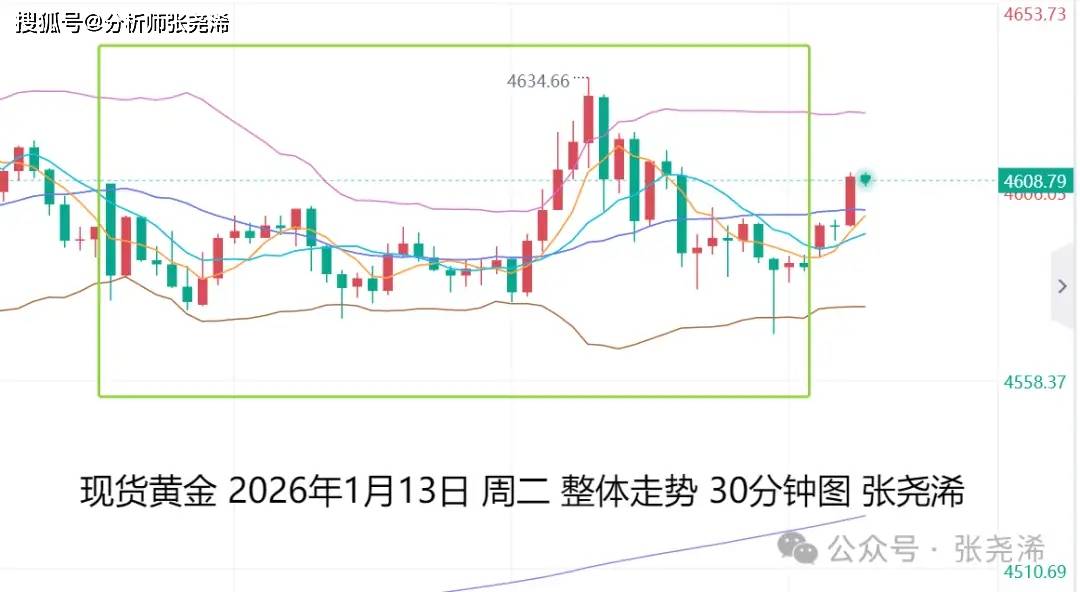
张尧浠:美CPI弱于预期、金价维持看涨前景不变 具体走势上,金价自亚市开于4603.39美元/盎司,日内先行震荡盘整运行,延续到美盘时段,多头再度发力,连续反弹走强,录得日内高点4634.43美元, 但最终震荡回撤,并至盘尾触及日内低点4569.74美元,最终有所止跌回升,收于4586.43美元,日振幅64.69美元,收跌16.96美元,跌幅0.37%。 影响上,日内因观望情绪而先行震荡波动,到晚间时段,美国12月CPI意外降温,通胀数据不及预期,交易员加码押注美联储4月降息,推动金价再创历 史新高,但交易员获利了结导致黄金回吐日内全部涨幅,不过,由于逢低买盘,以及持续的地缘政治和经济不确定性推动了避险需求,有所止跌。 展望今日周三(1月14日):国际黄金开盘,延续隔夜尾盘回升之力,先行走强,虽然美元指数近期偏强表现,但也难以对金价产生持续压力,金价将继续 受到降息周期,以及地缘局势避险需求而维持看涨前景,操作保持低多不变。 日内将重点关注美国11月零售销售月率,美国11月PPI年率及月率,还有美国第三季度经常帐(亿美元)、美国10月商业库存月率、美国12月成屋销售总数 年化(万户)等数据,目前整体预期是偏向 ...