制造业PMI

Search documents
12月中国PMI评论:亮眼数据迎新年
Yin He Qi Huo· 2025-12-31 09:14
Report Summary 1) Report Industry Investment Rating No information provided in the content. 2) Core View of the Report In December 2025, China's manufacturing PMI reached 50.1, up 0.9 from the previous month, significantly higher than the market - expected 49.3, returning above 50 for the first time in 8 months. The non - manufacturing PMI business activity was 50.2, up 0.7 from the previous month, higher than the market - expected 49.5. The manufacturing PMI showed an overall recovery, while the non - manufacturing PMI was in a relatively weak state [4][21]. 3) Summary by Relevant Catalogs First Part: Review of China's Manufacturing and Non - manufacturing PMI Data Tables - The table presents the manufacturing PMI and its sub - items for December and November 2025, including production, new orders, new export orders, etc., along with their changes [2]. Second Part: Full Recovery of Manufacturing PMI in December - In December 2025, the manufacturing PMI reached 50.1, with significant recoveries in production, new orders, new export orders, and production and operation expectations. The main raw material purchase price and employment sub - items declined. It recovered against the seasonal trend, and most sub - items were at the middle level of the historical same period, indicating economic recovery. The finished product inventory was at a relatively high level, and there was a time lag in the economic recovery reaching the price end. Small - sized enterprises' PMI declined, while large and medium - sized enterprises' PMI increased. The economic cycle also showed a repair state [4][5]. Third Part: Mixed Performance and Overall Weakness of Non - manufacturing PMI in December - In December 2025, the non - manufacturing PMI business activity was 50.2. Some sub - items such as new orders, employment, and business activity increased, while sales price, new export orders, input price, and on - hand orders decreased. The decline in input and sales prices reflected the weakness of the non - manufacturing economy. Seasonally, many key indicators were at relatively low levels in the historical same period. The construction industry PMI continued to decline, and the service industry PMI was at a relatively low level [21][22].
什么信号?时隔8个月,制造业景气度重回扩张区间!
券商中国· 2025-12-31 06:18
Core Viewpoint - The overall economic sentiment in China is improving, as indicated by the rise in manufacturing and non-manufacturing Purchasing Managers' Indices (PMI) in December, signaling a recovery in market demand and a more proactive economic policy [1][2]. Manufacturing PMI Analysis - The manufacturing PMI for December stands at 50.1%, marking a 0.9 percentage point increase from the previous month, breaking an eight-month streak below 50% and entering the expansion zone [3]. - Among the 13 sub-indices, production, new orders, new export orders, backlogs, finished goods inventory, purchasing volume, ex-factory prices, raw material inventory, supplier delivery times, and production expectations all showed increases ranging from 0.1 to 2.4 percentage points [3]. - The new orders index has risen above the critical point for the first time since the second half of the year, with specific industries like food processing, textiles, and electronics showing production and new orders indices above 53.0% [3]. Industry-Specific Insights - In the 21 manufacturing sectors surveyed, 16 sectors reported a rise in PMI compared to the previous month, indicating improved operational conditions [5]. - High-tech manufacturing PMI reached 52.5%, up 2.4 percentage points, while equipment manufacturing and consumer goods sectors both recorded PMIs of 50.4%, indicating expansion [5]. - However, industries such as non-metallic mineral products and black metal smelting remain under pressure, with their indices below the critical point [4]. Financial Sector Performance - The financial sector's business activity index and new orders index both rose for two consecutive months, exceeding 60%, indicating enhanced financial support for the real economy [6]. - The construction sector's business activity index increased to 52.8%, up 3.2 percentage points, ending a four-month period below 50% and signaling a rebound in construction activities [6][7]. Business Expectations - The manufacturing production and business activity expectation index rose to 55.5%, the highest since April 2024, while the service sector's expectation index reached 56.4% [8]. - The positive outlook is supported by clear policy signals and a stable trade environment, suggesting a solid foundation for the upcoming year [8]. Future Economic Outlook - The economic policies outlined in the 14th Five-Year Plan are expected to provide strategic direction for the next five years, with the recent Central Economic Work Conference setting clear goals for 2026 [9]. - The manufacturing sector is anticipated to achieve steady growth in both quality and quantity in 2026, driven by multiple positive factors [9].


东海期货宏观数据观察:12月制造业PMI超预期,经济产出持续扩张
Xin Lang Cai Jing· 2025-12-31 06:07
Key Points - The manufacturing PMI for December in China is 50.1%, exceeding expectations of 49.2% and the previous value of 49.2% [1][38] - The non-manufacturing PMI for December is 50.2%, above the expected 49.6% and previous 49.5% [1][38] - The composite PMI stands at 50.7%, up from 49.7% previously, indicating an overall recovery in economic sentiment [1][38] Manufacturing Sector - In December, the manufacturing PMI rose by 0.9 percentage points to 50.1%, indicating a better-than-expected recovery in manufacturing sentiment [4][40] - Large enterprises reported a PMI of 50.8%, up 1.5 percentage points, while medium-sized enterprises saw a PMI of 49.8%, up 0.9 percentage points; small enterprises reported a decline to 48.6% [4][40] - Key industries such as high-tech manufacturing saw a significant increase in PMI from 50.1% to 52.5%, indicating strong recovery [4][40] Demand and Supply - The new orders index rose to 50.8%, marking the first increase above the critical point since the second half of the year, indicating improved market demand [12][46] - The production index increased to 51.7%, suggesting accelerated manufacturing activities [12][46] - The new export orders index improved to 49%, indicating a recovery in external demand [12][46] Price and Inventory - The purchasing price index is at 53.1%, while the factory price index is at 48.9%, reflecting a short-term increase in manufacturing prices [23][55] - Finished goods inventory index rose to 48.2%, and raw material inventory index increased to 47.8%, indicating proactive replenishment by manufacturers [23][55] Non-Manufacturing Sector - The non-manufacturing business activity index increased to 50.2%, indicating an improvement in the non-manufacturing sector [26][59] - The construction industry saw a significant rise in its business activity index to 52.8%, reflecting a positive outlook [26][59] - The service sector's business activity index is at 49.7%, showing slight improvement but still in contraction territory [26][59] Composite PMI - The composite PMI output index rose to 50.7%, indicating overall expansion in production and business activities [34][68] - The manufacturing production index and non-manufacturing business activity index are at 51.7% and 50.2%, respectively, reflecting a broad-based recovery [34][68]

中国12月RatingDog制造业PMI 50.1,前值 49.9
Hua Er Jie Jian Wen· 2025-12-31 01:47
市场有风险,投资需谨慎。本文不构成个人投资建议,也未考虑到个别用户特殊的投资目标、财务状况或需要。用户应考虑本文中的任何 意见、观点或结论是否符合其特定状况。据此投资,责任自负。 中国12月RatingDog制造业PMI 50.1,前值 49.9。 风险提示及免责条款 ...
光大期货1230黄金点评:夜盘金价大幅回踩,警惕行情巨震风险
Xin Lang Cai Jing· 2025-12-30 01:34
Core Viewpoint - On December 29, COMEX gold experienced a sharp decline, closing at $4350.2 per ounce, a drop of 4.45%, while domestic SHFE gold also fell significantly to 975.80 yuan per gram, down 4.00% [2][6]. Market Dynamics - Despite a decrease in the US dollar index and US Treasury yields, these factors did not create a favorable environment for precious metals, as market sentiment dominated trading [2][6]. - Following a strong year-end rebound, both gold and silver markets faced severe sell-offs, with traders cashing in profits leading to a sharp drop in precious metal prices, ending the recent upward trend [2][6]. Price Movements - Spot gold saw an intraday drop of 5%, marking the largest single-day decline since October 21, and this was the second occurrence of such a significant drop this year [2][6]. - Silver's decline was even more pronounced, with an intraday drop reaching 11%, the largest single-day decline since September 2020 [2][6]. Future Outlook - The upcoming holiday period will see the release of the US December S&P Global Manufacturing PMI, which may influence gold prices, alongside ongoing geopolitical conflicts that could also impact market conditions [2][6]. - Caution is advised for holding positions during the holiday season due to the potential for increased price volatility in the short term [2][6].

元旦周重磅日程:美联储主席或揭晓,巴菲特退休,“港股GPU第一股”挂牌
华尔街见闻· 2025-12-28 12:49
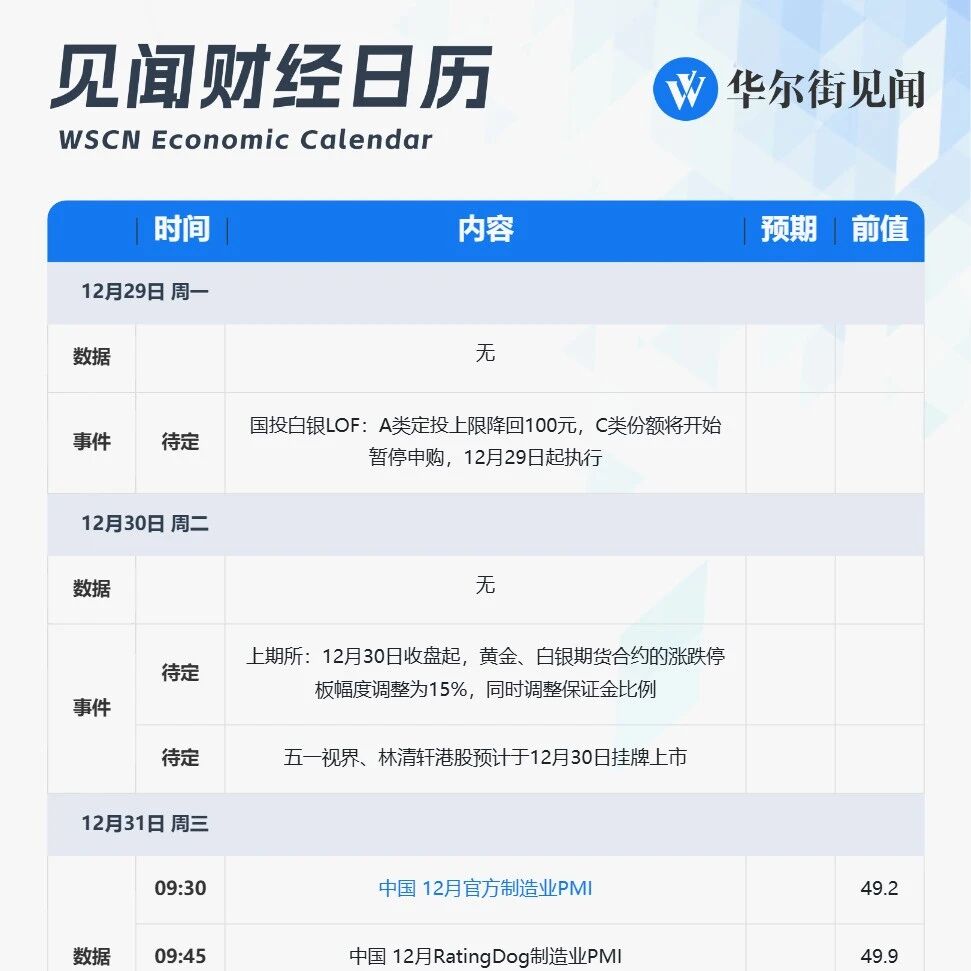
Core Viewpoint - The article highlights significant upcoming events and economic indicators, including the release of manufacturing PMI data for China and the US, changes in trading regulations for silver and gold futures, and notable corporate developments such as the leadership transition at Berkshire Hathaway and the IPOs of several companies in Hong Kong [4][6][12][16][17]. Economic Indicators - China's official manufacturing PMI for December is expected to be released on December 31, with a previous reading of 49.2 indicating contraction. Analysts anticipate a slight recovery due to policy support, focusing on new order indices and performance across different enterprise sizes [6]. - The US will release the S&P Global Manufacturing PMI for December on January 2, along with data on initial jobless claims for the week ending December 27 [7]. Corporate Events - Warren Buffett officially steps down as CEO of Berkshire Hathaway, with Greg Abel taking over the role starting January 1, 2026 [12]. - Wall Street anticipates the announcement of a new Federal Reserve chair by President Trump in the first week of January [10]. - Wall Street and various global markets will observe a holiday break from January 1 to January 4, 2026 [13][14]. Price Adjustments in Industries - A price increase trend is noted in the paper and chemical industries, with companies like Jilin Chemical Fiber and Hunan Youneng announcing significant price hikes for their products starting January 1, 2026 [25][26][27][28][29][30][31]. Regulatory Changes - The National Investment Silver LOF has tightened its subscription limits, reducing the A-class investment cap back to 100 yuan and suspending C-class subscriptions effective December 29 [18][19]. - The Shanghai Futures Exchange has adjusted the price fluctuation limits for gold and silver futures to 15% and modified margin requirements effective December 30 [20]. Legislative Developments - The "Fujian Province Promotion of Cross-Strait Standard Commonality Regulations" will take effect on January 1, 2026, marking a significant legislative move aimed at enhancing standards between the two regions [32].
【广发宏观王丹】12月EPMI量回落、价企稳
郭磊宏观茶座· 2025-12-23 03:31
Core Viewpoint - The Strategic Emerging Industries PMI (EPMI) for December 2025 decreased by 3.6 points to 49.1, which is higher than the levels in December 2022 and 2023 but lower than the levels in other years since 2014 [1][4][7]. Summary by Sections Overall EPMI Performance - The EPMI's absolute level of 49.1 is the third lowest since data collection began in 2014, indicating a relative decline compared to historical averages [7][8]. - Among seven major sub-industries, three are above the expansion threshold of 50, while four are below, consistent with November's performance [4][8]. Key Sub-Indicators - Production volume, product orders, and export orders fell by 3.5, 5.4, and 3.0 points respectively in December [9]. - The demand decline was faster than production, leading to a significant increase in the production-to-order ratio, which reached 4.8 in December, compared to average values from 2021 to 2025 [9][10]. - The sales price index rose by 0.2 points, with notable increases in the new energy and new energy vehicle sectors, which saw price increases of 3.6 and 1.8 points respectively [9][11]. - The difficulty of obtaining loans increased by 2.9 points, indicating a slightly tighter credit environment for emerging industries compared to November [9]. Sector Performance - The biotechnology, new energy vehicles, and next-generation information technology sectors maintained high levels of prosperity, with biotechnology seeing a 2.7-point increase in its prosperity index in December [14]. - The new energy and new energy vehicle sectors experienced a decline in prosperity compared to October, but remained among the top three sectors [14]. - Other sectors such as high-end equipment, new materials, and energy conservation and environmental protection are in a contraction phase [14][15]. Future Outlook - The EPMI is expected to continue reflecting seasonal trends, with a slight decline anticipated in the manufacturing PMI for December, as historical data shows a tendency for decreases during this period [18]. - The overall economic environment remains subdued, with nominal growth stabilizing due to supply-side policies, while actual growth remains to be validated in the context of investment recovery [21].

国债衍生品周报-20251221
Dong Ya Qi Huo· 2025-12-21 01:12
Report Summary Core View - There are both positive and negative factors in the bond market. Positive factors include a loose capital market despite the contraction of the manufacturing PMI, and rumors of "dual cuts" in the political situation boosting sentiment, leading to a decline in yields and an overall rise in futures. Negative factors are that the central bank's bond - buying scale is lower than expected, causing yields to rise and futures to fall, as well as banks selling bonds to realize profits and bond funds facing redemption pressure, resulting in consecutive increases in yields and falling futures. The trading advice is to pay attention to the central bank's bond - buying intensity and short - term liquidity and keep positions flexible [2] Specific Data and Indicators Yield and Interest Rate - Data on 2Y, 5Y, 10Y, 30Y, and 7Y treasury bond yields from 2024/04 to 2025/08 are presented, along with data on deposit - type institutional pledged repurchase weighted interest rates for 1 - day and 7 - day terms and 7 - day reverse repurchase rates from 2023/12 to 2025/06 [3] Term Spread - Data on treasury bond term spreads (7Y - 2Y and 30Y - 7Y) from 2024/04 to 2025/08 are provided [4][5] Futures Position and Trading Volume - Data on the positions and trading volumes of 2 - year, 5 - year, 10 - year, and 30 - year treasury bond futures from different time periods are shown [7][8] Basis and Spread - Data on the basis of the current - quarter contracts of 2 - year, 5 - year, 10 - year, and 30 - year treasury bond futures are presented, as well as the inter - period spreads (current - quarter minus next - quarter) of 2 - year, 5 - year, 10 - year, and 30 - year treasury bond futures. Additionally, data on cross - variety spreads (TS*4 - T and T*3 - TL) are provided [9][10][14][16][18][19][20]
钢材:原料发动补库,钢价触底反弹
Yin He Qi Huo· 2025-12-19 09:59
Group 1: Report Industry Investment Rating - Not provided in the report Group 2: Core Viewpoints of the Report - The steel price is expected to show a volatile and moderately strong trend due to raw material restocking. The iron - water output may recover next week, and the steel cost is supported. Although the seasonal decline of building material demand exists, the manufacturing demand still provides support. Short - term exports continue to be high, and the steel price presents a volatile and moderately strong trend [7]. - The trading strategies include maintaining a volatile and moderately strong trend for unilateral trading, suggesting to short the hot - rolled coil to rebar spread and short the hot - rolled coil to coking coal ratio for arbitrage, and suggesting to wait and see for options [7]. Group 3: Summaries by Related Catalogs Chapter 1: Steel Market Summary and Outlook Summary - **Current Situation**: This week, the iron - water output declined, and the five major steel products continued to reduce production, but the reduction speed slowed down. Rebar production increased while hot - rolled production decreased rapidly. The total steel inventory decreased at an accelerated pace, with the social inventory depletion faster than the factory inventory. Rebar demand improved month - on - month, but hot - rolled demand declined rapidly due to temperature and capital conditions [4][7]. - **Outlook**: Next week, the iron - water output may recover as blast furnace profits have been repaired. The supply of coal mines may shrink due to environmental protection, and steel mills have restocking expectations. The cost of steel is supported. The steel price shows a volatile and moderately strong trend due to raw material restocking. Follow - up attention should be paid to coal mine safety inspections, overseas tariffs, and domestic macro and industrial policies [7]. Chapter 2: Price and Profit Review Summary - **Spot Prices**: The summary price of rebar in Shanghai was 3300 yuan (+30), and the summary price of hot - rolled coil in Shanghai was 3280 yuan (+40) [11]. - **Profits**: The flat - rate electric furnace profit in East China was - 54.26 yuan (+3), and the valley - rate electric furnace profit was +111 yuan (+3). Long - process steel maintained a small profit [4][29]. Chapter 3: Important Domestic and Overseas Macroeconomic Data Summary - **Real Estate Data**: From January to November 2025, the national real estate development investment was 785.91 billion yuan, a year - on - year decrease of 15.9%. The sales prices of new commercial residential buildings in first, second, and third - tier cities showed varying degrees of decline [31]. - **Fixed - Asset Investment**: From January to November 2025, China's fixed - asset investment (excluding rural households) was 4.44035 trillion yuan, a year - on - year decrease of 2.6%. The growth rate continued to decline rapidly month - on - month [31][36]. - **Social Financing**: In November, the new social financing was 248.88 billion yuan, a year - on - year increase of 6.87%. The new RMB loans were 39 billion yuan. The government bonds and corporate bonds financing provided strong support, but the long - term investment demand of enterprises was insufficient, and the consumer and mortgage credit willingness of residents still needed to be boosted [35][36]. Chapter 4: Steel Supply, Demand, and Inventory Situation Summary - **Supply**: The daily average iron - water output of 247 steel mills was 226.55 million tons (- 2.65), and the capacity utilization rate of 49 independent electric arc furnace steel mills was 34.9% (+0.4). The small - sample rebar production was 181.68 million tons (+2.90), and the small - sample hot - rolled coil production was 291.91 million tons (- 16.8) [4][54][60]. - **Demand**: The small - sample rebar apparent demand was 208.64 million tons (+5.55), and the small - sample hot - rolled coil apparent demand was 298.28 million tons (- 13.69). The building material demand was affected by temperature and funds, and the manufacturing demand still had support. The export of steel products continued to be high in the short term [4]. - **Inventory**: The rebar inventory decreased by 26.96 million tons in total, with the factory inventory decreasing by 1.26 million tons and the social inventory decreasing by 25.7 million tons. The hot - rolled coil inventory decreased by 6.37 million tons in total, with the factory inventory decreasing by 0.61 million tons and the social inventory decreasing by 5.76 million tons [4].
集运指数(欧线)期货周报-20251219
Rui Da Qi Huo· 2025-12-19 09:22
1. Report Industry Investment Rating - Not provided in the content 2. Core Viewpoints of the Report - This week, the futures price of the Container Freight Index (European Line) rose slightly. The main contract EC2602 closed up 1.75%, and the far - month contracts rose between 1 - 2%. The latest SCFIS European Line settlement freight index was 1510.56, up 1.46 points from last week, a 0.1% increase. The Christmas stocking demand is beneficial for the futures price to rise, but the price increase announcements failed to materialize, and leading shipping companies have successively lowered the container prices, causing the previous price increase to be reversed. The traditional peak - season boost effect may be weaker than expected due to high tax rates on exports to the US. The freight market is highly influenced by news, and the futures price is expected to fluctuate more violently. Investors are advised to be cautious, pay attention to the operation rhythm and risk control, and track geopolitical, shipping capacity and cargo volume data in a timely manner [6][7][39] 3. Summary According to the Table of Contents 3.1. Market Review - Futures contracts: EC2512 fell 1.28% (- 21.20), closing at 1630.10; EC2602 rose 1.75% (29.60), closing at 1719.80; EC2604 rose 0.71% (8.00), closing at 1128.80; EC2606 rose 2.16% (27.20), closing at 1288.30; EC2608 rose 1.59% (22.70), closing at 1453.20; EC2610 rose 1.63% (16.80), closing at 1050.30. The SCFIS index rose 0.1% (1.46), closing at 1510.56. The trading volume and open interest of the EC2512 contract showed a divergence this week [9][10][15] 3.2. News Review and Analysis - China's re - implementation of export license management for steel after 16 years aims to strengthen monitoring, statistics and analysis of steel product exports and track product quality. The EU's FSR investigations on Chinese enterprises are opposed by China. The full - scale customs closure of Hainan Free Trade Port on December 18 expanded the "zero - tariff" commodity scope to over 6600 tariff items. The EU Commission proposed to relax the 2035 "ban on fuel - powered vehicles" requirement to a 90% emission reduction. The European Central Bank maintained the benchmark interest rate at 2% for the fourth consecutive time. The Fed's Williams said that the US unemployment rate is expected to drop to 4.5% by the end of 2025, and inflation is expected to rise to 2.5% in 2026 and fall to 2% in 2027 [18] 3.3. Weekly Market Data - The basis and spread of the Container Freight Index (European Line) futures contracts both contracted this week. The export container freight index rebounded slightly. Global container shipping capacity continued to grow, while European - line shipping capacity decreased slightly. The BDI and BPI declined, and freight rates fluctuated slightly. The charter price of Panamax ships continued to rise, and the spread between the offshore and on - shore RMB against the US dollar converged [24][27][31] 3.4. Market Outlook and Strategy - The same as the core viewpoints, the Christmas stocking demand is beneficial for the futures price to rise, but the price increase announcements failed to materialize, and the traditional peak - season boost effect may be weaker than expected. The freight market is highly influenced by news, and investors are advised to be cautious and track relevant data [39][40]