
反内卷政策

Search documents
温彬:反内卷政策显效,物价有望低位温和回升
Di Yi Cai Jing· 2025-09-11 03:05
Core Insights - The article highlights the gradual improvement in supply-demand relationships due to policies aimed at expanding domestic demand, countering excessive competition, and developing new growth drivers [1][2]. CPI Analysis - In August, the Consumer Price Index (CPI) showed a flat month-on-month change and a year-on-year decline of 0.4%, influenced by falling food and energy prices [4]. - Food prices were weaker than seasonal trends, with a month-on-month increase of 0.5%, below the historical average of 1.5%. Pork prices fell by 0.5%, while egg prices rose by 1.5%, both lower than historical averages [4]. - Energy prices decreased due to lower international oil prices, with transportation fuel prices down by 0.9% month-on-month and 7.1% year-on-year [4]. - Core CPI improved, remaining flat month-on-month and increasing by 0.9% year-on-year, marking the fourth consecutive month of growth [4]. PPI Analysis - The Producer Price Index (PPI) showed signs of recovery, with a month-on-month change from a decline of 0.2% to flat, and a year-on-year decline of 2.9%, narrowing by 0.7 percentage points [12]. - Prices for production materials improved, with a month-on-month increase of 0.1% and a year-on-year decline of 3.2%, also narrowing by 1.1 percentage points [12]. - Specific industries saw price increases, such as coal processing prices rising by 9.7% month-on-month, indicating a positive trend in domestic market competition [13]. Future Outlook - The outlook suggests a moderate recovery in prices, driven by the continued effects of domestic demand expansion policies and improved market competition [14]. - CPI is expected to reflect a trend of "food and energy prices declining while core inflation rises," with seasonal factors likely to support a decrease in food prices [15]. - PPI may enter a recovery phase, supported by ongoing policy measures against excessive competition and improvements in export structures [15].

8月通胀数据点评:CPI同比继续走低
Great Wall Securities· 2025-09-11 02:57
Group 1: CPI Analysis - In August 2025, the CPI year-on-year decreased to -0.4%, down from 0.0% in the previous month, while the month-on-month change remained flat at 0.0%[1] - The core CPI year-on-year rose to 0.9%, an increase of 0.1 percentage points from the previous month, marking four consecutive months of acceleration[2] - The average month-on-month CPI for August 2023-2024 was 0.35%, significantly lower than historical averages[2] Group 2: PPI Insights - The PPI year-on-year decreased by 2.9%, but the decline was less severe than the previous month's drop of 3.6%[1] - The month-on-month PPI change turned flat, ending an eight-month downward trend, indicating a positive effect from anti-involution policies[2] - The improvement in PPI is contingent on the recovery of domestic demand and international commodity price trends[3] Group 3: Market Dynamics - The weak CPI performance in August was primarily due to food and energy price pressures, while the core CPI showed improvement driven by policy-induced consumer activity[3] - The narrowing decline in PPI and the stabilization of key industrial product prices, such as coal and steel, suggest early signs of stabilization in production[3] - Risks include potential underperformance of domestic macroeconomic policies, unexpected changes in interest rates, and concentrated credit events[3]
物价负增系阶段性走低
Xinda Securities· 2025-09-11 02:28
Group 1: Price Trends - Current consumer price structure shows significant divergence between service prices and consumer goods prices, with service prices increasing by 0.6% year-on-year in August, while consumer goods prices fell to -1.0%[5] - Core CPI has risen for four consecutive months, reaching 0.9%, contrasting with the overall CPI which has dropped back into negative growth territory[5] - The decline in overall CPI is primarily driven by temporary factors, with 60% of the downward pressure on consumer goods prices attributed to weather and 30% to the pig cycle[14] Group 2: PPI Analysis - PPI has shown improvement, particularly in upstream and midstream sectors, with the PPI for production materials seeing a year-on-year decline narrowing by 1.1 percentage points in August[23] - Upstream raw material prices have improved significantly, with a year-on-year decline narrowing by 3.1 percentage points, while downstream manufacturing and consumption prices remain relatively weak[23] - The overall recovery in PPI is characterized by a strong performance in upstream sectors and a weaker performance in downstream sectors, indicating an "up strong, down weak" trend across the industry[23] Group 3: Future Outlook - Despite recent negative CPI readings, there is an expectation for CPI to rebound within the year, supported by signs of core inflation recovery and steady service price increases[12] - The report highlights that the downward pressure on consumer goods prices is largely temporary, suggesting a potential for recovery in the latter part of the year[12] - Risks to this outlook include geopolitical tensions and unexpected increases in international oil prices[29]
首席点评:降息意浓,绿稀红稠
Shen Yin Wan Guo Qi Huo· 2025-09-11 02:23
Report Summary 1. Report Industry Investment Rating No relevant content provided. 2. Core Viewpoints of the Report - The domestic liquidity in 2025 is expected to remain loose, and more incremental policies may be introduced in Q4 to boost the real economy. The external risks are gradually easing, and the probability of the Fed cutting interest rates in September is increasing, which further enhances the attractiveness of RMB assets. The current market is in a resonance period of "policy bottom + capital bottom + valuation bottom", but it is necessary to adapt to the accelerating rotation of sectors and structural differentiation. The CSI 500 and CSI 1000 indexes, which have more technology - growth components, are more offensive and volatile but may bring higher returns, while the SSE 50 and SSE 300, which have more dividend - blue - chip components, are more defensive with less volatility but relatively weaker price elasticity. The stock index has been rising since July and may experience short - term shock consolidation, but the probability of a medium - to - long - term upward trend is high [2][11]. - The double - coking futures are in a high - level shock trend. The current demand is in the off - season, and factors such as the expectation of coke price cuts and the low near - far - month price difference put pressure on the market, but policy expectations and the impact of over - production checks provide support [3][23]. - The palm oil price may be under pressure in the short term due to the lower - than - expected exports of Malaysian palm oil in August [3][25]. 3. Summary by Directory 3.1. Main News Concerns of the Day - **International News**: On September 10, Wang Yi, a member of the Political Bureau of the CPC Central Committee and Minister of Foreign Affairs, had a phone call with US Secretary of State Rubio. Both sides emphasized the importance of the strategic guidance of the heads - of - state diplomacy, proper management of differences, and exploration of practical cooperation to promote the stable development of Sino - US relations [4][5]. - **Domestic News**: In August 2025, the national consumer price index decreased by 0.4% year - on - year. The average consumer price from January to August decreased by 0.1% compared with the same period of the previous year [6]. - **Industry News**: Six departments including the Ministry of Industry and Information Technology jointly deployed a special rectification action for network chaos in the automotive industry, aiming to strengthen the handling of network chaos such as online water armies, "black public relations", "black mouths", and "fan circles" in the automotive industry [7]. 3.2. Daily Earnings of Overseas Markets - The report provides the closing prices, price changes, and percentage changes of various overseas market varieties on September 9 and 10, 2025, including the FTSE China A50 futures, ICE Brent crude oil, London gold, etc. For example, the FTSE China A50 futures rose by 0.48% from September 9 to 10, and ICE Brent crude oil rose by 1.61% [8]. 3.3. Morning Comments on Major Varieties - **Financial Products** - **Stock Index**: The stock index is expected to have short - term shock consolidation but a high probability of medium - to - long - term upward trend. The CSI 500 and CSI 1000 are more offensive, while the SSE 50 and SSE 300 are more defensive [2][11]. - **Treasury Bonds**: Treasury bond futures prices continued to fall. With the stabilization of the equity market and the gradual tightening of funds, the stock - bond seesaw effect continued. The new regulations on fund redemptions also disturbed the market, and long - term treasury bond futures prices hit new lows and are expected to remain weak [12]. - **Energy and Chemical Products** - **Crude Oil**: SC crude oil rose 0.82% at night. Eight countries decided to increase the daily crude oil production quota by 137,000 barrels starting from October, and the 1.65 million barrels of daily production cuts may be partially or fully restored [13]. - **Methanol**: Methanol rose 0.04% at night. The coastal methanol inventory increased significantly, and the overall device operating load increased. Methanol is expected to be bullish in the short term [14]. - **Rubber**: Rubber prices are expected to fluctuate and adjust in the short term. The supply is affected by the rainy season in the main production areas, and the demand is in the off - season with uncertainties [16]. - **Polyolefins**: Polyolefins are running weakly. The supply has shrunk, and the market pressure has eased. The support from downstream inventory replenishment needs to be monitored [17]. - **Glass and Soda Ash**: Glass futures are in shock consolidation, and soda ash futures rebounded after hitting the bottom. Both are in the process of inventory digestion, and the futures prices are weak and approaching the spot prices. Attention should be paid to the autumn consumption and policy changes [18]. - **Metals** - **Precious Metals**: Precious metals are strong. The weak US economic data and the expectation of interest rate cuts by the Fed, as well as other factors, support the rise of gold. Gold and silver are expected to be strong when the interest rate cut is approaching [19]. - **Copper**: Copper prices may fluctuate within a range. The concentrate supply is tight, and the smelting output is growing, while the downstream demand has both positive and negative factors [20]. - **Zinc**: Zinc prices may fluctuate weakly within a range. The smelting output is expected to increase, and the short - term supply may be in surplus [21][22]. - **Black Products** - **Double - Coking**: The double - coking futures are in a high - level shock trend, with both pressure and support factors [3][23]. - **Agricultural Products** - **Protein Meal**: Protein meal futures are expected to continue to fluctuate narrowly in the short term. The US soybean has strong support at the bottom, and the domestic raw material supply is expected to be loose [24]. - **Oils and Fats**: Palm oil prices may be under pressure in the short term due to lower - than - expected exports from Malaysia in August [3][25]. - **Sugar**: International sugar prices are expected to be weak, while the domestic sugar price is supported by high sales - to - production ratio and low inventory but is also dragged down by import pressure. Zhengzhou sugar is expected to follow the weak trend of international sugar [26]. - **Cotton**: ICE cotton prices rose slightly. The domestic cotton market is waiting for new cotton acquisition and traditional peak - season demand guidance, and Zhengzhou cotton is expected to be weak in the short term [27]. - **Shipping Index** - **Container Shipping to Europe**: The EC index is in shock and decline. The spot freight rate of European routes is in the off - season and is expected to continue to decline. The market may be more in a shock state [29].
核心CPI涨幅连续4个月扩大
Jin Rong Shi Bao· 2025-09-11 02:19
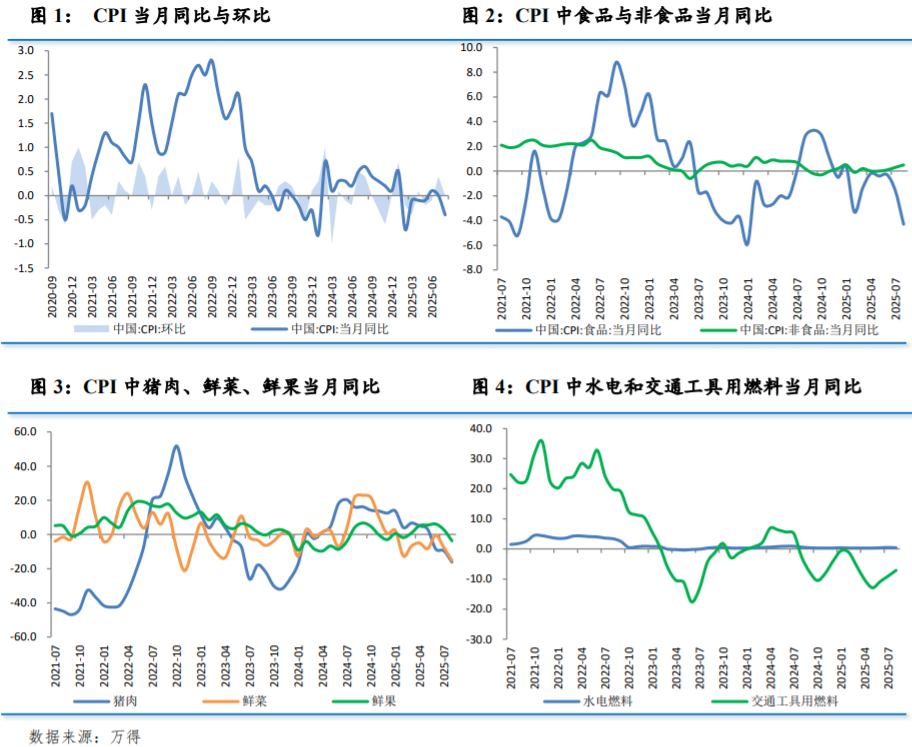
Core Insights - The consumer price index (CPI) remained stable in August, with a month-on-month change of 0% and a year-on-year decrease of 0.4% [1] - The core CPI, excluding food and energy prices, increased by 0.9% year-on-year, marking the fourth consecutive month of growth [1][4] CPI Analysis - The year-on-year decline in CPI is attributed to a high comparison base from the previous year and lower-than-seasonal food price increases in August [1][2] - The tail effect from last year's price changes contributed approximately -0.9 percentage points to the year-on-year CPI in August, with a downward impact that expanded by 0.4 percentage points compared to the previous month [1] - Food prices saw a month-on-month increase of 0.5%, but this was 1.1 percentage points below seasonal levels, with significant year-on-year declines in pork, eggs, and fresh vegetables [4] Food Price Dynamics - Year-on-year food prices decreased by 4.3%, with the decline expanding by 2.7 percentage points compared to the previous month, contributing an additional 0.51 percentage points to the CPI's year-on-year decline [4] - Specific declines included pork prices down 16.1%, fresh vegetables down 15.2%, and eggs down 14.2%, all showing an increase in downward pressure on CPI compared to the previous month [4] Core CPI and Industrial Prices - The core CPI's year-on-year increase of 0.9% reflects ongoing consumer demand and the effectiveness of policies aimed at boosting consumption [4][5] - Industrial consumer goods prices, excluding energy, rose by 1.5% year-on-year, with gold and platinum jewelry prices increasing significantly [6] Future Outlook - Analysts suggest that the CPI may remain weak throughout the year, with potential recovery towards the end of the year due to low base effects and supportive policies [6] - The impact of consumption-boosting policies is expected to further support prices of major goods in September [6]

宝城期货煤焦早报-20250911
Bao Cheng Qi Huo· 2025-09-11 01:51
投资咨询业务资格:证监许可【2011】1778 号 宝城期货煤焦早报(2025 年 9 月 11 日) ◼ 品种观点参考 时间周期说明:短期为一周以内、中期为两周至一月 | 品种 | | 短期 | 中期 | 日内 | 观点参考 | 核心逻辑概要 | | --- | --- | --- | --- | --- | --- | --- | | 焦煤 | 2601 | 震荡 | 震荡 | 震荡 偏弱 | 震荡 | 多空僵持,焦煤震荡调整 | | 焦炭 | 2601 | 震荡 | 震荡 | 震荡 偏弱 | 震荡 | 需求预期拖累,焦炭区间震荡 | 备注: 1.有夜盘的品种以夜盘收盘价为起始价格,无夜盘的品种以昨日收盘价为起始价格,当日日盘收盘 价为终点价格,计算涨跌幅度。 2.跌幅大于 1%为下跌,跌幅 0~1%为震荡偏弱,涨幅 0~1%为震荡偏强,涨幅大于 1%为上涨。 3.震荡偏强/偏弱只针对日内观点,短期和中期不做区分。 ◼ 主要品种价格行情驱动逻辑—商品期货黑色板块 品种:焦煤(JM) 日内观点:震荡偏弱 中期观点:震荡 参考观点:震荡 核心逻辑:9 月 10 日夜盘,焦煤 2601 合约减仓上行,价格维持区 ...
五矿期货早报有色金属-20250911
Wu Kuang Qi Huo· 2025-09-11 01:45
Group 1: Report Overview - The report is the Non - ferrous Metals Daily Report on September 11, 2025, from Wukuang Futures [1] Group 2: Copper - **Market Performance**: LME copper rose 0.96% to $10012/ton, and SHFE copper main contract closed at 80190 yuan/ton. The US PPI data was weaker than expected, and the US bond yield declined, leading to the rise of copper prices [2] - **Industry Situation**: LME copper inventory decreased by 225 to 155050 tons, with a cancellation warrant ratio of 14.0% and a Cash/3M discount of $56/ton. In China, SHFE copper warehouse receipts slightly increased to 19,000 tons. The spot premium in Shanghai decreased, while the inventory in Guangdong decreased and the procurement volume increased. The import of SHFE copper was slightly in the red, and the Yangshan copper premium increased. The refined - scrap copper price difference was 1620 yuan/ton, and the supply - demand of recycled copper was affected by policy adjustments [2] - **Price Outlook**: The market is hesitating between recession and interest - rate cut trading. If recession trading comes first, the attitude at the actual interest - rate meeting is expected to be dovish. Overseas copper mine supply is disturbed, and domestic copper production declines marginally. Although current consumption is weak, copper prices are expected to remain strong. The operating range of SHFE copper main contract is 79500 - 80800 yuan/ton, and that of LME copper 3M is 9900 - 10100 dollars/ton [2] Group 3: Aluminum - **Market Performance**: Aluminum prices fluctuated. LME aluminum fell 0.21% to $2622/ton, and SHFE aluminum main contract closed at 20830 yuan/ton. The position of SHFE aluminum weighted contract increased by 0.7 to 542,000 lots, and the futures warehouse receipts slightly increased to 65,000 tons [4] - **Industry Situation**: Domestic three - place aluminum ingot inventory decreased by 0.2 to 473,000 tons, and the aluminum bar inventory in Foshan and Wuxi decreased by 0.2 to 85,500 tons. The aluminum bar processing fee rebounded, but the market trading was average. The spot in East China was at a discount of 30 yuan/ton to the futures, and the discount widened. LME aluminum inventory remained unchanged, and the cancellation warrant ratio was 22.7%, with a Cash/3M premium of $2.92/ton [4] - **Price Outlook**: Aluminum prices are in a game between macro - expectations and fundamental realities. Overseas interest - rate cut expectations and the resilience of aluminum product exports provide support, but the weak improvement in domestic terminal demand restricts the upside. The key is to focus on the fulfillment of peak - season demand and inventory trends. If inventory turns, aluminum prices may rise further. The operating range of SHFE aluminum main contract is 20700 - 20960 yuan/ton, and that of LME aluminum 3M is 2600 - 2650 dollars/ton [4] Group 4: Lead - **Market Performance**: The SHFE lead index fell 0.74% to 16804 yuan/ton, and LME lead 3S fell $15 to $1977/ton [5] - **Industry Situation**: The lead industry shows a pattern of weak supply and demand. The supply of lead concentrates and waste lead - acid batteries is tight, restricting the smelter's production. The continuous losses of secondary lead have led to production cuts in Anhui. Downstream consumption is weaker than in previous years, and dealers' finished - product inventory is at a historical high [5] - **Price Outlook**: The supply of lead ingots is marginally narrowing, providing some support. However, if the commodity sentiment weakens and secondary smelting recovers, lead prices still face significant downside risks [5] Group 5: Zinc - **Market Performance**: The SHFE zinc index rose 0.34% to 22211 yuan/ton, and LME zinc 3S rose $13.5 to $2871/ton [7] - **Industry Situation**: Zinc ore and zinc ingots remain in surplus, with inventory accumulation. The TC of zinc concentrates is rising, and the domestic supply is loose. The downstream enterprise's operating rate has not improved significantly. After long - term destocking in the LME market, the LME zinc warrant is at a low level, and the LME zinc monthly spread has increased. The pattern of weak domestic and strong overseas markets is intensifying, and the SHFE - LME ratio is accelerating downward [7] - **Price Outlook**: Some institutional and foreign - capital seats regard zinc as a short - allocation variety in non - ferrous metals, with high consensus on shorting. It is expected to show a low - level oscillating pattern with limited short - term downside [7] Group 6: Tin - **Supply**: The resumption of tin mines in Wa State, Myanmar, is slow. Yunnan is still facing a severe shortage of tin mines, with smelters' raw - material inventory generally less than 30 days and a low operating rate. Some smelters plan to conduct maintenance in September, and the refined tin production in September is expected to decline by 29.89% month - on - month [8] - **Demand**: The downstream is in the off - season, with weak traditional consumption areas. Although AI computing power has increased some tin demand, it has limited impact on overall demand [8] - **Price Outlook**: The off - season demand is weak, but the short - term supply decline is significant. Tin prices are expected to oscillate in the short term [8] Group 7: Nickel - **Market Performance**: Nickel prices oscillated. The US PPI data cooled unexpectedly, and the US dollar index initially fell and then recovered [10] - **Industry Situation**: The profit of nickel - iron plants has improved but is still low. The stainless - steel plants' production in August and September is expected to increase, supporting the nickel - iron price. The supply of intermediate products is short, and the demand from some electric - nickel and nickel - sulfate producers provides price support [10] - **Price Outlook**: The short - term macro - environment is positive, and the expectation of interest - rate cuts may drive non - ferrous metals, including nickel, to strengthen. In the long - term, the US easing expectation and China's anti - involution policy will support nickel prices. It is recommended to go long on dips. The operating range of SHFE nickel main contract this week is 115000 - 128000 yuan/ton, and that of LME nickel 3M is 14500 - 16500 dollars/ton [10] Group 8: Lithium Carbonate - **Market Performance**: The Wukuang Steel Union's lithium carbonate spot index (MMLC) fell 2.73% to 71,237 yuan. The LC2511 contract closed at 70,720 yuan, down 2.99% [12] - **Industry Situation**: The resumption of the Jiaxiaowo mine may reverse the supply - demand repair expectation, suppressing lithium prices. In September, the domestic lithium carbonate is expected to continue destocking [12] - **Price Outlook**: The spot strength may support the bottom. The reference operating range of the Guangzhou Futures Exchange's lithium carbonate 2511 contract is 68,600 - 72,500 yuan/ton [12] Group 9: Alumina - **Market Performance**: On September 10, 2025, the alumina index rose 0.14% to 2934 yuan/ton, and the position decreased by 0.4 to 391,000 lots [14] - **Industry Situation**: The spot price in Shandong decreased by 10 to 3020 yuan/ton, with a premium of 105 yuan/ton over the 10 - contract. The overseas MYSTEEL Australia FOB price remained at $337/ton, and the import window is open. The futures warehouse receipts decreased by 0.78 to 121,900 tons [14] - **Price Outlook**: Overseas ore supply is improving, and the over - capacity in the smelting segment is difficult to change in the short term. The expectation of the Fed's interest - rate cut may drive the non - ferrous sector to strengthen. It is recommended to wait and see in the short term. The reference operating range of the domestic main contract AO2601 is 2850 - 3250 yuan/ton [14] Group 10: Stainless Steel - **Market Performance**: The stainless - steel main contract closed at 12915 yuan/ton, down 0.27%. The position decreased by 2037 to 285,900 lots [17] - **Industry Situation**: The spot prices in Foshan and Wuxi remained stable. The raw - material prices also remained unchanged. The social inventory decreased by 2.71%, and the 300 - series inventory decreased by 2.09% [17] - **Market Outlook**: The stainless - steel spot market is oscillating narrowly, with price differentiation. The 304 cold - rolled price is stable with light trading, while the 304 hot - rolled price has increased slightly due to tight supply [17] Group 11: Cast Aluminum Alloy - **Market Performance**: The AD2511 contract rose 0.22% to 20350 yuan/ton, and the weighted contract position increased by 0.23 to 11,700 lots [19] - **Industry Situation**: The downstream is gradually transitioning from the off - season to the peak season. The cost is strongly supported by the increased supply disturbance of domestic and overseas scrap aluminum. The exchange has lowered the margin ratio, increasing market activity [19] - **Price Outlook**: Cast aluminum alloy prices are expected to remain high in the short term [19] Group 12: Data Summary - The report also provides daily data on non - ferrous metals, including LME and SHFE inventory, inventory changes, warrant cancellation ratio, cash - 3M spread, SHFE position, position changes, spot premium, and import - export data [22]
通胀数据点评:PPI同比低点已过?
Tianfeng Securities· 2025-09-11 01:13
1. Report Industry Investment Rating Not provided in the report. 2. Core View of the Report - The inflation data in August showed a differentiated feature of "weak CPI and stable PPI". The year-on-year growth rate of CPI was lower than market expectations, mainly dragged down by a significant decline in food prices. The year-on-year decline of PPI narrowed, which was attributed to the initial effect of the "anti-involution" policy [1][6]. - For the bond market, the continuous recovery of core CPI for four months indicates that domestic demand is still moderately recovering, and the narrowing decline of PPI reflects that the "anti-involution" policy and the improvement of supply-demand relationship are taking effect. The ultimate impact of the "anti-involution" policy on the bond market depends on whether the price increase expectation it brings can be supported by real demand [1][6]. - Negative inflation means a passive increase in real interest rates. Compared with the weak economic fundamentals and low investment returns, the current level of real interest rates is relatively high, so the central bank may still have the demand to "reduce the financing cost of the real economy" [2][6]. 3. Summary According to Relevant Catalogs 3.1 8 - Month CPI: Food Prices Significantly Drag, Core CPI Continuously Improves - The year-on-year turn of CPI negative in this month was mainly due to two factors: the high-base effect, with the carry-over effect of last year's price changes on this month's CPI year-on-year being about -0.9 percentage points, and the pull-down effect expanding by 0.4 percentage points compared with last month; food prices were weaker than seasonal, with the month-on-month increase of food prices being 0.5%, about 1.1 percentage points lower than the seasonal level, and the price changes of pork, eggs, and fresh fruits all being weaker than seasonal [2][7]. - Although the overall performance of CPI was weak, core CPI showed resilience. The year-on-year increase of core CPI (excluding food and energy prices) was 0.9%, with the increase expanding for the fourth consecutive month. The year-on-year increase of industrial consumer goods prices excluding energy was 1.5%, with the increase expanding by 0.3 percentage points compared with last month, and the year-on-year increase of gold and platinum jewelry prices may be related to the rise in international gold prices; the year-on-year increase of service prices was 0.6%, with the increase expanding by 0.1 percentage points compared with last month [2][7]. 3.2 8 - Month PPI: Year-on-Year Decline Narrows, the First Narrowing Since March This Year - PPI decreased by 2.9% year-on-year, with the decline narrowing by 0.7 percentage points compared with last month, the first narrowing since March this year. This was affected by the lower comparison base in the same period last year and the implementation of active and effective macro - policies in China [3][8]. - Consistent with the "purchase price of major raw materials" in the manufacturing PMI in August being in the expansion range, price transmission started from "upstream to mid - stream", but the downstream consumer goods end still lacked bargaining power. - The optimization of market competition order drove the narrowing of year-on-year price declines in related industries. The year-on-year price declines of coal processing, ferrous metal smelting and rolling processing, coal mining and washing, photovoltaic equipment and component manufacturing, and new energy vehicle manufacturing narrowed by 10.3, 6.0, 3.2, 2.8, and 0.6 percentage points respectively compared with last month, reducing the pull - down effect on PPI year-on-year by about 0.50 percentage points compared with last month, which was the main reason for the narrowing of the PPI year-on-year decline [3][8]. - The new driving force of industry development drove the year-on-year price recovery of related industries. The prices of integrated circuit packaging and testing series increased by 1.1%, the prices of ship and related device manufacturing increased by 0.9%, the prices of communication system equipment manufacturing increased by 0.3%, and the prices of solid waste treatment equipment increased by 0.3% [3][8].
中银晨会聚焦-20250911
Bank of China Securities· 2025-09-11 01:12
Key Points - The report highlights a focus on the macroeconomic environment, noting that the August CPI growth rate was lower than expected, while the PPI growth rate met expectations, indicating structural changes in consumer prices and the impact of policies on supply-demand dynamics [2][5][6] - The report discusses the recent trends in the A-share merger and acquisition market, indicating a decrease in overall activity but with a diverse range of participants and sectors involved [8] - The Shanghai real estate market is analyzed, revealing a high proportion of older properties, with 82% of existing residential communities being over 20 years old, which poses challenges for the market [9][10][11] Macroeconomic Analysis - August CPI remained flat month-on-month but decreased by 0.4% year-on-year, with core CPI increasing by 0.9% year-on-year, indicating a structural divergence in consumer prices [5][6] - The report notes that food prices have a significant downward impact on CPI, while non-food prices have shown a consistent increase, contributing to the overall CPI growth [6][7] Mergers and Acquisitions - The report states that there were 68 disclosed M&A events during the period, with a total transaction value of 519 billion RMB, reflecting a decline in both the number and value of major M&A activities [8] - Key sectors for M&A activity included real estate management, machinery, and semiconductor products, indicating a trend towards horizontal integration and strategic cooperation among private and local state-owned enterprises [8] Real Estate Market Insights - The report identifies that as of May 2025, Shanghai had 27,500 existing residential communities, with 64% of the 9.62 million existing homes being over 20 years old, highlighting the aging housing stock [9][10] - The analysis of the Shanghai housing market indicates a cyclical evolution, with significant price fluctuations and regulatory impacts over the past three decades, leading to a current phase of stabilization and structural differentiation [10][11] Future Development Plans - The report outlines the "CAZ" (Central Activity Zone) and "One River, One River" initiatives as key future development directions for Shanghai, aiming to enhance urban functionality and livability [12][13] - The CAZ is projected to cover 75 square kilometers, contributing 25% of the city's GDP, while the "One River" initiative focuses on ecological and cultural improvements along the Huangpu and Suzhou Rivers [12][13] Sales and Pricing Trends - New home sales in Shanghai showed a positive year-on-year growth of 5% in the first five months of 2025, reversing a downward trend from previous years, while second-hand home sales also experienced significant growth [14][15] - The report notes that the average price of new homes reached 92,119 RMB per square meter, while second-hand home prices faced downward pressure, indicating a divergence in market performance [17][19] Inventory and Supply Dynamics - The report highlights that the overall inventory in Shanghai has increased, with a total of 39.06 million square meters of new and second-hand home inventory, but the average de-stocking period remains healthy at 14.9 months [21][22] - New home inventory pressure is concentrated in the outer ring areas, while second-hand home inventory pressure is more pronounced in the inner ring, reflecting differing supply-demand dynamics [22][23]
焦煤库存持续去化
Qi Huo Ri Bao· 2025-09-11 00:49
Core Viewpoint - The coking coal prices have experienced a significant decline since August, with futures contracts dropping over 19%, influenced by market sentiment shifts and ongoing industrial challenges [1][4]. Inventory Summary - Coking coal inventory has been consistently decreasing, with the total inventory at 3,034.82 million tons as of September 5, reflecting a reduction of 36.78 million tons from the previous period and a year-on-year decline of 20.70% [2]. - The inventory levels at coal mines, ports, and washing plants are notably lower than the previous year, with port inventory down 31.83% and washing plant inventory down 34.52% [2]. Supply Summary - Domestic coal mine production is operating at low levels, with a capacity utilization rate of 75.78%, down 8.26 percentage points from the previous period [3]. - The average daily production of raw coal and refined coal has decreased significantly, reaching near five-year lows [3]. - Import volumes of coking coal have increased, with July imports at 3,873.2 million tons, a 13% month-on-month rise [3]. Demand Summary - The average daily production of coke from independent coking plants and steel mills has declined to 110.04 million tons, indicating a decrease over two consecutive weeks [4]. - Despite some improvement in coking enterprise profits, the overall demand for coking coal remains limited due to ongoing challenges in the downstream steel market [4]. - The market sentiment is cautious, with downstream steel enterprises primarily focused on essential inventory replenishment rather than aggressive purchasing [4].