
反内卷政策

Search documents
8月份CPI同比下降0.4%
Mei Ri Jing Ji Xin Wen· 2025-09-10 14:04
Group 1 - The Consumer Price Index (CPI) for August showed a year-on-year decrease of 0.4%, primarily due to lower food prices and a high base from the previous year [1][2] - Core CPI, excluding food and energy, increased by 0.9% year-on-year, marking the fourth consecutive month of growth [1][3] - The Producer Price Index (PPI) ended an eight-month decline, remaining flat month-on-month, with a year-on-year decrease of 2.9%, but the decline was narrower than the previous month [4][5] Group 2 - Food prices saw a seasonal month-on-month increase of 0.5%, but the year-on-year decline in food prices expanded to 4.3%, significantly impacting the overall CPI [3][4] - The prices of vegetables, pork, and fruits remained stable, contributing to the CPI's downward trend [2][3] - The PPI's month-on-month stability was attributed to improved supply-demand relationships in certain sectors and the impact of anti-involution policies on price expectations [4][5] Group 3 - The core CPI's growth is supported by consumption promotion policies, particularly benefiting prices of automobiles and home appliances [3] - Future expectations suggest that the CPI may recover to positive growth in September, with a projected increase to around 0.1% year-on-year [3] - The PPI may enter a recovery phase due to ongoing anti-involution policies and improvements in export structures, which could support prices of raw materials and finished products [5]
2025年8月物价数据点评:反内卷效果:边际显现
GUOTAI HAITONG SECURITIES· 2025-09-10 13:11
Group 1: Inflation Trends - August CPI year-on-year growth is -0.4%, with a month-on-month change of 0.0%[10] - August PPI year-on-year growth is -2.9%, with a month-on-month increase to 0.0%[10] - Core CPI year-on-year improved significantly to 0.9% compared to the same period in 2024[15] Group 2: Impact of Policies - The effects of the anti-involution policy are beginning to show in the August PPI data, with mining industrial prices recovering for three consecutive months[22] - Prices in the black chain have stabilized, with coal mining and washing industry increasing by 2.8% month-on-month[22] - The rise in bulk commodity prices has positively impacted downstream manufacturing industries, with factory prices showing a month-on-month recovery of -0.05%[22] Group 3: Food Price Dynamics - Food prices, particularly pork and eggs, are the main drag on CPI, contributing -0.81% to the index[13] - Pork prices contributed -0.29% to CPI, while other food items contributed -0.51%[13] - The demand for pork is expected to recover in September, potentially lifting prices from their current low[15] Group 4: Risks and Future Outlook - There are ongoing pressures in the real estate sector, and consumer recovery momentum may not meet expectations[30] - The sustainability of price increases in bulk commodities and their impact on downstream industries will be closely monitored[28]
行业景气观察:8月PPI同比降幅收窄,集成电路出口金额同比增幅扩大
CMS· 2025-09-10 13:04
Core Insights - The report highlights a narrowing decline in PPI and an expansion in the year-on-year growth of integrated circuit exports, indicating a potential recovery in manufacturing and technology sectors [1][2][11] - The overall CPI turned negative at -0.4% in August, while the PPI's decline reduced to -2.9%, suggesting a mixed economic environment with pressures on consumer prices but some stabilization in production prices [11][22] Industry Overview Economic Indicators - August's core CPI showed a year-on-year increase of 0.9%, marking a continuous recovery over four months, while the PPI's decline was less severe than expected, indicating improvements in certain sectors [11][22] - The report notes that the decline in CPI was primarily driven by falling prices in food categories such as vegetables and eggs, while core CPI improvements were supported by rising prices in household appliances and services [13][14][22] Information Technology Sector - The Philadelphia Semiconductor Index and Taiwan Semiconductor Industry Index both saw increases, with the former rising by 3.82% to 5819.82 points, indicating a positive trend in the semiconductor market [24][25] - Global semiconductor sales in July experienced a year-on-year growth, further supporting the optimistic outlook for the technology sector [24] Midstream Manufacturing - Prices for polysilicon and silicon wafers have increased, reflecting a positive trend in the photovoltaic industry, while the sales of excavators showed a year-on-year increase [22][23] - The report indicates that the demand for construction machinery remains strong, with loader sales showing significant growth [22] Consumer Demand - Prices for fresh milk and pork have risen, while the prices of sugar and certain vegetables have decreased, reflecting mixed trends in consumer goods [16][22] - The report highlights that the demand for household appliances and clothing has improved, driven by government policies promoting consumption [14][22] Resource Sector - The report notes an increase in the price index for glass and a rise in construction steel prices, indicating a recovery in the resource sector [22][23] - The prices of coal and other energy resources have shown fluctuations, with some prices declining while others have increased, reflecting a complex supply-demand dynamic [22][23] Financial and Real Estate Sector - The report indicates a rise in land transaction premium rates, while the volume of transactions in the real estate market has decreased, suggesting a cooling in the property sector [22][23] - The A-share market has seen a decline in turnover rates and daily transaction volumes, indicating reduced investor activity [22][23] Public Utilities - The report notes a decrease in natural gas ex-factory prices in China, while UK natural gas futures prices have increased, reflecting divergent trends in energy markets [22][23] - The average daily power generation of key power plants has shown a narrowing year-on-year increase, indicating potential challenges in the energy supply [22][23]
鹏华基金苏俊杰详解,“高质量慢牛”行情中的资产配置利器
2 1 Shi Ji Jing Ji Bao Dao· 2025-09-10 12:54
Core Insights - The Chinese asset management industry is at a historic turning point, with passive public funds expected to surpass active equity funds by the end of 2024, marking a new development phase in the market [2][3][4] - The 2025 Asset Management Conference focused on the theme "Breaking the Deadlock and Restructuring - Rebuilding Competitiveness in Asset Management," gathering industry leaders to discuss future paths in the new cycle [1][2] Industry Trends - Index investment in China is rapidly advancing, with passive index funds becoming essential tools for both institutional and individual investors due to their stable Beta returns, high transparency, and low fees [2][4] - As of July 2025, the total number of ETF products in China reached 1,260, with a total scale of 4.7 trillion yuan, reflecting a 27.4% increase from the end of 2024 [3][4] - The growth of the ETF market in China is expected to continue, with significant room for expansion compared to the U.S. market, where ETF assets exceed 9 trillion USD [3][4] Market Dynamics - The rise of passive index investment is attributed to increasing market efficiency and the growing difficulty of achieving excess returns through active management [4][5] - The average management fee for equity ETFs has dropped to 0.28%, significantly lower than the approximately 1.18% for active equity funds, enhancing the competitive advantage of index products [5][6] - The current market is characterized by a "high-quality slow bull" trend, defined by low volatility and gradual upward movement, with a notable risk-return profile [5][6] Funding Sources - Key funding sources driving the current market include long-term capital from state-owned entities, margin financing, and increased participation from quantitative private equity [7][8][9] - The margin financing balance has recently surpassed 2 trillion yuan, indicating a shift in the investor base compared to previous market rallies [8][9] Company Positioning - Penghua Fund has established a comprehensive product matrix, including 46 onshore ETFs and 28 offshore LOFs, covering various dimensions such as broad-based and thematic strategies [10][11] - The firm has developed a robust active quantitative strategy system, with significant excess returns reported for its enhanced products since 2020 [12] - Penghua is also focusing on innovative "fixed income plus" products to meet diverse investor needs, enhancing the investment experience during the current market conditions [13][14] Future Outlook - The "golden era" of index investment in China is anticipated, with index and enhanced tools becoming crucial for asset allocation and capturing structural opportunities [15]
【新华解读】我国核心CPI同比涨幅连续4个月扩大 释放什么信号?
Xin Hua Cai Jing· 2025-09-10 12:53
Core CPI and Consumer Demand - In August, China's CPI remained flat month-on-month and decreased by 0.4% year-on-year, while the core CPI rose by 0.9%, marking the fourth consecutive month of growth in its year-on-year increase [1] - The continuous improvement in core CPI indicates a moderate recovery in consumer demand, driven by policies aimed at expanding domestic demand and promoting consumption [1][5] - Prices of durable goods such as household appliances, vehicles, and communication tools showed a month-on-month increase above historical averages, reflecting the positive impact of consumption policies [1] Industrial Product Prices - In August, the year-on-year price of industrial consumer goods, excluding energy, increased by 1.5%, with a 0.3 percentage point increase from the previous month [2] - Jewelry prices, including gold and platinum, rose significantly, contributing approximately 0.22 percentage points to the CPI increase [2] - Service prices also saw a year-on-year increase of 0.6%, with transportation and tourism costs rising by 0.8% and 0.7%, respectively [2] Food Prices and CPI Impact - Food prices increased by 0.5% month-on-month but decreased by 4.3% year-on-year, with significant declines in pork, eggs, and fresh fruit prices [3] - The year-on-year decline in food prices had a greater negative impact on CPI than the overall CPI decline, with a downwards influence of approximately 0.51 percentage points [3] - The weakening of food prices is attributed to high comparison bases from the previous year and lower seasonal price increases this month [2][3] PPI Trends - The PPI ended an eight-month decline, remaining flat month-on-month and decreasing by 2.9% year-on-year, with a narrowing decline of 0.7 percentage points from the previous month [3][4] - Improvements in PPI are linked to effective supply-demand adjustments and policy impacts, particularly in key industries such as coal, metals, and new energy vehicles [4] - Emerging industries and high-tech sectors are experiencing rapid growth, contributing positively to PPI data [5] Future Outlook - The overall price trend in August indicates a recovery, with expectations for a moderate rebound in prices as domestic demand policies take effect [5][6] - The CPI structure may reflect a decline in food and energy prices while core CPI continues to rise, suggesting a potential recovery phase for PPI [5][6]
市场主流观点汇总-20250910
Guo Tou Qi Huo· 2025-09-10 12:33
Report Summary 1. Report Industry Investment Rating There is no information about the report industry investment rating in the provided content. 2. Core View of the Report The report aims to objectively reflect the research views of futures companies and securities companies on various commodity varieties, track hot - spot varieties, analyze market investment sentiment, and summarize investment driving logic. It is based on the publicly - released research reports of institutions in the current week, and the closing price data is from last Friday, with the weekly change calculated as the change in the closing price compared to the previous Friday [1]. 3. Summary by Relevant Catalogs 3.1 Market Data - **Commodities**: From September 1st to September 5th, 2025, among commodities, polysilicon had the highest weekly increase of 14.49%, followed by silver (4.54%), gold (3.88%), etc. Aluminum decreased by 0.22%, crude oil by 0.66%, and PTA by 2.34% [2]. - **Stocks**: A - shares (including CSI 300, SSE 50, and CSI 500) generally declined, while overseas stock markets such as the Hang Seng Index, NASDAQ Index, and Nikkei 225 rose, with the Hang Seng Index increasing by 1.36% and the NASDAQ Index by 1.14% [2]. - **Bonds**: The yields of 2 - year, 5 - year, and 10 - year Chinese treasury bonds decreased, with the 2 - year yield down 2.01bp, the 5 - year down 5.5bp, and the 10 - year down 5.2bp [2]. - **Foreign Exchange**: The euro - US dollar exchange rate increased by 0.28%, the US dollar intermediate price by 0.05%, and the US dollar index decreased by 0.11% [2]. 3.2 Commodity Views - **Macro - financial Sector** - **Stock Index Futures**: Among 8 institutions' views, 2 were bullish, 0 were bearish, and 6 were neutral. Bullish factors included the continuation of domestic anti - involution policies, the increase in the number of ETF shares tracking the CSI 1000, etc. Bearish factors included the contraction of A - share trading volume and potential regulatory actions [4]. - **Treasury Bond Futures**: Among 7 institutions' views, 0 were bullish, 3 were bearish, and 4 were neutral. Bullish factors were the loose domestic monetary environment and the expectation of a Fed rate cut in September. Bearish factors were the high risk appetite and the expectation of domestic incremental policies [4]. - **Energy Sector** - **Crude Oil**: Among 8 institutions' views, 1 was bullish, 3 were bearish, and 4 were neutral. Bullish factors included poor non - farm data and the lower - than - expected OPEC+ production increase. Bearish factors were the planned OPEC+ production increase and concerns about demand recession [5]. - **Agricultural Products Sector** - **Palm Oil**: Among 8 institutions' views, 2 were bullish, 1 was bearish, and 5 were neutral. Bullish factors were strong export demand and potential zero - tariff treatment for the US. Bearish factors were the increase in Malaysian palm oil production and domestic inventory accumulation [5]. - **Non - ferrous Sector** - **Aluminum**: Among 7 institutions' views, 4 were bullish, 0 were bearish, and 3 were neutral. Bullish factors were the Fed rate - cut expectation, supply disruptions in Guinea's bauxite, and the improvement in downstream开工率. Bearish factors were the continuous inventory accumulation and the increase in electrolytic aluminum production capacity [6]. - **Chemical Sector** - **Glass**: Among 7 institutions' views, 1 was bullish, 1 was bearish, and 5 were neutral. Bullish factors were the improvement in the spot market atmosphere and the expected seasonal improvement in the Q4 real - estate market. Bearish factors were the stable supply and the high premium of the 01 contract [6]. - **Precious Metals** - **Gold**: Among 7 institutions' views, 6 were bullish, 0 were bearish, and 1 was neutral. Bullish factors were the strong expectation of a 50BP Fed rate cut in September and the increase in global fiscal concerns. Bearish factors were the short - term profit - taking pressure and the risk of the Fed rate cut not meeting expectations [7]. - **Black Metals** - **Coking Coal**: Among 8 institutions' views, 2 were bullish, 2 were bearish, and 4 were neutral. Bullish factors were the decrease in coking coal inventory and the improvement in coking enterprise production profits. Bearish factors were the high - level Mongolian coal imports and the weak demand in infrastructure and real estate [7].
黑色金属日报-20250910
Guo Tou Qi Huo· 2025-09-10 12:29
Report Summary Report Industry Investment Ratings - **Thread Steel**: ☆☆☆, indicating a relatively balanced short - term trend with poor operability on the trading floor [1] - **Hot - Rolled Coil**: ★☆☆, suggesting a bullish bias but poor operability on the trading floor [1] - **Iron Ore**: ★☆★, with a certain bullish trend and some operability [1] - **Coke**: ★☆☆, a bullish bias but poor operability on the trading floor [1] - **Coking Coal**: ★☆☆, a bullish bias but poor operability on the trading floor [1] - **Silicon Manganese**: ★☆☆, a bullish bias but poor operability on the trading floor [1] - **Silicon Iron**: ★☆☆, a bullish bias but poor operability on the trading floor [1] Report's Core Views - The steel market is in short - term oscillation, with the upper rebound height limited and the lower supported by cost. The iron ore market is expected to oscillate at a high level. The coke and coking coal markets are affected by factors such as iron - water production recovery and policy expectations, with large price volatility. The silicon manganese and silicon iron markets need to observe the continuity of "anti - involution" policies [2][3][4] Summary by Related Catalogs Steel - The thread steel's demand has fluctuated and recovered, the production has declined, and the inventory accumulation rhythm has slowed down. The hot - rolled coil's demand and production have both increased, and the inventory accumulation rhythm has also slowed down. The market is under potential negative - feedback pressure, with weak domestic demand and high exports. The short - term trend is oscillation [2] Iron Ore - The global iron ore shipment has significantly declined, the domestic arrival volume has slightly decreased, and the port inventory has stabilized and rebounded. The terminal demand is still weak, but there is a strong expectation of iron - water production recovery this week, and there is also a demand for pre - holiday inventory replenishment. The market is expected to oscillate at a high level [3] Coke - The price oscillated strongly during the day. The first round of coking price cuts has been fully implemented. The overall inventory has increased, and the price is greatly affected by policy expectations and market sentiment, with large volatility [4] Coking Coal - The price oscillated strongly during the day. Affected by the parade, the production of coking coal mines has significantly decreased, but the impact time is short. The overall carbon element supply is still abundant, and the price is greatly affected by policy expectations and market sentiment [6] Silicon Manganese - The price oscillated strongly during the day. The demand for iron - water production is expected to recover. The weekly production has continued to increase, and the inventory has not increased. The long - term manganese ore is expected to accumulate inventory [7] Silicon Iron - The price oscillated strongly during the day. The demand for iron - water production is expected to recover. The supply has continued to increase significantly, and the inventory has slightly decreased [8]
煤焦日报:多空僵持,煤焦震荡下行-20250910
Bao Cheng Qi Huo· 2025-09-10 10:51
Report Industry Investment Rating - Not provided in the report Core Views - On September 10, the coke main contract closed at 1,603 yuan/ton, with an intraday decline of 0.77%. The open interest of the main contract was 46,500 lots, a decrease of 678 lots from the previous trading day. The first round of price cuts for coke by mainstream steel mills in Shandong was successfully implemented this week, and the current quoted price of quasi-primary wet quenched coke at ports is 1,520 yuan/ton. The coke spot price is under downward pressure. Fundamentally, the supply and demand of coke have not improved significantly. After the September 3 parade, coke enterprises and steel mills gradually resumed production, but due to the shrinking profits of downstream steel mills, concerns on the demand side are emerging. The "anti-involution" policy expectation still disturbs from time to time, supporting coke to maintain a volatile operation for the time being. Attention should be paid to whether specific policies will be introduced in the future [3][32]. - On September 10, the coking coal main contract closed at 1,117 points, with an intraday decline of 1.93%. The open interest of the main contract was 704,400 lots, a decrease of 13,182 lots from the previous trading day. The latest quoted price of Mongolian coal at the Ganqimaodu Port is 1,180 yuan/ton, unchanged from the previous week. Recently, the domestic coking coal production has been suppressed to a certain extent, but due to the lack of expectation of further production cuts, the optimistic atmosphere in the futures market has cooled down, and the market has gradually returned to the logic of demand drag, driving the coking coal main contract to operate weakly and volatilely. The bullish risk lies in the secondary fermentation of the "anti-involution" policy [3][32]. Summary by Directory Industry News - Trump said he was willing to significantly increase tariffs on China and India, and the Chinese Foreign Ministry responded. China is not the creator or party to the Ukraine crisis, and firmly opposes using China as an excuse and imposing so - called economic pressure on China [6]. - On September 10, the online auction of coking coal in the Lvliang market showed mixed results. The total listed volume was 144,000 tons, and all were sold. The price of Lishi low - sulfur primary coking coal decreased by 32 yuan/ton to 1,366 yuan/ton; the price of Fangshan medium - sulfur primary coking coal decreased by 70 yuan/ton to 1,150 yuan/ton; the price of Xiaoyi high - sulfur fat clean coal decreased by 16 yuan/ton to 1,144 yuan/ton; the price of Liulin high - sulfur coking clean coal increased by 34 yuan/ton to 1,156 yuan/ton. In the short term, the market will continue to operate in a volatile manner [7]. Spot Market - The report provides the price data of coke and coking coal in different ports, including the current price, week - on - week change, month - on - month change, year - on - year change, and change compared with the same period. For example, the current price of quasi - primary coke at Rizhao Port is 1,520 yuan/ton, with a week - on - week decrease of 3.18%, a month - on - month decrease of 3.18%, a year - on - year decrease of 10.06%, and a decrease of 7.32% compared with the same period [11]. Futures Market - The closing price of the coke main contract is 1,603 yuan/ton, with a decline of 0.77%, the highest price is 1,631 yuan/ton, the lowest price is 1,578.5 yuan/ton, the trading volume is 23,655 lots, an increase of 3,754 lots, and the open interest is 46,467 lots, a decrease of 678 lots. The closing price of the coking coal main contract is 1,117 yuan/ton, with a decline of 1.93%, the highest price is 1,131.5 yuan/ton, the lowest price is 1,101.5 yuan/ton, the trading volume is 1,007,217 lots, a decrease of 18,010 lots, and the open interest is 704,402 lots, a decrease of 13,182 lots [12]. Related Charts - The report includes multiple charts showing the inventory of coke and coking coal in different sectors (such as independent coking plants, steel mills, and ports) over the years, as well as other related charts such as domestic steel mill production, Shanghai terminal wire and screw procurement volume, coal washing plant production, and coking plant operation [13][14][16][20][26][28][30]. Market Outlook - The analysis of coke and coking coal is the same as the core views, emphasizing the price trend, market supply and demand, and the impact of policies [32].
84位百亿基金经理持仓曝光!刘彦春、张坤、萧楠规模大幅下滑!
Sou Hu Cai Jing· 2025-09-10 10:31
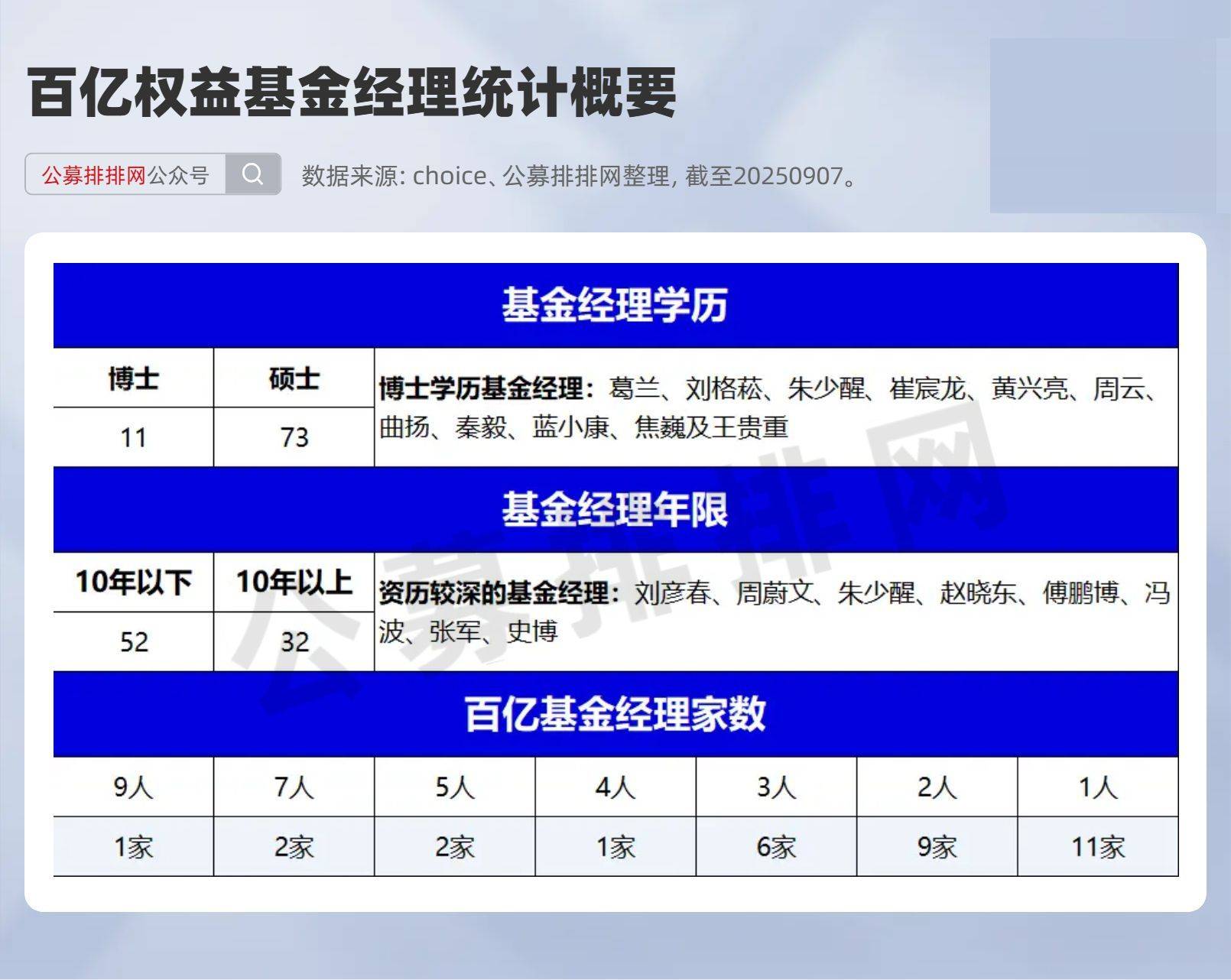
Group 1: Fund Manager Background - All billion active equity fund managers possess a master's degree or higher, with 73 holding a master's and 11 holding a doctorate [1] - The average tenure of billion active equity fund managers is 9.41 years, with notable tenures including Liu Yanchun (16.37 years) and Zhu Shaoxing (19.83 years) [1] - Major fund companies with a significant number of billion active equity fund managers include GF Fund, E Fund, and China Universal Fund, with 9, 7, and 7 managers respectively [1] Group 2: Fund Management Scale Changes - In the first half of 2025, 44 billion active equity fund managers saw an increase in management scale, while 40 experienced a decline due to net value fluctuations and investor redemptions [5] - Notable increases in management scale were observed for Xie Zhiyu (1.71 billion), Chen Hao (0.769 billion), and Liu Xu (6.892 billion), while Liu Yanchun's scale decreased by 6.297 billion [6] - Among the top ten fund managers by total scale, Zhang Kun's management scale is over 50 billion [6][7] Group 3: Investment Focus and Holdings - The top three heavily invested sectors by billion fund managers include electronics, power equipment, and biomedicine, aligning with strong performance in semiconductor electronics and innovative pharmaceuticals [12] - Notable fund managers and their top sectors include Ge Lan (biomedicine, electronics, banking) and Liu Yanchun (food and beverage, biomedicine, agriculture) [12][14] - The top ten holdings among billion fund managers include Tencent Holdings, Ningde Times, and Midea Group, with significant positions in high-quality companies with clear competitive advantages [19][20]





雅化集团(002497) - 002497雅化集团投资者关系管理信息20250909
2025-09-10 10:28
Group 1: Company Overview - Sichuan Yahua Industrial Group is a leading producer of lithium salt products, particularly battery-grade lithium hydroxide, with industry-leading production technology and equipment [1][2] - The company has achieved full automation, intelligent production, and information management in its production lines, enhancing efficiency and product quality [1] - Yahua is recognized as a core supplier for major global automotive and battery manufacturers, establishing a strong market position [2] Group 2: Market Position and Business Development - The company ranks fourth in the Chinese civil explosives industry, with electronic detonator sales leading the industry for several consecutive years [2] - Yahua has developed stable sales channels and maintains good relationships with large end-users, exporting products to countries such as Myanmar, Nepal, Mongolia, and Laos [2] - The company has diversified its lithium resource supply through self-controlled and purchased mines, ensuring a stable resource guarantee [4] Group 3: Customer Structure and Revenue - In the first half of 2025, revenue from top lithium business clients accounted for 91% of total revenue, with significant contributions from both domestic and international clients [3] - Major international clients include TESLA, LGES, and Panasonic, while domestic clients include CATL and Zhonghua [3] Group 4: Industry Trends and Company Strategy - The company is closely monitoring industry supply and demand changes, aiming for sustainable profitability while adjusting lithium salt production based on market conditions [5] - The recent "anti-involution" policy encourages companies to avoid cutthroat competition and focus on collaboration, capacity planning, and green production practices [5] Group 5: Risk Management - In the first half of 2025, the company utilized lithium carbonate futures for hedging against price volatility, aiming to mitigate risks associated with market fluctuations [7]
