降息预期

Search documents
黄金白银,会走到什么位置?
雪球· 2025-10-02 07:57
Core Viewpoint - The article expresses a strong bullish outlook on silver prices, predicting a rise from the current level of 46 to a range of 40-50, with a potential increase of around 10% [3][4]. Group 1: Economic Environment - The expectation of interest rate cuts is a key driver for rising gold and silver prices, influenced by a cooling job market and increasing unemployment rates in the U.S. [5][6]. - The current federal benchmark interest rate is still above the neutral rate, suggesting that a reduction is necessary to stimulate the economy, with anticipated cuts exceeding expectations next year [6]. - Global fiscal expansion and rising debt risks are contributing to a bullish environment for gold, as major economies face increasing government debt and deficit concerns [7][8]. Group 2: Market Dynamics - Speculative funds entering the market are significantly impacting gold prices, with a shift from a drag to a boost in price momentum as market sentiment improves [11][12]. - Predictions indicate that gold prices could reach 4,200 USD/oz by mid-next year, driven by continued demand from central banks and speculative investors [13]. Group 3: Historical Context - The relationship between gold prices and changes in the global monetary system is highlighted, with past transitions leading to significant price increases [14]. - The current challenges to the dollar-based monetary system are prompting a renewed interest in gold as a safe-haven asset [15]. Group 4: Central Bank Actions - Central banks are increasingly purchasing gold, reversing previous trends of reduction, which is expected to support higher gold prices [17][18]. - The trend of de-dollarization is gaining momentum, with central banks viewing gold as a key asset in their reserves [20][21]. Group 5: Geopolitical Factors - Geopolitical tensions, such as supply chain disruptions and sanctions, are driving demand for precious metals, particularly silver, which has both safe-haven and industrial properties [32][33]. Group 6: Silver Market Specifics - Industrial demand for silver is surging, particularly from the photovoltaic sector, which is expected to require over 50,000 tons annually due to increased solar installations [35]. - Supply constraints are evident, with global silver production projected to decline by 1.3% in 2024 due to mine closures and strikes [36]. - Market sentiment is shifting positively, with significant inflows into silver ETFs and increased physical demand, indicating a robust investment environment [37][38].


港股异动 | 黄金股全线走高 中国白银集团(00815)涨超24% 避险情绪及降息预期推高金价
智通财经网· 2025-10-02 02:41
Group 1 - Gold stocks experienced a significant rise, with China Silver Group up 24.53%, Zijin Mining up 14.18%, Lingbao Gold up 8.02%, Tongguan Gold up 6.27%, and Chifeng Jilong Gold up 6.18% [1] - On October 1, international gold prices hit a new record, with London gold approaching $3900 per ounce and COMEX gold also surpassing $3900 per ounce [1] - The U.S. ADP employment report indicated a decrease of 32,000 jobs in the private sector for September 2025, significantly below the expected increase of 50,000 jobs, leading to a 99% probability of a 25 basis point rate cut by the Federal Reserve in October [1] Group 2 - Everbright Securities noted that if the U.S. government shuts down, economic data will cease publication, complicating Federal Reserve decision-making, which may lead to a more gradual rate cut path, favoring gold over U.S. stocks and bonds [2] - Goldman Sachs projected that by mid-2026, international gold prices could soar to $4000 per ounce, potentially reaching $4500 in extreme scenarios [2] - Goldman Sachs also stated that if the independence of the Federal Reserve is compromised and investors shift a small portion of their holdings from U.S. Treasuries to gold bars, gold prices could rise to around $5000 per ounce [2]
贵金属狂欢!金银价格新高之后,投资者如何布局?
Sou Hu Cai Jing· 2025-09-30 10:11
Group 1 - The core viewpoint of the article highlights a significant surge in precious metals, particularly gold and silver, driven by multiple factors including macroeconomic changes and geopolitical tensions [1][2][5] - Gold prices recently surpassed $3897.7 per ounce, while silver reached $47.41 per ounce, with year-to-date increases of 46% and 60% respectively [1][19] - The Federal Reserve's decision to lower interest rates to a target range of 4.00% to 4.25% is expected to continue, with indications of potential further cuts, enhancing the appeal of non-yielding assets like gold and silver [3][4] Group 2 - The rising demand for safe-haven assets is evident as geopolitical uncertainties persist, with recent comments about potential government shutdowns in the U.S. increasing market anxiety [5][6] - Central banks globally, including the People's Bank of China, have been increasing their gold reserves, reflecting a long-term strategy of diversifying away from the U.S. dollar [11][13] - Despite high gold prices, global demand for gold reached 1249 tons in Q2 2025, a 3% year-on-year increase, with significant contributions from gold ETFs and bar/coin investments [19] Group 3 - Silver's price increase is attributed to its dual role as both a financial asset and an industrial metal, benefiting from both declining interest rates and rising industrial demand [21][23] - The gold-silver ratio indicates that silver is currently undervalued compared to gold, suggesting a potential for price correction and increased investment in silver [23][27] - The World Silver Association predicts a record supply-demand gap for silver in 2025, driven by the acceleration of global green energy transitions [26][28] Group 4 - The long-term outlook for precious metals remains positive, supported by ongoing central bank purchases, geopolitical risks, and structural supply-demand dynamics [28][30] - Investment strategies include balanced allocations in precious metals ETFs, aggressive positions in gold mining stocks, and direct investments in gold ETFs to mitigate volatility [31][32][33]
南华金属日报:贵金属维持强势,但建议轻仓过节-20250930
Nan Hua Qi Huo· 2025-09-30 08:39
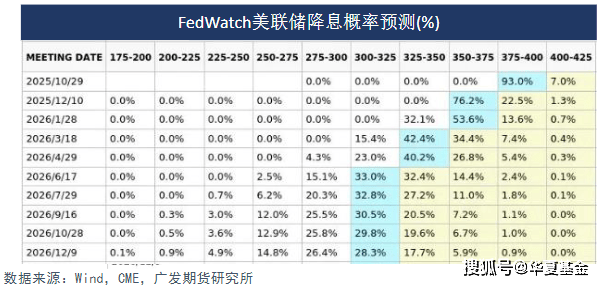
Report Investment Rating - No investment rating for the industry is provided in the report. Core View - The medium to long - term outlook for precious metals is bullish, and in the short - term, the technical form is also strong with potential for further upward movement. London gold has reached above 3800, and its resistance level has shifted up to 4000; London silver's resistance has lifted to 50. However, due to the approaching National Day holiday and the increase in short - term futures positions, it is recommended to hold light long positions during the holiday [2][5]. Summary by Directory Market Review - On Monday, the precious metals sector continued to rise strongly. Gold broke through the 3800 mark and reached a new high, while platinum and silver also hit stage highs, and palladium was close to its July high. The recent rise in precious metals is due to the influx of medium - to - long - term ETF investment demand and short - term futures capital buying, driven by concerns about the Fed's independence, the upcoming interest - rate cut cycle, and the risk of a government shutdown caused by the difficult passage of the US temporary budget bill. The House passed a temporary budget bill on September 19 to maintain government funding until November 21, but the Senate's vote on the same day did not reach the passing threshold. With the approaching National Day holiday and the large previous gains in precious metals, there is an increased risk of a short - term pullback due to profit - taking. COMEX Gold 2512 contract closed at $3862.9 per ounce, up 1.42%; US Silver 2512 contract closed at $47.11 per ounce, up 0.97%. SHFE Gold 2512 main contract closed at 866.52 yuan per gram, up 1.35%; SHFE Silver 2512 contract closed at 10939 yuan per kilogram, up 3.92% [2]. Interest - Rate Cut Expectations and Fund Holdings - Interest - rate cut expectations are cooling. According to CME "FedWatch" data, the probability of the Fed keeping interest rates unchanged in October is 10.2%, and the probability of a 25 - basis - point cut is 89.8%. For December, the probability of keeping rates unchanged is 2.5%, the probability of a cumulative 25 - basis - point cut is 29.9%, and the probability of a cumulative 50 - basis - point cut is 67.6%. In January, the probability of a cumulative 25 - basis - point cut is 16.6%, a cumulative 50 - basis - point cut is 49.2%, and a cumulative 75 - basis - point cut is 32.9%. In terms of long - term funds, SPDR Gold ETF holdings increased by 6.01 tons to 1011.73 tons; iShares Silver ETF holdings increased by 159.51 tons to 15521.35 tons. SHFE silver inventory increased by 31.4 tons to 1189.6 tons, and SGX silver inventory decreased by 35.4 tons to 1217 tons in the week ending September 19 [3]. This Week's Focus - This week's key data includes the non - farm payrolls report on Friday and US ISM PMI during the week. There will also be many speeches by Fed officials. On Tuesday at 18:00, Fed Vice - Chair Jefferson will speak. On Wednesday at 01:00, 2025 FOMC voter and Chicago Fed President Goolsbee will speak; at 07:10, 2026 FOMC voter and Dallas Fed President Logan will speak; at 08:30, Fed Vice - Chair Jefferson will speak. On Thursday at 22:30, 2026 FOMC voter and Dallas Fed President Logan will speak. On Friday at 18:05, FOMC permanent voter and New York Fed President Williams will speak at the farewell symposium of the Dutch central bank governor [4]. Price and Inventory Data - **Precious Metals Futures and Spot Prices**: SHFE Gold main - continuous contract is at 866.52 yuan per gram, up 1.22%; SGX Gold TD is at 862.5 yuan per gram, up 1.13%; CME Gold main contract is at $3862.9 per ounce, up 1.93%; SHFE Silver main - continuous contract is at 10939 yuan per kilogram, up 2.89%; SGX Silver TD is at 10878 yuan per kilogram, up 3.1%; CME Silver main contract is at $47.11 per ounce, up 1.61% [6]. - **Inventory and Holdings**: SHFE gold inventory is 68628 kilograms, up 4.26%; CME gold inventory is 1242.4729 tons, down 0.0003 tons; SHFE gold holdings are 263220 lots, down 0.41%; SPDR gold holdings are 1011.73 tons, up 0.6%; SHFE silver inventory is 1189.648 tons, up 2.71%; CME silver inventory is 16531.0249 tons, up 0.21%; SGX silver inventory is 1216.965 tons, down 2.83%; SHFE silver holdings are 508967 lots, down 6.48%; SLV silver holdings are 15521.351058 tons, up 1.04% [13][16]. - **Stock, Bond, and Commodity Overview**: The US dollar index is at 97.9486, down 0.25%; the US dollar against the Chinese yuan is at 7.1276, up 0.26%; the Dow Jones Industrial Average is at 46316.07 points, up 0.15%; WTI crude oil spot is at $63.45 per barrel, down 3.45%; LmeS copper 03 is at $10428.5 per ton, up 2.19%; the 10 - year US Treasury yield is at 4.15%, down 1.19%; the 10 - year US real interest rate is at 1.8%, down 1.1%; the 10 - 2 - year US Treasury yield spread is at 0.52%, down 8.77% [21].

金价,新纪录!
Jing Ji Wang· 2025-09-30 08:21
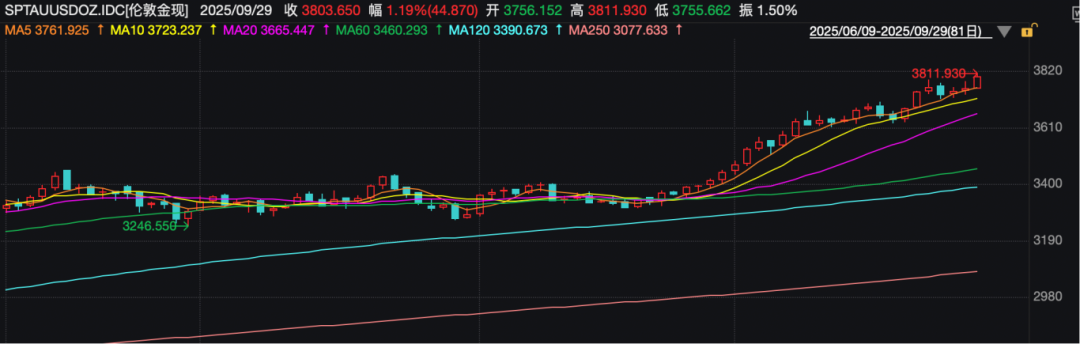
Core Insights - Gold prices have reached a new historical high, with spot gold surpassing $3800 per ounce on September 29, 2023, and trading at approximately $3803.65 per ounce at the time of reporting [1] - The Federal Reserve announced a 25 basis point interest rate cut on September 17, 2023, with indications of further cuts by the end of the year, influencing gold price trends [3] - Major financial institutions, including JPMorgan and UBS, have raised their gold price forecasts, anticipating prices to reach $3800 per ounce by the end of 2025 and potentially exceed $4000 per ounce in early 2026 [4] Group 1: Gold Price Trends - Spot gold reached $3800 per ounce, marking a new record high [1] - COMEX gold also hit a historical peak of $3840.4 per ounce [5] - The upward trend in gold prices has been attributed to financial investment participation, particularly in the ETF market, which has shifted focus from "de-dollarization" to interest rate cuts [3] Group 2: Federal Reserve Impact - The Federal Reserve's recent interest rate cut and future expectations have significantly influenced gold prices, with a high probability of additional cuts in October and December [3] - The Fed's projections for unemployment and inflation have been adjusted, impacting market sentiment towards gold [4] Group 3: Institutional Forecasts - JPMorgan predicts spot gold will reach $3800 per ounce by Q4 2025 and exceed $4000 per ounce in Q1 2026 [4] - UBS has revised its gold price forecast for the end of 2025 to $3800 per ounce, up from $3500, and anticipates prices around $3900 per ounce by mid-2026 [4] - Barclays analysts suggest that gold prices are not overvalued compared to the dollar and U.S. Treasury bonds, indicating a potential premium related to the Fed's actions [4]
广发期货《有色》日报-20250930
Guang Fa Qi Huo· 2025-09-30 05:09
Report Summary of the Metal Industry 1. Industry Investment Rating No investment rating information is provided in the reports. 2. Core Views - **Copper**: The copper price may rise in the short - term due to mine - end disturbances, and the medium - to long - term supply - demand contradiction provides bottom support. The price center may gradually increase. The main price range to watch is 81000 - 81500 yuan/ton [1]. - **Aluminum and Alumina**: Alumina is in a "high - supply, high - inventory, weak - demand" situation. The spot price is expected to be under pressure, with the main contract oscillating between 2850 - 3150 yuan/ton. For aluminum, the macro environment is relatively warm, and the price is supported by peak - season demand and inventory inflection points, with the main contract expected to oscillate between 20600 - 21000 yuan/ton [3]. - **Aluminum Alloy**: The price of ADC12 is expected to maintain a high - level oscillation, with the main contract's operating range between 20200 - 20600 yuan/ton, supported by cost and pre - holiday stocking but restricted by weak demand recovery and inventory accumulation [5]. - **Zinc**: The supply of zinc is in a loose situation, and the price may be driven up in the short - term by the macro environment but lacks upward momentum from the fundamentals. The main price range is 21500 - 22500 yuan/ton [9]. - **Tin**: If the supply in Myanmar recovers smoothly, the tin price may weaken; otherwise, it is expected to maintain a high - level oscillation in the range of 265000 - 285000 yuan/ton [11]. - **Nickel**: The nickel price is expected to oscillate in the range of 120000 - 125000 yuan/ton. The macro situation is stable, and there are more disturbances at the mine end, with cost support, but the medium - term supply is loose [12]. - **Stainless Steel**: The stainless - steel price is expected to oscillate in the range of 12600 - 13200 yuan/ton. The raw material price provides cost support, but the peak - season demand has not been fully realized, and inventory de - stocking is under pressure [14]. - **Lithium Carbonate**: The lithium carbonate price is expected to oscillate and consolidate, with the main price center in the range of 70000 - 75000 yuan/ton, supported by strong peak - season demand [16]. 3. Summary by Catalog Copper - **Price and Basis**: SMM 1 electrolytic copper price dropped to 82210 yuan/ton, a decrease of 0.33%. The SMM 1 electrolytic copper premium remained unchanged at - 5 yuan/ton [1]. - **Monthly Spread**: The spread between 2510 - 2511 contracts increased by 50 yuan/ton [1]. - **Fundamental Data**: In August, the electrolytic copper production was 117.15 million tons, a decrease of 0.24% compared to the previous month, and the import volume was 26.43 million tons, a decrease of 10.99% [1]. Aluminum and Alumina - **Price and Spread**: SMM A00 aluminum price dropped to 20690 yuan/ton, a decrease of 0.39%. The monthly spread between 2510 - 2511 contracts increased by 5 yuan/ton [3]. - **Fundamental Data**: In August, the alumina production was 773.82 million tons, an increase of 1.15% compared to the previous month, and the electrolytic aluminum production was 373.26 million tons, a slight increase [3]. Aluminum Alloy - **Price and Spread**: The price of SMM aluminum alloy ADC12 remained unchanged at 20900 yuan/ton. The monthly spread between 2511 - 2512 contracts increased by 15 yuan/ton [5]. - **Fundamental Data**: In August, the production of recycled aluminum alloy ingots was 61.50 million tons, a decrease of 1.60% compared to the previous month [5]. Zinc - **Price and Spread**: SMM 0 zinc ingot price dropped to 21630 yuan/ton, a decrease of 1.46%. The monthly spread between 2510 - 2511 contracts decreased by 15 yuan/ton [9]. - **Fundamental Data**: In August, the refined zinc production was 62.62 million tons, an increase of 3.88% compared to the previous month, and the import volume was 2.57 million tons, an increase of 43.30% [9]. Tin - **Spot Price and Basis**: SMM 1 tin price dropped to 271400 yuan/ton, a decrease of 0.84%. The LME 0 - 3 premium remained unchanged at - 50 dollars/ton [11]. - **Fundamental Data (Monthly)**: In August, the tin ore import was 10267 tons, a decrease of 0.11% compared to the previous month, and the SMM refined tin production was 15390 tons, a decrease of 3.45% [11]. Nickel - **Price and Basis**: SMM 1 electrolytic nickel price dropped to 122000 yuan/ton, a decrease of 0.37%. The LME 0 - 3 decreased to - 187 dollars/ton [12]. - **Supply and Inventory**: China's refined nickel production in August was 32200 tons, an increase of 1.26% compared to the previous month, and the import volume was 17536 tons, a decrease of 8.46% [12]. Stainless Steel - **Price and Basis**: The price of 304/2B (Wuxi Hongwang 2.0 roll) dropped to 13050 yuan/ton, a decrease of 0.38%. The monthly spread between 2511 - 2512 contracts increased by 15 yuan/ton [14]. - **Fundamental Data**: In August, the production of 300 - series stainless - steel crude steel in China was 171.33 million tons, a decrease of 3.83% compared to the previous month [14]. Lithium Carbonate - **Price and Basis**: SMM battery - grade lithium carbonate average price dropped to 73550 yuan/ton, a decrease of 0.07%. The monthly spread between 2510 - 2511 contracts increased by 100 yuan/ton [16]. - **Fundamental Data**: In August, the lithium carbonate production was 85240 tons, an increase of 4.55% compared to the previous month, and the demand was 104023 tons, an increase of 8.25% [16].
贵金属数据日报-20250930
Guo Mao Qi Huo· 2025-09-30 03:04
Group 1: Report Industry Investment Rating - No information provided Group 2: Core Viewpoints of the Report - On September 29, the main contract of Shanghai gold futures closed up 1.35% to 866.52 yuan/gram, and the main contract of Shanghai silver futures closed up 3.92% to 10,939 yuan/kilogram [5]. - Recently, geopolitical tensions in Russia and the Middle East, and the possible shutdown of the US government have boosted risk - aversion sentiment, pushing up precious metal prices. The continuous expectation of interest rate cuts also supports precious metal prices. For silver, the good performance of US economic data strengthens the expectation of a soft landing of the US economy after preventive interest rate cuts, which is beneficial to the industrial attribute of silver, leading to an accelerated rise in silver prices [5]. - In the long - term, the Fed still has room to cut interest rates this year, global geopolitical uncertainties continue, the US debt is unsustainable, and great - power games intensify, which will increase the credit risk of the US dollar in the long - term. The continuation of global central bank gold purchases will likely push the long - term center of gold prices higher [5]. - In the short - term, with the approaching of China's National Day holiday, investors are advised to be cautious about chasing up and hold light positions during the holiday, while enterprises are advised to do a good job in hedging to avoid possible sharp fluctuations during the holiday [5]. Group 3: Summary by Relevant Catalogs Price Tracking - **Precious Metal Prices**: On September 29, compared with September 26, London gold spot rose 2.0% to 3816.09 dollars/ounce, London silver spot rose 3.9% to 46.93 dollars/ounce, COMEX gold rose 1.9% to 3845.50 dollars/ounce, COMEX silver rose 3.7% to 47.12 dollars/ounce, AU2510 rose 1.3% to 863.60 yuan/gram, AG2510 rose 3.0% to 10912.00 yuan/kilogram, AU (T + D) rose 1.2% to 861.90 yuan/gram, and AG (T + D) rose 2.9% to 10880.00 yuan/kilogram [3]. - **Price Spreads and Ratios**: On September 29, compared with September 26, the gold TD - SHFE active spread was - 1.7 yuan/gram (up 193.1%), the silver TD - SHFE active spread was - 32 yuan/kilogram (up 68.4%), the gold (TD - London) spread was - 10.29 yuan/gram (up 148.4%), the silver (TD - London) spread was - 1098 yuan/kilogram (up 13.1%), the SHFE gold - silver main ratio was 79.14 (down 1.7%), the COMEX main ratio was 81.61 (down 1.7%), AU2512 - 2510 was 2.92 yuan/gram (down 16.1%), and AG2512 - 2510 was 27 yuan/kilogram (down 28.9%) [3]. Position Data - **ETF and Non - commercial Positions**: From September 25 to September 26, the gold ETF - SPDR rose 0.89% to 1005.72 tons, the silver ETF - SLV fell 0.18% to 15361.84024 tons. For COMEX gold non - commercial positions, the long positions rose 1.85% to 332808 contracts, the short positions rose 9.43% to 66059 contracts, and the net long positions rose 0.13% to 266749 contracts. For COMEX silver non - commercial positions, the long positions rose 0.97% to 72318 contracts, the short positions fell 0.21% to 20042 contracts, and the net long positions rose 1.43% to 52276 contracts [3]. Inventory Data - **SHFE and COMEX Inventories**: From September 26 to September 29, SHFE gold inventory rose 4.26% to 68628.00 kilograms, and SHFE silver inventory rose 2.71% to 1189648.00 kilograms. From September 25 to September 26, COMEX gold inventory rose 0.06% to 39946410 troy ounces, and COMEX silver inventory rose 0.08% to 530344533 troy ounces [3]. Other Related Data - **Dollar Index, Bond Yields, etc.**: From September 26 to September 29, the dollar index fell 0.09% to 98.19, the 2 - year US Treasury yield fell 0.27% to 3.63%, the 10 - year US Treasury yield fell 0.27% to 4.20%, NYMEX crude oil rose 0.48% to 6643.70, the dollar/yuan central parity rate fell 8.66% to 7.11, VIX fell 0.05% to 15.29, and the S&P 500 rose 0.59% to 65.19 [4].
晨会纪要——2025年第168期-20250930
Guohai Securities· 2025-09-30 01:35
Group 1 - The report addresses how to quantify current market implied interest rate cut expectations through interest rate swap pricing and floating rate bond spread analysis, aiming to fill gaps in traditional liquidity analysis [3] - The analysis identifies four stages of interest rate cut expectations evolution since 2024, indicating a significant reversal in market expectations compared to the beginning of the year [4] - Current market pricing does not reflect further easing potential and may even imply a marginal tightening of policy, suggesting that if a rate cut signal is released in Q4, it could create a significant positive impact on the bond market due to the existing low market consensus [4] Group 2 - The report highlights three marginal changes in institutional behavior following the breach of interest rates, indicating a shift in market dynamics [6] - Fund managers have significantly reduced their duration, with the median duration of long-term bond funds dropping to 2.8 years, and net purchases of ultra-long government bonds turning negative since early September [7] - Banks have been actively buying 10-year government bonds, acting as a buffer during the recent bond market correction, while the trading volume of certain bonds has shown a rapid adjustment [8]
美股波动加剧 QDII基金折溢价略有回升
Xin Lang Cai Jing· 2025-09-30 00:47
Core Viewpoint - The U.S. stock market experienced significant volatility last week, closing lower amid mixed signals from the Federal Reserve regarding interest rate expectations, with the S&P 500 index down 0.31% and the Nasdaq Composite down 0.65% [1] Group 1: Market Performance - The comments from Federal Reserve Chairman Jerome Powell regarding high stock valuations were interpreted as a warning against current market overheating, putting pressure on liquidity-dependent tech stocks [1] - The core Personal Consumption Expenditures (PCE) price index for August rose 0.2% month-over-month, aligning with market expectations and alleviating some market sentiment on Friday [1] - Despite high valuations, the market remains optimistic about potential interest rate cuts in October and December, suggesting continued expectations for accommodative policies from the Federal Reserve [1] Group 2: QDII Fund Dynamics - The overall premium level of QDII funds slightly rebounded last week, particularly notable in U.S. broad-based funds, which averaged a 1.68% increase, indicating renewed investor interest in these assets [1] - Several QDII funds, especially those focused on U.S. stocks, have seen adjustments in daily subscription limits, which may impact investor strategies and market liquidity [2] - The performance of various QDII funds will be influenced by macroeconomic data and Federal Reserve policy movements, with a focus on inflation pressures and employment data changes [2]
金价再创新高,2025年9月26日最新黄金报价,各大金店价格对比
Sou Hu Cai Jing· 2025-09-29 21:19
Core Insights - Gold prices have surged to 1108 CNY per gram, creating a significant price disparity among different retailers, with some stores like Shanghai China Gold still displaying prices as low as 1011 CNY per gram, leading to market tensions [1][2] - The international gold market has shown fluctuations, with spot gold reaching a high of 3761.38 USD per ounce and closing at 3748.13 USD, reflecting a slight increase of 0.32% [2] - The market is currently influenced by various factors, including U.S. economic indicators and geopolitical tensions, which are affecting investor sentiment and gold price movements [2][4] Price Dynamics - Retail gold prices are not uniform, with significant differences observed among various stores, indicating a competitive market where consumers are encouraged to compare prices [1][3] - The recovery prices for gold are also varied, with differences of over 10 CNY per gram among retailers, suggesting a potential for arbitrage opportunities for consumers [3][4] - The cost of gold jewelry includes additional processing fees, which can vary significantly based on the design and retailer, impacting the overall purchase price for consumers [4][5] Market Sentiment - Consumer behavior is influenced by current market conditions, with some buyers expressing a desire to purchase gold for personal reasons rather than as an investment or hedge [3] - There is a cautious sentiment among consumers regarding price fluctuations, with some opting to wait for more favorable conditions before making purchases [4][5] - The market is characterized by a mix of urgency and caution, as consumers navigate the volatility of gold prices while considering their personal financial situations [4][5]