
滞胀风险

Search documents
招商宏观:美联储对滞胀风险的前瞻判断是迟迟不肯降息的原因
news flash· 2025-06-18 23:25
招商宏观研报称,总体来看,本次会议增量信息较少,会议声明和演讲稿绝大多数措辞延续5月的内 容,答记者问鲍威尔多次暗示美联储将在通胀充分反映关税后再做决策,结合SEP下调增长预期、上调 通胀和失业率预期,美联储对滞胀风险的前瞻判断是迟迟不肯降息的原因。由于点阵图仍给出年内两次 降息预期,但美联储内部分歧较大。往后看,中东局势和关税同时升级的概率不高,若中东局势继续升 级推高油价带动非核心通胀上升,则关税政策将进一步缓和且缓解核心通胀压力,年内降息确属大概 率,变数在于降息次数是否符合两次的预期。 ...
黄金大顶将至?花旗拉响警报:年底恐开启20%下跌周期!
华尔街见闻· 2025-06-17 11:01
Group 1: Gold Market Outlook - The core view is that gold prices are expected to decline below $3000 per ounce in the coming quarters, marking the end of the current record rally [1][2] - Citigroup analysts predict that gold prices will peak between $3100 and $3500 per ounce in Q3 of this year, before gradually falling to a range of $2500 to $2700 per ounce by the second half of 2026, representing a decline of approximately 20-25% from current forward prices [2] - The report outlines three scenarios for gold price movements: a base case (60% probability) where prices remain above $3000 per ounce for the next quarter before declining, a bullish case (20% probability) where geopolitical tensions and inflation risks push prices to new highs, and a bearish case (20% probability) where resolution of tariff issues leads to a sharp price drop [4] Group 2: Factors Influencing Gold Prices - Short-term, gold is expected to maintain high prices in Q3 due to strong investment demand [5] - The rise in gold prices is primarily driven by concerns over tariffs, Federal Reserve policies, and geopolitical risks, rather than central bank purchases; resilient jewelry consumption also supports prices [6] - Global gold expenditure as a percentage of GDP has reached 0.5%, the highest level in the past fifty years, indicating strong investor preference for gold as a safe-haven asset [7] Group 3: Future Economic Conditions - In Q4, global growth confidence may improve slightly, particularly with the implementation of U.S. stimulus budgets, which could reduce safe-haven sentiment; a potential shift towards more moderate trade policies under Trump may also decrease market uncertainty [9] - Expectations of a shift from tightening to a neutral stance by the Federal Reserve could further diminish gold's appeal as a non-yielding asset [9] - Historical data over the past 55 years shows that when investment demand declines, gold prices tend to fall, as price adjustments lead to reduced jewelry consumption and encourage inventory holders to sell [10] Group 4: Industrial Metals Outlook - In contrast to gold, Citigroup maintains a structurally bullish outlook on industrial metals despite short-term pressures from tariffs and weak demand [11] - The aluminum market is particularly favored, with the report highlighting aluminum as a "future-facing" metal, constrained on the supply side by energy intensity and driven on the demand side by strong growth in AI data centers, humanoid robots, and decarbonization processes [12][13] - Citigroup forecasts a supply shortage in aluminum over the next five years at current price levels, necessitating prices to rise above $3000 per ton to incentivize sufficient supply growth [14]



策略师:美联储对经济预测与点阵图的修正成为关键
news flash· 2025-06-17 07:22
Core Viewpoint - The key issue for the Federal Reserve's upcoming meeting is the revision of economic forecasts and the dot plot, reflecting a slowdown in growth and persistent inflation despite recent surprising developments and a weakening labor market [1] Economic Predictions - Adjustments in economic policy expectations should indicate a slowdown in growth and that inflation is more persistent than previously anticipated [1] Labor Market - The labor market is showing signs of weakness, which may influence the Federal Reserve's cautious stance [1] Monetary Policy - In the context of stagflation risks and high uncertainty, the Federal Reserve is likely to reaffirm its cautious position [1] Interest Rates - The strategy anticipates that the Federal Reserve will maintain the key interest rate unchanged during the upcoming meeting, as long as hard data does not clearly justify easing policies [1]
海外经济政策跟踪:美国:通胀预期回落,消费者信心回升
Haitong Securities International· 2025-06-17 05:23
Economic Overview - The geopolitical tensions in the Middle East have led to a significant increase in commodity prices, with IPE crude oil futures rising by 12.8%, the S&P-Goldman Commodity Index increasing by 4.9%, and London gold prices up by 3.7%[7] - The U.S. stock market saw a decline of 0.4%, while the Hang Seng Index and Nikkei 225 rose by 0.4% and 0.2%, respectively[7] - The 10-year U.S. Treasury yield fell by 10 basis points to 4.41%[7] Inflation and Consumer Confidence - In May, the U.S. CPI year-on-year increased to 2.4%, slightly above the previous value of 2.3% but below market expectations of 2.4%[8] - The core CPI remained steady at 2.8%, while the month-on-month CPI rose by 0.1%, lower than the expected 0.2%[8] - The Sentix investor confidence index for June improved significantly by 12.5 points to -5.4, indicating a marginal recovery in investor sentiment[10] - The University of Michigan's consumer confidence index for June rebounded to 60.5, significantly exceeding the market expectation of 53.6[13] Inflation Expectations - Short-term inflation expectations have notably decreased, with the 5-year inflation expectation dropping by 4 basis points to 2.31% and the 10-year expectation falling by 3 basis points to 2.28%[15] Policy Outlook - Following the May inflation data, former President Trump called for the Federal Reserve to lower interest rates, emphasizing the need to reduce debt costs[23] - The European Central Bank (ECB) officials indicated that future rate cuts would depend on economic data, with the potential for further cuts in 2025[24] Risk Factors - There are risks associated with unexpected adjustments in overseas monetary policies and uncertainties surrounding tariff policies[25]
国际金价重回3450美元一线,机构投资者如何看待后期走势?
Huan Qiu Wang· 2025-06-14 00:44
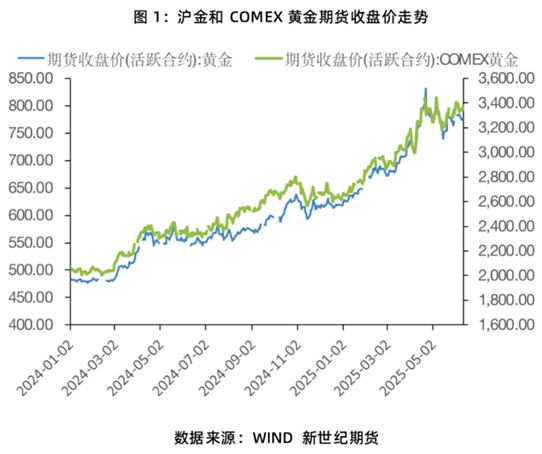
Group 1 - International precious metals futures generally rose, with COMEX gold futures up 1.48% to $3452.60 per ounce, and a weekly increase of 3.17% [1] - COMEX silver futures increased by 0.21% to $36.37 per ounce, with a weekly rise of 0.64% [1] - Analysts noted that escalating geopolitical tensions have heightened market risk aversion, supporting the safe-haven status of precious metals [1] Group 2 - Huishang Futures indicated that the safe-haven attribute of gold will limit its downside potential, predicting continued high-level fluctuations in gold prices [1] - The resilience of the U.S. economy may provide some support for silver's industrial demand, with potential for further correction in the gold-silver ratio [1] - Long-term factors such as stagflation risks, rising dollar credit risks, and central bank gold purchases are expected to provide core support for gold [1] Group 3 - New Century Futures reported that as of June 11, SPDR Gold ETF saw an outflow of 1.45 tons, indicating a bearish sentiment among institutional investors [4] - As of June 3, CFTC's non-commercial net long positions in gold increased by 13,721 contracts to 187,905 contracts, reflecting a bullish sentiment among speculators [4] Group 4 - Industrial Futures stated that the long-term outlook remains favorable for gold prices, maintaining a judgment of upward movement in the gold price's mid-term center [6] - The World Gold Council reported that in May, global physical gold ETFs experienced an outflow of approximately $1.8 billion, ending a five-month streak of net inflows [6] - The total assets under management for global gold ETFs fell to $374 billion by the end of May due to price volatility [6]
中东紧张局势陡然升温
Dong Zheng Qi Huo· 2025-06-13 00:41
1. Report Industry Investment Ratings No relevant content provided. 2. Core Views of the Report - Geopolitical risks in the Middle East are rising rapidly, with Trump indicating that Israel may attack Iran, which will lead to a short - term weakening of the US dollar index and a strong rise in gold prices [2][3][16][20]. - The US economic data shows signs of weakness, such as the initial jobless claims and May PPI being weaker than expected, which affects the performance of various financial and commodity markets [15][16][23][24]. - Different commodity markets have different trends. For example, the soybean meal in the agricultural product market is relatively strong but is expected to fluctuate around 3000; the sugar market is expected to be weak due to the expected increase in Brazilian sugar production; the coal price in the black metal market may experience a second dip; and the silicon material market in the non - ferrous metal market is facing price decline risks [30][36][39][50]. 3. Summary by Directory 3.1 Financial News and Comments 3.1.1 Macro Strategy (Gold) - Trump said that Israel's attack on Iran is "very likely", and the US economic data is weak. The initial jobless claims and May PPI are weaker than expected. Gold prices are expected to be strong with increased volatility [14][15][16]. 3.1.2 Macro Strategy (Foreign Exchange Futures - US Dollar Index) - Trump's statement that Israel may attack Iran accelerates the rise of geopolitical risks, and the US dollar index is expected to continue to weaken in the short term [19][20]. 3.1.3 Macro Strategy (US Stock Index Futures) - The US imposes tariffs on steel - made household appliances, and the unemployment benefit application data is weak. The US stock market is still in a volatile situation, and it is not recommended to chase high [22][23][25]. 3.1.4 Macro Strategy (Treasury Bond Futures) - The central bank conducts 1193 billion yuan of 7 - day reverse repurchase operations. The long - term bonds lack the driving force to break through directly. The market is expected to be volatile in the near future, and investors should seize the opportunity to buy on dips [26][27]. 3.2 Commodity News and Comments 3.2.1 Agricultural Products (Soybean Meal) - CONAB and the Buenos Aires Grain Exchange raise the soybean production forecasts of Brazil and Argentina respectively. The domestic soybean meal is stronger than the external market but is expected to fluctuate around 3000 [28][29][30]. 3.2.2 Agricultural Products (Soybean Oil/Rapeseed Oil/Palm Oil) - The Trump administration is expected to propose a biodiesel quota lower than 5.25 billion gallons. Investors holding long positions are advised to exit [31][33]. 3.2.3 Agricultural Products (Sugar) - The market expects an increase in sugar production in the central - southern region of Brazil in the second half of May. The domestic sugar market is expected to be weak, and the Zhengzhou sugar futures are expected to be weak with fluctuations [36][37]. 3.2.4 Black Metals (Steam Coal) - The steam coal price in the northern port market is temporarily stable, but it may experience a second dip due to factors such as weak power consumption demand [38][39]. 3.2.5 Black Metals (Iron Ore) - Roy Hill and Atlas Iron plan to merge. The iron ore price is expected to decline slightly with the weakening of terminal demand, but the decline will be gentle [40]. 3.2.6 Agricultural Products (Pigs) - The short - to medium - term pig price may be pessimistic, but the supply pressure may ease in the third to fourth quarter. It is recommended to wait and see [42][43]. 3.2.7 Black Metals (Rebar/Hot - Rolled Coil) - The inventory of five major steel products has decreased, but the performance of building materials and coils is differentiated. The steel price is expected to be weak with fluctuations [44]. 3.2.8 Agricultural Products (Corn Starch) - The consumption of corn by deep - processing enterprises has decreased, and the supply - demand situation may gradually improve. The CS07 - C07 is expected to be in low - level fluctuation [46]. 3.2.9 Agricultural Products (Corn) - The corn inventory of major processing enterprises has decreased, and the corn inventory is tightening. The 09 contract is expected to be strong first and then weak, with fluctuations [47][48]. 3.2.10 Non - Ferrous Metals (Polysilicon) - The price of N - type silicon wafers has slightly decreased. The spot market is bearish in the short term, but the price decline may stimulate silicon material manufacturers to cut production. A short - term short and long - term long strategy is considered [49][50][51]. 3.2.11 Non - Ferrous Metals (Industrial Silicon) - Some silicon plants in Sichuan have resumed production, and the demand is still weak. The disk price is expected to be in low - level fluctuation, and shorting on rebounds can be considered [53]. 3.2.12 Non - Ferrous Metals (Nickel) - The LME nickel inventory has increased. The short - term fundamental support exists, and it is recommended to wait and see. Options can be used to replace futures positions, and shorting on rebounds can be considered in the medium term [54][55]. 3.2.13 Non - Ferrous Metals (Lithium Carbonate) - The inventory pressure in June has been significantly relieved. It is recommended to pay attention to shorting opportunities on rebounds [58]. 3.2.14 Non - Ferrous Metals (Lead) - The lead price has oscillated upwards, and the supply is expected to decrease. It is recommended to wait and see in the short term and pay attention to medium - term long - buying opportunities [59][60]. 3.2.15 Non - Ferrous Metals (Zinc) - The zinc price has fluctuated widely, and the supply - demand pattern is expected to be strong in supply and weak in demand. It is recommended to short on rebounds and pay attention to the arrival situation in Shanghai [63][64]. 3.2.16 Energy Chemicals (Liquefied Petroleum Gas) - The domestic LPG commodity volume has increased, and the inventory has decreased. The spot price has limited upward momentum, and the disk is expected to be weak with fluctuations [66][67]. 3.2.17 Energy Chemicals (Carbon Emissions) - The National Energy Administration organizes hydrogen energy pilot projects. The CEA is expected to be volatile in the short term [68][70]. 3.2.18 Energy Chemicals (Natural Gas) - The US natural gas inventory has increased. It is recommended to wait and see [71][72]. 3.2.19 Energy Chemicals (PTA) - The demand for PTA is in the off - season, and the supply has increased. The short - term price faces pressure, and long - term long positions can be considered on dips [73][74]. 3.2.20 Energy Chemicals (Caustic Soda) - The price of caustic soda in Shandong is stable. The 09 contract of caustic soda is affected by the overall weakness of commodities, but the large discount on the disk will limit the downward space [75][77]. 3.2.21 Energy Chemicals (Pulp) - The price of imported wood pulp has continued to decline. The disk is expected to be volatile [78][79]. 3.2.22 Energy Chemicals (PVC) - The spot price of PVC has slightly increased, and the disk is expected to be volatile [80][81]. 3.2.23 Energy Chemicals (Urea) - The pre - sales of urea production enterprises have decreased. The urea price is expected to be weak in the long term, and attention can be paid to the possibility of policy relaxation [80][82]. 3.2.24 Energy Chemicals (Bottle Chips) - The supply pressure of bottle chips is large, and the processing fee is under pressure. It is recommended to build long positions on dips to expand the processing fee [85]. 3.2.25 Energy Chemicals (Soda Ash) - The soda ash price has declined significantly, and the market is in weak and stable adjustment. It is recommended to short on rebounds in the medium term [86]. 3.2.26 Energy Chemicals (Float Glass) - The float glass price has slightly decreased. The demand will decline seasonally, and the price is expected to be weak [87][88].
【百利好指数专题】降息概率再降 美股加剧动荡
Sou Hu Cai Jing· 2025-06-12 02:16
Group 1 - The U.S. stock market experienced significant volatility due to Trump's tariff policies, entering a technical bear market in early April, but has since rebounded strongly, with all three major indices recovering losses and the Nasdaq approaching historical highs [1] - The S&P 500 recorded its best monthly performance of 2023, indicating a strong recovery despite ongoing trade tensions and tariff policy uncertainties [1] Group 2 - The U.S. CPI annual rate fell to 2.3%, the lowest in recent years, showing a continued decline in inflation, yet concerns about consumer confidence and policy uncertainty have led to warnings from several Federal Reserve officials about potential inflation and unemployment risks [3] - The U.S. GDP recorded negative growth in Q1, marking the worst performance since October 2022, raising concerns about stagflation, which poses greater risks than a simple recession [3] - The "Big and Beautiful Act" promoted by Trump is projected to reduce tax revenue by approximately $3.75 trillion over the next decade and increase the fiscal deficit by $2.4 trillion, leading to a downgrade of the U.S. sovereign credit rating by Moody's [3] Group 3 - There is a significant divide within the Federal Reserve regarding policy direction, with dovish members viewing tariff impacts as temporary and advocating for a wait-and-see approach, while hawkish members emphasize the uncertainty of trade negotiations and advocate for maintaining stable interest rates [4] - The likelihood of interest rate cuts has been pushed back, with low probabilities for cuts in June, and potential cuts not expected until July or September, which may limit further gains in the stock market [4] - The stock market has shown signs of high-level consolidation, with the Dow Jones facing resistance around the 43,400 level [4]

研究所晨会观点精萃-20250611
Dong Hai Qi Huo· 2025-06-11 02:19
1. Report Industry Investment Rating No relevant content provided. 2. Core Views of the Report - Global risk preference is on the rise due to the positive progress of US trade negotiations, with the US showing good progress in tariff negotiations, such as the potential for an interim trade agreement between India and the US by the end of the month and the near - agreement on steel import tariffs between the US and Mexico. In China, May's export was slightly lower than expected, but the trade surplus was higher than expected, which boosts domestic risk preference in the short term [3]. - Different asset classes have different short - term trends: stocks are expected to be volatile in the short term, with a cautious long - position strategy; bonds are at a high level and volatile, suggesting cautious observation; commodities show different trends in sub - sectors [3]. 3. Summary by Relevant Catalogs Macro - finance - **Global and Domestic Market Conditions**: Overseas, US tariff negotiations are going well, which boosts global risk preference. In China, May's export was slightly lower than expected, but the trade surplus was higher than expected, strengthening the short - term economic pull of net exports and boosting domestic risk preference. The ongoing Sino - US economic and trade consultations may affect the market in the short term, increasing market volatility [3]. - **Asset Performance and Strategies**: Stocks are expected to be volatile in the short term, with a cautious long - position strategy; bonds are at a high level and volatile, suggesting cautious observation; in the commodity sector, black commodities are rebounding from a low level, suggesting cautious observation; non - ferrous metals are oscillating and rebounding, suggesting cautious long - positions; energy and chemical products are oscillating and rebounding, suggesting long - positions; precious metals are at a high level and volatile, suggesting long - positions [3]. Stock Index - **Market Performance**: Domestic stocks continued to decline slightly, dragged down by sectors such as semiconductors, artificial intelligence, and military industry. - **Fundamentals and Influencing Factors**: China's May export was slightly lower than expected, but the trade surplus was higher than expected, which helps boost domestic risk preference in the short term. The ongoing Sino - US economic and trade consultations may affect the market in the short term, increasing market volatility. The market's trading logic focuses on US trade policy changes and trade negotiation progress. - **Operation Strategy**: Short - term cautious long - positions [4]. Precious Metals - **Market Performance**: Gold prices fell slightly, with Shanghai gold dropping to 774 yuan/gram and Shanghai silver remaining at a high level of 8889 yuan. - **Influencing Factors**: Trade improvement boosts risk preference. Investors are waiting for more information on Sino - US consultations and focusing on the upcoming consumer price index data to judge the Fed's policy path. There are stagflation risks, and the Sino - US economic and trade consultation eases the trade situation, but negotiations between the US and other countries are ongoing. - **Operation Strategy**: Silver has a demand for technical breakthrough and catch - up growth, and the gold - silver ratio may be repaired. Gold is expected to remain at a high level and volatile. A callback - buying strategy is recommended, and attention should be paid to long - term layout opportunities after a phased callback [5]. Energy and Chemicals Crude Oil - **Market Performance**: Oil prices fell slightly as the market awaited the results of Sino - US trade talks. - **Influencing Factors**: The US Commerce Secretary said the talks were fruitful, but no agreement was announced. Some Canadian oil sands production affected by wildfires is resuming, and API data shows concerns about recent demand due to large increases in refined oil inventories despite a slight decrease in crude oil inventories. - **Trend Outlook**: Oil prices will continue to fluctuate in the near future [6][7]. Asphalt - **Market Performance**: Oil prices fell slightly, and asphalt prices remained at a high level and volatile. - **Influencing Factors**: Demand has recovered to some extent, but the recovery is limited. The basis in major consumption areas has declined significantly, and the market structure has weakened following the spot market. After profit recovery, production has increased, and inventory depletion has stagnated. - **Trend Outlook**: In the short term, it will continue to fluctuate at a high level following crude oil [7]. PX - **Market Performance**: PX prices are in a weak and volatile short - term pattern, with the external market price dropping to 817 US dollars and the PXN spread dropping to 257 US dollars. - **Influencing Factors**: PTA's recent increase in production has led to higher future demand for PX, and there are still many domestic maintenance plans from June to July, so the supply is expected to be tight. However, the recent decline in PTA prices has led to a decline in the external PX market. - **Trend Outlook**: It will maintain a weak and volatile pattern in the short term [7]. PTA - **Market Performance**: PTA's basis remains high, and the monthly spread has declined slightly. There is a high probability of a slight inventory accumulation pattern starting in June, and after the June contract delivery, the tight supply in the circulation link may ease, and both the structure and price may decline. - **Influencing Factors**: In recent days, the polyester market's logic is mainly related to the cost side, with a high degree of resonance with crude oil and limited self - driving factors. - **Trend Outlook**: It will mainly maintain a weak and volatile pattern [7]. Ethylene Glycol - **Market Performance**: The visible inventory of ethylene glycol remains above 650,000 tons, and inventory depletion is limited. - **Influencing Factors**: There are still many expectations for the return of syngas plants, and the supply side is putting pressure on the market. Downstream production has decreased due to production cuts, and the inventory depletion rate may decrease marginally. - **Trend Outlook**: It may maintain a volatile pattern in the near future [8]. Short - fiber - **Market Performance**: Short - fiber prices are in a weak and volatile pattern. - **Influencing Factors**: The recovery of terminal orders is significantly slower than expected, and short - fiber prices have weakened. Downstream production is expected to decrease in the short term, and short - term orders are still weak, leading to an increase in inventory. - **Trend Outlook**: It will continue to be weak and volatile in the short term [8]. Methanol - **Market Performance**: The port methanol market price is oscillating and rising, and the basis has increased. The inland and port inventories are rising simultaneously. - **Influencing Factors**: Due to the "ship age limit" event, the expected import volume is decreasing, and the port inventory accumulation process is expected to slow down. Inland plant production is gradually increasing, and the supply is abundant, while the downstream demand is generally good. - **Trend Outlook**: It is expected to oscillate and repair in the short term, but the price may decline in the long term [9]. PP - **Market Performance**: The domestic PP market is oscillating narrowly, and the futures price has slightly recovered with other energy - chemical products, but the space is limited. - **Influencing Factors**: PP production is increasing both year - on - year and month - on - month, with new production capacity being put into operation. Downstream production has slightly decreased, and inventory has increased significantly after the holiday, with high finished - product inventory, and the fundamentals are deteriorating. - **Trend Outlook**: The price will be under pressure and move downward in the long term [10]. LLDPE - **Market Performance**: The polyethylene market price has been adjusted, with prices rising in different regions. - **Influencing Factors**: The import windows for some LD and HD varieties are open, but there are not many import offers. The proportion of linear film production is the highest, and plant production is gradually resuming, while downstream production has slightly decreased, and inventory has increased to a neutral level. The expected new production capacity is suppressing prices. - **Trend Outlook**: The rebound space is limited, and attention should be paid to medium - and long - term short - selling opportunities [11][12]. Non - ferrous Metals Copper - **Market Performance**: The market is waiting for the results of Sino - US negotiations in London, and copper prices are expected to be volatile in the short term. - **Influencing Factors**: The copper ore supply is relatively tight, the copper concentrate TC has slightly increased, and the port inventory of copper concentrate is at a high level. Electrolytic copper production is at a high level, and there is no strong motivation for production cuts. The peak demand season is approaching its end, and there are risks of a marginal decline in demand. - **Trend Outlook**: It will be volatile in the short term [13]. Aluminum - **Market Performance**: Aluminum ingot inventories have continued to decline significantly, but the market's expectations are weak. - **Influencing Factors**: The subsidy funds for home appliances in Zhengzhou have been used up, and the demand side may weaken marginally under the high - supply background, and inventory depletion may slow down or even turn into inventory accumulation. - **Trend Outlook**: No clear short - term trend is mentioned, but there are concerns about future inventory changes [13]. Tin - **Market Performance**: Tin prices have rebounded, and there is potential for further short - term price repair. - **Influencing Factors**: The domestic tin ore supply is tight, processing fees have decreased, and the combined operating rate in Yunnan and Jiangxi has declined. The resumption of production in Myanmar's Wa State may be delayed, and Thailand has suspended tin ore transportation from Myanmar. The demand side has mixed trends, with some products maintaining high growth and others weakening, and it is entering the seasonal off - season. - **Trend Outlook**: The price may continue to repair in the short term, but the upside space is limited due to high - tariff risks, resumption of production expectations, and marginal demand decline [14]. Agricultural Products US Soybeans - **Market Performance**: The overnight CBOT 11 - month soybean contract closed at 1031.25, up 0.50 or 0.05%. - **Influencing Factors**: The weather conditions in US soybean - producing areas are good, the sowing progress is fast, and the production situation is stable for now. In South America, Brazil's soybean premium is still strong, and Argentina's soybean harvest is 91%, with the production volume adjusted down to 48.5 million tons. The USDA's June supply - demand report may have a neutral impact on the market, and the focus is on the end - of - month US soybean planting area forecast report. - **Trend Outlook**: The market expects an increase in US soybean planting area compared to previous expectations [15]. Soybean and Rapeseed Meal - **Market Performance**: The national dynamic full - sample oil mill operating rate increased by 1.49% to 65.03% compared to the previous day. - **Influencing Factors**: The soybean meal basis is low, and inventory repair is ongoing. The lack of upward momentum in US soybeans also means that soybean meal lacks stable upward support. For rapeseed meal, the inventory depletion in ports is slow, the Sino - Canadian trade relationship is expected to improve, and downstream demand is cautious due to the higher cost - performance of soybean meal. - **Trend Outlook**: No clear short - term trend is mentioned [16]. Corn - **Market Performance**: The short - term port inventory pressure is not large, and the price is stable. - **Influencing Factors**: The price difference between Shandong and North Ports/South Ports and North Ports is high, and the North Port's shipping volume is large, with rapid inventory depletion. The inventory of North China's deep - processing enterprises is at the end - of - year level, and the replenishment demand is strong. The proportion of wheat used for feed is increasing in most regions except for wheat - producing and consuming areas. - **Trend Outlook**: In the medium term, if the price difference between Brazilian and domestic corn narrows as expected, the price of old - crop corn is likely to rise [17]. Palm Oil - **Market Performance**: In May, Malaysia's palm oil production, import, export, and ending inventory all increased. In June, Malaysia's palm oil exports continued to improve, and the price remained stable within a certain range. - **Influencing Factors**: The improvement in exports and the strength of external crude oil and oils support palm oil prices. - **Trend Outlook**: It will remain stable within a certain range [18]. Pork - **Market Performance**: After the Dragon Boat Festival, the slaughter volume decreased, but the order volume has increased recently. The spot price has stabilized after a decline. - **Influencing Factors**: Consumption is weak in summer, and the supply is increasing as large - scale farms plan to increase the slaughter volume in June, and the average slaughter weight is decreasing. The "reserve purchase" information has boosted the farmers' reluctance to sell, and the second - fattening enthusiasm has increased, which has helped stabilize the spot price. - **Trend Outlook**: The futures and spot markets are under pressure in the short term, but the spot price has shown signs of stabilization [18].
2025年黄金走势预测:多重因素博弈下的机遇与风险
Sou Hu Cai Jing· 2025-06-11 00:59
Core Viewpoint - The article analyzes the future price trends of gold, emphasizing its role as a safe-haven asset and the increasing divergence in market expectations for 2025 after gold prices surpassed $2100 per ounce in 2023 [1] Group 1: Key Drivers of Gold Prices - Interest rate cut expectations are rising, with the U.S. 2/10 year Treasury yield curve inversion lasting 18 months, historically leading to rate cuts within 12-24 months [6] - The Federal Reserve's latest projections indicate three rate cuts in 2024 and two more in 2025, potentially resulting in negative real interest rates [6] - The U.S. dollar index has a strong negative correlation with gold at -0.7; a decline in the dollar index from 104 to 95 could theoretically increase gold prices by approximately 15% [7] - Central banks globally purchased 1136 tons of gold in 2023, with the share of U.S. dollars in emerging market reserves dropping below 60% from 67% in 2015, indicating a trend towards de-dollarization [7] Group 2: Geopolitical and Economic Factors - The prolonged Russia-Ukraine conflict has driven up energy prices, indirectly increasing gold production costs from $1200 to $1400 per ounce [9] - Global military spending is projected to exceed $2.3 trillion in 2024, a historical high, influenced by tensions in the Taiwan Strait and the Middle East [11] - The freezing of Russian foreign reserves has triggered a "gold substitution trend," with emerging market central banks increasing their gold reserves from 10% to 15% [11] Group 3: Inflation and Economic Conditions - The U.S. core PCE price index has remained above 4% for 28 consecutive months, highlighting persistent service inflation and reinforcing gold's anti-inflation properties [13] - Historical data shows that when CPI exceeds 5%, gold has an annualized return of 18% from 1970 to 2020 [13] - The IMF forecasts global economic growth to drop to 2.7% in 2025, with inflation remaining above 3%, reminiscent of the stagflation environment of the 1970s [13] Group 4: Market Sentiment and Positioning - Institutional holdings in gold have increased, with SPDR Gold ETF holdings rising from 800 tons to 950 tons, and hedge funds reaching a three-year high in net long positions [15] - Retail demand is also strong, with gold bar and coin sales in Asia increasing by 35% annually, and stable demand of 800 tons during India's wedding season [15] - Key resistance and support levels for gold prices are identified at $2300 (historical high adjusted for inflation) and $1900 (mining cost plus central bank buying psychology) respectively [15] Conclusion - Gold is expected to maintain strategic allocation value in 2025, with multiple factors indicating a likely structural price increase, despite potential short-term pullback risks [17] - The ultimate value of gold lies in its ability to hedge against uncertainty, making it a crucial asset in investment portfolios [17]

各国央行购金支撑金价
Qi Huo Ri Bao Wang· 2025-06-11 00:57
Group 1 - Current US-China trade relations show significant signs of easing, leading to a reduction in safe-haven demand for gold, which is currently undergoing a phase of adjustment, although gold's safe-haven attributes will limit its downside potential [1] - Recent data indicates that the negative impact of tariff policies on the US economy is becoming evident, with the manufacturing PMI index remaining weak and the services PMI index experiencing its first contraction in a year [1][2] - The US manufacturing PMI for May is reported at 48.5, the lowest since November of the previous year, with new orders index at 47.6, highlighting the impact of tariff increases on demand [1] Group 2 - The ISM services PMI for May fell to 49.9, significantly below expectations, with the new orders index dropping to 46.4, marking the largest decline since June 2024 [2] - The US added 139,000 non-farm jobs in May, exceeding market expectations, while the unemployment rate remained stable at 4.2% [2] - Average hourly earnings increased by 0.4% month-on-month and 3.9% year-on-year, reflecting tightening labor supply rather than strong demand [3] Group 3 - China's foreign exchange reserves rose to nearly $3.3 trillion in May, with gold reserves increasing slightly to 73.83 million ounces, marking the seventh consecutive month of gold accumulation [4] - Since November 2022, China's central bank has cumulatively added 10.16 million ounces of gold, although the pace of accumulation has slowed in recent months [4] - Global gold demand, including over-the-counter investments, saw a slight year-on-year increase of 1% in Q1 2025, with central banks remaining significant buyers despite a slight slowdown [4]