
流动性宽松

Search documents
有色金属早报:逆周期调节持续加码,震荡为主-20251020
Ning Zheng Qi Huo· 2025-10-20 09:01
Report Industry Investment Rating No relevant information provided. Report's Core View - Due to the combination of the stock - bond seesaw and loose liquidity counter - cyclical adjustments, bond futures operations are more difficult, and the bond market shows obvious oscillation characteristics. The future trend of the bond market is still mainly influenced by these two factors [2]. - The economic data released recently indicates that the downward pressure on the economy is still large, which provides long - term support for the bond market. The government's counter - cyclical adjustment measures and the central bank's loose monetary policy are double - edged swords for the bond market. Loose liquidity is beneficial to the bond market, especially the short - end bond market [2]. - Geopolitical risks give way to economic downward risks, and the bond market may see more favorable factors driven by risk - aversion factors. The overall bond market remains oscillatory. Attention should be paid to the impact of the stock - bond seesaw on the bond market. If the upward momentum of the stock market weakens, the bond market may enter an upward channel again [3]. - Looking forward to the fourth quarter, the bond market may be in a pattern of oscillating with a slight upward trend [31]. Summary by Directory 1. Chapter 1: Market Review - The stock - bond seesaw logic has led the bond market into a continuous downward trend, but on the weekly level, it shows a high - level oscillatory trend. On the daily level, it is at the neckline position of the long - term high - level oscillation and has the need for an oscillatory rebound. The combination of abundant liquidity logic and the stock - bond seesaw logic makes bond market operations more difficult [9]. 2. Chapter 2: Overview of Important News - In September, China's CPI rose 0.1% month - on - month and fell 0.3% year - on - year. The core CPI rose 1% year - on - year, with the increase expanding for the fifth consecutive month. PPI remained flat month - on - month and fell 2.3% year - on - year, with the decline narrowing for two consecutive months [13]. - Premier Li Qiang emphasized the need to implement counter - cyclical adjustments more effectively, expand domestic demand, and create a first - class industrial ecosystem [13][15]. - In the first three quarters of this year, China's total goods trade import and export value was 33.61 trillion yuan, a year - on - year increase of 4%. The import and export growth rate accelerated quarter by quarter. In September, the total import and export value was 4.04 trillion yuan, a year - on - year increase of 8%, the highest monthly growth rate this year [15]. - In September, the added value of large - scale industrial enterprises increased by 6.5% year - on - year and 0.64% month - on - month. From January to September, it increased by 6.2% year - on - year [15]. - From January to September 2025, China's fixed - asset investment (excluding rural households) was 371,535 billion yuan, a year - on - year decrease of 0.5%. Among them, private fixed - asset investment decreased by 3.1% year - on - year. In September, fixed - asset investment (excluding rural households) decreased by 0.07% month - on - month [15]. - China's social consumer goods retail in September was 4,197.1 billion yuan, a year - on - year increase of 3.0%. From January to September, the total retail sales of social consumer goods was 36,587.7 billion yuan, a year - on - year increase of 4.5% [16]. 3. Chapter 3: Analysis of Important Influencing Factors 3.1 Economic Fundamental - In September, the added value of large - scale industrial enterprises increased by 6.5% year - on - year and 0.64% month - on - month. China's social consumer goods retail in September was 4,197.1 billion yuan, a year - on - year increase of 3.0%. The overall economic data shows that the endogenous driving force of the economy is strengthening, and the downward pressure on the economy has weakened. If counter - cyclical adjustments continue to increase, the economic fundamentals will be bearish for the bond market in the long run [17]. 3.2 Policy Aspect - The central bank will continue to implement a moderately loose monetary policy to ensure abundant liquidity, support consumption and investment, and maintain the stability of the financial market and the RMB exchange rate. In August, the M1 - M2 scissors gap narrowed, indicating an increase in economic activities. The growth rate of social financing stock slightly increased, and the monthly new social financing mainly relied on government bond issuance [19]. 3.3 Capital Aspect - Since July 25, DR007 has been continuously declining, and the cost of funds has decreased. The central bank will implement a moderately loose monetary policy to maintain abundant liquidity. The Fed's potential interest rate cuts in the second half of the year may provide more room for domestic monetary policy easing, but the adjustment of monetary policy still depends on domestic demand. The probability of an unexpectedly loose monetary policy is low, but it remains an option if necessary [22]. 3.4 Supply - Demand Aspect - The National Development and Reform Commission will issue the third batch of funds for consumer goods trade - in this July and formulate a detailed plan for the use of national subsidy funds. The special treasury bond funds for equipment renewal this year amount to 200 billion yuan, with the first batch of about 173 billion yuan allocated to about 7,500 projects in 16 fields. The issuance of special bonds has accelerated recently, and the market is waiting for the effects and implementation of relevant policies [24]. 3.5 Sentiment Aspect - The stock - bond cost - performance ratio has broken through the short - term oscillatory range and declined, indicating that the market pays more attention to the stock market and the risk appetite has increased. Although the stock - bond cost - performance ratio has slightly decreased recently, it is still in a high - level range. Whether it will continue to decline needs continuous observation. Short - term bonds are more affected by the capital aspect, while long - term bonds are more affected by the stock - bond seesaw [27]. 4. Chapter 4: Market Outlook and Investment Strategy - The international environment for China's A - shares has become extremely complex, and short - term fluctuations may increase, but the long - term upward trend is generally recognized. The impact of the stock - bond seesaw on the bond market has become more complex. Under the background of continuous Fed interest rate cuts, the combined effect of the stock - bond seesaw and liquidity logic makes bond market operations more difficult. In the fourth quarter, the bond market may be in a pattern of oscillating with a slight upward trend [31].
期金破4300美元!从黄金到股票市场,看全球风险偏好再根据股票配(risk)资公司趋势定价
Sou Hu Cai Jing· 2025-10-20 01:04
Group 1 - The recent surge in gold prices, surpassing $4300, is driven by a combination of macroeconomic factors, including expectations of interest rate stability and increased demand for safe-haven assets amid economic slowdown and geopolitical risks [2][5] - The global stock market is experiencing a rebalancing of risk preferences, with investors shifting from high-valuation sectors to defensive assets such as banks, energy, and utilities, while still finding opportunities in growth sectors like AI and robotics [3][6] - The relationship between gold and the stock market is evolving, with both potentially rising together due to a combination of liquidity expectations and the need for diversification in investment portfolios [5][8] Group 2 - The A-share market is showing signs of structural differentiation, with stable performance in cyclical, financial, and consumer sectors, while technology growth sectors are experiencing increased volatility [6] - There is a cautious yet active market sentiment, with institutional interest in sectors like computing power, energy, and high-end manufacturing, indicating a shift from emotion-driven to logic-driven investment strategies [6][8] - The recent rise in gold prices reflects a significant revaluation of risk in global markets, highlighting the ongoing changes in macroeconomic variables such as interest rates and monetary policy [5][8]


有色:短暂休息,把握回调机会
2025-10-19 15:58
Summary of Conference Call on Non-Ferrous Metals Industry Industry Overview - The non-ferrous metals industry is currently experiencing a high-level fluctuation, awaiting demand recovery and liquidity easing to trigger a main upward trend in prices [1][3][13] - The expectation of a soft landing for the US economy, along with the first interest rate cut, has stabilized overseas demand, but the main upward wave in non-ferrous metal prices has not yet started [1][3] Key Points and Arguments Market Outlook - The performance expectations for various non-ferrous sub-sectors in 2026 are generally optimistic, with an expected increase of approximately 20% or more [1][4] - The anticipated main upward wave is expected around the end of Q1 2026, driven by interest rate cuts, the end of the US balance sheet reduction, and overseas reconstruction demand [1][5] Supply and Demand Dynamics - The ongoing US-China geopolitical tensions have normalized, reducing their impact on market sentiment, but the supply-side constraints are stronger than demand influences [1][6] - It is expected that most metals will remain in a supply-demand imbalance in 2026, with supply constraints being more definitive [1][6] Specific Metal Insights - **Gold**: Short-term trading is overheated, with valuations stretched. A potential adjustment is expected after geopolitical events cool down, but long-term prospects remain positive due to economic recovery and inflation [1][7] - **Copper**: Short-term demand is suppressed by high prices, but mining and smelting companies may reduce production, leading to a supply-demand imbalance from Q4 2025 through 2026 [1][8][9] - **Aluminum**: The electrolytic aluminum sector is recommended as a top investment choice due to its strong dividend attributes and resilience in profits, with a significant upside potential if prices rise [1][10][11] Small Metals Perspective - **Cobalt**: Inventory is decreasing, indicating potential for price increases [2][12] - **Lithium**: Currently under pressure but nearing a bottom in supply-demand dynamics, strategic positioning is advised [2][12] - **Tungsten**: Long-term outlook is positive due to supply shortages and geopolitical factors [2][12] Additional Important Insights - The overall sentiment for the non-ferrous metals industry remains optimistic, with recommendations to actively monitor and allocate resources to various metal sectors to capitalize on future growth opportunities [1][14] - The copper market is expected to see a price increase and earnings per share (EPS) growth, with mainstream companies' valuations returning to reasonable levels [1][9][14]
为何我们此时独树一帜看好铝
2025-10-16 15:11
Summary of the Conference Call on Aluminum Industry Outlook Industry Overview - The focus is on the aluminum sector, particularly electrolytic aluminum, with a positive outlook for 2025 and beyond, anticipating an economic bottom early in the year [1][3][12]. Core Insights and Arguments 1. **Market Positioning**: The aluminum sector is currently undervalued relative to gold, with valuations below the 40th percentile over the past two years. Most mainstream companies in this sector have single-digit valuations, aligning with market expectations [1][3]. 2. **Profitability and Demand**: The profit margin for electrolytic aluminum is approximately 4,500 RMB per ton, indicating significant potential for profit improvement with price increases. The expected global demand growth for electrolytic aluminum is between 3% and 5% under normal economic conditions [1][6][10]. 3. **Supply Dynamics**: Global electrolytic aluminum production is projected to grow at a compound annual growth rate (CAGR) of about 2% over the next three years, with cautious expansion from Chinese enterprises due to resource constraints [1][6][12]. 4. **Inventory Levels**: Current global electrolytic aluminum inventory is critically low, around 150,000 tons, equivalent to about one week of turnover. This low inventory level could lead to market squeezes and price spikes if shortages occur [1][8]. 5. **Economic Recovery Impact**: A potential economic recovery coupled with liquidity easing could trigger significant price increases and performance improvements in the electrolytic aluminum sector, making it a top investment choice [2][11][12]. Additional Important Points - **Defensive Attributes**: The aluminum sector exhibits strong dividend characteristics and stability in capital flows, making it a defensive investment during periods of risk aversion [6][9]. - **Regional Supply Constraints**: In the U.S. and Europe, high electricity prices and resource scarcity hinder the resumption of production in major aluminum companies, limiting overall supply growth [9]. - **Domestic Demand Trends**: In the domestic market, demand is expected to see slight declines in construction and photovoltaic sectors, while the automotive sector may experience modest growth due to increased aluminum usage in electric vehicles [10]. - **Future Variables**: The end of geopolitical conflicts could significantly boost demand for basic metals like copper and aluminum, further enhancing the market outlook [11]. This comprehensive analysis highlights the favorable conditions for the aluminum sector, particularly electrolytic aluminum, suggesting it as a strategic investment opportunity in the coming years.
谁导演了“1011”加密货币大崩盘? | 巴伦精选
Tai Mei Ti A P P· 2025-10-16 07:34
Core Insights - The global financial markets experienced significant turbulence following the National Day holiday in 2025, with the A-share Shanghai Composite Index dropping by 0.94% and the Nasdaq index falling by 3.56% on October 10. The cryptocurrency market faced even harsher conditions, with a record liquidation amount of $13.475 billion within 24 hours on October 11, marking the highest single-day liquidation in history [1][2]. Group 1: Market Reactions and Causes - The "1011 Black Swan" event was triggered by macroeconomic risks, market structure imbalances, and a crisis of technical trust, rather than being an isolated incident [1]. - The immediate catalyst for the market crash was the announcement by former President Trump on October 10 regarding a 100% tariff on Chinese goods and expanded export controls, which led to a global risk-off sentiment and a downgrade in the World Trade Organization's 2026 global goods trade growth forecast to 0.5%, the lowest since 2009 [1][2]. Group 2: Cryptocurrency Market Dynamics - In 2025, the correlation between cryptocurrencies and traditional financial assets reached a historical peak, with Bitcoin's 30-day correlation with the S&P 500 rising to 0.78, indicating that 40% of cryptocurrency price fluctuations could be explained by S&P 500 volatility [2][6]. - The leverage in the market significantly increased, with retail investors' average leverage ratio soaring to 10 times, and the overall market leverage ratio reaching a high of 38% since May 2022 [2][3]. Group 3: Technical and Structural Issues - The USDe stablecoin's 12% subsidy policy led to a leveraged entry into the market, creating a false sense of prosperity. However, this model's vulnerability became apparent when collateral prices fell, triggering a "death spiral" in the leveraged market as forced liquidations exacerbated price declines [3][5]. - The absence of major market makers during the crash period contributed to a liquidity crisis, as algorithmic trading triggered stop-loss orders at critical support levels, leading to a rapid price decline [3][4]. Group 4: Trust and Security Concerns - The market faced a trust collapse due to technical security anxieties, particularly regarding quantum computing threats. Over 60% of Bitcoin supply is stored in addresses vulnerable to quantum attacks, raising concerns about the security of digital assets [4][5]. - The USDe de-pegging incident, where it fell to $0.62 (a 38% drop), highlighted the risks associated with stablecoin mechanisms and the lack of liquidity during extreme market conditions [5][7]. Group 5: Regulatory and Market Sentiment - The tightening of global regulatory policies was evident, with the SEC and other international bodies initiating actions against unregulated crypto exchanges, leading to a significant drop in trading volumes [8]. - Despite the recent downturn, the underlying drivers of the cryptocurrency bull market, such as global liquidity easing, remain intact, suggesting that the market may be undergoing a deep adjustment rather than a complete reversal [9][10].
中信期货晨报:国内商品期市收盘涨跌参半,贵金属全部上涨-20251016
Zhong Xin Qi Huo· 2025-10-16 02:59
Report Industry Investment Rating No relevant content provided. Core Viewpoints of the Report - Overseas: Focus on Trump's new tariff threats and potential US government shutdown. There's a risk of conflict escalation before the APEC meeting at the end of October, and a shutdown over 30 days could raise recession risks [6]. - Domestic: Enter the "15th Five - Year Plan" focus period and track incremental policies. The 4th Plenary Session of the 20th CPC Central Committee will discuss the plan, and the progress and effectiveness of a 500 - billion new policy - based financial tool are worth following [6]. - Asset Allocation: There's a risk of increased volatility in global major assets this week. Maintain a strategic allocation of precious metals like gold, be cautious about risk assets in the short - term, and hold the view of equities > commodities > bonds in the fourth - quarter mid - term [6]. Summary by Related Catalogs 1. Macro Highlights - Overseas Macro: Pay attention to Trump's new tariff threats and US government shutdown. There's a risk of conflict escalation before the APEC meeting, and a long - term shutdown may increase recession risks [6]. - Domestic Macro: Enter the "15th Five - Year Plan" focus period and track incremental policies. The 4th Plenary Session of the 20th CPC Central Committee will discuss the plan, and the progress of a 500 - billion new policy - based financial tool is worth following [6]. - Asset View: Global major assets may have increased volatility this week. Suggest maintaining a strategic allocation of precious metals, being cautious about risk assets in the short - term, and holding the view of equities > commodities > bonds in the fourth - quarter mid - term [6]. 2. Viewpoint Highlights Financial - Stock Index Futures: Catalyzed by tech events, the growth style is active. May experience a volatile rise with the concern of overcrowded small - cap funds [7]. - Stock Index Options: Market turnover slightly declined. Expected to be volatile due to concerns about insufficient option market liquidity [7]. - Treasury Bond Futures: The bond market remains weak. Expected to be volatile with concerns about policy, fundamental repair, and tariff factors [7]. Precious Metals - Gold/Silver: Driven by dovish expectations, prices are rising. Expected to rise with volatility, with attention on US fundamentals, Fed policy, and global equity market trends [7]. Shipping - Container Shipping to Europe: The peak season in the third quarter has passed, and there's no upward drive. Expected to be volatile, focusing on the rate of freight decline in September [7]. Black Building Materials - Steel: There's pressure on the fundamentals, and cost support is weakening. Expected to be volatile, focusing on special bond issuance, steel exports, and iron - water production [7]. - Iron Ore: Frequent macro disturbances have weakened market sentiment. Expected to be volatile, focusing on overseas mine production, domestic iron - water production, and policy [7]. - Coke: The fundamentals have little change, and the market is volatile. Expected to be volatile, focusing on steel production, coking costs, and macro sentiment [7]. - Coking Coal: Most auctions showed price increases, and Mongolian coal customs clearance was briefly affected. Expected to be volatile, focusing on steel production, coal mine safety inspections, and macro sentiment [7]. Non - ferrous Metals and New Materials - Copper: Trade frictions have caused a short - term decline in copper prices. Expected to be volatile, with concerns about supply disruptions, domestic policies, and Fed policy [7]. - Aluminum: Pay attention to consumption changes, and aluminum prices are high and volatile. Expected to rise with volatility, with concerns about macro risks, supply disruptions, and demand [7]. Energy and Chemicals - Crude Oil: Affected by macro disturbances, the fundamentals are under pressure. Expected to decline with volatility, focusing on OPEC+ policies and Middle - East geopolitics [9]. - LPG: Supply is excessive, and low valuations are hard to change. Expected to decline with volatility, focusing on cost factors [9]. - Methanol: Affected by olefins and high inventory, prices are falling. Expected to be volatile, focusing on macro - energy and upstream - downstream device dynamics [9]. Agriculture - Oils and Fats: Expected to continue to be volatile, waiting for further information. Focus on US soybean weather and Malaysian palm oil production - demand data [9]. - Protein Meal: The market remains in low - level volatility. Focus on Sino - US trade relations [9]. - Corn/Starch: Market sentiment is boosted by government - guided purchases, and the price rebounds. Expected to be volatile, focusing on demand, macro factors, and weather [9].
美联储开始松口!10月份降息概率会有多高
Sou Hu Cai Jing· 2025-10-15 13:40
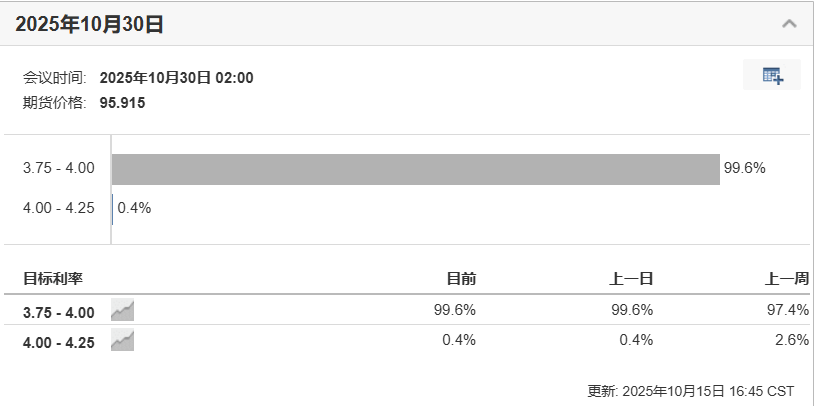
Core Viewpoint - Federal Reserve Chairman Powell indicated a potential end to the balance sheet reduction process in the coming months to prevent liquidity tightening in short-term funding markets [1][3]. Group 1: Federal Reserve Actions - The Federal Reserve expanded its balance sheet during the pandemic and began raising interest rates in March 2022, followed by balance sheet reduction starting in June 2022 [2]. - The first interest rate cut is expected in September 2024, while the balance sheet reduction has continued until now [2]. Group 2: Market Reactions - The expectation of interest rate cuts and the cessation of balance sheet reduction are likely to lead to increased liquidity, which historically correlates with better market performance in A-shares and Hong Kong stocks [5]. - Following Powell's remarks, the Hang Seng Index rose by 1.84%, and the Hang Seng Tech Index increased by 2.57%, indicating signs of stabilization [5]. - Despite the positive market reaction, there has been a net outflow of 5.4 billion from southbound funds, suggesting that foreign capital is not necessarily buying into the perceived benefits of rate cuts [5]. Group 3: A-share Market Dynamics - The A-share market showed weakness in early trading, primarily due to the previous day's decline [6]. - However, the surge in shares of Sanhua Intelligent Control led to a recovery in the broader technology sector, improving market sentiment [7]. Group 4: Investment Strategies - The current market environment is characterized by volatility, with frequent changes in trend signals, particularly in sectors like AI and chips [12]. - Investors are advised to be patient and wait for clear signals, as the market's oscillating nature can lead to increased trading frequency and potential losses [12].
国债期货:股市调整叠加流动性宽松 共同促进债市回暖
Jin Tou Wang· 2025-10-15 02:14
Market Performance - Government bond futures opened lower but closed higher across the board, with the 30-year main contract rising by 0.34%, having previously dropped by 0.65% during the day. The 10-year main contract increased by 0.11%, after a drop of 0.21%, while the 5-year and 2-year main contracts rose by 0.10% and 0.02%, respectively [1] - The yield on the 10-year government bond "25附息国债11" decreased by 0.9 basis points to 1.7520%, while the yield on the 30-year bond "25超长特别国债02" fell by 1.15 basis points to 2.1025%. Conversely, the yield on the 2-year bond "25附息国债17" increased by 0.25 basis points to 1.49% [1] Funding Conditions - The central bank announced a fixed-rate reverse repurchase operation of 91 billion yuan for 7-day terms on October 14, with an operation rate of 1.40%. The total bid and awarded amount was 91 billion yuan, resulting in a net injection of 91 billion yuan for the day [2] - The interbank market remains flush with liquidity, with overnight repurchase rates hovering around 1.31%. Non-bank institutions are borrowing overnight against credit bonds at rates as low as 1.4% [2] - The central bank also conducted a 600 billion yuan 6-month reverse repurchase operation, contributing to a total net injection of 400 billion yuan in reverse repos for the month, indicating a commitment to maintaining liquidity [2] Operational Suggestions - Recent adjustments in the stock market, combined with liquidity easing and uncertainties in US-China trade relations, have driven a rebound in the bond market. The future trajectory of the bond market remains uncertain, with attention needed on the new fund redemption fee regulations and changes in market risk appetite [3] - The current liquidity environment and the normalization of the yield curve are expected to limit the extent of declines in long-term bonds. If the yield on the 10-year government bond rises above 1.8%, there may be renewed value in allocation, while yields around 1.75% and 1.7% could face resistance [3] - Short-term bonds are expected to continue fluctuating within a range, with the T2512 contract likely maintaining a range of 107.4 to 108.3, suggesting a wait-and-see approach for potential adjustment opportunities [3]
美股三大指数集体收涨,COMEX黄金突破4100美元
Mei Ri Jing Ji Xin Wen· 2025-10-14 01:25
Core Insights - The U.S. stock market saw all three major indices rise, with the Dow Jones up 1.29%, the Nasdaq up 2.21%, and the S&P 500 up 1.56% [1] - Technology stocks led the rebound, with Broadcom's stock surging nearly 10% due to a chip collaboration agreement with OpenAI, while other popular tech stocks like Tesla and Nvidia also recorded significant gains [1] - Market sentiment was boosted by the Trump administration's softened trade stance and expectations for increased AI capital expenditures [1] Market Performance - The Nasdaq China Golden Dragon Index rose by 3.21%, with popular Chinese concept stocks also experiencing gains, including Century Internet up over 10%, and NIO and Alibaba following suit [1] - In commodities, COMEX gold futures surpassed $4100, reaching a historical high, while silver futures also surged. Crude oil prices saw a slight increase, with ICE Brent crude closing at $63.60 per barrel [1] Earnings Season Focus - Attention is shifting towards the U.S. earnings season, with bank stocks like JPMorgan Chase expected to set the tone for the market [1] - Institutions believe that the AI industry chain and liquidity easing logic continue to support the market, but caution is advised regarding potential trade policy reversals and valuation bubble risks [1] - The safe-haven attributes of precious metals are being reinforced, with mid-term allocation value gaining attention [1]
海外市场丨美股三大指数集体收涨,COMEX黄金突破4100美元
Mei Ri Jing Ji Xin Wen· 2025-10-14 01:04
Group 1 - The three major U.S. stock indices all closed higher, with the Dow Jones up 1.29%, the Nasdaq up 2.21%, and the S&P 500 up 1.56% [1] - Technology stocks led the rebound, with Broadcom's stock surging nearly 10% due to a chip collaboration agreement with OpenAI, while other popular tech stocks like Tesla and Nvidia also recorded significant gains [1] - Market sentiment was boosted by the Trump administration's softened trade stance and expectations for increased AI capital expenditures [1] Group 2 - The Nasdaq Golden Dragon China Index rose by 3.21%, with popular Chinese concept stocks generally increasing, including Century Internet which rose over 10%, and NIO and Alibaba also following suit [1] - In commodities, COMEX gold futures surpassed $4100, reaching a historical high, while silver futures also surged; crude oil prices saw a slight increase, with ICE Brent crude closing at $63.60 per barrel [1] Group 3 - The short-term focus is shifting towards the U.S. earnings season, with bank stocks like JPMorgan Chase expected to set the tone [1] - Institutions believe that the AI industry chain and liquidity easing logic continue to support the market, but caution is advised regarding the volatility of trade policies and valuation bubble risks [1] - The safe-haven attributes of precious metals are being reinforced, with mid-term allocation value gaining attention [1] Group 4 - Related ETFs include the Nasdaq ETF (513300) for global tech leaders, the S&P ETF (159655) for core U.S. equities, and the Gold ETF (518850) tracking gold price performance [2]