
货币政策

Search documents
2025年货币政策与利率债回顾与2026年展望:货币政策将延续支持性立场,收益率核心区间或为1.7%-1.9%
Zhong Cheng Xin Guo Ji· 2025-12-18 09:22
Report Summary 1. Industry Investment Rating No investment rating information is provided in the report. 2. Core Viewpoints - In 2026, the monetary policy will maintain a supportive stance with 2 - 3 potential reserve requirement ratio cuts and interest rate cuts, and the use of structural tools will be further strengthened. The issuance scale of interest - bearing bonds will be nearly 36 trillion yuan, and the 10 - year Treasury bond yield will mainly fluctuate between 1.6% - 1.9% [4][5]. - In 2025 (January - November), the monetary policy was moderately loose, the issuance of all types of interest - bearing bonds increased year - on - year, and the yield of interest - bearing bonds showed an "N" shape, with the 10 - year Treasury bond yield exceeding 1.9% at its highest [4][5]. 3. Summary by Directory 3.1 Monetary Policy and Liquidity Monitoring - **Monetary Policy Characteristics**: In 2025, due to external uncertainties and domestic issues such as weak domestic demand, the monetary policy was moderately loose. In May, a simultaneous reserve requirement ratio cut and interest rate cut occurred, and structural tools continued to play a role. Since April, the central bank has made net monthly capital injections, and in October, the central bank resumed Treasury bond trading operations [6][7]. - **Funds Rate**: The central funds rate fluctuated downward, and the spread between DR007 and R007 remained low. In the first quarter, the funds were relatively tight; in the second quarter, after the reserve requirement ratio cut and interest rate cut, the funds rate declined; from July to November, the central funds rate further declined [12]. 3.2 Interest - Bearing Bond Market Operation Characteristics - **Issuance Scale**: From January to November 2025, the issuance scale of interest - bearing bonds reached 30.66 trillion yuan, a year - on - year increase of 17.9%. The issuance of all types of interest - bearing bonds increased, and the issuance of special Treasury bonds was completed [14]. - **Yield Trend**: The yield of interest - bearing bonds showed an "N" shape. In the first half of the year, the yield declined quarter - by - quarter; in the second half, it fluctuated upward due to factors such as the increase in risk appetite. The 10 - year Treasury bond yield exceeded 1.9% at its highest [19]. 3.3 2026 Monetary Policy Outlook - The monetary policy will maintain a supportive stance. Considering the challenges faced by the economy, the policy will continue to exert force, focusing on releasing policy effectiveness and strengthening coordination with fiscal policy [26]. - There will be 2 - 3 potential reserve requirement ratio cuts and interest rate cuts in 2026. It is estimated that there will be 1 interest rate cut of 10BP in 2026, possibly in the first quarter, and 1 - 2 reserve requirement ratio cuts, likely in the middle or fourth quarter. The use of structural tools will be further strengthened [27][28]. 3.4 2026 Interest - Bearing Bond Outlook - **Issuance Scale**: In 2026, the issuance scale of interest - bearing bonds will be nearly 36 trillion yuan. The government bond supply will further increase, with the Treasury bond issuance scale reaching 17.4 trillion yuan, local bond issuance scale reaching 11.6 trillion yuan, and the policy financial bond issuance scale reaching nearly 7 trillion yuan [30][31][32]. - **Yield Trend**: In 2026, interest - bearing bonds will likely maintain low - interest - rate operation. The 10 - year Treasury bond yield will corely fluctuate between 1.7% - 1.9%, with the low point likely between 1.6% - 1.7% and the high point between 1.9% - 2.0%. However, there may be unexpected fluctuations due to internal and external uncertainties [34][35].
邢自强:更多消费补贴政策或在明年下半年
第一财经· 2025-12-18 09:01
Core Viewpoint - The central economic work conference indicates a moderate approach to economic stabilization rather than strong stimulus, focusing on maintaining growth levels and alleviating deflationary pressures without significant policy shifts [3]. Fiscal Policy - The fiscal deficit, including both explicit and implicit components, is set to remain at levels similar to 2025, with an emphasis on front-loading expenditures, particularly in infrastructure such as urban renewal and green transformation projects [4]. - There is potential for an additional fiscal space equivalent to 0.5% of GDP if conditions in real estate, prices, and employment improve in the first half of the year [5]. Monetary Policy - The actual space for interest rate cuts and reserve requirement ratio reductions is limited, with a focus on structural tools and quasi-fiscal measures, suggesting a possible reduction of 10-20 basis points throughout the year [5]. Real Estate Policy - Support measures for real estate, such as subsidizing mortgage rates, may not materialize until after the national two sessions, with details expected in the second quarter of 2026 [5]. - A broad and sustained subsidy for mortgage rates could stabilize market expectations and break the negative feedback loop of falling housing prices and credit contraction [6][9]. Consumption Policy - The continuation of the national subsidy for replacing old with new products is expected, with adjustments in scale and coverage, but there is uncertainty about significant support for service sector consumption [6]. - Direct subsidies for consumer spending, particularly in the service sector, may take longer to implement, potentially not appearing until the second half of the year [6]. Export Outlook - Despite concerns about export reliance, China's share of global exports is projected to increase from 15% to 16-17% over the next five years, with growth rates expected to outpace global trade growth [7]. - The shift towards "de-China-ization" is seen as a trade chain extension rather than a reduction in China's market share, with Chinese enterprises maintaining a competitive edge in high-value sectors [7][8]. Talent and Innovation - China produces approximately 11 million university graduates annually, with a significant portion in engineering and technology fields, contributing to its competitive advantage in key sectors [8]. - The global supply chain is evolving towards multi-polarity but remains reliant on Chinese enterprises, indicating a robust position for China in the global market [8]. Economic Transition - There is a call for a shift towards consumption-driven growth in 2026, emphasizing social security improvements and support for farmers and migrant workers to enhance consumer capacity [8]. - A broader focus on supporting service sector consumption through subsidies and vouchers is recommended to stimulate economic activity [8].


沪铜产业日报-20251218
Rui Da Qi Huo· 2025-12-18 08:43
Report Industry Investment Rating - Not provided Core View of the Report - The Shanghai Copper main contract shows a volatile trend, with an increase in open interest, spot discount, and strengthening basis. It is recommended to conduct short - term long trades at low prices with a light position, paying attention to controlling the rhythm and trading risks [2] Summary by Relevant Catalogs Futures Market - The closing price of the Shanghai Copper futures main contract is 92,600 yuan/ton, down 220 yuan; the LME 3 - month copper price is 11,735 dollars/ton, down 2 dollars. The main contract's inter - month spread is - 60 yuan/ton, up 10 yuan; the open interest of the Shanghai Copper main contract is 231,253 lots, up 7,279 lots. The top 20 futures positions of Shanghai Copper are - 33,302 lots, down 996 lots. The LME copper inventory is 166,925 tons, up 325 tons; the SHFE cathode copper inventory is 89,389 tons, up 484 tons; the SHFE cathode copper warehouse receipt is 44,650 tons, down 2,856 tons [2] Spot Market - The SMM 1 copper spot price is 92,240 yuan/ton, up 95 yuan; the Yangtze River non - ferrous market 1 copper spot price is 92,395 yuan/ton, up 110 yuan. The Shanghai electrolytic copper CIF (bill of lading) price is 50 dollars/ton, unchanged; the Yangshan copper average premium is 45.5 dollars/ton, unchanged. The CU main contract basis is - 360 yuan/ton, up 315 yuan; the LME copper cash - to - 3 - month spread is - 9.8 dollars/ton, down 0.28 dollars [2] Upstream Situation - The import volume of copper ore and concentrates is 245.15 million tons, down 13.56 million tons. The copper smelter's rough smelting fee (TC) is - 43.08 dollars/kiloton, down 0.22 dollars. The copper concentrate price in Jiangxi is 82,500 yuan/metal ton, up 300 yuan; in Yunnan, it is 83,200 yuan/metal ton, up 300 yuan. The southern processing fee for blister copper is 1,400 yuan/ton, up 100 yuan; the northern processing fee is 1,000 yuan/ton, up 100 yuan [2] Industry Situation - The refined copper output is 123.6 million tons, up 3.2 million tons. The import volume of unforged copper and copper products is 430,000 tons, down 10,000 tons. The social copper inventory is 41.82 million tons, up 0.43 million tons. The price of 1 bright copper wire in Shanghai is 62,990 yuan/ton, up 200 yuan; the price of 2 copper (94 - 96%) in Shanghai is 76,850 yuan/ton, up 100 yuan. The ex - factory price of 98% sulfuric acid of Jiangxi Copper is 970 yuan/ton, unchanged [2] Downstream and Application - The copper product output is 222.6 million tons, up 22.2 million tons. The cumulative value of power grid infrastructure investment completed is 4,824.34 billion yuan, up 446.27 billion yuan. The cumulative value of real estate development investment completed is 78,590.9 billion yuan, up 5,028.2 billion yuan. The monthly output of integrated circuits is 4,392 million pieces, up 215,000 pieces [2] Option Situation - The 20 - day historical volatility of Shanghai Copper is 18.1%, up 0.1%; the 40 - day historical volatility is 17.18%, down 0.02%. The current month's at - the - money IV implied volatility is 19.27%, up 0.0112. The at - the - money option call - put ratio is 1.28, up 0.0181 [2] Industry News - The "15th Five - Year Plan" starts with a moderately loose monetary policy aiming for economic growth and price recovery, with expected reserve requirement ratio and interest rate cuts next year. The Fed official indicates a 50 - 100 basis - point interest rate cut space. In November, the production and sales of commercial vehicles increased both month - on - month and year - on - year [2]
黄金交易量堪比GDP半数!泰国央行急呼财政部出手管控
Jin Shi Shu Ju· 2025-12-18 08:15
泰国央行行长周四表示,鉴于黄金交易激增助推泰铢升值,央行正呼吁财政部出手管控黄金交易;他还 补充称,在关键利率已降至三年低点后,若有必要,货币政策或将进一步放宽。 今年以来,泰铢兑美元汇率已上涨9.1%,成为亚洲表现第二好的货币,这加剧了泰国这个东南亚第二 大经济体的困境。 目前,泰国正面临多重挑战,包括美国关税冲击、高企的家庭债务、与柬埔寨的边 境冲突,以及明年2月8日大选前的政治不确定性。 泰国央行行长威塔伊·拉塔纳空(Vitai Ratanakorn)在一场商业论坛上表示,黄金交易资金流已成为影 响泰铢汇率波动的重要驱动因素。 "在泰铢大幅走强的日子里,黄金交易额约占推动泰铢上涨资金流动的一半,"他指出,目前大型黄金交 易商的交易量规模已相当于泰国国内生产总值(GDP)的50%左右。 "央行正竭尽所能,最大限度地扩充各类调控措施。我们有《外汇法》可以依托,但该法律并未覆盖黄 金交易业务。必须有相关部门出面监管黄金交易,"他说道。 暂不计划对黄金交易征税 泰国央行表示,目前暂无对黄金交易征税的计划。黄金交易商此前已明确反对征税举措,并警告称此举 将对该行业造成沉重打击。 威塔伊还表示,央行也不会通过对资本 ...
信用利差周报2025年第47期:中央经济工作会议延续积极政策基调,美联储再度降息减轻外部约束-20251218
Zhong Cheng Xin Guo Ji· 2025-12-18 08:01
Report Industry Investment Rating No relevant content provided. Core Viewpoints - The Central Economic Work Conference continued the positive policy tone, and the Fed's interest rate cut eased external constraints. The credit bond market in 2026 will have relatively stable liquidity support and structural development opportunities under the "moderately loose" monetary environment and clear policy guidance. However, it may present a volatile pattern, and investors are advised to focus on the coupon value of medium - short - term and high - grade bonds [4][14]. Summary by Directory Market Hotspots - **Central Economic Work Conference and Credit Bond Market**: The conference set the tone for a moderately loose monetary policy in 2026, emphasizing support for key areas such as scientific and technological innovation. The "Science and Technology Board" in the bond market promoted the development of science and technology bonds, with the stock scale reaching 3.37 trillion yuan and the ETF product scale exceeding 250 billion yuan. The current bond market default risk is generally stable, but tail and local risks still need attention. The credit bond market is expected to achieve stable and healthy development [11][13][14]. - **Fed's Interest Rate Cut**: On December 10, 2025, the Fed cut interest rates by 25bp for the third time this year. Although it eases the pressure of the inverted Sino - US interest rate spread and provides space for China's monetary policy, the credit bond market is still mainly determined by domestic fundamentals and policies. The market is likely to be volatile, and investors are advised to adopt a prudent strategy [15][16][18]. Macroeconomic Data - In November, the year - on - year CPI growth rate reached 0.7%, the highest since March 2024, indicating the continuous recovery of consumer demand. The year - on - year PPI decline was 2.2%. The social financing scale stock was 440.07 trillion yuan, with a year - on - year growth of 8.5%. The M1 year - on - year growth rate was 4.9%, and the M2 was 8.0%, with the M2 - M1 gap widening to 3.1 percentage points [6][20]. Money Market - Last week, the central bank net - injected 470 million yuan through open - market operations. Due to seasonal factors, the capital market tightened, and most capital prices rose. The DR001 decreased by 3bp, while other repurchase rates increased by 2 - 7bp. The 3 - month and 1 - year Shibor remained stable [22][23]. Credit Bond Primary Market - Last week, the credit bond issuance scale was 274.812 billion yuan, showing a recovery. The issuance scale of different bond types and industries varied. The infrastructure investment and financing industry had a net inflow of financing, and most industries in industrial bonds also had net inflows. The average issuance cost of credit bonds showed a long - short differentiation, with the 1 - year average issuance rate decreasing and the 3 - year and 5 - year rates mostly increasing [27][35]. Credit Bond Secondary Market - The trading volume of the bond secondary market reached 8.715913 trillion yuan, an increase of 191.82 billion yuan from the previous period, indicating increased trading activity. Bond yields mostly declined, with the 10 - year treasury bond yield dropping to 1.84%. Most credit spreads of AAA - rated bonds narrowed, and the rating spreads fluctuated [36][38][43].
1000亿元!央行开展14天期逆回购操作
Jin Rong Shi Bao· 2025-12-18 08:01
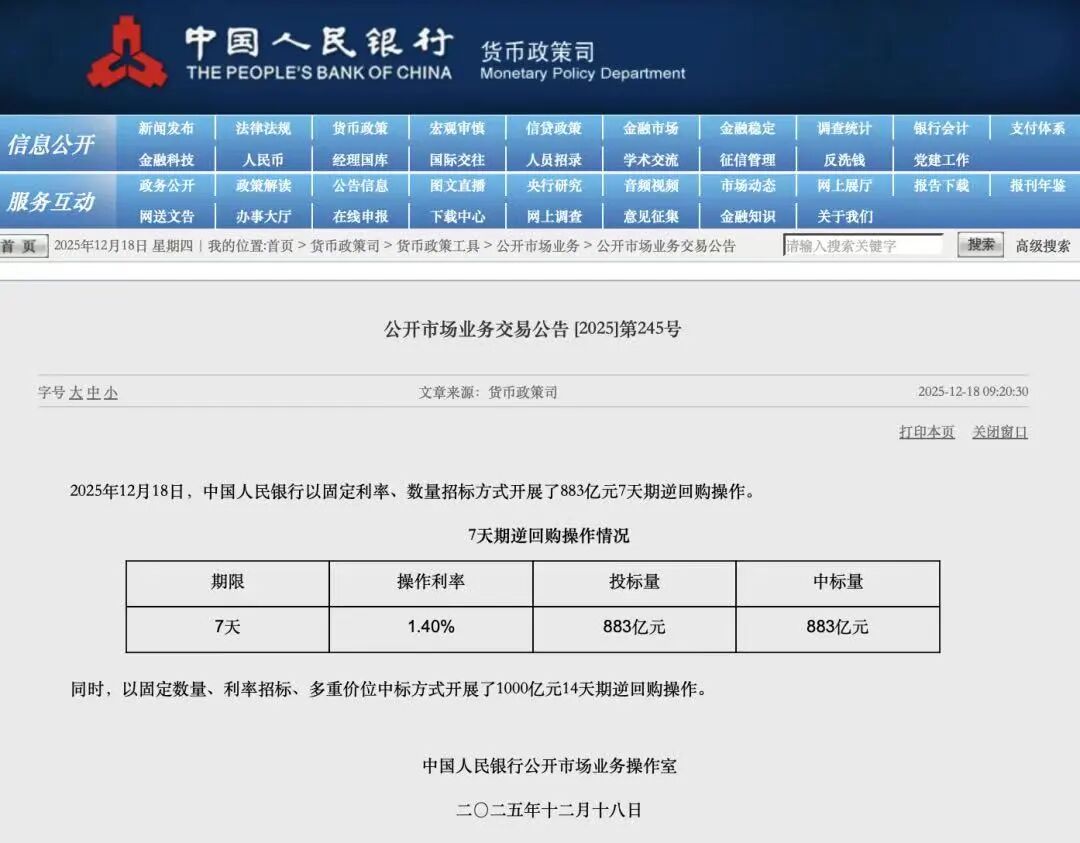
Core Viewpoint - The People's Bank of China (PBOC) has conducted a total of 883 billion yuan 7-day reverse repos at a fixed rate of 1.40% and 1,000 billion yuan 14-day reverse repos to manage liquidity ahead of year-end financial assessments and cash withdrawal demands [1][5]. Group 1: Reverse Repo Operations - The PBOC executed 883 billion yuan in 7-day reverse repos, maintaining the interest rate at 1.40% [1][4]. - A 1,000 billion yuan 14-day reverse repo operation was also conducted, which is slightly above the average scale of previous years [5]. - The simultaneous execution of both 7-day and 14-day reverse repos indicates a flexible approach to managing liquidity across different time frames [5]. Group 2: Market Liquidity Management - The 14-day reverse repo is aimed at smoothing out liquidity fluctuations and ensuring a stable and ample market liquidity environment as year-end approaches [5]. - Analysts expect the PBOC to utilize various liquidity management tools to enhance the precision and effectiveness of short- to medium-term liquidity management [6]. - The focus of monetary policy remains on creating a stable financial environment for the real economy, ensuring that liquidity tools effectively stabilize short-term fluctuations and guide reasonable interest rates [6].
“十五五”首席观察|专访明明:明年长债利率有望阶段性下行
Bei Jing Shang Bao· 2025-12-18 07:32
Group 1: Economic Outlook for 2026 - In 2026, China's economic policies will focus on releasing consumption potential, particularly in service consumption, durable goods renewal, and new consumption scenarios [1][4] - The core contradiction restricting consumer spending is the cautious expectations under medium to long-term uncertainties, rather than just insufficient current income [5] - The monetary policy is expected to shift from total easing to structural optimization, with the People's Bank of China likely to implement more targeted measures to guide funds to key sectors of the economy [6] Group 2: Currency and Debt Market Insights - The RMB is expected to appreciate moderately in 2026, supported by trade surplus resilience and improved capital flow structure, despite uncertainties from US-China interest rate differentials and geopolitical factors [7] - Long-term bond yields are anticipated to experience a phase of decline in 2026, influenced by fiscal expansion and the central bank's supportive monetary policy, although short-term market disturbances may persist [8] Group 3: Internal and External Economic Strategies - Strengthening "internal circulation" does not imply weakening external openness; instead, it aims to enhance the economy's autonomy and resilience [10] - Coordinated efforts between expanding domestic demand and promoting high-level institutional openness are essential for stabilizing foreign trade and investment expectations while responding to external shocks [10]

邢自强:更多消费补贴政策或在明年下半年
Di Yi Cai Jing· 2025-12-18 07:24
Group 1: Economic Policy Outlook - The central economic work conference indicates a moderate approach to policy, focusing on stability rather than strong stimulus, with no significant adjustments expected for 2025 policies [1] - The policy tone aims for gradual progress to stabilize growth and alleviate deflationary pressures, without strong measures for re-inflation or breaking the deflation cycle [1] - The nominal GDP growth forecast for 2026 is conservatively maintained at just over 4%, which is more cautious than market consensus [1] Group 2: Fiscal Policy - The fiscal deficit, including both explicit and implicit components, is set to be similar to 2025 levels, but with a noticeable front-loading towards infrastructure investments [2] - Key areas for fiscal spending include urban renewal, underground infrastructure, green transition projects, and public expenditures related to AI computing centers [2] - There is potential for an additional fiscal space equivalent to 0.5% of GDP if economic conditions worsen in the first half of the year [2] Group 3: Monetary Policy - The actual space for interest rate cuts and reserve requirement ratio reductions is limited, with a focus on structural and quasi-fiscal tools [2] - Any interest rate cuts in the coming year are expected to be modest, around 10 to 20 basis points, which is relatively small compared to the Federal Reserve's potential cuts [2] Group 4: Real Estate Policy - Further support for the real estate sector, such as mortgage rate subsidies, is likely to be detailed after the national two sessions, with implementation expected in the second quarter of 2026 [2] - A broad and sustained approach to mortgage rate subsidies could stabilize expectations in major cities, potentially aligning mortgage rates closer to local rental yields [2] Group 5: Consumer Policy - The continuation of the national subsidy for trade-ins is expected, but there is uncertainty about the introduction of new consumer support measures like service industry subsidies or consumption vouchers [3] - Direct subsidies for mortgage rates and service industry consumption may be necessary to stimulate consumer spending, with implementation likely pushed to the second half of next year [3] Group 6: Export Outlook - Despite concerns about export sustainability, the outlook remains positive, with China's share of global exports currently at 15% and expected to rise to 16-17% over the next five years [3] - The competitive landscape for Chinese industries is expected to improve, with significant advantages in emerging sectors such as batteries, new energy vehicles, and robotics [5] Group 7: Structural Changes in Global Trade - The trend of de-China-ization is not expected to reduce China's market share, as trade chains are lengthening rather than replacing Chinese enterprises [4] - China's competitive edge in high-value segments and its talent pool, with 11 million engineering graduates annually, positions it favorably in key industries [5] Group 8: Consumer Transition - A shift towards consumer-driven growth is anticipated, with a focus on enhancing social security and welfare, particularly for farmers and migrant workers, to boost consumption capacity [6] - Support for durable goods and broader service sector consumption is essential for economic recovery, alongside measures to stabilize the real estate market [6]
“十五五”首席观察|专访连平:扩大内需,推动内外循环深度融合
Bei Jing Shang Bao· 2025-12-18 06:01
Core Viewpoint - The macroeconomic environment in China is characterized by both opportunities and challenges as it transitions from the "14th Five-Year Plan" to the "15th Five-Year Plan," with a focus on stimulating domestic consumption and optimizing financial supply [1] Economic Policy and Monetary Measures - The People's Bank of China (PBOC) continues to maintain a loose monetary policy through tools like reserve requirement ratio (RRR) cuts and interest rate reductions to support economic recovery [1][8] - In 2026, there is a likelihood of a 0.25-0.5 percentage point RRR cut, and policy interest rates may be lowered by 0.1-0.3 percentage points to stimulate consumption and investment [2][9] Consumer Spending and Real Estate - Weak consumer spending is primarily attributed to a sluggish real estate market and income constraints, with future policies expected to focus on income growth and targeted real estate measures to unlock consumption potential [2][5] - The core issues affecting consumer spending include a decline in housing transactions impacting related consumption and the overall growth of various income sources [5] Consumption Growth Strategies - In 2026, China aims to expand the supply of quality consumer goods and services, fostering new consumption growth points and creating new consumption scenarios [6] - Policies will include increasing subsidies for consumption, optimizing the implementation of new policies, and enhancing income through various channels [6][7] Structural Financial Policies - The central economic work conference emphasizes the need for financial institutions to support key areas such as expanding domestic demand and technological innovation [10] - Structural monetary policy tools are expected to be expanded, with potential interest rate reductions to enhance support for small and micro enterprises and other critical sectors [10] Currency Outlook - The Chinese yuan is expected to appreciate in 2026, supported by factors such as stronger economic growth compared to the U.S., a favorable trade balance, and changing market expectations [12][11] - However, significant fluctuations in the yuan's value are unlikely, as regulatory measures will aim to maintain stability within a reasonable range [13] International Trade and Investment - The restructuring of global trade and the spillover effects of major economies' policies will remain significant external variables for China's economic development in 2026 [14] - Strategies will include enhancing foreign trade quality, expanding import trade, and promoting digital trade to foster a more integrated domestic and international market [15][16]
如何灵活高效运用多种货币政策工具?丨落实会议部署 问答中国经济
Zheng Quan Shi Bao· 2025-12-18 05:54
Core Viewpoint - The Central Economic Work Conference has outlined the overall requirements and policy direction for economic work in the coming year, emphasizing the importance of promoting stable economic growth and reasonable price recovery as key considerations for monetary policy [1] Group 1: Monetary Policy Tools - The conference highlighted the need for flexible and efficient use of various monetary policy tools to support economic growth and price stability [3] - The expected adjustments in reserve requirement ratios (RRR) and interest rates are projected to be around 0.5 and 0.1 percentage points, respectively, in the coming year [3] - The People's Bank of China (PBOC) aims to enhance the efficiency of monetary policy transmission by implementing structural monetary policy tools and addressing inefficiencies in financial resource allocation [2][4] Group 2: Financial Support for the Real Economy - The growth of social financing and broad money supply (M2) has consistently outpaced nominal economic growth, indicating a stable foundation for continued growth in the coming year [2] - Structural monetary policy tools will focus on expanding domestic demand, technological innovation, and support for small and micro enterprises, aligning with the "five major articles" of financial support [4] - The PBOC is expected to further narrow the interest rate corridor and stabilize the yield curve of government bonds to enhance the effectiveness of monetary policy transmission [4]