流动性宽松

Search documents
现货黄金升至4060美元再创新高,上海金ETF(159830)盘中涨超2%居同标的第一,机构:避险+流动性因素黄金或续涨
2 1 Shi Ji Jing Ji Bao Dao· 2025-10-13 02:21
Group 1 - The A-share market opened lower on October 13, with the CSI A500 index dropping over 1%, while the precious metals sector showed strength [1] - The Shanghai Gold ETF (159830) saw a 2.31% increase, leading in its category with a trading volume exceeding 10 million yuan [1] - The CSI A500 ETF Tianhong (159360) fell by 1.36%, tracking the CSI A500 index which reflects the performance of 500 large-cap, liquid stocks across various industries [1] Group 2 - Wheaton Precious Metals Corp's CEO Randy Smallwood predicts gold prices will exceed $5,000 next year, driven by geopolitical tensions and supply constraints [2] - Guosheng Securities notes that the U.S. government shutdown and global trade disruptions are increasing demand for gold as a safe haven [2] - Minsheng Securities highlights that the reduction in U.S. ADP employment numbers in September raises expectations for interest rate cuts, supporting strong demand for gold and driving prices higher [2]
视频|杨德龙:隔夜美股暴跌冲击全球资本市场
Xin Lang Cai Jing· 2025-10-11 03:36
Core Viewpoint - The overnight plunge in US stocks, with major indices falling sharply, was triggered by Trump's threats of increased tariffs on rare earth exports and ongoing government shutdown concerns, raising fears of economic recession and renewed trade tensions [1] Market Impact - The Nasdaq dropped nearly 4%, leading to a sell-off in technology stocks, which had accumulated significant profit margins [1] - Safe-haven assets like gold surged, while risk assets such as Bitcoin experienced significant declines and frequent liquidations [1] Short-term Outlook - The impact of the US stock market decline is expected to transmit to A-shares and Hong Kong stocks, particularly affecting technology stocks [1] - Despite short-term pressures, the medium-term outlook remains positive due to supportive domestic policies, including the "14th Five-Year Plan" for technology, potential interest rate cuts, and a shift in household savings [1] Valuation and Strategy - A-shares and Hong Kong stocks are still undervalued compared to historical averages, with traditional blue-chip stocks not showing signs of bubble formation [1] - The Federal Reserve has raised the probability of an interest rate cut in October to 100%, with another potential cut in December, maintaining a global liquidity easing environment [1] Investment Strategy - In the short term, it is advisable to reduce positions in technology stocks that have seen significant gains and have uncertain earnings outlooks, while maintaining core holdings [1] - In the medium term, focus on investing in technology and new consumer leaders that demonstrate technical breakthroughs and solid order placements [1] - Key monitoring areas include the progress of US-China trade negotiations and the resolution of the US government shutdown [1]
投行集体喊话!比特币刚跳水就被盯上,目标直指 20 万美元
Sou Hu Cai Jing· 2025-10-11 02:45
Core Viewpoint - The article discusses the contrasting perspectives in the cryptocurrency market, highlighting the significant price drop of Bitcoin and the bullish outlook from major international investment banks like Standard Chartered and Citibank, which predict a potential rise in Bitcoin prices driven by institutional investment and its correlation with gold [1][3][6]. Group 1: Investment Banks' Predictions - Standard Chartered raised its short-term Bitcoin price target from $120,000 to $135,000, asserting a year-end target of $200,000 [1][5]. - Citibank noted that the correlation between Bitcoin and gold has surged to 0.7, indicating a strong relationship where both assets tend to move together [6][8]. - Standard Chartered's analysis suggests that if global pension funds allocate just 1% (approximately $400 billion) to Bitcoin, it could push the price to $200,000 [5]. Group 2: Market Dynamics - The article emphasizes that institutional funds, including U.S. retirement and sovereign wealth funds, have not yet significantly entered the Bitcoin market, suggesting that the current price movements are just the beginning [3][5]. - The inflow of capital into Bitcoin ETFs has been substantial, with daily net inflows exceeding $1 billion multiple times in October [5]. - The article highlights the role of global liquidity easing, with the Federal Reserve having already cut interest rates and expectations for further cuts, which could benefit risk assets like Bitcoin [10][14]. Group 3: Risks and Considerations - Despite the optimistic outlook from investment banks, there are warnings about potential short-term volatility, with Bitcoin experiencing a 3.21% drop on October 11, raising concerns about market corrections [13]. - Regulatory risks remain a concern, particularly with the EU tightening cryptocurrency regulations, which could impact market sentiment and investment flows [16]. - The article advises caution regarding investment strategies, suggesting that investors should monitor ETF fund flows and Federal Reserve interest rate decisions as key indicators for market movements [18].



“水牛”行情延续,成长占优
Chang Jiang Qi Huo· 2025-10-09 05:10
1. Report Industry Investment Rating No relevant content provided. 2. Core View of the Report The "liquidity-driven bull" market continues, with growth stocks outperforming. In Q3, the A-share market showed a pattern of rising and then fluctuating. Looking ahead to Q4, the core support logic for the market's upward movement remains unchanged. If there are no unexpected negative factors, the market still has room to expand upwards after the phased adjustment. The two core driving forces are the continuation of the loose liquidity environment and the continuous support from the policy side [3][61]. 3. Summary by Related Catalogs Macro Economy - **CPI**: Monthly CPI was flat year-on-year, mainly dragged down by the food component, while the core CPI continued to rise year-on-year. The prices of industrial consumer goods and services were stronger than seasonal trends, driving the monthly CPI to rise month-on-month [13]. - **PPI**: Monthly PPI decreased by 3.6% year-on-year, with the decline remaining the same. The anti-involution policy has limited impact on price improvement, highlighting the need for more demand-side policy support [14]. - **Export**: Monthly exports increased by 7.2% year-on-year and decreased by 1.0% month-on-month. The "rush to export" effect was an important factor for the acceleration of exports. Exports to the EU and ASEAN provided main support [16]. - **Consumption and Real Estate**: The growth rate of social consumer goods retail sales declined, and the real estate market continued to weaken. The real estate demand still needs to be boosted, and the prices of second-hand and new houses are diverging [18]. - **Manufacturing**: The monthly manufacturing PMI rose by 3.1 percentage points to 51.5%, staying in the expansion range for two consecutive months. There was structural differentiation in sub - indicators, and the cost pressure on mid - and downstream enterprises remained [20]. - **Monetary Policy**: The subsequent monetary policy is expected to maintain a "moderately loose" tone, focusing more on the use of structural tools. There may be a small interest rate cut in Q4, and the possibility of the central bank resuming treasury bond trading operations within the year has increased [23]. Market Review - **A-share Performance**: At the beginning of the month, the A-share market had a slight correction, and the risk appetite of investors fluctuated. Since the middle of the month, the main indexes showed different trends. The market capitalization was active, and the margin trading balance reached a record high [29]. - **Industry Performance**: As of the end of the month, among the 31 Shenwan primary industries, the power equipment industry led the market with a 21.17% increase, and more than 60% of the industries recorded declines, showing obvious industry differentiation [30]. - **Market Style**: Growth-style indexes led the rise, and mid - cap stocks performed particularly well. The market showed a preference for growth sectors [32]. - **Liquidity**: During a certain period, the average daily trading volume of the A-share market increased month-on-month, and the newly established partial - stock fund shares also increased, indicating active market liquidity [38]. - **Market Sentiment**: The trading enthusiasm of the A-share market remained high, and the risk appetite gradually recovered in the middle of the month. The main funds were concentrated in high - growth sectors, and the margin trading balance continued to rise [41][42]. Private Equity Strategy - **Basis Analysis**: Monthly basis fluctuations were significant, with the first half showing convergence and the second half widening, which affected neutral strategies [47]. - **Performance of Private Equity Sub - strategies**: In a certain month, all private equity strategies achieved positive returns. Long - only strategies and arbitrage strategies ranked among the top [50]. - **Index Enhancement Strategy**: The excess returns of different index enhancement strategies showed significant differentiation. Mid - and small - cap index enhancement strategies led the way in the long term, and different strategies responded differently to market environments [53][54]. - **Market Neutral Strategy**: The environment for the neutral strategy improved in a certain month. The average return of the market neutral strategy was 0.5%, and about 83.87% of the products achieved positive returns [59]. Future Outlook The A-share market in Q3 showed a pattern of rising and then fluctuating. In Q4, if there are no unexpected negative factors, the market still has room to expand upwards, supported by the loose liquidity environment and policy support [61].
股市迎来新机遇,超越楼市投资价值,财富增值首选方向
Sou Hu Cai Jing· 2025-10-08 23:55
Group 1 - The core viewpoint suggests a shift in investment sentiment from the real estate market to the stock market, driven by declining property prices and rising stock market activity [1][3][5] - From 2022 to 2025, property prices in second-tier cities fell by approximately 20%, while third-tier cities experienced declines of around 30%, indicating a significant downturn in the real estate sector [3] - The stock market saw a nearly 20% increase in the first half of 2025, with a surge in new account openings, highlighting a growing interest in equity investments [3][5] Group 2 - The current economic environment, characterized by lower interest rates and stagnant real estate returns, has led investors to seek opportunities in the stock market, which is perceived as a more viable option for potential gains [5][9] - Regulatory changes have resulted in an increase in delisted companies in the A-share market, creating a more competitive environment where only strong companies thrive, although this has also led to losses for some retail investors [7][11] - Investor sentiment is marked by a mix of frustration from years of poor returns and anxiety about missing out on potential gains, reflecting a complex emotional landscape in both the real estate and stock markets [9][11]

释放呵护流动性宽松信号 央行公告节后加量续作买断式逆回购
2 1 Shi Ji Jing Ji Bao Dao· 2025-09-30 15:34
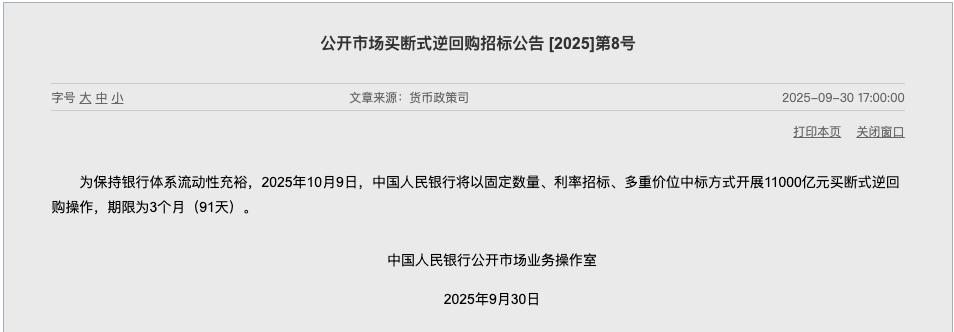
Core Viewpoint - The People's Bank of China (PBOC) is set to conduct a 1.1 trillion yuan reverse repo operation on October 9, 2025, to maintain liquidity in the banking system, with a term of 3 months [1] Group 1: Reverse Repo Operations - In October, 800 billion yuan of 3-month reverse repos and 500 billion yuan of 6-month reverse repos are set to mature [3] - After the 1.1 trillion yuan reverse repo operation on October 9, there will be a net injection of 300 billion yuan in 3-month reverse repos [3] - The PBOC is expected to continue injecting medium-term liquidity through reverse repos for the fifth consecutive month [3] Group 2: Market Conditions and Government Actions - The government is expected to issue a large volume of bonds in October, and the National Development and Reform Commission has announced the acceleration of 500 billion yuan in new policy financial instruments [4] - The strong performance of the stock market and the "migration" of household deposits in October may tighten liquidity, prompting the PBOC to inject medium-term liquidity [4] - Analysts suggest that the PBOC's reverse repo operations are aimed at stabilizing liquidity ahead of the holiday season [4] Group 3: Future Expectations - The PBOC may continue to use reverse repos and Medium-term Lending Facility (MLF) tools to inject liquidity, but the scale of net liquidity injection may decrease from the previous monthly level of 600 billion yuan [5] - There is speculation that the PBOC may implement a new round of reserve requirement ratio (RRR) cuts in the fourth quarter, which could lead to a larger scale of long-term liquidity injection [5] - Overall, the PBOC's policy stance is expected to remain supportive, with a focus on fiscal strength and monetary easing [5]
光大期货金融期货日报-20250930
Guang Da Qi Huo· 2025-09-30 03:48
Report Industry Investment Rating - Stock index: Bullish [1] - Treasury bonds: Sideways [1] Core Viewpoints - The A-share market fluctuated at a high level, with the Wind All A index rising 1.37% and a turnover of 2.18 trillion yuan. The CSI 1000, CSI 500, SSE 50, and SSE 300 indices also showed varying degrees of increase. The market should closely monitor policy announcements during the holiday and the progress of the Fourth Plenary Session of the 20th CPC Central Committee. The Fed cut interest rates by 25BP, but its stance was cautious, and there were differences within the Fed regarding the path of interest rate cuts this year. The market expects three interest rate cuts this year. The logic of loose domestic and foreign liquidity and the rise in A-share valuations remains unchanged. Short-term volatility may increase, and there is potential for further upward movement in the long term. After November, the market may gradually return to fundamental trading, and attention should be paid to the year-on-year revenue growth rate in the A-share third-quarter reports and other indicators [1]. - Treasury bond futures closed with declines in the 30-year, 10-year, 5-year, and 2-year contracts. The central bank conducted 2886 billion yuan of 7-day reverse repurchase operations, with a net injection of 481 billion yuan. The weighted average interest rate of DR001 decreased, while that of DR007 increased. Currently, loose funds are beneficial to the bond market, but the cooling of expectations for monetary policy interest rate cuts and the increase in quasi-fiscal tools restrict the bond market. With the continuous advancement of anti-involution policies and the bullish stock market, bond market sentiment is cautious, and the sideways and bearish trend continues. During the holiday, attention should be paid to the September PMI data and holiday consumption and travel data [1][2] Summary by Directory Research Views - **Stock Index**: The A-share market showed a high-level shock, with different indices rising to varying degrees. The market needs to pay attention to policy announcements during the holiday and the progress of the Fourth Plenary Session of the 20th CPC Central Committee. The Fed cut interest rates, but there were differences in the path of interest rate cuts. The logic of loose liquidity and rising valuations remains unchanged, with short-term volatility expected to increase and long-term upward potential. After November, the market may return to fundamental trading, and attention should be paid to relevant indicators [1]. - **Treasury Bonds**: Treasury bond futures closed lower, and the central bank conducted reverse repurchase operations with a net injection of funds. The weighted average interest rates of DR001 and DR007 changed. Loose funds are beneficial to the bond market, but the cooling of interest rate cut expectations and the increase in quasi-fiscal tools restrict the bond market. With the bullish stock market, bond market sentiment is cautious, and the sideways and bearish trend continues. Attention should be paid to relevant data during the holiday [1][2] Daily Price Changes - **Stock Index Futures**: The prices of IH, IF, IC, and IM increased, with increases of 1.07%, 1.76%, 2.15%, and 2.06% respectively [3]. - **Stock Indices**: The SSE 50, SSE 300, CSI 500, and CSI 1000 indices all rose, with increases of 1.09%, 1.54%, 1.51%, and 1.36% respectively [3]. - **Treasury Bond Futures**: The prices of TS, TF, T, and TL decreased, with decreases of 0.02%, 0.05%, 0.02%, and 0.41% respectively [3]. - **Treasury Bond Yields**: The yields of 2-year, 5-year, 10-year, and 30-year treasury bonds changed, with changes of -0.94, 0.33, 0.11, and 1.1 respectively [3] Market News - On September 29, the National Development and Reform Commission announced that it is promoting the work of new policy-based financial instruments with a total scale of 500 billion yuan, all of which will be used to supplement project capital. The funds will be invested in specific projects, and local governments will be urged to accelerate project construction to promote economic development [4] Chart Analysis - **Stock Index Futures**: The report presents the trend charts of IH, IF, IM, and IC main contracts, as well as the basis trend charts of each index [6][7][9]. - **Treasury Bond Futures**: The report shows the trend charts of treasury bond futures main contracts, treasury bond spot yields, basis, inter - period spreads, cross - variety spreads, and fund interest rates [13][14][19]. - **Exchange Rates**: The report provides the trend charts of the US dollar against the RMB, the euro against the RMB, forward exchange rates, the US dollar index, and various currency pairs [23][24][27]
黄金有望继续受益于流动性宽松,关注黄金基金ETF(518800)
Sou Hu Cai Jing· 2025-09-29 01:25
Core Viewpoint - Gold is expected to continue benefiting from liquidity easing and can hedge against uncertainties brought by tariffs [1][2] Group 1: Market Performance - As of September 26, 2025, COMEX gold futures have risen nearly 8% in September [1] - The key drivers for this increase include concerns over European fiscal stability and the recent 25 basis point interest rate cut by the Federal Reserve, marking the first cut in 2025 [1] Group 2: Economic Factors - The U.S. job market faces downside risks, and inflation has not exceeded expectations, suggesting further rate cuts may occur within the year [1] - Ongoing uncertainties in the global landscape, including political turmoil in Europe and Japan, have contributed to the rise in gold prices since August [1] Group 3: Tariff Impact - The recent initiation of Section 232 tariff investigations by the U.S. on specific industries adds to the uncertainty surrounding U.S. tariff policies, making gold a potential hedge against volatility in risk assets like the stock market [1]
黄金3760成 “拦路虎”!
Sou Hu Cai Jing· 2025-09-28 02:39
Core Viewpoint - The gold market is experiencing a "high rebound and stabilization" pattern, with spot gold struggling to break the key resistance level of $3,760 per ounce, ultimately closing at $3,749.05 per ounce, a slight increase of 0.35% from the previous day [2]. Group 1: Support Factors - Central bank liquidity release provides a buffer, with the People's Bank of China conducting a 600 billion yuan one-year MLF operation, signaling a commitment to stabilize growth and indirectly lowering the cost of holding gold [3]. - The trend of central banks in emerging markets continuing to purchase gold is expected to lead to over 1,000 tons of gold bought globally in 2024, with this trend persisting into 2025, providing fundamental support for gold prices [3]. - The physical consumption market is showing resilience, with leading domestic gold retailers like Chow Tai Fook and Lao Feng Xiang raising prices to 1,098 yuan per gram and surpassing 1,100 yuan per gram respectively, indicating strong consumer demand despite high gold prices [4]. Group 2: Pressuring Factors - The Federal Reserve's hawkish signals are causing market fluctuations, with mixed expectations regarding potential interest rate cuts in November, leading to a short-term stabilization and rebound of the US dollar index, which suppresses upward movement in gold prices [5]. - Technical resistance is significant at the $3,760 per ounce level, which coincides with a Fibonacci retracement level since gold's rise from $3,300, compounded by selling pressure from previously trapped positions [6]. - The low level of 550,000 open contracts in COMEX gold indicates that institutional funds are adopting a wait-and-see approach regarding breaking through key price levels, lacking the momentum to push gold prices higher [6]. Group 3: Market Outlook - The market is expected to remain in a strong oscillation pattern due to the interplay of bullish and bearish factors [7].
暴跌!雷军,刷屏!
Xin Lang Cai Jing· 2025-09-26 09:03
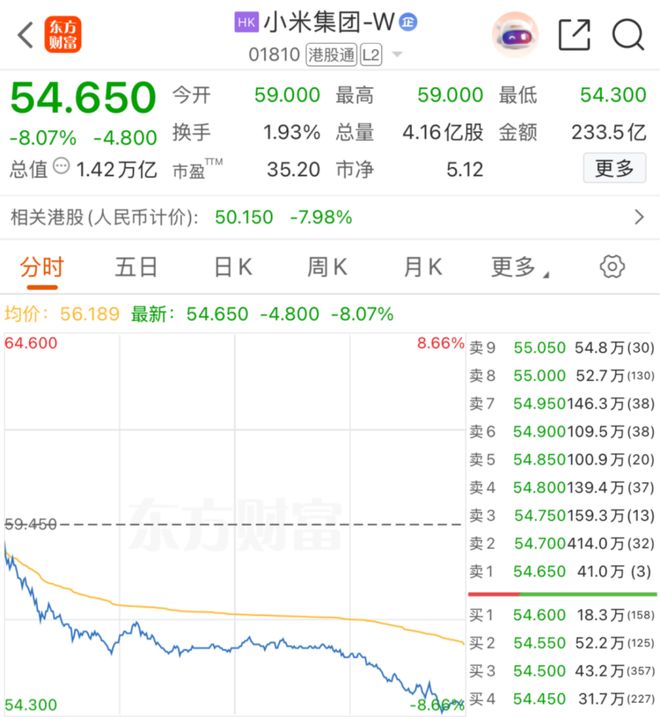
Group 1 - The core viewpoint of the news is that the Hong Kong stock market, particularly technology stocks, experienced a significant drop on September 26, with Xiaomi Group's stock falling over 8% due to profit-taking by short-term investors after a product launch event [1][2][4] - Xiaomi Group's stock closed at 54.65 HKD per share, with a total trading volume of 23.35 billion HKD on the day of the drop [2] - The company's chairman, Lei Jun, emphasized the importance of self-developed chips for Xiaomi's success, committing to invest at least 50 billion RMB over the next decade [4] Group 2 - Other technology stocks in Hong Kong also declined, with the Hang Seng Technology Index dropping over 3%, and notable declines in companies like Horizon Robotics and Kingsoft [6] - Morgan Stanley expressed optimism about Xiaomi's new flagship smartphone series, predicting that the sales performance could exceed expectations and maintain an "overweight" rating with a target price of 62 HKD [5] - UBS maintained a positive outlook on Chinese stocks, expecting further growth potential in the market, particularly in the technology sector [7]