
反内卷政策

Search documents
未知机构:维远股份PC扩产接近尾声电解液投产在即2026年有望轻装上阵-20260120
未知机构· 2026-01-20 02:20
Company and Industry Summary Company: Weiyuan Co., Ltd. (维远股份) Key Points - **2025 Profit Forecast**: The company announced a profit warning for 2025, expecting a net loss attributable to shareholders of 950-1,050 million yuan, primarily due to impairment provisions for long-term assets and inventory, which account for approximately 630 million yuan of the loss [1][2] - **Price Recovery**: Multiple major product prices have begun to rise from their bottom levels, and with the reduction of future impairment risks, the company's performance is expected to reach a turning point [2] - **PC Industry Outlook**: The expansion phase in the PC (Polycarbonate) industry is nearing completion. The company has undertaken technical upgrades to its existing 130,000 tons/year capacity, which is expected to enhance capacity and reduce unit costs. Additionally, no new capacity is anticipated in the PC industry by 2026 [2] - **Current PC Pricing**: As of January 16, the price of PC is 14,185 yuan/ton, reflecting an increase of 631 yuan/ton (4.66%) since the price low in September 2025 [2] - **Supply-Demand Dynamics**: The overall supply-demand landscape of the "Phenol-Acetone—Bisphenol A—PC" industry chain is expected to gradually improve, providing significant upward elasticity in profit levels due to the ongoing "anti-involution" policies [2] - **Electrolyte Production**: The company is on the verge of launching a 250,000 tons/year electrolyte project, which is anticipated to contribute to a second growth curve. The existing 100,000 tons/year dimethyl carbonate facility will add 50,000 tons/year of dimethyl carbonate, 29,400 tons/year of diethyl carbonate, 150,400 tons/year of methyl ethyl carbonate, and 20,000 tons/year of propylene carbonate upon completion [2] - **Propylene Oxide Performance**: The company has a propane dehydrogenation capacity of 600,000 tons/year and an epoxy propane capacity of 300,000 tons/year. As of January 16, the price of epoxy propane is 8,620 yuan/ton, having increased by 700 yuan/ton weekly and 1,675 yuan/ton (24.12%) since the price low in 2025, indicating a significant improvement in profitability [3]

年末需求进入淡季,关注供给改善品种 | 投研报告
Sou Hu Cai Jing· 2026-01-20 01:51
Group 1: Cement Industry - The national market is gradually entering the off-season, with overall demand showing a downward trend, particularly in the housing construction market, while infrastructure demand is regionally differentiated under policy influence, and the civil market shows relatively rigid demand [1] - In the medium term, the cement industry's capacity is expected to continue declining under policies limiting overproduction, leading to a significant increase in capacity utilization and profit elasticity [1] - Key companies to watch include Conch Cement and Huaxin Cement [1] Group 2: Glass Industry - The demand side is experiencing a continuous decline in 2025 due to the impact of real estate, with short-term demand during the traditional peak season showing limited improvement and high inventory levels among intermediaries [1] - The supply side faces ongoing supply-demand contradictions, and despite recent cold repairs of multiple production lines, prices are expected to remain low and fluctuate in the short term [1] - Key company to watch is Qibin Group [1] Group 3: Glass Fiber Industry - As the year-end approaches, many pool kiln factories focus on cash collection, resulting in weak performance in middle and downstream deliveries [2] - The supply side sees the completion of cold repairs at China Jushi's production line, with a resurgence in production; the electronic yarn segment is thriving due to demand from the AI industry, leading to a rise in both volume and price for low dielectric products [2] - Key companies to watch include China Jushi and China National Building Material [2] Group 4: Consumer Building Materials - The industry has reached a profitability bottom, with prices having no downward space after years of competition; there is a strong demand for price increases and profit improvement driven by anti-involution policies [2] - In 2025, multiple categories such as waterproofing, coatings, and gypsum boards are expected to issue price increase notices, with anticipated profit improvements for leading companies in 2026 [2] - Key companies to watch include Oriental Yuhong, Sankeshu, Beixin Building Materials, and Rabbit Baby [2] Group 5: Market Overview - In the past week (January 12–18), the main index performance was as follows: the Shenwan Building Materials Industry Index decreased by 0.67%, the Shanghai Composite Index decreased by 0.45%, the Shenzhen Component Index increased by 1.14%, the ChiNext Index increased by 1.00%, and the CSI 300 Index decreased by 0.57% [2] - Among the 31 first-level sub-industry indices in Shenwan, the building materials sector ranked 18th in terms of performance [2]


碳酸锂的分歧在哪里
2026-01-20 01:50
Summary of Conference Call on Lithium Carbonate Market Industry Overview - The conference call focused on the lithium carbonate market, discussing both short-term and long-term trends in supply and demand dynamics [1][2]. Key Points and Arguments Market Dynamics - Current market transactions reflect long-term factors such as an increase in lithium price central tendency and fundamental improvements, while short-term supply remains weak against strong demand [1][2]. - The demand for lithium during January and February showed resilience, with a year-on-year decline of less than 4%, contrasting with typical declines of 20%-30% during the same period in previous years [2]. Supply Constraints - Short-term supply is limited due to slow environmental assessments for mining operations and stringent solid waste management regulations [2]. - The expected supply growth for lithium in 2026 is around 20%, primarily concentrated in the second half of the year, with a total supply chain increment of approximately 400,000 tons [5]. Demand Projections - Demand for power batteries is anticipated to grow by 10%-15%, while energy storage demand is expected to double domestically and increase by about 60% internationally, leading to an overall demand growth of approximately 30% [5]. Price and Profit Distribution - The introduction of anti-involution policies is expected to optimize performance and profit distribution within the lithium battery sector, with recent government actions aimed at improving cost structures and redistributing profits [3][4]. - The export tax rate for certain materials will decrease from 9% to 6% starting April 1, 2023, with a complete removal planned for 2027, which is expected to promote healthier market pricing [4]. Long-term Outlook - The long-term capital expenditure in the lithium industry is limited, with a supply ceiling estimated at around 3 million tons. Without new greenfield mining projects, supply will face constraints [6]. - The current phase is viewed as an opportunity for investment, as the market is in a price correction phase while maintaining a strong demand-supply imbalance [7]. Additional Important Insights - In the most optimistic supply and neutral demand scenario, a surplus of approximately 100,000 tons of lithium carbonate is expected, which could be balanced if inventory levels reach one month [5]. - The market is currently experiencing a price correction, which is seen as a good entry point for investments in the equity sector, given the clear upward trend in the price central tendency [6][7].
财信宏观 | 2025顺利收官,2026向新而行——2025年宏观数据点评
Xin Lang Cai Jing· 2026-01-20 00:36
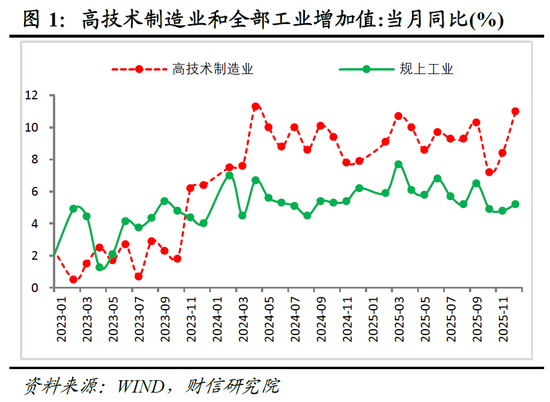
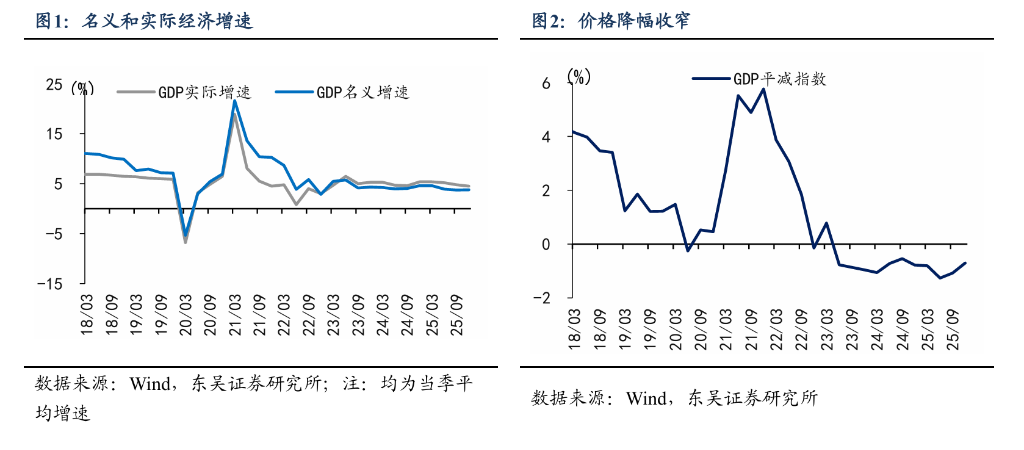
Economic Outlook for 2025 - The GDP growth for 2025 is projected at 5.0%, with a quarterly growth of 4.5% in Q4, characterized by a "strong supply, weak demand" scenario and low inflation pressure [1][4][54] - The macroeconomic policy is expected to strengthen, but the efficiency of transmission and marginal effectiveness needs improvement [1][5][54] - The transition from old to new economic drivers is accelerating, with significant structural optimization [1][7][54] Economic Forecast for 2026 - GDP growth for Q1 2026 is anticipated at 4.9%, with an annual growth of around 4.8% [1][54] - Despite the continuation of the "strong supply, weak demand" pattern, the contribution from high-tech manufacturing and modern services is expected to increase, enhancing internal growth resilience [1][54] December Economic Performance - The economy in December continued to show a "production recovery, consumption and investment under pressure" structural characteristic, with industrial value-added and service production indices both improving [2][55] - Social retail sales grew by only 0.9%, with high base effects and weak consumption from low-income groups being major drag factors [2][55] - Investment saw a cumulative decline, with manufacturing, infrastructure, and real estate investment growth rates all accelerating downward [2][55] Inflation Trends - Inflation is expected to continue its upward trend in 2026, following a weak inflation environment in 2025, where the GDP deflator index decreased by 1.0% [2][4][54] - By the end of 2025, signs of improvement were noted, with CPI rising for four consecutive months and PPI showing positive month-on-month growth for three months [2][4][54] Financial Data Insights - The growth rate of social financing continued to slow, with a significant reliance on government bonds, which contributed 76% of the annual increase in social financing [3][57] - In December, social financing and M1 growth rates continued to decline, but there were signs of improvement in corporate credit [3][57] - The overall credit growth is expected to stabilize gradually, although social financing still faces downward pressure [3][57]

债市 迎来小幅修复行情
Qi Huo Ri Bao· 2026-01-19 17:52
Group 1 - The core viewpoint of the news is that the central bank's recent monetary policy adjustments aim to support key sectors and enhance financial stability while managing inflation expectations [1][2][3] - In January, the bond market experienced fluctuations, initially declining due to stronger-than-expected economic indicators, including a manufacturing PMI above 50% and CPI rising to its highest level since March 2023 [1] - The central bank implemented a structural interest rate cut of 0.25 percentage points on January 15, optimizing various monetary policy tools to support strategic sectors and small private enterprises [1][2] Group 2 - The overall economic resilience and the acceleration of high-quality transformation are emphasized, with the central bank's policies focusing on targeted support rather than broad measures [2] - The central bank conducted a 900 billion yuan six-month reverse repurchase operation on January 15, indicating a continued injection of medium-term liquidity into the market [2] - The bond market is expected to remain supported by a reasonable liquidity environment, with short-term bonds stabilizing while long-term bonds face more negative factors due to rising inflation signals [3]
2025收官:高技术制造领跑,5%目标如期达成,2026年有望“开门红”
Hua Er Jie Jian Wen· 2026-01-19 13:35
Economic Overview - In 2025, China's GDP surpassed 140 trillion yuan, achieving a year-on-year growth of 5%, successfully meeting the government's growth target despite complex external conditions and domestic supply-demand contradictions [1] - The industrial production, particularly in high-tech manufacturing, showed strong resilience, with exports exceeding expectations and becoming a key driver of economic growth [1] Production Sector - Industrial production was a major highlight in 2025, with a year-on-year increase of 5.2% in December for large-scale industrial added value, and high-tech manufacturing value growing by 11%, more than double the overall industrial growth rate [5] - Specific products like industrial robots and integrated circuits saw significant production increases of 14.7% and 12.9%, respectively, indicating the strengthening role of new productive forces in the economy [5] - The supply-side structure is changing due to "anti-involution" policies, leading to a reduction in blind expansion in some industries, with solar cell production growth dropping from 18.2% in the first half to -9.7% in December [7] Export Performance - The export value of large-scale industrial products increased by 2.2% year-on-year in 2025, with notable performance in equipment manufacturing sectors such as railways, ships, and aerospace [7] Consumption Sector - The consumption market exhibited a structural characteristic where services outperformed goods, with service retail sales growing by 5.5% compared to goods retail [9] - The "old-for-new" policy showed mixed effects, with communication equipment retail sales surging by 20.9% in December, while categories like home appliances and automobiles faced demand pressure, declining by 18.7% and 5%, respectively [9][10] - There is a noticeable trend of consumption downshifting, with rural retail sales growing by 1.7%, surpassing urban growth of 0.7% [9] Investment Trends - Fixed asset investment decreased by 3.8% in 2025, with real estate development investment dropping by 17.2%. However, signs of stabilization in real estate sales were observed, with a narrowing decline in December for both sales value and area [11] - Equipment renewal investment grew by 11.8%, supported by special government bonds, marking a structural highlight in the investment sector [11] Outlook for 2026 - The market anticipates a "good start" for 2026, driven by the continued effects of the "old-for-new" policy, proactive government bond issuance, and the release of delayed policies [11] - The focus will shift towards deeper economic structural transformation, emphasizing consumption over investment and technology over traditional manufacturing [11]
热卷日报:震荡偏弱-20260119
Guan Tong Qi Huo· 2026-01-19 09:48
Report Industry Investment Rating - The report suggests a cautious and bullish approach, recommending buying on dips [6]. Core Viewpoints - The current output pressure of hot-rolled coils is not significant. The anti-involution policy still holds expectations, providing strong support at the lower end. The weekly-on-week recovery of apparent demand remains strong year-on-year, indicating strong resilience in off-season demand. The warming sentiment of winter storage may drive a wave of demand. Although the total inventory is relatively high, there has been continuous destocking recently, and if this trend continues, the pressure will ease. The hot-rolled coil futures have currently fallen below the 5-day and 10-day moving averages, and attention should be paid to the support around the 30-day moving average in the medium term. However, it has not completely broken out of the oscillation range [6]. Summary by Relevant Catalogs Market行情回顾 - Futures prices: The trading volume of the main hot-rolled coil futures contract on Monday decreased compared to the previous trading day. It showed a weak oscillation during the day, falling below the 5-day and 10-day moving averages in the short term. It closed at 3,299 yuan/ton, down 25 yuan or 0.75%. The intraday low was 3,291 yuan, and the high was 3,340 yuan. The open interest decreased by 12,645 lots, and the trading volume was 486,769 lots [1]. - Spot prices: The price of hot-rolled coils in the mainstream Shanghai area was reported at 3,290 yuan/ton, down 10 yuan from the previous trading day [2]. - Basis: The basis between futures and spot was -9 yuan, with futures slightly at a premium to the spot [3]. Fundamental Data - Supply: As of January 15, the weekly output of hot-rolled coils increased by 28,500 tons to 3.0836 million tons compared to the previous week. Year-on-year, it decreased by 118,300 tons. The output has rebounded for three consecutive weeks, mainly due to improved profitability of steel mills, increased production enthusiasm, the transfer of hot metal from building materials to plates by some steel mills, and the resumption of production after the end of annual maintenance [4]. - Demand: As of January 15, the weekly apparent consumption increased by 58,200 tons to 3.1416 million tons compared to the previous week. The apparent demand rebounded significantly this week, up 5,100 tons year-on-year. The demand data is at a high level in recent years, with demand still showing resilience, mainly driven by accelerated exports and rigid procurement in the manufacturing industry. The willingness of end-users to stock up actively is weak, and speculative demand is also weak [4]. - Inventory: As of January 15, the total inventory decreased by 58,000 tons to 3.6233 million tons week-on-week (the social inventory decreased by 50,100 tons, and the steel mill inventory decreased by 7,900 tons). The total inventory continued to be destocked, indicating that the current demand for hot-rolled coils has resilience. The total inventory is at a high level in the past five years. If destocking can continue, the pressure on prices will decrease [4]. - Policy: The new regulations on the export license management of steel products will cause short-term fluctuations in exports, increase supply, and put pressure on prices. In the long term, it will promote industrial upgrading, structural optimization, and competitiveness improvement. The Central Economic Work Conference in December proposed a proactive fiscal policy and a moderately loose monetary policy, and listed the in-depth rectification of involution-style competition as a key task for 2026, which is beneficial to prices and industry profitability. Efforts will be made to stabilize the real estate market and expand domestic demand [5]. Market Driving Factor Analysis - Bullish factors: Decrease in supply output, expectation of the start of winter storage demand, rush for export market, policy support ("14th Five-Year Plan", infrastructure investment), and strong iron ore as a furnace charge [6]. - Bearish factors: The resumption of production of steel mills in January exceeded expectations, seasonal weakening of demand, insufficient manufacturing orders, and inventory accumulation suppressing prices [6].
核心是能够找到多少“预期差”!淡水泉赵军与陶冬最新对话,细谈2026年投资机会
Xin Lang Cai Jing· 2026-01-19 07:08
Core Insights - The dialogue between Zhao Jun and Tao Dong focuses on investment opportunities for 2026, highlighting a positive sentiment towards Chinese assets and a shift in market logic from valuation recovery to profit-driven growth [6][7][11]. Market Outlook - The sentiment towards Chinese assets is warming, with expectations for a "slow bull" market and more sustainable trends emerging [7][11]. - The market logic is shifting from valuation recovery to a focus on profit-driven growth, necessitating a more nuanced understanding of industry and company performance [7][11]. - The liquidity environment is seen as a significant supportive factor for the stock market, with potential inflows from both domestic and foreign investors [16][48]. Investment Opportunities - The concept of "expectation difference" is emphasized as a key opportunity in the next 6-12 months, particularly in low-attention assets that have not been fully recognized by the market [8][40][49]. - Key sectors for investment include AI, innovative pharmaceuticals, new consumption trends, and commodities, with a focus on structural opportunities and supply-demand constraints [8][40][55]. - The AI sector is highlighted for its potential, with a focus on domestic market opportunities and applications in various industries, including autonomous driving and robotics [50][51][52]. Structural Changes in Consumption - The consumption landscape is evolving, with new structural opportunities emerging as demographics shift, particularly among younger and older populations [56][58]. - The "new consumption" trend is characterized by a focus on sustainable growth drivers rather than mere volume increases, with an emphasis on understanding consumer behavior and market connections [57][58]. Challenges and Risks - The competitive landscape is marked by "involution" among Chinese enterprises, leading to price wars and constrained profitability, which the "anti-involution" policies aim to address [46][47]. - The market is experiencing a shift towards short-term perspectives in asset pricing, necessitating a focus on risk management and scenario planning [60][61].
核心是能够找到多少“预期差”!淡水泉赵军与陶冬最新对话,细谈2026年投资机会
聪明投资者· 2026-01-19 07:03
Core Viewpoint - The dialogue emphasizes a pragmatic and optimistic investment approach, focusing on identifying and leveraging "expectation gaps" in low-attention assets as key investment opportunities for 2026 [4][6]. Group 1: Market Outlook for 2026 - Investor sentiment towards Chinese assets is warming, with expectations for a "slow bull" market emerging as macroeconomic and geopolitical concerns become less pressing [5][9]. - The market logic is shifting from valuation recovery to profit-driven growth, necessitating a more nuanced understanding of industry and company performance [5][9]. - Liquidity is expected to be a significant supportive factor for the stock market, with both institutional and individual investors showing increased willingness to allocate funds to equities [13][14]. Group 2: Investment Opportunities - The focus for the next 6-12 months is on identifying "expectation gaps" in various sectors, particularly in low-attention assets that have not been fully recognized by the market [6][16]. - Key areas of interest include AI applications, innovative pharmaceuticals, and new consumer trends, with a particular emphasis on structural opportunities that arise from supply-demand constraints [7][22]. - The commodity bull market narrative is being driven by AI and material demand, with potential investment opportunities in mining and exploration sectors expected to yield significant returns [25]. Group 3: Consumer Trends - The concept of "new consumption" is evolving, with structural changes in consumer demographics and preferences creating new investment opportunities [27][28]. - The "people, place, and goods" framework is used to analyze consumption opportunities, highlighting the importance of understanding consumer behavior and market connections [28][29]. - Sustainable growth in consumer sectors is anticipated, particularly in areas that cater to younger and older demographics, as well as products that enhance personal satisfaction [30][31]. Group 4: Risk Management and Investment Strategy - The importance of recognizing crowded trades and consensus risks is emphasized, as these can lead to market volatility when expectations shift [32]. - Developing investment contingency plans and maintaining a proactive approach to market changes are crucial for navigating uncertainties [33]. - The company advocates for a team-based investment approach, leveraging diverse expertise to adapt to complex market scenarios [37].

煤炭ETF(515220)盘中涨超1%,煤炭板块高分红特点引关注
Sou Hu Cai Jing· 2026-01-19 06:08
Group 1 - The coal ETF (515220) rose over 1% during trading, drawing attention to the high dividend characteristics of the coal sector [1] - According to Tianfeng Securities, the coal industry is positioned within the first layer of the "anti-involution" policy framework, which focuses on "public finance logic" [1] - The policy aims to maintain reasonable profit margins through direct capacity control and price intervention, stabilizing the coal sector as a stabilizer for the fiscal and financial system [1] Group 2 - Under the management of "supply guarantee" and "price limit," the supply elasticity of the coal industry has decreased, leading to narrowed price fluctuations and sustained high industry profit margins [1] - Leading companies in the coal sector are capable of maintaining high dividends, with their assets exhibiting "debt-like" characteristics [1] - In an environment of declining interest rates and growth uncertainty, such assets become a core defensive allocation due to their stable cash flow and high dividends [1] Group 3 - The coal ETF (515220) has a scale exceeding 8 billion yuan, tracking the CSI Coal Index (399998) [1] - The dividend yield of the coal sector is relatively high, with the tracked index expected to have a dividend yield exceeding 6% over the next 12 months by the end of 2025 [1] - The value of allocation becomes prominent against the backdrop of declining risk-free interest rates [1]