
去美元化

Search documents
金银年末狂奔!白银“疯牛”碾压黄金,全金属盛宴引爆?
Sou Hu Cai Jing· 2025-12-23 07:24
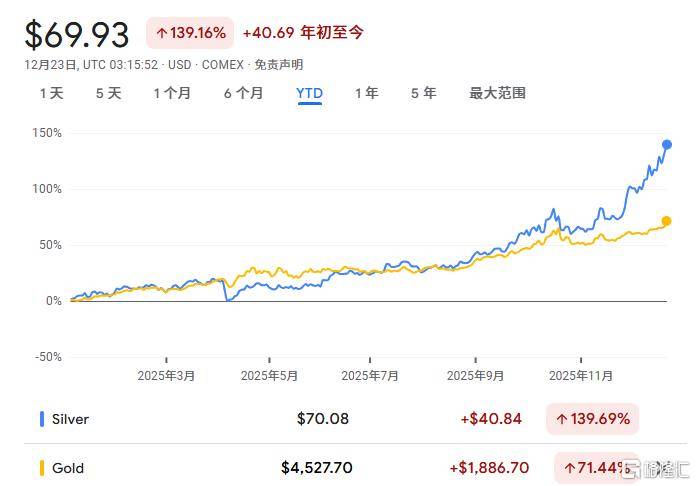
Core Viewpoint - Precious metals, particularly gold and silver, are expected to be the biggest winners among global asset classes this year, with both reaching historical highs and showing significant year-to-date gains [2][9]. Price Performance - Spot silver surpassed $70 per ounce, while spot gold reached $4,490.88 per ounce, both setting new historical records [2]. - Year-to-date, gold has achieved its 50th new high with an increase of over 71%, while silver has surged by 140% [2]. - COMEX gold and silver futures also saw gains exceeding 2%, reaching historical highs [4]. Market Dynamics - The secondary market for gold and precious metal stocks in Hong Kong and A-shares has seen collective upward movement [5]. - Other precious metals like platinum and palladium are also experiencing significant price increases, with platinum hitting a 17-year high and palladium reaching a three-year peak [6][7]. Supporting Factors - Geopolitical tensions have enhanced the safe-haven appeal of gold and silver [10]. - Increased expectations for interest rate cuts have provided support for precious metals, with recent comments from Federal Reserve officials highlighting potential economic risks if rates are not lowered [12]. - Central bank purchases and speculative inflows into silver are also contributing to the price increases, with global central banks accelerating "de-dollarization" and net gold purchases reaching 634 tons in the first three quarters of 2025 [13][14]. Future Outlook - Market expectations suggest that gold and silver prices have not yet peaked, with forecasts indicating potential further increases [18]. - The World Gold Council anticipates a 5%-15% rise in gold prices next year, while major financial institutions like Goldman Sachs and UBS project significant price targets for gold by 2026 [19][20]. - Analysts believe that the foundation for a gold bull market remains intact, with silver potentially having greater upside due to its market dynamics and technical factors [21][23].

2025.12.23-黄金上涨加速,长期继续看多,短期关注波动率指标
Sou Hu Cai Jing· 2025-12-23 06:13
Core Viewpoint - The long-term trend for gold prices is upward, driven by multiple factors including Federal Reserve interest rate cuts, rising geopolitical tensions, ongoing de-dollarization, and continuous gold purchases by central banks [2][3]. Group 1: Factors Supporting Gold Price Increase - Continuous interest rate cuts by the Federal Reserve: On December 11, the Fed cut rates by 25 basis points to a range of 3.5%-3.75%, which reduces the opportunity cost of holding gold. Global gold investment demand reached 1,566 tons in the first three quarters of 2025, an 87% year-on-year increase, offsetting declines in jewelry manufacturing and central bank demand [2]. - Escalation of geopolitical conflicts: Recent tensions, such as Israel's potential strikes on Iranian facilities and ongoing U.S.-Venezuela relations, have increased global demand for safe-haven assets [2]. - Ongoing de-dollarization and weakening of U.S. dollar credit: The U.S. is trapped in a cycle of fiscal deficits and increasing national debt, projected to exceed $38.3 trillion by November 2025, with a debt-to-GDP ratio over 120%. This situation is expected to keep gold prices on an upward trajectory [2]. Group 2: Central Bank Gold Purchases - Since 2008, global gold reserves have steadily increased, with a total rise of 6,351 tons by the third quarter of 2025 compared to 2008. The proportion of gold in the foreign exchange reserves of many central banks has been on the rise since 2021 [3]. Group 3: Market Analysis and Investment Strategy - Historical data shows that gold prices have increased by approximately 1.5 times since 2019, but past decades have seen much larger increases. If a collapse of global currency credit occurs, future gold price increases could be significant. The importance of timing in gold investments is emphasized, with technical indicators like volatility and trading volume being more effective than fundamental analysis for short-term trends [4]. - Gold is considered a non-yielding asset, making it more suitable for long-term investment rather than frequent trading. Economic factors have less influence on gold pricing, which has decoupled since 2022. The management and custody fees for gold ETFs, such as Huaxia (518850) and gold stock ETF (159562), are among the lowest in their category, facilitating lower-cost participation in the gold market [4].
机构看金市:12月23日
Xin Hua Cai Jing· 2025-12-23 05:49
Core Viewpoints - Precious metals are expected to maintain an upward trend due to geopolitical tensions and expectations of interest rate cuts by the Federal Reserve [2][4] - Silver prices may face further correction risks, while gold's market structure appears relatively strong [1][2] Group 1: Market Analysis - Nanhua Futures indicates that the precious metals market continues to experience supply constraints, with strong demand from investment and allocation sides. The largest gold ETF, SPDR Gold Trust, saw an increase of 12.02 tons to 1064.56 tons, while the largest silver ETF, iShares Silver Trust, surged by 533.01 tons to 16599.25 tons [1] - Dongwu Futures reports that the U.S. November CPI rose by 2.7% year-on-year, below the expected 3.1%, which may support further interest rate cuts by the Federal Reserve. Precious metals are expected to benefit from geopolitical conflicts and a weakening dollar [2] - Kitco Metals highlights that geopolitical tensions have led to strong increases in gold and silver prices, with the next target for gold being a stable close above 4500 USD [3] Group 2: Geopolitical Factors - FXStreet notes that ongoing geopolitical tensions, particularly in the Caribbean and between Iran and Israel, are driving gold prices higher. The market anticipates a 59 basis point rate cut by the Federal Reserve in 2026, contributing to the bullish outlook for gold [4] - The recent events, including U.S. actions in Venezuela and the assassination of a Russian general, have heightened market concerns, further supporting the rise in precious metal prices [3]

突破历史极值!黄金期货现货携手飙升 国内金价站上千元大关
2 1 Shi Ji Jing Ji Bao Dao· 2025-12-23 05:49
值得关注的是,此次领涨的COMEX黄金与现货黄金分属不同交易品种,交易规则存在差异。 作为全球黄金定价基准之一,COMEX黄金是纽约商品交易所(隶属于芝加哥商业交易所集团)推出的 美式黄金期货合约(交易代码GC),每宗交易量100金衡盎司、标的为99.5%成色金,涵盖期货、迷你 期货等多种交易类型,迷你期货每宗交易量50盎司、最小波动0.25美元/盎司,实行保证金制度并支持 实物交割;其市场参与者以大型对冲基金及机构为主、流动性充足,价格受美联储政策和地缘风险等因 素显著影响,交易时段主要分为夏令时(北京时间6:00-次日5:00)和冬令时(7:00-次日5:00)。 (原标题:突破历史极值!黄金期货现货携手飙升 国内金价站上千元大关) 21世纪经济报道记者 张欣 延续本周一的上涨热潮,12月23日11点17分,黄金期货与现货黄金价格双双暴涨并再创历史新高。其 中,COMEX黄金升破4500美元/盎司,年内涨幅超71%;现货黄金升破4485美元/盎司,年内涨幅超 70%,两大品种均刷新历史纪录。 此次新高行情并非突然爆发,12月22日国际金价已率先发力,现货黄金盘中首次突破4400美元/盎司整 数关口,为后续 ...
全线大涨!金饰价冲上1403元,白银首破70美元,专家称黄金可能突破5200美元
Xin Lang Cai Jing· 2025-12-23 05:32
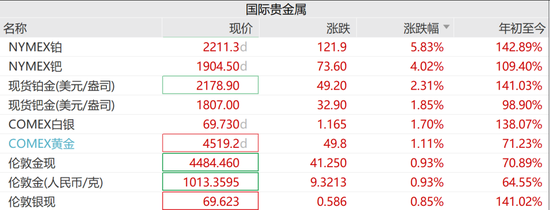
Core Viewpoint - The gold prices have surged to historic highs, with COMEX gold surpassing $4500 per ounce and spot gold exceeding $4485 per ounce, marking annual increases of over 71% and 70% respectively [1][12]. Price Movements - As of December 23, 2025, COMEX gold reached $4519.2 per ounce, reflecting a 1.11% increase on that day and a 71.23% increase year-to-date [2][13]. - Spot platinum and palladium also saw significant increases, with platinum at $2211.3 per ounce (up 5.83% for the day) and palladium at $1807.00 per ounce (up 1.85% for the day) [2][13]. - Domestic gold prices have crossed the 1000 RMB per gram mark, with prices reported at 1009 RMB per gram, corresponding to an international price of $4479 per ounce [3][14]. Market Dynamics - The surge in gold prices is attributed to multiple factors, including expectations of interest rate cuts by the Federal Reserve, geopolitical uncertainties, and a trend towards de-dollarization [9][20]. - Central banks globally are increasing their gold reserves, with a reported net addition of 1045 tons in 2024, which is 21% of the global gold production for that year [10][21]. Regulatory Changes - The Shanghai Gold Exchange has announced fee adjustments for trading in 2026, including reduced fees for various contracts, aiming to manage the market's volatility [17]. - The Shanghai Futures Exchange has also set limits on the maximum number of contracts for silver futures trading, effective December 24, 2025 [19]. Future Outlook - Analysts predict that gold prices may stabilize between $4500 and $5000 per ounce, with extreme scenarios potentially exceeding $5200 per ounce [11][22]. - The ongoing trend of central banks increasing gold holdings is expected to remain a significant factor influencing the gold market in 2026 [21].
现货黄金再度刷新历史高点,黄金ETF、上海金ETF上涨,年内涨幅超62%
Ge Long Hui· 2025-12-23 03:14
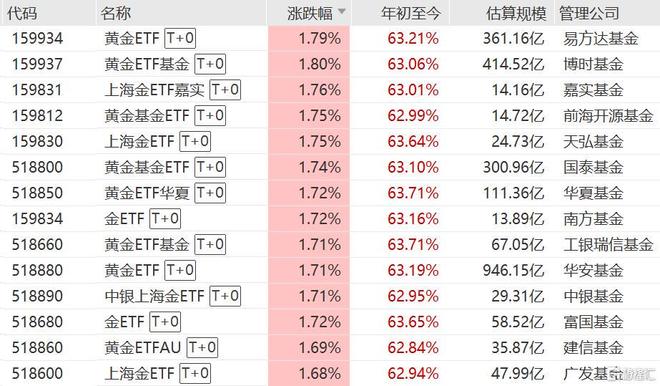
Group 1 - Spot gold has reached a new historical high, with London gold prices surpassing $4,490 per ounce, marking a year-to-date increase of 70.87%, nearing the largest annual increase since 1979 [1] - Gold ETFs, including various funds, have also seen significant gains, with year-to-date increases exceeding 62% [1] Group 2 - International gold and silver futures prices have reached historical highs, influenced by geopolitical tensions, particularly the U.S. seizure of a Venezuelan oil tanker, adding uncertainty to the market [3] - Analysts from UBS noted that gold prices rebounded quickly from a drop at the end of October, solidifying its position as one of the strongest assets this year, driven by geopolitical unrest and changes in the U.S. interest rate environment [3] - Central banks and investors continue to show strong demand for gold, with global central bank purchases expected to reach between 900 to 950 metric tons this year [3] Group 3 - Wall Street is optimistic about gold prices in the coming year, with target ranges between $4,800 and $5,000, driven by strong central bank purchases and ongoing fiscal concerns in the U.S. [4] - HSBC's report emphasizes that the U.S. fiscal deficit is a significant factor driving gold demand, as investors increasingly view gold as a hedge against debt sustainability risks and potential dollar weakness [4] Group 4 - The Federal Reserve's recent decision to lower interest rates is seen as dovish, which is favorable for gold, with expectations of further rate cuts increasing [5] - Long-term factors indicate a continued decline in global dollar reserves and rising U.S. fiscal deficits, which are beneficial for gold's monetary attributes [5] - Concerns about domestic physical gold demand due to new tax policies and potential declines in jewelry demand by 2026 highlight the importance of central bank purchases and investment demand to offset these declines [5]
美国制造业回流梦碎?高成本与劳动力断层下的产业链困局
Sou Hu Cai Jing· 2025-12-23 03:00
Core Insights - The article discusses the complex realities behind the global restructuring of supply chains, driven by geopolitical factors, which has led to higher costs, slower processes, and increased fragility in manufacturing [1][2]. Group 1: Geopolitical and Economic Factors - Manufacturing is not simply "returning" but is becoming "more expensive, slower, and more fragile" due to geopolitical influences [2]. - The interplay of technology, finance, labor, and resources is creating a multi-faceted competition that is reshaping global supply chains [2]. - The rise of regionalization and fragmentation in global supply chains is a significant trend that companies must prepare for [2]. Group 2: Technological Decoupling - The costs of technological decoupling include fragmentation of global innovation and standards, as well as a decline in supply chain integration capabilities [4]. - Increased technological barriers among countries complicate industry cooperation and hinder efforts for standardization [4]. - Geopolitical risks are driving companies to increase liquidity assets, which in turn reduces domestic R&D investments and raises intermediate goods trade costs [4]. Group 3: Labor Market Challenges - Labor rights disputes and structural imbalances in labor markets are significant challenges in the reconfiguration of supply chains [5]. - In traditional outsourcing locations like Mexico, rising strike rates in key industries highlight labor dissatisfaction, which disrupts supply chain continuity [5]. - The mismatch between labor skills and industry demands in economies advocating for manufacturing return is slowing down the restructuring process [5]. Group 4: High Costs of Manufacturing Return - The high costs associated with manufacturing return are undermining the effectiveness of policy incentives [6]. - Structural issues such as high local manufacturing costs and inflation are exacerbating the challenges of returning manufacturing to the U.S. [6]. - The rising cost of capital and declining confidence in long-term U.S. Treasury bonds reflect a broader concern about the investment environment [6]. Group 5: Trade Policy Impacts - High trade barriers can provide short-term benefits but lead to long-term negative consequences for industries [7]. - The reintroduction of tariffs under the Trump administration aimed to reshape global supply chains but had limited effectiveness [7]. - The restructuring of global supply chains involves not only capacity reallocation but also significant adjustments in financial order and settlement systems [7]. Group 6: De-dollarization Trends - Emerging markets are increasingly adopting local currency settlements in trade, reflecting a shift away from reliance on the U.S. dollar [8]. - The weakening of the U.S. credit mechanism is accelerating the de-dollarization process, with countries seeking alternatives to mitigate currency risks [8]. - The share of the U.S. dollar in global central bank reserves has decreased significantly, indicating a long-term trend towards de-dollarization [8]. Group 7: Regional Currency Networks - The establishment of regional currency settlement networks is becoming a complementary effort to the regionalization of supply chains [9]. - Initiatives like the Regional Comprehensive Economic Partnership are promoting local currency exchange mechanisms to enhance trade efficiency [9]. - Central bank digital currencies, such as the digital yuan, are emerging as potential new vehicles for cross-border settlements [9]. Group 8: New Competitive Dynamics - The formation of a new competitive landscape reflects the division of standards between the Global North and South, particularly in technology and resources [10]. - The disparity in technological capabilities is creating a polarized global supply chain, complicating innovation and cooperation [10]. - Resource nationalism is becoming a critical factor in global supply chain dynamics, as countries seek to protect their strategic resources [10].
西南期货早间评论-20251223
Xi Nan Qi Huo· 2025-12-23 02:36
Report Industry Investment Ratings No relevant information provided. Core Views - The overall outlook for various futures markets is diverse. Some markets are expected to have upward trends, some to be in a weak or strong oscillation, and some are recommended for specific trading strategies such as waiting for opportunities or light - position participation [6] [7] [9]. Summary by Categories Bonds - **Treasury Bonds**: On the previous trading day, treasury bond futures closed down across the board. The central bank conducted 67.3 billion yuan of 7 - day reverse repurchase operations on December 22, with a net withdrawal of 63.6 billion yuan. LPR remained unchanged for 7 consecutive months. Given the current situation, treasury bond futures are expected to face some pressure [5]. - **Investment Strategy**: Remain cautious [6]. Stock Index Futures - **Market Performance**: On the previous trading day, stock index futures showed mixed trends. The CSRC will halve the delivery fees of stock index futures and treasury bond futures and the exercise (performance) fees of stock index options from January 1, 2026, to December 31, 2026. - **Investment Strategy**: The volatility center of the stock index is expected to gradually move up, and investors can choose the right time to go long [7]. Precious Metals - **Market Performance**: On the previous trading day, the gold and silver main contracts rose. The complex global trade and financial environment, the trend of "de - globalization" and "de - dollarization", and the possible continuous interest rate cuts by the Federal Reserve are all beneficial to precious metals. - **Investment Strategy**: Wait and see for now and wait for opportunities to go long [9]. Steel and Iron - related Products - **Rebar and Hot - Rolled Coil**: On the previous trading day, rebar and hot - rolled coil futures oscillated weakly. In the medium term, the price is mainly determined by industry supply and demand. The demand for rebar is in a downward trend year - on - year, and the market will enter the off - season. Although the supply pressure has eased, the inventory is higher than last year. - **Investment Strategy**: Investors can pay attention to shorting opportunities at high levels during rebounds and manage positions carefully [11]. - **Iron Ore**: On the previous trading day, iron ore futures oscillated. The supply - demand pattern is weak, and the futures may face resistance near the previous high. - **Investment Strategy**: Investors can pay attention to shorting opportunities at high levels and manage positions carefully [13]. - **Coking Coal and Coke**: On the previous trading day, coking coal and coke futures rebounded slightly. The supply of coking coal decreased in December, and the procurement of downstream coking enterprises increased. The third - round price cut of coke spot procurement has started, and the demand from steel mills has weakened. - **Investment Strategy**: Investors can pay attention to buying opportunities at low levels and manage positions carefully [16]. - **Ferroalloys**: On the previous trading day, manganese silicon and silicon iron main contracts rose. The supply of manganese ore decreased, and the cost of ferroalloys increased. The demand for ferroalloys was weak, and the inventory continued to rise. - **Investment Strategy**: Consider long - position opportunities at low levels after the expansion of spot losses [18]. Energy Products - **Crude Oil**: On the previous trading day, INE crude oil opened high and went high. The CFTC data showed that US funds reduced their net short positions, and the number of active oil and gas rigs in the US decreased. Barclays maintained its 2026 Brent crude price forecast. - **Investment Strategy**: Pay attention to long - position opportunities [19] [20]. - **Fuel Oil**: On the previous trading day, fuel oil rose significantly. The Asian spot fuel oil market was weak, but the on - shore inventory was relieved. The sudden tightness of Asian fuel oil supply and the stable trend of crude oil supported the fuel oil price. - **Investment Strategy**: Pay attention to long - position opportunities [22] [23]. Chemical Products - **Polyolefin**: On the previous trading day, the PP market in Hangzhou and the LLDPE market in Yuyao showed a downward trend. The supply pressure of standard products is expected to slow down slightly, and the downstream demand is expected to weaken. - **Investment Strategy**: Pay attention to long - position opportunities [25]. - **Synthetic Rubber**: On the previous trading day, the synthetic rubber main contract rose. The price was supported by cost and demand in the short term, and attention should be paid to the changes in supply - side equipment and demand - side recovery. - **Market Outlook**: Oscillate [27] [29]. - **Natural Rubber**: On the previous trading day, the natural rubber main contract fell. The market is expected to have a long - short game, and the rubber price may oscillate. - **Market Outlook**: Oscillate [30] [31]. - **PVC**: On the previous trading day, the PVC main contract fell. The supply - demand imbalance continues, but the downward space may be limited. - **Investment Strategy**: Pay attention to the changes on the supply side [32] [33]. - **Urea**: On the previous trading day, the urea main contract fell. The daily output of urea is expected to fluctuate slightly, and the demand is expected to increase slightly. - **Market Outlook**: The downward space is limited [34] [35]. - **PX**: On the previous trading day, the PX2603 main contract rose. The PXN spread is at a neutral - to - high level, and the short - term profit is improving. The supply - demand pattern has improved, and the cost of crude oil has a short - term driving force. - **Investment Strategy**: Pay attention to long - position opportunities at low levels, be vigilant about crude oil changes, and pay attention to macro - policy changes [36] [37]. - **PTA**: On the previous trading day, the PTA2605 main contract rose. The supply load decreased, and the demand load remained stable. The processing fee decreased, and the inventory was low. - **Investment Strategy**: Consider long - position opportunities following the cost side, control risks, and pay attention to oil price changes [38]. - **Ethylene Glycol**: On the previous trading day, the ethylene glycol main contract fell. The supply pressure increased, the port inventory continued to rise, and the demand support weakened slightly. - **Investment Strategy**: Consider trading within the range and pay attention to port inventory and supply changes [39] [40]. - **Short Fiber**: On the previous trading day, the short fiber 2602 main contract rose. The supply decreased but remained at a high level, the demand support weakened, and the cost - driving force increased. - **Investment Strategy**: Follow the cost - side logic, pay attention to cost changes and macro - policy adjustments, and control risks [41]. - **Bottle Chip**: On the previous trading day, the bottle chip 2603 main contract rose. The processing fee decreased, the supply load decreased slightly, and the export growth rate increased. - **Investment Strategy**: Follow the cost - side logic and control risks [42]. Non - ferrous Metals - **Copper**: On the previous trading day, the Shanghai copper main contract was flat. The macro - situation is complex, with concerns about economic recession and speculation about Fed rate cuts. The fundamentals remain in a tight balance, and the copper price is expected to remain in a high - level oscillation. - **Market Outlook**: High - level oscillation [44] [45]. - **Aluminum**: On the previous trading day, the Shanghai aluminum main contract fell, and the alumina main contract rose. The alumina supply is in surplus, and the aluminum price may maintain a high - level oscillation. - **Market Outlook**: High - level oscillation [46] [47]. - **Zinc**: On the previous trading day, the Shanghai zinc main contract fell. The zinc price lacks strong driving force, and it is expected to oscillate and adjust. - **Market Outlook**: Oscillate and adjust [48] [49]. - **Lead**: On the previous trading day, the Shanghai lead main contract rose slightly. The consumption is in the off - season, and the lead price is expected to oscillate weakly within a range. - **Market Outlook**: Oscillate within a range [50] [51]. - **Tin**: On the previous trading day, the tin main contract fell. The supply is tight, and the demand has certain resilience. The tin price is expected to oscillate strongly. - **Market Outlook**: Oscillate strongly [53]. - **Nickel**: On the previous trading day, the nickel main contract rose. The Indonesian policy risk increases, and the nickel market is in a surplus pattern. - **Investment Strategy**: Pay attention to relevant Indonesian policies [54]. Agricultural Products - **Soybean Oil and Soybean Meal**: On the previous trading day, soybean meal and soybean oil main contracts rose. The domestic soybean supply is relatively loose, the demand for soybean meal grows moderately, and the demand for soybean oil improves slightly. - **Investment Strategy**: Pay attention to long - position opportunities for soybean meal at the low - cost support interval and long - position opportunities for soybean oil call options at the low interval [55] [56]. - **Palm Oil**: The Malaysian palm oil price rose. The domestic palm oil inventory is at a medium - to - low level in the past 7 years. - **Investment Strategy**: Wait and see for now [57] [59]. - **Rapeseed Meal and Rapeseed Oil**: The Canadian rapeseed price rebounded. The domestic rapeseed meal and rapeseed oil are in the process of destocking. - **Investment Strategy**: Wait and see for now [60] [61]. - **Cotton**: The domestic cotton price oscillated strongly, and the international cotton price oscillated weakly. The domestic cotton output increased, but the inventory accumulation was less than expected, and the cotton price is expected to run strongly. - **Market Outlook**: Run strongly [62] [64]. - **Sugar**: The domestic sugar price rebounded slightly, and the international sugar price rose. The domestic sugar supply pressure is increasing, but the 01 contract is lower than the spot price, and the current warehouse receipt volume is low. - **Market Outlook**: Run weakly and oscillate [66] [69]. - **Apple**: The domestic apple futures oscillated. The apple inventory is at a low level in recent years, and the output and quality have declined. The apple price is expected to run strongly. - **Market Outlook**: Run strongly [70] [71]. - **Pig**: The national average pig price rose slightly. The northern market may turn stronger, and the southern market may slow down its decline. - **Investment Strategy**: Wait and see [73] [74]. - **Egg**: The egg price remained flat. The egg supply in December may remain at a high level, but the demand is weak. - **Investment Strategy**: Wait and see for now [75] [77]. - **Corn and Starch**: The corn and corn starch main contracts rose slightly. The northern port inventory is expected to continue to accumulate, and the demand for corn maintains a slight growth trend. Corn starch may follow the corn market. - **Investment Strategy**: Wait for the release of supply pressure [78] [80].
年度跌幅逼近9% 美指陷政策信用双重困境
Jin Tou Wang· 2025-12-23 02:26
美国经济基本面的疲软态势,为美元指数的弱势提供了基本面支撑。数据层面呈现明显的分化与走弱迹 象:就业市场方面,11月非农新增就业虽略超预期,但失业率升至4.6%,且8-10月就业数据累计下修超 13万个,薪资同比增速放缓至3.5%的近三年低位;经济活力方面,12月美国制造业PMI初值降至51.8的 五个月新低,服务业与综合PMI也同步下滑至六个月低位,反映出经济动能正在逐步放缓。厦门大学教 授蔡庆丰指出,当前美国经济面临"滞胀"担忧,私人需求复苏乏力,企业投资意愿受贸易政策冲击持续 低迷,这种基本面状况难以支撑美元指数形成有效反弹。 技术面来看,美元指数短期处于弱势盘整状态,中长期下行趋势未改。从近期走势看,指数自11月下旬 以来连续跌破100、99两大整数关口,当前在98关口附近挣扎,下方97.50一线构成短期支撑,上方98.50 则形成较强阻力。动量指标显示,指数仍处于下行趋势通道内,空头动能虽有边际减弱,但尚未出现明 确的反转信号。机构预测方面,彭博社汇总的共识显示,超过6家大型投行普遍预计2026年美元指数将 继续走弱,年底可能再下跌约3%;德意志银行更直言,本世纪漫长的美元牛市周期或正接近尾声。 综 ...
美指震荡回落待数据指引 政策与通胀博弈主导走势
Jin Tou Wang· 2025-12-23 02:24
2025年12月23日消息,美元指数(DXY)在连续三日反弹后于亚洲交易时段出现回落,当前交投于98.100 附近。市场在关键宏观数据公布前观望情绪浓厚,投资者普遍降低方向性押注,短期内指数或维持震荡 格局等待新信号指引。 核心数据与政策动向成为短期关键变量。本周二即将公布的美国第三季度GDP年化数据,被市场视为评 估美国经济韧性及美联储下一步政策节奏的核心参考。此前,美联储官员的表态强化了"暂缓行动"的基 调,克利夫兰联储主席哈马克明确表示,当前货币政策处于合适位置,需在第一季度评估此前累计75个 基点降息对经济的实际影响。这一言论被解读为短期内政策调整空间有限,一定程度上为美元提供了支 撑。 利率市场定价也印证了政策观望的预期。CME FedWatch工具显示,美联储1月会议维持利率不变的概率 已升至79.0%,而25个基点降息的可能性则下滑至21.0%,降息预期的回落有效缓解了美元的下行压 力。不过,美国经济基本面呈现分化态势,最新数据显示密歇根大学12月消费者信心指数终值下修至 52.9,消费者预期指数同步回落,反映家庭对经济前景仍持谨慎态度;但值得注意的是,一年期通胀预 期被上修至4.2%,通胀黏性 ...