
弱现实

Search documents
库存持续累积,下游节前存补库预期:铁矿日报-20260127
Guan Tong Qi Huo· 2026-01-27 09:58
1. Report Industry Investment Rating - There is no information about the report industry investment rating in the provided content. 2. Core Viewpoints of the Report - The iron ore market is expected to fluctuate in the short term. The supply pressure has eased slightly due to the decrease in arrivals, while the demand is relatively stable. Although the ports are still accumulating inventory, it is gradually shifting to downstream steel mills. The futures contracts show a back structure and positive basis, with a slight short - term weakness, but the overall downside space may be limited [2][4]. 3. Summary According to the Directory Market行情态势回顾 - **Futures prices**: The main iron ore futures contract continued to fluctuate within a narrow range, closing at 788 yuan/ton, up 3.5 yuan/ton or 0.45% from the previous trading day. The trading volume was 212,000 lots, the open interest was 571,000 lots, and the settled funds were 9.9 billion yuan. The futures market is in a narrow - range consolidation, showing a slight short - term weakness, and attention should be paid to further tests near the short - term support of 780 [1]. - **Spot prices**: The mainstream port spot varieties, such as PB powder at Qingdao Port, rose 6 yuan to 799 yuan, and Super Special powder rose 6 yuan to 678 yuan. The swap's main contract was at 103.7 (+0.15) US dollars/ton. Spot and swap prices increased slightly [1]. - **Basis and spread**: The price of PB powder at Qingdao Port converted to the futures market was 832.4 yuan/ton, with a basis of 44.4 yuan/ton, and the basis narrowed. The iron ore 5 - 9 spread was 18.5 yuan, and the 9 - 1 spread was 12.5 yuan. The iron ore futures contracts showed a back structure and positive basis, with a short - term weakness and limited downside space [1]. Fundamental Analysis - **Supply**: Overseas mine shipments increased, mainly due to the recovery in Australia, while shipments from Brazil and non - mainstream countries declined. The arrivals continued to weaken, and there were expected disturbances on the supply side due to weather. The short - term supply pressure eased, but the inventory pressure was still increasing [2]. - **Demand**: The molten iron output increased slightly month - on - month, the profitability of steel mills recovered, and the rigid demand was relatively stable. Steel mills were in the process of restocking, but the enthusiasm was still weak, and there was strong game between upstream and downstream. Attention should be paid to the recovery height of molten iron and the release rhythm of restocking demand before the festival [2]. - **Inventory**: Port inventories continued to accumulate, and steel mill inventories also increased, but were still significantly lower than the historical average. The total inventory pressure was still building up [2]. Macro - level Analysis - **Domestic**: This week, the domestic macro situation continued the pattern of "weak reality, stable policy, and strong expectation". The recovery of domestic demand was still slow, consumption and investment had not formed an effective resonance, and exports could not offset the insufficient domestic demand. The macro environment was mainly for bottom - support [3]. - **Overseas**: This week, the overseas macro logic revolved around the marginal weakening of demand, the slow decline of inflation, and the increasing policy uncertainty. US consumption was still resilient, but the income growth slowed down, the savings rate was low, and the internal driving force was weakening. Core inflation continued to cool down, but the stickiness in the service sector remained, and the decline of inflation was not smooth. The market's focus shifted to the expectation of the Fed's leadership change, and the policy prospects changed from a single interest - rate cut path to "rhythm and framework game" [3].
1月26日钢铁市场:厉害了广东!万亿项目引爆2026!!节前交易冷清,明日钢价走势如何?
Sou Hu Cai Jing· 2026-01-27 02:50
Group 1 - The overall steel market in South China is stable, with minor fluctuations in individual brands, while the futures market shows an increase in most black series products, led by coking coal with a rise of 1.35% [3] - Guangdong plans to invest over 1 trillion yuan in 2026, with significant allocations for infrastructure, industry, and public welfare projects, which is expected to support steel demand [4] - The China Iron and Steel Association reported a slight decrease in daily crude steel production but an increase in daily steel output, indicating a mixed supply situation that may pressure steel prices [5][9] Group 2 - Guangdong's public budget revenue for 2025 was 1.39 trillion yuan, with a growth of 3%, and the forecast for 2026 is 1.44 trillion yuan, also growing by 3%, indicating stable fiscal conditions that support steel demand [6][7] - The increase in public budget expenditures and the growth in the less developed regions of Guangdong provide ongoing support for steel demand, particularly in construction [7] - The futures market shows a mixed sentiment, with rebar prices rising but with a decrease in positions, indicating weaker momentum despite the price increase [8][9]


开年狂涨50%!碳酸锂期货突破18万关口
2 1 Shi Ji Jing Ji Bao Dao· 2026-01-23 09:22
Group 1 - The lithium carbonate market continues to rise sharply, with futures contracts surging over 7% to exceed 180,000 yuan/ton, closing at 181,520 yuan/ton, indicating a significant increase in market activity [1] - The average price of battery-grade lithium carbonate reached 171,000 yuan/ton, while industrial-grade lithium carbonate averaged 167,500 yuan/ton, both showing daily increases of 6,500 yuan/ton, or approximately 3.95% and 4.04% respectively [1] - Since the beginning of 2026, lithium carbonate prices have increased by 50.46%, breaking through multiple price thresholds within a month [1] Group 2 - The adjustment of export tax rebate policies for battery products is a key driver of the current price surge, with the rebate rate set to decrease from 9% to 6% starting April 1, 2026, and to be completely eliminated by January 1, 2027 [1] - Demand is being driven by downstream manufacturers ramping up production in response to the anticipated reduction in export tax rebates, with phosphate iron lithium manufacturers canceling maintenance to operate at full capacity [1][2] - Supply constraints are evident, with a reported weekly production decrease of 338 tons and inventory reduction of 783 tons, attributed to annual maintenance at lithium salt plants and strong demand from battery manufacturers [2] Group 3 - Despite the bullish sentiment in the market, analysts caution that the current situation reflects a "strong expectation, weak reality" dynamic, with actual improvements in the lithium carbonate fundamentals being limited [2] - The market is experiencing a shift from a "full industry chain destocking" phase to a scenario where smelters and traders are accumulating inventory while downstream manufacturers are passively destocking [2] - Major lithium industry players are accelerating capacity expansion, with significant investments announced for new projects aimed at increasing production capacity [3][4]
资金情绪高涨,PTA远端加工费修复
Hua Tai Qi Huo· 2026-01-23 03:13
Report Industry Investment Rating No relevant content provided. Core Viewpoints - The cost side has been fluctuating around the situations in Venezuela and Iran recently. The PXN was $330/ton in the day before last trading day (a month-on-month change of -$9.50/ton). The spot floating performance was weak, with March at -5, April around -3/-2, and May dropping to par. The expected increase in PX supply due to improved profitability, along with more imports from internal and external market arbitrage, and the implementation of demand-side maintenance plans, have led to a decline in PXN. However, the medium-term outlook for PX remains positive. The logic that profit restoration will lead to the cancellation or postponement of PX maintenance plans in the second quarter is difficult to confirm. Attention should be paid to the implementation of PX maintenance and import conditions [1]. - The spot basis of the TA main contract was -71 yuan/ton (a month-on-month change of -1 yuan/ton), the PTA spot processing fee was 387 yuan/ton (a month-on-month change of -29 yuan/ton), and the processing fee on the main contract's futures price was 399 yuan/ton (a month-on-month change of +21 yuan/ton). The implementation of polyester factories' Spring Festival production cut plans has led to a reduction in the average monthly polyester load in February from around 83% to 81%, increasing the PTA inventory accumulation in February and weakening the near-term fundamentals. In the long run, as the cycle of concentrated capacity expansion ends, the PTA processing fee is expected to gradually improve [1]. - The polyester operating rate was 88.3% (a month-on-month decrease of 2.5%). The weaving load will be concentrated on holidays around late January, which may accelerate the decline. Due to the firm price of polyester yarn, the current terminal has difficulty passing on costs to downstream, and is mainly digesting raw material inventories, with low purchasing enthusiasm and accumulating filament inventories. In January, the Spring Festival maintenance plans of polyester plants will be gradually implemented, and the polyester load will accelerate its decline. There will be more maintenance plans for staple fibers and small factories. The average monthly load in January will be around 88%, and the average monthly load in February will be reduced to around 81% [2]. - The spot production profit of PF was -20 yuan/ton (a month-on-month increase of 13 yuan/ton). Supported by costs, direct-spun polyester staple fibers remained at a high level. Downstream orders are gradually decreasing, and some yarn mills have completed their raw material reserves before the Spring Festival. The number of yarn mills reducing or suspending production will increase near the end of the month, and staple fibers will face inventory accumulation pressure in the later period [2]. - The spot processing fee of PR was 582 yuan/ton (a month-on-month change of +11 yuan/ton). Recently, the Spring Festival maintenance plans of polyester bottle chip factories have been gradually implemented, and the inventory reduction before the Spring Festival has been smooth. The market's spot supply has decreased slightly. Attention should be paid to cost fluctuations [2]. - For trading strategies, in the short term, with increased capital positions, PX/PTA/PF/PR are bullish, but the structure and near-term fundamentals have not significantly improved. Currently, there is a situation of weak reality and strong expectations, with PTA being stronger than PX. Attention should be paid to whether there will be unplanned resumptions of PTA production due to the restoration of processing fees. For cross-variety trading, go long on PTA and short on MEG. There is no cross-period trading strategy [3]. Summaries by Directory Price and Basis - Figures include the TA main contract, basis, and inter-period spread trends; PX main contract trends, basis, and inter-period spread; PTA East China spot basis; and short fiber 1.56D*38mm semi-gloss natural white basis [7][8][13] Upstream Profit and Spread - Figures cover PX processing fee PXN (PX China CFR - Naphtha Japan CFR), PTA spot processing fee, South Korean xylene isomerization profit, and South Korean STDP selective disproportionation profit [15][19] International Spread and Import-Export Profit - Figures involve the toluene US-Asia spread (FOB US Gulf - FOB South Korea), toluene South Korea FOB - Japan Naphtha CFR, and PTA export profit [21][23] Upstream PX and PTA Operation - Figures show China's PTA load, South Korea's PTA load, Taiwan's PTA load, China's PX load, and Asia's PX load [24][27][29] Social Inventory and Warehouse Receipts - Figures include PTA weekly social inventory, PX monthly social inventory, PTA total warehouse receipts + forecast volume, PTA warehouse warehouse receipt inventory, PX warehouse receipt inventory, and PF warehouse receipt inventory [35][37][38] Downstream Polyester Load - Figures cover filament sales volume, staple fiber sales volume, polyester load, direct-spun filament load, polyester staple fiber load, polyester bottle chip load, filament DTY factory inventory days, filament FDY factory inventory days, filament POY factory inventory days, Jiangsu and Zhejiang loom operating rate, Jiangsu and Zhejiang texturing machine operating rate, Jiangsu and Zhejiang printing and dyeing operating rate, filament FDY profit, and filament POY profit [43][45][53] PF Detailed Data - Figures include 1.4D physical inventory, 1.4D equity inventory, polyester staple fiber load, polyester staple fiber factory equity inventory days, recycled cotton-type staple fiber load, original-recycled spread (1.4D polyester staple fiber - 1.4D imitation large chemical fiber), pure polyester yarn operating rate, pure polyester yarn production profit, polyester-cotton yarn operating rate, polyester-cotton yarn processing fee, pure polyester yarn factory inventory available days, and polyester-cotton yarn factory inventory available days [68][69][72] PR Fundamental Detailed Data - Figures cover polyester bottle chip load, bottle chip factory bottle chip inventory days, bottle chip spot processing fee, bottle chip export processing fee, bottle chip export profit, East China water bottle chips - recycled 3A-grade white bottle chips, bottle chip next-month spread (next month - base month), and bottle chip next-next-month spread (next next month - base month) [85][89][94]
长江有色:19日锌价延续暴跌行情 实际交投明显转淡
Xin Lang Cai Jing· 2026-01-19 08:57
整体来看,资金扰动仍是锌价波动的主要因素。预计短期锌市将延续"强宏观、弱现实"格局,关注价格 运行区间23700-24700元/吨。 (长江有色金属网cjys.cn研发团队 0592-5668838) 新浪合作大平台期货开户 安全快捷有保障 ccmn锌市分析:今日国内现货锌价暴跌。 宏观层面,国际地缘政治局势复杂多变,美欧关系备受瞩目。1月17日,美国总统宣布对八个北约成员 国输美商品实施"逐步升级关税",直至"达成全面收购格陵兰协议"。这一突发地缘风险事件,为美元等 避险资产提供强劲支撑,市场风险偏好急剧下降,多头资金纷纷出逃。 国内方面,经济数据对市场情绪产生负面影响。2025年第四季度中国经济增速降至三年低点,尽管全年 仍能达成约5%的官方增长目标,但内需疲软与外部贸易摩擦的双重压力依然存在。在此宏观背景下, 市场对锌锭需求前景持谨慎态度,尤其是房地产和部分制造业恢复力度有限,进一步抑制了需求预期。 基本面方面,供应端,国内锌精矿加工费整体维持低位,1月各地区加工费陆续确定,下行趋势明确, 且北方地区下调幅度大于南方。不过,矿端紧张状况未进一步恶化,冶炼端存在复产预期,短期供应压 力不大,当前现货市场货 ...

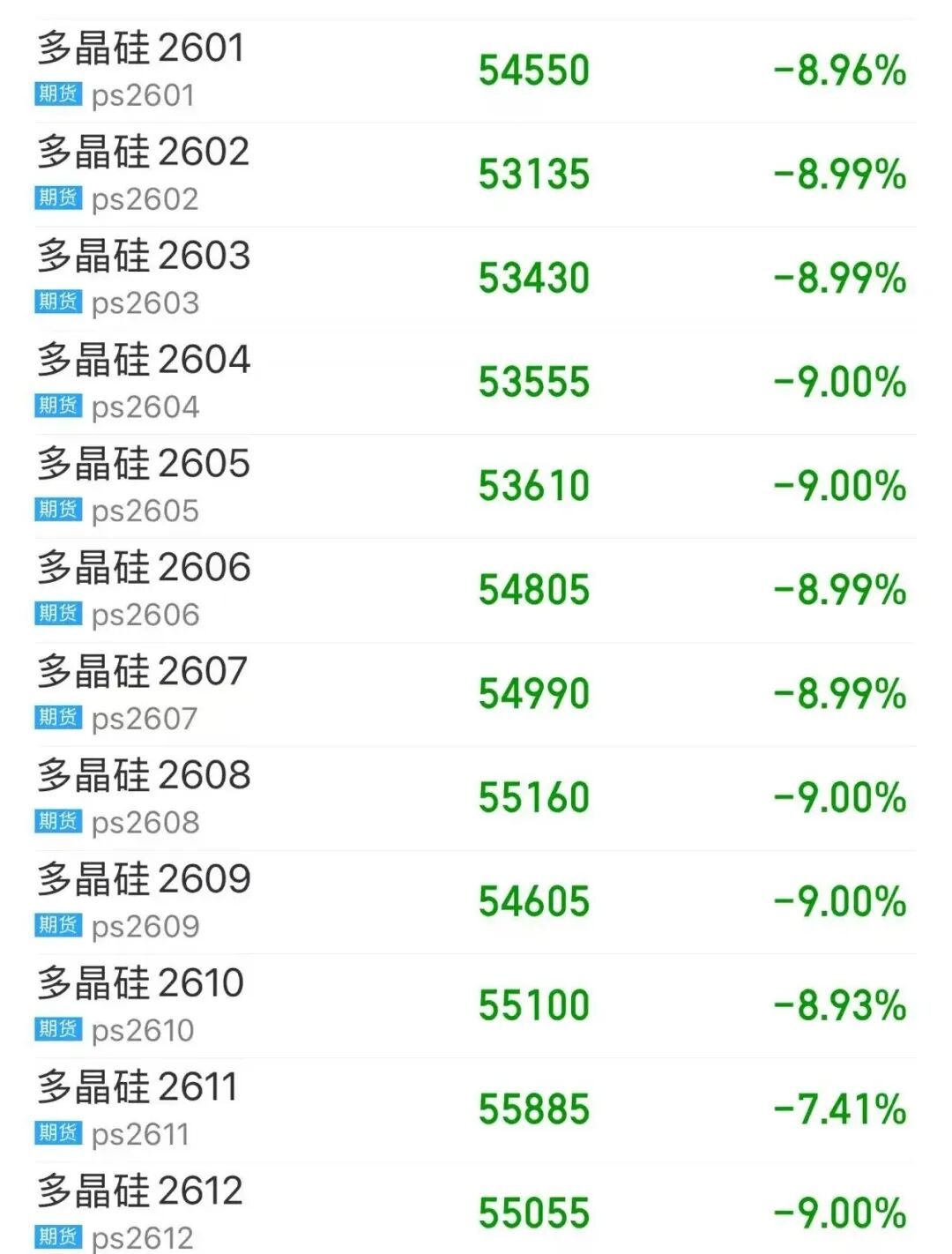
“弱现实”压力仍在 多晶硅期货多个合约跌停
Qi Huo Ri Bao· 2026-01-09 00:34
1月8日,多晶硅期货多个合约午后跌停,截至午盘收盘,主力2605合约报53610元/吨,下跌9%。 | 多晶硅 2601 | 54550 | -8.96% | | --- | --- | --- | | 期货 ps2601 | | | | 多晶硅 2602 | 53135 | -8.99% | | 期货 ps2602 | | | | 多昌硅 2603 | 53430 | -8.99% | | 期货 ps2603 | | | | 多晶硅 2604 | 53555 | -9.00% | | 期货 ps2604 | | | | 多晶硅 2605 | 53610 | -9.00% | | 期货 ps2605 | | | | 多晶硅 2606 | 54805 | -8.99% | | 期货 ps2606 | | | | 多晶硅 2607 | 54990 | -8.99% | | 期货 ps2607 | | | | 多醋硅 2608 | 55180 | -9.00% | | 期货 ps2608 | | | | 多晶硅 2609 | 54605 | -9.00% | | 期货 ps2609 | | | | 多晶硅 2610 ...
在产蛋鸡存栏跌破13亿只!国家发改委:蛋鸡养殖每只亏损25.87元
Xin Lang Cai Jing· 2026-01-05 11:45
Core Viewpoint - The egg price is expected to remain low in 2025 due to high inventory of laying hens and lack of accelerated capacity elimination in the industry [1][6] Group 1: Inventory and Production - The inventory of laying hens dropped to 1.295 billion in December 2025, with a month-on-month decrease of 0.07 billion, while the main production area accounts for over 80% of the total [3][8] - The age structure of laying hens is relatively young, with the main production hens making up 80.12% of the inventory, compared to 75% in 2022, indicating challenges in capacity elimination [3][8] - The sales of commercial broiler chicks have started to recover since November 2025, but the industry has not yet entered a phase of accelerated capacity elimination [3][8] Group 2: Financial Performance - The National Development and Reform Commission reported a loss of 25.87 yuan per laying hen as of December 29, 2025 [4][9] - The current egg price is 6.00 yuan per kilogram, with feed prices at 2.64 yuan per kilogram, resulting in an egg-to-feed price ratio of 2.35, which is a decrease of 2.08% from the previous week [5][9] - The overall market conditions indicate that the egg price is at a low point, with a slight reluctance to sell from the farming sector, although demand may improve temporarily due to pre-holiday stocking [10]

齐盛期货:焦煤回升持续性存疑
Qi Huo Ri Bao· 2025-12-26 00:35
Core Viewpoint - The recent rebound in coking coal futures is driven by macro policy expectations and changes in supply-demand dynamics, despite the fundamental market conditions remaining unchanged [1][2]. Group 1: Macroeconomic and Policy Factors - The release of the "Key Areas for Clean and Efficient Utilization of Coal (2025 Edition)" in mid-December has been a pivotal factor in shifting market sentiment, imposing stricter coal consumption standards for power generation and heating [1]. - This policy aims to eliminate outdated production capacity and suppress low-price homogeneous competition, which is expected to reshape the overall valuation of the coal industry [1]. - The Central Economic Work Conference's stance on addressing excessive competition has provided emotional support for undervalued black commodities [1]. Group 2: Supply Dynamics - Coking coal supply is characterized by weak domestic production and strong imports, with major coal-producing regions like Shanxi and Inner Mongolia reducing output as they complete annual production assessments [2]. - Safety production policies have tightened, further exacerbating supply constraints, while imports of Mongolian coal have remained high, with customs clearance rates peaking at over 1,600 trucks per day in mid-December [2]. - Despite rumors of restrictions on imported coal, actual customs data indicates that the influx of Mongolian coal has not been hindered, leading to an accumulation of inventory at ports [2]. Group 3: Market Conditions - The high volume of imported Mongolian coal is suppressing domestic coking coal prices, as the typical seasonal supply contraction is offset by the influx of imports and high social inventory levels [3]. - Price differentiation among coal types is evident, with main coking coal and fat coal showing resilience, while other types like lean coal and gas coal face significant price pressure due to weak demand and ample supply [3]. - The steel industry is currently in a traditional consumption lull, with average daily pig iron production dropping to approximately 2.265 million tons, leading to reduced consumption of coking coal and coke [4]. Group 4: Inventory and Demand Outlook - Coking coal inventories at steel mills are at 8.0499 million tons, with a usable days supply of 13.02 days, while independent coking plants hold 10.3629 million tons with 12.4 days of supply [4]. - The winter storage replenishment by coking steel enterprises is expected to be delayed this year due to sufficient social inventory and the later timing of the Spring Festival [4]. - Short-term forecasts suggest that coking coal futures may maintain a strong trend, but the sustainability of this rebound is uncertain, with potential inventory pressures from imports and steel production levels limiting price increases [5].
11月宏观数据分析:11月经济数据继续走弱,内需不足是主要制约
Xi Nan Qi Huo· 2025-12-16 02:02
Report Industry Investment Rating No relevant information provided. Core Viewpoints - In November 2025, the macro - economic data continued to decline, and the recovery momentum remained weak. The manufacturing PMI rebounded but was still below the boom - bust line. Industrial production, consumption, and fixed - asset investment growth rates all continued to weaken, and the real estate market was still in a downward trend. Domestic effective demand was insufficient, and the economy faced many challenges [3]. - The implementation of more proactive macro - policies is required to expand domestic demand and optimize supply, promoting both qualitative improvement and reasonable quantitative growth of the economy. "Expanding domestic demand and anti - involution" will be long - term and important policy measures [3]. - The financial market is in a state of "weak reality, strong expectation", and market sentiment is continuously improving. Despite the twists and turns, the macro - economy and asset prices in 2025 are expected to continue the upward - repair trend [3]. Summary by Directory 1. Manufacturing PMI - In November, the manufacturing PMI was 49.2%, up 0.2 percentage points from the previous month, but still below the boom - bust line. Large - scale enterprise PMI decreased, while medium and small - scale enterprise PMIs increased [4]. - Among the 5 classification indexes of manufacturing PMI, the supplier delivery time index was above the critical point, the production index was at the critical point, and the new order index, raw material inventory index, and employment index were below the critical point [4]. - The non - manufacturing business activity index was 49.5% in November, down 0.6 percentage points from the previous month. The construction industry business activity index increased, while the service industry business activity index decreased [7]. 2. CPI and PPI - In November 2025, the national CPI increased by 0.7% year - on - year and decreased by 0.1% month - on - month. The PPI decreased by 2.2% year - on - year and increased by 0.1% month - on - month. The core inflation continued to improve [8][10]. - The anti - involution policy has achieved continuous results, and the PPI is in an upward - repair trend. The PPI year - on - year growth rate is expected to turn positive in 2026 [12]. 3. Import and Export - In November, China's total import and export value was 549.03 billion US dollars, with a year - on - year growth of 4.3%. Exports were 330.35 billion US dollars, up 5.9% year - on - year, and imports were 218.67 billion US dollars, up 1.9% year - on - year, with a trade surplus of 111.68 billion US dollars [13]. - Exports to the EU rebounded significantly, while exports to the US were gradually replaced by those to ASEAN. China's exports have shown strong resilience, and the real risk for foreign trade lies in the potential decline in global demand [16]. 4. Credit and Money Supply - At the end of November 2025, the stock of social financing scale was 440.07 trillion yuan, with a year - on - year growth of 8.5%. The growth rates of both M1 and M2 declined, and the M1 - M2 gap narrowed [18][23]. - Resident and enterprise credit demand was weak. Resident short - term and long - term loans decreased significantly, and enterprise short - and long - term loans were at a low level, with a significant increase in bill financing [19][21]. 5. Industrial Production, Consumption, and Investment - In November, the added value of large - scale industries increased by 4.8% year - on - year and 0.44% month - on - month. The total retail sales of consumer goods increased by 1.3% year - on - year, but the growth rate continued to decline, especially in sectors such as home appliances, furniture, and automobiles [24][26]. - From January to November, national fixed - asset investment (excluding rural households) decreased by 2.6% year - on - year, with declines in private fixed - asset investment, real estate development investment, and infrastructure investment [28]. 6. Real Estate Market - From January to November, the sales area and sales volume of new commercial housing decreased by 7.8% and 11.1% year - on - year respectively, and the decline accelerated in November. Real estate new construction, construction, and completion also decreased [31][33]. - The real estate market is in the process of bottoming out and transforming. Although there are fluctuations, the year - on - year decline in sales and prices is narrowing, and the de - stocking effect is emerging. The first half of 2026 is expected to be a critical period for the real estate market to stop falling and stabilize [38].
广发期货《能源化工》日报-20251107
Guang Fa Qi Huo· 2025-11-07 06:43
Report Industry Investment Ratings No information provided regarding industry investment ratings in the given reports. Core Views Methanol - Market is currently following a "weak reality" trading logic, with the core contradiction centered on high port inventories. The 01 contract faces challenges in inventory digestion, and the weak reality pattern may continue until the implementation of gas restrictions in Iran. The 05 contract is expected to see significant inventory reduction, and opportunities for MTO profit contraction in the 05 contract can be focused on later [3]. Polyester - PX supply is generally stable, but demand may be affected by potential PTA production cuts. The price rebound space is limited, and strategies include reducing long positions on rallies and short - selling above 6800, as well as attempting to narrow the PX - SC spread. - PTA is expected to have a slightly loose supply - demand situation with a small inventory build - up. The price rebound space is limited, and strategies include reducing long positions and short - selling on rallies, and treating TA1 - 5 as a rolling reverse spread. - Ethylene glycol is expected to face high inventory build - up in November - December, with significant upward pressure. Strategies include selling out - of - the - money call options on rallies and reverse - spreading EG1 - 5 on rallies. - Short - fiber supply is relatively high in the short term, but demand may weaken seasonally. The price rebound space is limited, and strategies are similar to PTA, with the focus on narrowing the processing margin on rallies. - Bottle - chip supply and demand remain in a loose pattern, and it is likely to enter a seasonal inventory build - up period. Strategies are similar to PTA, and the main contract processing margin is expected to fluctuate between 300 - 450 yuan/ton [6]. Polyolefins - PP supply increase is slowing down due to more unplanned maintenance, while PE supply is expected to increase as maintenance peaks. Demand has improved, but there is still significant pressure with increasing supply and decreasing demand. The 01 contract has inventory pressure, while the 05 contract may have long - term low - buying opportunities, and the monthly spread is suitable for reverse - spreading [8]. PVC and Caustic Soda - Caustic soda supply is expected to increase in November, with weak demand support. The price is expected to be weak and stable, and the overall trend is bearish. - PVC supply - demand remains in an oversupply situation, with continuous supply pressure from new capacity and weak demand in the traditional off - season. The price is expected to continue to oscillate weakly at the bottom, and the trading strategy is to short on rebounds [11]. Pure Benzene and Styrene - Pure benzene supply is expected to be loose in November, with limited demand support and increasing port inventories. The price driving force is weak, but attention should be paid to device changes due to low valuation. - Styrene supply may slightly decrease in November, with overall stable demand. The cost support is weakening, and the price driving force is limited. The strategy is to be bearish on EB12 price rebounds [12]. Summary by Relevant Catalogs Methanol Price and Spread - MA2601 closed at 2125 on November 6, down 0.75% from the previous day; MA2605 closed at 2226, down 0.45%. The MA15 spread was - 101, up 6.32%. The Taicang basis was - 30, up 25%. Spot prices in Inner Mongolia, Henan, and Taicang showed different changes, with the Taicang - Inner Mongolia and Taicang - Luoyang regional spreads also changing [1]. Inventory - Methanol enterprise inventory was 38.641%, up 2.75%; port inventory was 151.7 million tons, up 0.71%; social inventory was 190.4%, up 1.11% [2]. Upstream and Downstream Operating Rates - Upstream domestic enterprise operating rate was 76.09%, up 0.31%; overseas enterprise operating rate was 70.7%, down 2.68%. Downstream, the MTO device operating rate was 84.98%, up 1.09%, while the acetic acid operating rate was 72.3%, down 1.15% [3]. Polyester Upstream and Downstream Prices - Upstream crude oil, naphtha, and other prices showed different changes. Downstream polyester product prices and cash flows also had various fluctuations, such as POY150/48 cash flow down 31.2% [6]. Inventory and Operating Rates - MEG port inventory was 56.2 million tons, up 7.5%. The comprehensive operating rate of polyester was 91.7%, up 0.3%. Different products' operating rates also showed different trends [6]. Polyolefins Price and Spread - L2601 closed at 6805 on November 6, down 0.13%; L2605 closed at 6886, down 0.22%. PP2601 closed at 6471, down 0.31%; PP2605 closed at 6592, down 0.20%. The L15 spread was - 81, down 6.90%; the PP15 spread was - 121, up 6.14% [8]. Inventory and Operating Rates - PE enterprise inventory was 49.0 million tons, up 17.84%; social inventory was 52.7 million tons, down 3.30%. PP enterprise inventory was 60.0 million tons, up 0.81%; trader inventory was 22.9 million tons, up 3.91%. PE device operating rate was 82.6%, up 2.13%; PP device operating rate was 77.8%, up 0.9% [8]. PVC and Caustic Soda Price and Spread - Shandong 32% liquid caustic soda equivalent price was 2500, unchanged; Shandong 50% liquid caustic soda equivalent price was 2500, unchanged. The price of PVC in East China showed a decline [11]. Supply and Demand - Caustic soda industry operating rate was 88.3%, up 3.3%; PVC total operating rate was 77.1%, up 4.5%. The downstream operating rates of caustic soda and PVC also had different changes [11]. Inventory - Liquid caustic soda inventory in East China factories and Shandong increased, while PVC total social inventory decreased slightly [11]. Pure Benzene and Styrene Upstream and Downstream Prices - Upstream crude oil, naphtha, and other prices changed. Pure benzene and styrene prices also showed different trends, such as pure benzene East China spot price down 0.4% [12]. Inventory and Operating Rates - Pure benzene Jiangsu port inventory was 12.10 million tons, up 42.4%; styrene Jiangsu port inventory was 17.93 million tons, down 7.1%. The operating rates of pure benzene and styrene and their downstream industries also had various changes [12].