
以旧换新政策

Search documents
【周度分析】车市扫描(2025年12月15日-12月21日)
乘联分会· 2025-12-24 08:37
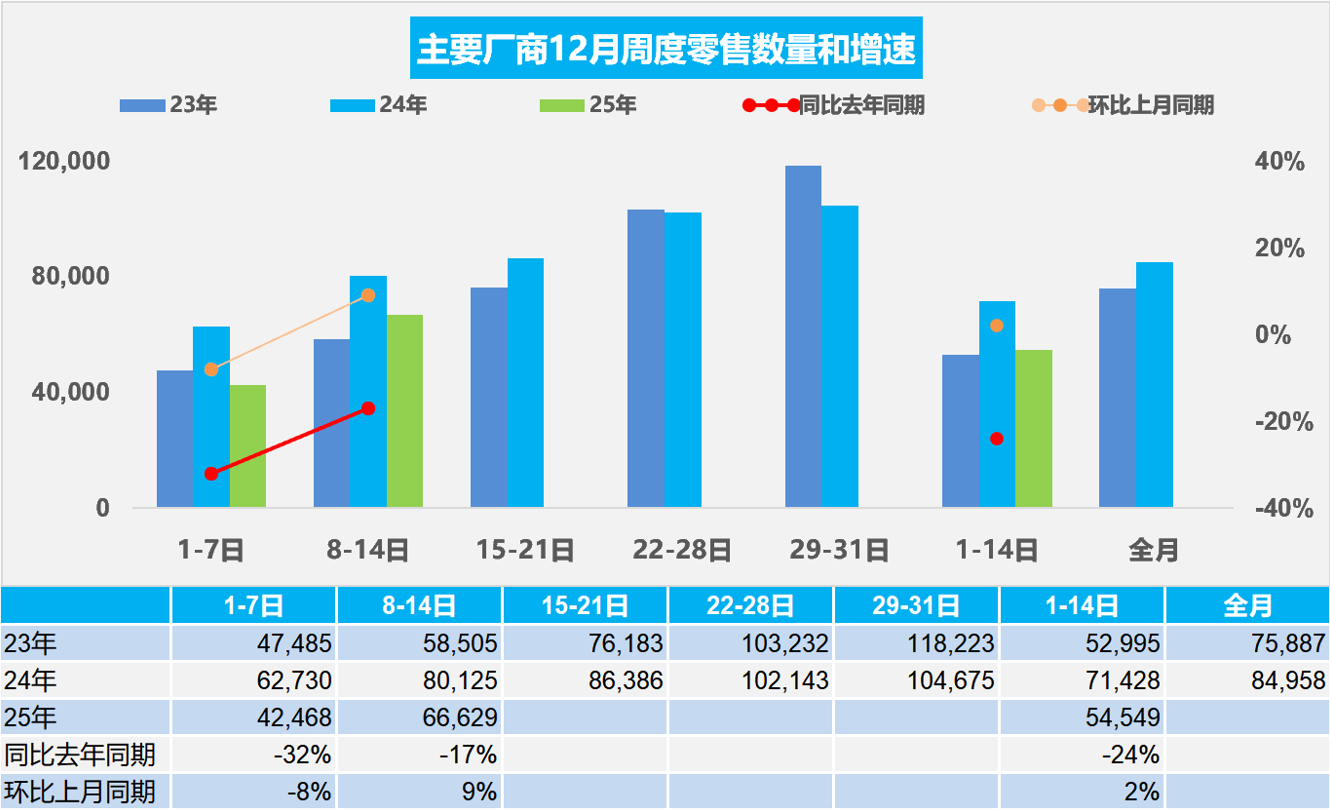
Market Overview - From December 1 to 21, the national retail sales of passenger cars reached 1.3 million units, a year-on-year decrease of 19%, but a month-on-month increase of 5%. Cumulatively, retail sales for the year reached 22.783 million units, a year-on-year increase of 4% [2] - During the same period, wholesale sales of passenger cars were 1.302 million units, down 23% year-on-year and down 13% month-on-month. Cumulative wholesale sales for the year reached 28.067 million units, a year-on-year increase of 9% [2] New Energy Vehicles - Retail sales of new energy vehicles from December 1 to 21 reached 788,000 units, a year-on-year increase of 1% and a month-on-month increase of 3%. The penetration rate of new energy vehicles in the passenger car market was 60.6%, with cumulative retail sales for the year at 12.26 million units, up 18% year-on-year [2] - Wholesale of new energy vehicles during the same period was 782,000 units, down 10% year-on-year and down 12% month-on-month, with a cumulative wholesale of 14.538 million units, up 25% year-on-year [2] Production Trends - In the first three weeks of December, production of pure fuel light vehicles was 681,000 units, down 25% year-on-year and down 10% month-on-month. Production of hybrid and plug-in hybrid vehicles was 398,000 units, down 19% year-on-year and down 11% month-on-month [3] Retail and Wholesale Trends - Daily average retail sales in the first week of December were 42,000 units, down 32% year-on-year and down 8% month-on-month. In the second week, daily average retail sales were 67,000 units, down 17% year-on-year but up 9% month-on-month. In the third week, daily average retail sales were 77,000 units, down 11% year-on-year and up 9% month-on-month [5][6] - The overall retail trend for December is weak, influenced by the tightening of replacement policies and a cautious attitude from dealers due to previous weak retail performance [6] Export Performance - In November, China exported 810,000 vehicles, a year-on-year increase of 48%, with a total of 7.33 million vehicles exported from January to November, a year-on-year increase of 25% [14] - Exports of new energy vehicles in November reached 350,000 units, a year-on-year increase of 156%, with cumulative exports for the year at 3.01 million units, up 62% year-on-year [14] Battery Market Analysis - In November, the production of power batteries was 176 GWh, a year-on-year increase of 53%. Cumulative production from January to November reached 1,469 GWh, up 46% year-on-year [12] - The proportion of battery installations for electric vehicles reached 53%, with ternary batteries at 50% and lithium iron phosphate batteries at 54% [12] Russian Market Insights - In November, the Russian automotive market saw sales of 142,000 units, a year-on-year decrease of 2%. Cumulative sales from January to November were 1.33 million units, down 21% year-on-year [18] - Chinese brands have increased their market share in Russia to 57.5% as of November, with strategies including local production and supply chain restructuring to adapt to the market [19][20]


家电ETF(159996)涨超1%,机构称生态融合或成扫地机行业竞争关键
Mei Ri Jing Ji Xin Wen· 2025-12-24 07:33
Group 1 - The future competition in the robotic vacuum cleaner industry will shift from a single product focus to a comprehensive competition in ecosystem building and service capabilities, with companies that can deeply integrate robotic vacuums into smart home ecosystems more likely to establish long-term barriers [1] - The "old-for-new" policy has significantly boosted home appliance sales this year, with the scale of old-for-new home appliances reaching 12,844 million units [1] - The domestic air conditioning market continues to be sluggish, with a year-on-year decline in domestic sales of 39.8% and a 25.6% decline in exports, primarily due to the reduction of national subsidies, high overseas inventory, and a high base effect, resulting in a dual decline pattern [1] Group 2 - The home appliance ETF (159996) tracks the home appliance index (930697), which selects listed companies involved in the manufacturing and sales of home appliances such as air conditioners, refrigerators, and washing machines from the Shanghai and Shenzhen markets to reflect the overall performance and market trends of related listed companies [1] - This index has strong consumer attributes and cyclical characteristics, providing a comprehensive representation of the overall development status of the home appliance industry [1]
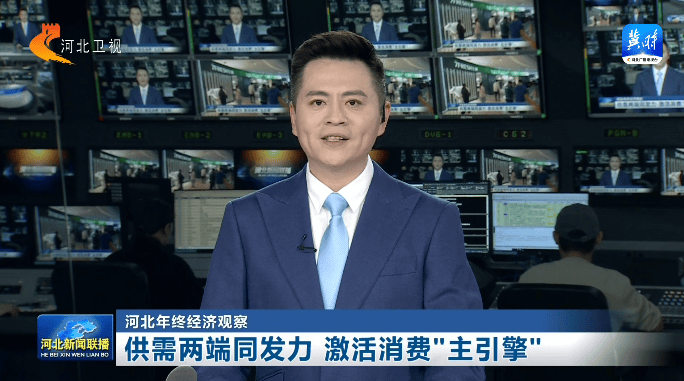
【河北年终经济观察】供需两端同发力 激活消费“主引擎”
Sou Hu Cai Jing· 2025-12-23 14:17
Group 1 - JD Fresh Supermarket officially opened its first store in Shijiazhuang, covering nearly 5,000 square meters, featuring unique areas like "24-hour vegetables" and "7-day fresh eggs" [1] - The store offers a new shopping experience with a combination of in-store tasting and online ordering through an app or mini-program, providing instant delivery services [1] - The opening of this store is part of a broader initiative to enhance urban commercial layouts and improve service consumption quality in the region, with a focus on immediate retail service upgrades [2] Group 2 - The province has established 448 urban convenience living circles, with new stores like JD Fresh, Hema, and Sam's Club opening in Shijiazhuang and Tangshan [2] - Service consumption in the province has seen rapid growth, with total revenue from various service categories reaching 423.51 billion yuan, a year-on-year increase of 8.4%, surpassing the national average by 1.2 percentage points [2] - The province is innovating consumption scenarios and expanding into niche markets, with various projects combining culture, tourism, and health to stimulate consumer spending [2]
王微:促消费向稳向好需政策加力优化
Jing Ji Ri Bao· 2025-12-23 00:03
Core Viewpoint - The Chinese government is prioritizing the expansion of domestic demand and strengthening the domestic circulation to stabilize economic growth, with consumer spending playing a crucial role in this strategy [1]. Group 1: Economic Growth and Consumer Contribution - In the first three quarters of 2025, China's GDP grew by 5.2% year-on-year, with final consumption expenditure contributing 53.5% to economic growth, an increase of 9 percentage points compared to the previous year [1]. - The Central Economic Work Conference emphasized the importance of expanding domestic demand and optimizing supply as key tasks for economic work in the coming year [1]. Group 2: Consumer Demand and Retail Performance - From January to November 2025, the total retail sales of consumer goods increased by 4.0% year-on-year, surpassing the 3.5% growth rate of 2024 [2]. - The "old-for-new" consumption policy has been expanded to cover various sectors, leading to over 2.5 trillion yuan in sales and benefiting more than 360 million people [2]. Group 3: New Consumption Trends - New service consumption, including travel, culture, and health, has become a consumption hotspot, with significant increases in domestic travel during holidays [3]. - The online retail of physical goods grew by 5.7% year-on-year, accounting for 25.9% of total retail sales, indicating a shift towards digital consumption [3]. Group 4: Supply Chain and Price Index - The Consumer Price Index (CPI) rose by 0.7% year-on-year in November 2025, reflecting improved product quality and innovation in supply [4]. - The number of new consumer goods registered in 2024 exceeded 21.63 million, marking a significant increase in supply innovation [4]. Group 5: Foreign Consumption and Policy Changes - The number of inbound foreign visitors increased by 27.8% from January to August 2025, driven by optimized entry policies and payment facilitation [5]. - The number of stores offering tax refunds for outbound tourists tripled compared to the end of 2024, indicating a growing trend in inbound consumption [5]. Group 6: Structural Challenges in Consumption - Despite the overall growth in consumption, the increase in consumer spending is lagging behind income growth, with real disposable income rising by 5.2% while consumption expenditure grew by only 4.7% [6]. - Service consumption growth has slowed, with a 4.1% increase in per capita service spending, which is below the overall consumption growth rate [7]. Group 7: Policy Recommendations for Consumption Growth - To address the challenges, policies should focus on enhancing employment, increasing income, and stabilizing expectations to boost consumer capacity [9]. - The government should optimize the "old-for-new" policy and support service consumption, particularly in sectors like tourism and elderly care [10]. - Strengthening innovation in consumption and improving the supply of quality goods and services is essential for sustainable growth [10].
宏观快报点评:核心CPI同比维持高位
Haitong Securities International· 2025-12-19 07:03
Group 1: CPI Insights - In November 2025, the CPI increased by 0.7% year-on-year, while the PPI decreased by 2.2% year-on-year[7] - The core CPI remained high at 1.2% year-on-year, unchanged from the previous month, marking the highest level since February 2024[10] - Food prices contributed positively to the CPI, with fresh vegetable prices rising by 7.2% month-on-month, while pork prices fell by 2.2%[8] Group 2: PPI Analysis - The PPI showed a month-on-month increase of 0.1%, but the year-on-year decline expanded to 2.2%[15] - Upstream prices were supported by rising global non-ferrous metal prices, while the impact of "anti-involution" policies continued to manifest in certain industries[15] - Coal mining and non-ferrous mining sectors led the PPI increase, with coal prices rising by 4.1% month-on-month[15] Group 3: Policy and Market Outlook - The "14th Five-Year Plan" and recent central economic meetings emphasized the importance of service consumption, indicating a potential shift in price recovery drivers towards service CPI in 2026[14] - The effectiveness of fiscal subsidies and anti-involution policies is expected to continue influencing market dynamics, with a focus on core service CPI recovery elasticity[14] - Risks remain regarding the uncertainty in the real estate market and the potential inadequacy of policy measures[4]
【周度分析】车市扫描(2025年12月8日-12月14日)
乘联分会· 2025-12-17 08:38
Group 1: Market Overview - From December 1 to 14, the national retail sales of passenger cars reached 764,000 units, a year-on-year decrease of 24%, but a month-on-month increase of 2%. Cumulative retail sales for the year reached 22.247 million units, a year-on-year increase of 5% [2][5] - During the same period, wholesale sales of passenger cars were 734,000 units, down 31% year-on-year and down 15% month-on-month. Cumulative wholesale sales for the year reached 27.499 million units, a year-on-year increase of 9% [2][9] - The retail penetration rate of new energy vehicles (NEVs) in the passenger car market reached 62.3% in the first two weeks of December, with retail sales of NEVs at 476,000 units, a year-on-year decrease of 4% [2][6] Group 2: Production and Sales Trends - In the first two weeks of December, production of pure fuel light vehicles was 457,000 units, down 24% year-on-year, while production of hybrid and plug-in hybrid vehicles was 275,000 units, down 14% year-on-year [3] - The average daily retail sales in the first week of December were 42,000 units, down 32% year-on-year, while in the second week, it increased to 67,000 units, down 17% year-on-year [5][6] - The production of passenger cars in November was 3.52 million units, a year-on-year increase of 2%, with NEVs accounting for 1.84 million units, a year-on-year increase of 17% [11] Group 3: Economic and Policy Impact - The macroeconomic environment remains stable, but the tightening of trade-in and scrapping subsidy policies has led to a decline in retail sales in November [6][10] - The expectation of a strong year-end sales push is influenced by the expiration of tax exemptions for NEVs, prompting consumers to purchase vehicles before the end of the year [6][10] - The government is expected to announce new trade-in policies for 2026, which could stimulate demand and support sales in early 2026 [7] Group 4: Industry Challenges and Compliance - The automotive industry faces intensified competition and price disorder, with 52.6% of dealers reporting losses and 74.4% experiencing price discrepancies [12] - The introduction of the "Automotive Industry Price Behavior Compliance Guidelines" aims to stabilize the market and protect the interests of dealers and suppliers [12][13] - The industry is encouraged to adopt measures to reduce price wars and ensure fair competition, which is crucial for the sustainability of dealerships [12][13] Group 5: Pickup Truck Market Analysis - In November 2025, the pickup truck market saw sales of 56,000 units, a year-on-year increase of 18.8%, with a cumulative sales of 537,000 units for the year, up 12.1% [14][15] - The export of pickups reached 32,000 units in November, a year-on-year increase of 54%, with exports accounting for 57% of total sales in November [14][15] - The market for new energy pickups is growing rapidly, with sales increasing by 152% year-on-year in November [15]

乘联分会:12月前两周全国乘用车新能源市场零售47.6万辆 同比下降4%
智通财经网· 2025-12-17 08:15
Group 1: New Energy Vehicle Market Performance - From December 1 to December 14, the retail sales of new energy vehicles in the passenger car market reached 476,000 units, a year-on-year decrease of 4%, but a month-on-month increase of 1% [1] - Cumulative retail sales for the year reached 11.948 million units, representing an 18% year-on-year growth, with a penetration rate of 62.3% in the new energy segment [1] - Wholesale figures for new energy vehicles during the same period were 457,000 units, down 15% year-on-year and 14% month-on-month, with a cumulative wholesale of 14.213 million units for the year, up 26% [1] Group 2: Overall Passenger Car Market Trends - Total retail sales of passenger cars from December 1 to December 14 were 764,000 units, down 24% year-on-year but up 2% month-on-month, with cumulative retail sales for the year at 22.247 million units, a 5% increase [4][5] - Wholesale sales for the same period were 734,000 units, a 31% year-on-year decline and a 15% month-on-month decrease, with cumulative wholesale for the year at 27.499 million units, up 9% [9] Group 3: Market Dynamics and Consumer Behavior - The market is experiencing a cautious sentiment among dealers due to tightened trade-in and scrapping subsidy policies, leading to a negative growth in retail sales in November [5] - The end of the year is marked by a strong urgency among consumers to purchase vehicles due to the impending expiration of tax exemptions for new energy vehicles [5] - The expectation of a new trade-in policy for 2026 could stimulate demand, but the current retail growth is considered weak compared to the previous year [4][5] Group 4: Production and Export Trends - In the first two weeks of December, production of pure fuel light vehicles was 457,000 units, down 24% year-on-year, while production of hybrid and plug-in hybrid vehicles was 275,000 units, down 14% year-on-year [1] - The export market for Chinese vehicles has shown positive trends, particularly in the new energy segment, with significant growth in overseas markets [10] - The overall production of vehicles in November was 3.52 million units, with new energy vehicle production at 1.84 million units, reflecting a 17% year-on-year increase [11]

长虹华意(000404) - 2025年12月16日投资者关系活动记录表(2025-04)
2025-12-17 01:22
Group 1: Business Performance and Market Trends - The gross margin of the company's closed piston compressor business is expected to fluctuate slightly in 2025, with a production capacity utilization rate exceeding 90% [2] - In 2024, the production capacity of closed piston compressors in China increased by 14%, while total industry sales only grew by 2.1%, indicating intensified competition [2] - The domestic sales of closed piston compressors are projected to grow by 3.5% in 2025, while exports are expected to decline by 5.9% due to trade tensions and weak consumer demand [3] Group 2: Future Outlook and Strategic Planning - The industry is anticipated to face increased price competition in 2026, with a focus on enhancing product structure and increasing the proportion of high-value-added products [2] - There are no authoritative forecasts for 2026 yet, but it is generally believed that exports will grow while domestic sales may face downward pressure [4] - The company is actively considering overseas factory plans to adapt to clients' capacity shifts abroad [6] Group 3: Cost Structure and Profitability - Copper constitutes a small portion of the company's raw material costs, thus fluctuations in copper prices have minimal impact on overall profitability [2] - The company aims to improve profitability in its electric vehicle air conditioning compressor segment by focusing on market share expansion rather than immediate profit margins [7] Group 4: Shareholder Returns and Investment Strategy - The company adheres to its three-year shareholder return plan (2023-2025) and will consider factors like annual profit, future funding needs, and shareholder preferences when formulating profit distribution plans [8] - Future mergers and acquisitions will focus on targets that align with the company's existing business for strategic expansion [9]

香港汽车ETF(520720)回调超2.7%,政策与行业规范或重塑消费预期,关注回调布局机会
Mei Ri Jing Ji Xin Wen· 2025-12-16 06:47
Group 1 - The core viewpoint is that the "Guidelines for Compliance with Pricing Behavior in the Automotive Industry (Draft for Comments)" is expected to further promote the "anti-involution" process, regulating price competition in the domestic automotive industry, which may slow down the price war and improve profit margins for manufacturers and dealers [1] - Dealers, who have seen a significant decline in profitability in recent years, are expected to experience a more substantial improvement in their profit margins due to the new guidelines [1] - The guidelines require companies to adopt pricing strategies based on production costs and market supply and demand, ensuring price behavior is regulated across the entire chain, including vehicle sales and financial services [1] Group 2 - The Hong Kong Automotive ETF (520720) tracks the Hong Kong Stock Connect Automotive Index (931239), which selects listed companies involved in vehicle manufacturing, components, and emerging fields like smart driving to reflect the overall performance of automotive-related securities [2] - The index has a high research and development investment and growth characteristics, with the vehicle manufacturing sector accounting for over 60% of its weight, demonstrating strong market elasticity and international features [2] - The Hong Kong Automotive ETF (520720) can be traded directly through A-share accounts without the need for a Hong Kong Stock Connect permission, addressing the pain point of ordinary investors lacking investment tools [2]
两轮车系列专题:政策发力叠加格局优化,行业高景气拐点渐近
2025-12-16 03:26
Summary of Conference Call Notes Industry Overview - The motorcycle industry is experiencing a shift with policy support and market optimization, indicating a potential turning point in high prosperity for the sector in 2025 [1][2][5] - The electric two-wheeler market is driven by trade-in policies, but the effectiveness of these policies is diminishing, leading to a subdued sales performance post-implementation of new national standards [1][12] Key Insights on Motorcycle Market - In 2025, the domestic sales growth of large-displacement motorcycles is expected to stabilize, with a projected year-on-year growth of single digits from January to October, maintaining levels similar to the previous year [2][5] - The top companies in the large-displacement motorcycle segment, such as Chuanfeng Power, Longxin General, and Qianjiang Motorcycle, hold a market share of approximately 20%-30% and are likely to benefit from the expansion of the leisure consumer base [3][5] Export Performance - China’s motorcycle exports are robust, with 110cc and above motorcycle exports increasing by 24% year-on-year, and 250cc and above models seeing a 60% increase [6][9] - The overseas market, particularly in North America, South America, and Europe, presents significant growth potential, with the total global motorcycle sales exceeding 50 million units annually [6][9] Competitive Landscape - Chinese brands are narrowing the performance gap with Japanese brands through improved product features and supply chain advantages, achieving a market share of over 5% in Europe [7][8] - The Turkish market is experiencing short-term challenges due to currency fluctuations, impacting sales for companies heavily reliant on exports, but long-term growth prospects remain positive [9][10] Electric Two-Wheeler Market Insights - The electric two-wheeler market is expected to grow by approximately 10% in 2025, driven by trade-in policies, although the impact of these policies is expected to wane in 2026 [12][14] - Major players like Yadi and Aima are positioned to capture market share due to the challenges faced by smaller companies, especially in light of new national standards [12][13] Recommendations - The motorcycle sector is recommended for investment, particularly in companies like Chuanfeng Power and Longxin General, which are expected to outperform the industry average growth in 2026 [4][11][18] - For the electric two-wheeler segment, companies such as Yadi, Aima, and 9号 are highlighted as potential beneficiaries of market share opportunities in 2026, provided they can adapt to new market conditions [18] Additional Considerations - The electric golf cart market is primarily concentrated in North America, with significant growth expected, particularly in the outdoor segment where Chinese brands hold a substantial market share [15][16] - Chinese electric golf cart manufacturers are responding to anti-dumping measures by relocating production to Southeast Asia, which is expected to enhance their competitive position in the North American market [17]

