
地缘冲突

Search documents
长江有色:圣诞临近谨慎情绪及地缘溢价逐步减弱 24日锡价或下跌
Xin Lang Cai Jing· 2025-12-24 03:21
Group 1 - The core viewpoint of the article highlights the mixed macroeconomic environment affecting the tin market, with U.S. economic resilience and the onset of a Federal Reserve rate cut cycle boosting market optimism, while inflation concerns and geopolitical tensions pose risks [1] - The LME tin price closed at $42,835 per ton, up $105, reflecting a 0.25% increase, while domestic Shanghai tin futures showed a decline, closing at 336,110 yuan per ton, down 5,570 yuan, or 1.63% [1] - The global macroeconomic landscape is at a critical juncture, transitioning from recession fears to a re-evaluation of growth and liquidity, but the market is expected to experience high volatility due to competing bullish and bearish factors [1] Group 2 - Supply concerns from geopolitical conflicts remain, but expectations of resumed production in Myanmar and normalized tin exports from Indonesia are easing previous price-driving fears [1] - Demand is facing negative feedback due to high prices, with traditional sectors like electronic soldering showing weakness, despite long-term positive prospects in emerging fields like semiconductors and photovoltaics [1] - The tin industry association has indicated that current tin prices are disconnected from fundamental market conditions, calling for a more rational market approach, which reflects a consensus against high prices and provides a negative outlook for market expectations [1]


龚翔日记 金价破 1400 元!2025 年涨价时间线整理,现在该入手吗?
Sou Hu Cai Jing· 2025-12-23 08:33
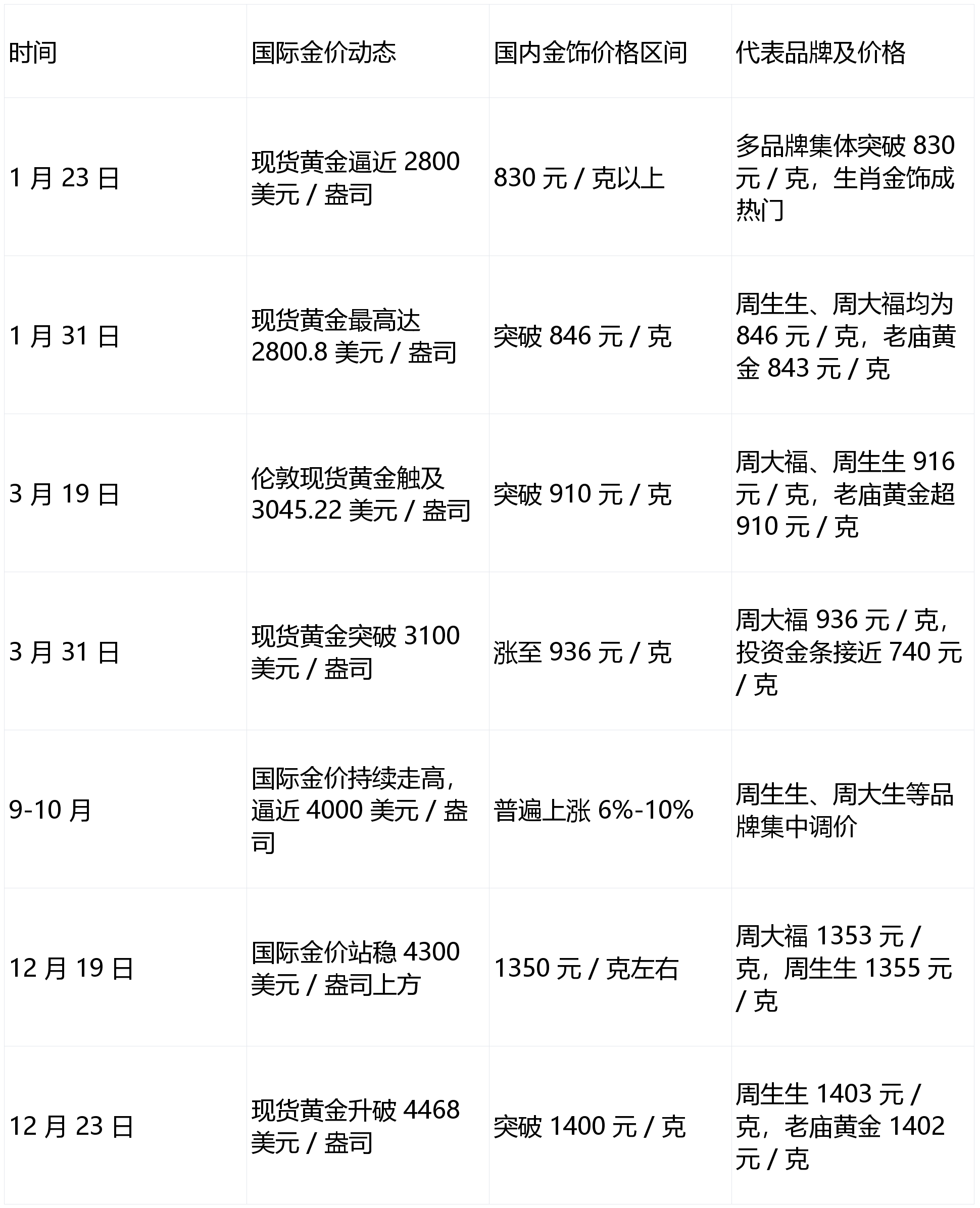
Group 1 - The core point of the article highlights the significant rise in gold prices, with domestic gold jewelry prices surpassing 1400 RMB per gram, indicating a daily increase of 36 RMB for Chow Sang Sang and 35 RMB for Lao Miao Gold [1][2] - The timeline of gold price increases in 2025 shows a steady rise, with international gold prices approaching 4000 USD per ounce in September-October and breaking through 4468 USD per ounce by December 23 [2] - Three main factors driving the surge in gold prices include strong expectations for Federal Reserve interest rate cuts, ongoing global geopolitical conflicts prompting safe-haven buying, and significant gold purchases by central banks, with a net purchase of 634 tons in the first three quarters of 2025 [2] Group 2 - The article notes that gold prices have increased over 70% this year, with Chow Tai Fook experiencing a nearly 68% rise, reflecting a shift in perception of gold from a traditional jewelry item to a widely recognized hard currency [2][3] - Analysts suggest that gold prices are likely to continue a volatile upward trend into 2026, contingent on further Federal Reserve interest rate cuts, although short-term overbought conditions may lead to minor corrections [2] - The article emphasizes the importance of aligning gold purchases with personal needs and market trends, advising against impulsive buying during price surges [3]
1223黄金点评:年末沪金再破千点,关注地缘冲突进展
Xin Lang Cai Jing· 2025-12-23 02:01
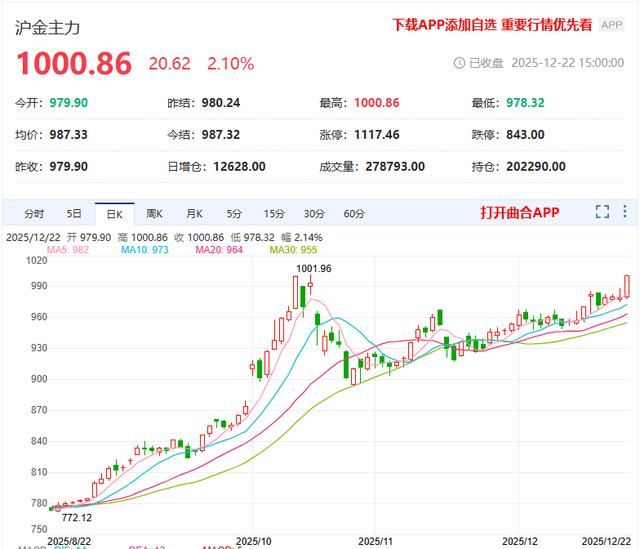
Core Viewpoint - The article discusses the recent surge in gold prices driven by market speculation regarding the Federal Reserve's interest rate policies and geopolitical tensions affecting oil supply [2][6]. Summary by Relevant Sections Gold Market - COMEX gold prices rose significantly, closing at $4480.6 per ounce, an increase of 2.13%. The domestic SHFE gold night market also saw gains, closing at 1003.08 yuan per gram, up 1.60% [2][6]. Federal Reserve Outlook - There is a notable division among Federal Reserve officials regarding the potential for interest rate cuts in the coming year. The Director of the National Economic Council, Hassett, indicated that there is substantial room for rate cuts, while Fed official Goolsbee expressed concerns about preemptive cuts given the positive inflation data from November [2][6]. - Despite a generally pessimistic outlook on the Fed's future rate-cutting capacity, discussions around the selection of the next Fed Chair and the pace of rate cuts and balance sheet expansion are ongoing. The market remains cautiously optimistic due to concerns over financial market liquidity and weak employment [2][6]. - President Trump is expected to appoint a new Fed Chair in the first week of January, which may influence the independence of the Fed and subsequently support gold prices by suppressing the dollar index [2][6]. Geopolitical Factors - Recent geopolitical tensions have heightened market concerns regarding oil supply. The U.S. has intercepted Venezuelan oil tankers three times in two weeks, and Israel is preparing for new actions against Iran. Additionally, Ukrainian drones have targeted Russian ports in the Black Sea, further escalating risks [2][6]. - These geopolitical developments have contributed to increased market risk aversion, which in turn supports gold prices. However, there is a cautionary note regarding the potential for a market correction if gold prices rise too quickly [2][6].

油价、铜价、黄金齐破纪录!大宗商品“三巨头”疯涨,中长线该追哪一个?
Sou Hu Cai Jing· 2025-12-23 01:06
家人们,今天行情太炸裂了!油价单日暴涨2.4%,伦铜今年已狂飙36%逼近1.2万美元,黄金更是直接 冲破4400美元历史新高!这"三巨头"的集体狂欢,是陷阱还是时代级的机会? · 黄金:可分批配置,作为资产组合的"压舱石",但忌追高。 · 原油:谨慎看待,除非供需格局发生根本扭转。 【关键数据】 · +2.4%:油价单日涨幅 三大品种,逻辑天差地别! 1. 油价(地缘脉冲行情):美国拦截委内瑞拉油轮,乌克兰袭击俄罗斯油轮,地缘冲突直接把供应风险 拉满!但帮主提醒:今年油价整体已跌五分之一,全球供应过剩才是核心底色,这波上涨的持续性存 疑。 2. 铜价(长期产业趋势):这可能是最有看点的!贸易动荡导致铜涌向美国,叠加全球矿山停产和AI 数据中心、新能源带来的爆炸性需求,创造了2009年以来最大涨幅。这更像是长期产业趋势,而非短期 炒作。 3. 黄金(避险+货币双驱动):在美联储降息预期和全球地缘紧张的双重引擎下,避险资金汹涌而入, 现货金单日大涨2.4%,势头强劲。 帮主20年中长线视角的核心策略: · 铜:逢回调布局,AI与绿色革命的需求是长期逻辑。 A. 铜(代表未来AI与绿色需求) B. 黄金(代表避险与 ...

现货黄金年内飙升近68% 三重逻辑支撑黄金新叙事行至“中场”
Shang Hai Zheng Quan Bao· 2025-12-22 18:23
◎记者 张骄 定投黄金,逐步成为河南郑州"90后"上班族小陈的理财习惯。今年9月,他在工商银行开通了积存金业 务并完成首笔交易,此后关注金价波动便成了他的日常。而小陈的经历,正是2025年全球黄金投资潮中 的一朵"浪花"。 行至年末,黄金市场的狂热没有消退。12月22日,现货黄金历史性地冲破4400美元/盎司大关。截至上 海证券报记者发稿时,其以年内近68%的耀眼涨幅,大幅跑赢其他主要资产,改写了全球资产的回报叙 事。 从投资者的"买金潮",到机构的策略配置,再到全球央行的储备增持,黄金已从传统的"避险符号",演 变为最具共识的核心资产。一轮新的财富故事,也随之铺开。 新老玩家众生相 2025年10月,在国际金价创新高之时,南京广告从业者徐珍妮(化名)跃跃欲试。她在每克930元左右 的价位入场,买入招商银行积存金(一种黄金投资的储蓄产品)。"美联储降息和地缘冲突的消息,让 我期待金价冲到每克1000元。"徐珍妮对上海证券报记者说。 市场的剧本演绎却没那么简单,随后的追涨加仓将她牢牢套住。每天频繁看盘,也让她心情跌宕起伏, 经常感到"坐不住"。 "没卖就是没亏!"她告诉记者。好在目前金价回升,让她庆幸11月时的 ...
金丰来:避险需求与降息预期升温
Xin Lang Cai Jing· 2025-12-22 10:56
Group 1 - The core viewpoint of the article highlights the significant rise in international gold prices, reaching a peak of approximately $4,300 per ounce, driven by a weakening dollar and a surge in global risk-averse investments [1][3] - The macroeconomic fundamentals indicate that expectations of a shift in Federal Reserve policy are fueling the surge in gold prices, with recent U.S. inflation data showing unexpected slowdown and a cooling job market, leading to increased calls for monetary policy easing [1][3] - Geopolitical tensions, particularly the ongoing conflict between Israel and Iran and escalating U.S.-Venezuela tensions, are creating high uncertainty, prompting institutional investors to seek safe-haven assets like gold [1][3] Group 2 - Economic data shows that the University of Michigan's December consumer confidence index was unexpectedly revised down to 52.9, reflecting concerns about the economic outlook, which in turn strengthens market expectations for a looser monetary environment [2][4] - The CME FedWatch tool indicates a 21.0% probability of the Federal Reserve cutting interest rates in January, despite hints from the Cleveland Fed President that policy may enter a pause [2][4] - Technical analysis reveals that gold's upward trend remains intact, with prices consistently above the 100-period exponential moving average (EMA), and the Bollinger Bands indicating increased market volatility driven by bullish sentiment [2][4]
异动点评:欧美节日临近资金情绪仍较强驱动贵金属上涨
Guang Fa Qi Huo· 2025-12-22 10:26
Report Industry Investment Rating - Not provided in the content Core Viewpoints of the Report - Near the end - of - year important festivals in Europe and America, with the release of dovish signals by Fed officials, large - scale short positions in COMEX silver and delivery demand exacerbating spot supply shortages, and institutional pre - allocation of metal assets, precious metal prices are pushed up. In the day session on December 22, the Shanghai silver main contract AG2602 rose by more than 6%, platinum and palladium futures main 06 contracts hit the 7% daily limit in the morning, the international gold price exceeded the historical high since October 20, and the Shanghai gold main contract AU2602 rose by more than 2% and returned above 1000 yuan/gram [1] - In the short - term, without clear negative factors, the precious metal market will remain strong, but during the end - of - year holiday in the European and American markets, trading liquidity will weaken, which may further amplify market fluctuations, and investors need to set reasonable stop - loss and take - profit levels [11] Summary by Relevant Catalog Driving Analysis 1: US Employment and Inflation Data Slowdown Support Fed's Loose Policy, Geopolitical Conflicts Stimulate Precious Metals to Strengthen - US economic data shows that the labor market has a downward risk and the inflation rebound momentum slows down. The unemployment rate in November soared to 4.6%, the highest since 2021, and the average monthly new non - farm employment in the second half of this year was only 22,800. The core CPI in November fell to 2.6%, weaker than expected and the lowest since March 2021. The Fed may further loosen monetary policy, and the market predicts about 3 interest rate cuts in 2026 [2] - Geopolitical conflicts such as the possible Israeli military strike on Iran, the slow progress of the "peace plan" in the Russia - Ukraine conflict, and the US blockade on Venezuela continue to increase investors' risk - aversion demand, supporting the precious metal market [4] Driving Analysis 2: The Performance of the COMEX Silver Delivery Month and the Persistent Tightness of Circulating Inventory - From December to now, the COMEX silver futures market has a physical delivery demand of more than 60 million ounces in a single month, accounting for nearly 50% of the total registered warehouse inventory of 128 million ounces. The short position is as high as 990 million ounces. The shortage of physical inventory forces some shorts to close positions or hedge in the spot market, amplifying the upward momentum of silver prices [5] - There is a strong expected demand for silver in the electric vehicle and AI data center fields. The World Silver Association predicts that the compound annual growth rate of silver demand in the global automotive industry will be about 3.4% from 2025 - 2031, and the potential annual silver consumption of silver - carbon solid - state batteries in the next few years can reach thousands of tons. More countries may increase strategic silver reserves [5] Driving Analysis 3: Favorable Supply - Demand Fundamentals and Continuous Capital Inflow into the Platinum and Palladium Markets - The strong prices of platinum and palladium are due to the favorable supply - demand fundamentals, and factors such as high trading enthusiasm, low margin cost, and small tradable volume amplify price fluctuations. In the absence of more guiding data, the upward logic of platinum and palladium prices will continue to strengthen [9] Outlook for the Future Market - With global mainstream institutions continuously raising precious metal price forecasts, some investors are pre - allocating precious metals, leading to an increase in ETF and derivatives positions. The short - term market will remain strong. The potential weekly increase of silver may reach 9% (90% confidence interval), and the monthly increase can reach up to 18%. The potential increase of gold and platinum and palladium is relatively small [11]
金、银、铂金、钯金利好风险解析
Sou Hu Cai Jing· 2025-12-22 09:13
Gold - Positive factors include continuous gold purchases by global central banks, particularly the People's Bank of China, and weaker U.S. December PCE data reinforcing rate cut expectations [1] - Geopolitical conflicts, such as those in the Middle East and Ukraine, are driving safe-haven inflows into gold [1] - Risks include hawkish statements from Federal Reserve officials that may weaken rate cut expectations, a rebound in the U.S. dollar index putting pressure on gold prices, and profit-taking at high levels leading to short-term corrections [1] Silver - Positive factors include increased silver demand from the photovoltaic industry as year-end inventory replenishment occurs, and a low gold-silver ratio providing upward momentum for silver prices [1] - A weaker U.S. December manufacturing PMI could boost expectations for industrial metal demand [1] - Risks involve high implied volatility leading to increased price fluctuations, profit-taking by speculative funds causing rapid corrections, and the upcoming results of the U.S. Section 232 silver investigation potentially triggering selling pressure [1] Platinum - Positive factors include ongoing power cuts in South Africa leading to further declines in mining output, and the EU's easing of fuel vehicle bans strengthening demand expectations for automotive catalysts [1] - Hydrogen energy policies are expected to boost demand for fuel cells [1] - Risks include concentrated profit-taking by high-level investors causing price volatility, global automotive sales falling short of expectations impacting industrial demand, and unexpected increases in inventory data alleviating supply-demand tensions [1] Palladium - Positive factors include stable demand from the automotive industry for catalysts and the emergence of substitution effects with platinum [2] - The introduction of platinum and palladium futures options on the Dalian Commodity Exchange is attracting capital and enhancing liquidity [2] Futures Company Perspective - Current structural differentiation in the U.S. economy and labor market suggests a low risk of recession, but the Federal Reserve remains cautious regarding inflation targets [4] - Market expectations for monetary easing may rise due to comments from influential figures and concerns over the Fed's independence, potentially leading to long-term upward space for gold prices [4] - Short-term market dynamics may be influenced by the U.S. labor market returning to a low supply and low growth equilibrium, with gold price momentum being suppressed [4] Additional Market Insights - Russia's relaxed export policies are increasing market supply, while high valuation bubbles are susceptible to market sentiment [5] - Industrial demand falling short of expectations is weakening price support [5]
集运指数(欧线)期货周报-20251219
Rui Da Qi Huo· 2025-12-19 09:22
1. Report Industry Investment Rating - Not provided in the content 2. Core Viewpoints of the Report - This week, the futures price of the Container Freight Index (European Line) rose slightly. The main contract EC2602 closed up 1.75%, and the far - month contracts rose between 1 - 2%. The latest SCFIS European Line settlement freight index was 1510.56, up 1.46 points from last week, a 0.1% increase. The Christmas stocking demand is beneficial for the futures price to rise, but the price increase announcements failed to materialize, and leading shipping companies have successively lowered the container prices, causing the previous price increase to be reversed. The traditional peak - season boost effect may be weaker than expected due to high tax rates on exports to the US. The freight market is highly influenced by news, and the futures price is expected to fluctuate more violently. Investors are advised to be cautious, pay attention to the operation rhythm and risk control, and track geopolitical, shipping capacity and cargo volume data in a timely manner [6][7][39] 3. Summary According to the Table of Contents 3.1. Market Review - Futures contracts: EC2512 fell 1.28% (- 21.20), closing at 1630.10; EC2602 rose 1.75% (29.60), closing at 1719.80; EC2604 rose 0.71% (8.00), closing at 1128.80; EC2606 rose 2.16% (27.20), closing at 1288.30; EC2608 rose 1.59% (22.70), closing at 1453.20; EC2610 rose 1.63% (16.80), closing at 1050.30. The SCFIS index rose 0.1% (1.46), closing at 1510.56. The trading volume and open interest of the EC2512 contract showed a divergence this week [9][10][15] 3.2. News Review and Analysis - China's re - implementation of export license management for steel after 16 years aims to strengthen monitoring, statistics and analysis of steel product exports and track product quality. The EU's FSR investigations on Chinese enterprises are opposed by China. The full - scale customs closure of Hainan Free Trade Port on December 18 expanded the "zero - tariff" commodity scope to over 6600 tariff items. The EU Commission proposed to relax the 2035 "ban on fuel - powered vehicles" requirement to a 90% emission reduction. The European Central Bank maintained the benchmark interest rate at 2% for the fourth consecutive time. The Fed's Williams said that the US unemployment rate is expected to drop to 4.5% by the end of 2025, and inflation is expected to rise to 2.5% in 2026 and fall to 2% in 2027 [18] 3.3. Weekly Market Data - The basis and spread of the Container Freight Index (European Line) futures contracts both contracted this week. The export container freight index rebounded slightly. Global container shipping capacity continued to grow, while European - line shipping capacity decreased slightly. The BDI and BPI declined, and freight rates fluctuated slightly. The charter price of Panamax ships continued to rise, and the spread between the offshore and on - shore RMB against the US dollar converged [24][27][31] 3.4. Market Outlook and Strategy - The same as the core viewpoints, the Christmas stocking demand is beneficial for the futures price to rise, but the price increase announcements failed to materialize, and the traditional peak - season boost effect may be weaker than expected. The freight market is highly influenced by news, and investors are advised to be cautious and track relevant data [39][40]

2026年燃料油、低硫燃料油期货行情展望:估值已被重塑,静待明确驱动
Guo Tai Jun An Qi Huo· 2025-12-18 12:59
1. Report Industry Investment Rating No relevant content provided. 2. Core Views of the Report - After a year of evolution in the supply - demand pattern, the valuations of fuel oil and low - sulfur fuel oil in the Asia - Pacific region have been completely reshaped and are currently at historical lows, which basically match the current supply - demand situation. In 2026, on the premise of fully reshaped valuations and a return to a tight supply - demand balance, seasonal and sudden events will drive the market [2]. - The sanctions and geopolitical conflicts have led to a gradual decline in Russia's supply. In 2026, Latin America's supply may also change due to refinery startups. The Middle East, as the core region for global high - sulfur component supply, will continue to increase in importance. On the demand side, marine fuel and power generation can still support the valuation of high - sulfur fuel oil, but there is a certain drag from the refining end. For low - sulfur fuel oil, its consumption may have reached the bottom in recent years in 2025, indicating that the drag on the demand side may gradually weaken in 2026. In terms of supply, regions with low elasticity such as Brazil and Indonesia still dominate, and the supply changes in these regions and other regions with high elasticity will cause marginal changes in the market in the short term [2]. 3. Summary by Relevant Catalogs 3.1 Market Review - In Q1 2025, due to sanctions on Russia and drone attacks in Ukraine, there was a shortage of high - sulfur supply in Russia, leading to a continuous decline in heavy oil inventories in Singapore and Fujairah. High - sulfur prices remained strong. Meanwhile, as Q1 is the off - season for marine fuel demand, the market share of high - sulfur fuel oil continued to rise, and low - sulfur fuel oil was relatively weak both at home and abroad, causing the high - low sulfur spread to narrow rapidly to a historical low [6]. - In Q2, the seasonal demand for high - sulfur fuel oil in power generation and marine fuel was gradually realized, and the geopolitical conflict in the Middle East further strengthened the strength of the high - sulfur market. High - sulfur prices and cracking reached their annual highs. However, later, the strength comparison between high - and low - sulfur fuel oil began to change. With the easing of geopolitical conflicts and the full pricing of Russia's supply shortage, the factors supporting the high valuation of high - sulfur fuel oil gradually disappeared. On the low - sulfur side, the centralized maintenance of some major production areas and the adjustment of the yield of gasoline, diesel, and low - sulfur fuel oil by domestic refineries jointly promoted the strengthening of low - sulfur fuel oil at home and abroad. From the end of Q2, the high - low sulfur spread stopped narrowing and rebounded in Q3 [6]. - At the end of the year, the continuous decline in crude oil prices drove down the price center of the entire fuel oil market. The high export volume of fuel oil from the Middle East and the intermittent supply shortage of low - sulfur fuel oil led to a more obvious decline in high - sulfur fuel oil in the Singapore market, and the high - low sulfur spread remained at the annual high [6]. 3.2 Global Refining Industry Review and Outlook 3.2.1 Global Refined Oil Demand - The demand for global refined oil shows a trend of "new replacing old". Traditional consumption areas such as China and the United States are losing their driving force for global demand growth, while emerging consumption areas such as India and Southeast Asia are becoming new growth drivers. The structural contradictions between different regions or different oil products may be more obvious than the total contradictions and are more likely to break the balance [9][10]. - Seasonal consumption is still an important anchor for demand changes, but it is increasingly affected by sudden events. In 2026, the impact of various sudden events on seasonality needs to be closely monitored [11]. 3.2.2 Global Refining Capacity Changes and Outlook - In H1 2025, due to sanctions, trade wars, and geopolitical conflicts, the refining capacity in some regions declined. However, the rise in the prices of refined oil products gradually repaired refinery profits, and the operating rate rebounded from the bottom. In Q3, the traditional refining maintenance season led to an increase in supply shortages and an upward movement in production profits [32]. - In 2026, traditional refining countries and regions need stable refining profits to maintain a stable operating rate. Russia's production decline is mainly due to sanctions and geopolitical conflicts. The Middle East and India will play an important role in ensuring the stable production of global refined oil, but they also face some challenges such as geopolitical conflicts and sanctions [35][36]. - The rapid increase in refining capacity utilization in H2 2025 may lead to short - term supply surpluses in 2026, causing prices and spreads to fall rapidly from high levels [37]. 3.2.3 Summary - The demand for global refined oil is in a situation of "new replacing old", and seasonality is still the core factor determining demand realization. However, the impact of sudden events on demand needs to be noted. On the supply side, the global refining industry needs to maintain stability in multiple dimensions to ensure a certain capacity utilization rate. The situation at the end of 2025 may reverse in 2026, and uncertainty is the most prominent feature of the current global refined oil market [60]. 3.3 High - Sulfur Fuel Oil 3.3.1 Supply - The supply of high - sulfur fuel oil is characterized by "low elasticity and high concentration". Russia's supply is affected by drone attacks and sanctions, and there may be a reduction in exports of 200 - 300 million tons in 2026. The new Dos Bocas refinery in Mexico may reduce the export of heavy components, and Venezuela's supply is also restricted by sanctions [61][62][64]. - The Middle East will play a decisive role in the global high - sulfur fuel oil market. Its supply is relatively stable, and its export direction can be judged by trade arbitrage economics. In 2026, the recovery of Russia's exports will be a marginal variable for the Asia - Pacific market, and attention should be paid to the possible westward flow of Middle East supplies [65][66]. 3.3.2 Demand - The market share of high - sulfur fuel oil in the marine fuel market continues to increase due to the growth of desulfurization tower installations and the postponement of the IMO's net - zero framework. In the power generation field, high - sulfur fuel oil has an advantage in calorific value cost, but its demand is affected by natural gas supply and climate [71]. - The refining demand for high - sulfur fuel oil in China and India has declined in recent years. In 2026 Q1, the refining demand in these two countries may continue to be weak due to factors such as weakened refining profits and sanctions on Russian fuel oil [74]. 3.4 Low - Sulfur Fuel Oil 3.4.1 Supply - The supply of low - sulfur fuel oil in the Asia - Pacific region has a diversified pattern with an increasing concentration. Regions with low elasticity such as Brazil, Indonesia, and Kuwait dominate, and their supply changes will have a significant impact on the market. In addition, regions with high elasticity such as the Dangote refinery in Nigeria and European arbitrage goods also need attention [95][96][98]. - In China, the production of low - sulfur fuel oil is affected by the profit difference between low - sulfur fuel oil and refined oil. In 2026, if the cracking of refined oil at home and abroad does not significantly shrink or the cracking of low - sulfur fuel oil does not significantly strengthen, the domestic production of low - sulfur fuel oil may remain at a monthly average of about 1 million tons [99][101]. 3.4.2 Demand - The demand for low - sulfur fuel oil has been under pressure in the past, but there are some marginal changes. In the marine fuel field, the squeezing effect of high - sulfur fuel oil on low - sulfur fuel oil may have reached its limit. In the power generation field, low - sulfur fuel oil still has a certain rigid demand. The refining demand for low - sulfur fuel oil is mainly affected by refining profits [117][118][123]. 3.5 Conclusion and Investment Outlook 3.5.1 Supply - Demand Balance - In 2026, the change in the supply - demand balance of fuel oil may still come from the supply side. For high - sulfur fuel oil, attention should be paid to whether the supply decline in Russia and Latin America can be filled by the Middle East. For low - sulfur fuel oil, attention should be paid to the production and export volume of regions with large shares and low production elasticity, as well as the supply changes in regions with high elasticity [136]. 3.5.2 Investment Outlook - In 2026, the cracking and spread of fuel oil may continue to decline in Q1 due to the traditional off - season and high inventories. However, the Contango structure of the fuel oil market may provide better upward momentum for the near - month contracts in Q2, especially for high - sulfur fuel oil [137][138]. - The 20 - 100 US dollars/ton range of the high - low sulfur spread in 2025 can be used as a reference for trading in 2026. If overseas refineries resume production and China's refined oil production decreases in Q1, the high - low sulfur spread may decline [139].