
货币政策宽松

Search documents
南华期货早评-20251009
Nan Hua Qi Huo· 2025-10-09 02:11
1. Report Industry Investment Ratings No relevant content provided. 2. Core Views of the Report - Domestic economic repair depends on the demand side, with potential incremental policies. Overseas, the US government shutdown increases market uncertainty, and the Fed's decision - making may be affected. The Japanese political situation also impacts the market [2]. - The RMB exchange rate needs continuous improvement in internal and external environments and policy signals for trend - like appreciation. Short - term strategies are provided for export and import enterprises [4]. - A - shares are expected to be easy to rise and hard to fall after the holiday, with a likely structural market. Attention should be paid to multiple events in the future [7]. - Treasury bonds are expected to continue the oscillatory trend, and it is advisable to enter long positions at low prices without chasing high [8]. - The shipping market is affected by the US policy on Chinese ships and the Gaza cease - fire negotiation. The 10 - contract may decline, and other contracts are likely to oscillate [12]. - Precious metals are expected to remain strong, but there may be price adjustments. Any adjustment is a mid - to - long - term buying opportunity [13][14][15]. - Copper prices are driven up by supply disruptions and Fed's rate - cut expectations. However, high - price industrial acceptance is a risk [16][17]. - Nickel prices are expected to rise slightly after the holiday, showing an oscillatory and strong pattern, and attention should be paid to multiple factors [18]. - For lithium carbonate, focus on downstream restocking. For industrial silicon and polysilicon, the price of industrial silicon may rise slightly, and polysilicon has high volatility and risks [20][21]. - Steel products face de - stocking pressure, and the market is expected to be under pressure. Iron ore prices are likely to rise in the short - term due to supply disturbances. Coal and coke prices' rebound depends on the steel market. Ferroalloys have prominent supply - demand contradictions [24][27][28]. - LPG is expected to run weakly. PX - TA and MEG - bottle chips are expected to oscillate weakly. Methanol supply pressure increases. PVC is in a weak - reality and strong - policy - disturbance pattern. Pure benzene and styrene follow the cost decline. Fuel oil is expected to open flat, and low - sulfur fuel oil is expected to open slightly lower. Asphalt may open slightly lower, with a possible last - chance rise this year [30][33][34][37][39][40][41][42][44]. - Glass, soda ash, and caustic soda are expected to oscillate weakly. Propylene prices rise slightly [45][47][48][49]. - The pig market is in a supply - strong and demand - weak situation, and it is advisable to short at high prices. Oilseeds are affected by Sino - US negotiations. Oils may rebound after the holiday. Soybean prices are expected to decline. Cotton prices are under pressure, and it is advisable to short on rebounds. Sugar prices may open high and go high in the short - term. Egg prices are expected to be weak, and it is advisable to be cautious. Apple prices may rise due to bad weather. Red dates may face downward pressure [52][54][56][59][61][63][65][66][68]. 3. Summaries According to Relevant Catalogs Financial Futures Macro - Key information includes the Fed's meeting minutes, the US government shutdown, the US budget deficit, and international political situations. Domestic economic repair focuses on the demand side, and overseas uncertainties increase [1][2]. RMB Exchange Rate - The previous trading day's RMB exchange rate data is provided. The RMB exchange rate is affected by the Fed's decision, the US government shutdown, and the Japanese political situation. Short - term strategies for enterprises are given [3][4]. Stock Index - Before the holiday, A - shares were strong, and overseas stock indexes were also strong during the holiday. A - shares are expected to be easy to rise and hard to fall, with attention on multiple events [6][7]. Treasury Bonds - The Fed's internal differences and the US government shutdown are important information. The bond market rebounded before the holiday, and it is expected to oscillate after the holiday [8]. Container Shipping - Spot market prices are relatively stable. Global trade volume and the Gaza cease - fire negotiation are key factors. Short - term strategies for different contracts are provided [9][10][12]. Commodities Non - ferrous Metals - **Gold & Silver**: Prices rose strongly during the holiday, driven by investment demand, inflation concerns, and the US government shutdown. Attention should be paid to data release and the Fed's meeting [13][14]. - **Copper**: Prices rose during the holiday due to supply disruptions and Fed's rate - cut expectations. There are concerns about industrial acceptance at high prices [16][17]. - **Nickel**: Prices were strong during the holiday, affected by Indonesian policies. It is expected to rise slightly after the holiday with limited upward momentum [18]. - **Carbonate Lithium**: There were no significant changes during the holiday. Attention should be paid to the resumption of production and downstream restocking [20]. - **Industrial Silicon & Polysilicon**: There were no significant changes during the holiday. Industrial silicon prices may rise slightly, and polysilicon has high volatility and risks [21]. Black Metals - **Rebar and Hot - Rolled Coil**: Inventory increased significantly during the holiday. The market faces de - stocking pressure, and the price is expected to be under pressure [23][24]. - **Iron Ore**: Supply disturbances increase. The price is expected to rise in the short - term due to demand recovery and supply issues [25][26][27]. - **Coking Coal and Coke**: Supply elasticity is limited, and the price is supported by winter storage. The rebound depends on the steel market. Strategies for different contracts are provided [28][29]. - **Silicon Iron & Silicon Manganese**: There is a prominent supply - demand contradiction, with high supply and weak demand [29]. Energy and Chemicals - **LPG**: Overseas prices were weak during the holiday. Supply pressure remains in the fourth quarter, and the demand requirement is higher [30]. - **PTA - PX**: It oscillates weakly with the cost side. The polyester season is not very strong, and PTA processing fees have limited expansion [33]. - **MEG - Bottle Chips**: There is a marginal improvement in supply and demand, but the long - term inventory increase expectation makes it difficult to break through upward [34][35][36]. - **Methanol**: Supply pressure increases, and attention should be paid to the 1 - 5 reverse spread [37]. - **PVC**: There were few changes during the holiday. The market is in a weak - reality and strong - policy - disturbance pattern [38][39]. - **Pure Benzene and Styrene**: Prices follow the cost decline. The supply of pure benzene is high, and the supply of styrene will increase later. Consider widening the price spread [40]. - **Fuel Oil**: It is expected to open flat, with a strong self - performance. Low - sulfur fuel oil is expected to open slightly lower, following the cost [41][42]. - **Asphalt**: Supply increases, and demand is affected by weather and funds. There may be a last - chance rise this year [43][44]. - **Glass, Soda Ash, and Caustic Soda**: They are expected to oscillate weakly, with different influencing factors for each [45][47][48]. - **Propylene**: Prices rise slightly, with changes in supply and demand [49]. Agricultural Products - **Hogs**: Prices declined during the holiday, in a supply - strong and demand - weak situation. Short at high prices [52][53]. - **Oilseeds**: Affected by Sino - US negotiations, with different trends in the internal and external markets. Strategies for contracts are provided [54][55]. - **Oils**: May rebound after the holiday, with different supply and demand situations for different oils [56][57][58]. - **Soybeans**: Prices are expected to decline, with attention on policy and market factors [59][60]. - **Cotton**: Prices are under pressure, and it is advisable to short on rebounds, with a focus on multiple factors [61][62]. - **Sugar**: Prices may open high and go high in the short - term, affected by production and disasters [63][64]. - **Eggs**: Prices were weak during the holiday, and it is advisable to be cautious or short far - month contracts [65]. - **Apples**: Prices may rise due to bad weather, with different price levels for good and poor - quality products [66][67]. - **Red Dates**: May face downward pressure, with attention on weather and inventory [68].

市场分析:美联储会议纪要偏向鸽派
Ge Long Hui A P P· 2025-10-08 22:36
格隆汇10月9日|FXStreet分析师表示,最新公布的美联储9月会议纪要显示,决策者正倾向于在今年进 一步降息。尽管大多数官员支持当前会议的25个基点降息,但讨论内容反映出他们对劳动力市场风险的 担忧加剧,以及对通胀前景的看法趋于平衡。整体基调谨慎,但仍指向持续的宽松倾向。 ...
美联储会议纪要:多数官员称今年继续宽松可能适宜,少数人本来可能支持9月不降息
Hua Er Jie Jian Wen· 2025-10-08 18:03
市场有风险,投资需谨慎。本文不构成个人投资建议,也未考虑到个别用户特殊的投资目标、财务状况或需要。用户应考虑本文中的任何 意见、观点或结论是否符合其特定状况。据此投资,责任自负。 美联储会议纪要:多数官员称今年继续宽松可能适宜,少数人本来可能支持9月不降息。 风险提示及免责条款 ...
宽松步伐领跑全球!新西兰联储意外降息50基点 纽元闻声大跌
智通财经网· 2025-10-08 03:06
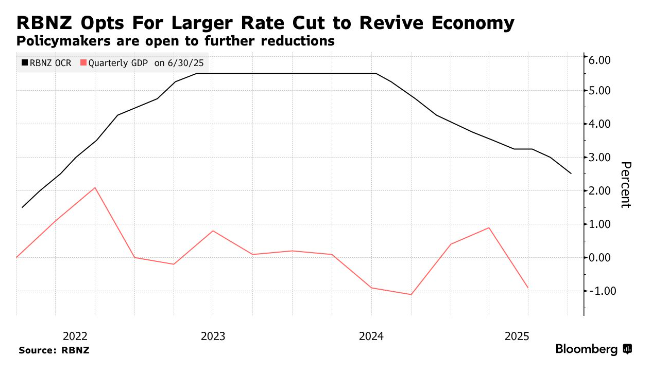
智通财经APP获悉,新西兰联储宣布将基准利率下调50个基点,并表示,鉴于当前经济增长乏力,未来 仍有可能进一步降息以刺激需求。消息公布后,新西兰元汇率应声下跌。 当地时间周三,新西兰联储货币政策委员会将官方现金利率(OCR)从3%下调至2.5%。此前接受一项调 查的25位经济学家中,仅有10人预判了这一幅度,其余15位均预计降息幅度为25个基点。 新西兰联储在声明中指出:"2025年中期的经济活动表现疲软。为使通胀率持续稳定在2%的目标水平附 近,委员会仍愿意在必要时进一步下调官方现金利率。" 新西兰第二季度经济萎缩幅度超出预期,企业信心持续低迷,这让市场对下半年经济复苏力度产生疑 虑。当前经济中的闲置产能意味着,物价压力有望逐步缓解,预计到2026年,通胀率将回落至新西兰联 储1%-3%目标区间的中点。 ASB Bank首席经济学家Nick Tuffley表示:"考虑到新西兰联储8月的预测已显示,官方现金利率本就极 有可能在年底前降至这一水平,此次50个基点降息的负面影响有限。"他补充称,"11月再降息25个基 点,或许足以支撑经济复苏;但如果效果不及预期,新西兰联储不排除进一步加大降息力度的可能"。 声明 ...

金价爆发背后的真相 意味着什么?
Sou Hu Cai Jing· 2025-10-01 11:47
Market Performance and Data - Recent surge in international gold prices, with futures prices rising significantly within weeks, indicating a rare one-sided upward trend [1] - Increased trading volume in both futures and spot markets, reflecting a substantial influx of market capital [3] Global Economic Uncertainty - Heightened global economic uncertainties, including geopolitical conflicts and slowing economic growth, have driven investors to seek gold as a safe-haven asset [4] - Major economies showing signs of contraction, with declining manufacturing PMI and lowered growth forecasts from the IMF [4] Monetary Policy Easing Expectations - Global central banks signaling a shift towards looser monetary policies, with expectations of paused interest rate hikes and potential rate cuts [5] - Increased liquidity and risk of currency depreciation make gold more attractive as a non-currency asset [5] Inflation Expectations - Divergence in inflation expectations, with some economists predicting a return to low inflation while others foresee persistent inflation due to previous monetary easing [6] - Gold's role as an inflation hedge is emphasized, leading to increased investment in gold to mitigate inflation risks [6] Impact on Financial Markets - Gold price surge positively affecting related stocks, particularly in the gold mining and jewelry sectors, while also boosting prices of other precious metals [8] - Interaction between rising gold prices and bond market dynamics, with potential capital shifts from bonds to gold [8] Impact on the Gold Industry - Gold mining companies experiencing significant profit increases due to high gold prices, with some previously unprofitable mines becoming viable [9] - Increased exploration and development activities in the gold sector as companies seek to capitalize on favorable market conditions [9] Investor Implications - Opportunities for investors to engage in gold-related assets, such as futures and ETFs, to benefit from rising prices [10] - Need for investors to maintain a rational approach and consider their risk tolerance when investing in volatile gold markets [10] Future Price Outlook - Continued uncertainty in gold price trends, supported by ongoing geopolitical tensions and expectations of monetary easing [11] - Potential factors that could suppress gold prices include unexpected economic recovery and strengthening of the dollar [11]

反弹先锋已就位!券商股强势拉升7%,释放什么信号?
Xin Lang Cai Jing· 2025-09-29 08:43
Core Viewpoint - The securities sector has shown strong performance, with significant gains in various indices and stocks, driven by supportive monetary policies and improved market conditions [1][2]. Group 1: Market Performance - On September 29, 2025, the securities index rose over 7% at one point, while the securities and insurance index increased by more than 6% [1]. - Key stocks such as Huatai Securities hit the daily limit, and several others like Guosheng Financial Holdings and GF Securities saw gains exceeding 9% [1]. - The current A-share environment is characterized by multiple positive signals, including a low interest rate environment and increased risk appetite among investors [1]. Group 2: Monetary Policy Impact - The central bank's recent meeting emphasized the need for a moderately loose monetary policy, encouraging financial institutions to increase credit supply [1]. - Policies such as securities, fund, and insurance company swap facilities and stock repurchase loans are expected to provide liquidity support to non-bank financial institutions, benefiting the brokerage sector [1]. Group 3: Sector Analysis - The securities sector is highly correlated with stock market performance, with brokerage, proprietary trading, and investment banking businesses set to benefit from market recovery [2]. - Although the growth rate of insurance premiums has slowed, the recovery in equity markets is expected to enhance investment returns for insurance companies, indicating potential for increased allocation from public funds [2].
券商板块爆发!证券ETF南方(512900)加速上攻涨超7%,国盛金控涨停,证券行业景气上行趋势未改
Xin Lang Cai Jing· 2025-09-29 06:48
Core Viewpoint - The Southern Securities ETF (512900) has shown significant upward movement, reflecting a strong performance in the securities sector, driven by favorable monetary policy and market conditions [1][2]. Group 1: ETF Performance - The Southern Securities ETF (512900) surged over 7% in the afternoon trading session on September 29, 2025, with a transaction volume of 118 million yuan [1]. - As of September 26, 2025, the latest share count for the Southern Securities ETF reached 6.302 billion, marking a three-month high [2]. Group 2: Market and Policy Insights - The People's Bank of China held its monetary policy committee meeting on September 23, 2025, emphasizing the need for a moderately loose monetary policy to support high-quality economic development and stabilize the capital market [2]. - West Securities noted that the securities industry remains in an upward trend, characterized by relative undervaluation and high year-on-year performance growth, indicating potential for valuation recovery [2]. - Open Source Securities highlighted rising risk aversion ahead of the National Day holiday, but maintained a positive long-term outlook for the securities and financial sectors, suggesting a "hold through the holiday" strategy due to low valuation levels [2]. Group 3: Index Composition - The Southern Securities ETF closely tracks the CSI All Share Securities Company Index, which categorizes companies into various industry levels, providing a comprehensive analysis tool for investors [3]. - The top ten weighted stocks in the index include prominent firms such as Dongfang Wealth, CITIC Securities, and Huatai Securities, among others [3].

国债半年度报告:风险偏好提升,债券吸引力下降
Guo Mao Qi Huo· 2025-09-29 05:38
Report Summary 1. Report Industry Investment Rating No relevant content provided. 2. Core Viewpoints of the Report - The bond market experienced a significant downturn in the second half of 2025, mainly due to the rise of the equity market and commodities, as well as institutional behavior adjustments. However, in the fourth quarter, the bond market is expected to recover, supported by the coordinated efforts of monetary and fiscal policies and the relatively friendly monetary environment [2][37][47]. 3. Summary by Relevant Catalogs 3.1. Sharp Decline of Bond Futures in the Second Half of the Year - In 2025, the Treasury bond futures market was extremely volatile, with five distinct stages. From July onwards, all maturities of Treasury bond futures declined from their highs, and there was no obvious sign of stabilization in the short term. For example, the TL main contract dropped by more than 6% [3]. 3.2. Correction of Premature Pricing 3.2.1. Dominance of the Game between Institutions and the Central Bank - In the first half of the year, the market continued the bullish trend since November 2024. After the Politburo meeting and the Central Economic Work Conference, the market anticipated interest rate cuts and reserve requirement ratio cuts in advance, leading to a rapid decline in bond yields. However, the Central Bank took measures to cool down the market, including strict supervision, tightening of the capital market, and policy implementation, which weakened the bullish sentiment [11][12]. 3.2.2. Asset Rotation and Increased Risk Appetite - **Commodity Market**: In July, the anti - involution policy promoted the rise of certain commodities such as lithium carbonate, polysilicon, coking coal, and coke. The policy was later adjusted, and the enthusiasm in the commodity market subsided [20][24]. - **Equity Market**: Driven by factors such as technological innovation narratives and policy reforms, the domestic stock market had a strong bullish trend from July to September. Major indices such as the Shanghai Composite Index, Shenzhen Component Index, ChiNext Index, and CSI 300 all had significant increases, attracting funds from the bond market [28]. - **Institutional Behavior**: The revision of the regulations on public - offering fund sales fees and the possible cancellation of tax exemptions for public - offering fund dividends affected institutional behavior. Although there was some short - term panic selling, the long - term impact on the market structure was limited [34]. 3.3. Expected Recovery of the Bond Market in the Fourth Quarter - **Insufficient Attractiveness of Bond Yields**: In the past two years, the decline in bond yields was supported by the fundamental situation and the asset shortage environment. However, this year, the emergence of the equity market and the commodity market's bullish trends has led to a diversion of funds from the bond market [37]. - **Fundamentals as the Anchor**: The main negative factor for the bond market is the diversion of funds to risk assets. Although the short - term impact of asset linkage on the bond market is magnified, the market deviation will eventually be corrected. The monetary policy is expected to remain relatively loose, which is beneficial to the bond market [40]. - **Synergistic Efforts of Monetary and Fiscal Policies**: The Ministry of Finance and the Central Bank will cooperate more closely to improve the effectiveness of macro - policies. Considering the current economic situation, the fundamentals are still favorable for the bond market, and the bond market is expected to recover in the fourth quarter [46][47].
领峰贵金属双倍积分再暴击!美联储降息落地,黄金剑指4000大关?
Sou Hu Cai Jing· 2025-09-29 03:00
Group 1 - The Federal Reserve has officially initiated interest rate cuts, leading to increased market liquidity and a surge in gold prices, which have risen for four consecutive weeks and are hovering near historical highs, with a potential breakthrough of the 3700 mark [1] - The decision to cut rates is primarily driven by structural weaknesses in the job market, with the unemployment rate rising to 4.3% in August and non-farm payrolls increasing by only 22,000, significantly below the expected 150,000 [1] - Market expectations suggest that the Federal Reserve may implement three rate cuts this year, reinforcing strong support for gold prices, with a consensus that prices could reach 4000 USD by the end of the year [1] Group 2 - Current bullish momentum in gold suggests that any pullback may present a good entry opportunity, with a 91.9% probability of a 25 basis point rate cut by the Federal Reserve in October [2] - A promotional campaign by the company offers double points for trading gold and silver, incentivizing traders to participate in the market during this bullish phase [2][4] - The points earned from trading can be redeemed for bonuses, enhancing the trading experience and encouraging more transactions [4][5]

黄金时间·观点:金价上涨的基本面因素均未实质性改变 新高可能只是上涨过程中的里程碑
Zhong Guo Jin Rong Xin Xi Wang· 2025-09-28 03:37
Core Viewpoint - The recent surge in international gold prices, surpassing $3,700 per ounce, is a response to global monetary policy easing, technological shifts, and the weakening of dollar credibility, indicating a long-term upward trend rather than a peak [1][9]. Historical Market Cycles - The first gold bull market lasted from August 1971 to January 1980, with prices rising from $35 to $850 per ounce, driven by U.S. fiscal deficits and stagflation, reflecting gold's role as a hedge against currency crises [2]. - The second bull market spanned from February 2001 to August 2011, with prices increasing from $251.9 to $1,920.3 per ounce, influenced by economic weakness post-dot-com bubble and the subprime mortgage crisis [2]. - The current bull market, recognized since 2022, is characterized by structural cracks in the U.S. dollar credit system, driven by political instability, fiscal challenges, and technological competition [2]. De-dollarization Trend - The global de-dollarization process is accelerating, with central banks, including China's, increasing gold reserves, reflecting skepticism towards dollar asset safety [3]. - A survey indicates that 95% of central banks plan to continue increasing gold holdings, with 43% betting on the rise of yuan and euro reserves, highlighting strategic adjustments due to dollar credit cracks [3]. - The weaponization of the dollar post-Russia-Ukraine conflict has catalyzed the de-dollarization movement, emphasizing gold's strategic value as a "ultimate payment method" [3]. Current Price Drivers - Global monetary policy easing is a primary driver of rising gold prices, with the U.S. Federal Reserve recently lowering interest rates, enhancing gold's investment appeal [4]. - The weakening U.S. dollar index, which fell from around 108 to approximately 97.62, has made gold cheaper for holders of other currencies, boosting demand [5]. - Political and economic uncertainties, including U.S. domestic political interference and emerging market financial turmoil, have increased demand for gold as a safe asset [5]. Future Outlook - The U.S. political divide and global economic governance changes are expected to reshape gold's strategic value, with central bank gold purchases potentially transitioning from diversification to strategic accumulation [6]. - In the next six months, gold prices are projected to maintain a strong oscillating pattern, with potential to exceed $3,800 per ounce if the Fed signals stronger easing [7]. - Long-term projections suggest gold prices could exceed $6,000 per ounce within 3 to 5 years, driven by structural changes in the global monetary system [8]. Price Scenarios - In a baseline scenario, gold prices may fluctuate between $3,500 and $4,500 per ounce over the next 12 months, with a midpoint around $3,750 per ounce [10]. - An optimistic scenario could see prices surpassing $4,000 to $4,500 per ounce due to geopolitical crises or significant Fed rate cuts, while a pessimistic scenario might see a drop to $3,400 to $3,600 per ounce if the U.S. economy stabilizes [10]. Investment Strategy - Investors should focus on the Fed's policy rhythm and geopolitical events affecting gold prices, while considering gold as a strategic asset in their portfolios to optimize risk-return structures [11].