地缘政治

Search documents
铁矿石:产业政策发酵,短期波动加剧
Hua Bao Qi Huo· 2026-03-13 03:17
1. Report Industry Investment Rating No relevant content provided. 2. Core Viewpoint of the Report - The short - term domestic anticipation of the iron ore market is in line with expectations, and the supply - demand contradiction is continuously accumulating. Supply is growing at a high rate year - on - year, while demand is still restricted by the industrial chain profit. The futures price is mainly driven by trade restriction policies, Iranian supply disruptions, and rising shipping costs, leading to a continuous weakening of the basis. Considering the continued weakness of the steel industry chain, there is significant upward pressure. It is recommended to participate in bull spreads. The expected price range is 104 - 109 US dollars/ton (61% index), corresponding to 790 - 825 yuan/ton for Dalian iron ore futures. The strategy is to conduct range trading and sell call options [2]. 3. Summary by Relevant Catalogs Supply - Current overseas ore shipments have emerged from the off - season, with off - season shipments showing above - seasonal growth and reaching the highest level in the same period of the past five years. In the short term, Australia and Brazil have seen some reduction due to maintenance. There are concerns about the impact of the geopolitical factors between the US and Iran on Iran's global iron ore supply, and there are also transfer pressures from other countries. The supply of domestic ore is expected to enter a seasonal recovery cycle. Overall, the short - term supply pressure remains high, providing a downward driving force [2]. Demand - Domestic iron ore demand mainly depends on the profit level of steel mills and the degree of steel inventory reduction. The probability of an unexpected increase in terminal demand is low. Attention should be paid to the timing of steel inventory reduction and the intensity of resumption of work. The environmental protection restrictions in North China are about to be lifted, creating restocking demand. However, considering the low profit level of steel mills and weak demand expectations, the upward driving force of demand is weak [2]. Inventory - Steel mills are maintaining a low - inventory operation mode and are cautious in procurement. There is short - term restocking demand. Currently, port inventories are still accumulating, and the short - term port inventory pressure remains high, with the inventory driving force being downward [2].
国泰君安期货商品研究晨报:能源化工-20260313
Guo Tai Jun An Qi Huo· 2026-03-13 03:10
1. Report Industry Investment Ratings - The report does not explicitly provide an overall industry investment rating. However, it gives trend intensities for each commodity, which can be used as a reference for investment. The trend intensity ranges from -2 (most bearish) to 2 (most bullish), with -2, -1, 0, 1, 2 representing weak, weakish, neutral, strongish, and strong respectively. For example, PX, PTA, and synthetic rubber have a trend intensity of 2 or 1, indicating a relatively strong investment outlook [10][18]. 2. Core Views of the Report - The report focuses on the energy and chemical commodities market, analyzing the fundamentals and market trends of various commodities. It points out that due to geopolitical uncertainties, especially the Middle - East conflict, many commodities are affected in terms of supply, demand, and price. For example, the conflict leads to supply disruptions in some commodities like PX, PTA, and LPG, while also affecting the cost and production of other commodities [6][19]. 3. Summary by Commodity PX, PTA, MEG - **PX**: Supply - side reduction is expected, with potential further load - reduction in the future. Overseas imports may decline, and 4 - 5 months are expected to see accelerated inventory depletion. The cost is strongly supported by the rising crude oil price, and the unilateral trend is upward [10]. - **PTA**: The cost is pushed up by the strong PX price. Raw material supply reduction leads to PTA device production cuts, and the demand side shows an increase in polyester start - up. PTA will enter a de - stocking pattern from April to May, with the price continuing to be strong [10]. - **MEG**: The domestic cracking unit has reduced production, and the ethylene glycol start - up rate has dropped significantly. The downstream polyester start - up continues to rise, and ethylene glycol starts to de - stock this week. However, the spot - end trading is still weak, and the basis weakens [11]. Rubber - It shows a wide - range oscillation. Overseas production areas are entering the off - cutting period, and some areas in Yunnan have started trial - cutting. The import volume of rubber in February decreased, and the tire enterprise capacity utilization rate has recovered to a certain extent. The overall market is in a neutral state [13][14][15]. Synthetic Rubber - It has an intraday wide - range oscillation with an upward - moving price center. The domestic butadiene inventory is in a downward trend, and the supply - side contraction expectation makes the fundamentals of the butadiene - styrene rubber industry chain gradually strengthen. It is expected to maintain the cost - push logic [16][18]. LLDPE and PP - **LLDPE**: Geopolitical uncertainties are high, and the cracking supply contraction continues. The cost is pushed up by the strong performance of naphtha, and the post - festival demand for mulch film is expected to improve [19][20]. - **PP**: Multiple raw material supplies are restricted, and the upstream start - up contracts. The cost of C3 is strongly supported, and the demand is expected to improve after the Lantern Festival [19][20]. Caustic Soda - Supply is passively reduced, and the market shows a strong - side oscillation. The Middle - East situation affects the downstream of chlorine - consuming products, leading to overseas caustic soda production cuts and a significant increase in export prices. However, the futures premium is large, and overseas device dynamics and Chinese export orders need to be continuously tracked [22][23]. Pulp - It operates in an oscillatory manner. The futures market shows a narrow - range oscillation, and the spot market is stable. The supply - side port inventory remains high, and the demand - side downstream paper mills' procurement is cautious [26][27]. Glass - The original sheet price is stable. The domestic float - glass market price has a slight increase, and the downstream processing plants replenish inventory moderately in the price - increasing atmosphere [30][31]. Methanol - It oscillates in a wide range at a high level. The port methanol market oscillates widely at a high level, and the inventory starts to deplete. The inland methanol price rises significantly, driven by geopolitical emotions and demand recovery [33][35]. Urea - It oscillates in a wide range, and the fundamentals support the price. The enterprise inventory has decreased significantly recently, and the market trading sentiment is driven by the international geopolitical conflict. However, the policy restricts the upward space of the valuation [37][38]. Styrene - It oscillates strongly. The conflict causes a reduction in pure benzene supply, an increase in styrene exports, and active replenishment by downstream industries. The downstream profit is still high, and the follow - up increase of downstream prices needs to be observed [40][41]. Soda Ash - The spot market changes little. The domestic soda - ash market is stable and firm, with an increase in supply and general downstream demand. The short - term price may be slightly stronger [44]. Propylene - The cost - side is affected by geopolitical factors, and the supply is expected to decrease. The LPG and propylene market shows certain price fluctuations, and the PDH start - up rate has decreased [47]. PVC - Supported by cost and with supply reduction, the market oscillates strongly. The Middle - East conflict affects the upstream energy and ethylene raw materials, increasing the cost of domestic ethylene - based enterprises and reducing production loads [55]. Fuel Oil and Low - Sulfur Fuel Oil - **Fuel Oil**: It maintains a rebound and is in a high - volatility environment in the short term. - **Low - Sulfur Fuel Oil**: It hit the daily limit during the day, and the spot price difference between high - and low - sulfur fuels in the overseas market decreased marginally [58]. Container Shipping Index (European Line) - Driven by geopolitical emotions, it has large fluctuations. The demand side's post - Lantern - Festival resumption of work and production is average, and the supply side's weekly average capacity will increase in the second half of March. The freight rate is affected by oil price increases and emergency fuel surcharges [60][69][71]. Short - Fiber and Bottle - Chip - **Short - Fiber**: It fluctuates at a high level, and upward risks need to be guarded against. The futures price rises significantly, and the spot price also increases, but the downstream purchases cautiously. - **Bottle - Chip**: It fluctuates at a high level, and upward risks need to be guarded against. The upstream raw material price rises, and the factory quotation increases, with mainly rigid - demand transactions in the market [75][76]. Offset Printing Paper - It is advisable to wait and see. The spot market price is stable, and the paper - enterprise price increase is not actively responded to by the downstream, with light trading [78][79][81]. Pure Benzene - It oscillates strongly. The supply of pure benzene is reduced due to the conflict, and downstream industries actively replenish inventory. The port inventory has a slight decrease, and the price rises [83][84].
聚酯数据日报-20260313
Guo Mao Qi Huo· 2026-03-13 03:01
Report Industry Investment Rating - Not provided Core Viewpoints - Geopolitical conflicts support crude oil prices, and the impact of poor crude oil logistics has fermented. PTA plants in Zhejiang and Shandong have started to reduce production, and those in Fujian are about to do so. The possibility of production cuts by PX and PTA enterprises will continue to increase, and the PTA market will surge [2]. - The Middle East situation is tense, and the market is in chaos. Northeast Asian refineries are extremely dependent on crude oil supplies from the Middle East. Affected by the closure of the Strait of Hormuz, they have faced tight crude oil supplies and had to reduce their loads. Asian naphtha cracking units have significantly reduced production and shut down [2]. - The speculative sentiment in the Asian PX market has recovered, but the physical supply is tight, and PX physical goods are in short supply. Due to extreme market concerns, downstream replenishment is rapid, and the operating load of polyester is lower than expected. South Korea, India, and Thailand may face significant operational difficulties [2]. Summary by Relevant Catalogs Market Data - INE crude oil price increased from 662.0 yuan/barrel on March 11, 2026, to 722.3 yuan/barrel on March 12, 2026, with a change of 60.30 yuan/barrel [2]. - PTA-SC decreased from 1849.2 yuan/ton to 1749.0 yuan/ton, a change of -100.21 yuan/ton [2]. - PTA/SC decreased from 1.3844 to 1.3332, a change of -0.0512 [2]. - CFR China PX increased from 1217 to 1305, a change of 88 [2]. - PX-naphtha spread increased from 376 to 430, a change of 54 [2]. - PTA main contract futures price increased from 6660 yuan/ton to 6998 yuan/ton, a change of 338.0 yuan/ton [2]. - PTA spot price increased from 6320 yuan/ton to 7030 yuan/ton, a change of 710.0 yuan/ton [2]. - Spot processing fee increased from (11.9) yuan/ton to 231.1 yuan/ton, a change of 243.0 yuan/ton [2]. - Disk processing fee decreased from 328.1 yuan/ton to 204.1 yuan/ton, a change of -124.0 yuan/ton [2]. - Main contract basis decreased from (14) to (22), a change of -8.0 [2]. - PTA warehouse receipt quantity increased from 126068 to 143618, a change of 17550 [2]. - MEG main contract futures price increased from 4577 yuan/ton to 4653 yuan/ton, a change of 76.0 yuan/ton [2]. - MEG-naphtha increased from (294.95) yuan/ton to (294.14) yuan/ton, a change of 0.8 yuan/ton [2]. - MEG domestic price increased from 4400 yuan/ton to 4715 yuan/ton, a change of 315.0 yuan/ton [2]. - Main contract basis decreased from -55 to -85, a change of -30.0 [2]. Industrial Chain Operating Conditions - PX operating rate remained at 80.34%, with a change of 0.00% [2]. - PTA operating rate decreased from 79.81% to 77.57%, a change of -2.24% [2]. - MEG operating rate decreased from 54.19% to 53.88%, a change of -0.31% [2]. - Polyester load decreased from 84.88% to 84.49%, a change of -0.39% [2]. Product Data - POY150D/48F increased from 8515 to 9240, a change of 725.0 [2]. - POY cash flow increased from 387 to 400, a change of 13.0 [2]. - FDY150D/96F increased from 8735 to 9460, a change of 725.0 [2]. - FDY cash flow increased from 107 to 120, a change of 13.0 [2]. - DTY150D/48F increased from 9905 to 10690, a change of 785.0 [2]. - DTY cash flow increased from 577 to 650, a change of 73.0 [2]. - Filament sales rate increased from 9% to 10%, a change of 1% [2]. - 1.4D direct-spun polyester staple fiber increased from 7885 to 8480, a change of 595 [2]. - Polyester staple fiber cash flow decreased from 107 to (10), a change of -117.0 [2]. - Staple fiber sales rate decreased from 64% to 57%, a change of -7% [2]. - Semi-gloss chip increased from 7040 to 7650, a change of 610.0 [2]. - Chip cash flow decreased from (188) to (290), a change of -102.0 [2]. - Chip sales rate decreased from 25% to 10%, a change of -15% [2]. Device Maintenance - A 2.5 million-ton PTA plant in East China has returned to normal operation after a shutdown for maintenance around February 10 [2]. - A 3.6 million-ton PTA plant in East China has returned to normal operation after operating at 50% capacity [2]. - A 1.25 million-ton PTA plant in South China has returned to normal operation after maintenance in mid-January [2].
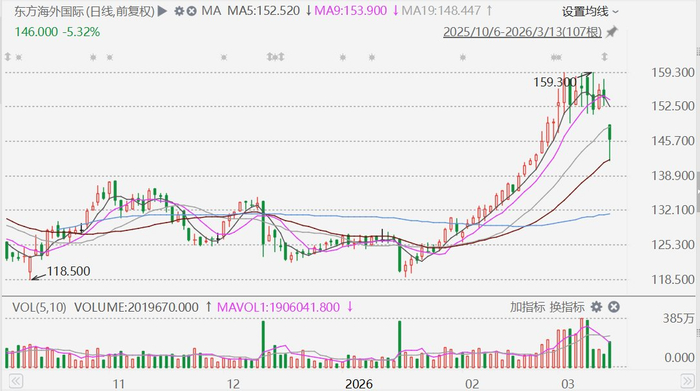
港股异动丨东方海外国际跌8%,2025年收入利润均下滑
Ge Long Hui A P P· 2026-03-13 02:56
Core Viewpoint - The company, Orient Overseas International (0316.HK), reported a significant decline in its financial performance for the year ending December 31, with a net profit of $1.513 billion, down 41.28% year-on-year, and a revenue of $9.722 billion, down 9.15% year-on-year [1][1][1] Financial Performance - The company's earnings per share (EPS) stood at $2.29 [1] - A final dividend of $0.42 per share was declared [1] Industry Outlook - The shipping industry faces concerns over oversupply of capacity as new ship deliveries continue to rise, with some shipping companies operating certain routes through the Red Sea [1] - Despite the oversupply concerns, the current charter market remains tight, indicating a challenging balance between supply and demand [1] - Geopolitical events are increasingly frequent, adding uncertainty to future market trends, making it difficult to predict market movements accurately [1]


宏观金融类:文字早评-20260313
Wu Kuang Qi Huo· 2026-03-13 02:02
1. Report Industry Investment Rating No relevant content provided. 2. Core Viewpoints - The overall market is affected by geopolitical conflicts, especially the Iran - US conflict, which has led to fluctuations in various asset prices. Different industries have different trends and investment strategies based on their own fundamentals and market sentiment [4][8][10] - In the short term, due to the uncertainty of geopolitical conflicts, risk control is emphasized, and different investment strategies are proposed for different industries, such as short - term trading, hedging, and waiting for opportunities [4][10][53] 3. Summary by Directory 3.1 Macro - Financial 3.1.1 Stock Index - **Market Information**: News includes Iran's stance on revenge and the closure of the Strait of Hormuz, fiber - optic cable product procurement issues, Fed rate - cut expectations, and Cambrian's financial results [2] - **Strategy**: Due to the Iran - US conflict affecting global risk appetite, it is recommended to pay attention to the situation in the Middle East and control risks [4] 3.1.2 Treasury Bonds - **Market Information**: Bond prices showed small fluctuations. The US government's trade investigation and Iran's oil price remarks, along with central bank liquidity operations, were reported [5] - **Strategy**: The economic recovery's sustainability needs to be observed. Inflation pressure may put pressure on the bond market, and the bond market is expected to continue to fluctuate [8] 3.1.3 Precious Metals - **Market Information**: Gold and silver prices declined. US inflation data showed a certain trend, and there were relevant statements from Iran and the US government [9] - **Strategy**: Gold prices are in a narrow - range shock. Higher inflation expectations suppress precious metal prices. A cautious bearish view is taken, with reference price ranges provided [10] 3.2 Non - ferrous Metals 3.2.1 Copper - **Market Information**: Copper prices fluctuated due to the Middle East conflict. LME and domestic inventories changed, and the basis and spreads showed certain characteristics [12] - **Strategy**: The short - term copper price is expected to be in a shock state, with reference price ranges provided [13] 3.2.2 Aluminum - **Market Information**: Aluminum prices were strong due to supply concerns. Inventory and basis changes were reported [14] - **Strategy**: Aluminum prices are expected to remain strong, with reference price ranges provided [15] 3.2.3 Zinc - **Market Information**: Zinc prices declined. Inventory and basis data were provided [16] - **Strategy**: The zinc industry is weak. There is a risk of the zinc price breaking downward, and it is expected to fluctuate widely [16] 3.2.4 Lead - **Market Information**: Lead prices declined. Inventory and basis data were provided [17] - **Strategy**: The lead market has poor consumption and inventory accumulation. There is a possibility of the lead price further declining [17] 3.2.5 Nickel - **Market Information**: Nickel prices rose. Cost and price data of nickel - related products were provided [19] - **Strategy**: In the medium - term, the nickel price center may rise. In the short - term, it is expected to fluctuate, with reference price ranges provided [20] 3.2.6 Tin - **Market Information**: Tin prices rose. Supply and demand were in a post - holiday transition period [18] - **Strategy**: The tin price is expected to fluctuate widely. It is recommended to wait and see, with reference price ranges provided [18] 3.2.7 Carbonate Lithium - **Market Information**: Carbonate lithium prices declined. Production and inventory data were provided [21] - **Strategy**: The price is expected to fluctuate in a range. Future factors such as downstream stocking and market atmosphere need to be concerned [21] 3.2.8 Alumina - **Market Information**: Alumina prices declined. Inventory and basis data were provided [22] - **Strategy**: It is recommended to wait and see. The price is expected to fluctuate widely, and potential driving factors need to be focused on [23] 3.2.9 Stainless Steel - **Market Information**: Stainless steel prices rose. Inventory and basis data were provided [25] - **Strategy**: It is expected to maintain an upward - fluctuating pattern, with a reference price range provided [25] 3.2.10 Cast Aluminum Alloy - **Market Information**: Cast aluminum alloy prices rose. Inventory and basis data were provided [26] - **Strategy**: The price is expected to remain strong in the short - term [27] 3.3 Black Building Materials 3.3.1 Steel - **Market Information**: Steel prices fluctuated. Inventory and basis data were provided [29] - **Strategy**: The steel market is neutral - weak. It is expected to fluctuate in a range, and future demand and raw material prices need to be concerned [30] 3.3.2 Iron Ore - **Market Information**: Iron ore prices rose. Inventory and basis data were provided [31] - **Strategy**: The iron ore price is expected to be strong with increased volatility. Attention should be paid to negotiation progress and geopolitical situations [32] 3.3.3 Coking Coal and Coke - **Market Information**: Coking coal and coke prices rose. Technical support and resistance levels were analyzed [33][34][35] - **Strategy**: In the short - term, the market sentiment is bullish, but there are still supply and demand constraints. In the long - term, the coking coal price is expected to be optimistic [36][37] 3.3.4 Glass and Soda Ash - **Market Information**: Glass and soda ash prices rose. Inventory and basis data were provided [38][40] - **Strategy**: Glass demand has improved slightly, and soda ash is mainly driven by cost. Reference price ranges are provided [39][41] 3.3.5 Manganese Silicon and Ferrosilicon - **Market Information**: Manganese silicon and ferrosilicon prices rose. Technical analysis was provided [42] - **Strategy**: The market sentiment is bullish. The future market is affected by market sentiment and cost factors [43][44] 3.3.6 Industrial Silicon and Polysilicon - **Market Information**: Industrial silicon and polysilicon prices rose. Supply and demand data were provided [45][47] - **Strategy**: Industrial silicon is expected to fluctuate or rebound, and polysilicon is expected to fluctuate [46][48] 3.4 Energy and Chemicals 3.4.1 Rubber - **Market Information**: The rubber market has different views on supply and demand. Tire enterprise operating rates and inventory data were provided [50][51] - **Strategy**: It is recommended to trade flexibly and set stop - losses. A hedging strategy is provided [53] 3.4.2 Crude Oil - **Market Information**: Crude oil and related product prices rose. US inventory data were provided [54][55] - **Strategy**: Several trading strategies are proposed, including short - selling and spread trading [56] 3.4.3 Methanol - **Market Information**: Methanol prices rose. MTO profit data were provided [57] - **Strategy**: It is recommended to take profits at high prices [58] 3.4.4 Urea - **Market Information**: Urea prices rose. Regional price and basis data were provided [59] - **Strategy**: It is recommended to short - sell at high prices, and pay attention to short - term demand changes [60] 3.4.5 Pure Benzene and Styrene - **Market Information**: Pure benzene and styrene prices rose. Supply, demand, and cost data were provided [61][62] - **Strategy**: It is recommended to wait and see [63] 3.4.6 PVC - **Market Information**: PVC prices rose. Cost, supply, demand, and inventory data were provided [64] - **Strategy**: The short - term fundamentals are weak, but there is a possibility of a rebound. Attention should be paid to risks [65] 3.4.7 Ethylene Glycol - **Market Information**: Ethylene glycol prices rose. Supply, demand, and inventory data were provided [66] - **Strategy**: The inventory is expected to decline. Attention should be paid to risks due to excessive short - term price increases [67] 3.4.8 PTA - **Market Information**: PTA prices rose. Supply, demand, and cost data were provided [68] - **Strategy**: It is necessary to observe the subsequent maintenance situation. There is room for valuation to rise, but attention should be paid to risks [69] 3.4.9 p - Xylene - **Market Information**: p - Xylene prices rose. Supply, demand, and cost data were provided [70] - **Strategy**: The supply is expected to decline, and the inventory is expected to decrease. There is room for valuation to rise, but attention should be paid to risks [71] 3.4.10 Polyethylene (PE) - **Market Information**: PE prices rose. Supply, demand, and inventory data were provided [72] - **Strategy**: It is recommended to short - sell the spread between different contracts when the shipping situation improves [73] 3.4.11 Polypropylene (PP) - **Market Information**: PP prices rose. Supply, demand, and inventory data were provided [74] - **Strategy**: The short - term is affected by geopolitical conflicts, and the long - term is affected by production and demand mismatches [75] 3.5 Agricultural Products 3.5.1 Live Pigs - **Market Information**: Pig prices showed different trends in different regions. Supply and demand situations were analyzed [77] - **Strategy**: The short - term spot price is expected to be weak and stable. Different trading strategies are proposed for the near - term and far - term [79] 3.5.2 Eggs - **Market Information**: Egg prices were generally stable. Supply and demand situations were analyzed [80] - **Strategy**: The short - term supply is high. Different trading strategies are proposed for the near - term and far - term [81] 3.5.3 Soybean and Rapeseed Meal - **Market Information**: Soybean import and production data were provided [82] - **Strategy**: It is recommended to wait and see in the short - term due to price fluctuations [83] 3.5.4 Oils and Fats - **Market Information**: Palm oil production, export, and inventory data were provided [84] - **Strategy**: The short - term price is affected by geopolitical conflicts, and the medium - term is bullish [85] 3.5.5 Sugar - **Market Information**: Global and regional sugar production and supply data were provided [86] - **Strategy**: It is not advisable to be overly bearish. It is recommended to buy on dips [87][88] 3.5.6 Cotton - **Market Information**: Global and US cotton production, export, and inventory data were provided [89] - **Strategy**: It is recommended to buy on dips if the downstream starts up well [90]

《能源化工》日报-20260313
Guang Fa Qi Huo· 2026-03-13 01:49
1. Report Industry Investment Ratings No relevant content provided. 2. Core Views of the Reports Pure Benzene and Styrene - Due to the tense geopolitical situation, the supply of pure benzene is expected to decline, and the supply - demand outlook has improved. However, the price will fluctuate with oil prices. The strategy is to wait and see on a single - side basis and shrink the EB04 - BZ04 spread when it is high [1]. - The supply of styrene in March remains high, and the supply - demand is expected to slightly reduce inventory. The price will follow oil price fluctuations, and the strategy is the same as that for pure benzene [1]. Urea - The short - term price of urea is relatively firm, but there may be a downward trend after the return - green fertilizer season in mid - March, mainly affected by sentiment. The main contract should focus on whether it can break through the 1860 - 1900 range, and the strategy is to go long at low levels [2]. PVC and Caustic Soda - The short - term rise of caustic soda is due to the optimistic expectations from geopolitical conflicts. The supply - demand situation is still severe, and attention should be paid to the actual delivery volume of downstream and the price fluctuation of liquid chlorine [3]. - The price of PVC is expected to be passively pushed up. The supply - demand situation has slightly changed, and the cost - end transmission has uncertainties [3]. Natural Rubber - The new rubber supply is gradually being released, and the demand has uncertainties. The price is expected to fluctuate within the range of 16500 - 17500, and attention should be paid to the reduction of tire demand in the Middle East [4]. Glass and Soda Ash - The supply of soda ash is strong and the demand is weak, and it is affected by macro fluctuations. The market is expected to fluctuate, and the range is 1150 - 1300. The strategy is to wait and see on a single - side basis and consider the arbitrage of short soda ash and long glass [5]. - The supply of glass has a low daily melting volume, and the inventory has been well reduced. The strategy is to wait and see, with a range of 1000 - 1150, and go long at low levels after the macro situation stabilizes. Also, consider the arbitrage of short soda ash and long glass [5]. Polyolefins - The short - term market of LLDPE and PP is strong due to cost support, supply reduction, and demand recovery expectations. Attention should be paid to the sustainability of cost support and the actual procurement demand of downstream [6]. Methanol - The price of methanol is widely fluctuating due to geopolitical sentiment. The supply may have an actual reduction, the demand is gradually recovering, and the inventory has started to reduce. Attention should be paid to the progress of the conflict, the inventory reduction rhythm, and the implementation of maintenance [7]. Crude Oil - In the short term, oil prices will maintain a pattern of "policy suppression + geopolitical support", and Brent is likely to fluctuate in the range of 80 - 100 US dollars per barrel [8]. Polyester Industry Chain - For PX, the supply is expected to decline, but attention should be paid to the downstream negative feedback. The price will follow oil price fluctuations, and the strategy is to go long at low levels after the market stabilizes [10]. - For PTA, the self - driving force is limited, and the price follows the cost - end. The strategy is to wait and see on a single - side basis [10]. - For ethylene glycol, the supply in March has decreased significantly, and the inventory reduction amplitude may increase. The price has the momentum to rise, but attention should be paid to the risk of a sharp fall [10]. - For short - fiber, the supply - demand pattern is weak, and it follows the raw material fluctuations. The strategy is the same as that for PTA [10]. - For bottle - chips, the supply is expected to increase in March, and the supply - demand is expected to be tight. The strategy is the same as that for PTA [10]. LPG No specific view statement provided. 3. Summaries According to Relevant Catalogs Pure Benzene - Styrene - **Upstream Prices and Spreads**: On March 12, the prices of Brent crude oil, WTI crude oil, CFR Japan naphtha, etc. all increased compared with March 11, while the spreads of pure benzene - naphtha and ethylene - naphtha decreased [1]. - **Benzene - Styrene - Related Prices and Spreads**: The prices of benzene - styrene spot and futures increased slightly, but the spreads and cash - flows decreased to varying degrees [1]. - **Downstream Cash - Flows**: The cash - flows of downstream products such as phenol, caprolactam, and aniline changed, with some increasing and some decreasing [1]. - **Inventory and Operating Rates**: The inventories of pure benzene and benzene - styrene in Jiangsu ports decreased, and the operating rates of some industries changed slightly [1]. Urea - **Futures and Spot Prices**: The futures prices of urea increased, and the spot prices were generally stable [2]. - **Raw Materials and Downstream Products**: The prices of upstream raw materials were mostly stable, and the prices of some downstream products increased slightly [2]. - **Supply and Demand**: The daily production of urea decreased slightly, the operating rate remained high, and the inventory decreased slightly. The demand from agriculture and industry is in a state of recovery [2]. PVC and Caustic Soda - **Spot and Futures Prices**: The prices of caustic soda and PVC increased to varying degrees, and the basis and spreads changed [3]. - **Overseas Quotes and Export Profits**: The overseas quotes of caustic soda and PVC changed, and the export profits increased [3]. - **Supply and Demand**: The operating rate of the caustic soda industry decreased slightly, and the operating rate of the PVC industry decreased slightly. The demand for downstream products of caustic soda and PVC improved [3]. - **Inventory**: The inventory of caustic soda factories increased slightly, and the inventory of PVC upstream factories and the total social inventory decreased [3]. Natural Rubber - **Spot Prices and Basis**: The price of natural rubber in Yunnan increased, and the basis changed significantly [4]. - **Monthly Spreads**: The monthly spreads of natural rubber changed [4]. - **Fundamental Data**: The production of natural rubber in some countries changed, the operating rates of tire industries increased, and the import and export volumes and inventories also changed [4]. Glass and Soda Ash - **Prices and Spreads**: The prices of glass and soda ash increased slightly, and the basis and spreads changed [5]. - **Supply**: The operating rate and weekly output of soda ash increased slightly, and the daily melting volume of glass decreased [5]. - **Inventory**: The inventories of glass and soda ash factories decreased [5]. - **Real Estate Data**: The year - on - year changes in real estate data such as new construction area, construction area, completion area, and sales area improved to varying degrees [5]. Polyolefins - **Futures and Spot Prices**: The futures prices of LLDPE and PP increased, and the spot prices also increased. The basis and spreads changed [6]. - **Upstream and Downstream Operating Rates**: The operating rates of PE and PP devices decreased, and the operating rates of downstream industries increased [6]. - **Inventory**: The enterprise inventory of PE increased, and the social inventory decreased. The enterprise inventory of PP increased slightly, and the trader inventory decreased [6]. Methanol - **Prices and Spreads**: The futures prices of methanol increased, and the basis and spreads changed [7]. - **Inventory**: The inventories of methanol enterprises, ports, and the society decreased [7]. - **Upstream and Downstream Operating Rates**: The operating rate of upstream domestic enterprises remained stable, and the operating rates of some downstream industries increased [7]. Crude Oil - **Prices and Spreads**: The prices of Brent, WTI, and SC crude oil increased significantly, and the spreads also changed [8]. - **Refined Oil Prices and Spreads**: The prices of refined oil products increased, and the spreads and cracking spreads changed [8]. Polyester Industry Chain - **Upstream and Downstream Product Prices and Cash - Flows**: The prices of upstream raw materials such as crude oil and naphtha increased, and the prices and cash - flows of downstream polyester products also changed [10]. - **PX - Related Prices and Spreads**: The prices and spreads of PX changed [10]. - **PTA - Related Prices and Spreads**: The prices and spreads of PTA changed, and the processing fees decreased [10]. - **MEG - Related Prices and Spreads**: The prices and spreads of MEG changed, and the import profit increased [10]. - **Operating Rates**: The operating rates of various industries in the polyester industry chain changed, with some increasing and some decreasing [10]. LPG - **Prices and Spreads**: The futures prices of LPG increased, and the basis and spreads changed [11]. - **External Market Prices**: The external market prices of LPG increased [11]. - **Inventory**: The refinery storage ratio of LPG decreased, and the port inventory and storage ratio increased [11]. - **Upstream and Downstream Operating Rates**: The operating rate of upstream main refineries increased slightly, and the operating rates of downstream industries also increased [11].
能源化工日报-20260313
Wu Kuang Qi Huo· 2026-03-13 01:16
Report Industry Investment Rating No relevant information provided. Core Viewpoints of the Report - For crude oil, start a strategic short - position configuration, do long the spread of Platts north - south non - identical oil types and short the high - sulfur fuel oil cracking spread and INE - Brent cross - regional spread [2] - For methanol, since it already includes the current geopolitical premium and there are no major short - term supply - demand contradictions, take profit at high prices [4] - For urea, short it on rallies as the domestic contradiction is not prominent in the context of high supply and demand, and the export quota has little cost - effectiveness. There may be short - term marginal support for demand when the substitution valuation reaches the extreme [7] - For rubber, trade flexibly according to the market, set stop - losses, and consider opening or holding a long position in NR and a short position in RU2609 for hedging [12] - For PVC, although the short - term fundamentals are weak, the narrative is turning to expectations. It may rebound before the Iranian issue is resolved, but be cautious as it has risen too much [16] - For pure benzene and styrene, with the easing of the Middle East geopolitical conflict, the non - integrated profit of styrene is neutral to high, and it is recommended to stay on the sidelines [19] - For polyethylene, with the cooling of the Middle East geopolitical conflict, short the LL2605 - LL2609 contract spread on rallies [22] - For polypropylene, the short - term geopolitical conflict dominates the market, and the long - term contradiction shifts from the cost side to the production mismatch [24] - For PX, although the current load is high, it is expected to decline significantly in March. The supply - demand structure of PX and PTA is strong, but be cautious as it has risen too much [27] - For PTA, it is difficult to enter a de - stocking cycle. The processing fee may rise, but be cautious as it has risen too much [29] - For ethylene glycol, the load is expected to decline, imports are expected to decrease, and the port inventory is expected to de - stock. However, be cautious as it has risen too much [32] Summary According to Relevant Catalogs Crude Oil - **Market Information**: INE's main crude oil futures rose 73.10 yuan/barrel, or 11.26%, to 722.30 yuan/barrel; high - sulfur fuel oil rose 392.00 yuan/ton, or 9.20%, to 4653.00 yuan/ton; low - sulfur fuel oil rose 730.00 yuan/ton, or 14.83%, to 5653.00 yuan/ton [1] - **Strategy**: Start a strategic short - position configuration; do long the spread of Platts north - south non - identical oil types; short the high - sulfur fuel oil cracking spread; short the INE - Brent cross - regional spread [2] Methanol - **Market Information**: The main contract changed by 120.00 yuan/ton, reported at 2726 yuan/ton, and the MTO profit changed by - 98 yuan [4] - **Strategy**: Take profit at high prices as it already includes the current geopolitical premium and there are no major short - term supply - demand contradictions [4] Urea - **Market Information**: Regional spot prices in Shandong, Henan, Hebei, Hubei, Jiangsu, Shanxi, and Northeast China did not change. The overall basis was reported at - 15 yuan/ton. The main contract changed by 3 yuan/ton, reported at 1875 yuan/ton [6] - **Strategy**: Short it on rallies. There may be short - term marginal support for demand when the substitution valuation reaches the extreme [7] Rubber - **Market Information**: The market was affected by refinery shutdowns and policy expectations, leading to a rebound in related products. The overall market changed rapidly. Bulls and bears had different views. As of March 5, 2026, the operating load of all - steel tires in Shandong tire enterprises was 66.41%, and that of semi - steel tires was 73.52%. As of March 1, 2026, China's natural rubber social inventory was 138.3 million tons. Spot prices of some products had changes [9][10][11] - **Strategy**: Trade flexibly according to the market, set stop - losses, and consider opening or holding a long position in NR and a short position in RU2609 for hedging [12] PVC - **Market Information**: The PVC05 contract rose 49 yuan to 5620 yuan. The spot price of Changzhou SG - 5 was 5650 (+380) yuan/ton, the basis was 30 (+331) yuan/ton, and the 5 - 9 spread was - 13 (+16) yuan/ton. The overall operating rate was 81.1%, a 1% decrease. The downstream operating rate was 35.8%, an 18.7% increase. Factory inventory was 45.8 million tons (- 4.6), and social inventory was 140.4 million tons (+5.1) [14] - **Strategy**: Although the short - term fundamentals are weak, the narrative is turning to expectations. It may rebound before the Iranian issue is resolved, but be cautious as it has risen too much [16] Pure Benzene and Styrene - **Market Information**: The price of East China pure benzene rose 650 yuan/ton to 8635 yuan/ton. The active contract of pure benzene closed at 8297 yuan/ton, up 650 yuan/ton. The basis of pure benzene expanded by 400 yuan/ton. The spot price of styrene rose 100 yuan/ton to 10100 yuan/ton. The active contract of styrene closed at 9926 yuan/ton, up 106 yuan/ton. The basis of styrene weakened by 6 yuan/ton. The BZN spread decreased by 38.75 yuan/ton. The non - integrated device profit of EB decreased by 355.5 yuan/ton. The upstream operating rate was 74.11%, a 0.13% decrease. The inventory in Jiangsu ports decreased by 0.91 million tons to 16.65 million tons. The weighted operating rate of three S was 40.79%, a 10.34% increase [18] - **Strategy**: With the easing of the Middle East geopolitical conflict, the non - integrated profit of styrene is neutral to high, and it is recommended to stay on the sidelines [19] Polyethylene - **Market Information**: The closing price of the main contract was 8236 yuan/ton, up 82 yuan/ton. The spot price was 8575 yuan/ton, up 750 yuan/ton. The basis was 339 yuan/ton, strengthening by 668 yuan/ton. The upstream operating rate was 81.77%, a 0.76% decrease. The production enterprise inventory was 57.54 million tons, accumulating 3.92 million tons, and the trader inventory was 5.00 million tons, de - stocking 0.77 million tons. The downstream average operating rate was 30%, a 1.38% increase. The LL5 - 9 spread was 302 yuan/ton, narrowing by 46 yuan/ton [21] - **Strategy**: With the cooling of the Middle East geopolitical conflict, short the LL2605 - LL2609 contract spread on rallies [22] Polypropylene - **Market Information**: The closing price of the main contract was 8303 yuan/ton, up 106 yuan/ton. The spot price was 8650 yuan/ton, up 550 yuan/ton. The basis was 347 yuan/ton, strengthening by 444 yuan/ton. The upstream operating rate was 68.42%, a 0.44% decrease. The production enterprise inventory was 68 million tons, accumulating 2.49 million tons, the trader inventory was 20.61 million tons, de - stocking 0.655 million tons, and the port inventory was 7.47 million tons, de - stocking 0.67 million tons. The downstream average operating rate was 45.87%, a 9.13% increase. The LL - PP spread was - 67 yuan/ton, narrowing by 24 yuan/ton. The PP5 - 9 spread was 552 yuan/ton, expanding by 1 yuan/ton [23] - **Strategy**: The short - term geopolitical conflict dominates the market, and the long - term contradiction shifts from the cost side to the production mismatch [24] PX - **Market Information**: The PX05 contract rose 686 yuan to 10218 yuan. The PX CFR price rose 88 US dollars to 1305 US dollars. The basis was 154 yuan (+19), and the 5 - 7 spread was 546 yuan (+134). The Chinese load was 84.7%, a 5.7% decrease; the Asian load was 76.9%, a 6.3% decrease. Some domestic and overseas devices reduced their loads. The PTA load was 80.1%, a 0.9% decrease. In early March, South Korea's PX exports to China were 15.7 million tons, a year - on - year decrease of 1.8 million tons. The inventory at the end of January was 464 million tons, a month - on - month decrease of 1 million tons. The PXN was 342 US dollars (+32), the South Korean PX - MX was 80 US dollars (- 32), and the naphtha crack spread was 189 US dollars (+17) [26] - **Strategy**: Although the current load is high, it is expected to decline significantly in March. The supply - demand structure of PX and PTA is strong, but be cautious as it has risen too much [27] PTA - **Market Information**: The PTA05 contract rose 338 yuan to 6998 yuan. The East China spot price rose 710 yuan to 7030 yuan. The basis was - 22 yuan (- 8), and the 5 - 9 spread was 392 yuan (+26). The PTA load was 80.1%, a 0.9% decrease. The downstream load was 87.2%, a 3.1% increase. The social inventory (excluding credit warehouse receipts) on March 6 was 262.3 million tons, accumulating 2.6 million tons. The spot processing fee of PTA rose 247 yuan to 226 yuan, and the on - disk processing fee fell 112 yuan to 295 yuan [28] - **Strategy**: It is difficult to enter a de - stocking cycle. The processing fee may rise, but be cautious as it has risen too much [29] Ethylene Glycol - **Market Information**: The EG05 contract rose 76 yuan to 4653 yuan. The East China spot price rose 315 yuan to 4715 yuan. The basis was - 58 yuan (- 35), and the 5 - 9 spread was 117 yuan (- 26). The supply - side load was 66.8%, a 5.7% decrease. Some domestic and overseas devices had maintenance or load reduction. The downstream load was 87.2%, a 3.1% increase. The import arrival forecast was 7.8 million tons, and the East China departure on March 11 was 1.2 million tons. The port inventory was 106.8 million tons, accumulating 6.6 million tons. The naphtha - based production profit was - 2155 yuan, the domestic ethylene - based production profit was - 1216 yuan, and the coal - based production profit was 661 yuan. The cost - side ethylene rose to 970 US dollars, and the price of Yulin pit - mouth bituminous coal fines fell to 580 yuan [31] - **Strategy**: The load is expected to decline, imports are expected to decrease, and the port inventory is expected to de - stock. However, be cautious as it has risen too much [32]
中国期货每日简报-20260313
Zhong Xin Qi Huo· 2026-03-13 00:29
Report Industry Investment Rating No relevant content provided. Core Viewpoints - On March 12, equity index futures dropped, and most commodities rose, with energy & chemicals leading the raise. In equity index futures, IC dropped 0.8%, and IH dropped 0.6%. In commodity futures, LSFO, Paraxylene, and Crude Oil were the top three gainers, while Apple, Silver, and Palladium were the top three decliners [10][11][12]. Summary by Directory 1. China Futures 1.1 Overview - On March 12, equity index futures dropped, and most commodities rose, with energy & chemicals leading the raise. IC dropped 0.8%, and IH dropped 0.6%. In commodity futures, the top three gainers were LSFO, Paraxylene, and Crude Oil, and the top three decliners were Apple, Silver, and Palladium [10][11][12]. 1.2 Daily Raise 1.2.1 Crude Oil - On March 12, the Crude Oil main contract rose 11.3% to 722.3 yuan/barrel (INE). Strategic petroleum reserve releases will not reverse supply tightness expectations, leaving oil prices strong. Geopolitical uncertainty and passive production cuts will keep the market volatile and biased upward [18][20][21]. 1.2.2 LSFO - On March 12, the main contract of LSFO rose 14.8% to 5653 yuan/ton (INE). LSFO is pressured by green fuel substitution and limited HSFO replacement demand, but is currently undervalued and moves with crude oil. It has strong primary product attributes, and its crack spread strengthens when crude oil prices rise. Fundamentally, it enjoys a more favorable export tax rebate rate than refined oil products [25][26][27]. 1.2.3 Paraxylene - On March 12, the main contract of Paraxylene rose 13.0% to 10218 yuan/ton (ZCE). Cost increases have evolved into actual supply shocks, with force majeure declared at multiple refineries in the Asia - Pacific. Short - term prices will stay strong, and the medium - term logic of buying on dips holds. PX 05 - 09 month spread is recommended for positive calendar spread, and PXN is expected to trade range - bound between USD 250–330/ton [32][33][34]. 2. China News 2.1 Macro News - IEA Member States Agree to Release 400 Million Barrels of Oil Reserves. The 32 member states of the International Energy Agency will release 400 million barrels of oil from their emergency reserves. - U.S. to Release 172 Million Barrels from Strategic Petroleum Reserve. The U.S. will start releasing 172 million barrels of oil from the Strategic Petroleum Reserve next week, which is expected to take about 120 days. - U.S. February CPI Rises 2.4% YoY, Core CPI Up 2.5% YoY. U.S. CPI rose 2.4% year - on - year in February, and core CPI increased 2.5% year - on - year. The market still expects the Federal Reserve to cut interest rates again as early as July. - U.S. to Launch Section 301 Investigations Against 16 Trading Partners. The U.S. will launch Section 301 investigations against 16 trading partners, including China, the European Union, Mexico, Vietnam, India, and Japan [37].
农产品多品种维持偏强运行
Zhong Xin Qi Huo· 2026-03-13 00:29
1. Report Industry Investment Rating The report does not provide an overall industry investment rating. 2. Core Views of the Report - Multiple agricultural products are maintaining a relatively strong performance. The price trends of various agricultural products are influenced by multiple factors, including geopolitical issues in the Middle East, supply - demand relationships, and policy changes [1]. - The short - term uncertainty in the Middle East situation is high, and the high - level operation of crude oil has led to a risk of increased costs for vegetable oils. There is an expected increase in biodiesel demand, and it is recommended to focus on the phased low - level buying strategy [1]. 3. Summary by Relevant Catalogs 3.1 Oils and Fats - **View**: Crude oil and the external market are strong, boosting the trend of oils and fats. The price trends are highly correlated with the evolution of the Middle East situation, and there is uncertainty in short - term price fluctuations due to the repeated war situation. The fundamentals have both positive and negative factors, and short - term capital is relatively optimistic [1][5]. - **Logic**: Geopolitically, the Middle East situation affects market expectations and oil supply. For soybean oil, the US biodiesel policy is expected to be clarified, and there are concerns about South American soybean shipments to China. For palm oil, Indonesia is accelerating B50 biodiesel tests, and Malaysia's early - March export data is positive, but there is a risk of price decline if production continues to increase and the Middle East conflict eases. For rapeseed oil, it is expected that rapeseed will be concentrated for arrival and crushing from March to May, and domestic inventories will gradually accumulate [1][5]. - **Outlook**: Soybean oil, palm oil, and rapeseed oil are all expected to fluctuate with a slightly upward trend. It is recommended to focus on phased low - level buying strategies [1][5]. 3.2 Protein Meal - **View**: The market anticipates the auction of imported soybeans, causing funds to flow out and the prices of double - meal to open high and close low [1][5]. - **Logic**: Internationally, the March supply - demand report was uneventful, and the focus is on the Middle East conflict, which potentially benefits biodiesel demand and supports the high - level operation of US soybean futures. Domestically, the spot price has slightly increased due to concerns about short - term supply shortages, but high prices suppress demand. The market anticipates the auction of imported soybeans, leading to a high - opening and low - closing of the soybean meal market [5][6]. - **Outlook**: Both soybean meal and rapeseed meal are expected to fluctuate. Pay attention to the development of the Middle East situation [6]. 3.3 Corn - **View**: Corn futures are consolidating at a high level [1][7]. - **Logic**: Domestic corn prices are stable with a slight increase. The upstream supply pressure is limited, and the downstream has a certain demand for replenishing stocks. The speed of upstream supply is slower than the increase in downstream demand, resulting in a short - term tight supply situation [7][8]. - **Outlook**: Corn is expected to fluctuate with a slightly upward trend. In March, it is expected that the price increase will narrow, and attention should be paid to the capital movement in the futures market. In the medium - term, the overall trend is positive [8]. 3.4 Pigs - **View**: The supply of pigs is abundant, and the pig price is weak [1][8]. - **Logic**: In the short - term, the planned daily slaughter volume in March has increased. In the medium - term, the supply pressure is still high. In the long - term, the process of reducing production capacity is not smooth. The post - holiday consumption is in the off - season, and the demand for pigs has decreased, while the slaughter pressure and inventory have increased [8][9]. - **Outlook**: The pig price is expected to fluctuate with a downward trend. In the first half of the year, the industry should consider short - selling hedging opportunities. It is expected that the pig cycle will gradually bottom out and recover in the second half of 2026 [9]. 3.5 Natural Rubber - **View**: Natural rubber prices rose and then fell, remaining restricted below 17,500 yuan [1][10]. - **Logic**: The short - term trading logic is related to the Middle East geopolitical situation, which has a negative impact on downstream tire orders. The market sentiment is weak, and there is a need for price adjustment. However, due to the expected low - production period and stable downstream demand, the price is likely to rise rather than fall [10][11]. - **Outlook**: The fundamentals have limited variables, and the price will maintain a fluctuating trend [11]. 3.6 Synthetic Rubber - **View**: The expectation of limited cracking production still dominates the market [13]. - **Logic**: Affected by the strong performance of the chemical industry, BR prices have risen. The short - term trading logic has shifted to the geopolitical situation. As long as crude oil remains strong, the price of BR is likely to rise even though its fundamentals are weak [13]. - **Outlook**: The price will follow the sentiment of the sector. If crude oil prices continue to rise, the price will remain strong in the short - term, but attention should be paid to the rapid change in geopolitical sentiment [13]. 3.7 Cotton - **View**: Both domestic and foreign cotton prices are strengthening [14]. - **Logic**: Zhengzhou cotton has strengthened this week. The domestic cotton market is expected to be in a tight - balance state in the 25/26 season, and the commercial inventory is decreasing. There is a possibility of a decrease in the cotton - planting area in Xinjiang in 2026. The overseas market is expected to have a tighter supply - demand relationship in the next season [14]. - **Outlook**: Cotton prices are expected to fluctuate with a slightly upward trend and are recommended for long - term allocation [14]. 3.8 Sugar - **View**: The ongoing conflict in the Middle East and short - term oil price fluctuations continue to drive sugar prices to fluctuate [15]. - **Logic**: In the medium - to long - term, domestic and foreign sugar prices are expected to continue to fluctuate weakly at the bottom. In the short - term, the supply surplus pattern is difficult to reverse, and sugar prices do not have the conditions for a continuous and substantial unilateral increase. However, oil price fluctuations may cause short - term price fluctuations [15][16]. - **Outlook**: Sugar prices are expected to fluctuate. The price range of the domestic market can be moderately widened to 5,100 - 5,500 yuan/ton [16]. 3.9 Pulp - **View**: Pulp prices are operating at a low level, and the futures performance is weak [17]. - **Logic**: The fundamentals show a pattern of weak current demand and strong seasonal expectations. The demand in the industry chain is not strong, but there is a seasonal improvement in demand in the future. The supply of broad - leaf pulp has a positive impact, while the high overseas inventory of coniferous pulp and stable import prices have a negative impact [17]. - **Outlook**: Pulp prices are expected to fluctuate with a slightly upward trend, maintaining a wide - range fluctuating pattern [17]. 3.10 Double - Gum Paper - **View**: Double - gum paper prices are fluctuating within a range [18]. - **Logic**: In the short - term, there is no clear upward or downward driving force. From March to April, the market is expected to see an increase in both supply and demand. In May, the price may decline due to publisher bargaining and weak social orders [18]. - **Outlook**: Double - gum paper prices are expected to fluctuate. It is recommended to operate within the range of 4,000 - 4,400 yuan/ton [18]. 3.11 Logs - **View**: The post - holiday demand improvement is limited, and the transmission of spot price increases is average [19][20]. - **Logic**: The geopolitical situation has increased the cost of sea freight and affected the CFR quotes. The domestic spot price has increased, but the fundamentals have not changed significantly. After a large number of logs arrive at ports in March and April, the domestic spot price may be under pressure [20]. - **Outlook**: Log prices are expected to fluctuate within a range. The increase in overseas quotes has supported the domestic price, but the geopolitical situation is volatile [20]. 3.12 Commodity Index - On March 12, 2026, the comprehensive index of CITICS Futures commodities showed an increase. The special index, including the commodity 20 index, industrial products index, and PPI commodity index, also had positive changes. The agricultural product index had a daily increase of 0.77%, a 5 - day increase of 2.50%, a 1 - month increase of 5.18%, and a year - to - date increase of 5.20% [183][184].
“我的两艘船在波斯湾飘着”
汽车商业评论· 2026-03-12 23:05
Core Viewpoint - The article discusses the impact of the recent military conflict between the US, Israel, and Iran on the Chinese automotive export market, particularly focusing on the disruptions faced by Chinese car manufacturers in the Middle East due to the conflict [3][4][21]. Group 1: Impact on Automotive Exports - The UAE, as a significant market for Chinese automotive exports, imported 567,000 vehicles from China last year, making it the third-largest destination for Chinese car exports [4][19]. - The conflict has led to a halt in operations for Chinese automotive dealers in Dubai, with many switching to remote work, severely affecting sales [4][9]. - A large number of vehicles en route to the Middle East are facing delivery delays due to shipping disruptions, with shipping companies either halting operations or imposing high war risk surcharges [4][10][12]. Group 2: Shipping and Logistics Challenges - The blockade of the Strait of Hormuz by Iran has created significant logistical challenges, as it is a crucial route for shipping vehicles to the Middle East [10][22]. - Shipping costs have surged, with the price to transport a vehicle to Europe increasing from approximately $1,500 to over $3,000 due to rerouting around the Cape of Good Hope [21]. - The blockade has also affected the supply chain for essential automotive components, with potential increases in raw material costs by 15% to 25% if the situation persists [22][23]. Group 3: Market Reactions and Future Outlook - Companies like Geely have shifted focus from the Middle East to markets like Canada, which recently opened up for Chinese electric vehicle exports [5][4]. - The conflict has prompted some Chinese automakers to announce price increases for their vehicles due to rising costs of raw materials and logistics [24]. - Analysts predict that the geopolitical tensions will have long-lasting effects on the automotive supply chain, similar to past disruptions caused by geopolitical events [30][31].