金九银十

Search documents
58安居客研究院:8月房产经纪行业景气度指数上升至47.26 市场成交量有望增长
Xin Hua Cai Jing· 2025-09-15 06:31
Core Insights - The national real estate market in August continued to show a differentiated adjustment trend, with policy benefits gradually becoming evident and market confidence showing positive changes, indicating a clearer market bottom and laying the foundation for the traditional peak season of "Golden September and Silver October" [1][2] Group 1: Market Trends - In first-tier cities, the decline in new home prices has shown signs of narrowing, with new residential sales prices decreasing by 0.1% month-on-month, a reduction of 0.1 percentage points compared to July, indicating resilience in core city markets [1] - Shanghai experienced a month-on-month increase in new home prices of 0.4%, attributed to the concentration of quality improvement-type housing in core areas and the relaxation of purchase restrictions in outer areas, which effectively stimulated demand [1] Group 2: Three-tier City Challenges - Third-tier cities face significant inventory pressure due to previous years' stimulus policies leading to oversupply, and the support for these cities is relatively weaker compared to first and second-tier cities, limiting their self-adjustment capabilities [1] - Although measures such as converting existing housing into affordable housing have alleviated some inventory pressure, the direct effects of policies are gradually weakening due to continuously decreasing demand [1] Group 3: Industry Outlook - The real estate brokerage industry’s prosperity index rose by 2.8 to 47.26 in August, marking the largest single-month increase of the year, with new and second-hand housing search heat slightly increasing by 0.6 and 1.0 respectively compared to July, signaling positive market sentiment [2] - It is anticipated that September may end the downward trend observed since June, with transaction volumes expected to rebound as the traditional peak season approaches, supported by favorable policies [2] - In the medium to long term, the acceleration of the implementation of affordable housing refinancing and the monetization of urban village renovations are expected to inject new momentum into the market [2]
8月全国70城二手房同比全面下跌,环比仅长春上涨
Guan Cha Zhe Wang· 2025-09-15 06:02
Group 1 - In August, new residential property prices in Shanghai, Hangzhou, and Yichang led the country with a month-on-month increase of 0.4% [1] - Shanghai's new home prices saw a year-on-year increase of 5.9%, the highest in the nation, while Hangzhou followed with a 2.6% increase [1] - Nine cities experienced a month-on-month increase in new residential property prices, with Nanning at 0.3% and Shenyang, Hefei, and Jilin at 0.2% [1] Group 2 - First-tier cities saw a month-on-month decrease of 0.1% in new residential property prices, with Beijing, Guangzhou, and Shenzhen declining by 0.4%, 0.2%, and 0.4% respectively [1] - The year-on-year decline in new residential property prices for first-tier cities was 0.9%, with Beijing, Guangzhou, and Shenzhen experiencing declines of 3.5%, 4.3%, and 1.7% respectively [2] Group 3 - The second-hand housing market showed weaker price increases, with only Changchun experiencing a 0.1% month-on-month increase, while other cities saw declines [2] - First-tier cities' second-hand residential property prices decreased by 1% month-on-month, with declines of 1.2%, 1%, 0.9%, and 0.8% in Beijing, Shanghai, Guangzhou, and Shenzhen respectively [2] Group 4 - Zhang Bo from 58 Anjuke Research Institute noted a clear trend of price stability in first-tier and second-tier hot cities due to government policies aimed at boosting buyer confidence [3] - The upcoming traditional peak buying season is expected to show a structural recovery in core cities while smaller cities continue to adjust [3] - Policies will continue to be implemented based on local conditions, with first-tier cities benefiting from relaxed purchase restrictions and optimized public housing fund policies [3]


楼市去库存效果已现 全国商品房待售面积连降6个月
Di Yi Cai Jing· 2025-09-15 05:41
Core Insights - The real estate market in China is showing signs of stabilization despite fluctuations due to domestic and international factors, with a narrowing decline in sales and prices [1][2][3] Group 1: Sales and Inventory - From January to August 2023, the total sales area of new commercial housing reached 57,304 million square meters, a year-on-year decrease of 4.7%, while sales revenue was 55,015 billion yuan, down 7.3% year-on-year [1] - As of the end of August, the total unsold commercial housing area was 76,169 million square meters, a decrease of 3.17 million square meters from the end of July, marking a continuous six-month decline in inventory [1] - The spokesperson from the National Bureau of Statistics indicated that the reduction in inventory is a positive sign for the market, suggesting ongoing efforts to stabilize the real estate sector [1] Group 2: Price Trends - In August, the sales prices of new residential properties in first-tier cities decreased by 0.1% month-on-month, while second-tier and third-tier cities saw declines of 0.3% and 0.4%, respectively, with year-on-year declines of 0.9%, 2.4%, and 3.7% [1] - The number of cities experiencing price increases rose to 9 in August, up from 6 in the previous month, indicating a growing demand in second-tier cities [2] - The year-on-year decline in new residential property prices is narrowing, suggesting a potential bottoming out of the market [2] Group 3: Policy and Market Activity - As the traditional peak season for real estate approaches, various policies are being introduced at both central and local levels to stimulate the market [3] - Recent policy changes in cities like Beijing, Shanghai, and Shenzhen aim to optimize purchase restrictions and loan rates, leading to a significant increase in transaction volumes [3] - The market is expected to see a temporary rebound in activity as developers accelerate the launch of new projects, particularly in core cities [3]
棉花周报(9.8-9.12)-20250915
Da Yue Qi Huo· 2025-09-15 05:33
Report Industry Investment Rating No relevant information provided. Core View of the Report - Cotton prices weakened in a volatile manner this week, with the main contract oscillating below 14,000. The start of the "Golden September" was not ideal, leading to a decline in market confidence. There are significant differences in the market during the "Golden September and Silver October" peak season, and the textile and clothing export data in August was not satisfactory. With new cotton about to be listed, the hedging pressure has increased [5][6]. - There are both positive and negative factors in the market. Positive factors include a reduction in previous Sino - US mutual tariffs and a year - on - year decrease in commercial inventory, along with an enhanced expectation for the consumption peak season of "Golden September and Silver October". Negative factors include the postponement of trade negotiations, high current export tariffs to the US, a general decline in foreign trade orders, increased inventory, and the upcoming large - scale listing of new cotton [7]. Summary by Directory 1. Previous Day's Review - Cotton prices weakened in a volatile manner this week, with the main contract oscillating below 14,000. The start of the "Golden September" was not ideal, leading to a decline in market confidence. The ICAC September report predicted a 2025/26 annual output of 25.5 million tons and consumption of 25.5 million tons. The USDA September report predicted a 2025/26 annual output of 25.622 million tons, consumption of 25.872 million tons, and an ending inventory of 15.925 million tons. In August, textile and clothing exports were $26.54 billion, a year - on - year decrease of 5%. In July, China imported 50,000 tons of cotton, a year - on - year decrease of 73.2%, and 110,000 tons of cotton yarn, a year - on - year increase of 15.38%. The Ministry of Agriculture predicted a 2025/26 annual output of 6.25 million tons, imports of 1.4 million tons, consumption of 7.4 million tons, and an ending inventory of 8.23 million tons [5]. 2. Daily Prompt - During the "Golden September and Silver October" peak season, there are significant differences in the market. The textile and clothing export data in August was not satisfactory. New cotton is about to be listed, increasing the hedging pressure. The main 01 contract fell below 14,000, oscillating within the range of 13,800 - 14,000 during the day [6]. 3. Today's Focus No relevant information provided. 4. Fundamental Data - **USDA Global Supply and Demand Forecast (September)**: In 2025/26, the total global output is expected to be 25.622 million tons, with a month - on - month increase of 230,000 tons; consumption is expected to be 25.872 million tons, with a month - on - month increase of 184,000 tons; and the ending inventory is expected to be 15.925 million tons, with a month - on - month decrease of 168,000 tons [10][11]. - **ICAC Global Cotton Supply and Demand Balance Sheet**: In the 2025/26 annual, the global output is 2.59 million tons, a year - on - year increase of 40,000 tons (+1.6%); consumption is 2.56 million tons, basically unchanged; the ending inventory is 1.71 million tons, a year - on - year increase of 26,000 tons (+1.6%); and the global trade volume is 970,000 tons, a year - on - year increase of 36,000 tons (+3.9%) [12]. - **Ministry of Agriculture Data**: In 2025/26, the output is 6.25 million tons, imports are 1.4 million tons, consumption is 7.4 million tons, and the ending inventory is 8.23 million tons. The average domestic cotton 3128B price is expected to be in the range of 15,000 - 17,000 yuan/ton, and the Cotlook A index is expected to be in the range of 75 - 100 cents/pound [14]. 5. Position Data No relevant information provided.
PTA:基本面驱动不足,PTA延续弱势震荡,MEG:供应压力难解,MEG偏弱运行
Zheng Xin Qi Huo· 2025-09-15 04:40
1. Report Industry Investment Rating No relevant content provided. 2. Core Views of the Report - PTA is expected to continue its weak oscillatory pattern in the short - term. Although the cost side provides some support and there is a mild recovery during the "Golden September and Silver October" season, with an expected increase in domestic supply, the balance sheet may shift from destocking to stockpiling. Also, the processing fee is at a low level [6]. - MEG is expected to operate weakly in the short - term. It is in a destocking cycle, but the total supply is expected to increase due to new device commissioning, and the demand side shows a slow increase in polyester load. Attention should be paid to the lower support level [6]. 3. Summary According to the Table of Contents 3.1 Upstream Industry Chain Analysis - **Market Review**: Geopolitical instability supports oil prices, but OPEC+ may increase production in October, and demand has a seasonal decline. Thus, international oil prices are expected to face pressure next week. PX supply - demand is weak due to the previous unexpected shutdown of downstream PTA devices. As of September 12, the Asian PX closing price was $831.33 per ton CFR China, up $1.33 per ton from September 5 [16]. - **PX Capacity Utilization**: There was no device change this week, and production was stable. The domestic PX weekly average capacity utilization was 84.63%, with a 0% week - on - week change. The Asian PX weekly average capacity utilization was 74.71%, up 0.27% week - on - week [19]. - **PX - Naphtha Price Spread**: As of September 12, the PX - naphtha price spread was $232.8 per ton, down $0.92 per ton from September 5. With the increase in downstream PTA operating rate, PX is entering a destocking phase, and the PX - naphtha price spread is expected to rebound [22]. 3.2 PTA Fundamental Analysis - **Market Review**: With the restart of previously overhauled PTA devices and mediocre terminal orders during the traditional peak season, the PTA balance sheet is still destocking. However, due to overall poor commodity performance and concerns about future supply increases, PTA oscillated narrowly this week. As of September 12, the PTA spot price was 4,565 yuan per ton, and the spot basis was 2601 - 79 [25]. - **Capacity Utilization**: The weekly average PTA capacity utilization reached 74.95%, up 4.30% week - on - week and down 6.33% year - on - year. The restart of previously overhauled devices led to an increase in capacity utilization. In September, with the planned and expected restart of multiple devices, the domestic PTA device capacity utilization is expected to reach around 78% [28]. - **Processing Fee**: The PTA processing fee has weakened again due to increased domestic supply and slow terminal recovery. However, with a low valuation, the further downward space is limited, and it is expected to continue its weak pattern in the short - term [30]. - **Supply - Demand in September**: In September, with insufficient PTA device overhauls and the restart of overhauled devices, and little change in demand, PTA supply - demand is expected to shift from destocking to a loose balance [33]. 3.3 MEG Fundamental Analysis - **Market Trend**: The supply - demand structure of ethylene glycol has no obvious change, and the main port inventory has reached a new low this year. However, due to new capacity commissioning and high domestic operating rates, the price decline has widened, once breaking through the 4,400 - yuan integer mark. As of September 12, the closing price of ethylene glycol in Zhangjiagang was 4,378 yuan per ton, and the delivered price in the South China market was 4,460 yuan per ton [38]. - **Domestic Production**: The total ethylene glycol capacity utilization was 66.55%, down 0.90% week - on - week. The integrated device capacity utilization was 66.92%, up 0.09% week - on - week, and the coal - based ethylene glycol capacity utilization was 65.96%, down 2.47% week - on - week. In September, with the restart of some domestic existing devices and the end of the overhaul season, the overall ethylene glycol production is expected to continue to rise [42]. - **Port Inventory**: As of September 18, 2025, the total expected arrival volume of ethylene glycol in East China was 11.28 tons. As of September 11, the total port inventory of MEG in the East China main port area was 36.32 tons, down 2.36 tons from September 8 and 1.31 tons from September 4 [43]. - **Processing Profit**: With the ethylene glycol main port inventory remaining at a low level, but new device commissioning and a pessimistic supply outlook, the ethylene glycol price declined this week. With raw material prices showing different trends, the sample profits of each ethylene glycol process showed both increases and decreases. As of September 12, the profit of naphtha - based ethylene glycol was - $102.41 per ton, down $3.99 per ton from last week, and the profit of coal - based ethylene glycol was - 53.39 yuan per ton, up 3.31 yuan per ton from last week [48]. 3.4 Downstream Demand Analysis of the Industry Chain - **Polyester Production**: The weekly average polyester capacity utilization was 87.9%, up 0.56% week - on - week. There is no clear expected change in polyester device supply next week, and domestic polyester production is expected to remain stable [51]. - **Capacity Utilization Expectation**: In August, the polyester operating rate fluctuated narrowly. In September, due to the expectation of the traditional peak season, the planned restart of some previously reduced - production and overhauled devices, and the expected commissioning of multiple new devices, the monthly polyester load is expected to increase [54]. - **Capacity Utilization of Polyester Filament**: This week, the weekly average capacity utilization of polyester filament was 91.43%, up 0.15% from the previous period. The average capacity utilization of polyester staple fiber was stable at 86.82%, up 0.37% week - on - week. The capacity utilization of fiber - grade polyester chips was 81.99%, up 1.57% week - on - week [57]. - **Product Inventory**: Downstream procurement is cautious, and the overall sales level is average. The finished product inventory of polyester filament factories has slightly accumulated this week [60]. - **Cash Flow of Polyester Products**: With the decrease in polymerization cost, the transaction center of polyester products has also decreased, but the decline is smaller than that of raw materials, resulting in a partial repair of cash flow [62]. - **Weaving Load**: As of September 11, the comprehensive operating rate of chemical fiber weaving in the Jiangsu and Zhejiang regions was 62.42%, the same as the previous data. The average terminal weaving order days were 14.55 days, an increase of 0.66 days from last week. Order recovery is less than expected, and the weaving load is expected to remain stable [67]. 3.5 Summary of Polyester Industry Chain Fundamentals - **Cost Side**: Geopolitical instability supports oil prices, but OPEC+ may increase production in October, and demand has a seasonal decline. International oil prices are expected to face pressure next week. PX supply - demand is weak due to the previous unexpected shutdown of downstream PTA devices [68]. - **Supply Side**: PTA capacity utilization has increased this week. MEG total capacity utilization has decreased slightly, with a slight increase in integrated device capacity utilization and a decrease in coal - based capacity utilization [68]. - **Demand Side**: Polyester capacity utilization has increased, and the chemical fiber weaving operating rate in the Jiangsu and Zhejiang regions has remained the same. Order recovery is less than expected, and the overall market is in a wait - and - see state [68]. - **Inventory**: PTA has a strong expectation of future supply - demand stockpiling. MEG port inventory in the East China main port area has decreased [68].
华龙期货螺纹周报-20250915
Hua Long Qi Huo· 2025-09-15 02:57
Report Industry Investment Rating - Investment Rating: ★★ [6] Core Viewpoints - Last week, the price of the rebar 2601 contract rose by 0.03%. Although the recent fundamentals of rebar are relatively weak, the demand during the "Golden September and Silver October" period may improve, and the steel price may still have the possibility of volatile rebound in the future [4][34] Summary by Directory Price Analysis - **Futures Price**: Not detailed in the report - **Spot Price**: As of September 12, 2025, the spot price of rebar in Shanghai was 3,210 yuan/ton, unchanged from the previous trading day, and the spot price in Tianjin was 3,190 yuan/ton, also unchanged [13] - **Basis and Spread**: Not detailed in the report Important Market Information - On September 10, Chinese Foreign Minister Wang Yi had a phone call with US Secretary of State Rubio, expressing China's opposition to the US's negative actions. - In August, China's CPI decreased by 0.4% year - on - year (previous value 0%), and was flat month - on - month; the PPI decreased by 2.9% year - on - year, with the decline narrowing by 0.7 percentage points compared with the previous month, and turned flat from a 0.2% decline month - on - month. - In August 2025, the total transaction (signing) area of newly built commercial housing in 10 key cities was 5.4516 million square meters, a month - on - month decrease of 2.6% and a year - on - year decrease of 14.7%. The total transaction (signing) area of second - hand housing was 8.5618 million square meters, a month - on - month decrease of 9.9% and a year - on - year increase of 4% [17] Supply - side Situation - Mysteel's survey of 247 steel mills showed that the blast furnace operating rate was 83.83%, a month - on - month increase of 3.43% and a year - on - year increase of 6.20%; the blast furnace ironmaking capacity utilization rate was 90.18%, a month - on - month increase of 4.39% and a year - on - year increase of 6.29%; the daily average hot metal output was 2.4055 million tons, a month - on - month increase of 0.1171 million tons and a year - on - year increase of 0.1717 million tons. - According to My Steel Network data, last week, the weekly output of rebar was 2.1193 million tons, a month - on - month decrease of 0.0675 million tons; the steel mill inventory was 1.6663 million tons, a month - on - month decrease of 0.0471 million tons; the social inventory was 4.8723 million tons, a month - on - month increase of 0.1857 million tons. The weekly output of the five major steel products was 8.5724 million tons, a month - on - month decrease of 0.0341 million tons; the total inventory was 15.1461 million tons, a month - on - month increase of 0.1391 million tons; the apparent demand was 8.4333 million tons, a month - on - month increase of 0.155 million tons. - Zhaogang Network data showed that as of the week of September 10, the national building materials output was 4.7872 million tons, a decrease of 0.0567 million tons from the previous week; the mill inventory was 4.4837 million tons, a decrease of 0.1639 million tons from the previous week; the social inventory was 5.8199 million tons, an increase of 0.0962 million tons from the previous week; the total inventory was 10.3036 million tons, a decrease of 0.0677 million tons from the previous week [31][32][33] Demand - side Situation - As of August 2025, the current value of the non - manufacturing PMI for the construction industry was 49.1, a month - on - month decrease of 1.5%; the current value of the Lang Steel Iron and Steel Circulation Industry Purchasing Managers' Index was 49.8, unchanged month - on - month [23] Fundamental Analysis - The same as the supply - side situation, including blast furnace operating rate, capacity utilization rate, hot metal output, rebar output, inventory, and apparent demand data [31][32] 后市展望 - Although the recent fundamentals of rebar are relatively weak, the demand during the "Golden September and Silver October" period may improve, and the steel price may still have the possibility of volatile rebound in the future [34] Operation Strategy - **Single - side**: It is recommended to pay attention to the support at 3,100 yuan/ton and try to go long with a light position. - **Arbitrage**: Wait and see. - **Options**: Choose the opportunity to sell the deep out - of - the - money put option strategy for rb2601 [35]
“金九银十”来了!上海外环外项目批量入市
Mei Ri Jing Ji Xin Wen· 2025-09-15 01:55
Core Insights - The Shanghai real estate market is experiencing a significant increase in supply and demand following the implementation of new policies on August 25, which have removed purchase restrictions for homes outside the outer ring and allowed the use of public housing funds for down payments [1][9] Group 1: Market Supply and Demand - In September, Shanghai developers launched 11 new projects with a total of 1,099 units, primarily located outside the outer ring [1] - A local state-owned enterprise anticipates a 20% to 30% increase in luxury home sales in September due to favorable policies [2] - The first batch of new projects in September has a total supply area of 139,000 square meters, valued at approximately 8.31 billion yuan [3] Group 2: Pricing Trends - Some new projects have seen a decrease in listing prices compared to previous batches, making it easier for buyers to purchase homes outside the outer ring [6] - The average price for the Dahuajing'an project in the Jing'an District is set at approximately 130,000 yuan per square meter [5] - The average transaction price for new homes in Shanghai during the first week of September was about 74,914 yuan per square meter [8] Group 3: Market Activity and Projections - The total area of newly supplied residential properties in Shanghai from September 1 to 7 was 51,600 square meters, with a transaction volume of 106,700 square meters [8] - The second-hand housing market has seen a slight increase in transactions, with over 5,000 units sold since the beginning of September [8] - The Shanghai Real Estate Research Institute predicts that the market will stabilize and improve due to the ongoing effects of the new policies and the traditional sales peak season [9]

ETF日报|上周五A股三大指数权限回调,证券ETF龙头(159993)净申购4800万份,连续11天获资金净流入(0912)
Sou Hu Cai Jing· 2025-09-15 01:29
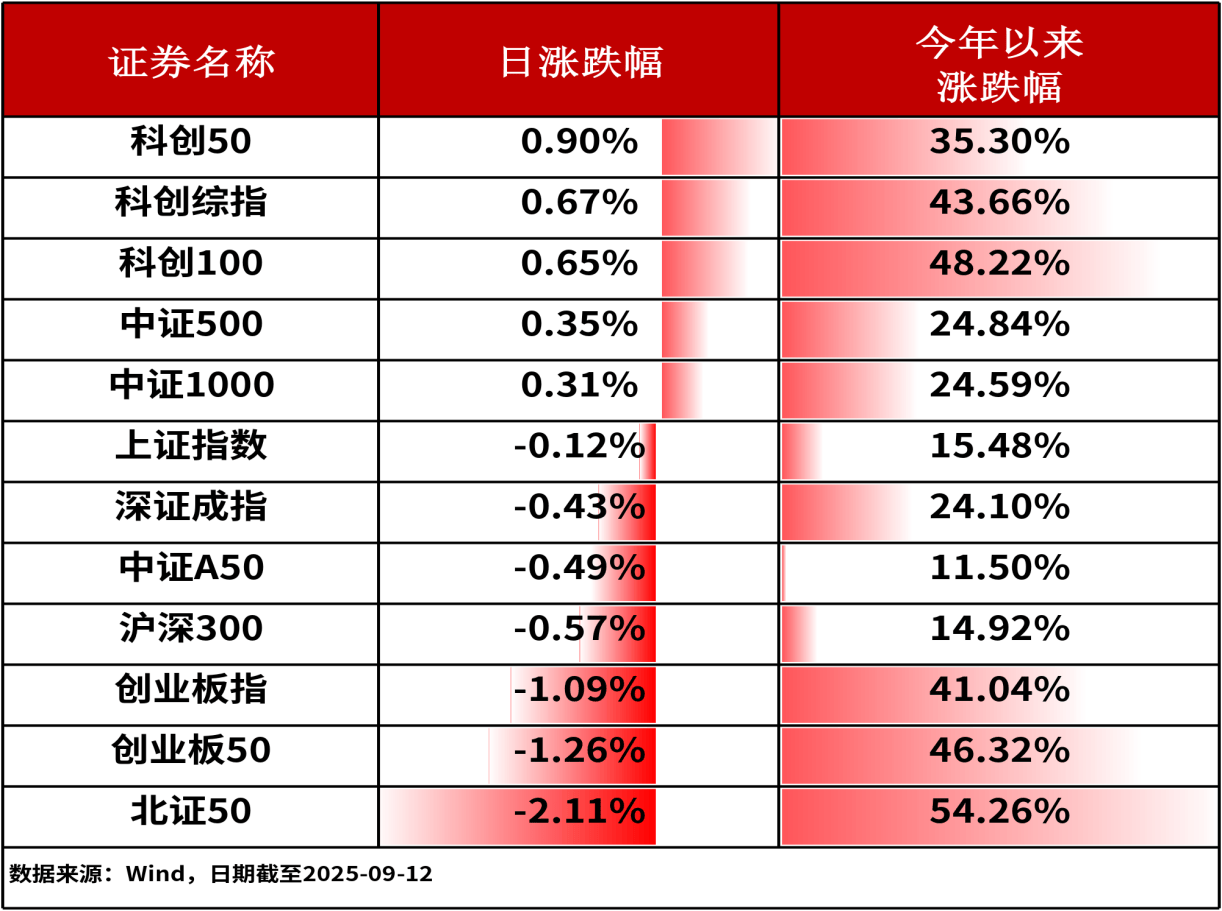
Market Overview - On September 12, A-shares experienced a pullback with the Shanghai Composite Index down 0.12%, Shenzhen Component down 0.43%, and ChiNext down 1.09%, indicating an overall adjustment in the market [1] - The STAR Market 50 Index rose by 0.90%, showing relative strength among major indices [1] - Approximately 1,920 stocks in the market saw gains, while the Hong Kong stock market indices collectively rose, with the Hang Seng Technology Index up 1.71% [1] Sector Performance - The non-ferrous metals sector led gains with an increase of 1.96%, followed by real estate at 1.51% and steel at 1.41% [6] - Conversely, the telecommunications sector saw a decline of 2.13%, with the comprehensive sector down 1.95% and beauty care down 1.52% [6] Fund Flow Analysis - Despite the overall pullback in A-shares, the ETF market maintained a net inflow of 25.94 billion yuan, with industry-specific ETFs seeing a net inflow of 31.28 billion yuan [7][8] - Cross-border ETFs were particularly favored, with a net inflow of 35.96 billion yuan, indicating a trend towards global risk diversification and thematic investments [7][8] - The financial sector, including the CSI 300 and securities, attracted significant inflows, while the STAR Market 50 and semiconductor sectors faced notable outflows [9] Key Focus Areas - The leading securities ETF (159993) saw a net subscription of 48 million units, marking 11 consecutive days of net inflow, reflecting strong investor interest in the brokerage sector [10] - The Hong Kong innovative drug ETF (159286) rose nearly 1%, with optimism surrounding the long-term prospects of innovative drugs and their global competitiveness [11] Commodity Insights - The non-ferrous metals sector is expected to benefit from rising copper prices due to anticipated Federal Reserve rate cuts and seasonal demand increases during the "golden September and silver October" period [12] - The market is advised to monitor the Federal Reserve's rate cut decisions and the demand dynamics during the upcoming seasonal peak [12] Technology Sector Outlook - The U.S. Consumer Price Index (CPI) data indicated a moderate inflation rate, leading to heightened expectations for multiple rate cuts by the Federal Reserve, which could benefit the Hong Kong technology sector [14] - The relative advantage of Hong Kong stocks is expected to become more pronounced as A-shares enter a valuation digestion phase, with a focus on internet, consumer, and pharmaceutical sectors [14]
降息预期强烈,商品价格迎来全面上涨
Sou Hu Cai Jing· 2025-09-14 15:15
Group 1: Industrial Metals - The market anticipates a continued rise in industrial metal prices due to weaker-than-expected non-farm payrolls and seasonal demand improvements during the "Golden September and Silver October" period [2] - Copper supply is under pressure due to a production accident at Grasberg, with the SMM import copper concentrate index reporting a decrease of $0.45 per ton week-on-week [2] - Domestic aluminum production capacity remains high, with an increase in operating rates and improved order conditions reported by most profile enterprises [2] Group 2: Energy Metals - Cobalt supply continues to decrease, leading to expectations of a significant price increase, while lithium demand is optimistic as the traditional peak season approaches [3] - The market may experience a temporary supply tightness for lithium due to faster demand growth compared to supply [3] - Nickel prices are expected to rise due to limited supply from nickel salt plants and ongoing purchasing demand from downstream enterprises [3] Group 3: Precious Metals - Gold and silver prices are reaching new highs driven by strong expectations for Federal Reserve rate cuts following disappointing U.S. non-farm payroll data [4] - Geopolitical tensions, including the Russia-Ukraine conflict, are contributing to risk premiums in gold prices [4] - The long-term outlook for gold remains positive, with central bank purchases and weakening dollar credit as key drivers [4]
铝行业周报:旺季需求继续提升,铝锭库存拐点初现-20250914
Guohai Securities· 2025-09-14 12:04
Investment Rating - The report maintains a "Recommended" rating for the aluminum industry [1] Core Viewpoints - The demand for aluminum continues to rise during the peak season, with signs of a turning point in aluminum ingot inventory [1] - The macroeconomic environment is favorable, with expectations of interest rate cuts by the Federal Reserve, which may further support aluminum prices [6][11] - The aluminum processing sector is experiencing a recovery in operating rates, indicating a potential increase in demand [11] Summary by Sections 1. Prices - As of September 12, 2025, the LME three-month aluminum closing price was $2701.0 per ton, up $98.5 from the previous week, a 3.8% increase [23] - The Shanghai aluminum active contract closing price was 21120.0 CNY per ton, up 425.0 CNY from the previous week, a 2.1% increase [23] - The average price of A00 aluminum in Changjiang was 21050.0 CNY per ton, up 370.0 CNY from the previous week, a 1.8% increase [23] 2. Production - In August 2025, the production of electrolytic aluminum was 373.3 million tons, a month-on-month increase of 1.1 million tons, and a year-on-year increase of 5.0 million tons [56] - The production of alumina in August 2025 was 773.8 million tons, a month-on-month increase of 8.8 million tons, and a year-on-year increase of 56.5 million tons [56] 3. Key Companies and Earnings Forecast - China Hongqiao (1378.HK) is rated "Buy" with an EPS forecast of 2.35 CNY for 2024, increasing to 2.89 CNY by 2026 [5] - Tianshan Aluminum (002532.SZ) is rated "Buy" with an EPS forecast of 0.96 CNY for 2024, increasing to 1.27 CNY by 2026 [5] - Shenhuo Co. (000933.SZ) is rated "Buy" with an EPS forecast of 1.91 CNY for 2024, increasing to 2.56 CNY by 2026 [5] - China Aluminum (601600.SH) is rated "Buy" with an EPS forecast of 0.72 CNY for 2024, increasing to 0.99 CNY by 2026 [5] - Yunnan Aluminum (000807.SZ) is rated "Buy" with an EPS forecast of 1.27 CNY for 2024, increasing to 2.07 CNY by 2026 [5] 4. Inventory - As of September 11, 2025, the domestic electrolytic aluminum ingot inventory was recorded at 625,000 tons, with a week-on-week decrease of 1,000 tons [7] - The aluminum rod inventory in major domestic consumption areas was 132,500 tons, with a week-on-week decrease of 750 tons [7] 5. Demand - The arrival of the traditional peak season has led to improved order conditions for most profile enterprises, with various downstream sectors showing varying degrees of recovery [7] - The operating rate of aluminum processing leading enterprises increased by 0.4 percentage points to 62.1% [7]