资产配置

Search documents
为什么此刻应该关注CTA?
私募排排网· 2026-02-01 03:06
Core Viewpoint - The article emphasizes that the CTA (Commodity Trading Advisor) strategy is poised for significant opportunities in 2026, driven by a combination of favorable market conditions and the need for diversification in investment portfolios [2][6]. Group 1: 2025 Performance of CTA Strategies - In 2025, the futures and derivatives strategy index rose by approximately 13.86%, with the median return across all products reaching 12.51% and a maximum drawdown median of only -6.33%, highlighting the necessity of allocation to these strategies [2]. - The performance of subjective and quantitative CTA products was impressive, with profitability ratios of 88.2% and 90.4%, and median annual returns of 16.47% and 12.65%, respectively [3]. - The long-cycle trend CTA strategy benefited from the prolonged rise in precious metals, establishing itself as a leader in the full-spectrum trend CTA category [3]. Group 2: Market Outlook for 2026 - The article forecasts that 2026 will be a year of opportunities for CTA strategies, as the global economy transitions from "weak recovery" to "early reflation," characterized by a "cooling energy market and rising metals" [6]. - Key bullish areas include gold, supported by factors such as Federal Reserve rate cuts and central bank purchases, with Goldman Sachs predicting gold prices to reach $4,900 per ounce by the end of 2026 [7]. - Conversely, bearish areas include crude oil, with a projected oversupply of 4 million barrels per day, leading to a forecasted Brent crude price drop to $57 per barrel [7]. Group 3: CTA Strategy Logic and Market Conditions - The article notes that the "clear long and short" market structure aligns with CTA trading logic, where quantitative CTAs capture emerging trends and subjective CTAs leverage fundamental research for wave opportunities [8]. - The ongoing global low-interest-rate environment and the "yield drought" backdrop create fertile ground for trend-following and cross-sectional arbitrage strategies, enhancing the risk-adjusted returns of CTA strategies [12]. - The CTA strategy is positioned as a "ballast" in investment portfolios, capable of navigating through cycles and capturing both long and short opportunities, especially in a market characterized by structural adjustments and geopolitical risks [12].


大类资产配置双周观点:资产配置的双A主线:AI+Au
Guoxin Securities· 2026-02-01 02:50
Asset Allocation Insights - Core conclusion favors equities over commodities and bonds, with a macro backdrop of "monetary + credit" easing, shifting focus from valuation recovery to profit realization[2] - The model indicates a preference for equities, suggesting a hierarchy of performance: stocks > commodities > bonds[6] Precious Metals - Gold's pricing logic is shifting from real interest rates to order security, supported by four strong pricing factors: inflation, interest rates, safe-haven demand, and central bank activity[2] - Silver shows signs of divergence with smart money exiting positions, raising concerns about potential volatility due to tightening margin policies at major exchanges[12] Currency Trends - The Chinese yuan has shown a modest increase of less than 0.6% in January, lagging behind a 2% decline in the US dollar index, indicating a potential for seasonal weakness in February[17] - The Japanese yen's pricing anchor has shifted from interest rate differentials to fiscal concerns, limiting its appreciation potential amid upcoming elections[23] A-Share Market Dynamics - The A-share market is transitioning from a "crazy bull" to a "slow bull," with extreme equity-to-bond value ratios providing core support[2] - Focus on sectors benefiting from supply-demand recovery, particularly in high-growth areas like rail transit and battery production[31] US Equity Market Outlook - The S&P 500's tech sector is facing valuation pressures, with an estimated 8% gap between market cap and profit contribution, indicating overvaluation risks[45] - The market anticipates over 38% profit growth for tech stocks, a high bar that may not be met, raising concerns about future performance[45] US Treasury Bonds - Short-term US Treasury yields are stabilizing, supported by resilient economic data, while long-term concerns persist due to a 6% budget deficit and lack of fiscal discipline[57] - Recommended strategy includes a core holding of 3-5 year investment-grade bonds while controlling long-end exposure to mitigate fiscal expansion risks[57]
大类资产配置双周观点:资产配置的双A主线:AI+Au-20260201
Guoxin Securities· 2026-02-01 02:15
Core Insights - The report concludes that equities are favored over commodities and bonds, with a macroeconomic backdrop characterized by a "dual easing" of monetary and credit conditions, shifting the global narrative from valuation recovery to earnings realization [2] - In the equity market, U.S. tech stocks and South Korean storage sectors are in sync, while A-shares are expected to experience a "de-involution" supply-demand recovery under extreme value conditions [2] - Gold is highlighted as having long-term allocation value due to a shift in pricing logic, while the bond market is constrained by fiscal premiums and persistent inflation, suggesting a defensive stance with short-duration bonds [2] Asset Allocation - The report emphasizes a "dual easing" environment, indicating that liquidity remains ample and credit conditions are improving, which supports the preference for equities over commodities and bonds [6] - The liquidity index shows stable fluctuations, and the marginal improvement in credit conditions offsets the high base effects, indicating solid financial support for the real economy [6] Precious Metals - Gold's pricing anchor is shifting from real interest rates to order security, with geopolitical tensions enhancing its appeal as a safe-haven asset [11] - Silver shows signs of divergence, with a retreat in smart money positions despite rising prices, indicating potential short-term volatility due to speculative unwinding [14][16] Currency Outlook - The report warns of a potential depreciation of the Chinese yuan, with a notable lag in its performance compared to the U.S. dollar and other G10 currencies [17] - The Japanese yen's pricing anchor has shifted from interest rate differentials to fiscal concerns, limiting its appreciation potential [23] A-Share Market - The A-share market is transitioning from a "crazy bull" to a "slow bull" phase, with extreme value conditions providing core support [27] - The report suggests focusing on sectors with strong supply-demand dynamics, such as rail transit and battery industries, while also identifying areas of supply contraction [31] U.S. Equity Market - The report notes that the U.S. equity market is experiencing stringent pricing, with the tech sector's market cap significantly exceeding its profit contribution, indicating a potential overvaluation [45] - The upcoming earnings season is expected to reveal a negative skew in market reactions, with even positive earnings surprises leading to stock price declines [34] South Korean Equity Market - South Korea's stock market is benefiting from a super cycle in AI storage chips, with earnings forecasts for 2026 being significantly upgraded, positioning it as a leader in the Asia-Pacific region [46] U.S. Bond Market - The U.S. bond market shows resilience in the short term, with economic data indicating strength and inflation remaining manageable, but long-term concerns about fiscal deficits persist [49][57] - The report recommends a strategy focused on short-duration investment-grade bonds while controlling exposure to long-term risks associated with fiscal expansion [57]
突然大跌,超42万人爆仓
Mei Ri Jing Ji Xin Wen· 2026-02-01 00:54
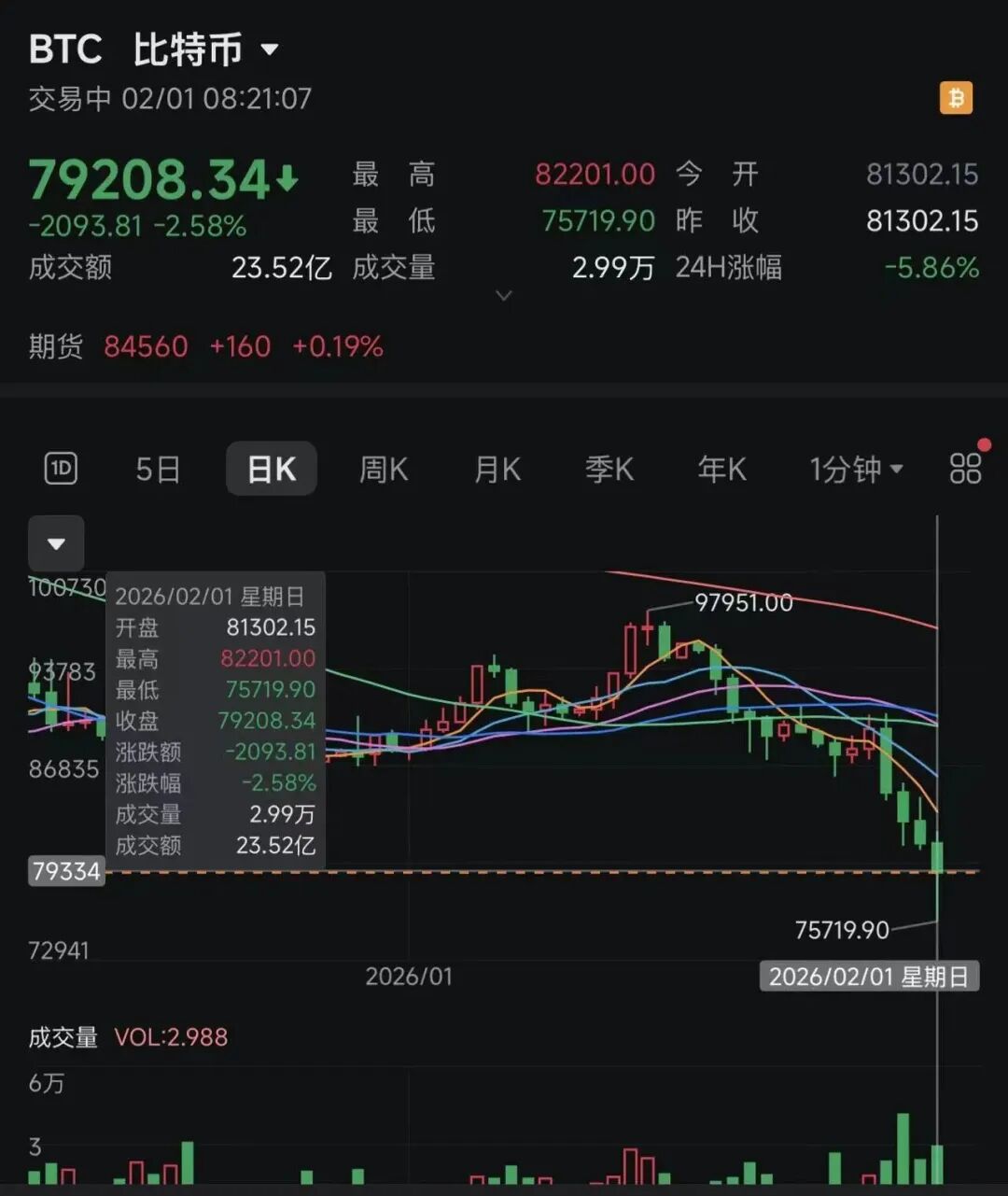
Core Viewpoint - The cryptocurrency market experienced a significant crash, with Bitcoin dropping to its lowest level since April 2025, reflecting a broader decline across various cryptocurrencies [1][5]. Group 1: Market Performance - Bitcoin fell to a low of $75,719 before recovering slightly to $79,000, marking a daily decline of 2.58% [1]. - Other cryptocurrencies such as Ethereum, SOL, and Dogecoin saw declines exceeding 10%, with Ethereum down 9.24% and SOL down 9.95% [5]. - The total market capitalization of cryptocurrencies decreased by approximately $111 billion over the past 24 hours, with over 420,000 liquidations amounting to $2.566 billion [5][7]. Group 2: Market Sentiment and Influences - Recent weeks have shown Bitcoin's lack of response to favorable market changes, such as a weakening dollar and rising gold prices, which traditionally would boost its value [7][8]. - The ongoing regulatory uncertainty in the U.S. cryptocurrency market has diminished investor interest in digital assets [8]. - Analysts suggest that the current price levels indicate extremely low retail interest, with trading volumes expected to remain subdued for one to two more quarters [8]. Group 3: Geopolitical Factors - The rising tensions between Israel and Iran may also be impacting Bitcoin's price, as geopolitical risks typically influence market behavior [8][10]. - Recent comments from former President Trump regarding U.S.-Iran negotiations have added to the uncertainty in the market [9][10].
刚刚,加密市场崩了!40万人爆仓!
Sou Hu Cai Jing· 2026-02-01 00:37
Group 1 - The cryptocurrency market experienced a significant downturn on February 1, with Bitcoin dropping below $80,000 and Ethereum falling over 10% [1][4] - The total market capitalization of cryptocurrencies decreased by approximately $111 billion in the past 24 hours, with over 400,000 investors facing liquidations amounting to around $2.5 billion, primarily in Bitcoin and Ethereum [4] - Bitcoin has shown little response to market changes that would typically be favorable, such as a weakening dollar and rising gold prices, indicating a lack of investor interest in digital assets [4] Group 2 - The absence of sustained buying pressure has led to renewed skepticism regarding Bitcoin's role in asset allocation, as it struggles to fulfill its perceived functions of trend following and hedging against currency devaluation [4] - Traditional safe-haven investments, such as precious metals and cash, continue to attract more capital than cryptocurrencies, further diminishing interest in Bitcoin [4] - Analysts suggest that retail interest in Bitcoin is at an extremely low level, with trading volumes expected to remain subdued for another one to two quarters [4]
崩了,40万人爆仓
Zhong Guo Ji Jin Bao· 2026-01-31 23:56
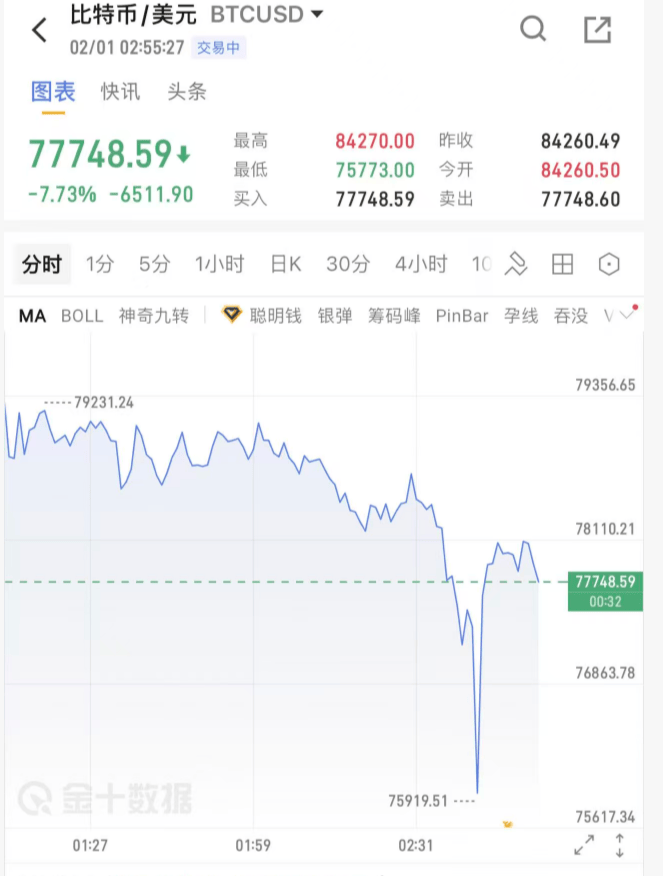
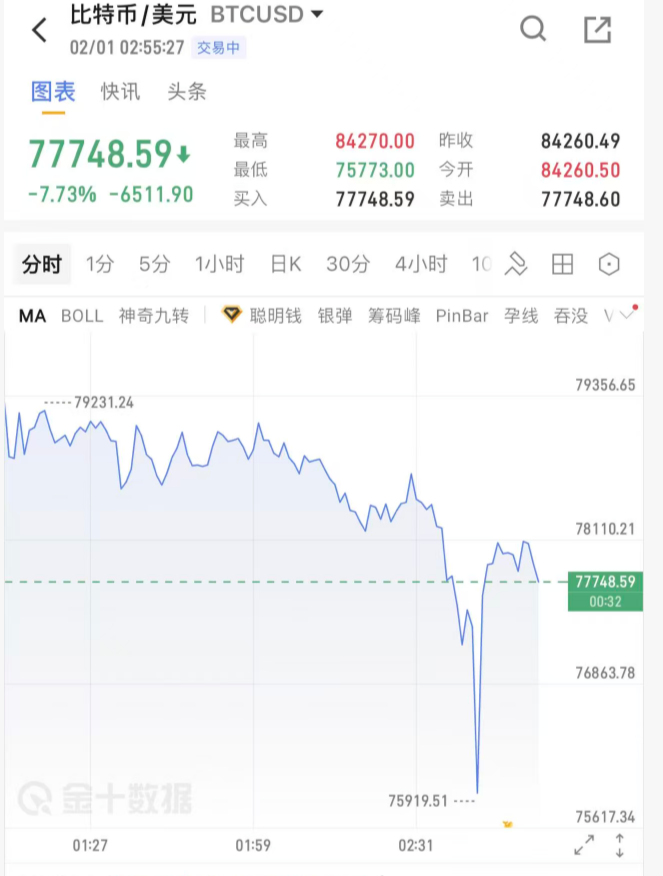
Core Insights - The cryptocurrency market has experienced a significant downturn, with Bitcoin dropping below $80,000 and other major tokens like Ethereum and Solana seeing declines of over 10% and 11% respectively [1][4] - The total market capitalization of cryptocurrencies has decreased by approximately $111 billion in the past 24 hours, with over 400,000 investors facing liquidations amounting to around $2.5 billion, primarily in Bitcoin and Ethereum [4] Market Reactions - Bitcoin has shown little response to market changes that would typically be favorable, such as a weakening US dollar and rising gold prices, indicating a lack of investor interest in digital assets [5] - The absence of sustained buying pressure has led to renewed skepticism regarding Bitcoin's role in asset allocation, as it has failed to act as a hedge against currency devaluation or attract funds during periods of geopolitical tension [5] Investor Sentiment - Analysts suggest that current price levels indicate extremely low retail interest, with trading volumes expected to remain subdued for another one to two quarters [5]
Gold's 2026 Trends: Portfolio Positioning Amid Sharp Rally & Global Volatility
Youtube· 2026-01-31 21:01
Core Viewpoint - The gold market is experiencing significant momentum, with prices reaching record highs and a year-to-date increase of over 25% [2][4]. Market Dynamics - The relationship between bonds and equities is changing, particularly during periods of economic stress, leading to increased diversification into gold [3][9]. - Current market conditions are characterized by aggressive buying and momentum, contributing to the rapid rise in gold prices [4][5]. Investment Strategy - Investors are encouraged to reassess their portfolios, considering gold as a long-term diversification strategy rather than a short-term speculative asset [6][7]. - The volatility in the gold market is expected to continue, but it is essential for investors to maintain a long-term perspective on their allocations [6][8]. Economic and Geopolitical Factors - Global economic conditions, including inflation and currency strength, are significant drivers of gold's value, with geopolitical shocks adding to market volatility [12][13]. - Upcoming events, such as Supreme Court decisions and political meetings, could further impact market conditions and gold's role as a safe haven [15][16][17].
惊魂一夜!金银市场遭到血洗!黄金一度跌近12%!白银暴跌26%,创有史以来最大单日跌幅!
雪球· 2026-01-31 04:21
Group 1 - The core viewpoint of the article highlights the significant impact of Kevin Warsh's nomination as the next Federal Reserve Chairman on the precious metals market, leading to a sharp decline in gold and silver prices [4][5]. - On January 31, the precious metals market experienced extreme volatility, with COMEX gold and silver prices dropping by 8.74% and 26.58% respectively, marking one of the largest intraday declines in history [2][3]. - The dollar index saw a strong rebound, surpassing 97.10, which diminished the attractiveness of dollar-denominated commodities, further pressuring precious metals [5]. Group 2 - The market's reaction to Warsh's nomination was characterized by a "liquidation" of crowded positions, as many investors had heavily bet on rising gold and silver prices, leading to a sharp sell-off [9]. - The gold mining sector was significantly affected, with major companies like Endeavour Silver and First Majestic Silver experiencing declines of 17%, and the overall gold sector dropping over 14% [6][7]. - Analysts suggest that the recent volatility reflects a broader market reassessment of concentrated risks, similar to trends seen in technology stocks, indicating that crowded trades can lead to significant corrections [9]. Group 3 - Looking ahead, institutions like China International Capital Corporation believe that the gold bull market may not be over, despite increased volatility, and recommend focusing on asset trend changes rather than specific price predictions [11]. - Factors supporting gold prices include ongoing de-dollarization, central bank purchases, geopolitical tensions, and inflation expectations, although caution is advised due to potential profit-taking and uncertainties in Federal Reserve policies [11]. - Investment strategies suggested include locking in profits for current investors and considering staggered buying opportunities for those yet to invest, emphasizing the importance of risk diversification [11][13].
视频|黄金白银“瀑布流直线跳水” !有人后悔“卖飞了”,有人懊恼“买少了”,后市他们这么看
Sou Hu Cai Jing· 2026-01-31 02:18
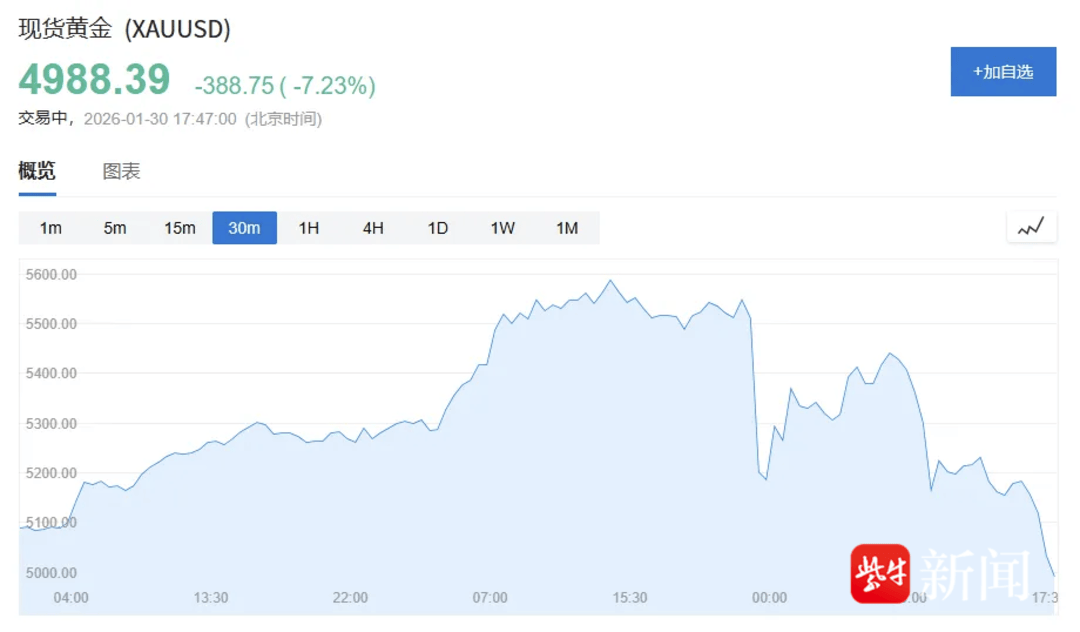
Core Viewpoint - The recent sharp decline in gold and silver prices, with gold dropping from approximately $5600 to below $5000 per ounce in a single day, is attributed to a combination of profit-taking and market sentiment, rather than a fundamental shift in the long-term bullish trend for precious metals [1][12][14]. Price Movements - On January 29, gold prices surged to around $5600 per ounce before plummeting to $5105.83, marking a maximum intraday drop of 5.7%, and closing at $5377.4, down 0.69% [2][6]. - Silver prices fell from a historical high of $121.67 per ounce to $106.80, with a maximum intraday decline of 8.5% [2]. - By January 30, gold further declined to $4950, with a daily drop exceeding 7%, while silver fell to approximately $96, reflecting a 16% decrease [6]. Market Reactions - The drastic price movements have led to significant losses for gold stocks, with companies like Shandong Gold and Chifeng Gold experiencing declines of over 14% on January 30 [6]. - Retail investors expressed regret over missed opportunities, with discussions on social media highlighting sentiments of both regret for selling too early and frustration over not buying more [7]. Consumer Behavior - Gold jewelry prices have adjusted, with retail prices dropping from around 1700 yuan per gram to approximately 1685 yuan, with promotional discounts bringing effective prices down to about 1605 yuan [9]. - The end of the year remains a peak consumption period for gold jewelry, with consumers advised to purchase based on personal needs rather than short-term price fluctuations [12]. Expert Insights - Experts suggest that the recent price drop is a temporary adjustment within a longer-term bullish trend for precious metals, likening it to a "deep squat" rather than a fundamental reversal [12]. - Investment strategies should focus on maintaining a diversified portfolio and avoiding high-risk speculative behavior, especially during periods of extreme market volatility [13][14]. - The long-term outlook for gold remains positive, supported by ongoing financial and geopolitical uncertainties, although short-term volatility is expected to continue [14][15].
中国投资者去年买走全球近十分之一黄金
36氪· 2026-01-30 13:35
以下文章来源于21世纪经济报道 ,作者21记者 21世纪经济报道 . 权威、专业、深度、有趣!用经济思维看世界。 互联网新闻信息服务许可证编号:44120180007 李蓓解释,这并非直接看空黄金,黄金未必会跌,可能在高位震荡,但机会成本极高,未来两年中国顺周期蓝筹或迎来大牛市,持有黄金将错失更大机 会。更重要的是,人民币升值背景下,人民币计价的黄金可能下跌,进一步降低投资价值。对普通投资者而言,跟风追涨不可取,需警惕高位震荡与汇率 波动的双重风险。 此前,美国银行将其短期黄金目标价上调至6000美元/盎司。美银分析师迈克尔·哈特内特在给客户的报告中写道:"历史虽不能预测未来,但回顾四次黄 金牛市,价格平均在43个月内暴涨约300%,据此推算,黄金有望在2026年春季触及6000美元/盎司。" 投资观点总是见仁见智,有人认为当前金价已透支上涨空间,存在估值泡沫;也有人看好黄金长期配置价值,认为新高只是起点。面对市场上的种种声 音,1月29日,世界黄金协会中国区CEO王立新在2025年全年《全球黄金需求趋势报告》媒体发布会上表示,市场始终存在多元的声音,不同投资者的风 险偏好、策略目标和分析视角各不相同,这十分 ...