
货币宽松

Search documents
铝价:连涨七日或创逾一年最长纪录,触及2705美元
Sou Hu Cai Jing· 2025-09-15 05:42
Core Viewpoint - Aluminum prices have risen for seven consecutive days ahead of the Federal Reserve's policy decision, potentially marking the longest streak in over a year, driven by expectations of interest rate cuts and increased supply concerns [1]. Group 1: Market Trends - Aluminum prices increased by 0.6% to $2,705 per ton during the Asian trading session, reaching the highest level since March [1]. - The rise in aluminum prices is attributed to heightened expectations of monetary easing, which has put pressure on the US dollar and boosted industrial metal prices [1]. Group 2: Supply and Demand Dynamics - There has been a surge in aluminum inventory withdrawal requests, raising concerns about supply, which continues to support aluminum prices [1].
美联储决议前多头延续 铝价或创一年最长连涨纪录
Sou Hu Cai Jing· 2025-09-15 04:48
来源:格隆汇APP 格隆汇9月15日|铝价在本周美联储议息会议前连续第七个交易日上涨,市场预期美联储可能实施降 息。伦敦金属交易所基准铝价在亚盘时段走高,一度上涨0.6%至每吨2,705美元,触及3月以来最高水 平,随后涨幅收窄,有望创下逾一年来最长连涨纪录。投资者正等待美联储周三的政策决议,对货币宽 松的预期升温令美元承压,从而提振工业金属价格。近期铝库存提取请求激增引发供应担忧,持续为铝 价提供支撑。 ...
降息或延续美国牛市?BMO:美股涨势可续但涨幅料低于历史均值
Zhi Tong Cai Jing· 2025-09-15 02:24
Group 1 - The core viewpoint is that the Federal Reserve's shift towards interest rate cuts could extend the U.S. bull market, but future stock returns may be weaker than historical averages [1] - BMO Capital Markets' analysis shows that since 1982, in 8 out of 10 interest rate cut cycles, the S&P 500 index achieved positive returns, with an average increase of approximately 10.4% in the following year [1] - The performance of the stock market is contingent on whether interest rate cuts can prolong economic expansion and maintain corporate profit growth; if monetary easing fails to prevent economic recession, stock markets may suffer losses [1] Group 2 - BMO's analysis indicates that most sectors have risen in the year following the first interest rate cut since 1982, with communication services, consumer discretionary, industrials, and information technology typically performing well [2] - The energy sector has historically lagged, but sectors like energy, healthcare, materials, and utilities, which have underperformed prior to the current rate cut, may rebound stronger than average in the coming year [2] - BMO maintains a target price of 6700 for the S&P 500 index by the end of 2025, corresponding to an earnings per share of $275 and a price-to-earnings ratio of 24.4 [2]
从“顺周期+内循环”,看懂电解铝配置价值
2025-09-15 01:49
Summary of Key Points from the Conference Call Industry Overview - The conference call discusses the **electrolytic aluminum industry** and its investment potential in the context of macroeconomic trends and domestic demand dynamics [1][2]. Core Insights and Arguments - Following the Jackson Hole meeting, industrial and precious metals have seen price increases, with copper outperforming aluminum due to previously pessimistic demand expectations for aluminum, which have since improved with rising downstream operating rates and overseas motor capacity expansion [1]. - The domestic electrolytic aluminum market is entering a peak season, with significant increases in downstream operating rates and a decrease in aluminum ingot social inventory year-on-year [1][5]. - The implementation of Document 770 has suppressed the growth rate of the recycled aluminum industry, thereby supporting the operating rates of primary aluminum processing [1][5]. - Global electrolytic aluminum supply is expected to grow between **1.3 to 2.2 million tons** over the next two years, with domestic policies impacting the recycled lead recovery prices in inland regions [6]. - The recycled tungsten industry is entering a phase of standardized development, which is expected to drive overall supply growth, although the supply side is facing a reshuffle [7][8]. Investment Value of the Electrolytic Aluminum Sector - The electrolytic aluminum sector is currently experiencing significant stagnation, but its investment value is considered high relative to other industrial metals, with potential price increases expected to exceed those of copper [2]. - Factors supporting this outlook include cyclical momentum, increased downstream operating rates, inventory reduction, and improved dividend policies enhancing safety margins [2][3]. Recent Performance and Trends - Since the Jackson Hole meeting on **August 22**, industrial metals, including copper, have seen approximately **20%** price increases, while aluminum companies have raised their dividend payout ratios, supporting higher dividend yields and improved profitability [3]. - The aluminum sector's profit and balance sheets have been corrected to a healthy state, with companies like Tianshan Aluminum entering a high dividend tier [11][12]. Supply and Demand Dynamics - The latest data indicates a **5.4%** week-on-week decrease in aluminum bar inventory and a **1.1%** year-on-year decrease in aluminum ingot social inventory, with downstream sectors like aluminum profiles and plates showing rising operating rates [5]. - The implementation of Document 770 has had a limited impact on coastal regions but has raised recycled lead recovery prices in inland areas, affecting the growth of the recycled tungsten industry [6]. Macroeconomic Influences - The likelihood of consistent interest rate cuts by the Federal Reserve is high, which is favorable for demand expansion in the context of monetary easing [9]. - Observing inflation changes is crucial for adjusting market strategies, with current trading conditions favoring monetary easing [9]. Future Outlook for the Aluminum Sector - The potential for high dividend stocks in the aluminum sector presents clear opportunities for price recovery, with market trends indicating stronger certainty than before [13]. - The aluminum price is expected to break through **20,000** and continue to rise, with mid-term profitability significantly exceeding expectations [13]. - Recommendations include increasing allocations to the electrolytic aluminum sector, particularly in companies expected to raise dividend ratios, such as China Aluminum, Yun Aluminum, and Tianshan Aluminum [14].
美联储降息“箭在弦上” 节奏仍是悬念
Qi Huo Ri Bao Wang· 2025-09-12 00:29
Group 1 - The market anticipates a 95.5% probability that the Federal Reserve will cut interest rates by 25 basis points in September, with a 4.5% chance of a 50 basis point cut, and no probability for maintaining or increasing rates [1] - There are two main viewpoints on why the market is optimistic about a rate cut: one suggests pressure from President Trump is a key factor, while the other argues that the Federal Reserve operates as a collective decision-making body, independent of Trump's influence [2][3] - Trump's economic policy aims to increase government spending while minimizing taxes, which necessitates lower interest rates to manage the cost of new debt issuance [4][8] Group 2 - The Federal Reserve has not cut rates this year due to concerns about inflation and unemployment, but current economic conditions suggest that a rate cut is warranted [5][6] - The expected pace of rate cuts will depend on inflation trends; if inflation remains stable, the Fed may implement cuts of 50 basis points each quarter, while any signs of inflation rebound could lead to smaller cuts [7][8] - The potential appointment of a new Federal Reserve chair next year could shift the balance towards a more dovish stance, possibly accelerating the pace of rate cuts [8]
金银铂:看涨势头建立
Sou Hu Cai Jing· 2025-09-11 04:39
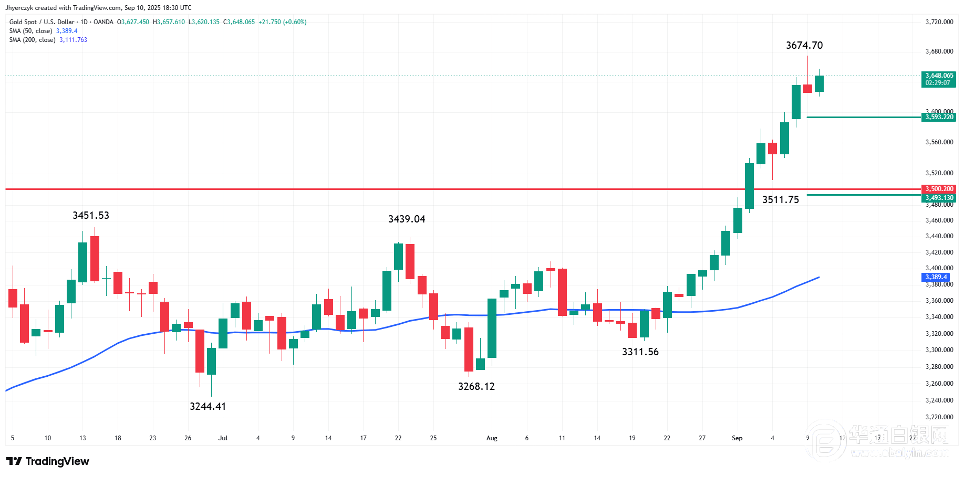
Group 1: Gold Market - Gold prices remain near record highs, supported by weak U.S. inflation data and expectations of monetary easing [3] - The Producer Price Index unexpectedly declined in August, and weak non-farm payroll reports reinforce the view that the U.S. economy is losing momentum [3] - Traders currently anticipate a 90% chance of a 25 basis point rate cut by the Federal Reserve during the meeting on September 16-17 [3] - Analysts suggest that the Fed may cut rates more than twice before the end of the year, which historically supports gold prices [3] - Increased uncertainty surrounding the independence of the Federal Reserve has added to risk premiums [3] Group 2: Technical Analysis of Gold - Gold prices reached a high of $3,674.70 before closing around $3,648.06, maintaining a bullish structure above the 50-day moving average of $3,389.4 [4] - A resistance level is formed around $3,750, with a daily close above this level potentially opening the way to $3,900 [4] - Initial support levels are at $3,593 and $3,511, with further support at the 50-day moving average if prices decline [4] Group 3: Silver Market - Silver benefits from a moderate macroeconomic environment, gaining momentum due to expectations of declining real yields as inflation slows and employment data weakens [8] - Silver's dual role as both a monetary and industrial metal adds extra market interest amid changing economic expectations [8] Group 4: Technical Analysis of Silver - Silver prices increased by 0.8% to $41.19, remaining strong above the 50-day moving average of $38.5 [9] - The recent high of $41.67 forms a key resistance level, with a breakthrough potentially leading to $42.50 [9] - Notable support levels include $40.40 and $39.88, with bullish momentum maintained as long as prices stay above the short-term trend line [9] Group 5: Platinum Market - Platinum surged by 1.7% to $1,395.05, benefiting from the overall strength of metals and speculation that soft monetary policy will support industrial demand [12] - Platinum prices tend to follow gold trends in a rate-sensitive environment, despite typically larger price fluctuations [12] Group 6: Technical Analysis of Platinum - Platinum has recovered above the 50-day moving average of $1,377 and is stabilizing above this level [12] - Recent resistance is seen at $1,400, followed by a key target around $1,430 [12] - Support is located at $1,366, where bulls may defend the area if momentum stalls [12] Group 7: Market Outlook - The outlook for gold, silver, and platinum remains bullish, driven by dovish Federal Reserve expectations and strong technical positions [12] - The upcoming CPI report will be crucial for confirming the next phase of this rally [12]

中航期货橡胶周度报告-20250905
Zhong Hang Qi Huo· 2025-09-05 10:31
Report Summary - The report focuses on the rubber market from September 3 - 9, 2025, analyzing its macro - and micro - level factors and providing a short - term outlook [5][6] Report Industry Investment Rating - Not provided in the report Core Viewpoints - Rubber fundamentals have no obvious contradictions. With the Fed's potential rate cut boosting monetary easing expectations and post - parade economic policies coming back as the trading mainline, rubber prices are expected to oscillate strongly in the short term [6][28] Summary by Directory Report Summary (PART 01) - Rainfall in Southeast Asian natural rubber main - producing areas changed compared to the previous period, with varying impacts on tapping. The rubber market showed a narrow - range oscillation from Monday to Thursday and a stronger trend on Friday. Macro - factors improved market sentiment, and the cost side was supported. However, tire production utilization declined, and terminal demand had no strong recovery signs [5][6] - The market bets that the probability of the Fed's September rate cut is nearly 100% after the release of disappointing ADP employment data. The central bank will conduct a 1 - trillion - yuan 3 - month buy - out reverse repo operation [7] Multi - Empty Focus (PART 02) - Bullish factors include weather - related supply disruptions leading to stable - to - stronger raw material prices, rubber inventory reduction, and the Fed's potential rate cut with loose domestic funds. Bearish factor is the slight decline in tire operating rates [10] Data Analysis (PART 03) - Natural rubber raw material prices are stable - to - stronger. As of September 4, Thai fresh glue was 55.8 baht/kg, cup - lump was 52.05 baht/kg, Yunnan glue was 14,600 yuan/ton, and Hainan glue was 13,400 yuan/ton [11] - Natural rubber inventory continued to decline slightly. As of August 31, 2025, China's social inventory was 126.5 million tons, down 0.6 million tons month - on - month, and Qingdao's inventory was 60.2 million tons, down 0.4 million tons [14] - The price of butadiene, the raw material for butadiene rubber, fluctuated within a narrow range. As of September 4, the price in Shandong was 9,550 - 9,600 yuan/ton, and the theoretical production loss of butadiene rubber was 185 yuan/ton [15] - The supply - demand structure of butadiene rubber is relatively loose. As of September 5, the factory inventory decreased by 450 tons, while the trader inventory increased by 640 tons, and production increased by 125 tons [21] - Tire overall capacity utilization decreased. As of September 5, the capacity utilization of all - steel and semi - steel tires decreased significantly due to planned maintenance, and terminal demand has not fully recovered [22] - The spread of the three major rubber contracts on the futures market was stable, indicating no internal differentiation in the rubber fundamentals [24] 后市研判 (PART 04) - From a macro perspective, the Fed's potential rate cut and domestic loose funds improved market sentiment. From a fundamental perspective, raw material prices are supported, inventory pressure is reduced, but tire production utilization declined, and terminal demand is weak. Overall, rubber prices are expected to oscillate strongly in the short term [28]
国际金价持续回暖 黄金ETF(518880)成交显著活跃
Sou Hu Cai Jing· 2025-09-02 06:10
Core Viewpoint - Recent international gold prices have shown a significant recovery, with COMEX gold futures prices surpassing $3,500 per ounce as of September 2 [1] Group 1: Market Performance - The largest commodity ETF in the domestic market, the Gold ETF (518880), has recently exhibited notable activity, with a single-day increase of over 2% on September 1, marking the highest daily gain in over three months [1] - The trading volume of the Gold ETF exceeded 6 billion yuan in a single day for the first time in two months [1] Group 2: Factors Influencing Gold Prices - The anticipated initiation of a new interest rate cut cycle by the Federal Reserve in September is expected to benefit gold due to a more accommodative monetary environment [1] - Ongoing global macroeconomic uncertainties since the beginning of the year have led to increased interest in gold as a hedge against macro risks [1] - Concerns regarding the sustainability of dollar assets have arisen due to high levels of debt and deficits, prompting other countries to reconsider their exposure to dollar-denominated assets [1] - Gold exhibits low correlation with various asset classes, attributed to differing pricing logic, which allows it to effectively diversify risk [1]
薛鹤翔:货币宽松与风险偏好的角力—9月份国债期货投资策略报告
Sou Hu Cai Jing· 2025-09-02 04:17
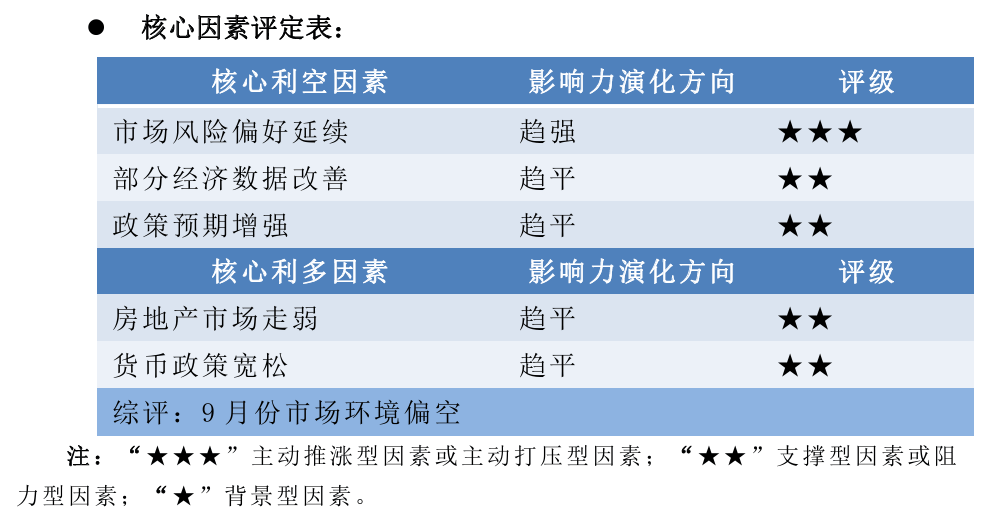
Market Overview - In August, driven by a series of policies, market risk appetite increased, leading the Shanghai Composite Index to break a 10-year high, with a continued stock-bond seesaw effect [1][25] - Bond funds and deposits from residents and enterprises flowed into higher-yielding non-bank sectors, suppressing bond market sentiment, while the 10-year government bond yield exceeded 1.8% [1][25] - The average daily trading volume of government bond futures in August was 417,000 contracts, a month-on-month increase of 39.41% [5] Economic Indicators - Domestic real estate investment, sales, and price declines continued to expand, indicating weak demand [1][25] - The central bank is expected to continue implementing a moderately loose monetary policy to maintain reasonable liquidity in the market, which will provide some support for the bond market, especially for short-term government bond futures [1][25] Bond Market Dynamics - The bond market is experiencing a shift as funds continue to flow into non-bank sectors, which may lead to further weakening of government bond futures prices [1][25] - The Ministry of Finance has resumed the collection of value-added tax on government bonds and financial bonds, which may increase the tax burden on new bonds and widen the price differences across varieties [1][25] Financing and Supply - As of the end of August, the bond market's outstanding scale exceeded 191.71 trillion yuan, with net financing of 17,571 billion yuan in August, maintaining a high level [18] - The government is expected to continue high levels of bond financing, with a cumulative increase of 10.2 trillion yuan in government and local government bonds by August [21] Future Outlook - The report anticipates that the seesaw effect between stocks and bonds will continue, with bond market sentiment likely to remain suppressed as funds flow into higher-yielding sectors [1][25] - The central bank's monetary policy will play a crucial role in stabilizing the economy and supporting the bond market amid external uncertainties and domestic demand weaknesses [1][25]
工业企业利润点评:反内卷初见成效,低基数下利润迎来修复
Huafu Securities· 2025-08-28 11:37
Profit Trends - In July, the year-on-year decline in industrial enterprise profits narrowed for the second consecutive month, decreasing by 2.8 percentage points to -1.5%[3] - Cumulative year-on-year profit decline was -1.7%, slightly narrowing by 0.1 percentage points compared to June[3] - The main driver for profit recovery in July was a significant reduction in operating costs, which fell by 1.1 percentage points to 0.8%, marking a new low since September 2024[3] Revenue and Costs - July revenue saw a slight year-on-year decline of 0.5%, with cumulative revenue also dropping by 0.2 percentage points to 2.3%, the lowest since the beginning of the year[3] - Cumulative expenses per 100 yuan of revenue remained stable at 8.38 yuan, with operating expenses further dragging down profits by 0.1 percentage points[3] Sector Performance - Manufacturing and public utilities saw slight improvements in cumulative profits, rising by 0.3 and 0.6 percentage points to 4.8% and 3.9% respectively[4] - Conversely, the mining sector experienced a worsening cumulative profit decline of 1.3 percentage points to -31.6%, a new low due to previous price competition pressures[4] Inventory and Market Conditions - Finished goods inventory saw a significant year-on-year decline of 0.7 percentage points to 2.4%, with actual inventory dropping by 0.8 percentage points to 6.2%, the lowest since the beginning of the year[4] - The ongoing downturn in the real estate market and strict control over new hidden debts are suppressing production confidence among industrial enterprises[4] Economic Outlook - The report suggests that effective governance of chaotic price competition and continuous cost reductions are key to the slight recovery in industrial profits[5] - However, insufficient domestic demand and declining revenue growth pose challenges for sustainable profit increases in industrial enterprises[5] - Monetary policy may consider slight interest rate cuts to stabilize the real estate market and support durable consumer goods demand[5]