
反内卷政策

Search documents
湘财证券晨会纪要-20260105
Xiangcai Securities· 2026-01-05 01:04
Macro Insights - The manufacturing PMI for December rose to 50.10%, marking the first expansion since April, driven by synchronized recovery in production and demand [2] - New export orders index increased from 45.90% in October to 49% in December, while the new orders index rose to 50.80%, indicating expansion [2] - The production index for December reached 51.70%, with large enterprises leading at 50.80%, while medium and small enterprises showed improvements but remained below the expansion threshold [2] Stock Market Overview - A-shares experienced narrow fluctuations from December 29 to December 30, 2025, with the Shanghai Composite Index rising 18.41% and the Shenzhen Component Index increasing by 29.87% over the year [3] - The technology sector benefited from the development of domestic models, while the "anti-involution" policy boosted cyclical stocks, particularly in the non-ferrous metals sector [3][4] - The overall performance of A-share indices in 2025 was positive, with significant gains in the ChiNext Index (49.57%) and the STAR Market Index (46.30%) [3] Industry Performance - In 2025, the non-ferrous metals and communication sectors saw substantial annual gains of 94.73% and 84.75%, respectively, while the food and beverage sector faced declines [4] - The aerospace equipment II and communication equipment sectors led the secondary industry gains with increases of 146.03% and 130.60% [4] - The communication network equipment and aerospace equipment III sectors recorded the highest gains among tertiary industries, with increases of 176.57% and 146.03% [4] Investment Recommendations - For 2026, the report suggests a favorable policy environment for industrial upgrades, supporting a "slow bull" market [5] - The report highlights potential in insurance, securities, and agriculture-related sectors, as well as opportunities in aerospace aligned with the "14th Five-Year Plan" [5] - The report emphasizes the importance of efficiency optimization and product innovation in the home appliance industry, recommending focus on leading companies in white goods and emerging technologies [11] Home Appliance Industry Insights - The home appliance sector saw a 0.7% increase, with components leading the gains, while the overall market remains competitive [7] - The current PE ratio for the home appliance industry is 15.33, indicating a relatively low valuation compared to the broader market, suggesting investment potential [8] - January 2026 production for air conditioners, refrigerators, and washing machines showed mixed results, with total production increasing by 6% year-on-year [9][10]
烧碱市场要闻与数据:需求季节性下滑,关注宏观动态
Hua Tai Qi Huo· 2026-01-04 11:53
1. Report Industry Investment Rating No relevant content provided. 2. Core Views of the Report - The current spot price of caustic soda is stable with a slight decline. The supply side is operating at a high level, and the demand side shows weakening trends. The overall supply - demand situation is weak. The future focus is on changes in liquid chlorine prices, device dynamics, and the implementation of macro anti - involution details [3]. - The PVC market was weak in the early part of the month, rebounded due to macro - sentiment, and then the macro - sentiment faded, with the overall supply - demand situation remaining weak. It is expected to fluctuate in the near future, and attention should be paid to subsequent device maintenance and macro - side policies [6]. 3. Summary According to the Directory 3.1 Basis Strategy Analysis - **Caustic Soda**: The basis of caustic soda maintains a C - structure. The spot price first fell, then rose, and then fell again. The inventory is at a high level, and the basis is expected to continue to weaken. A reverse cash - and - carry strategy is recommended [12]. - **PVC**: The basis of PVC also shows a C - structure. After the price hit a new low, the supply - demand situation improved marginally, and the basis strengthened slightly. However, it is expected to weaken again in the future, and a reverse cash - and - carry strategy is recommended [12]. 3.2 Caustic Soda Price & Spread - In December, the spot price of caustic soda first fell, then rose, and then fell again. The high - level operation of production led to an oversupply situation and inventory accumulation. The demand from alumina is relatively stable, but the procurement price has been adjusted downward. Non - aluminum downstream demand enters the off - season in January [13]. 3.3 PVC Price & Spread - In December, the PVC price first fell and then rose. The high inventory led to a continuous decline in price, and the low price improved the supply - demand situation marginally. Macro - sentiment boosted the long - term demand expectation, but the overall supply - demand situation remained weak after the macro - sentiment faded [35]. 3.4 Cost and Profit - The comprehensive profit of chlor - alkali has been significantly reduced and is at a low level compared to the same period. The profit of PVC upstream raw materials is extremely compressed. The price of ethylene is expected to remain weak in January [52]. 3.5 Caustic Soda Supply - In December, new caustic soda production capacity was put into operation, and the overall supply remained at a high level. There are few planned maintenance enterprises in January, and the supply is expected to remain high due to the good market conditions of liquid chlorine [70]. 3.6 Liquid Chlorine Price and Its Downstream Products - In December, the price of liquid chlorine increased. The downstream demand supported the price, but in January, the terminal demand of some downstream products entered the off - season, and the price is expected to fluctuate slightly [82]. 3.7 PVC Supply - The overall PVC output remained high in December. All new production capacity has been put into operation, and the supply is still abundant. There is no new domestic production capacity in 2026, and the overseas supply contraction in December 2025 provided a small support to the market sentiment [98]. 3.8 Caustic Soda Downstream Demand - The demand from alumina is expected to weaken in the long - term. The non - aluminum downstream demand enters the off - season in January, and the demand of various industries is expected to decline seasonally [110]. 3.9 Caustic Soda Import and Export - The main import sources of domestic liquid caustic soda in November were Singapore, Norway, and Germany, and the main export destinations were Indonesia, Australia, and Canada. The export orders remain normal [132]. 3.10 PVC Downstream Demand - The downstream demand for PVC is weakening. The demand for pipes and profiles is affected by the sluggish real - estate market, while the film industry performs relatively well. The downstream demand is expected to decline further in January [145]. 3.11 PVC Import and Export - The BIS certification and anti - dumping duties of PVC in India have been cancelled, and the export expectation for 2026 is improving. The current PVC export maintains its resilience through price - for - volume strategy [156]. 3.12 Caustic Soda and PVC Inventory Data - The inventory of caustic soda increased in December due to factors such as production increase and weakening downstream demand. The PVC social inventory continued to increase, and the high - level futures warehouse receipts continued to suppress the PVC futures price [160].
3分钟看清元旦全球要闻(申万宏观·赵伟团队)
赵伟宏观探索· 2026-01-04 01:40
Global Macro Assets - Major overseas stock indices showed mixed performance during the New Year holiday, with the US indices collectively declining: Nasdaq down 1.6%, Dow Jones down 1.4%, and S&P 500 down 1.1% [2][7] - Long-term government bond yields in major developed countries mostly rebounded, with the 10Y US Treasury yield rising by 5.0 basis points to 4.19% [9][12] - Oil prices continued to weaken, with WTI and Brent crude down 1.8% and 2.4% respectively, while gold prices quickly retreated by 3.7% after reaching a historical high [12][13] Overseas Fundamentals & Data - The Federal Reserve's December meeting minutes revealed a division of opinions among officials regarding future interest rate cuts, with some supporting a pause in rate cuts [15][19] - Initial jobless claims in the US for the week ending December 27 were 199,000, lower than the expected 218,000 [17][18] - The US military conducted a large-scale airstrike in Venezuela, marking an escalation in military pressure on President Maduro's regime [20][19] - President Trump announced a delay in tariff increases on imported furniture and kitchen cabinets from January 1, 2026, to January 1, 2027 [25][26] Domestic Events & Data - The intensity of domestic travel during the New Year holiday increased significantly, with a year-on-year increase of 20.3% in cross-regional daily passenger flow [30][37] - Domestic tourism, particularly "ice and snow tourism" and "winter escape tourism," saw a notable rise, while cross-border travel experienced a decline [43][28] - The average ticket price for economy class flights during the New Year holiday was 597 yuan, showing a slight decrease of 1.1% year-on-year [50] - The film market showed steady recovery, with average daily box office revenue increasing by 42.5% compared to the same period in 2025 [53]



2026年,物价走势会怎样?3个关键信号已出现,普通家庭这样应对
Sou Hu Cai Jing· 2026-01-04 00:06
Core Viewpoint - Experts generally predict that consumer prices in 2026 will not experience significant inflation, instead showing a trend of "low and moderate recovery" with CPI expected to rise around 0.8% year-on-year, with a possibility of reaching 2.0% in a reasonable range [1] Group 1: CPI and Consumer Behavior - The CPI year-on-year growth rate has expanded, with November CPI rising by 0.7%, the highest since March 2024, driven mainly by an increase in food prices, particularly fresh vegetables which surged by 14.5% [3] - The core CPI, excluding food and energy, rose by 1.2% year-on-year, remaining above 1% for three consecutive months, indicating a recovery in consumer spending, with prices for household appliances and clothing increasing [3] Group 2: PPI and Industrial Prices - The Producer Price Index (PPI) increased by 0.1% month-on-month in November, marking two consecutive months of growth, suggesting a gradual recovery in production material prices [4] - Prices in sectors such as coal mining, photovoltaic equipment, and lithium-ion batteries are stabilizing, with emerging industries showing significant upward price trends, which may eventually affect downstream consumer prices [4] Group 3: Policy Impact on Prices - The "anti-involution" policies implemented this year have played a crucial role in stabilizing prices, with accelerated capacity governance in key industries leading to more regulated market competition and a noticeable reduction in price declines in sectors like new energy vehicles and photovoltaic equipment [5] - Continued policy efforts to expand domestic demand and promote consumption are expected to further support price recovery, mitigating risks of deflation or uncontrolled inflation [5]

3分钟看清元旦全球要闻(申万宏观·赵伟团队)
申万宏源宏观· 2026-01-03 12:17
Global Macro Assets - Major overseas stock indices showed mixed performance during the New Year holiday, with the US indices declining: Nasdaq down 1.6%, Dow Jones down 1.4%, and S&P 500 down 1.1% [2][7] - Long-term bond yields in major developed countries mostly rebounded, with the 10Y US Treasury yield rising by 5.0 basis points to 4.19% [9][12] - Oil prices continued to weaken, with WTI and Brent crude down 1.8% and 2.4% respectively, while gold prices quickly retreated by 3.7% after reaching a historical high [12][13] Overseas Fundamentals & Data - The Federal Reserve's December meeting minutes revealed a division of opinions among officials regarding future interest rate cuts, with some supporting a pause [15] - Initial jobless claims in the US for the week ending December 27 were 199,000, lower than the expected 218,000 [17] - The US military conducted airstrikes in Venezuela, escalating geopolitical tensions, with President Trump claiming the capture of Venezuelan President Maduro [20] - Trump announced a delay in tariff increases on furniture and kitchen cabinets from January 1, 2026, to January 1, 2027 [25] Domestic Events & Data - During the New Year holiday, domestic travel intensity increased significantly, with a year-on-year increase of 20.3% in cross-regional passenger flow [30][37] - Domestic tourism, particularly "ice and snow tourism" and "winter escape tourism," saw a notable rise, while cross-border travel experienced a decline [43] - The average ticket price for economy class flights during the New Year holiday was 597 yuan, showing a slight decrease of 1.1% year-on-year [50] - The film market showed steady recovery, with daily box office revenue increasing by 42.5% compared to the same period in 2025 [53]

浙商宏观:预计流动性驱动下A股将在2026年继续走强,低波红利与科技成长交织的结构化行情
Sou Hu Cai Jing· 2026-01-03 11:56
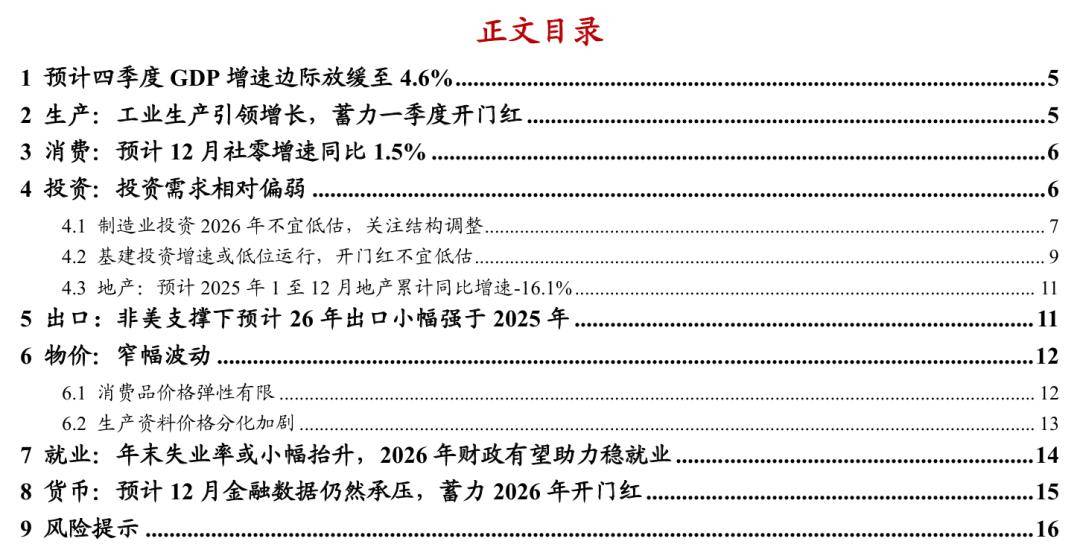
Economic Overview - The GDP growth rate for Q4 2025 is expected to slow to 4.6%, with a strong production sector and moderate demand recovery [1][14] - Industrial production is projected to maintain steady growth, significantly supporting the overall GDP growth target [2][15] - External demand remains resilient, with export growth expected to continue positively [1][5] Production - The industrial added value growth rate for December is estimated at 5.0%, with an annual growth rate of 5.9% for 2025, significantly higher than GDP growth [2][15] - Improvement in demand is noted, driven by pre-holiday inventory buildup and construction progress [2][16] - Manufacturing enterprises are experiencing improved production and market demand, with production growth slightly outpacing demand [2][16] Consumption - The retail sales growth rate for December is expected to be 1.5%, a slight increase from 1.3% [3][19] - Policies supporting the replacement of old products are anticipated to bolster consumer spending, particularly in durable goods [3][19] - The automotive sector continues to face challenges with declining sales and increased discounts, impacting overall retail recovery [3][20] Investment - Fixed asset investment for 2025 is projected to decline by 3.3%, with manufacturing investment showing resilience at 1.2% growth, while infrastructure and real estate investments are under pressure [4][23] - The investment environment has been notably weak since June 2025, with a focus on stabilizing growth in 2026 [4][25] - Manufacturing and broad infrastructure investments are expected to jointly drive growth in early 2026, with a projected increase of 2.5% for the year [4][25][30] Export - December export growth is anticipated at 3.9%, with an annual growth rate of 6.6% for 2026, supported by stable external demand from non-developed countries [5][5] - The stabilization of US-China trade relations and reduced trade friction with Europe and Japan are expected to benefit exports [5][5] Prices - The Consumer Price Index (CPI) growth rate for December is expected to be 0.7%, while the Producer Price Index (PPI) is projected at -1.9% [6][6] - The overall price level is expected to remain stable, with core CPI showing signs of recovery [6][6] Employment - The urban unemployment rate for December is projected to rise slightly to 5.2%, influenced by seasonal factors [7][7] - Continued policy support is expected to help stabilize employment, particularly for vulnerable groups [7][7] Monetary Policy - Financial data for December indicates continued pressure, with new loans and social financing expected to decline [8][8] - The central economic work conference emphasizes the need for flexible monetary policy to support economic stability and reasonable price recovery [8][8]
年终盘点:港股收官,恒指全年飙升28%,有色领跑涨幅榜
Sou Hu Cai Jing· 2026-01-02 06:15
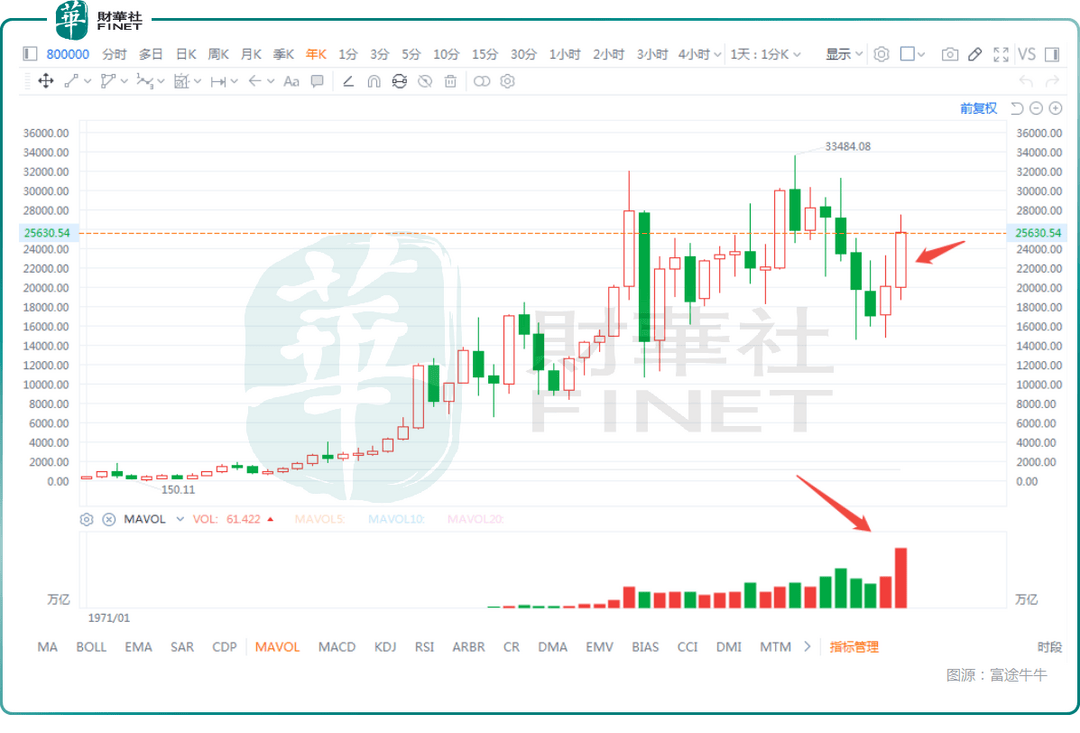
Core Viewpoint - The Hong Kong stock market experienced a strong upward trend in 2025, with the Hang Seng Index rising by 27.77% and the Hang Seng Tech Index increasing by 23.45%, driven by active trading and improved market sentiment [1][12]. Market Performance - The trading volume in the Hong Kong stock market significantly increased compared to previous years, indicating heightened trading activity and a broad release of market profit potential [1]. - The year saw a clear phase rotation in the market, with different sectors driving the market's upward movement at various times, including AI technology, innovative pharmaceuticals, and non-competitive policies leading to industrial optimization [3][5]. Sector Analysis - The technology sector was a major player in the market, with the Hang Seng Tech Index rising by 20.74% in Q1 2025, outperforming the Hang Seng Index's 15.25% increase during the same period [4]. - The innovative pharmaceutical sector gained momentum due to a surge in business development (BD) transactions, benefiting from improved global liquidity as the Federal Reserve began its rate-cutting cycle [4][5]. - The metals sector, particularly non-ferrous metals, emerged as the strongest performer by year-end, with copper stocks rising by 261.85%, gold and precious metals by 197.85%, and other metals and mining stocks by 187.91% [6][7]. Individual Stock Performance - Notable individual stock performances included Zijin Mining (02899.HK) rising by 162%, Shandong Gold (01787.HK) increasing by over 183%, and Jiangxi Copper (00358.HK) climbing nearly 281% [9]. - The stock of珠峰黄金 (01815.HK) skyrocketed by over 1286%, marking it as a rare "tenfold" stock in a year [9]. Investment Drivers - The rise in non-ferrous metals was attributed to multiple favorable factors, including the global trend of "de-dollarization," supply-demand imbalances in industrial metals, and domestic policies optimizing supply structures [6][10]. - The rapid development of emerging industries such as AI, new energy, and innovative pharmaceuticals provided a wealth of high-growth investment opportunities, supporting long-term stock price increases [12][13]. Future Outlook - Analysts expect the Hong Kong stock market to continue its upward trend in 2026, driven by improved liquidity and corporate profit recovery, with a potential shift in market driving logic from valuation recovery to profit growth [13].


2026年投资展望 科技板块“众望所归”
Zhong Guo Zheng Quan Bao· 2026-01-02 05:11
近期,多家公募机构发布了2026年投资策略展望。多位业内人士表示,2026年的市场值得乐观期待,上 涨动力或将从单一的估值驱动逐渐转向"盈利+估值"双重驱动,上市公司的整体业绩有望进一步改善, 结构性亮点大概率增多,有利于提高市场风险偏好。在众多板块中,科技成为公募机构普遍看好的主线 之一。 整体投资环境具备较强支撑性 展望2026年,财通基金副总经理、权益投资总监、基金经理金梓才表示,A股市场有望步入整体环境更 优、结构性特征深化的发展阶段,核心驱动力源于全球流动性环境的进一步改善,以及以AI为代表的 产业趋势进入加速兑现期,整体投资环境具备较强支撑性。 宏观层面,金梓才认为,全球与国内流动性环境预计同步向好,为市场奠定坚实基础。外部来看,美联 储2026年降息节奏或加快,A股面临的外部约束大幅减弱,海外资金环境更趋友好;内部而言,国内货 币政策将持续为经济高质量发展与产业升级提供支持,维持流动性合理充裕。内外部流动性的协同改 善,将有效提升市场风险偏好,为估值修复创造有利条件。 华宝基金认为,在"反内卷"政策进一步深化与落地的节奏下,供给层面的边际变化有望带动PPI进一步 上行,具体幅度取决于"反内卷"和 ...
2025期市盘点:金银狂飙、铜锂闪耀、原油“失意”!今年有哪些机会?
Zheng Quan Shi Bao· 2026-01-01 00:48
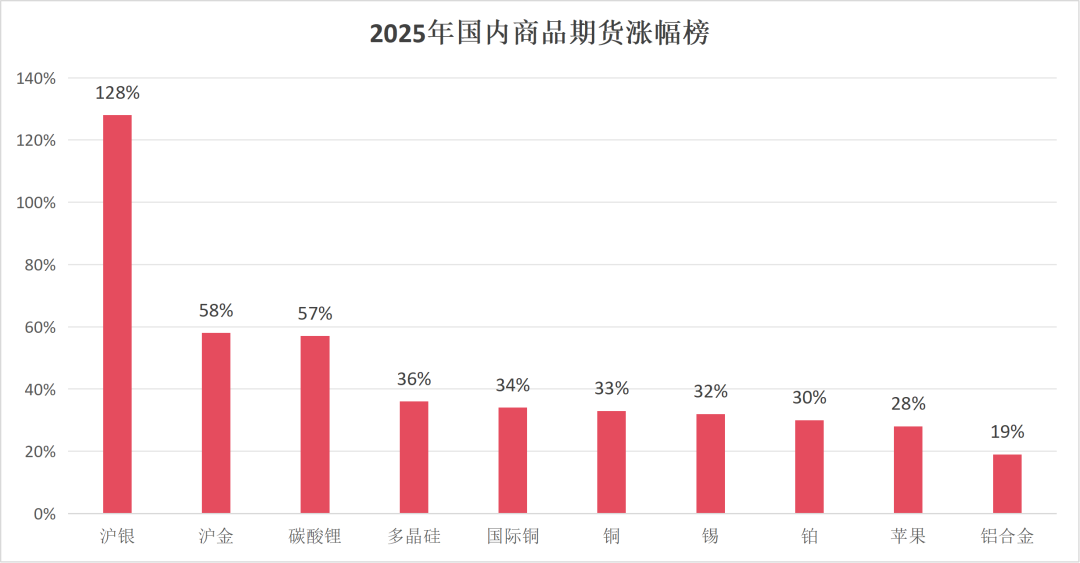
Core Insights - The year 2025 was characterized as a "differentiated game year" for commodities, with significant movements in gold and silver, disappointing performance in crude oil, and notable rises in platinum and palladium [1][12]. Precious Metals Sector - The precious metals sector experienced a "bull market" in 2025, with gold prices reaching historical highs in the first half and silver following suit in the second half, leading to increased investment interest [3][15][16]. - Analysts predict continued upward potential for the precious metals sector in 2026, driven by factors such as potential interest rate cuts by the Federal Reserve and ongoing global central bank gold purchases [3][17]. - Gold prices are expected to rise due to a decrease in opportunity costs for holding gold, while silver is anticipated to have stronger price elasticity due to its dual role as a precious and industrial metal [3][17]. Non-Ferrous and New Energy Metals Sector - The non-ferrous and new energy metals sector showed significant differentiation in 2025, with lithium carbonate, polysilicon, and international copper leading in price increases, while aluminum oxide and industrial silicon faced declines [3][18][19]. - Analysts foresee copper and tin emerging as leading commodities in 2026, with a focus on the sustainability of lithium demand and the resolution of polysilicon production capacity issues [3][20]. Energy and Chemical Sector - The energy and chemical sector faced challenges in 2025 due to oversupply, with most products under pressure, except for PX and PTA which saw price increases [3][21][22]. - Analysts expect continued pressure on crude oil prices in 2026, with a focus on structurally sound products like the aromatics chain [3][22]. Agricultural Products Sector - The agricultural products sector showed overall weakness in 2025, with some products like apples and cotton performing better than livestock [3][23]. - Analysts predict a potential turnaround in 2026, particularly for live pigs and cotton, driven by supply adjustments and reduced planting areas [3][23]. Black Building Materials Sector - The black building materials sector experienced a "flat" year in 2025, characterized by weak demand and limited cost support, leading to price declines for many products [3][24]. - Expectations for 2026 include potential improvements driven by macro policy changes, with structural differentiation among products becoming more pronounced [3][24]. Stock Index Futures - The stock index futures market saw a "small bull market" in 2025, with expectations for a "slow bull" market in 2026, driven by improving corporate earnings and a shift from valuation-driven to earnings-driven market dynamics [3][25][26]. - Key sectors to watch in 2026 include those benefiting from strong industry trends and policy support, particularly in the AI sector and cyclical stocks [3][26].
乘用车与重卡以旧换新政策解读及2026年车市展望
2025-12-31 16:02
Summary of Conference Call on Automotive Industry and Policies Industry Overview - The conference call discusses the automotive industry, specifically focusing on passenger vehicles and commercial trucks, with an emphasis on the 2026 automotive subsidy policies and market outlook [1][2][3]. Key Points on 2026 Automotive Subsidy Policies - **Total Subsidy Amount**: The total subsidy for 2026 is set at 300 billion, with approximately 150 billion allocated to the automotive sector. Funds will be distributed more evenly across quarters to avoid issues seen in 2025 [1][3]. - **Subsidy Structure Changes**: The subsidy method will shift from fixed amounts to a percentage of the vehicle price, favoring models priced above 150,000 yuan. For electric vehicles, the scrappage subsidy is 12% (up to 20,000 yuan), while for fuel vehicles, it is 10% (up to 1,500 yuan) [1][3]. - **Incentives for New Energy Vehicles (NEVs)**: NEVs will receive higher scrappage and replacement subsidies compared to fuel vehicles, indicating a strong policy push towards electric mobility [1][4]. Market Outlook for 2026 - **Passenger Vehicle Market**: The overall expectation for the passenger vehicle market in 2026 is positive, with a forecasted wholesale volume of approximately 30 million units, remaining stable compared to 2025. Domestic demand is expected to decline slightly by 2%, while exports are projected to grow by 10% to 6 million units [2][8]. - **Commercial Vehicle Market**: The commercial vehicle sector, particularly heavy-duty trucks, is expected to see a slight decline or stabilization in domestic sales, estimated at around 750,000 units. However, the penetration rate of new energy vehicles in this segment is anticipated to rise to 32%-35% [2][15]. Investment Opportunities - **Valuation and Investment Timing**: The current valuation of the automotive sector is considered low, at the 60th percentile of the past five years. The new policies and positive January data are expected to drive a significant upward trend in the first quarter [2][9]. - **Focus on Specific Brands**: Brands such as Geely, BYD, and Leap Motor are highlighted as having beta attributes that may benefit from the new policies. Additionally, companies like XPeng Motors and Changan Automobile are recommended for their potential in self-driving and international expansion [2][10]. Regulatory and Market Dynamics - **Regulatory Changes**: Stricter regulations to prevent subsidy fraud are expected to enhance consumer confidence and promote healthy market growth. The government aims to ensure that subsidies effectively reach consumers [5][6]. - **Impact of Economic Conditions**: Despite uncertainties in the overall economic environment, the demand for high-end NEVs is expected to continue growing, supported by consumer upgrade trends [5]. Commercial Vehicle Specifics - **Subsidy Impact on Heavy-Duty Trucks**: The scrappage and replacement subsidies for commercial vehicles are more substantial than anticipated, with diesel and natural gas vehicles receiving over 25% and NEVs up to 30% in subsidies [2][13]. - **Export Market Growth**: The export market for heavy-duty trucks is projected to benefit from infrastructure development in Africa and Southeast Asia, with an expected growth rate of 15% or higher in 2026 [2][17][18]. Conclusion - The automotive industry is poised for a transformative year in 2026, driven by favorable subsidy policies, a shift towards new energy vehicles, and a stable market outlook for both passenger and commercial vehicles. Investment opportunities are emerging, particularly in brands that align with the new regulatory environment and consumer trends.