
金九银十

Search documents
2025海报集团金秋车展今日启幕
Hai Nan Ri Bao· 2025-09-11 01:24
Group 1 - The 2025 Haibao Group Autumn Auto Show will officially open on September 11 at the Hainan International Convention and Exhibition Center, featuring multiple automotive brands and significant purchase discounts, with over 80% of the exhibited vehicles being new energy vehicles [2][3] - The auto show is a key driver for automotive sales in Hainan, coinciding with the "Golden September and Silver October" sales peak, as evidenced by a notable improvement in national passenger car sales, which reached approximately 2 million units in August, showing a clear month-on-month increase [2][3] - In Hainan, new energy vehicles accounted for over 60% of new car sales from January to July this year, with some months approaching 70%, reflecting a growing trend in the local automotive market [2][3] Group 2 - The auto show has a history of 19 years since its inception in 2007, becoming one of the most influential auto shows in Hainan, with nearly 3 million attendees and over 99,000 vehicles sold, generating a transaction amount of 12.5 billion yuan [4] - Various automotive brands are offering substantial purchase incentives, such as ICAR providing a discount of 2,000 yuan for a purchase of 1.2 million yuan, and BYD offering multiple promotional activities, indicating a competitive market environment [3] - The event also features a large rest area for visitors, providing diverse dining options to enhance the overall consumer experience, showcasing local culinary specialties [3]
焦煤期价波动,怎么看“金九银十”?
Zhong Guo Chan Ye Jing Ji Xin Xi Wang· 2025-09-11 01:01
今年初以来,焦煤价格先抑后扬,呈现出V形反转走势,波动剧烈。以JM2509为例,1月—5月份 JM2509合约价格从1234.5元/吨暴跌41.2%至726元/吨,其中5月份加速下跌,重挫204.5元/吨(降低 22%);6月份企稳反弹13.6%至825元/吨;7月份强劲拉涨26.7%至1045.5元/吨;8月份涨势放缓,波动 收窄,8月20日收盘价为1044.5元/吨。 炼焦煤自身供需 无法解释价格暴跌 1月—5月份炼焦煤平衡表实际上偏紧,除了3月份小幅累库之外,其他月份均为去库存,1月—5月份累 计去库存816万吨。 钢联样本数据显示,5月底炼焦煤样本总库存(矿山+港口+焦化厂+钢厂)较去年底下降279万吨(降低 10.4%)。因此,仅从炼焦煤自身供需的角度,并不能解释1月—5月份焦煤价格的暴跌。 6月份动力煤迎峰度夏 炼焦煤自身矛盾浮出水面 6月份动力煤迎峰度夏,库存去化,炼焦煤自身矛盾随之浮出水面,价格企稳反弹。 一方面,异常高温天气推动动力煤提前去库存。根据中国气象局发布的信息,今年6月份(截至6月25 日),全国平均气温为21.1摄氏度,较常年同期高0.9摄氏度。6月底,动力煤库存为7616万吨, ...
楼市“金九银十”观察 | 新政为深圳楼市“再添一把火”
Mei Ri Jing Ji Xin Wen· 2025-09-11 00:35
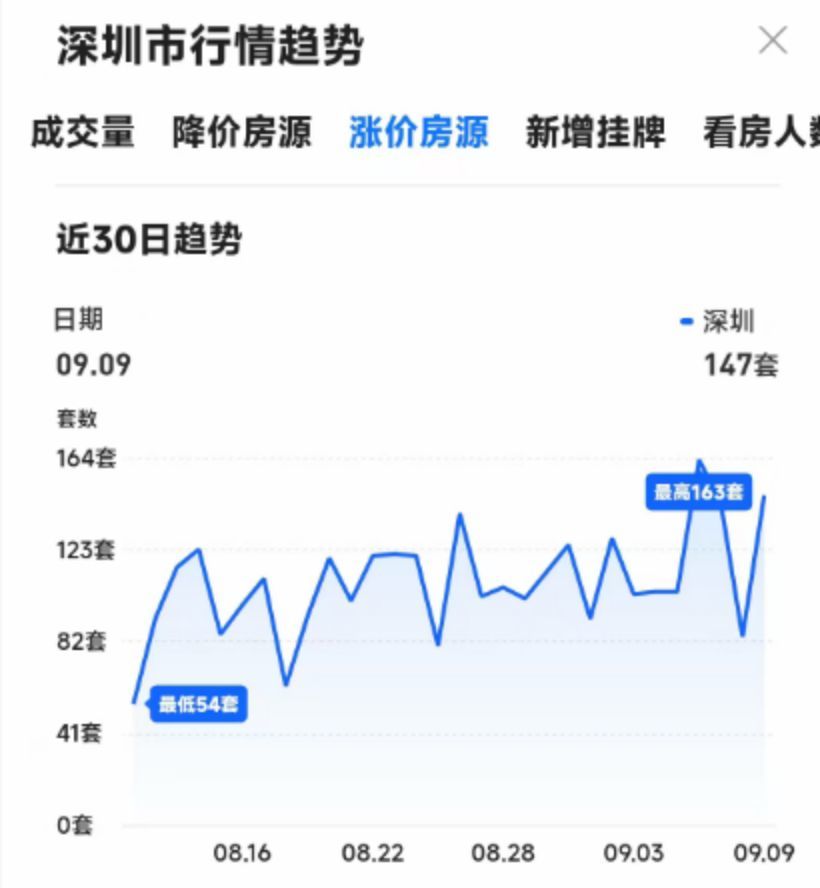
Core Viewpoint - The recent policy adjustment in Shenzhen's real estate market, known as the "9.5 New Policy," aims to stimulate sales during the traditional peak season of "Golden September and Silver October" by implementing differentiated controls and lowering mortgage rates [1][2]. Policy Changes - The "9.5 New Policy" was implemented on September 6, 2023, allowing for differentiated control measures in core areas like Futian and Nanshan, while non-core areas such as Luohu and Guangming have seen the removal of purchase limits [1]. - The policy also eliminates the distinction between first and second home mortgage rates, with the lowest mortgage rate now at 3.05% [1]. Market Response - Following the policy announcement, there was a significant increase in both property viewings and transactions over the first weekend, with some projects reporting a 30% increase in viewings and 16 units sold in one project [2][6]. - The overall visitations to new housing projects increased by approximately 48%, and transaction volumes rose by about 60% during the first weekend after the policy was enacted [6]. Pricing Trends - Despite the policy changes, many properties are still offering discounts, with reductions ranging from 86% to 93% of the listed price [3][4]. - For example, a 92.54 square meter unit at the Jiayu Jiu Xi project originally priced at approximately 5.03 million yuan is now available for about 4.68 million yuan, translating to around 5.06 thousand yuan per square meter [3]. Second-Hand Market Dynamics - The number of second-hand properties with price increases reached 163 on the first day of the new policy, marking a recent high, although the total number of discounted second-hand properties remains above a thousand [7][10]. - The second-hand market is characterized by a "volume increase and price stability" trend, with properties priced significantly below market value selling quickly [10][11]. Expert Analysis - Analysts suggest that the new policy serves as a supplement to last year's "9.30 policy," aiming to boost market confidence during the peak sales season [11]. - The cautious approach of developers, focusing on maintaining prices or reducing them to drive sales, reflects a careful market assessment [11].

冠通每日交易策略-20250910
Guan Tong Qi Huo· 2025-09-10 11:44
Report Summary 1. Market Overview - As of the close on September 10, domestic futures contracts showed mixed performance. Industrial silicon, fuel oil, and liquefied petroleum gas (LPG) rose over 1%, while lithium carbonate and polysilicon dropped over 4%. In the stock index futures market, the CSI 300 and SSE 50 index futures contracts rose, while the CSI 500 and CSI 1000 index futures contracts declined. In the bond futures market, all contracts fell [6][7]. - In terms of capital flow, as of 15:33 on September 10, funds flowed into the 30 - year treasury bond 2512, rebar 2601, and CSI 300 2509, while funds flowed out of Shanghai gold 2510, Shanghai silver 2510, and CSI 1000 2509 [7]. 2. Core Views 2.1 Copper - The US labor data was weak, but considering the low - level inventory in the fundamentals and the expected improvement during the peak season, copper is expected to fluctuate strongly [9]. 2.2 Crude Oil - In the medium - to - long - term, it is recommended to short on rallies as the supply - demand situation will weaken. In the short - term, it is advised to partially close out short positions due to the release of negative news and geopolitical risks [11]. 2.3 Asphalt - With weak supply and demand, and the futures price reaching the lower limit of the oscillation range, it is recommended to close out short positions [13]. 2.4 PP - It is expected to oscillate with limited downside space as the downstream enters the peak season, but the impact of policies to solve over - capacity remains to be seen [14]. 2.5 Plastic - It is expected to oscillate with limited downside space as the demand of the agricultural film sector is expected to increase, but the impact of policies to solve over - capacity remains to be seen [15][16]. 2.6 PVC - It is expected to oscillate downward due to high supply, weak demand, and large inventory pressure, and the impact of policies to solve over - capacity remains to be seen [17]. 2.7 Urea - The market is weak, with high inventory and lackluster demand, and the price is bottoming out [19]. 3. Industry - Specific Analysis 3.1 Copper - The monthly average non - farm employment in the US decreased by 76,000, and the smelting fees and sulfuric acid prices in the copper market are not favorable for smelters. Five smelters plan to conduct maintenance in September, and the import of copper may affect the domestic market. Although it is the off - season, the investment in power grid facilities boosts demand, and there is an expected improvement during the peak season [9]. 3.2 Crude Oil - It is at the end of the seasonal travel peak. EIA and IEA have raised the forecast of global oil surplus. OPEC+ plans to increase production in October, and Saudi Aramco has lowered the price. The trade relationship between the US and India may affect the global oil trade flow. The end of the consumption peak season and weak employment data may lead to weak demand [10][11]. 3.3 Asphalt - The asphalt production rate continued to decline last week, but the planned production in September increased. The downstream industry's production rate mostly decreased, and the shipment volume decreased. The refinery inventory decreased but remained at a low level. The increase in oil production by OPEC+ and the decline in oil prices weakened the cost support [12][13]. 3.4 PP - The downstream production rate increased slightly, and the enterprise production rate remained stable. The new production capacity was put into operation, and the cost increased due to geopolitical risks. The downstream is entering the peak season, but the impact of policies to solve over - capacity remains to be seen [14]. 3.5 Plastic - The production rate increased due to the restart of some devices, and the downstream production rate also increased. The new production capacity was put into operation, and the demand of the agricultural film sector is expected to increase. The impact of policies to solve over - capacity remains to be seen [15][16]. 3.6 PVC - The upstream calcium carbide price increased in some areas, and the production rate increased. The downstream production rate was still low, and the export was affected by policies. The inventory was high, and the real - estate market was still in adjustment. New production capacity was put into operation, and the demand has not improved significantly [17]. 3.7 Urea - The price opened low and fluctuated. The upstream factory price declined, and the market sentiment was cautious. The supply was abundant, and the demand was weak. The inventory continued to increase [19].
冠通研究:基本面支撑,铜价偏强
Guan Tong Qi Huo· 2025-09-10 10:59
【冠通研究】 基本面支撑,铜价偏强 制作日期:2025 年 9 月 10 日 【策略分析】 沪铜低开低走,日内震荡收跌,美国劳工统计局公布年度基准修订数据,截至 2025 年 3 月的 12 个月内,非农就业总人数下修 91.1 万,月均少增 7.6 万,创 2000 年以来最 大下修幅度,远超市场预期的 70 万。基本面来看,前期冶炼厂加工费出现回升拐点后, 近两期继续下降。且硫酸价格逐渐出现拐点,预计价格已升至高位,后续对于冶炼厂的 利润弥补将有所下滑,9 月有 5 家冶炼厂有检修计划,涉及粗炼产能 100 万吨,预计 9 月国内电解铜产量将环比下降,铜关税落地后,进口铜货源回流至国内,且国内产量下 半年预计有回落,进口铜货源将挤占国内市场,影响定价。需求方面,截至 2025 年 7 月,铜表观消费量为 137.45 万吨,整体来看,虽目前处于消费淡季阶段,但国内电网设 施投资规模不断加大,拉动铜需求。目前铜价上行后,下游买单意愿不佳,升水承压, 但临近金九银十旺季,需求有转好预期。综合来看,基本面库存低位及金九银十旺季有 好转预期,虽美国就业数据低迷,但铜偏强震荡为主。 投资有风险,入市需谨慎。 本公司 ...
聚烯烃日报:需求旺季支撑,盘面窄幅波动-20250910
Hua Tai Qi Huo· 2025-09-10 07:46
Report Industry Investment Rating - Unilateral: Neutral; Inter - period: 01 - 05 reverse spread; Inter - variety: Long L - P [3] Core View - The peak demand season has arrived, but it is still mainly for rigid - demand procurement, with the market fluctuating narrowly. Multiple PE units are under maintenance, and the overall operating rate has slightly decreased, with supply pressure expected to ease slightly, while new PP production capacity is being released. Downstream demand is in the transition period between the "Golden September and Silver October" seasonal off - peak and peak seasons, and the operating rates of downstream industries such as agricultural films and packaging films show a slight upward trend. The upstream production inventory has increased slightly, while the inventory in the middle - stream has decreased. As the peak demand season arrives in mid - to late September, the downstream operating rate is expected to rise, and the short - term supply - demand margin may improve. Crude oil is weakly consolidating, and the profit of PDH - made PP is slightly in the red, with an increase in the maintenance volume of PDH units [2] Summary by Directory 1. Polyolefin Basis Structure - The L (LLDPE) main contract closed at 7229 yuan/ton (- 22), and the PP main contract closed at 6949 yuan/ton (- 19). The LL North China spot price was 7180 yuan/ton (+ 30), the LL East China spot price was 7190 yuan/ton (+ 20), and the PP East China spot price was 6800 yuan/ton (+ 0). The LL North China basis was - 49 yuan/ton (+ 52), the LL East China basis was - 39 yuan/ton (+ 42), and the PP East China basis was - 149 yuan/ton (+ 19) [1] 2. Production Profit and Operating Rate - The PE operating rate was 80.5% (+ 1.9%), and the PP operating rate was 79.9% (- 0.3%). The PE oil - based production profit was 344.5 yuan/ton (- 41.0), the PP oil - based production profit was - 265.5 yuan/ton (- 41.0), and the PDH - made PP production profit was - 296.9 yuan/ton (- 21.8) [1] 3. Polyolefin Non - standard Price Difference - No specific data provided in the given text 4. Polyolefin Import and Export Profit - The LL import profit was - 238.9 yuan/ton (- 1.6), the PP import profit was - 523.0 yuan/ton (+ 54.2), and the PP export profit was 38.8 US dollars/ton (+ 3.9) [1] 5. Polyolefin Downstream Operating Rate and Downstream Profit - The PE downstream agricultural film operating rate was 20.2% (+ 2.7%), the PE downstream packaging film operating rate was 50.5% (+ 0.9%), the PP downstream plastic weaving operating rate was 42.7% (+ 0.4%), and the PP downstream BOPP film operating rate was 61.4% (+ 1.0) [1] 6. Polyolefin Inventory - The upstream production inventory increased slightly, and the inventory in the middle - stream decreased [2]
长江期货市场交易指引-20250910
Chang Jiang Qi Huo· 2025-09-10 07:38
Report Industry Investment Ratings - **Macro Finance**: Index futures - bullish in the medium to long term, recommended to buy on dips; Treasury bonds - hold and observe [1][5] - **Black Building Materials**: Coking coal - range trading; Rebar - range trading; Glass - buy on dips [1][7][8] - **Non - ferrous Metals**: Copper - hold and observe or buy on dips for short - term trading; Aluminum - recommended to buy on dips after a pullback; Nickel - recommend to observe or short on rallies; Tin - range trading; Gold - range trading; Silver - range trading [1][9][10][13][14] - **Energy Chemicals**: PVC - volatile; Caustic soda - volatile; Soda ash - short 01 and long 05 arbitrage; Styrene - volatile; Rubber - bullish volatile; Urea - volatile; Methanol - volatile; Polyolefins - wide - range volatile [1][19][20][24][27][28][30] - **Cotton Textile Industry Chain**: Cotton and cotton yarn - volatile; PTA - volatile; Apples - bullish volatile; Jujubes - bearish volatile [1][34][36][38] - **Agricultural and Livestock**: Pigs - short on rallies; Eggs - short on rallies; Corn - wide - range volatile; Soybean meal - range volatile; Oils - bullish volatile [1][39][40][41][45][51] Core Views The report provides investment strategies and market analyses for various futures products across multiple industries. It takes into account factors such as supply and demand, cost, macro - economic environment, and policy expectations. For most products, the market is expected to be volatile in the short term, with some showing potential for long - term improvement based on factors like seasonal demand, trade policies, and production capacity changes [1][5][7][9][19][34][39] Summary by Industry Macro Finance - **Index Futures**: A - share market was volatile on Tuesday. Short - term market fluctuations are intensifying. It is recommended to focus on high - growth overseas - oriented sectors, AI - related opportunities, and non - banking sectors. The technology theme may remain active, and it is advisable to buy on dips in the medium to long term [5] - **Treasury Bonds**: The bond market has been weak recently. Market sentiment is fragile, and it is recommended to hold and observe in the short term [5] Black Building Materials - **Coking Coal and Coke**: Steel mills' daily hot - metal production decreased this week. After the parade, production is expected to recover. The "Golden September and Silver October" demand season is approaching, and it is recommended to buy on dips. Coking coal is recommended to be observed in the range of [1030 - 1230] [7] - **Rebar**: Futures prices fluctuated on Tuesday. The iron ore price rose, but the impact is on the far - term. Fundamental supply and demand weakened, but it is the traditional demand season in September. It is recommended to buy on dips, and the RB2601 contract should focus on the [3000 - 3100] support level [7] - **Glass**: Supply increased slightly last week, and inventory was stable overall. Demand improved, and the market sentiment warmed up. It is recommended to take partial profit on the 01 long position and buy on dips around the 1130 - 1140 support level [8] Non - ferrous Metals - **Copper**: The US employment data declined, and the market's expectation of a Fed rate cut increased, but concerns about the US economy limited the upside of copper prices. The supply of copper concentrate is tight, and the consumption season is approaching. Copper prices are expected to remain volatile at a high level, with a short - term operating range of 79000 - 80500 yuan/ton [9][10] - **Aluminum**: The price of bauxite in Guinea increased, and the production of alumina and electrolytic aluminum was stable. Demand is entering the peak season, and it is recommended to buy on dips and consider the long AD and short AL arbitrage strategy [10] - **Nickel**: The demonstration in Indonesia and the Fed rate - cut expectation affected nickel prices. The supply of nickel ore is expected to increase, but the price has support. The nickel market is in an oversupply situation in the long term, and it is recommended to short on rallies [13][14] - **Tin**: Domestic refined tin production decreased in August. The supply of tin ore is tight, and the demand for semiconductors is expected to recover. Tin prices are expected to be volatile, with the Shanghai tin 10 - contract operating in the range of 26 - 27.5 million yuan/ton [15][16] - **Gold and Silver**: The US non - farm payrolls in August were lower than expected, increasing the market's expectation of a Fed rate cut. Gold and silver prices rebounded. It is recommended to buy on dips after a pullback, with the Shanghai gold 10 - contract operating in the range of 790 - 835 and the Shanghai silver 10 - contract in the range of 9100 - 10000 [16][18] Energy Chemicals - **PVC**: The cost is at a low level, supply is high, and demand is weak. Exports may face challenges. The market is expected to be volatile, and the 01 contract should focus on the 4700 - 5000 range [19][20] - **Caustic Soda**: Affected by factors such as inventory and demand, the market is expected to be volatile, and the 01 contract should focus on the 2530 - 2680 range [20][21] - **Styrene**: Due to factors like cost and demand, the market is expected to be volatile, and it should focus on the 6900 - 7200 range [22][24] - **Rubber**: The cost provides support, but the high - price raw materials face resistance from downstream. The market is expected to be bullish volatile, and it should focus on the 15600 support level [24][25] - **Urea**: Supply decreased slightly, demand was weak, and inventory increased. It is expected to be volatile, and the 01 contract should focus on the 1650 - 1700 support level [27][28] - **Methanol**: Supply was stable, cost was weak, and demand was mixed. The market is expected to be volatile, and the 01 contract should focus on the 2350 - 2450 range [28] - **Polyolefins**: The "Golden September and Silver October" demand season is approaching, and downstream demand is improving. PE supply pressure is relieved, while PP supply is high. LL is expected to be range - volatile in the 7200 - 7500 range, and PP is expected to be bearish volatile in the 6900 - 7200 range [30] - **Soda Ash**: The spot market is weak, and supply is abundant. It is recommended to short the 01 contract and long the 05 contract for arbitrage [33] Cotton Textile Industry Chain - **Cotton and Cotton Yarn**: Global cotton supply and demand are improving, but new cotton production is expected to increase. It is recommended to prepare for hedging [34] - **PTA**: Crude oil prices fell, and PTA supply increased. The market is expected to be volatile, and it should focus on the 4600 - 4950 range [35][36] - **Apples**: Early - maturing apples are priced higher than last year, and the market is expected to be bullish volatile [36] - **Jujubes**: Consumption is weak, and the market is expected to be bearish volatile [38] Agricultural and Livestock - **Pigs**: Supply increased in September, and demand growth was slow. The price is under pressure, but policies and holiday demand may provide support. It is recommended to take profit on short positions and add short positions on rallies, and consider the long 05 and short 03 arbitrage [39] - **Eggs**: Short - term demand was boosted, and supply pressure was relieved. However, cold - storage eggs may affect the price. It is recommended to be cautious about shorting the 12 and 01 contracts, and the market is expected to be range - volatile [40] - **Corn**: The new crop is about to be listed, and the old - crop inventory is relatively tight. The 11 contract should not be overly bearish. It is recommended to short on rallies and consider the 1 - 5 reverse arbitrage [41][43] - **Soybean Meal**: The US soybean price has support, and domestic supply is abundant in the short term. The price is expected to be volatile, and the M2601 contract should focus on the 3030 support level [45][46] - **Oils**: Short - term price increases are limited due to factors such as inventory and report expectations. In the long term, demand is expected to improve, and it is recommended to buy on dips and consider the rapeseed oil 11 - 01 contract positive arbitrage [51]
低位地产逆市补涨?全市场唯一地产ETF(159707)放量三连涨!政策暖风频吹,“金九银十”点火在即
Xin Lang Ji Jin· 2025-09-09 12:16
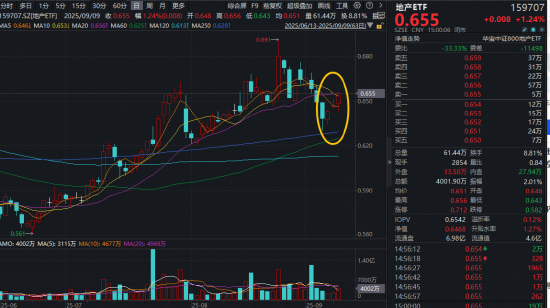
Group 1 - The A-share market experienced a volume contraction and a collective decline in the three major indices, while the real estate sector saw a rare surge, with the CSI 800 Real Estate Index rising over 1% against the market trend [1][3] - Major real estate stocks such as Binjiang Group and New Town Holdings saw significant gains, with Binjiang Group hitting the daily limit and New Town Holdings rising over 4% [1] - The only ETF tracking the CSI 800 Real Estate Index, ETF 159707, also rose by 1.24%, marking three consecutive days of gains, with a total trading volume of 40 million yuan and a net subscription of 8.5 million units in a single day [1][3] Group 2 - The strength of the real estate sector is attributed to recent policy adjustments in first-tier cities, including a combination of measures announced by the Shenzhen Housing and Urban-Rural Development Bureau and the People's Bank of China [3] - September is typically a period of intensive policy announcements for the real estate sector, and new supportive policies are expected to accelerate, coinciding with the traditional peak sales season of "Golden September and Silver October" [3] - Analysts predict a rebound in real estate transaction volumes in the fourth quarter, supported by the recent optimization of purchase restrictions in major cities, and suggest that the current low valuations in the real estate sector present a buying opportunity [3][5] Group 3 - The CSI 800 Real Estate Index currently has a price-to-book (PB) ratio of only 0.75, indicating a significant undervaluation at the 17th percentile over the past decade, suggesting substantial room for recovery [3][5] - Leading real estate companies, particularly state-owned enterprises and high-quality firms, are expected to demonstrate resilience due to their strong land reserves in core cities, which positions them for a quicker recovery in sales and profitability [5] - The ETF 159707, which tracks the CSI 800 Real Estate Index, includes 13 top-tier real estate companies, with over 90% of its weight concentrated in the top ten holdings, highlighting its focus on leading firms in the industry [5]






电解铝期货品种周报-20250908
Chang Cheng Qi Huo· 2025-09-08 02:46
Report Industry Investment Rating No relevant content provided. Core View of the Report - In September, the domestic aluminum market is expected to show a stable - to - strong supply - demand situation. The operating rate of aluminum plants is expected to increase slightly, the proportion of molten aluminum is likely to rise, and the ingot casting volume is expected to decline. With the arrival of the "Golden September and Silver October" demand recovery period, downstream orders are expected to increase, and the social inventory of aluminum ingots is approaching the de - stocking inflection point, which is expected to support prices. The price of Shanghai Aluminum is expected to show a volatile and upward - biased trend, with an attempt to break through and stabilize at the 21,000 yuan/ton level, but attention should be paid to the fulfillment of peak - season expectations and macro - economic policy changes [5][12]. - Currently, the consumption side shows only marginal improvement, and it still takes time for inventory to be effectively reduced. However, due to the low total inventory, the aluminum price is likely to rise rather than fall in the traditional peak season of September, but there is still upward pressure [14]. Summary by Relevant Catalogs Mid - term Market Analysis - **Trend Judgment**: In September, the domestic aluminum plant capacity utilization rate is expected to increase slightly, the proportion of molten aluminum is expected to increase, and the ingot casting volume is expected to decline. The demand recovery expectation during the "Golden September and Silver October" is strong, downstream orders are expected to increase, and the social inventory of aluminum ingots is approaching the de - stocking inflection point, which is expected to start de - stocking around mid - September, forming support for prices. The supply - demand situation in September is stable and slightly strong [5]. - **Strategy Suggestion**: Consider holding medium - term long positions below 20,000 [5]. Variety Trading Strategy - **Last Week's Strategy Review**: For Shanghai Aluminum 2510 in the coming week, the support was seen at 20,600, and the resistance was seen at 20,900 - 21,000. It was advisable to wait and see [7]. - **This Week's Strategy Suggestion**: For Shanghai Aluminum 2510 in the coming week, the support is seen at 20,300, and the resistance is seen at 20,900. Short - term trading is advisable [8]. - **Hedging Suggestion for Spot Enterprises**: Maintain an appropriate inventory [9]. Overall View - **Bauxite Market**: The domestic bauxite inventory is at a high level, and raw material supply is abundant [10]. - **Alumina Market**: As of September 5, the domestic alumina installed capacity is about 112.55 million tons, the operating capacity is about 95.2 million tons, and the capacity utilization rate is about 84.38% (85.58% last week), currently at the highest level since 2022. With the existence of smelting profits, the weekly output remains high, but the spot price has dropped to the high - marginal cost this week, increasing the risk of alumina plant production cuts [10]. - **Electrolytic Aluminum Production**: According to Steel Union data, the current domestic electrolytic aluminum installed capacity is about 45.45 million tons, the operating capacity is about 44.2 million tons, and the capacity utilization rate is about 97%, at the average level since 2023. In September, with the commissioning of a small amount of replacement capacity, the operating capacity will increase slightly, and the output is expected to increase slightly. There is an expectation of a rebound in the proportion of molten aluminum in September [10]. - **Imports and Exports**: Currently, the theoretical loss of electrolytic aluminum imports is about 1,200 yuan/ton (about 1,300 yuan/ton last week). According to customs data, aluminum exports have generally rebounded since March this year and are currently at a relatively high level in recent years. However, in general, the export growth rate in the second half of the year is expected to decline compared with the first half [10]. - **Demand**: The overall operating rate of domestic aluminum downstream processing leading enterprises increased by 1 percentage point to 61.7% this week, and the "Golden September" effect is gradually emerging. Different sectors have different performances, such as the slow recovery of the primary aluminum alloy sector, the strong performance of the aluminum strip due to order growth in the automotive and 3C fields, and the rebound of the aluminum cable due to concentrated grid order delivery [11][25]. - **Inventory**: The social inventory of electrolytic aluminum ingots is 628,000 tons, an increase of about 1% compared with last week and about 21% lower than the same period last year. The weekly inventory accumulation pace has slowed down. The aluminum rod inventory is 136,500 tons, an increase of about 8% compared with last week and about 19% higher than the same period last year. The LME aluminum inventory is basically stable and is still at a low level since 1990, and there is a high probability of further inventory accumulation in the future [11]. - **Profit**: The average full - cost of the Chinese alumina industry is about 2,850 yuan/ton, and the profit is about 270 yuan/ton (about 380 yuan/ton last week). The average production cost of domestic electrolytic aluminum is about 17,500 yuan/ton, and the theoretical profit is about 3,200 yuan/ton (3,100 yuan/ton last week), with profits at a relatively high level [12]. - **Market Expectation**: In September, with the arrival of the consumption peak season, the price of Shanghai Aluminum is expected to show a volatile and upward - biased trend, with an attempt to break through and stabilize at the 21,000 yuan/ton level, but attention should be paid to the fulfillment of peak - season expectations and macro - economic policy changes [12]. Important Industry Link Price Changes - The prices of most aluminum - related products have changed to varying degrees this week. For example, the price of Henan first - grade alumina decreased by 2.04% week - on - week, and the price of power coal decreased by 1.58% week - on - week. The price of pre - baked anodes in Henan increased by 1.48% week - on - week [13]. - The bauxite bulk cargo trading volume has increased slightly, and the price is expected to remain stable in the near future. The coal price has decreased slightly, and downstream customers are resistant to the current price. The alumina price has continued to decline slightly, with supply exceeding demand, inventory accumulation, and downward pressure on the spot price [13]. Important Industry Link Inventory Changes - The port inventory of imported bauxite decreased by 2.16% week - on - week, and it is expected to continue to decline in early September. The overall alumina inventory has continued to accumulate, with the increase mainly coming from electrolytic aluminum plants and alumina plants [16][18]. - The social inventory of electrolytic aluminum ingots in 7 cities increased by 0.96% week - on - week, and the inventory accumulation pace has slowed down. The aluminum rod inventory increased by 7.91% week - on - week, mainly due to the full resumption of processing plants and weak downstream demand. The LME aluminum inventory increased by 0.75% week - on - week and is still at a low level since 1990 [11][16][18]. Futures - Spot Structure - The current Shanghai Aluminum futures price structure remains neutral. Although the inventory has accumulated recently, the near - month contracts maintain a premium over the far - month contracts, and the futures side is still relatively resistant to decline [31]. Spread Structure - The spread between aluminum ingots and ADC12 this week is about - 1,960 yuan/ton, compared with - 1,830 yuan/ton last week. Currently, the spread between primary aluminum and alloy is at the mid - axis level in recent years, and the current spread has a neutral impact on electrolytic aluminum [38][39]. Market Capital Situation - **LME Aluminum**: The net long positions of overseas funds have remained stable in the past three weeks. With the increasing expectation of the Fed's significant interest - rate cut frequency, the price may show a strong - biased volatile trend in the near future [41]. - **SHFE Electrolytic Aluminum**: This week, the net long positions of the main force remained stable, and both the long and short camps continued to reduce their positions since July. The net long positions of funds with a financial speculation background rebounded slightly, but the camp differentiation is still obvious. The net long positions of funds with a mid - downstream enterprise background remained stable. The market is expected to be dominated by wide - range fluctuations in the near future [44].
棉花周报(9.1-9.5)-20250908
Da Yue Qi Huo· 2025-09-08 02:43
Report Industry Investment Rating No relevant content provided. Core Viewpoints - This week, the main cotton contract 01 fluctuated around 14,000. With the arrival of the "Golden September and Silver October" peak season, there are significant market differences. New cotton is about to be listed, increasing hedging pressure, and the main 01 contract will continue to fluctuate around 14,000. [5][6] - There are both positive and negative factors in the market. Positive factors include the reduction of previous mutual tariffs between China and the US, a year - on - year decrease in commercial inventory, and increased expectations for the "Golden September and Silver October" consumption peak season. Negative factors are the postponement of trade negotiations, currently high export tariffs to the US, an overall decline in foreign trade orders, increased inventory, and the upcoming large - scale listing of new cotton. [7] Summary by Directory 1. Previous Day Review (This part may be mis - named as "Previous Day" but actually contains weekly review) - The main cotton contract 01 fluctuated around 14,000 this week. [5] - ICAC September report: In the 2025/26 season, global cotton production is 25.5 million tons, and consumption is 25.5 million tons. USDA August report: In the 2025/26 season, production is 25.392 million tons, consumption is 25.688 million tons, and the ending inventory is 16.093 million tons. [5] - In July, textile and clothing exports were $26.77 billion, a year - on - year decrease of 0.1%. In July, China imported 50,000 tons of cotton, a year - on - year decrease of 73.2%, and imported 110,000 tons of cotton yarn, a year - on - year increase of 15.38%. [5] - The Ministry of Agriculture's August forecast for the 2025/26 season: production is 6.25 million tons, imports are 1.4 million tons, consumption is 7.4 million tons, and the ending inventory is 8.23 million tons. [5] 2. Daily Hints No relevant content provided. 3. Today's Focus No relevant content provided. 4. Fundamental Data - **USDA Global Cotton Supply, Demand, and Inventory Forecast (August)**: - Production: The total global production in August 2024/25 is 25.392 million tons, a month - on - month decrease of 391,000 tons and a year - on - year decrease of 2% or 551,000 tons. [12] - Consumption: The total global consumption in August 2024/25 is 25.688 million tons, a month - on - month decrease of 30,000 tons and a year - on - year increase of 0.4% or 60,000 tons. [12] - Imports: The total global imports in August 2024/25 are 9.489 million tons, a month - on - month decrease of 239,000 tons and a year - on - year increase of 2% or 193,000 tons. [13] - Exports: The total global exports in August 2024/25 are 9.489 million tons (same as imports in the balance). [13] - Ending Inventory: The total global ending inventory in August 2024/25 is 16.093 million tons, a month - on - month decrease of 742,000 tons and a year - on - year decrease of 2.4% or 247,000 tons. [13] - **Global Cotton Supply and Demand Balance Sheet (ICAC) for 2025/26**: - Global production is 2.59 million tons, an increase of 400,000 tons (+1.6%) year - on - year, mainly due to increased production in Brazil and stable planting areas in the Northern Hemisphere. [14] - Global consumption is 2.56 million tons, basically unchanged year - on - year. China's consumption accounts for 32% (8.2 million tons), and India's cotton - planting area accounts for 38% of the world's. [14] - Ending inventory is 1.71 million tons, an increase of 260,000 tons (+1.6%) year - on - year. The inventory - to - consumption ratio rises to 66.8%, indicating a loose supply. [14] - Global trade volume is 970,000 tons, an increase of 36,000 tons (+3.9%) year - on - year. Major exporters are Brazil (32% share) and the US (3.18 million tons), and major importers are Bangladesh (19% share). China relies on Brazilian cotton to ease trade frictions. [14] - The price forecast (Cotlook A Index) is 57 - 94 cents per pound (median 73 cents), with a narrower year - on - year fluctuation, reflecting the expected supply - demand balance. [14] - **China's Cotton Supply and Demand Forecast (Ministry of Agriculture) for 2025/26**: - Beginning inventory is 8.01 million tons, production is 6.25 million tons, imports are 1.4 million tons, consumption is 7.4 million tons, and ending inventory is 8.23 million tons. [16] - The average domestic cotton 3128B price is expected to be in the range of 15,000 - 17,000 yuan per ton, and the Cotlook A Index is expected to be in the range of 75 - 100 cents per pound. [16] 5. Position Data No relevant content provided.