
反内卷

Search documents
马年到,码住这份全球投资指南!
Sou Hu Cai Jing· 2026-02-13 10:46
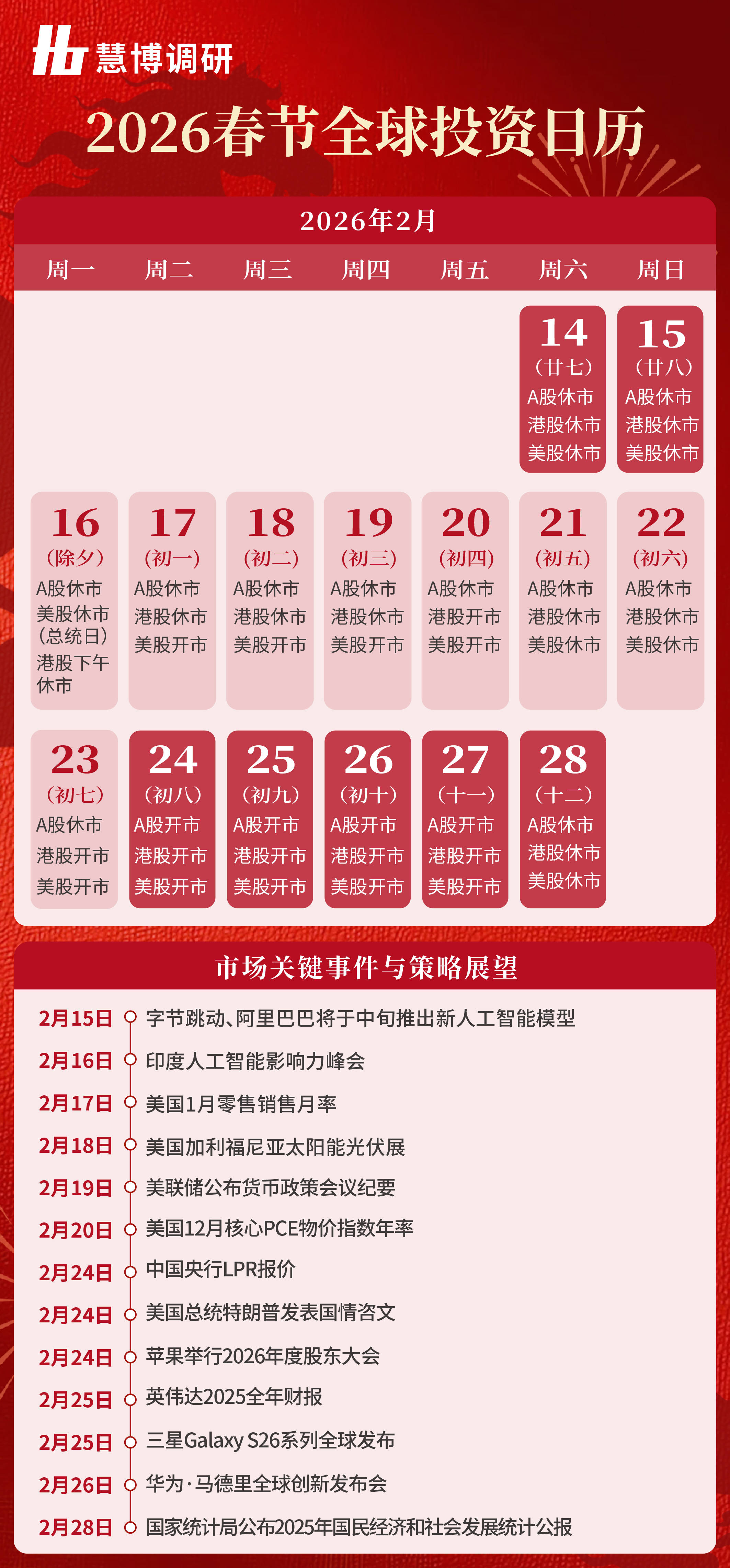
春节假期将至,A股也将迎来长达10天的休市期。到底是清仓持币,落袋为安过节?还是持股期待节后行情呢?这是一个问题。 昨晚,海外突然全线暴跌,今天是A股的最后一个交易日,市场连日来震荡调整,持股还是持币过节,今天(2月13日)就是作出决定的最后一天。从近日 券商、公募、私募等机构的调查和建议来看,"持股过节"似乎成为主流选择。 不过,机构提醒这一建议是基于过往大数据的梳理,持股还是持币的决定性因素在于投资者的持仓结构。需要注意的是,虽然港股只在2月17日至19日休市3 天,但春节期间港股通渠道是关闭的。如果投资者是通过港股通购买的港股,那么其将和A股一起"放假"。 其实,不必纠结,我们可以结合历史的规律、当前的市场环境及自己的风险偏好,来做出最适合自己的投资决策。 马年春节到,慧博调研贴心准备了一份春节假期全球投资交易日历,并附上了假期期间全球财经大事,一起来码住这份全球投指南! 提醒一下大家,算上周末,A股春节前最后一个交易日是2月13日,其后直到2月23日,A股与港股通均进入长假模式,春节后第一个交易日是2月24日星期 二。 港股市场2月16日除夕当天上午交易,下午休市。2月17日到2月19日,即新年初一到 ...

推动物价合理回升,我们该怎么花钱?
Xin Lang Cai Jing· 2026-02-13 09:02
Core Viewpoint - The year 2026 is anticipated to be a year of price increases, with various sectors already showing signs of rising prices, including food and consumer goods [1][6]. Group 1: Economic Policy and Price Trends - The Central Economic Work Conference has indicated that promoting stable economic growth and a reasonable recovery of prices will be a key consideration in monetary policy [1][6]. - The National Development and Reform Commission and the central bank have expressed intentions to facilitate a reasonable price recovery, focusing on a balanced approach where some prices may rise while ensuring essential living costs remain stable [1][3]. Group 2: Factors Influencing Price Increases - Regulatory measures have been implemented to address "involution" in competition, leading to a necessary increase in prices in the food and beverage sector, including the adjustment of delivery costs for riders [3][5]. - The cleaning up of substandard products in the renewable energy sector has resulted in higher costs for compliant products, which will reflect in their selling prices [3][5]. Group 3: Consumer Impact and Strategies - The anticipated price increases will affect consumers, but there is a focus on increasing household incomes through the implementation of urban and rural resident income growth plans [7][10]. - Consumers are advised to take advantage of government subsidies for purchasing new products, such as vehicles and electronics, to mitigate the impact of rising prices [9][10]. - Emphasis is placed on investing in durable goods rather than frequently purchasing cheaper, lower-quality items, which can lead to long-term savings [12][13].

建材行业双周报(2026/01/30-2026/02/12):“防内卷”带来建材供需格局优化,电子布价格提升预期增强-20260213
Dongguan Securities· 2026-02-13 08:48
Investment Rating - The report maintains a "Market Weight" rating for the building materials industry, indicating that the industry index is expected to perform within ±10% of the market index over the next six months [46]. Core Insights - The building materials industry is experiencing an optimization in supply and demand dynamics due to the "anti-involution" policies, with expectations for price increases in electronic fabrics [2][4]. - The cement sector is anticipated to see a further contraction in total production capacity in 2026, driven by regulatory measures and a potential recovery in real estate sales in key cities [4][39]. - The flat glass market is showing signs of recovery with a slight increase in production and prices, although short-term demand remains weak due to seasonal factors [4][40]. - The photovoltaic glass market is facing challenges with excess supply and ongoing losses, but long-term demand is expected to be supported by the development of new energy bases [4][40]. - The glass fiber industry is in a structural recovery phase, with increasing demand for high-end products driven by advancements in AI and 5G technologies [4][40]. Summary by Sections Cement - The Ministry of Industry and Information Technology has implemented measures to control cement production capacity, leading to an expected reduction in total capacity in 2026 [4][39]. - Recent data indicates a recovery in real estate sales, which, combined with major infrastructure projects, may improve the supply-demand balance in the cement industry [4][39]. - Recommended stocks include Shangfeng Cement, Taipai Group, and Huaxin Cement, which have favorable fundamentals and high dividend yields [4][39]. Glass and Fiberglass - The flat glass production in 2025 is projected to be 97,591 million weight boxes, a 3% decrease year-on-year, but December 2025 saw a 3.4% increase compared to the previous year [4][40]. - The price of float glass has shown a slight recovery, with expectations for price stabilization due to supply-side adjustments [4][40]. - The fiberglass market is benefiting from increased demand for low-DK glass fabrics, with Taiwanese manufacturers shifting production to meet this demand [4][40]. - Recommended stocks in the fiberglass sector include China Jushi, which is expected to benefit from the structural recovery in the industry [6][40]. Consumer Building Materials - Leading companies like Keshun and Sankeshu have announced price increases due to rising raw material costs, indicating a trend of price stabilization in the industry [6][42]. - The demand for new construction is weakening, but renovation and urban renewal projects are expected to drive growth [6][42]. - Recommended stocks include Beixin Building Materials, Tubaobao, and Sankeshu, which are well-positioned to recover ahead of their peers [6][42].


利率债周报:债市延续偏强震荡-20260213
BOHAI SECURITIES· 2026-02-13 07:52
1. Report Industry Investment Rating There is no information about the industry investment rating in the provided content. 2. Core Viewpoints of the Report - The bond market continued to oscillate strongly. The 10Y Treasury bond yield was gradually testing downwards around 1.8%. After the Spring Festival, the market will enter the policy waiting period before the Two Sessions, and the pattern of interest - rate bonds oscillating within a range is expected to remain unchanged. The downward space for the 10Y Treasury bond yield is limited. Attention should be focused on varieties around 3Y and the opportunities for the narrowing of the 30Y - 10Y Treasury bond spread and the 10Y term CDB - Treasury bond spread [22]. - In terms of inflation data, it is expected that in February 2026, both the year - on - year and month - on - month increases of CPI will expand, and the month - on - month increase of PPI may be similar to that in January, with the year - on - year decline further narrowing to around - 1.0% [9]. - The possibility of comprehensive reserve requirement ratio cuts and interest rate cuts remains limited. After the Spring Festival, it is difficult for the capital market to loosen significantly, and DR007 is expected to remain above 1.5% [20][22]. 3. Summary According to the Directory 3.1 Important Event Review - In January 2026, CPI increased by 0.2% year - on - year, and PPI decreased by 1.4% year - on - year. The core inflation month - on - month increase reached the highest in the past six months, mainly due to the increase in holiday travel demand, the rise in international gold prices, and the boost from the new round of "trade - in" programs. The PPI year - on - year decline narrowed, and the month - on - month increase expanded. It is expected that in February 2026, both the year - on - year and month - on - month increases of CPI will expand, and the month - on - month increase of PPI may be similar to that in January, with the year - on - year decline further narrowing to around - 1.0% [9]. 3.2 Capital Price: Stable Capital Market Before the Festival - From February 6th to February 12th, the central bank's open - market operations had a net capital injection of 1.1 trillion yuan. The capital price was generally stable, with DR007 remaining below 1.6%, R007 remaining around 1.6%, and the 3M inter - bank certificate of deposit rate remaining basically unchanged [10]. 3.3 Primary Market: Slight Decrease in Special Bond Issuance Scale - From February 6th to February 12th, 96 interest - rate bonds were issued in the primary market, with an actual issuance total of 964.3 billion yuan. The issuance scale of Treasury bonds increased, while the issuance scale of special bonds decreased slightly [12]. 3.4 Secondary Market: The Bond Market Continued to Oscillate Strongly - From February 6th to February 12th, the bond market continued its previous strong - oscillation feature, with an accelerating trend in the last two trading days. On the one hand, it was because the pre - festival capital pressure was relatively controllable; on the other hand, the central bank's fourth - quarter monetary policy implementation report indicated that it would regularly conduct Treasury bond trading operations, which affirmed the current operation state of Treasury bond yields to some extent. The 10Y Treasury bond yield was gradually testing downwards around 1.8%. In terms of the term structure, the short - end performance was weak, the decline of the Treasury bond yield around 7Y was relatively large, and the ultra - long - term Treasury bonds continued to recover [14]. 3.5 Market Outlook - **Fundamentals**: The 2026 Spring Festival holiday was extended to 9 days. The Ministry of Transport estimated that the cross - regional passenger flow during the Spring Festival travel season would reach 9.5 billion person - times, an increase of about 0.5 billion person - times compared with the 2025 Spring Festival travel season. The high - frequency consumption data during the holiday is expected to perform well. Although the current market environment is different from that around the 2025 Spring Festival, caution is still needed regarding the potential disturbances of unexpectedly high consumption data [21]. - **Policy**: The central bank's fourth - quarter monetary policy implementation report mentioned "fiscal and financial coordination to support the expansion of domestic demand". Currently, it focuses on the coordinated efforts of "re - loans + fiscal interest subsidies" and guarantee and other credit enhancement methods to implement a new round of "trade - in" programs and cultivate service consumption growth points. In this context, the possibility of comprehensive reserve requirement ratio cuts and interest rate cuts remains limited [20]. - **Capital**: After the Spring Festival, factors such as reserve requirements, tax payments, a large number of reverse repurchase maturities, and the end - of - month factor are superimposed. It is difficult for the capital market to loosen significantly, and DR007 is expected to remain above 1.5% [20].
综合晨报-20260213
Guo Tou Qi Huo· 2026-02-13 02:52
国投期货研究院 gtaxinstitute@essence.com.cn 综合晨报 2026年02月13日 (原油) 隔夜原油大幅走低,布伦特原油跌破68美元/桶。特朗普表示谈判可能持续一个月,缓解了市场对近 期军事行动的担忧。IEA月报将今年全球石油需求增长预期从93万桶/日下调至85万桶/日。 供应 端,1月美国受风暴天气干扰,原油产量明显下滑;同时,停产与出口受限亦削弱了啥萨克斯坦、俄 罗斯及委内瑞拉的供应。IEA预计2026年原油供应过剩将超过370万桶/日,创年度平均水平的历史 新高。我们此前提示,油价在70美元/桶附近涨势明显松动,次日在地缘溢价回撤与库存累积的双重 压制下,原油遭遇大幅回调。鉴于奉节假期较长、美伊谈判前景仍不明朗,建议投资者注意规避风 险。 (贵金属) 隔夜贵金属震荡。本周美国非农就业超预期,降息预期受到压制,市场等待今晚CPI数据。她缘前景 仍存不确定性,短期责金属波动率逐渐下降,震荡等待驱动,保持观望。 【铜】 隔夜伦铜转跌,贵金属与美国股市联动下滑,金银关注非农就业指标超预期;而美股担忧Al发展影 响传统行业营收,且不确定就业潜力强弱。沪铜持仓缩减至55万手,价格跌破MA4 ...
弘元绿能2025年预计扭亏为盈,融资余额处高位引关注
Jing Ji Guan Cha Wang· 2026-02-13 01:52
Recent Performance - The company has announced a profit turnaround for the fiscal year 2025, expecting a net profit attributable to shareholders of between 180 million and 250 million yuan [2] Company Status - The company plans to amend its articles of association regarding registered capital due to an increase in total share capital from the implementation of an equity incentive plan, which will require approval from the shareholders' meeting [3] Industry Policy Landscape - The photovoltaic industry continues to be influenced by policies, with local renewable energy construction plans boosting sector sentiment. Analysts highlight the need to monitor the advancement of "anti-involution" policies and the long-term impact of integrated solar and storage trends on industry demand [4] Financial Situation - As of February 3, 2026, the company's financing balance stands at 810 million yuan, representing a high proportion of its circulating market value, which may affect short-term stock price fluctuations [5] Shareholder Dynamics - As of September 30, 2025, the number of shareholders has decreased compared to the previous period, with new public fund products entering the top ten circulating shareholders list, indicating potential changes in shareholder structure to watch in upcoming reports [6]

中原证券晨会聚焦-20260213
Zhongyuan Securities· 2026-02-13 00:45
Core Insights - The report highlights a positive outlook for the semiconductor industry, driven by increased capital expenditure from major cloud companies and a robust demand for AI infrastructure [22][24][25] - The electric power sector is expected to benefit from a significant increase in installed capacity, with a focus on renewable energy sources such as solar and wind [27][28][29] - The food and beverage sector shows mixed performance, with certain sub-sectors like prepared foods and snacks performing well, while others face challenges [19][20] Domestic Market Performance - The Shanghai Composite Index closed at 4,134.02, with a slight increase of 0.05%, while the Shenzhen Component Index rose by 0.86% to 14,283.00 [4] - The A-share market has shown resilience, with average P/E ratios for the Shanghai Composite and ChiNext at 16.91 and 53.15, respectively, indicating a favorable environment for medium to long-term investments [10][11] International Market Performance - Major international indices such as the Dow Jones and S&P 500 experienced declines of 0.67% and 0.45%, respectively, reflecting a cautious global market sentiment [5] Industry Analysis - The semiconductor industry saw a strong performance in January 2026, with a 18.63% increase in the domestic semiconductor index, significantly outperforming the broader market [22][23] - The electric power sector's installed capacity reached 38.9 billion kilowatts by the end of 2025, marking a 16.1% year-on-year increase, with solar and wind energy contributing significantly to this growth [27][28] - The food and beverage sector's sales in January 2026 showed a slight increase of 0.11% year-on-year, with a notable decline in month-on-month sales due to policy changes [19][20] Investment Recommendations - The report suggests a balanced investment strategy focusing on technology sectors, particularly AI and high-end manufacturing, while also considering opportunities in consumer sectors [10][11][15] - In the semiconductor space, investors are encouraged to look at companies benefiting from AI demand and increased capital expenditures from cloud providers [24][25][26] - For the electric power sector, a "barbell strategy" is recommended, focusing on stable, high-dividend companies as well as growth opportunities in renewable energy [27][29]
渤海证券研究所晨会纪要(2026.02.13)-20260213
BOHAI SECURITIES· 2026-02-13 00:31
Macro and Strategy Research - The PPI year-on-year decline continues to narrow, with a January PPI decrease of 1.4% and a month-on-month increase of 0.4, indicating improvements in supply-demand structures in key sectors and rising prices in some industries due to international metal prices [4][7] - The CPI for January increased by 0.2% both year-on-year and month-on-month, with a marginal decline in the year-on-year growth rate attributed to high base effects from the previous year and falling energy prices [3][4] - The central bank's monetary policy report emphasizes continued implementation of a moderately loose monetary policy, focusing on stabilizing economic growth and reasonable price recovery, with no immediate expectations for rate cuts or reserve requirement ratio reductions [4] Industry Research - Significant capital expenditure growth is observed among overseas cloud vendors, with projected capital expenditures reaching $660 billion in 2026, a 60% increase from 2025, indicating strong demand for AI computing power [11] - The AI application sector is approaching a commercialization inflection point, with notable advancements in products like ByteDance's AI video generation model Seedance 2.0, which shows significant improvements in core metrics and is expected to enhance content production efficiency [11] - The computer industry saw a 1.72% increase in the week from February 5 to February 11, with all sub-sectors experiencing growth, highlighting a positive market trend [9]
多地春节前发文要求各大外卖平台停止“内卷式”竞争
Yang Shi Wang· 2026-02-12 23:02
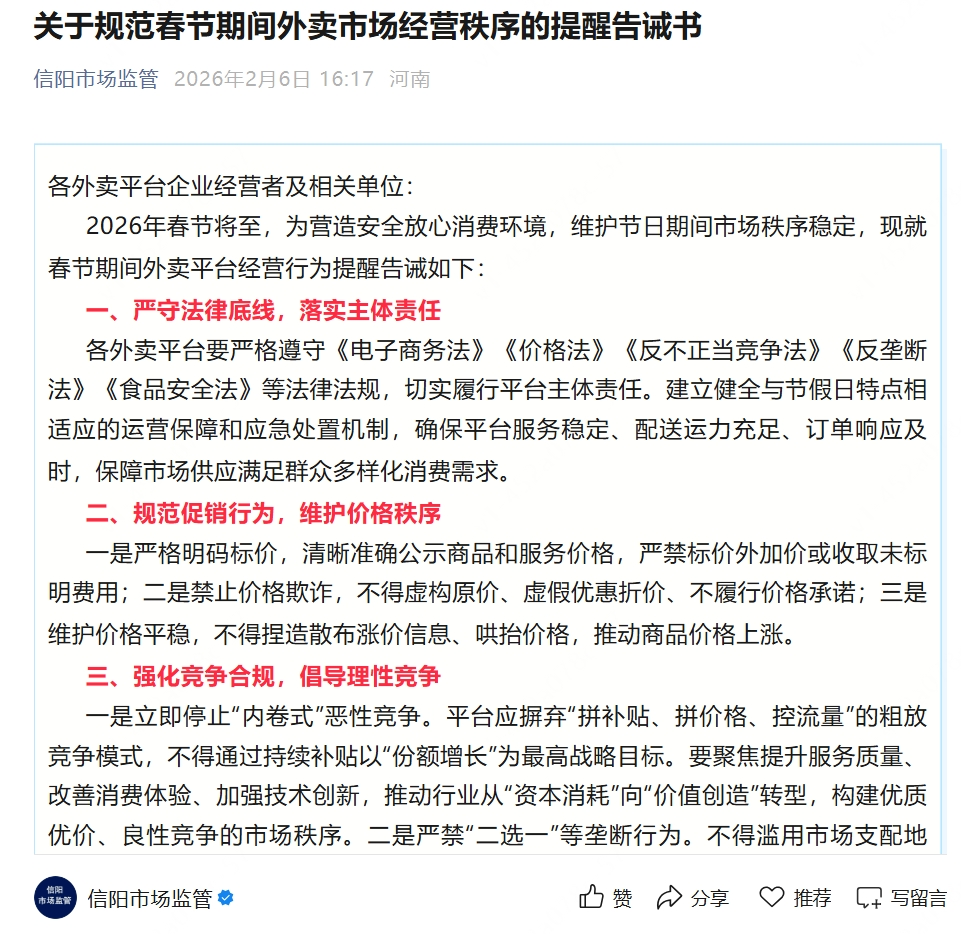
Core Viewpoint - Regulatory authorities across multiple regions in China have issued guidelines to curb "involution" and unhealthy competition in the food delivery sector ahead of the Spring Festival, emphasizing the need for rational competition and the cessation of harmful practices such as excessive subsidies and price wars [1][5][11]. Group 1: Regulatory Actions - Various market supervision departments, including those in Henan, Anhui, Guangdong, and Hainan, have mandated food delivery platforms to stop engaging in low-quality, low-price "involution" competition [1][5]. - The market supervision bureau of Xinyang issued a reminder highlighting issues like "price wars" and the negative impact of continuous subsidies on small merchants, which disrupts the industry ecosystem [1][5]. - The South Yanyang market regulatory authority has prohibited unfair competition practices such as "choose one from two," data monopolization, and other tactics aimed at eliminating competitors [1][5]. Group 2: Industry Response - Industry associations, such as the Gansu Catering and Cooking Industry Association, have called for self-regulation within the industry, urging a halt to low-quality, low-price competition and advocating for a stable market order [8][10]. - The association's initiative emphasizes that the ongoing subsidy wars are shifting competition from quality and service to capital endurance, negatively affecting small merchants' pricing power and profit margins [8][10]. Group 3: Policy Background - The negative effects of "involution" competition have garnered significant attention from regulatory bodies, with the Central Economic Work Conference identifying it as a key economic task [11]. - The State Administration for Market Regulation has included the "subsidy war" among the top ten typical cases for comprehensive rectification of "involution" competition by 2025, indicating a clear policy signal against such practices [11][13]. - As the Spring Festival approaches, nationwide regulatory actions aim to preemptively manage low-price involution, fostering a fair competition environment and maintaining market order during the holiday season [13].
【2026春节特别报道】用心护航 安心奔跑
Xin Lang Cai Jing· 2026-02-12 21:36
Group 1 - The core viewpoint of the articles emphasizes the optimization of algorithms by platform companies to enhance labor rights and create a more transparent and fair working environment for workers [1][2][3] - Since September 2021, Meituan has publicly disclosed its algorithm rules nine times, including delivery time estimates and order distribution, while implementing measures to protect rider rights such as fatigue reminders and a points deduction system for late deliveries [1] - Taobao Shanguo has also made strides in algorithm transparency, recently disclosing its pricing algorithm and signing a labor agreement with rider representatives that covers labor remuneration and rights protection [1][2] Group 2 - Huolala, as a leading freight platform, has publicly shared its algorithm mechanisms focusing on transparency, fairness, and social responsibility, including a driver autonomy algorithm and measures against fake orders [2] - The implementation of new national standards aims to enhance the rights of delivery workers, with the new electric bicycle safety standards and delivery platform service management standards set to take effect in December 2025 [2][3] - The new delivery platform standards require platforms to optimize dispatch algorithms considering various factors and to provide subsidies for delivery workers during holidays and adverse weather conditions [3] Group 3 - The express delivery industry is experiencing a growth trend, but frontline couriers face declining pay due to intense price competition, prompting calls for a shift from price wars to value-based competition [4] - The industry is encouraged to adopt collective bargaining mechanisms to ensure couriers' demands are effectively communicated to platforms, enhancing trust and loyalty among employees [4] - There is significant room for improvement in income security, management innovation, and service efficiency within the express delivery sector [4] Group 4 - Ride-hailing platforms such as Didi and T3 have announced reductions in commission rates to enhance driver incentives, creating a positive cycle of increased driver income and improved service quality [5][6] - Didi plans to lower its maximum commission from 29% to 27% by the end of 2025, with additional measures to ensure that drivers completing a minimum number of orders benefit from lower commission rates [5] - Other platforms like Cao Cao and Gaode are also reducing commission rates and implementing measures to support driver income, ensuring that drivers receive a fair share of passenger payments [6]