
消费

Search documents
ETF市场周报 | 三大指数回暖!人工智能、创新药两条主线带动相关ETF走强
Sou Hu Cai Jing· 2025-06-06 09:34
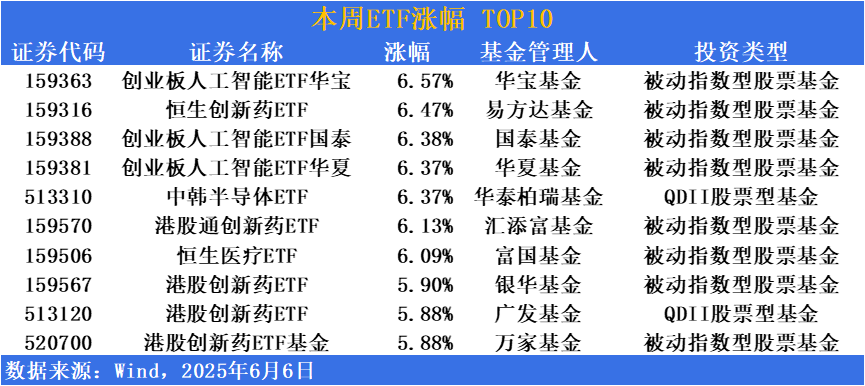
Market Overview - A-shares experienced narrow fluctuations in the first half of the week, followed by a brief rise and subsequent decline, with overall performance remaining stable and trading volume maintaining at over 1 trillion [1] - The three major indices saw a continuous recovery, with the Shanghai Composite Index, Shenzhen Component Index, and ChiNext Index rising by 1.13%, 1.42%, and 2.32% respectively [1] - The bond market showed a slight decline but remained at a relatively high level, reflecting a decrease in overall market risk appetite [1] ETF Performance - The average increase of all ETFs was 1.47%, with cross-border ETFs performing particularly well, averaging a rise of 2.23% [1] - AI and innovative pharmaceuticals were the main growth drivers, with top-performing ETFs in these sectors showing significant gains, such as the Huabao ChiNext AI ETF rising by 6.57% [2][3] - Conversely, consumer and automotive ETFs experienced notable declines, with the Greater Bay Area ETF dropping by 2.21% [4][5] Fund Flow Trends - The ETF market saw a net outflow of 24.88 billion, with a notable decrease in market activity [6] - Conservative investment preferences led to significant inflows into bond ETFs, with the Short-term Bond ETF attracting 14.69 billion, making it the top inflow [8] - The Shanghai Corporate Bond ETF recorded a weekly trading volume of 363.50 billion, indicating strong interest in bond funds [10] Upcoming ETF Listings - Four new ETFs are set to launch next week, including the Guotai ChiNext New Energy ETF, which tracks a representative index of the new energy industry [11] - The Invesco CSI 300 Enhanced Strategy ETF aims to provide returns exceeding the index through active management, focusing on high-quality core assets [12]

显微镜下的中国经济(2025年第20期):如何看待5月宏观经济形势
CMS· 2025-06-03 09:34
Supply and Demand Analysis - In May, the manufacturing PMI showed stability, with the production index above 50%, while new orders, raw material inventory, and employment remained below the critical threshold[3] - The non-manufacturing PMI was at 50.3%, a slight decrease of 0.1 percentage points month-on-month, indicating marginal contraction in services[3] - Real estate investment continues to drag down overall investment, with the construction PMI dropping by 0.9 percentage points to 51%[3] Consumption and Investment Trends - Supported by policy, consumer demand showed improvement, with automobile sales increasing by 26% year-on-year in the last week of May[3] - Real estate sales in 30 cities exceeded 2 million square meters, marking a new high for Q2, with a significant reduction in year-on-year decline[3] - The manufacturing PMI for consumer goods returned to the expansion zone, indicating a recovery in consumer goods production[3] Trade and Export Performance - The external trade situation remained resilient, with the SCFI index rising by 30.7% to 2072.71, and the NCFI index increasing by 51.5% to 1676.25[3] - Port cargo throughput exceeded 270 million tons, showing a month-on-month recovery, indicating strong export activity[3] Economic Outlook and Risks - The economic outlook remains uncertain due to geopolitical risks and potential underperformance of domestic policies[3] - There is a likelihood of reduced contribution from exports to economic growth in the second half of the year, necessitating a reliance on domestic demand to fill the gap[3]
通过再分配提振消费、促进经济增长
Bei Jing Shang Bao· 2025-05-28 14:46
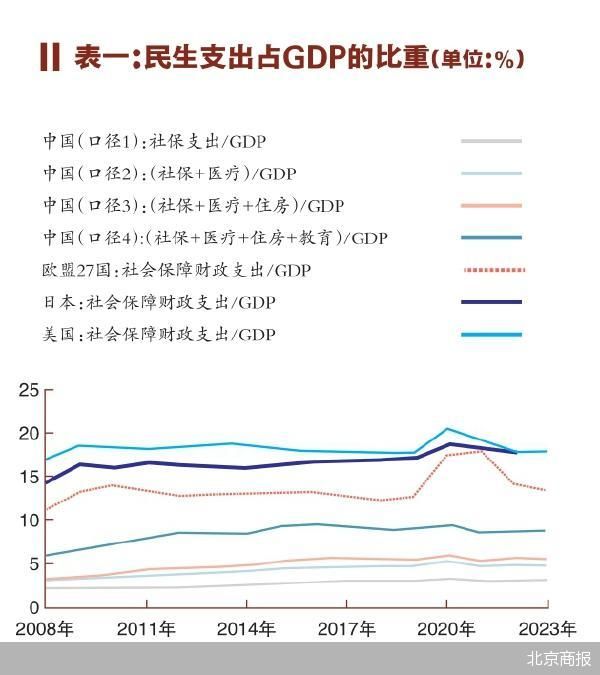
Core Viewpoint - The article emphasizes the importance of income distribution structure in relation to consumption promotion and economic growth, suggesting that improving the redistribution mechanism can stimulate internal consumption and drive economic growth [1][2]. Economic Growth and Income Distribution - The relationship between macro income distribution structure and economic growth is a long-standing research theme, where the distribution of income among enterprises, government, and households influences consumption and investment, thereby affecting economic growth [4]. - A reasonable income structure that covers different income levels can create a diversified consumer market, promoting economic optimization and upgrading [4]. Current State of Income Distribution in China - China's household disposable income as a percentage of GDP is significantly lower than that of major economies, with 60.8% in 2022 compared to Japan (70.3%), Germany (69.5%), and the US (84.9%) [5][6]. - The proportion of disposable income has been persistently lower than the initial distribution since 2000, indicating an unreasonable redistribution mechanism [7]. Policy Recommendations - Policies should focus on increasing transfer payments to households, optimizing government spending structure, and enhancing tax reforms to stimulate consumption [3][11]. - Short-term transfer payments are essential for boosting consumption demand, especially in underdeveloped regions [9][10]. - Long-term improvements in the transfer payment system are necessary to address regional economic imbalances and enhance disposable income [12]. Consumption Structure and Government Spending - The article advocates for increasing government spending in the livelihood sector to shift economic demand towards consumption, particularly in services [16][17]. - The current fiscal expenditure structure favors construction over services, necessitating a reallocation to enhance market supply and related investments [17][18]. Tax Reforms and Pension System - Tax reforms should address structural contradictions in the economy and enhance consumer capacity, including raising the personal income tax threshold and lowering rates for middle and low-income groups [19][11]. - Increasing tax incentives for personal pension accounts can improve the overall pension replacement rate, thereby enhancing current consumption tendencies [20]. Fiscal Policy and Debt Management - There is significant room for increasing government debt and deficit levels, with a current debt ratio of 65.7%, allowing for potential fiscal expansion to support consumption [22][23]. - The article suggests that issuing special government bonds can help bridge funding gaps while balancing consumption and investment needs [25][26].
消费为何能成为驱动经济腾飞的核心“引擎”
Jin Rong Shi Bao· 2025-05-25 05:57
随着"五一"小长假落下帷幕,消费市场释放的"热力值"令人瞩目:热门景区摩肩接踵,网红餐厅排号叫座,处处洋溢着蓬勃生机。这些鲜活场景,正是消 费为经济注入强劲动能的生动注脚。就在5月7日,中国人民银行、国家金融监督管理总局、证监会协同发力,推出设立5000亿元服务消费与养老再贷款、 下调结构性货币政策工具利率等一系列政策"组合拳"。这些举措将持续激发消费潜能,让百姓的美好生活愿景加速照进现实。 今天,我们邀请到辽宁大学经济学院院长李政教授做客《金融时报》,深入探讨消费为何能成为驱动经济腾飞的核心"引擎",以及这场消费变革将为普通 人带来哪些实实在在的利好。 李政辽宁大学经济学院院长,二级教授、博士生导师,入选教育部新世纪优秀人才支持计划和"兴辽英才计划"文化名家暨"四个一批"人才(领军人才)。 消费是经济发展的强大引擎 当前,我国将促进高水平消费提升至国家战略层面。今年的《政府工作报告》提出大力提振消费、提高投资效益,全方位扩大国内需求。我国提振消费的 潜力和空间巨大,而消费是我国超大规模市场优势的体现,也是我国独特竞争力的来源,有助于推动产业结构转型升级和新质生产力发展。 为了推动高水平消费落地,李政认为,要 ...

渤海证券研究所晨会纪要(2025.05.21)-20250521
BOHAI SECURITIES· 2025-05-21 01:01
Macro and Strategy Research - In April 2025, the industrial added value increased by 6.1% year-on-year, exceeding the expected 5.2% but lower than the previous value of 7.7% [2] - The retail sales of consumer goods grew by 5.1% year-on-year, slightly below the expected 5.5% and previous 5.9% [2] - Fixed asset investment accumulated a year-on-year growth of 4.0%, which is lower than both the expected 4.2% and the previous value of 4.2% [2] - The production growth rate of nearly 80% of industries slowed down due to tariff impacts, with industrial enterprises' export delivery value growth dropping significantly by 6.8 percentage points to 0.9% [2] - The service industry production index grew by 6.0% year-on-year, with modern service sectors like information technology and finance showing relatively fast growth [2] Consumption Trends - The year-on-year growth rate of retail sales of consumer goods slowed down in April, primarily due to a decline in automobile consumption driven by price reductions [3] - The "old-for-new" policy continued to boost furniture and home appliance consumption, while rising gold prices increased jewelry consumption [3] - Service retail sales from January to April grew by 5.1% year-on-year, outpacing the growth of goods retail sales by 0.4 percentage points [3] - May is expected to see an increase in retail sales growth due to holiday consumption and the continuous refinement of national policies to expand domestic demand [3] Investment Insights - Fixed asset investment growth slightly decreased in April, with manufacturing investment dropping by 1.0 percentage points to 8.2% year-on-year [4] - Infrastructure investment growth fell by 3.0 percentage points to 9.6%, with central government-led investments in electricity, heating, and water declining [4] - Real estate investment growth saw a year-on-year decline of 1.3 percentage points to -11.3%, with sales in major cities stabilizing [4] - The central bank's further reduction of mortgage rates may not yield immediate effects, and real estate investment growth is expected to remain at a low level until urban renewal projects progress [4] Fixed Income Research - The issuance scale of credit bonds decreased, with corporate bonds seeing zero issuance and a reduction in company bonds, medium-term notes, and directed tools [6] - The net financing amount of credit bonds decreased, with corporate bonds and short-term financing bonds showing negative net financing [6] - The secondary market saw an increase in transaction amounts, with credit bond yields showing differentiation [6] - The overall conditions for a bear market in credit bonds are not sufficient, and long-term yields are expected to enter a downward channel [6] Industry Research - The Guinea government has reclaimed 51 mining licenses, impacting the mining sector [10] - The steel industry faces short-term pressure due to increased rainfall in southern regions, affecting demand [10] - The copper market is influenced by macroeconomic sentiment and export behaviors, with prices expected to fluctuate [10] - The aluminum market is supported by improved US-China trade relations, but domestic demand is entering a low season [10] - The gold market may experience fluctuations influenced by US economic data and geopolitical situations [10] - The lithium market is facing oversupply, with export behaviors impacting demand [10]
4月中国经济数据解读(上)丨多项指标显示4月中国经济向新向好
Sou Hu Cai Jing· 2025-05-20 02:13
Economic Overview - In April, China's economy continued to show a recovery trend, with retail sales of consumer goods and the service production index growing by 4.7% and 5.9% respectively, both up by 0.1 percentage points compared to the first quarter [3][4] - Exports increased by 7.5%, while industrial added value maintained a stable growth rate of 6.4% [3][4] - The data indicates that despite external pressures and internal challenges, China's economy demonstrates significant resilience [1][3] Industrial Growth - The industrial production index for April showed a year-on-year growth of 6.1%, with 36 out of 41 major industries experiencing growth, indicating a broad-based recovery [6][24] - Notably, equipment manufacturing and high-tech manufacturing sectors grew by 9.8% and 10.0% respectively, with new industries becoming key growth drivers [6][7] - The production of 3D printing equipment, industrial robots, and new energy vehicles saw year-on-year increases exceeding 20% [6][24] Service Sector Performance - The national service production index rose by 6.0% year-on-year in April, reflecting a stable recovery and expansion in the service sector [8][25] - The information transmission, software, and IT services sectors grew rapidly, with a year-on-year increase of 10.4% [10][25] - The service sector's internal structure is continuously optimizing, with modern and productive service industries maintaining strong growth [10][25] Consumer Spending - In April, the total retail sales of consumer goods reached 37,174 billion yuan, marking a year-on-year growth of 5.1% [12][11] - The increase in consumer spending is attributed to the effectiveness of government policies aimed at boosting consumption and improving consumer confidence [12][11] - Notable growth was observed in travel, communication, and other service-related consumption categories, driven by holiday travel demand [12][11] Investment Trends - From January to April, fixed asset investment grew by 4.0%, with equipment investment rising by 18.2%, contributing significantly to overall investment growth [14][13] - Infrastructure investment (excluding electricity) increased by 5.8%, while manufacturing investment maintained a stable growth rate of 8.8% [14][15] - The "two heavy" and "two new" policies have positively influenced investment stability, particularly in infrastructure and manufacturing sectors [14][15] Export Dynamics - Despite rising tariffs on exports to the U.S., China's exports remained robust, with a total export value of 22,645 billion yuan in April, reflecting a growth of 9.3% [17][16] - The total import value was 15,745 billion yuan, with a growth rate of 0.8%, indicating a potential need for further activation of domestic demand [17][16] - The share of private enterprises in total imports and exports increased to 56.9%, highlighting an improvement in trade structure [17][16] Employment Market - The average urban unemployment rate from January to April was 5.2%, consistent with the previous year, indicating a stable employment situation [19][18] - The employment market is expected to continue improving, supported by economic fundamentals and effective employment policies [19][18] - However, structural challenges and external pressures remain, necessitating attention to skill development and training [19][18]
生产保持强劲——4月经济数据解读【陈兴团队•财通宏观】
陈兴宏观研究· 2025-05-19 12:07
Core Viewpoint - The April economic data indicates a mixed performance in China's economy, with strong industrial production and consumption, but a decline in investment and real estate sectors [1][13]. Demand Side - April's external demand faced challenges due to reciprocal tariffs, leading to a significant drop in exports to the US; however, transshipment trade helped maintain export resilience [1][2]. - Internal demand showed a decline in both investment and consumption, although consumption remained at a high level; investment was dragged down by the real estate and manufacturing sectors [1][7]. Production Side - Industrial production maintained a high level, with April's industrial value-added growth rate dropping to 6.1%, supported by equipment manufacturing and high-tech manufacturing [3][5]. - The service sector's production index slightly decreased, but still benefited from low base effects and consumption recovery [3]. Investment Trends - National fixed asset investment growth rate fell by 0.8 percentage points to 3.5%, with real estate investment continuing to decline significantly [7]. - High-tech industry investments performed well, particularly in information services and computer manufacturing, with year-on-year growth rates of 40.6% and 28.9% respectively [7]. Consumption Patterns - Retail sales growth rate decreased by 0.8 percentage points to 5.1%, while service retail sales showed an upward trend, particularly in tourism-related sectors [9]. - Essential consumer goods saw a decline in growth, while sectors benefiting from trade-in programs performed strongly [9]. Real Estate Market - Real estate sales area growth rate worsened to -2.1%, with new construction area also declining significantly [11]. - Despite the drop in sales volume, housing prices continued to rise, with the decline in new and second-hand housing prices narrowing [11]. Employment and External Factors - The unemployment rate remained stable at 5.1%, indicating a steady employment situation despite external challenges [13]. - Future export performance may exceed expectations due to potential European recovery, although this could lead to a more cautious domestic policy response [13].

五矿期货早报有色金属-20250515
Wu Kuang Qi Huo· 2025-05-15 03:40
Group 1: Investment Ratings - No investment ratings for the industry are provided in the report. Group 2: Core Views - The domestic "One Bank, One Commission, One Administration" policy slightly exceeded expectations, and the Sino - US negotiation achieved significant progress, but the current tariff level remains high, which may limit market optimism. The supply of copper ore and recycled copper remains tight, while consumption shows signs of marginal weakening, making it difficult for copper prices to continue rising in the short term [1]. - The domestic aluminum ingot is approaching its production capacity limit, and the continuous decline in short - term inventory strongly supports aluminum prices. However, due to the current seasonally weak consumption, the sustainability of demand improvement may face challenges, restricting the rebound height of aluminum prices [3]. - The port inventory of lead concentrate continues to rise, the waste inventory is limited, and the downstream battery enterprises' holiday has been extended. After the Sino - US economic and trade talks, the short - term commodity sentiment is strong, and the medium - term Shanghai lead index is expected to fluctuate within a range [4]. - The port inventory of zinc concentrate continues to rise, and the zinc ore surplus expectation remains unchanged. The zinc ingot inventory has slightly increased, but the domestic warehouse receipts remain at a low level. The Russian lead - zinc mine's expected shutdown in June may boost zinc prices from an emotional perspective [6]. - The supply of tin is currently tight but is expected to ease. The impact of tariffs on the demand side remains to be observed. If downstream demand remains weak, the tin price center may shift downward [7][8]. - The cost of nickel is expected to ease, and the spot demand is weak. Nickel prices should be treated with a bearish mindset [9]. - The short - term tariff change of lithium carbonate will bring additional orders, and the peak season is expected to continue. The futures price is likely to fluctuate, and attention should be paid to the upstream and downstream operating rates and domestic inventory changes [11]. - The supply of alumina is subject to continuous disturbances, and the new production capacity has increased uncertainty. The cost support continues to decline. In the short term, it is recommended to wait and see, and the medium - to - long - term supply surplus trend is difficult to change [13]. - The stainless steel market shows a differentiated trend of narrow cost fluctuations and rising spot prices, with significantly improved steel mill profits. The short - term market is resilient, but the medium - to - long - term trend depends on the game between terminal recovery intensity and the off - season cycle [15]. Group 3: Summary by Metal Copper - Yesterday, LME copper closed down 0.34% at $9592/ton, and SHFE copper's main contract closed at 78,650 yuan/ton. LME inventory decreased by 4075 to 185,575 tons, and the cancellation warrant ratio dropped to 41.8%. In China, SHFE copper warehouse receipts increased by 21,000 to 50,000 tons. The spot in Shanghai was at a discount of 25 yuan/ton to the futures, and in Guangdong, it changed from a premium to a discount of 15 yuan/ton. The domestic copper spot import loss narrowed to about 250 yuan/ton, and the Yangshan copper premium declined. The refined - scrap copper price difference widened to 1680 yuan/ton. The expected operating range for SHFE copper's main contract today is 78,000 - 79,200 yuan/ton, and for LME copper 3M, it is $9500 - $9700/ton [1]. Aluminum - Yesterday, LME aluminum closed up 1.16% at $2522/ton, and SHFE aluminum's main contract closed at 20,255 yuan/ton. The position of the SHFE aluminum weighted contract decreased by 3000 to 545,000 lots, and the futures warehouse receipts increased by 1000 to 62,000 tons. The domestic aluminum ingot inventory in three regions decreased by 8000 to 471,000 tons, and the inventory of aluminum rods in Guangdong and Wuxi decreased by 4000 to 93,000 tons. The spot in East China was at a premium of 20 yuan/ton to the futures. The expected operating range for the domestic main contract today is 20,050 - 20,320 yuan/ton, and for LME aluminum 3M, it is $2480 - $2550/ton [3]. Lead - On Wednesday, the Shanghai lead index closed down 0.16% at 16,937 yuan/ton. LME lead 3S fell by $9 to $1984/ton. The SMM1 lead ingot average price was 16,750 yuan/ton, and the refined - scrap lead price difference was 25 yuan/ton. The SHFE lead ingot futures inventory was 48,300 tons, and the LME lead ingot inventory was 253,200 tons. The domestic social inventory increased to 47,600 tons. The medium - term Shanghai lead index is expected to fluctuate between 16,300 - 17,800 yuan/ton, and the short - term lead price shows a strong - side fluctuation [4]. Zinc - On Wednesday, the Shanghai zinc index closed up 1.69% at 22,605 yuan/ton. LME zinc 3S rose by $40 to $2732.5/ton. The SMM0 zinc ingot average price was 22,840 yuan/ton. The SHFE zinc ingot futures inventory was 1600 tons, and the LME zinc ingot inventory was 168,000 tons. The domestic social inventory slightly decreased to 83,300 tons. The Russian lead - zinc mine is expected to shut down in June, which may boost zinc prices emotionally. The zinc price has rebounded slightly [6]. Tin - On May 14, 2025, the closing price of the SHFE tin main contract was 262,070 yuan/ton, down 0.43%. The SHFE registered warehouse receipts decreased by 60 to 8179 tons, and the LME inventory decreased by 15 to 2775 tons. The domestic tin ore is gradually resuming production, and the demand is affected by tariffs. The expected operating range for the domestic main contract is 250,000 - 270,000 yuan/ton, and for overseas LME tin, it is $30,000 - $33,000/ton [7][8]. Nickel - On Wednesday, the nickel price fluctuated upward. The closing price of the SHFE nickel main contract was 125,230 yuan/ton, up 1.11%, and the LME main contract closed at $15,800/ton, up 0.35%. The price of nickel ore from the Philippines remained stable, and the price of high - nickel pig iron in the market continued to weaken. The expected operating range for the SHFE nickel main contract today is 120,000 - 130,000 yuan/ton, and for LME nickel 3M, it is $15,000 - $16,300/ton [9]. Lithium Carbonate - The MMLC spot index of lithium carbonate closed at 64,727 yuan, down 0.13%. The LC2507 contract closed at 65,200 yuan, up 3.13%. The main contract's closing price was at a premium of 250 yuan to the MMLC average price of battery - grade lithium carbonate. The short - term tariff change will bring additional orders, and the futures price is likely to fluctuate. The expected operating range for the Guangzhou Futures Exchange's lithium carbonate 2507 contract today is 64,200 - 66,000 yuan/ton [11]. Alumina - On May 14, 2025, the alumina index rose 3.54% to 2941 yuan/ton. The spot prices in various regions increased. The Shandong spot price was at a discount of 60 yuan/ton to the 07 contract. The overseas price also increased. The futures warehouse receipts decreased to 209,800 tons. In the short term, it is recommended to wait and see, and the expected operating range for the domestic main contract AO2509 is 2700 - 3050 yuan/ton [13]. Stainless Steel - On Wednesday, the stainless steel main contract closed at 13,080 yuan/ton, up 1.16%. The spot prices in Foshan and Wuxi markets increased. The raw material prices were mostly stable. The futures inventory decreased to 158,809 tons, and the social inventory increased to 1.113 million tons. The short - term market is resilient, and the medium - to - long - term trend depends on terminal recovery and the off - season [15].
出口量价回落:节前消费保持平稳
CMS· 2025-05-13 05:31
1. Report Industry Investment Rating No relevant content provided. 2. Core Viewpoints - The weekly economic index declined, with the China Weekly Economic Index (WEI) at 5.2%, down 0.2 percentage points from the previous value. The production sub - index decreased while the demand sub - index increased, and the supply - demand gap widened [1]. - Production showed a downward trend, with a decline in the 4 - week moving average year - on - year of rebar production and a significant drop in the automobile semi - steel tire operating rate [1]. - Infrastructure high - frequency indicators remained flat, with a slight decline in cement shipping and grinding rates and a slight increase in the petroleum asphalt plant operating rate [1]. - The growth rate of commercial housing sales slowed down, and the floor area of land transactions in 100 large and medium - sized cities decreased significantly [2]. - Consumption increased, with improvements in movie box office and domestic flight execution numbers, but a slight decline in the subway passenger volume in Beijing, Shanghai, Guangzhou, and Shenzhen [2]. - Exports decreased, as indicated by the sharp decline in South Korea's export year - on - year in early May and the drop in shipping freight rate indices [2]. - The price of pork increased, while the overall agricultural product wholesale price index decreased slightly. Industrial product prices generally declined [3]. 3. Summary by Directory 3.1 Weekly Economic Index - The WEI was 5.2%, down 0.2 percentage points from the previous value. The production sub - index was 5.0%, down 0.6 percentage points, and the demand sub - index was 5.8%, up 0.3 percentage points. The supply - demand gap was 0.8%, up 0.9 percentage points [1]. 3.2 Production - The 4 - week moving average year - on - year of rebar production was 2.4%, down 3.4 percentage points. The blast furnace operating rate was 84.6%, up 0.2 percentage points. The automobile semi - steel tire operating rate was 58.4%, down 14.0 percentage points. The 4 - week moving average year - on - year of the average daily coal consumption of coastal power plants was 1.1%, down 0.9 percentage points [1]. 3.3 Infrastructure - The cement shipping rate was 39.3%, down 1.2 percentage points. The cement mill operating rate was 41.7%, down 1.8 percentage points. The petroleum asphalt plant operating rate was 28.8%, up 0.5 percentage points [1]. 3.4 Real Estate - The 4 - week moving average year - on - year of the commercial housing sales area in 30 large and medium - sized cities was - 8.1%, up 4.3 percentage points. The 4 - week moving average year - on - year of the floor area of land transactions in 100 large and medium - sized cities was - 17.4%, down 15.8 percentage points [2]. 3.5 Consumption - The 4 - week moving average year - on - year of movie box office was - 43.0%, up 0.8 percentage points. The 4 - week moving average year - on - year of domestic flight execution numbers was 4.2%, up 1.0 percentage points. The 4 - week moving average year - on - year of subway passenger volume in Beijing, Shanghai, Guangzhou, and Shenzhen was 2.6%, down 0.2 percentage points [2]. 3.6 Exports - South Korea's export year - on - year in early May was - 23.8%, down 43.1 percentage points from late April. The 4 - week moving average year - on - year of the Shanghai Export Containerized Freight Index (SCFI) was - 33.6%, down 5.5 percentage points. The 4 - week moving average year - on - year of the Baltic Dry Index (BDI) was - 28.9%, down 4.6 percentage points [2]. 3.7 CPI - The 4 - week moving average year - on - year of the agricultural product wholesale price 200 index was - 2.6%, down 0.3 percentage points. The 4 - week moving average year - on - year of the average wholesale price of pork was 1.5%, up 0.3 percentage points. The 4 - week moving average year - on - year of the average wholesale price of 28 key monitored vegetables was - 5.9%, down 2.3 percentage points [3]. 3.8 PPI - The 4 - week moving average year - on - year of the Nanhua Composite Index was - 9.4%, down 0.3 percentage points. The 4 - week moving average year - on - year of the Brent crude oil spot price was - 24.8%, up 1.1 percentage points. The 4 - week moving average year - on - year of the rebar price was - 12.7%, down 0.9 percentage points. The 4 - week moving average year - on - year of the Qinhuangdao Port steam coal closing price was - 21.3%, down 2.0 percentage points. The 4 - week moving average year - on - year of the cement price index was 15.8%, down 1.9 percentage points [3].