
股债跷跷板

Search documents
下半年双降预期或升温,关注十年国债ETF(511260)
Mei Ri Jing Ji Xin Wen· 2025-08-12 01:22
Core Viewpoint - The bond market is experiencing fluctuations due to the interplay between stock and bond performance, with the 10-year yield recently rising to 1.7175% after a previous decline [1] Group 1: Market Conditions - The bond market is expected to maintain volatility ahead of several international uncertainties, with a potential for the Federal Reserve to resume interest rate cuts in September [2] - The current economic environment is characterized by weak demand and initial stages of anti-deflation, suggesting limited downside for bond prices despite recent corrections [1] Group 2: Economic Indicators - Recent global PMI data indicates a weakening trend, with a month-on-month decline in demand [1] - Container shipping data showed a significant drop in the last week of July, indicating a potential year-on-year decrease in exports compared to June [1] - The Producer Price Index (PPI) remains low at -3.6%, reflecting insufficient domestic demand [1] Group 3: Investment Strategy - It is recommended to consider opportunities around the 10-year government bond yield of approximately 1.75%, and to continue investing in the 10-year government bond ETF (511260) [2] - The strategy suggests taking advantage of market adjustments while being flexible with duration limits [2]
股债跷跷板依然是主逻辑,国债震荡偏空
Ning Zheng Qi Huo· 2025-08-11 13:57
Report Industry Investment Rating - The report gives a "shockingly bearish" rating on the bond market, suggesting investors focus on the stock-bond seesaw [5]. Core Viewpoints - The stock-bond seesaw remains the main logic in the bond market, with long-term bond yields breaking below the 60-day moving average, and this logic is expected to continue to dominate the bond market [10]. - Despite a decline in economic sentiment in July, subsequent economic data shows that the economy still has resilience, and countercyclical adjustments such as infrastructure investment are expected to increase in the second half of the year [3]. - The fiscal policy is "very active," with sufficient funds for stabilizing growth and expanding domestic demand. The main tone for the second half of the year is an active fiscal policy and a moderately loose monetary policy, but the likelihood of incremental policies exceeding market expectations is limited [4]. Summary by Chapter Chapter 1: Market Review - The stock-bond seesaw logic has led to a significant decline in long-term bond yields, breaking below the 60-day moving average, and this logic is expected to continue to dominate the bond market [10]. - The Politburo meeting in July provided some assurance for the steady growth of the economy in the second half of the year, with an active fiscal policy and a moderately loose monetary policy [10]. Chapter 2: Key News Overview - A number of major foreign investment projects have made new progress, and the National Development and Reform Commission plans to introduce a new batch of major foreign investment projects and a new version of the "Catalogue of Industries Encouraging Foreign Investment" [15]. - In July, China's total goods trade imports and exports reached 3.91 trillion yuan, a year-on-year increase of 6.7%, with exports growing by 8% and imports by 4.8% [16]. - Seven departments including the central bank jointly issued a guiding opinion on financial support for new industrialization, aiming to build a mature financial system by 2027 [16]. - Multiple departments have deployed key tasks for the second half of the year, with the keywords being effectively releasing domestic demand potential, promoting the integration of "two innovations," and advancing capacity governance in key industries [16][17]. - China's CPI in July was flat year-on-year, with urban CPI remaining unchanged, rural CPI down 0.3%, food prices down 1.6%, non-food prices up 0.3%, consumer goods prices down 0.4%, and service prices up 0.5% [16]. Chapter 3: Analysis of Key Influencing Factors 3.1 Economic Fundamentals - China's official manufacturing PMI in July was 49.3, down 0.4 percentage points month-on-month, and the comprehensive PMI output index was 50.2, down 0.5 percentage points, indicating a decline in economic sentiment and an increase in downward pressure [18]. - China's GDP in the second quarter increased by 5.2% year-on-year and 1.1% quarter-on-quarter, exceeding expectations [18]. - China's CPI in July was flat year-on-year, with different performance in urban and rural areas, as well as in food and non-food prices [18]. 3.2 Policy Front - As of the end of June 2025, the stock of social financing scale was 430.22 trillion yuan, a year-on-year increase of 8.9%. New RMB loans in the first half of the year were 12.92 trillion yuan, and new RMB deposits were 17.94 trillion yuan [20]. - At the end of June, the balance of broad money M2 was 330.29 trillion yuan, a year-on-year increase of 8.3%, and the balance of narrow money M1 was 113.95 trillion yuan, a year-on-year increase of 4.6%. The M2 - M1 gap narrowed by 1.9 percentage points compared to May [20]. 3.3 Capital Front - Although the 7-day reverse repurchase rate has not changed significantly and the policy rate has not been lowered, bond yields and DR007 have declined significantly, indicating that the capital market has loosened to a certain extent [22]. - With the weakening of exchange rate pressure, expectations of further monetary easing may increase, but the probability of significant monetary easing such as reserve requirement ratio cuts and interest rate cuts in the second half of the year is low [22]. 3.4 Supply and Demand Front - In the past week, 16 provinces and municipalities including Shanghai, Hebei, and Beijing issued 161 local government bonds with a total scale of 641.64 billion yuan, including new general bonds, new special bonds, and refinancing bonds [26]. - The National Development and Reform Commission will issue the third batch of consumer goods trade-in funds in July and coordinate relevant aspects to ensure the orderly implementation of the policy throughout the year [26]. - The issuance of special bonds and ultra-long-term special treasury bonds has basically been realized, and the market is waiting for the effects and implementation of relevant policies [26]. 3.5 Sentiment Front - The stock-bond ratio has broken through the short-term shock range and declined, indicating that the market's attention to stocks is greater than that to bonds, and market risk appetite has increased [28]. - Although the stock-bond ratio has slightly declined recently, it is still at a high level compared to the previous period. Attention should be paid to whether it will continue to decline and whether funds will continue to flow from the bond market to the stock market [28]. Chapter 4: Market Outlook and Investment Strategy - The theme of economic work in the second half of the year is to combat involution and maintain stable economic recovery. With the start of infrastructure projects such as the Yajiang Hydropower Station, market expectations for further fiscal and infrastructure investment in the second half of the year have increased [31]. - Although the loose liquidity has supported the bond market, the stock-bond seesaw remains the main logic in the bond market recently. Paying attention to the subsequent trend of the stock market is the key to judging the medium-term trend of the bond market [31].
固定收益点评:8月会出现债市拐点吗?
Guohai Securities· 2025-08-11 05:03
Report Industry Investment Rating No relevant content provided. Core View of the Report - In previous bond bull years since 2019 (excluding 2020), the bond market often reached a low point in August. This year, considering fundamentals, institutional behavior, and bond supply, the previous "anti - involution" trading in the bond market has cooled marginally. Related policies will mainly raise the interest rate fluctuation center, and the probability of driving a significant upward movement in interest rates is low. With the central bank's positive attitude towards protecting the capital market, bond market interest rates are expected to remain volatile [5][23]. Summary by Related Catalogs 1. Review of August Market Trends in Previous Years - **2019**: Intensified Sino - US trade friction pushed bond market interest rates down. However, in August, inflation data exceeded expectations, and financial data also exceeded expectations. The Sino - US trade negotiation showed signs of easing, and the TMLF was absent in October, causing bond market interest rates to rise from August to October [7]. - **2021**: The central bank's full - scale reserve requirement ratio cut in early July led to abundant liquidity and a decline in bond market interest rates. In August, the issuance of local bonds increased, and positive signals from the State Council executive meeting and the increase in new re - loan quotas in September raised expectations of broad credit and drove up interest rates [7]. - **2022**: Multiple rounds of reserve requirement ratio cuts and interest rate cuts led to loose liquidity and a decline in bond market interest rates. In August, the State Council executive meeting proposed an additional 300 billion yuan in policy - based and development - oriented financial instruments, and the PMI entered the expansion range in September, causing bond yields to rise [7]. - **2023**: Disappointing economic data in May and multiple interest rate cuts led to a decline in bond market interest rates. Starting from late August, a series of real - estate stabilization policies were introduced, and economic data in August was better than expected, causing bond market interest rates to rise [8]. - **2024**: The central bank's interest rate cut in July drove bond market interest rates down. In August, the Jiangsu branch of the People's Bank of China required rural commercial banks to pay attention to long - bond holding risks, and the central bank's second - quarter monetary policy implementation report mentioned medium - and long - term interest rate risks, causing interest rates to rise [10]. 2. Reasons for the Frequent Appearance of Inflection Points in August 2.1 Fundamental Factors - After the Politburo meeting in July, a series of growth - stabilizing policies are usually introduced around August, leading to a "first - down - then - up" bond market trend. However, based on this year's Politburo meeting, the probability of interest rate cuts in the short term is low, and the possibility of introducing incremental policies this year is small, with limited impact on the bond market [11][12]. 2.2 Institutional Behavior Factors - From September to the fourth quarter, it is usually the redemption period for wealth management products, increasing the pressure on bond market adjustments. The correlation between the stock market and the bond market strengthens during external shocks, but in other cases, the direct impact of the stock market's rise on the bond market is limited, and the suppression of the bond market by the stock market is expected to gradually weaken [14][15]. 2.3 Supply Factors - Around August, the supply of local bonds is usually large, which is negative for the bond market. However, this year, the issuance rhythm of local special bonds has advanced, and the issuance speed from July to September may be relatively smooth, resulting in limited marginal supply pressure on the bond market in August [18][19]. 3. Outlook on the Current Market - **Fundamentals**: The possibility of introducing incremental policies this year is small, with limited impact on the bond market [22]. - **Institutional Behavior**: The bond - allocating power of wealth management products usually declines marginally from August to September, which may put upward pressure on the bond market. The suppression of the bond market by the stock market is expected to gradually weaken [22]. - **Bond Supply**: The marginal supply pressure on the bond market in August is limited [22].
周观:10年期国债利率在1.7%附近形成新的震荡中枢(2025年第31期)
Soochow Securities· 2025-08-11 02:33
1. Report Industry Investment Rating - Not provided in the content 2. Core Viewpoints of the Report - The one - time impact of the "anti - involution" policy on the bond market has ended, raising the oscillation center of the 10 - year Treasury bond yield from 1.65% to 1.7%, and it is expected to maintain a high - level oscillation pattern. The bond yield is driven by upward and downward forces, and will remain relatively balanced and return to a narrow - range oscillation state. The increase in social financing and social retail growth rates due to the "anti - involution" policy has limited impact on the bond market this year, but risks in the fundamental verification period next year need to be guarded against. It is recommended to appropriately reduce leverage and duration [1][16]. - Overseas, the U.S. bond market continues the previous week's trend, with the short - end rising less than the long - end. The global is facing challenges of regional supply - demand imbalance during the "re - globalization" process. The Fed's expectation of interest rate cuts has increased, and there is a high probability of interest rate cuts in the near future, with the second half of the year being a key period for policy adjustment [2][4]. 3. Summary by Relevant Catalogs 3.1 One - Week Views 3.1.1 Domestic Bond Market - From August 4 - 8, 2025, the yield of the 10 - year Treasury bond active bond decreased by 0.4bp from 1.695% to 1.691%. The yield was affected by various factors such as tax policies, stock - bond seesaw effects, news events, and import - export data throughout the week [1][11]. 3.1.2 U.S. Bond Market - From August 4 - 8, 2025, overseas continued the previous week's trend, with U.S. bonds falling and U.S. stocks flat. The short - end of U.S. bonds rose less than the long - end. The U.S. jobless claims, manufacturing new orders, and service PMI data showed a weakening economic situation, and the Fed's expectation of interest rate cuts has increased [2][4]. 3.2 Domestic and Overseas Data Aggregation 3.2.1 Liquidity Tracking - The net investment in the open market from August 4 - 8, 2025, was - 5365 billion yuan. The money market interest rates showed a certain degree of decline [30]. 3.2.2 Domestic and Overseas Macroeconomic Data Tracking - Domestic: The total transaction area of commercial housing increased overall. Steel prices fluctuated, and LME non - ferrous metal futures prices rose. - Overseas: U.S. jobless claims increased, manufacturing new orders declined, and service PMI decreased. The yield of U.S. bonds changed, with the short - end rising and the long - end falling [51][58][2]. 3.3 Local Bond One - Week Review 3.3.1 Primary Market Issuance Overview - From August 4 - 8, 2025, 32 local bonds were issued in the primary market, with an issuance amount of 165.459 billion yuan, a repayment amount of 82.611 billion yuan, and a net financing amount of 82.848 billion yuan. The top three provinces in terms of issuance amount were Hunan, Tianjin, and Hebei [82][85]. 3.3.2 Secondary Market Overview - As of this week, the local bond stock was 52.61 trillion yuan, the trading volume was 302.322 billion yuan, and the turnover rate was 0.57%. The top three provinces in terms of trading activity were Sichuan, Jiangsu, and Yunnan, and the top three trading - active maturities were 30Y, 10Y, and 20Y [100]. 3.3.3 This Month's Local Bond Issuance Plan - The issuance plan of local bonds in the future shows the planned issuance amounts of different provinces on different dates [106]. 3.4 Credit Bond Market One - Week Review 3.4.1 Primary Market Issuance Overview - This week, 441 credit bonds were issued in the primary market, with a total issuance amount of 370.193 billion yuan, a total repayment amount of 172.857 billion yuan, and a net financing amount of 197.336 billion yuan, an increase of 13.19 billion yuan compared to last week [107]. 3.4.2 Issuance Interest Rates - The actual issuance interest rates of various bond types this week showed different degrees of change, with short - term financing bills increasing by 41.49bp, medium - term notes increasing by 3.60bp, and corporate bonds increasing by 4.39bp [117]. 3.4.3 Secondary Market Transaction Overview - The total trading volume of credit bonds this week was 242.326 billion yuan, with different trading volumes for different bond types and ratings [120]. 3.4.4 Maturity Yields - The maturity yields of various bond types such as government - owned development bonds, short - term financing bills, medium - term notes, corporate bonds, and urban investment bonds showed different degrees of decline this week [120][121][124]. 3.4.5 Credit Spreads - The credit spreads of short - term financing bills, medium - term notes, corporate bonds, and urban investment bonds all narrowed this week [132][134][139]. 3.4.6 Grade Spreads - The grade spreads of short - term financing bills and medium - term notes generally narrowed, those of corporate bonds generally widened, and those of urban investment bonds showed a differentiated trend [142][145][149]. 3.4.7 Trading Activity - The top five most actively traded bonds of each bond type this week are presented in a table [153].
2025年8月小品种策略:关注市场配置力量回归节奏
Orient Securities· 2025-08-10 13:13
Group 1 - The report emphasizes the return of market allocation forces, suggesting a cautious increase in credit positions, particularly in the 2-3 year range, with a potential configuration window around mid-August [4][10][11] - The expectation for the second half of the year remains a "dual bull market" for stocks and bonds, with stocks outperforming bonds, driven by market allocation dynamics [9][10] - The corporate perpetual bond market shows limited potential for excess returns in August, recommending a conservative approach with a focus on larger issuers [11][18] Group 2 - In the primary market for corporate perpetual bonds, issuance volume increased, with a total of 158 bonds issued in July, raising 171.5 billion yuan, a 9% increase from the previous month [18][19] - The financing cost for AAA and AA rated bonds decreased, with rates at 2.12% and 2.35% respectively, down 11 basis points and 18 basis points [18][19] - The sectors leading in issuance include public utilities, urban investment, and construction, with Jiangsu, Zhejiang, and Guangdong being the top provinces for new bond issuance [20][21][22] Group 3 - In the secondary market, the yield on corporate perpetual bonds showed mixed results, with short-term yields remaining stable while medium to long-term yields increased, leading to passive compression of spreads [28][30] - The report notes that the majority of urban investment perpetual bonds maintained stable or slightly compressed spreads, while industrial bonds experienced slight widening [30][33] - The report highlights that the risk profile of asset-backed securities (ABS) remains attractive, with a focus on standardized underlying assets, despite limited opportunities in August [13][14]
出口超预期、物价低徘徊,国债期货或延续震荡
Ge Lin Qi Huo· 2025-08-09 07:17
Report Overview - Report Title: "Export Surpasses Expectations, Prices Linger at Low Levels, Treasury Bond Futures May Continue to Fluctuate" - Report Date: August 9, 2025 - Researcher: Liu Yang - Contact Information: liuyang18036@greendh.com - Futures Qualification Certificate Number: F3063825 - Futures Trading Consultation Number: Z0016580 1. Report Industry Investment Rating - No industry investment rating is provided in the report. 2. Report's Core View - The central government emphasizes continuous and timely efforts in macro - policies, with more active fiscal and moderately loose monetary policies. The 7 - month export growth is better than expected, but likely to slow down. July's CPI is flat and PPI is down, with overall prices at a low level. Residents tend to save more. The stock market's changes will affect the bond market, and treasury bond futures may continue to fluctuate in the short - term, with a suggestion to consider buying on dips [40]. 3. Summary by Relevant Catalogs 3.1 Treasury Bond Futures Weekly Market Review - This week, the main contracts of treasury bond futures fluctuated and rose slightly. The 30 - year treasury bond rose 0.19%, the 10 - year rose 0.18%, the 5 - year rose 0.10%, and the 2 - year rose 0.03% [5]. - As of August 8, compared with August 1, the 2 - year and 5 - year and 10 - year treasury bond yields decreased by 3BP, 2BP, and 2BP respectively, while the 30 - year yield increased by 1BP [7]. 3.2 Foreign Trade Data - In July, China's exports in US dollars increased by 7.2% year - on - year, better than the expected 5.8%, and imports increased by 4.1%, better than the expected 0.3%. The trade surplus was $98.24 billion. From January to July, exports increased by 6.1% year - on - year [10]. - In July, exports to ASEAN increased by 16.6%, to the EU by 9.2%, and to the US decreased by 21.7%. Exports to countries and regions outside the top five continued to grow at a high rate [12][15]. 3.3 Price Data - In July, CPI was flat year - on - year, better than the expected - 0.1%, and rose 0.4% month - on - month. Food prices decreased year - on - year and month - on - month, while non - food prices increased [18][20]. - In July, PPI decreased by 3.6% year - on - year, lower than the expected 3.4%, and decreased by 0.2% month - on - month. Production and living material prices both decreased [26][28]. - The Nanhua Industrial Products Index continued to decline slightly this week after reaching a high on July 25 [31]. 3.4 Economic Survey Data - In the second - quarter urban depositor survey, the future income confidence index and employment expectation index both declined compared with the first quarter [33]. - In the second - quarter survey, the proportion of residents inclined to "more savings" increased, while those inclined to "more consumption" decreased [35]. 3.5 Capital Market Data - After the month - end, this week's capital interest rates remained low. The weighted average of DR001 was between 1.31% - 1.32%, DR007 was 1.45%, and the one - year AAA inter - bank certificate of deposit issuance rate was 1.63%, lower than last week [38]. 3.6 Market Logic and Trading Strategy - **Market Logic**: The central government emphasizes policy efforts, the 7 - month export is better than expected but likely to slow, prices are low, and residents tend to save more. The stock market affects the bond market, and treasury bond futures may continue to fluctuate [40]. - **Trading Strategy**: Traders are advised to conduct band - trading operations [41].
【笔记20250808— 餐饮住宿利润暴跌67%】
债券笔记· 2025-08-08 15:09
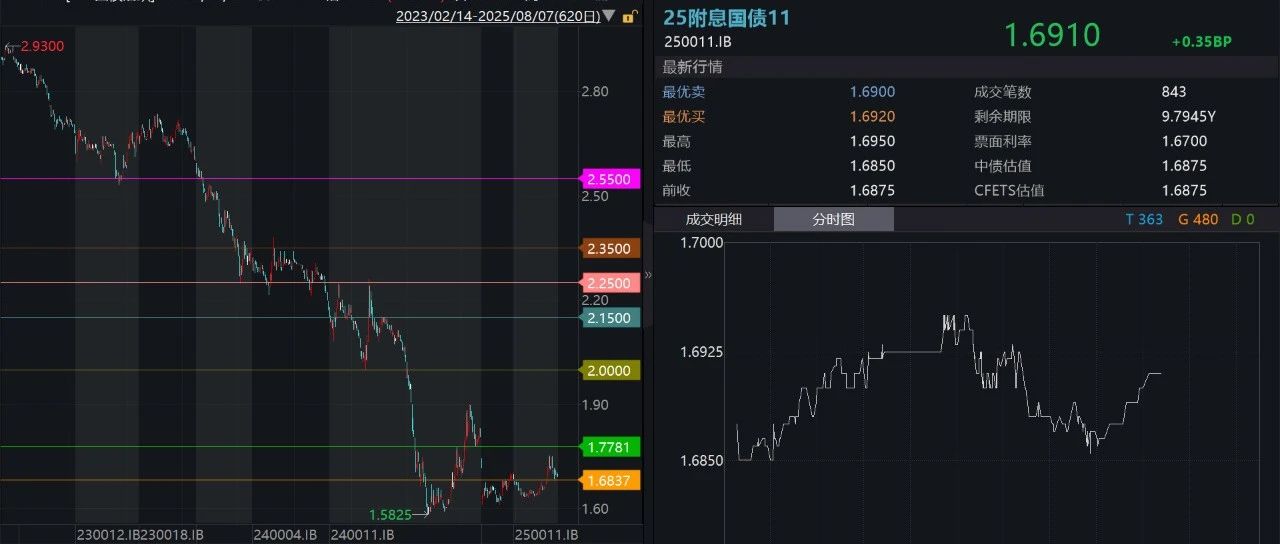
Core Viewpoint - The market appears chaotic and random on the surface, but it actually follows a significant trend, whether it is rising, falling, or consolidating [1] Group 1: Market Conditions - The restaurant and accommodation sector experienced a profit drop of 67% in the first half of 2025 [8] - The central bank conducted a 122 billion yuan reverse repurchase operation, with 126 billion yuan maturing today, resulting in a net withdrawal of 4 billion yuan [4] - The interbank funding market showed a slight decline in funding rates, with DR001 around 1.31% and DR007 around 1.43% [5] Group 2: Bond Market - The bond market saw a slight increase in long-term bond yields, with the 10-year government bond yield dropping to approximately 1.685% before closing at 1.691% [7][10] - The issuance of local government bonds was stable, with new issuance rates about 5 basis points higher than the secondary market, aligning with market expectations [8] - The market is anticipating the upcoming Producer Price Index (PPI) data, as there are concerns about rising commodity prices [8]

五矿期货文字早评-20250808
Wu Kuang Qi Huo· 2025-08-08 01:09
Report Industry Investment Ratings No relevant content provided. Core Views - The stock market may experience increased short - term volatility after continuous previous gains, but the general approach is to go long on dips. The bond market is expected to have a downward trend in interest rates in the long run, with a possible short - term return to a volatile pattern. Precious metals prices are supported by Trump's influence on the Fed, and it is advisable to buy on dips. Base metals, black building materials, energy chemicals, and agricultural products each have their own supply - demand and price trends, and corresponding trading strategies are recommended [3][5][6]. Summary by Category Macro - Financial Stock Index - **News**: The central bank will conduct a 7000 - billion - yuan repurchase operation on August 8th. Huawei may launch a triple - folding eSIM phone, and eSIM services are resumed. Seven departments aim to make breakthroughs in brain - computer interface technology by 2027. Apple will invest 6000 billion dollars in the US in the next four years [2]. - **Basis Point Ratios**: The basis point ratios of different contracts for IF, IC, IM, and IH are provided. The trading logic is to go long on dips in the long - term despite short - term volatility [3]. Treasury Bonds - **Quotes**: On Thursday, the main contracts of TL, T, TF, and TS had different increases. - **News**: China's July exports and imports increased year - on - year. The central bank will conduct a 7000 - billion - yuan repurchase operation. The central bank had a net withdrawal of 1225 billion yuan on Thursday [4]. - **Strategy**: Interest rates are expected to decline in the long run, but the bond market may return to a volatile pattern in the short term [5]. Precious Metals - **Quotes**: Shanghai gold and silver, COMEX gold and silver all rose. The US 10 - year Treasury yield is 4.23%, and the US dollar index is 98.00 [6]. - **Market Outlook**: Trump's influence on the Fed supports precious metals prices. It is recommended to buy on dips, with reference price ranges provided for Shanghai gold and silver [6][7]. Non - Ferrous Metals Copper - **Quotes**: LME copper closed down 0.04%, and Shanghai copper closed at 78360 yuan/ton. - **Industry**: LME copper inventory decreased, and domestic social inventory decreased slightly. The price is expected to have a limited upside in the short term, with reference price ranges provided [9]. Aluminum - **Quotes**: LME aluminum closed down 0.42%, and Shanghai aluminum closed at 20670 yuan/ton. - **Industry**: Domestic aluminum ingot inventory is relatively low, but the short - term upward movement is difficult, with reference price ranges provided [10]. Zinc - **Quotes**: Shanghai zinc index rose 0.97%. - **Industry**: Zinc ore inventory is increasing, and domestic zinc ingot inventory is accumulating. The short - term consumption is weakening, and the price decline risk is rising [11][12]. Lead - **Quotes**: Shanghai lead index rose 0.19%. - **Industry**: Lead ore inventory is decreasing, and lead ingot supply is tightening. The short - term price is expected to be strong [13]. Nickel - **Quotes**: Nickel price rebounded slightly. - **Industry**: Nickel price is still anchored to nickel iron price. It is recommended to wait and see, with reference price ranges provided [14]. Tin - **Quotes**: Shanghai tin rose 0.38%. - **Industry**: Tin supply and demand are both weak in the short term, and the price is expected to be volatile and weak, with reference price ranges provided [15][16]. Carbonate Lithium - **Quotes**: The spot index was flat, and the futures contract rose 3.85%. - **Industry**: The supply is increasing, and the inventory is rising. The price is affected by capital games, with a reference price range provided [17]. Alumina - **Quotes**: The index fell 0.62%. - **Industry**: The supply is expected to be in excess. It is recommended to short on rallies, with a reference price range provided [18]. Stainless Steel - **Quotes**: The futures contract rose 0.50%. - **Industry**: The social inventory decreased, and the short - term price is expected to be strong [19]. Cast Aluminum Alloy - **Quotes**: The contract rose 0.3%. - **Industry**: The downstream is in the off - season, and the price rebound space is limited [20][21]. Black Building Materials Steel - **Quotes**: Rebar and hot - rolled coil prices declined. - **Industry**: The supply and demand of rebar increased, and those of hot - rolled coil decreased. The inventory is rising, and the price may return to the supply - demand logic. It is recommended to pay attention to demand and cost [23][24]. Iron Ore - **Quotes**: The futures contract fell 0.19%. - **Industry**: The supply is affected by overseas shipments, and the demand is related to iron water production. The short - term trend is not strong, and attention should be paid to demand and possible production restrictions [25][26]. Glass and Soda Ash - **Glass**: The spot price was flat, and the inventory increased. The short - term price is expected to be volatile, and the long - term trend depends on real estate policies [27]. - **Soda Ash**: The spot price fell, and the inventory increased. The short - term price is expected to be volatile, and it is recommended to wait and see in the short term and short on rallies in the long term [28]. Manganese Silicon and Ferrosilicon - **Quotes**: Manganese silicon fell 0.52%, and ferrosilicon fell 1.25%. - **Industry**: The short - term price is expected to be volatile. It is recommended to wait and see for investment positions and choose hedging opportunities for hedging positions [29]. Industrial Silicon and Polysilicon - **Industrial Silicon**: The futures contract fell 0.52%. The supply is in excess, and the demand is insufficient. The price is expected to be volatile, and attention should be paid to relevant initiatives [33][34]. - **Polysilicon**: The futures contract fell 2.41%. The price is affected by capacity policies and is expected to be volatile. It is recommended to be cautious [35][36]. Energy and Chemicals Rubber - **Quotes**: NR and RU rebounded and then oscillated. - **Industry**: The tire industry has different operating rates. The rubber price is recommended to be traded with a slightly long - biased and fast - in - and - out strategy [38][39][41]. Crude Oil - **Quotes**: WTI, Brent, and INE crude oil futures all fell. - **Industry**: The fundamentals are healthy, but the seasonal demand will limit the upside. It is recommended to go long on dips and set a target price [42]. Methanol - **Quotes**: The 09 contract fell 8 yuan/ton. - **Industry**: The supply is expected to increase, and the demand is weak. It can be considered as a short - position variety in the sector [43]. Urea - **Quotes**: The 09 contract fell 13 yuan/ton. - **Industry**: The supply is relatively loose, and the demand is weak in the short term. It is recommended to go long on dips [44]. Styrene - **Quotes**: The spot and futures prices rose. - **Industry**: The BZN spread is expected to repair, and the price may follow the cost to rise after the port inventory is reduced [45]. PVC - **Quotes**: The 09 contract fell 5 yuan. - **Industry**: The supply is strong, the demand is weak, and the valuation is high. It is recommended to wait and see [47]. Ethylene Glycol - **Quotes**: The 09 contract fell 18 yuan. - **Industry**: The supply and demand are changing, and the inventory is expected to increase. The short - term valuation may decline [48]. PTA - **Quotes**: The 09 contract fell 36 yuan. - **Industry**: The supply is expected to increase, and the demand is about to end the off - season. It is recommended to go long on dips following PX [49]. p - Xylene - **Quotes**: The 09 contract fell 38 yuan. - **Industry**: The load is high, and the inventory is expected to decrease. It is recommended to go long on dips following crude oil [50]. Polyethylene PE - **Quotes**: The futures price fell. - **Industry**: The price is affected by cost and supply - demand. It is recommended to hold short positions [51]. Polypropylene PP - **Quotes**: The futures price fell. - **Industry**: The price is expected to follow crude oil to rise in July, affected by supply and demand [52]. Agricultural Products Live Pigs - **Quotes**: The domestic pig price continued to fall. - **Industry**: The supply is abundant, and the demand is limited. It is recommended to focus on the spread opportunities [54]. Eggs - **Quotes**: The egg price was mostly stable. - **Industry**: The supply is large, and the price is expected to be stable in the short term. It is recommended to short on rallies in the medium term [55]. Soybean and Rapeseed Meal - **Important Information**: Malaysian palm oil export and production data, and Brazilian soybean planting area forecast are provided [56]. - **Trading Strategy**: The palm oil price is expected to be volatile, and it is recommended to go long on dips for soybean meal and expand the spread between soybean meal and rapeseed meal [58][61]. Sugar - **Quotes**: Zhengzhou sugar futures fell. - **Industry**: The import supply is increasing, and the price is expected to continue to fall [62][63]. Cotton - **Quotes**: Zhengzhou cotton futures continued to oscillate. - **Industry**: The downstream consumption is average, and the price is expected to be short - term bearish [64].
债券策略月报:2025年8月中债市场月度展望及配置策略-20250807
Zhe Shang Guo Ji· 2025-08-07 01:20
Group 1: Market Overview - The economic data for July showed a stable performance, with policy stimulus expectations driving market trends, particularly following the announcement of the Yarlung Tsangpo River hydropower station project, which has an investment scale of over 1 trillion yuan, leading to significant increases in equity and commodity markets [3][4] - The Shanghai Composite Index and Shenzhen Component Index recorded increases of 3.74% and 5.32% respectively, reflecting improved market risk appetite [3][4] - The bond market underperformed due to negative factors such as the "stock-bond seesaw" effect and unexpected tightening of liquidity around tax periods, resulting in rising yields across different maturities [4][11] Group 2: Macroeconomic Environment - The macroeconomic environment remains mixed, with GDP growth around 5.35% year-on-year, but nominal growth lagging at 3.9%, indicating a strong aggregate but weak microeconomic structure [5][34] - Manufacturing PMI for June was recorded at 49.7%, showing a slight recovery but still indicating contraction, while consumer demand showed signs of divergence with retail sales exceeding expectations [5][34] - The monetary policy stance has shifted towards a more hawkish tone, reducing expectations for further rate cuts in the near term [5][34] Group 3: Bond Market Outlook - Looking ahead to Q3, demand remains weak, and short-term policy stimulus expectations are retracting; however, the cooling of commodity and stock markets may provide support for the bond market [6][34] - There is potential for a 10-12 basis point downward adjustment in the yields of 10-year and 30-year government bonds, indicating attractive potential returns [3][6] - The bond issuance pressure is expected to increase in August, with net issuance projected to rise to 1.47 trillion yuan, although it may ease in September [21][34]
“+”出来的收益: 固收打底 理财驾驭多元资产有术
Zhong Guo Zheng Quan Bao· 2025-08-06 22:05
Core Viewpoint - The performance of asset yields has shown divergence, with fixed income products experiencing a decline while "fixed income +" and mixed products have yielded better returns, highlighting the advantages of diversified allocation strategies in the current market environment [1][2][7]. Group 1: Market Trends - Since late July, the bond market has seen adjustments, leading to a decline in the yields of pure fixed income products, which are primarily based on bonds [2][3]. - The average annualized yield for open-ended fixed income products from July 21 to July 27 was 2.81%, down 0.23 percentage points from the previous period, while the average redemption yield was 2.43%, down 0.21 percentage points [2]. - Factors influencing the bond market include increased expectations for "anti-involution" policies, a strong equity market, and a shift in investor risk appetite, causing funds to flow from the bond market to the equity market [3]. Group 2: Product Performance - Some "fixed income +" products have provided significant returns, with one product yielding over 4% annualized in the past month, utilizing a mix of stable fixed income assets and diversified strategies [4][6]. - The "fixed income +" products incorporate various strategies, including gold, high dividend, and preferred stock strategies, aiming to balance risk and return [4][7]. - The use of multi-asset strategies, such as FOF (Fund of Funds), allows for diversified investment across multiple funds, enhancing risk-return profiles [5][6]. Group 3: Future Outlook - The bond market is expected to remain volatile in the first half of 2025, which may impact the yields of financial products, with "fixed income +" products becoming increasingly valuable in this context [7][8]. - There is a structural contradiction between ample funds and a scarcity of quality assets, suggesting that "fixed income +" products will play a crucial role in balancing returns and volatility [7]. - The industry is encouraged to explore project-based assets and capture structural opportunities in the equity market through various strategies, including quantitative index enhancement and cross-border investments [7][8].