
债市

Search documents
通胀数据点评:大宗涨价推不动7月PPI?
Tianfeng Securities· 2025-08-09 14:24
1. Report Industry Investment Rating No information provided in the given content. 2. Core Views of the Report - The inflation data in July showed that CPI was weakly recovering, while PPI was oscillating at the bottom. The positive changes in price operation were mainly due to the continuous manifestation of the effects of policies to expand domestic demand. In the future, prices may continue to rise moderately at a low level [1][2][3]. - In the short - term, the bond market may maintain a pattern of "oscillation + recovery". The overall stable macro - policy, fundamental logic, loose orientation of monetary policy, and reasonable and sufficient liquidity still support the bond market, but attention should be paid to the possible disturbances of changes in the stock and commodity markets to the bond market sentiment [3]. 3. Summary by Relevant Catalogs 3.1 7 - month Inflation Data: CPI Weakly Recovering, PPI Oscillating at the Bottom - In July, CPI was flat year - on - year (previous value was 0.1%), with a month - on - month increase of 0.4% (previous value was - 0.1%); PPI was - 3.6% year - on - year (unchanged from the previous value), and - 0.2% month - on - month (with the decline narrowing by 0.2 percentage points compared to the previous value) [1]. - The data in July confirmed "inflation at the bottom and structural differentiation". On one hand, policies to expand domestic demand promoted the recovery of service consumption and industrial consumer goods prices, and the increase in core CPI confirmed the marginal repair of internal driving force. On the other hand, seasonal factors and uncertainties in the international trade environment affected the price decline of some industries, and PPI was still oscillating at the bottom year - on - year [2]. - The rise in bulk prices in July deviated from the weak PPI. The reasons were that the price increase in the upstream could not be effectively transmitted to the downstream, and the insufficient terminal demand weakened the price transmission power. If there was no obvious repair of demand, the pulling effect of upstream price increases on PPI would be limited [3]. 3.2 CPI: Month - on - Month Change from Decline to Increase, Core CPI Reached a New High in the Year - In July, CPI was flat year - on - year, and the month - on - month change turned from decline to an increase of 0.4%, stronger than the seasonal level, mainly supported by service and industrial consumer goods prices. Core CPI increased by 0.8% year - on - year, with the increase expanding for three consecutive months, reaching a new high since March 2024 [9]. - Service prices increased by 0.6% month - on - month, contributing about 0.26 percentage points to the month - on - month increase of CPI. Affected by the peak summer travel season, prices of air tickets, tourism, hotel accommodation, and vehicle rental increased by 17.9%, 9.1%, 6.9%, and 4.4% respectively month - on - month [10]. - Industrial consumer goods prices increased by 0.5% month - on - month, with the increase expanding by 0.4 percentage points compared to the previous month, contributing about 0.17 percentage points to the month - on - month increase of CPI. Energy prices increased by 1.6% month - on - month, and industrial consumer goods prices excluding energy increased by 0.2% [11]. - Core CPI increased by 0.8% year - on - year, reaching a high point since March 2024, mainly due to the increase in the prices of gold and platinum jewelry. The year - on - year decline in automobile prices converged. Food prices decreased year - on - year, becoming the main drag on CPI [11]. 3.3 PPI: Month - on - Month Decline Narrowed, Year - on - Year Continued to Bottom - In July, PPI was - 3.6% year - on - year, remaining the same as the previous month, showing signs of bottoming out, indicating weak demand in the industrial sector. The month - on - month decline was 0.2%, with the decline narrowing by 0.2 percentage points compared to the previous month, the first narrowing of the month - on - month decline since March [18]. - The drag on the month - on - month PPI was mainly affected by seasonal disturbances and trade uncertainties. Eight industries in total affected the month - on - month decline of PPI by about 0.24 percentage points. Seasonal factors affected the PPI of some industries, and uncertainties in the international trade environment put pressure on the prices of export - related industries [19][20]. - Positive factors were that the effects of capacity governance and "anti - involution" policies were gradually emerging, and the month - on - month decline in the prices of coal, steel, photovoltaic, and lithium batteries narrowed, weakening the downward pull on PPI [20].
30年国债ETF博时(511130)回调蓄势,最新单日资金净流入3.65亿元,机构判断8月债市受重要会议后政策方向影响显著
Sou Hu Cai Jing· 2025-08-08 06:15
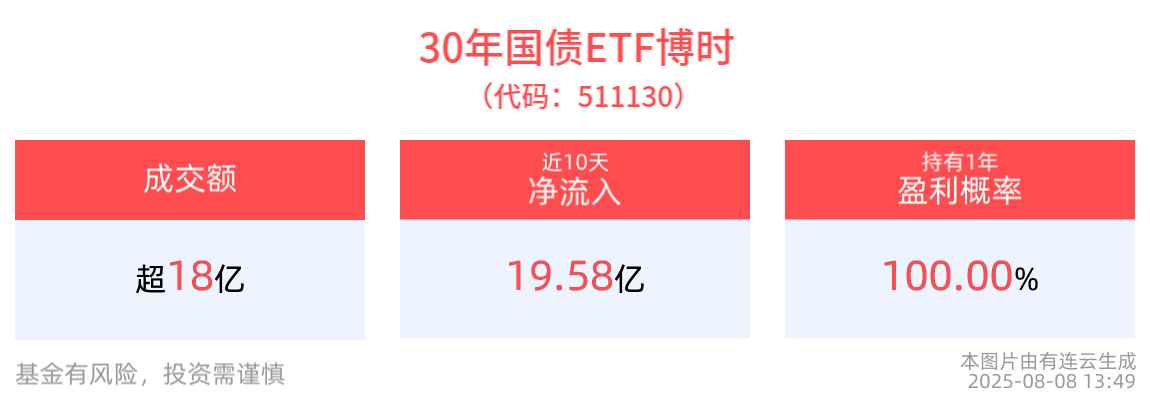
截至2025年8月8日 13:49,30年国债ETF博时(511130)下跌0.11%,最新报价111.18元。拉长时间看,截至2025年8月7日,30年国债ETF博时近1年累计上涨 8.90%。 流动性方面,30年国债ETF博时盘中换手12.52%,成交18.81亿元,市场交投活跃。拉长时间看,截至8月7日,30年国债ETF博时近1周日均成交39.67亿元。 消息面上,央行公告,为保持银行体系流动性充裕,2025年8月8日,中国人民银行将以固定数量、利率招标、多重价位中标方式开展7000亿元买断式逆回购 操作,期限为3个月(91天)。据了解,8月份有4000亿元3个月期限和5000亿元6个月期限买断式逆回购到期,还有3000亿元MLF到期。尽管8月买断式逆回 购的到期规模大于此次央行买断式逆回购操作规模,但东方金诚指出,预计本月央行还将开展一次6个月期限的买断式逆回购操作,本月中期借贷便利 (MLF)也有望加量续作,保持中期流动性处于净投放状态。 华创证券固收研究回溯 2019-2024 年数据发现,8 月债市受政治局会议后政策方向影响显著,若无总量降息或风险偏好明显回落,债市表现往往偏弱。其列 举了 8 ...

7月债市回顾及8月展望:股债均衡下回归震荡格局,波动中寻机
Yin He Zheng Quan· 2025-08-07 11:29
Group 1: Report Industry Investment Rating - No relevant content provided Group 2: Core Views of the Report - In July, the bond market oscillated weakly due to factors such as the central bank's protection of the capital market, short - term settlement of Sino - US economic and trade negotiations, and the "anti - involution" driving the equity and commodity markets. The long - end yield increased more, with the 10Y and 1Y Treasury bond yields rising by 6BP and 4BP respectively [1][8]. - In August, from the fundamental perspective, focus on the possible improvement of CPI and social financing structure, the resilience of exports after the extension of Sino - US tariff exemptions, the marginal changes of PMI in domestic and external demand, and the impact of the "anti - involution" policy on the improvement of the prosperity index. Also, observe the possible disturbances of the improvement of key data such as real estate on the fundamentals and expectations [2]. - In terms of supply, the single - month issuance peak of ultra - long special national bonds and the continued high - level use of new special bonds are expected to drive the high supply of government bonds in August. The net supply of government bonds in August may be around 1.4 trillion yuan, which may be the peak in the second half of the year [2]. - Regarding the capital market, there may be phased fluctuations due to the end of the month and the peak of inter - bank certificate of deposit (CD) maturities. After entering August, with the decline of inter - bank CD scale and the central bank's protection, the capital market is expected to return to a balanced and loose state. The central bank may restart Treasury bond trading, and multiple tools will jointly support the reasonable and abundant liquidity [2]. - From the policy perspective, the Politburo meeting at the end of July was positive but with limited incremental information. The Sino - US tariff negotiation was settled at the end of July, with a 90 - day tariff exemption extension, and the attitude of the US needs to be continuously monitored [3]. - In terms of institutional behavior, institutions still increased their holdings in July. In August, with interest rates likely to decline and fluctuate, focus on the support of large - scale banks for the short - end, the increase in the long - end holdings of rural commercial banks, the recovery of the fund's motivation to increase holdings by extending the duration, and the marginal change in the insurance company's willingness to allocate ultra - long - end bonds [3]. Group 3: Summary According to the Catalog 1. Bond Market Review: Interest Rates Oscillated Upward, and the Yield Curve Steepened Bearishly - In July, affected by multiple factors, the bond market oscillated weakly. The long - end yield increased more, with the 10Y and 1Y Treasury bond yields rising by 6BP and 4BP respectively. The term spread widened by 2BP to 32BP [1][8]. - The yield curve of Treasury bonds steepened bearishly in July, with the medium - and long - end yields generally rising more. The implied tax rate of China Development Bank bonds generally increased [9]. - Overseas, US inflation continued to rise slightly, labor data improved, and the Fed maintained the benchmark interest rate unchanged in July. The market's expectation of a September interest rate cut decreased. The yield of US Treasury bonds rose, and the Sino - US interest rate spread inverted further [10]. 2. This Month's Outlook and Strategy (1) This Month's Bond Market Outlook: The Capital Market is Likely to Return to Normal, and Supply will Reach a Peak in the Second Half of the Year - **Fundamentals**: For the July macro - data to be released, pay attention to the possible improvement of CPI and social financing structure, the resilience of exports after the extension of tariff exemptions, the marginal changes of PMI, and the impact of real estate data improvement on fundamentals and expectations [2][28]. - **Supply**: The single - month issuance peak of ultra - long special national bonds and the continued high - level use of new special bonds will drive the high supply of government bonds in August. The net supply of government bonds in August is expected to be around 1.4 trillion yuan, which may be the peak in the second half of the year [2][41]. - **Capital Market**: There may be phased fluctuations at the end of the month, but after entering August, with the decline of inter - bank CD scale and the central bank's protection, the capital market is expected to return to a balanced and loose state. The central bank may restart Treasury bond trading, and multiple tools will jointly support the reasonable and abundant liquidity [2][48]. - **Policy**: The Politburo meeting at the end of July was positive but with limited incremental information. The Sino - US tariff negotiation was settled at the end of July, with a 90 - day tariff exemption extension, and the attitude of the US needs to be continuously monitored [3][61]. - **Institutional Behavior**: Institutions still increased their holdings in July. In August, with interest rates likely to decline and fluctuate, focus on the support of large - scale banks for the short - end, the increase in the long - end holdings of rural commercial banks, the recovery of the fund's motivation to increase holdings by extending the duration, and the marginal change in the insurance company's willingness to allocate ultra - long - end bonds. The adjustment of government bond VAT may also affect institutional allocation logic [3][68]. (2) Bond Market Strategy: Focus on the Balance between Stocks and Bonds, the Bond Market will Oscillate Downward, and Pay Attention to Trading Opportunities - In August, the main points of concern are the return of the capital market to a loose state under the central bank's protection, the shift from the stock - bond seesaw to the balance between stocks and bonds, the peak supply of government bonds due to the acceleration of special bond issuance, and the short - term impact of the change in government bond VAT [74]. - In terms of interest rates, the bond market's capital market in August is likely to return to a stable state under the central bank's protection. The bond market is still in a favorable environment, but the implementation of broad - based monetary policies needs to be awaited. The subsequent market is likely to evolve from the stock - bond seesaw to a balanced state. Short - term bond interest rates may decline marginally. Strategies include maintaining an appropriate duration, focusing on band trading, paying attention to the trading value of old bonds and the allocation value of new bonds, taking profits when yields are low, and increasing allocations when the 10 - year Treasury bond yield rises above 1.75% [76]. 3. Important Economic Calendar for August - The table provides the expected release dates and market expectations of various economic indicators in July and August, including foreign exchange reserves, CPI, PPI, M2, social financing scale, etc. [78]
主流券商债市观点汇总
2025-08-07 05:18
Summary of Key Points from Conference Call Records Industry Overview - The records primarily discuss the bond market in China, focusing on the impact of recent policy changes, particularly the adjustment of value-added tax (VAT) on bond investments and its implications for government bonds, local government bonds, and financial bonds. Core Insights and Arguments 1. **Market Expectations and Interest Rates** - The July PMI data showed a decline, but corporate expectations are improving, suggesting that interest rates may remain volatile. The 10-year government bond yield is expected to fluctuate between 1.65% and 1.80% in the coming months [2][2][2]. 2. **Government Bond Supply and Monetary Policy** - The bond market may face significant pressure in August and September due to high government bond supply. If market adjustments worsen, the central bank may resume bond purchases to stabilize liquidity [2][2][2]. 3. **Impact of VAT on Bonds** - The new VAT policy will not affect existing bonds but may lead to increased demand for older bonds due to their tax advantages. This could push down the interest rates on these bonds, counteracting the tax impact on newly issued bonds [2][2][2]. 4. **Phased Repricing of New and Old Bonds** - The adjustment of VAT is expected to lead to a three-phase repricing of new and old bonds: - Phase 1: Narrowing of the spread as demand for older bonds increases - Phase 2: Widening of the spread due to reduced liquidity of older bonds - Phase 3: Long-term narrowing as tax benefits expire [5][5][5]. 5. **Market Volatility and Risk Factors** - The bond market is anticipated to remain volatile due to seasonal factors, government bond supply, and geopolitical uncertainties. The market is currently in a "hard mode" of trading, with the 10-year government bond yield expected to stabilize around 1.65% to 1.75% [3][3][3]. 6. **Investor Behavior and Market Dynamics** - Investors may shift their focus to older bonds due to the new tax regulations, which could lead to a temporary surge in demand for these securities. However, the overall sentiment remains cautious as the market adjusts to the new tax landscape [4][4][4]. Other Important but Potentially Overlooked Content 1. **Long-term Market Trends** - The bond market's recovery is contingent on fundamental economic conditions and the overall demand for bonds. A sustained recovery may require lower interest rates to support both supply and demand dynamics [4][4][4]. 2. **Credit Spread Adjustments** - The new VAT policy is expected to have a limited impact on credit spreads for non-financial corporate bonds, as their tax structure remains unchanged. This could lead to a narrowing of credit spreads in the market [5][5][5]. 3. **Future Policy Directions** - The focus of monetary policy is likely to shift from fiscal measures to monetary easing, which could further influence bond yields and market dynamics in the second half of the year [2][2][2]. 4. **Market Sentiment and Investment Strategies** - Investors are advised to remain flexible and consider tactical adjustments in their bond portfolios, especially in light of upcoming economic events and policy announcements that could impact market sentiment [2][2][2].
信用债ETF总规模继续流入,公司债ETF(511030)回撤稳定备受关注
Sou Hu Cai Jing· 2025-08-07 02:11
Group 1 - The total scale of credit bond ETFs has continued to flow in, reaching 336.3 billion yuan, with a daily increase of 400 million yuan [1] - The weighted median duration is 3.9 years, and the overall transaction amount is 112.1 billion yuan, with an average single transaction amount of 3.9 million yuan [1] - The median yield is 1.82%, and the median discount rate is -8.1 basis points [1] Group 2 - The Ping An Company Bond ETF (511030) has the best performance in controlling drawdown during the current bond market adjustment, maintaining a relatively stable net value [1] - The bond market sentiment has gradually stabilized, with the 10-year government bond yield dropping below 1.7%, recovering half of the previous decline [1] - The bond market is expected to return to a range-bound trend without significant external information shocks [1]
申万宏源:8至10月或是债市颠簸期 中短端仍料表现稳健
Xin Lang Cai Jing· 2025-08-07 01:12
Core Viewpoint - The report from Shenwan Hongyuan indicates that the 10-year government bond yield in China is expected to fluctuate between 1.65% and 1.80% from August to October, with stringent conditions required for a downward breakthrough [1] Group 1: Market Conditions - The bond market is anticipated to experience volatility during August to October, with mid to short-term bonds expected to perform steadily, leading to a steeper yield curve compared to the current state [1] - In August, the pressure on the bond market may not be significant due to a peak in government bond supply, and monetary policy will need to support liquidity alongside fiscal needs [1] Group 2: Central Bank Actions - If the bond market experiences intensified adjustments, the central bank may consider restarting open market operations for government bonds [1] - The focus on preventing capital turnover and managing risks suggests that liquidity is more likely to remain loose rather than further easing [1] Group 3: Future Risks and Economic Indicators - The transition between the third and fourth quarters is identified as a potential risk window, as government bond supply is expected to decrease, leading to a lower probability of liquidity hedging [1] - There may be a risk of rising consumer price index and producer price index as the economy enters a verification period for anti-involution effects [1] Group 4: Investment Opportunities - The second half of the year may present lower odds for the bond market and higher odds for the stock market, driven by the migration of household deposits and insurance funds into equities [1] - The stock market is showing signs of bottoming out, with a gradual emergence of wealth effects, while the bond market's pricing is becoming less sensitive to fundamentals and liquidity, making it more reactive to changes in price expectations [1]

每日债市速递 | 央行公开市场单日净回笼1705亿
Wind万得· 2025-08-06 22:35
Open Market Operations - The central bank conducted a 7-day reverse repurchase operation on August 6, with a fixed rate and quantity tendering, amounting to 138.5 billion yuan at an interest rate of 1.40%, with the same amount being awarded [1] - On the same day, 309 billion yuan in reverse repos matured, resulting in a net withdrawal of 170.5 billion yuan [1] Funding Conditions - Continuous net withdrawals by the central bank do not hinder the loose funding conditions in the interbank market, with the overnight repo weighted average rate (DR001) slightly rising but remaining around the low point of 1.31% [3] - The latest overnight financing rate in the U.S. is 4.33% [3] Interbank Certificates of Deposit - The latest transaction rate for one-year interbank certificates of deposit among major banks is at 1.63%, showing a slight decrease from the previous day [7] Government Bond Futures - The 30-year main contract fell by 0.04%, while the 10-year main contract remained flat; the 5-year and 2-year main contracts both increased by 0.02% [13] Industry News - A new standard aimed at ensuring the stable operation of information systems in the securities industry is being solicited for opinions, which will provide authoritative guidance for brokerages [14] - Inner Mongolia has announced its exit from the list of key debt provinces, which may serve as a demonstration effect for other provinces, potentially improving local financing conditions [14] Global Macro - The U.S. Treasury will auction 100 billion dollars in four-week Treasury bills, marking a record single auction size, reflecting significant financing needs [16] - The Indian central bank maintained the reverse repo rate at 3.35% and raised the cash reserve ratio to 4% from 3% [16] Bond Market Developments - Year-to-date, securities firms have issued nearly 770 billion yuan in bonds, a year-on-year increase of over 32% [18] - Jiangsu Province has been allocated a new local government debt limit of 280.1 billion yuan for 2025 [18] - Gansu Bank plans to sell a low-yield asset package worth 15.3 billion yuan to Gansu Asset Management [18] - ZTE Corporation has completed the issuance of 3.584 billion yuan in zero-coupon convertible bonds [18]

债市日报:8月6日
Xin Hua Cai Jing· 2025-08-06 14:54
Core Viewpoint - The bond market is experiencing a strong consolidation phase, with fluctuations in yields and a net withdrawal of liquidity from the market, influenced by the recent news on VAT collection and profit-taking by investors [1][5]. Market Performance - The majority of government bond futures closed higher, with the 30-year main contract down 0.04% at 119.330, while the 10-year main contract remained flat at 108.555 [2]. - The interbank yield on the 10-year government bond increased by 0.25 basis points to 1.797%, while the yield on the 10-year treasury bond decreased by 0.5 basis points to 1.6975% [2]. Overseas Bond Market - In North America, most U.S. Treasury yields rose, with the 2-year yield up 4.9 basis points to 3.720% and the 10-year yield up 1.17 basis points to 4.208% [3]. - In Asia, Japanese bond yields increased across the board, with the 10-year yield rising by 2.9 basis points to 1.503% [3]. - In the Eurozone, the 10-year French bond yield rose by 0.1 basis points to 3.283%, while the 10-year German bond yield fell by 0.1 basis points to 2.621% [3]. Primary Market - The Ministry of Finance reported weighted average winning yields for 91-day, 182-day, and 1-year government bonds at 1.2110%, 1.3019%, and 1.3277%, respectively, with bid-to-cover ratios of 3.31, 2.7, and 2.7 [4]. - Agricultural Development Bank's financial bonds had winning yields below market estimates, with 1.074-year, 3-year, 5-year, and 10-year yields at 1.39%, 1.61%, 1.69%, and 1.82%, respectively [4]. Liquidity Conditions - The central bank conducted a 7-day reverse repurchase operation of 1385 billion yuan at a rate of 1.40%, resulting in a net withdrawal of 1705 billion yuan for the day [5]. - Short-term Shibor rates mostly increased, with the overnight rate rising by 0.1 basis points to 1.316% [5]. Institutional Perspectives - Industry analysts suggest that the current convertible bond valuations are nearing historical highs, indicating limited downside potential and possible breakout opportunities [6]. - The outlook for August indicates that central bank liquidity is expected to remain reasonably ample, with funding rates likely to stay low, although regulatory goals may prevent further declines [6]. - Analysts anticipate that the market's trading focus may shift as the impact of anti-involution policies is validated by data, with interest rates expected to stabilize [6].
中债策略周报-20250805
Zhe Shang Guo Ji Jin Rong Kong Gu· 2025-08-05 11:46
Report Summary 1. Report Industry Investment Rating No relevant content provided. 2. Core Viewpoints - The weakening domestic demand is reflected by the July manufacturing PMI falling short of expectations, and the correction in the commodity market pricing this week is favorable for the bond market, with yields of different maturities declining. The potential returns are considerable considering the downward space of 10 - 12bp for the 10 - year and 30 - year Treasury bond yields and the duration [3][6]. - In terms of fundamentals and monetary policy, the demand side remains weak, and the short - term policy stimulus expectations are retreating. The cooling of the commodity market and the stock market may be beneficial to the bond market due to the stock - bond seesaw effect. The opportunities in the first and middle ten - days of the month may be greater, while the situation in the last ten - days needs further observation [6]. - For the second half of the year, policy clues may be the main variable guiding the macro - economic trend. The loose monetary policy will continue, and the bond market can prioritize high - cost - effective varieties [35]. 3. Summary by Directory Bond Market Performance Review - Interest rate bonds: The yield curve has flattened. The 1 - year Treasury bond yield decreased by 1bp to 1.37%, and the yields of 3 - year and above decreased more significantly. The 10 - year and 30 - year Treasury bond yields decreased by 3.3bp and 3.4bp to 1.71% and 1.92% respectively [12][15]. - Credit bonds: The spreads generally widened. On the implied AA+ urban investment bond curve, the 1 - year, 3 - year, and 5 - year yields increased by 10bp, with the 5 - year yield reaching 2.04%. On the AAA - secondary capital bond curve, the 1 - year, 3 - year, and 5 - year yields increased by 7bp, 14bp, and 14bp respectively [15]. Bond Market Primary Issuance Situation - Local bonds: Issued 3372 billion yuan this week, with a net issuance of 2360 billion yuan, including 209 billion yuan of new general bonds, 1832 billion yuan of new special bonds (575 billion yuan of special special bonds), 877 billion yuan of ordinary refinancing bonds, and 454 billion yuan of special refinancing bonds [20]. - Treasury bonds: Issued 4061 billion yuan this week, with a net issuance of 107 billion yuan, including 830 billion yuan of special Treasury bonds [20]. - Policy - financial bonds: Issued 1580 billion yuan this week, with a net issuance of - 56 billion yuan [20]. Fund Market Situation - The cross - month capital market remained stable. Before the cross - month, the central bank's large - scale net reverse - repurchase injection made the capital market looser. The overnight interest rate fell below the OMO rate, and the R001 decreased by 19bp to 1.36%. On the cross - month day, the central bank's "unexpected" reduction in roll - over still maintained a balanced capital market [26]. - The overnight and one - week Shibor rates closed at 1.32% and 1.45%, changing by - 5bp and + 3.8bp respectively compared with last week. The overnight and one - week CNH Hibor rates closed at 1.1% and 1.28%, changing by - 43.1bp and - 36.2bp respectively compared with last week [26]. - The yields of inter - bank certificates of deposit mostly declined. The 1 - month AAA inter - bank certificate of deposit decreased by 6.9bp to 1.49%. The weighted issuance period of inter - bank certificates of deposit was compressed to 5.9 months. The average trading volume of inter - bank pledged repurchase decreased from 7.70 trillion yuan last week to 6.72 trillion yuan [29]. China Bond Market Macro - environment Tracking and Outlook - The US dollar index has been below 100 for the past week, and the offshore RMB has continued to appreciate. The central bank may maintain a loose tone in the second half of the year. This week, the central bank conducted a basically equal - amount roll - over, with a net injection of 69 billion yuan [34]. - In terms of the macro - economic outlook, achieving the 5% annual target is not difficult. Policy clues will be the main variable guiding the macro - economic trend in the second half of the year. The loose monetary policy will continue, and the bond market can prioritize high - cost - effective varieties [35].
宏观利率周报:重要会议落地,三季度货币政策仍将有利于债市-20250805
Hengtai Securities· 2025-08-05 11:29
Group 1: Monetary Policy and Market Impact - The Ministry of Finance announced the resumption of VAT on interest income from government bonds starting August 8, which may increase issuance pressure on government bonds[1] - The attractiveness of interest rate bonds is expected to decrease, potentially driving institutional funds towards risk assets[1] - Short-term interest rates may decline due to the increased value of existing bonds, while medium to long-term rates will depend on economic fundamentals and policy direction[1] Group 2: Economic Indicators and Forecasts - The IMF raised China's GDP growth forecast for 2025 to 4.8%, an increase of 0.8 percentage points[2] - The manufacturing PMI for July fell to 49.3, indicating a contraction in manufacturing activity[2] - The weighted average interest rate for new commercial loans in Q2 was reported at 3.09%[2] Group 3: International Trade and Tariffs - The US has implemented a 50% tariff on imported semi-finished copper products effective August 1, impacting market dynamics[2] - The US GDP annualized growth rate for Q2 was reported at 3%, exceeding the expected 2.4%[2] - Market expectations for a Federal Reserve rate cut in September are approximately 45%[2] Group 4: Risks and Uncertainties - Potential risks include unexpected tightening of liquidity and changes in monetary policy that could affect investment behavior[3]